



Abstract
Balancing work and life stands as an on-going challenge in contemporary times. Today’s global market place demands conflicting professional responsibilities in the form of unflinching ‘work–life commitment’. In organizational context, a high quality of work–life balance is essential to continue attracting and retaining its employees. This kind of practice is having significant implications on employee attitudes, behaviours, well-being as well as organizational effectiveness. In contemporary times, many multinational corporations (MNCs) have been found focusing on organizing work–life programmes as these are becoming an intelligent choice to help in increasing job satisfaction among employees and in career accomplishment. On the other hand, the popular concept of ‘organizational citizenship behaviour’ inherently strives from its employees to extend their discretionary behaviours beyond the expected normal duties. However, this kind of anticipated behaviour of employees is somehow silently contradicting the notion of work–life balance. Thus, in this context, the influences of work–life balance on organizational citizenship behaviour need to be explored. Keeping this objective in mind, the present study examines the effect of work–life balance on organizational citizenship behaviour. It examines the role of organizational commitment on the relationship between work–life balance and organizational citizenship behaviour. A survey was conducted using a set of established questionnaire on work–life balance, organizational citizenship behaviour and organizational commitment with employees and executives of manufacturing industries in eastern India. The study reports significant effects of work–life balance on organizational citizenship behaviour. It also shows the mediating effect of organizational commitment on the relationship between work–life balance and organizational citizenship behaviour. The study has suggested implications for researchers and practitioners in the field of human resource management and experts in the area of organizational development.
Introduction
Twenty-first century is witnessing the issues of work–life balance (WLB) because of demographic and social changes resulting in creation of a diverse workforce. This is evident with the penetration of working women into the workforce, rise in dual career family in one side and in the other side the progressively dissolving psychological contract between the employer and employee, namely, job security happening across business sectors. In this connection, it is assumed that innovative work time and human resource (HR) policies with an orientation towards WLB can possibly lead for a positive impact at organizational level which may include enhanced employee performance, reduced absenteeism level, better recruitment and retention potential as well as greater overall time efficiency. Contemporary research progresses have been made in advancing the conceptual rigour and empirical attention for WLB as this construct offers organizations to help in increasing job satisfaction among employees and career accomplishment collectively. In the context of organizational commitment (OC) and citizenship behaviour, it is believed that when a management strategy relieves the undue interference from one domain (i.e., work), the demands of the second domain (family) may be better met and proves to be less disruptive to the first domain (Kirchmeyer & Cohen, 1999). This is because the ultimate purpose of WLB is to have a harmonious and holistic integration of work and family so that individual professionals can achieve their potential across domains in which they live (Singh, 2004).
Extant research has clearly revealed that organizational citizenship behaviour (OCB) is critical for the success of today’s organization (Podsakoff, MacKenzie, Paine & Bachrach, 2000) as it inherently strives from its employees to extend their discretionary behaviours in the form of OC beyond the expected normal duties. However, this kind of anticipated behaviour of employees is somehow silently contradicting the notion of WLB. Unfortunately, a major gap in the WLB literature is the absence of a strong theoretical foundation for linking work–family balance to organizational outcomes, such as OCB and OC. Therefore, our research findings shed light on whether WLB can impact the demonstration of OCB in a work setting. The first primary step that we have undertaken is to argue that WLB results in positive emotions which may potentially promote committed actions within organizations in various ways, including engaging in discretionary behaviour/citizenship orientation. This is followed through hypothesizing WLB with OCB and the association of these two variables is further mediated by OC. We have assumed OC as a mediator, from the view point that the construct will help employers to discover ways of enhancing the work life of their employees. This is followed with discussions, managerial implications and scope for future research.
Genesis of Work–Life Balance
Our earlier generations had less pressure on time, which helped them in creating excellent networks of friends for deriving support from their near communities. They used to attend family functions, community gatherings, take care of their parents and dependents, etc. They were found virtually there in the good and bad times of their kith and kin and were present when the community wanted them to be. The then generation had visualized work and individual roles in a family setup through their sexual orientation, as men were drawn to the public domain for earning the livelihood for the family while women remained within the private domain as caretakers of home and children. Historically, the WLB lingo was generally perceived by that generation as the absence of work–family conflicts. Drawing the previous nominal definition, Clark (2000) has defined WLB as ‘the extent to which individuals are equally engaged in and are equally satisfied with work and family roles’.
However, the changing scenarios at workplaces coupled with changes in socio-economic levels later across the globe have led to imbalance of people overall. Today’s organizations faces intense competition on a global basis and because of this, the employees working with them are experiencing increasing performance pressures. The high performing organizations ‘to meet the standards have raised their expectation regarding, time, energy and work commitment from its employees’ (Burke, 2010). Precisely, globalization characterized by increasing requirements at the job level and changing social attitudes has made balancing of work and personal life of people very much challenging.
The specific expression ‘work–family balance’ was first used in UK in late 1970s to define an individual’s stability between work life and personal life. Over the past years, there was a change in terminology from work–family balance to present WLB, which acknowledges that besides family, people are occupied with multiple roles in their personal and professional life to fulfil various goals. The revised term ‘work–life balance (WLB)’ till date remains to be inconsistently defined. Kalliath and Brough (2008) in this connection have mentioned that ‘despite the contradiction in the definition, a large part of literature has defined work–life balance as being either the absence of work–life conflict or work–life spill over’. This is predominantly influenced with less-defined role with the genders creating the opportunity for more work–life spillover. Quick, Henley and Quick et al. (2004) have substantiated that the spillover effect has experienced people to suffer with apprehension about their ‘life issues during work hours as they feel guilty about the intrusion of their personal life on their work life, and at the same time they do experience more worry about their job during their family hours’. This finding has triggered us to explore an in-depth understanding on the behavioural dimension influencing the construct of WLB. We believe that this will become first such strategic attempt in the area of industrial/organizational (I/O) psychology to understand how WLB leads towards fostering human effectiveness and organizational productivity.
To debate the novelty in our research question, we have explored from related literature of I/O psychology that many researchers have commonly agreed that WLB is significantly related to an individual’s psychological well-being, which is an indicator of balance between the workplace role and the role in one’s personal life (Marks & Dermid, 1996). The significance over such findings was primarily dependent on organizations’ investment for employee’s lives which correspondingly gets personified by workers through displaying their sense of belongingness for their job and organization (Jena & Pradhan, 2014). In this context, Van Dyne, Graham and Dienesch (1994) have noted that when a professional is able to identify their role and personal needs with organizational values and goals, their attachment gets much stronger. It is believed that ‘organizations showing concern for their employee’s lives through work–life balance programs can enhance and stabilize an employee’s perception about their employer in return’ (Grover & Crooker, 1995). This has given us a firm belief that in an organizational context, WLB initiatives could potentially encourage employees to exert extra effort and get them committed in the form of OCB.
Organizational Citizenship Behaviour and Its Dimensions
Organizational citizenship behaviour has attained much academic attention since its formation, as it reflects the flexible and discretionary nature of employee’s role in a workplace (Van Scotter, Motowidlo & Cross, 2000). Bateman and Organ (1983) have first tried to explore the antecedents of OCB, finding job satisfaction to be the best predictor in an organizational set-up. The popular dimensions to measure OCB has been proposed later by Organ (1988) through postulating five fundamental factor models: altruism (being helpful); courtesy (being polite and courteous); conscientiousness (attention to detail for preventing/minimizing errors); civic virtue (demonstrating interest and involvement); and sportsmanship (acceptance of changes and perform without complaining). The proposed dimensions of Bateman & Organ (1983) on citizenship behaviour recommended a different underlying behavioural principle in an organizational context. This is because altruism or helping co-workers builds the work system to be more dynamic because an employee can offer one’s unutilized time for assisting their colleagues on their key tasks. Acts of civic virtue propels employees for providing suggestions on saving resources, cutting down the costs which may influence individual efficiency and organizational productivity. Conscientiousness breeds individual employee’s compliance with company policies, enhancing reliability and maintaining consistency in one’s work schedules. Sportsmanship disseminates an individual’s strength from complaining about trivial matters. Williams and Anderson (1991) have critically evaluated the dimensions proposed by Bateman and Organ (1983) and have grouped altruism and courtesy as individual-directed behaviour (OCB-I) and the other three, that is, conscientiousness, civic virtue and sportsmanship, as organization-directed behaviour (OCB-O). Later by Van Dyne et al. (1994), the concept of OCB has been dissected to provide a clear cut understanding of the construct stating it as ‘extra-role behavior’ that ‘benefits the organization and is intended to benefit the organization, which is discretionary and goes beyond existing role expectations’.
It is believed that if OCB gets rewarded, the levels of OCB will ascend across the organization over time. At the same time, in the context of WLB, we have assumed that the consideration of OCB (silently denoting overtime) will become an organizational norm and this will no longer become spontaneous keeping it as a voluntary expectation from its employees. Research evidence in this context has recently termed these kind of organizational practice as ‘citizenship pressure’ which is impacting negatively on employee stress levels (Bolino, Turnley, Gilstrap & Suazo, 2010) causing work–life imbalance. In behavioural context, citizenship behaviour may reveal power motives wherein power-oriented citizens gain visibility and support for such behaviours and this may derive them with extrinsic rewards, promotions, etc. At the same time, a handful of professionals gets discouraged and disengaged as they did not like to play politics to get ahead in the corporate rat race (Chien, Lawler & Uen 2010). However, in a positive note, (Smith, Organ & Near 1983) has said that through enforcing OCB professionals can derive the strength of collectivism and mutual trust, and with this belief they are likely to engage in behaviours for making a difference in their respective organizations.
Organizational Commitment, Organizational Citizenship Behaviour and Work–Life Balance
Generally, the concept of WLB is supported with the fact that a employed professional is noticeably divided into two distinct areas: work and life, ‘with the former oftentimes having negative restrictions on the latter’ (Nwagbara & Akanji, 2012). The statement is subject to scrutiny as it is presumed that WLB principle grossly underscores the interface of work and family with its corresponding consequences on commitment to work, job satisfaction and addressing varied family roles.
On the other hand, there is a reverse relationship found in several studies establishing the fact that OC predicts as well as shapes important factors that include job satisfaction, organizational citizenship behaviour, absenteeism, performance, turnover and WLB among other variables (Greenhaus & Beutell, 1985; Lambert et al., 2006). Though OCB and OC are empirically related (Cohen & Vigoda, 2000; Lambert et al., 2006), however, Organ (1988) has argued that OCB is distinct from a related construct like OC. This is because OCB refers to a particular class of employee behaviour, whereas OC is essentially an attitude-based construct (Mowday, Steers & Porter, 1979).
In a simpler way, citizenship behaviour improves organization’s functioning by ‘lubricating’ its social machinery and thereby promoting the attitudinal aspect of its people in the form of commitment to one’s job (Pathardikar & Sahu, 2011; Smith, Organ & Near, 1983). Based on social exchange theory (Blau, 1964), research has indicated that those employees who are treated well by their organization respond well by engaging in citizenship behaviour. Chiaburu and Harrison (2008) in their research have shown that if a co-worker is supportive of another employee, there will be a kind of analogous effect on the other employee for getting engaged in organizational citizenship behaviour-individual (OCBI). This kind of attitude aligns with social exchange theory (Blau, 1964) ‘where if employee-X does something for employee-Y, employee-Y will feel like he needs to do something for employee-X’. It is believed that the sharing of responsibilities may create an ideal WLB for both X and Y. In a connected world of work, job-sharing colleagues can play an important role to help each other for balancing time between work and personal life. Through this kind of discretionary effort, co-workers can extend emotional support to one another and may address their WLB issues.
At the same time, research findings have suggested that the absence of social exchange rapport between individual and individual and with the organization could cause higher turnover, lower commitment and lower citizenship behaviour (Wayne, Shore & Liden, 1997). In a study with professional academicians on semblance of conflict between work and personal life, Bragger, Rodriguez-Srednicki, Kutcher, Indovino and Rosner (2005) have found a negative impact on OCB stating that ‘the more role conflict an employee is feeling, the less likely he or she will engage in OCBs’. Therefore, many organizations of twenty-first century are vehemently promoting their HR policies to address the WLB need as a part of social exchange relationship with their employed professionals. The policies devised by a handful of multinational corporations (MNCs) are primarily helping employees to cope with time pressures with the objective to enhance the autonomy through coordinating and integrating work and non-work aspect of one’s lives (De Cieri, Holmes, Abbott, & Pettit, 2005; Kotowska et al., 2010). On the context of ‘great place to work’, earlier studies by Eisenberger, Fasolo and Davis-LaMastro (1990) have indicated that employees tend to personify their organizations ‘the extent to which the organizations values their contribution and cares about their well-being simultaneously’.
Objective and Rationale of the Study
It is apprehended from the literature review that as more employers are looking to adopt WLB initiatives, attention is required to study the factors that are influencing the construct in detail. We have found that there is a great deal of disparity of response on WLB among employees and some of the corporate have a great deal of variations in types of WLB programmes they have adopted. Some of the earlier researchers have suggested that WLBs play a significant role in shaping individual’s life while evoking a sense of commitment towards one’s profession and organization (Newhall-Marcus, Halpern & Han, 2008). The basic underlying principle is that work–family balance sustains a level of positive emotions that may kindle discretionary behaviour, such as OCB. Therefore, our focus through this empirical research is primarily to link the dimensions of WLB with OC to study whether WLB affects individual commitment to work. The second objective is to study the consequent impact of such practices on organizational productivity and employee motivation. This is because the literature has given sufficient evidence that if the nature of WLB is adversely affected, then this will in turn impact commitment to work.
Measures of the Study
Participants and Procedures
The population for the survey was drawn through simple random sampling and there was no deliberate bias in identifying the sample respondents. The research authors had visited the manufacturing public sector industries of eastern Indian subcontinent and approached the executives through their respective HR head/departmental heads to undertake the survey. The manufacturing industries for our survey were two Indian public sector undertakings with 4,000–6,000 employees and executives employed in each of their units. Human resource department had provided a list of technical and non-technical employees and executives working in their unit to us during our initial interaction. We have identified random group of executives belonging to different discipline, department and experience profile. The sample participants were selected from the complete list of all employees and executives who had served the present organization for 2 years or more. It is believed that by devoting substantial amount of years in an organization, the respondents will have a fair idea to judge the kind of WLB they are able to make. A total of 254 questionnaires were distributed to such respondents who were working as full-time employees and executives in their present organizations. The identified sample respondents were instructed that the present survey was carried out primarily for academic purpose, and therefore, the information and opinion collected from them would be kept confidential. They were also been assured that in the process of data analysis, their individual identity would never be disclosed and the conclusion derived subsequently would be a generalized one for analysis and study. As soon as the rapport was established with the respondent, they were provided with the questionnaire for exercising their responses. Out of 254 questionnaires, 206 questionnaires were finally collected, with a response rate of 81.88 per cent, and all of which were deployed for statistical analysis. Of the 254 responses, 21 responses were rejected due to incomplete information filled in of the questionnaire by some of the respondents. The accepted sample respondent consisted of 84.13 per cent married employees and executives and 59.13 per cent of the respondents had worked for more than 10 years in their present establishments.
Measures
A set of standardized tools were used for data collection on WLB, OCB and OC. All these tools were presented in the form of questionnaires to participants for exercising their options. Each questionnaire consisted of certain statements or questions and was answered on Likert’s five point rating scales varying from strongly disagree (1), disagree (2), neither agree nor disagree (3), agree (4) and strongly agree (5).
Work–life Balance Scale
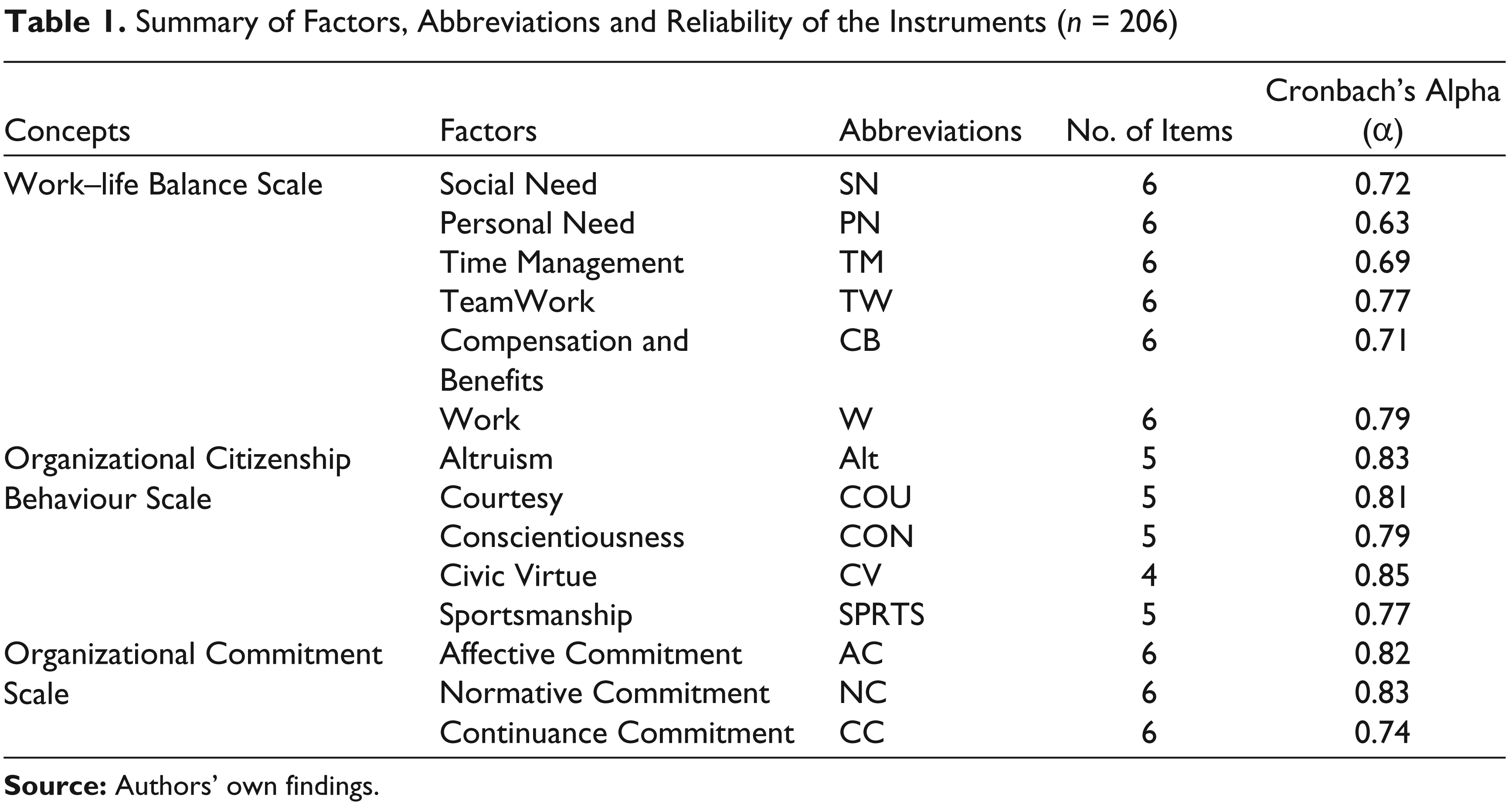
The scale was proposed by Pareek and Joshi (2010) which consisted of 36 items for measuring the areas of personal needs, social needs, time management, teamwork, compensation and work itself. The internal consistency reliability was found to be α = 0.71 (0.72 = social needs, 0.63 = personal needs, 0.69 = time management, 0.77 = teamwork, 0.71 = compensation and benefits and 0.79 = work).
Organizational Citizenship Behaviour Scale
The scale consisting of 24 items was primarily based on the conceptual work of Organ (1988) and was developed by Podsakoff et al. (1990). There were five reverse scored items in this scale and these item numbers were 11, 12, 13, 14 and 15. The rest of the items were positively scored. Due care was taken in these aspects while analyzing the items for statistical analysis. The internal consistency of the scale was α = 0.85 (Altruism = 0.83, Courtesy = 0.81, Conscientiousness = 0.79, Civic Virtue = 0.85, Sportsmanship = 0.77).
Organizational Commitment Scale
The scale measured the three-dimensional commitment dimensions proposed by Allen and Meyer (1990). Each of the affective, normative and continuance commitment dimensions were composed of six items and they were developed in the form of an instrument by Meyer, Allen and Smith (1993). There were 18 items in total and internal consistency reliability was found to be α = 0.79 (i.e., for affective commitment [0.82], continuance commitment [0.74] and normative commitment [0.83]).
Responses in the items elicited from the sample were averaged to yield composite scores of each scale for total respondent statistical analysis. A summary of all the scales is presented in Table 1, showing (i) the major constructs used in the study, (ii) their factor-analytically derived dimensions with (iii) abbreviations, the number of items constituting the factors and (iv) the Cronbach’s alpha coefficients indicating the internal consistency of WLB, OCB and OC.
Summary of Factors, Abbreviations and Reliability of the Instruments (n = 206)
Data Analysis and Findings
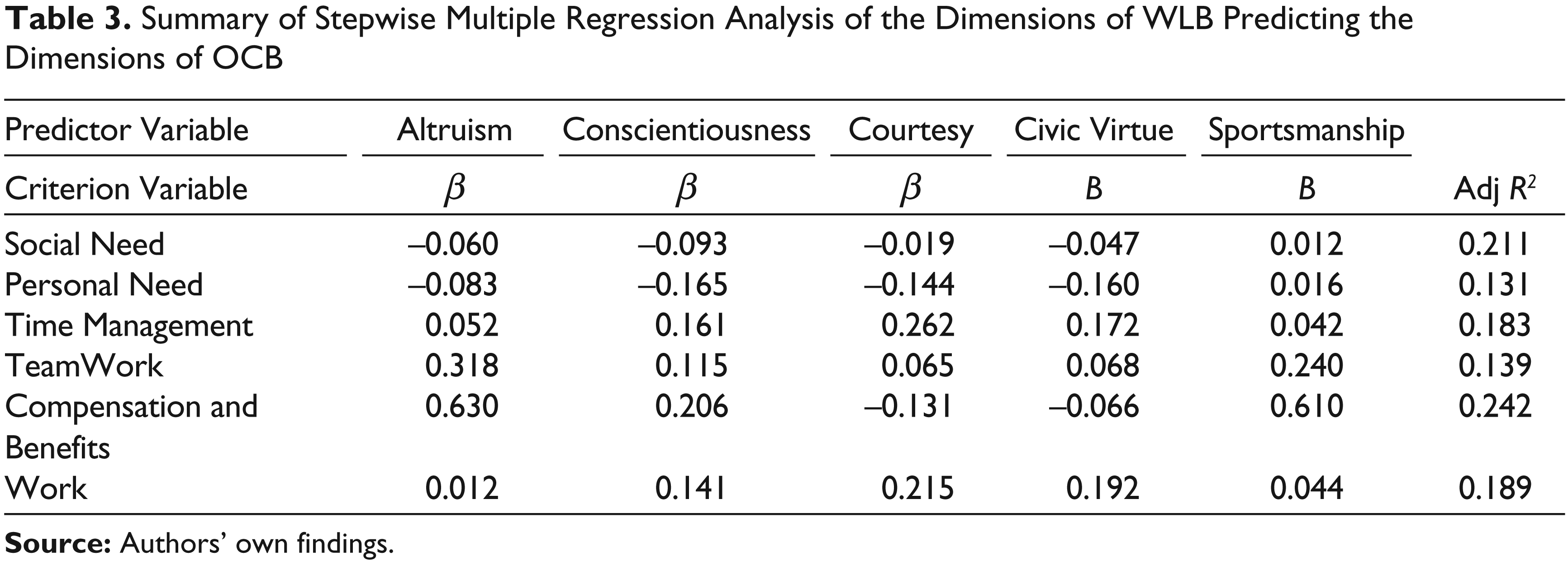
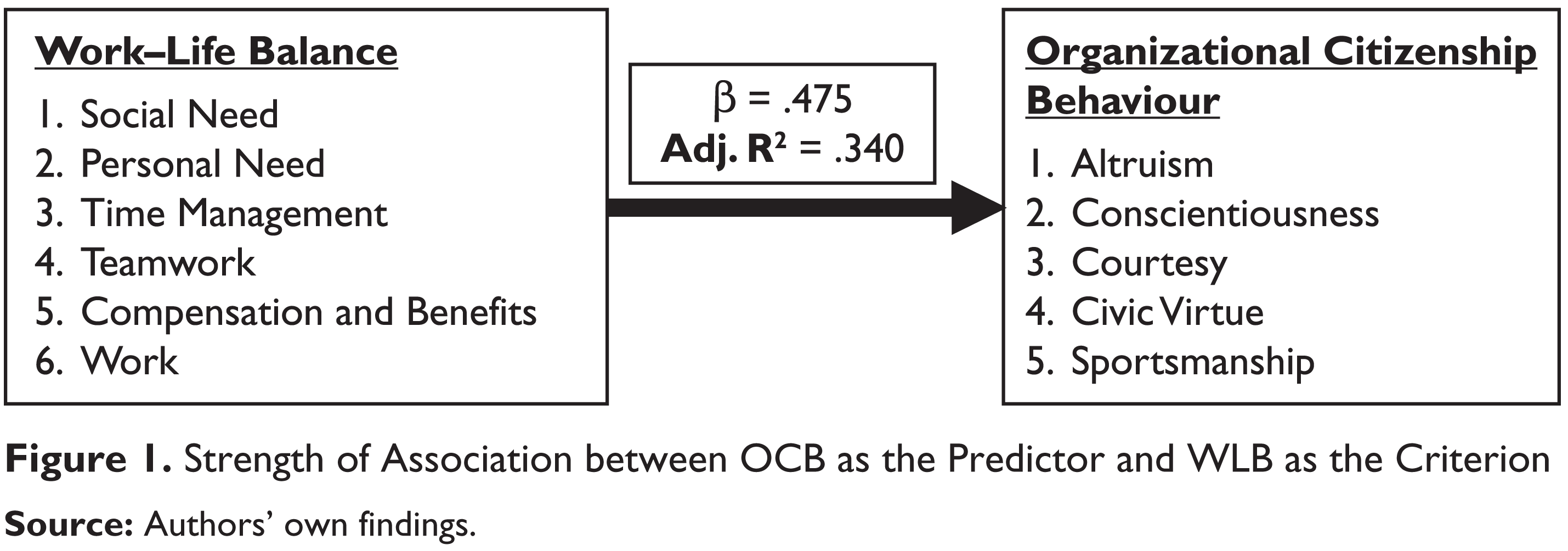
The descriptive statistics and correlation matrix are displayed in Table 2. The table of zero-order correlation shows that the results are consistent with the objective of the study. The results have shown that all the factors of WLB are positively correlated with the dimensions of OCB. Table 3 shows the results of stepwise multiple regression analysis of the dimensions of WLB predicting the dimensions of OCB. Regression analysis shows the differential impact of WLB on different dimensions of OCBs. Social needs, personal needs and compensation and benefits were found to be the negative predictors with the different dimensions of OCB. However, time management, teamwork and work itself of WLB questionnaire were found to be predicted with OCB positively. Figure 1 shows the overall strength of association between OCB as the predictor and WLB as the criterion. The beta value of 0.475 between WLB balance and OCB is significant at 0.01 level of confidence. It shows significantly high association between the two constructs and WLB predicts 34 per cent of OCB.
Mean, Standard Deviation and Intercorrelations of WLB and OCB (n = 206)
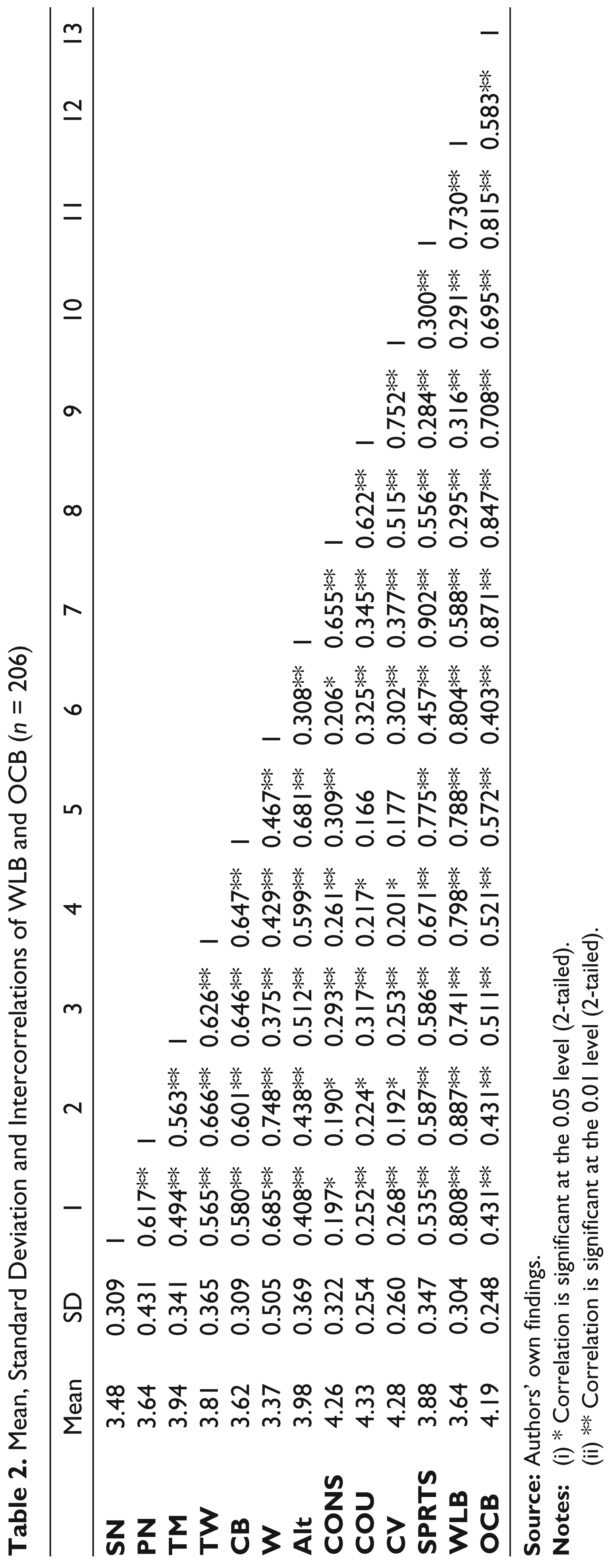
(ii) ** Correlation is significant at the 0.01 level (2-tailed).
Summary of Stepwise Multiple Regression Analysis of the Dimensions of WLB Predicting the Dimensions of OCB
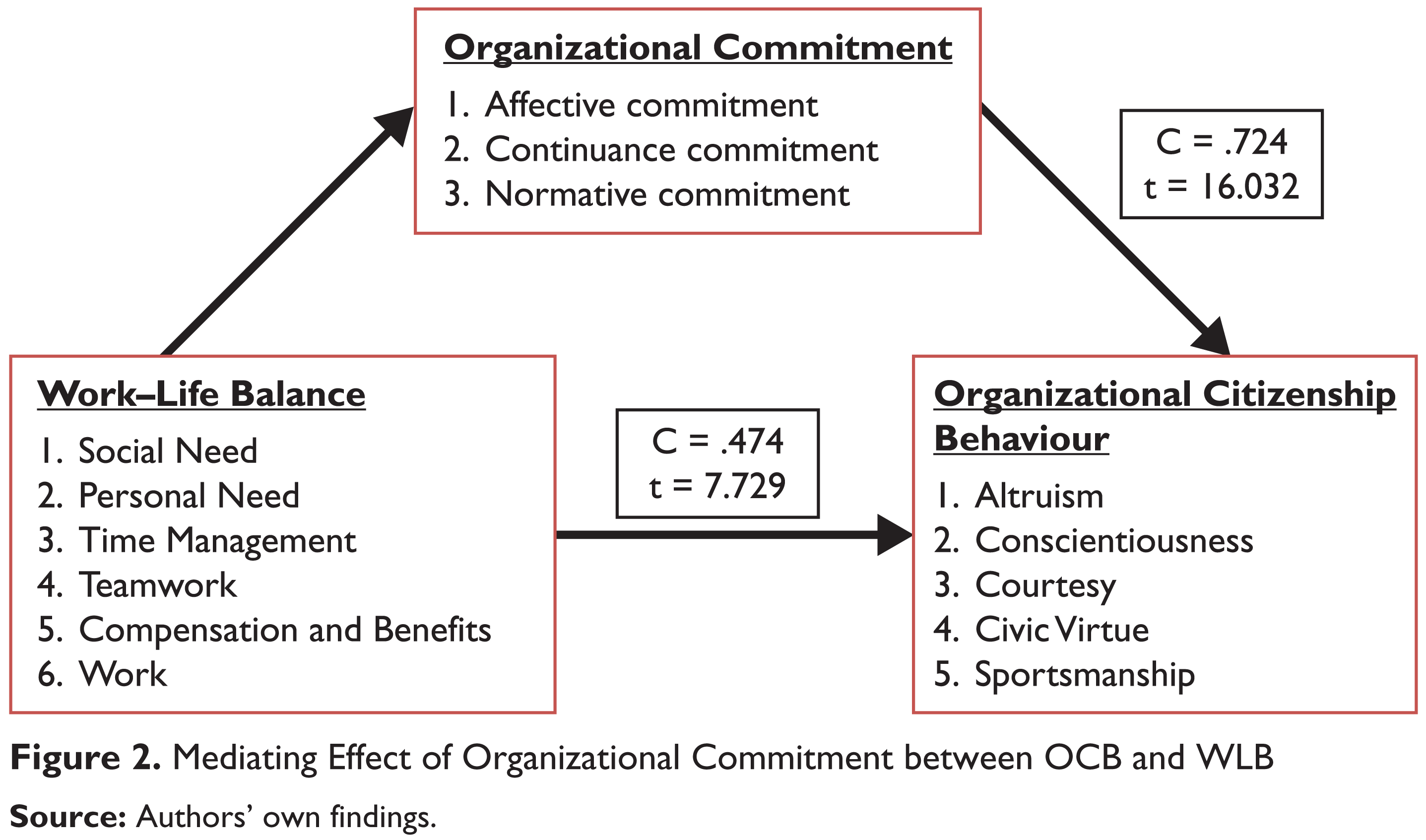
To understand the influence of OC between WLB and OCB, a mediation analysis was performed using the causal-step approach proposed by Baron and Kenny (1986). In addition to it, bootstrapped confidence interval (CI) for the indirect effect was obtained using procedures described by Preacher and Hayes (2008). The causal variable for the present study is WLB, whereas the outcome variable is OCB and the proposed mediating variable is the dimensions of OC proposed by Meyer et al. (1993). Preliminary data screening has suggested that there were no serious defilements of assumptions of normality and α = 0.01 2-tailed is the criterion for statistical significance. Figure 2 presents the total effect of WLB on OCB is found to be significant at c = 0.474, t = 7.729, p < 0.001, whereas the indirect effect of WLB on OCB moderated with OC is found to be highly significant at c = 0.7246, t = 16.032 and p < 0.001. This was judged for statistical significance by using the Sobel (1982) test at z = 9.404 and p = 0.001. Using the SPSS script for the Indirect procedure (Preacher & Hayes, 2008), bootstrapping was performed; a total of 5,000 samples were requested; a bias-corrected and accelerated CI was created for both the constructs. For the 95 per cent CI, the lower limit was found to be 0.6037 and the upper limit was found to be 0.8549.
Discussions
In this study, we have first examined the relationship between WLB and OCB and later both the variables have been mediated with OC. The results were found to be supportive and consistent with our objective that WLB is significantly mediated with the dimensions of OC, showing a strong prediction of OCB. Thus, the findings of the study was in alignment with past research, demonstrating that perceived WLB support mechanisms have a profound influence on employee commitment and productivity (Eby, Casper, Lockwood, Bordeaux & Brindley, 2005). Our findings have also supported the empirical survey carried out by Organ, Podsakoff and MacKenzie (2006) with the bottom line that WLB appears to promote employee’s engagement in OCBs which may benefit the organization through positive affectivity. The significant correlation between teamwork of WLB with all the dimensions of OCB found in our research is found to be consistent with prior research findings, suggesting that ‘when both coworkers and supervisors are supportive of an employee, that employee may be more satisfied with his or her job and develop emotional attachments to the organization’ (Bragger et al., 2005; Rousseau & Aube, 2010). The earlier literature review and our findings related to the dimensions of WLB and employee commitment are found to be relying on the concept of ‘psychological contract’ (Rousseau, 1995) and ‘social exchange theory’ (Settoon, Bennett & Liden, 1996), predicting OCB in return for perceived usefulness of work–family benefits. The study has found that WLB strategies deployed by sample Indian manufacturing organizations are predominantly associated with the findings on ‘tendency for individual employees to go above and beyond their job profile/role, as well maintain the desire to stay with their respective organization and increase their attachment with it’ (Canivet et al., 2010; Eaton, 2001; Grawitch, Gottschalk & Munz, 2006; Richman, Civian, Shannon, Hill & Brennan, 2008). We have also understood that it may be beneficial for the organizations to consider flexible scheduling as it may help the professionals to alleviate some of the stressors that cause work–life imbalance, such as time allocation (Batt & Valcour, 2003).
Managerial Implications
The findings of the study have practical implications for organizations and individual employees. First of all, the present study is a solid first step in offering a better understanding of WLB construct while expanding the empirical foundations of citizenship behaviour and OC. It is suggested that organizations with extensive WLB programmes educe discretionary behaviour from its employee resources and correspondingly bring higher levels of OC and productivity in its fold. However, Pocock, Van Wanrooy, Strazzari and Bridge (2001) in their findings have stated that the nature of work and career paths of contemporary organizations demand long hours as a signal of OC, productivity and motivation for advancement. Though working long hours reflects job involvement, commitment and productivity, however, such behaviour stands as an obstacle to meeting family requirements. Tombari and Spinks (1999) in this connection have urged that management support is critical to WLB initiatives. Nord, Fox, Phoenix and Viano (2002) have emphasized that HR managers may need to serve as a communication channel between employees and top management. They have proposed that HR should communicate with high-level mangers about how the existing assignments are affecting employees’ life and organizational performance, and hence, programmes need to be devised supporting more to the WLB programmes.
Allen (2001) in his findings had indicated that a strong relation between supervisor support and family-supportive work environments was less likely to experience work–family conflicts (Thompson & Prottas, 2006) and employees will have a positive inclination for taking up available work–life/family programmes initiated by the establishments (McDonald, Brown & Bradley, 2004). Therefore, it is implicit to support the findings that employee decision to stay with an organization is possible only when there is WLB (Deery, 2008). Through empirical tests, has confirmed the work of Deery (2008) that ‘the importance of work–life balance by showing that work–family balance experiences increased employees’ life satisfaction and job satisfaction. Parkes and Langford (2008) have suggested for creating
work–life alignment through congruent goal and values, looking after the health and safety of employees, improving reward and performance appraisal system to more accurately reflect performance outcome (rather than time in the office), developing fair and supportive supervisors, facilitating participation and involvement in decision-making among all employees, would increase employee engagement, commitment, retention generally and flow on to greater satisfaction with work–life balance.
Strategies, for example, such as implementation or expansion of ‘workplace flexibility initiatives, or launching training programs to ensure supervisors are sufficiently supportive of workers activities outside the workplaces as well as training programs designed to enhance employee skill-sets to help them achieving work–life balance could prove valuable intangibly to the construct of OCBs’ (Carlson, Grzywacz & Kacmar, 2010).
Present day organizations need to keep in mind that the new generation skilled HR evaluates their professional career not only in terms of rewarding assignments, but also in terms of policies and practices that can help them in maintaining a healthy WLB. Therefore, if organizations are unable to address their employees with regard to concern on WLB issues, there may be a flight of talented professionals with loss of productivity. The HR in organizations needs to rechristen its vision that ‘only happy and engaged employees having a balanced life can go beyond the call of duty and walk that extra mile which is critical for realizing the mission and vision and the company’s business strategy’. Innovative HR policies on work–life benefit programmes such as Happy Friday (employees can leave their office two hours early on the last Friday of every month), refreshing day-offs (employees can take two weeks off in every three years to refresh their mind and to have time to spend with families) and a flexible labour time system (employees can choose work time based on their preferences). These kinds of benefit programmes will likely influence employees’ emotions and perceptions in that they will feel the organizational support of caring about their well-being (Kim, 2014). Considering the significant positive associations of WLB and citizenship behaviour in this study, it is proposed that organizations need to think of enhancing the quality of employees’ work and family lives by redesigning their jobs.
Conclusion and Scope for Future Research
The existing study is purely a survey-based empirical attempt by the research authors. However, during the process of developing the literature, it has been felt that a sequential strategy can be used for such kind of study. Therefore, it is proposed that future scholars need to start with a quantitative approach, which should be followed by a qualitative approach to further understand and contextualize the feelings and perceptions of professionals on WLB, commitment and discretionary behaviour. At the same time, the present study was conducted at a relatively small scale as our sample size was 206 respondents from two sector manufacturing public sector organizations. Therefore, future research can be conducted with increased sample size from other different sectors (private manufacturing sectors and service sectors) to enhance and enrich the understanding of WLB, OCB and commitment. It is concluded that findings of this study have made a significant contribution to the literature, providing direction to integrate WLB and commitment levels for achieving discretionary behaviour in the form of OCB for deriving greater satisfaction in the work and family domains. The results from this study suggest that employee-friendly policies and practices are some of the important management weapon towards building desirable behaviours within the workplace.
Footnotes
Acknowledgements
The authors are grateful to the anonymous referees of the journal for their extremely useful suggestions to improve the quality of the article. Usual disclaimers apply.