



Abstract
As the key engine to support the country’s economic transformation goal, the influence of engineers on the lives of people comes with tremendous responsibilities (Abdull Rahman, 2012). Because they add values through the use of appropriate technology and processes (Malan, 2004), engineers need to be equipped with ways to build and capitalize on their strength, to keep up with changes in technology and to shorten design cycles and computerizing designs. All these are needed to maintain their excellent performance. Unfortunately, these tremendous responsibilities, such as the strong need for growth and personal development, have influenced the engineers’ psychological well-being. The lack of attention given to studying engineer’s psychological well-being has worsened the scenario, especially in the context of Asian countries. Therefore, this article reports on the influence of proactive career behaviours on engineer’s psychological well-being. In the context of this study, 387 registered professional engineers (PEs) were chosen as the sample of study. The hypotheses were investigated through a correlation and path analysis using partial least squares (PLS). The results provided useful information on the positive influence of career exploration on psychological well-being. The results further showed that there is a positive influence of career goal development on psychological well-being. On the other hand, the result also revealed the negative influence of career goal development on psychological well-being. The implications of these findings for understanding the process through which career attitudes affect individuals’ psychological well-being are discussed.
Keywords
Introduction
As careers in the new economy emerged in response to economic and labour market changes, it has forced changes in working careers and spawned new career models (Lips-Wiersma & Hall, 2007). Similarly, work has become more flexible as organizations become flatter (Feldman & Ng, 2007). As a result, changing the attitudes of employees towards their career development and their own role is needed (Briscoe & Hall, 2006). Employees who adapt to these changes in the labour markets and organizational structures modify their work values and behaviours. They also bear most of the responsibilities for planning and managing their own careers. For example, they participate in proactive career behaviours which are directed to achieving their personal value goals (Crant, 2000; Lent & Brown, 2006). Pursuing personal relevant goals is a key way that people can contribute to their own well-being. In addition, it enables individuals to exercise personal agency to meet the target they set and work towards their goals and perceive that they are making progress (Lent & Brown, 2006).
Individuals who proactively manage their careers are more satisfied with their career, compared with individuals with passive career attitude (Volmer & Spurk, 2011). Orpen (1994) found that proactive career behaviours influence employee’s career success. Self-managing individuals strive more actively to attain their desired career goals, which in turn should make them feel more successful in their career (Arthur, Khapova & Wilderom, 2005). Employees with high level of career self-management seek for opportunities that will allow them to change the scope of their careers or to make career progress towards desired positions or job within organization (Crant, 2000). This behaviour can function as a navigation system that guides individuals to use career exploration as the process by which they collect information about values, interests, skills, strength and weakness (Weng, McElroy, Morrow & Liu, 2010).
Literature has proven that individuals who proactively manage their careers are more satisfied with their careers, compared with individuals with passive career attitude (Volmer & Spurk, 2011). The question is: Does it also influence the personal satisfaction derived from the career itself, namely the psychological well-being? Psychological well-being is predicted by meaningful work (Arnold, Turner, Barling, Kelloway & McKee, 2007). This notion is supported by Jahoda (1982), who said that employment not only serves as the manifest function of providing income, but also provides individuals with valuable experiences, social interactions and opportunities for personal development and skill use. The potential loss of such psychologically important factors would reduce the individual well-being (Lazarus & Folkman, 1984). For example, engineers who focus on their work will experience their job as important and meaningful. Hence, when they experience their job as meaningful, they enjoy working and they do not see it as something effortful. However, if they have to struggle with the complexities of their job, they may experience their job as meaningless (Schaufeli & Bakker, 2001).
Engineers are fast-track individuals who have specialist knowledge and expertise. Therefore, they will have great expectations and ambitions in their career (Malan, 2004). Engineers are also known to be energetic in climbing their career ladder. To achieve success, they set themselves challenging goals by engaging proactive career management behaviours (Hall, 2002). These behavioural components are often within the control of the individuals. Unfortunately, the combination of being visionary, ambitious and having their own goals and expectations are sometimes not aligned with the working of the companies in which they are employed (Taris, Schreurs & Van Iersel-Van Silfhout, 2001). The lack of potential development may also lead to stress or even to burnout (Malan, 2004). The conflict between fulfilling the work demand structured by the organization and being visionary, ambitious and having their own goals and expectation has influenced the well-being of the engineers.
In light of the details just described, this study was carried out to address the issues regarding the influence of proactive career management behaviours on the psychological well-being, as practiced by the professional engineers (PEs) in Malaysia. Accordingly, the following research questions were posed to further examine the topic:
Does proactive career behaviour (career exploration) influence the psychological well-being among Malaysian engineers? Does proactive career behaviour (career goal development) influence the psychological well-being among Malaysian engineers? Does proactive career behaviour (career strategy implementation) influence the psychological well-being among Malaysian engineers?
The remaining sections of this article are organized as follows. The next section reviews the literature on the influence of proactive career management behaviours (career exploration, career goal development and career strategy implementation) on psychological well-being among Malaysian engineers. The literature review leads to the development of hypotheses and the framework for this study. The third section gives an overview of the methods employed for this study. This is followed by the fourth section, which presents the findings from statistical tests and the fifth section, which discusses the results of this study. The final section concludes the study.
Literature Review
Proactive Career Behaviours
Proactive career behaviour refers to the anticipatory action that individuals take to impact themselves and/or their environments (Parker et al., 2006). Proactivity is conceived as a process that can be applied to any set of actions through anticipating, planning and striving to have an impact (Grant & Ashford, 2008). Hence, the key criterion for identifying proactive behaviour is whether the individual anticipates, plans for and attempts to create a future outcome that has an impact on the self or environment (Grant & Ashford, 2008; Parker et al., 2006). The notion of proactive behaviour in the workplace challenges the conceptualization of employees as relatively passive and reactive (Grant & Ashford, 2008). Alternatively, it explicitly recognizes the deliberate actions employees take to influence their environments (Bateman & Crants, 1993; Seibert, Crant & Kraimer, 1999). In this respect, proactive behaviour can be distinguished from the more generally motivated, more reactive behaviours, which are passive behaviours, in that they encompass acting in advance and are directed towards an intended impact (Grant & Ashford, 2008). Inherent to the notion of the new career is that the individual is primarily responsible for managing his or her career (Briscoe & Hall, 2006; Hall, 2002). In the career literature, this has brought a shift in focus on organizational career support to individuals’ proactive career behaviours. Proactive career behaviours include the deliberate actions undertaken by individuals to realize their career goals (King, 2004; Kossek, Roberts, Fisher & DeMarr, 1998; Noe, 1996; Orpen, 1994; Sturges et al., 2000, 2002). They form an application of proactive career behaviour to a specific context, namely, career management.
A review of the literature reveals a wide range of cognitions and behaviours being studied as indicators of proactive career behaviour (King, 2004; Kuijpers, Schyns & Scheerens, 2006; Sturges et al., 2002). From these studies, two components of proactive career behaviours can be discerned, that is, a cognitive component and a behavioural component (De Vos & Soens, 2008). While the former refers to the insights individuals develop into their own career aspirations, the latter refers to the behaviours they initiate with the aim of managing their career. Several studies address the importance of cognitions as an antecedent of career success (DeFillippi & Arthur, 1994; Eby, Butts & Lockwood, 2003; Kuijpers et al., 2006). The results suggest that it is important for individuals to develop career insight that allows them to make meaningful choices. The behavioural component refers to the concrete actions undertaken by employees to realize their career goals (King, 2004; Noe, 1996; Sturges et al., 2002). Several authors have studied the relationship between career self-management behaviours enacted by individuals and career-related outcomes. These studies reveal the importance of a wide range of behaviours, such as collecting information about existing or possible career opportunities, searching for feedback about one’s performance and competencies and creating career opportunities through networking and actions aimed at enhancing one’s visibility (e.g., Claes & Ruiz-Quintanilla, 1998; King, 2004; Orpen, 1994; Seibert, Kraimer & Crant, 2001; Sturges et al., 2000, 2002).
From the propositions of social cognitive theory (SCT) and integrated model of proactive career behaviours, it can be assumed that individual’s career outcomes will affect individual’s choice to initiate a certain career-related action. According to Guthrie, Coate and Schwoerer (1998) and Dougherty, Chueng and Florea (2008), it is important for individuals to adopt proactive career behaviours that suit to their personality because it will help them to be successful in their career. For example, self-initiated individuals engage in seeking social support (one type of career strategy) because they are sociable and like to make friends and have the capability to expand their network to get valuable career information. This point has been supported by Lent and Brown (2006) that individuals who manage their own career development can affect their individual interest. Such interest can promote career-relevant choices, collect information about values, identify a career goal and engage in career strategies. A wide range of behaviours have been incorporated in career studies such as positioning, influence, boundary management, reflection, networking, skill development, ingratiation, consultation, self-assessment and optimization (Abele & Wiese, 2008; Crant, 2000; De Vos & Soens, 2008; King, 2004; Kossek et al., 1998; Sturges et al., 2002). As a result, this study follows Noe’s (1996) career management multi-step processes which are career exploration, career goal development and career strategy implementation to address proactive career management behaviours.
Psychological Well-being
Psychological well-being is about lives going well. It is a combination of feeling good and functioning effectively. Psychological well-being is defined in terms of the overall effectiveness of an individual’s psychological functioning (Berkman, 1971a). Sustainable well-being does not require individuals to feel good all the time; the experience of painful emotions, such as disappointment, failure and grief, is normal part of life. Being able to manage these negative or painful emotions is essential for long-term well-being. However, psychological well-being is compromised when negative emotions are extreme or very long lasting and interface with a person’s ability to function in his or her daily life. The concept of feeling good incorporates not only the positive emotions of happiness and contentment, but also such emotions as interest, engagement, confidence and affection. In a psychological sense, the concept of functioning effectively involves the development of one’s potential, having some control over one’s life, having a sense of purpose such as working towards value goals and experiencing positive relationships. There is a long tradition of theoretical and empirical research that has emphasized the importance of psychological well-being. Over the years, researchers have primarily focused on identifying and defining the key features of the psychological well-being construct. However, clarifying the structure of psychological well-being has neither been easy nor straightforward as evidenced by the multitude of both terms used to coin the construct (e.g., emotional well-being, mental well-being and affective well-being) and conceptual approach that exist.
Despite the lack of agreement about the number of dimensions that composes psychological well-being and conceptualizations defining psychological well-being, a number of investigators agree that psychological well-being contains affective and cognitive components (Diener & Emmons, 1984; Liang, 1985). The affective component is often characterized by an evaluation of one’s life in terms of his or her ongoing emotional feelings. This component is based on the fact that individuals experience unpleasant (negative) or pleasant (positive) moods and emotions in response to different life events. According to Bradburn (1969), the affective component of psychological well-being is best understood as a hedonic balance in which an individual’s overall emotional tone is determined by that individual’s level of positive and negative affect and the difference between these emotional states. As mentioned in the preceding paragraph, high psychological well-being is thus associated with experiencing frequent pleasant feelings (e.g., enjoyment, affection and pride) and only infrequent unpleasant effect (e.g., sadness, anger and anxiety).
Psychological well-being has three characteristics. First, psychological well-being is a subjective experience (Cropanzano & Wright, 2001; Diener, 1994). People with high level of psychological well-being believe that they are happy (Wright, 2005). Second, psychological well-being includes both relative presence of positive emotions and relative absence of negative emotions (Argyle, 1987; Diener & Larsen, 1993). Particularly, psychological well-being is typically operationalized as capturing both positive and negative emotional states on a single axis. Similarly, the high or positive pole is anchored by such hedonic or pleasantness-based descriptors as joyous. On the other hand, the low or negative pole is anchored by such unpleasantness descriptors as sad and annoyed. Therefore, to be high on well-being is to be simultaneously low on negative emotion and high on positive emotion. Third, psychological well-being is a global judgement that refers to one’s life on a whole. In addition, psychological well-being is not tied to any particular situation (Wright, 2005). Its special significance to human resources personnel is concerned with selection, training and development, as well as placement decisions. Although psychological well-being exhibits some measure of temporal stability, it has also been shown that individual well-being can be influenced by any number of environmental events (Wright, 2005).
Research Framework
Figure 1 shows the proposed research framework which consists of independent variables (career exploration, career goal development and career strategy implementation) and the dependent variable of psychological well-being.
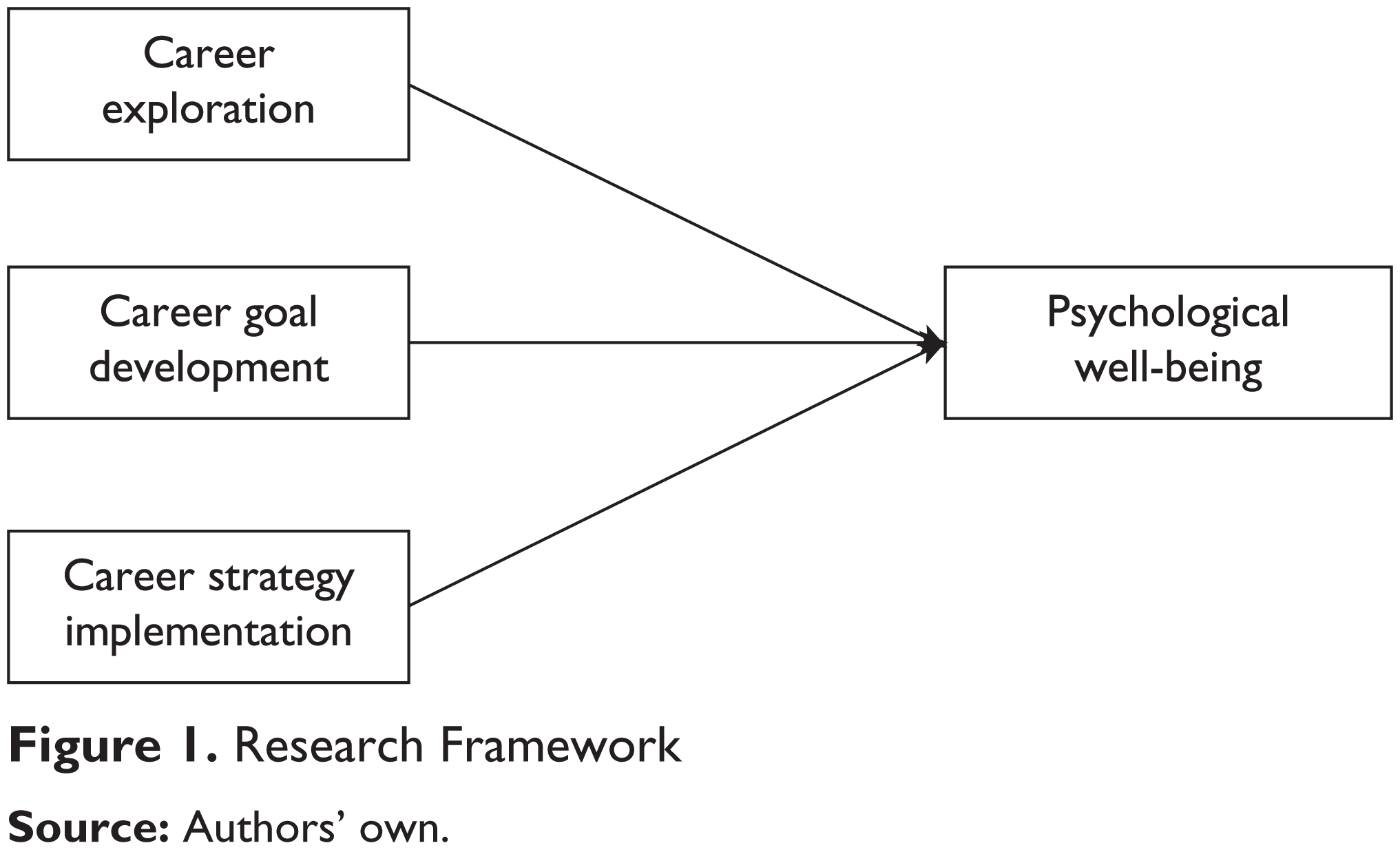
Based on the above research framework, the following hypotheses were postulated: (i) Career exploration has a positive relationship with psychological well-being; (ii) career goal development has a positive relationship with psychological well-being; and (iii) career strategy implementation has a positive relationship with psychological well-being.
Methodology
Sampling and Data Collection
This study applied self-administered questionnaire for collecting the data. The unit of analysis in this study consisted of 387 PEs who are registered with Board of Engineers Malaysia (BEM). These engineers need to chalk up an average of 50 hours of Continuous Professional Development (CPD) activities per year to renew their practicing certificate; therefore, they have to participate in the CPD activities. The CPD activities are organized by the Institution of Engineers Malaysia (IEM). IEM also organizes activities, such as meetings, exhibitions and visits, as well as other activities to promote the profession of engineering. Because the IEM performs these functions, the researcher approached IEM and sought its permission to distribute the questionnaires to the PEs during the CPD activities.
Measures
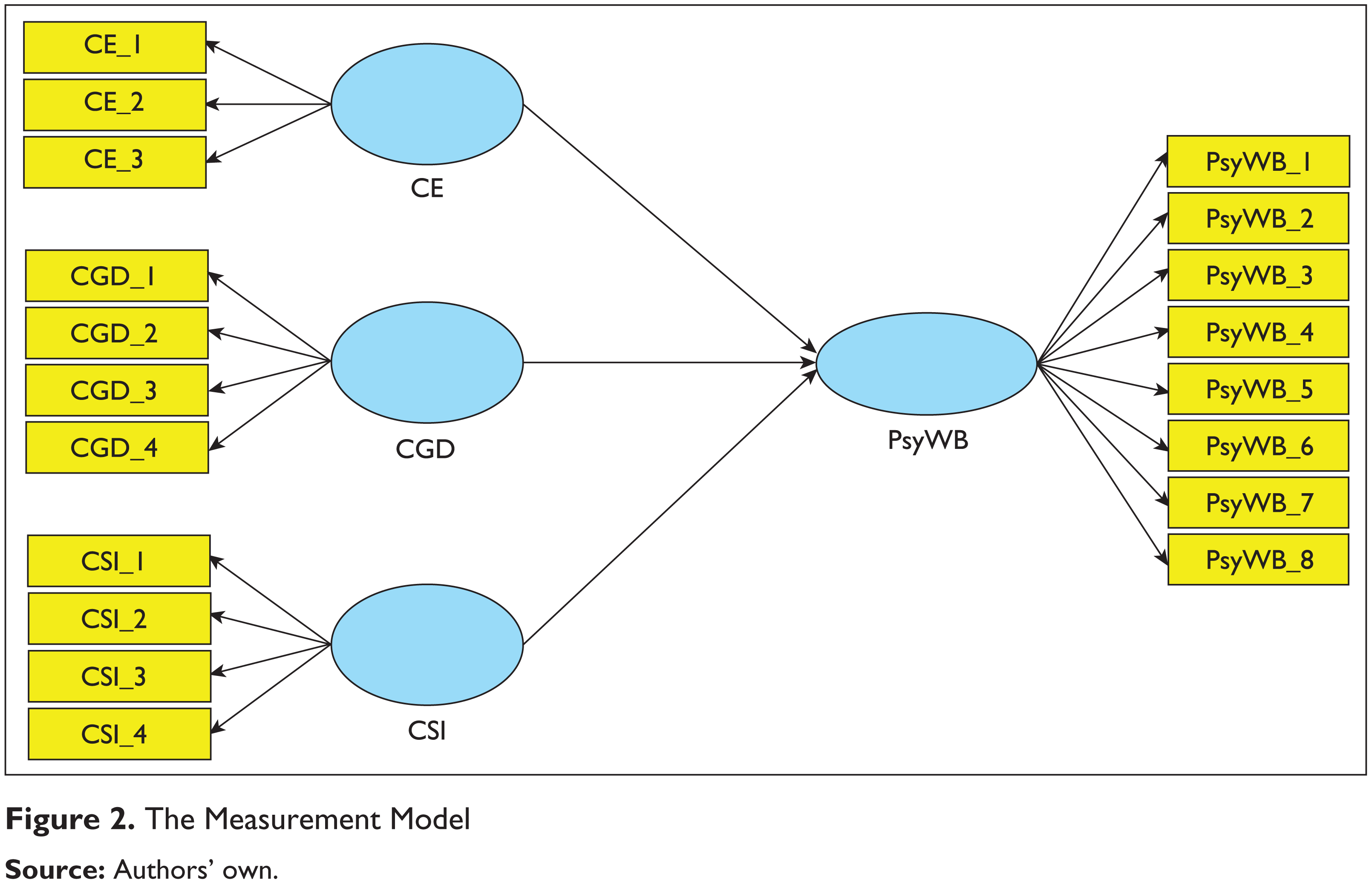
The measures used in this study were mostly adopted from previous studies with acceptable reliabilities. Scales developed by previous researchers (Noe, 1996; Zikic & Klehe, 2006) were used to measure the three dimensions of proactive career behaviours. Career exploration was measured by three questions. Career goal development was measured by four questions, and finally, career strategy implementation was measured by four questions. The Cronbach’s alpha for the three scales is as follows: career exploration = 0.86, career goal development = 0.83 and career strategy implementation = 0.87. Meanwhile, psychological well-being was measured using the eight-item Index of Psychological Well-Being developed by Berkman (1971a, 1971b). In this study, the coefficient alpha was 0.72. Ratings were made on a five-point Likert scale ranging from 1 = strongly disagree to 5 = strongly agree for all the variables in this study. Appendix A shows the list of the questionnaire items used to test the hypotheses in this study.
Data Analysis
Data were analyzed by SmartPLS software developed by Ringle, Wende and Will (2005) by means of Structural Equation Model (SEM) from Partial Least Squares (PLS) approach. PLS-SEM was preferred because it has many advantages compared with other first generation techniques. Some of its major advantages are as follows.
Partial Least Squares makes fewer demands regarding sample size than other methods.
Partial Least Squares does not require normal-distributed input data.
Partial Least Squares can be applied to complex SEMs with a large number of constructs.
Partial Least Squares can handle multiple dependent and independent variables in a single model.
In addition, PLS as variance-based SEM was preferred because covariance-based SEM assumes that the observed measures have random error variance and measure specific variance components, which are not of theoretical interest and are excluded from the measurement model, whereas PLS-SEM assumes that the explanation of all the observed measures of variance are useful.
Findings
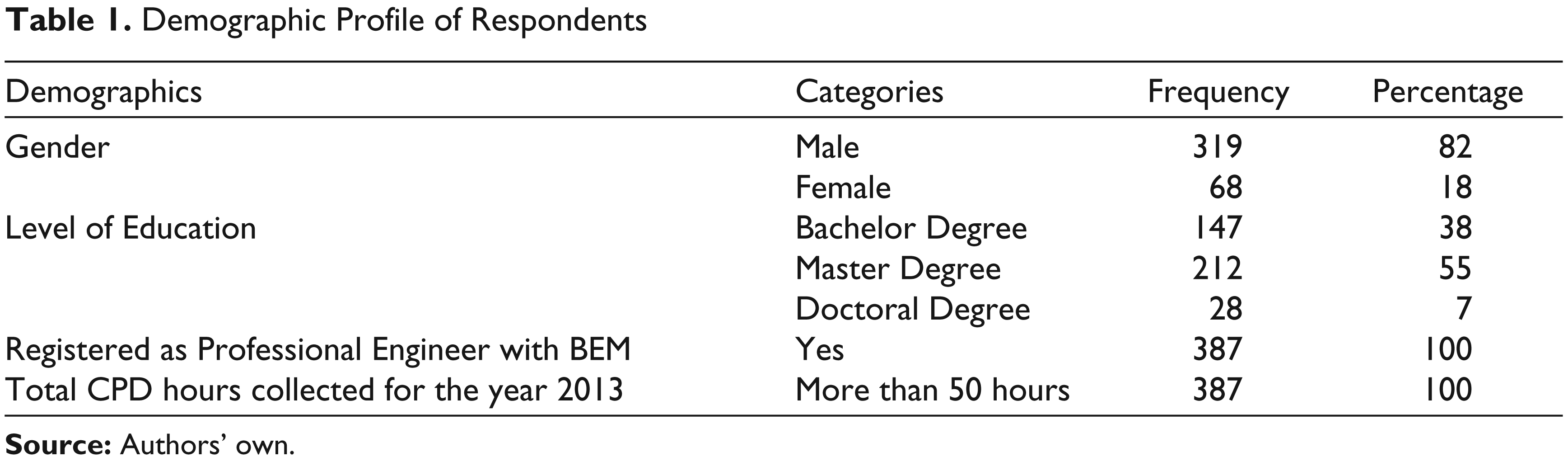
This section presents the demographic profile of the respondents. In terms of gender, the number of male respondents was 319 (82 per cent) compared with the number of female respondents which was 68 (18 per cent). They were predominantly master degree holders 212 (55 per cent), followed by degree holders 147 (38 per cent) and 28 (7 per cent) of the respondents were PhD holders. The 387 respondents in this study (100 per cent) were registered PE with BEM (100 per cent). The total CPD hours collected by the PE for the year 2013 was more than 50 h (100 per cent). Table 1 summarizes the demographic characteristics of the respondents.
Model Testing
To test the conceptual model of the study, this study used the two-step approach as suggested by Anderson and Gerbing (1988) and Chin (2010) to first analyze the measurement model and second the structural model. The purpose of using this approach was to assess the fit and construct validity of the measurements before assessing the structural model for path coefficients or relationships between the constructs. Therefore, ‘convergent validity’ and ‘discriminant validity’ were then assessed to confirm ‘construct validity’, by looking at the measurement model results. Figure 2 shows the measurement model, while Figure 3 shows the structural model used in this study.
Convergent Validity
As depicted in Table 2, cross-loadings, average variance extracted (AVE) and composite reliability (CR) could be assessed to confirm the convergent validity. Average variance extracted is the mean variance extracted for the items loading on a construct and is a summary indicator of convergence (Fornell & Larcker, 1981). Average variance extracted value of at least 0.5 indicates sufficient convergent validity, meaning that, on average, the latent variable is able to explain more than half of the variance of its indicators (Gotz, Liehr-Gobbers & Krafft, 2009).
Demographic Profile of Respondents

Results of Items Reliability, Internal Consistency and Convergent Validity

b Composite reliability (CR) = (square of the summation of the factor loadings)/{(square of the summation of the factor loadings)/(square of the summation of the error variances)}.
Then, the CR would be assessed for reliability, which is a measure of convergent validity. The CR value should be above 0.7 to assure an accurate scale (Nunnally & Bernstein, 1994). Based on this guideline, the CR values as per Table 2 are satisfactory. Therefore, it can be concluded that the measures used provide satisfactory reliability. In view of the aforementioned results of factor loadings, AVE and CR, adequate evidence of convergent validity was established. To confirm the construct validity, the results of discriminant validity will be discussed next. Table 2 illustrates the items loading, CR and AVE in this study.
Discriminant Validity
Hair, Black, Babin and Anderson (2010) suggested that discriminant validity is the extent to which a construct is fully distinct from other constructs. It is investigated to indicate to what extent measures in the model are different from other measures in the same model. Discriminant validity is investigated by comparing the square roots of the AVE with the correlations between the variables. Chin (2010) suggested that discriminant validity is established if the square root of the AVE exceeds the value of the correlation coefficient. As depicted in Table 3, the square roots of the AVE are placed in the diagonal. The results show that the correlation for each construct is less than the square root of the AVE by the indicators measuring that construct, indicating adequate discriminant validity. Based on the reported results, the measurement model confirms the construct validity, which allows the hypotheses to be further analyzed to prove the research model.
Discriminant Validity

The result of the relationship among proactive career behaviour (career exploration, career goal development and career strategy implementation) on the psychological well-being is presented in the following section.
The first hypothesis was postulated for the relationship between career exploration and psychological well-being. The result showed that career exploration has a positive influence on psychological well-being (β = 0.119, p < 0.1). Therefore, H1 is supported. This result is shown in Table 4.
The second hypothesis was postulated for the relationship between career goal development and psychological well-being. The result showed that career goal development has a positive influence on psychological well-being (β = 0.352, p < 0.1). Therefore, H2 is supported. This result is illustrated in Table 5.
The third hypothesis was postulated for the relationship between career strategy implementation and psychological well-being. The result showed that career strategy implementation has a negative influence on psychological well-being. Therefore, H3 (β = 0.001, p > 0.1) was not supported. This result is presented in Table 6.
Path Coefficient for Career Exploration and Psychological Well-being

Path Coefficient for Career Goal Development and Psychological Well-being

Path Coefficient for Career Strategy Implementaton and Psychological Well-being

Discussion
This article sets off with the discussion of the main objectives. The first objective is to see whether career exploration influences psychological well-being. The second objective is to see whether goal development career influences psychological well-being. Finally, the third objective is to see if goal development career strategy implementation influences psychological well-being.
The empirical findings from the study showed that career exploration has a positive influence on psychological well-being. This finding implies that career exploration affects psychological well-being. As stated in the literature, several factors, such as skill utilization, professional development and social support, have consistently been shown to be related to functional well-being and to outcomes such as engagement, job satisfaction and health (Halbesleben, 2010). The result from this hypothesis testing contributes to the literature that suggested career exploration has a positive influence on psychological well-being.
The study also found that career goal development has a positive influence on psychological well-being. This finding implies that individuals who have established detailed career development plans often feel particularly excited or interested in something. According to De Vos and Soens (2008), the more focused the employees’ career goals are, the more likely will they be engaged in behaviours which will help them reach their goals and the greater will be the motivation to participate in development activities.
Finally, the findings indicated that career strategy implementation does not have a positive influence on psychological well-being (β = 0.001, p > 0.05). One possible explanation for this finding could be that the extent to which individuals are proactively managing their careers does not automatically imply stronger feelings of psychological well-being. The result from this new hypothesis testing contributes to the literature that suggested career strategy implementation has a negative influence on psychological well-being.
Conclusion
While the majority of previous literature on well-being originates from Western backgrounds with industrial context, this article is one of the few studies which have investigated the interaction among proactive career behaviours on psychological well-being in Malaysian context. This article intends to contribute to the literature regarding the relationship among career exploration, career goal development and career strategy implementation, with psychological well-being among PEs in Malaysia. Theoretically, the findings show support by providing empirical evidence on the impact of career exploration and career goal development on psychological well-being. It implies that PEs who are more engaged in career exploration and career goal development will be responsible for managing their career. This indicates that engineers who are committed to the organization do not frequently complain about their health.
Practically, the findings of this study encourage PEs to have high career exploration so that they will be motivated to use their acquired skills or to develop potential abilities to the fullest. The implication of this is that individual would experience their job as meaningful and would enjoy working. The findings show that organizations need to revise the key performance areas of their engineers so that the engineers would feel that their goals and expectations are aligned with those of the companies they work for. In addition, it is also crucial for organizations to provide opportunities for their engineers and to let them use their acquired skills or develop their potential abilities to the fullest.
In conclusion, engineers act as key players and they have contributed highly to Malaysia’s economic development. They also act as the key to wealth creation and helping the country to become an active player in the global economy. The study on well-being is relatively new in Malaysia. However, the government has already supported the spirit; therefore, organizations need to put heavy emphasis on employee’s well-being. By highlighting the proactive career behaviour as important contributors towards psychological well-being, this study calls for organization and the government to look into enhancing the well-being of PEs to enhance their image, reputation and sustainability.