



Abstract
This article is an attempt to explore the problems faced by Indian agriculture for food security in terms of inadequate infrastructure and highly inefficient supply chain. Due to lack of efficient infrastructure, supply chain mechanism and food processing, around 30–35 per cent of all foods produced in India are wasted. This article examines the critical issues at subsystem of agriculture supply chain, with a view to integrating them in efficient and effective manner. This article broadly covers some important aspects of agriculture supply chain in India—identification of issues at different levels in the supply chain; transformation in the agriculture due to various supply chain interventions; and the role of information technology in supply chain management. As this article is based on both primary and secondary research methodology, it has led us to finding that there is not much research in this field in India and importance of integration in agricultural development. The article concludes that efficient supply chain plays a very important role for development and is a contemporary issue for agriculture, therefore, the government and the corporates must address the issue of integration, infrastructure development and information management to achieve the objective of a feasible agricultural sector which will lead to food security for all.
Keywords
Introduction
An integrated system in agriculture is a network of producers (suppliers), manufacturing units, warehouses (cold storage), distribution channels and retailers through which raw materials or products are acquired (procurement), processed (value addition) and delivered to the end consumer. An integrated supply chain framework is the strategic, planned and operational-level decision making that enhances value addition of produce and supply chain performance. The strategic level comprises of aspects such as selection of suppliers, transportation routes, manufacturing facilities, production levels and warehouses. The tactical level includes planning and scheduling the supply chain and third one is the operational level which executes plans with decision-making functions across the supply chain.
In order to improve productivity, supply chain agencies must function in an integrated manner. But the underlying forces of the enterprise and the market make this difficult; raw materials do not reach on time, failure of production facilities, inefficient workers and unpredictable dynamics of consumer behaviour, etc., causing deviations from plan. Some issues can be dealt with locally but many cases require modifications across functionality of various stakeholders and an effective supply chain management (SCM) framework must coordinate all the schedules and reschedules across supply chain mechanism.
The Integrated Supply Chain Management (ISCM) at both tactical and operational levels comprised of a set of cooperating, intelligent agents, each performing chain functions and coordinating their activities with other agents. The focus of paper is on the development of (i) a theory on coordination that allows stakeholders in agricultural sector to cooperatively manage change, (ii) a model of stakeholders problem solving that enables stakeholders to cooperate with other agents in their search for solutions and (iii) a model of agency and support tools that enable firms to develop multi-agent systems with minimal programming effort, based on reliable components.
Agricultural sector in India since the introduction of reforms of 1991 had a very significant impact on agriculture and supply chain. Further, first part of reforms brings out that there was a visible deceleration of growth in agriculture during the post-reforms period. It also comes out that the growth of agriculture exports which picked up after 1991 slowed down after 1996–1997, and has stagnated since then and in fact it went down and, fluctuating in nature, it picked up due to some policy reforms and good monsoon in 2010–2011 and it rose to growth rate of 5.4 per cent (Kumar, 2002). The deceleration of agriculture growth was also accompanied by visible deceleration of growth in growth rate of employment. The growth rate for employment collapsed to nearly zero during that period. The data on both barter and income terms of trade brings out that both of them did show some improvement in mid-1980s up to 1996–1997, but had stagnated since then (Chand, 2005). All these numbers point out that agriculture sector is lagging sector in the Indian economy and farmers and other agricultural workers engaged in this sector have not been able to derive much benefit from new economic policies initiated in 1991 (Rao & Jeromi, 2006).
Indian agriculture, with nearly 12 per cent of the world’s arable land, constitutes 13.8 per cent of the country’s gross domestic product, compared to 51 per cent in the 1950s (Government of India, 2011). India is the world’s third-largest producer of foodgrains, the second-largest producer of fruits and vegetables and the largest producer of milk; it also has the largest number of livestock. Add to that a range of agro-climatic regions and agricultural produce, extremely industrious farmers, a country that is fundamentally strong in science and technology and an economy which one of the largest in the world with one of the highest growth rate and you should have the makings of a very good harvest (Chand, 2005).
Economic reforms and liberalization in the agriculture sector has emphasized on transforming Indian agriculture by designing agricultural supply chain model covering innovations at farming levels, which can help farmers regain profitability in a sustainable manner under changing conditions with proper assurance of market arrangements (Rao & Punwar, 2004) (Malik, 2009). The reforms in agricultural marketing system to ensure participation for establishing direct linkage with farmers, capacity building and infrastructure development in regulated markets, extension of road network and transportation, storage and warehousing, market intelligence system, introduction of commodity by establishing commodity are some important areas of interventions, but the changes are taking place at a very slow pace.
This article mainly focuses on current food supply chain process in Indian agriculture and its impact on Indian agriculture and food security. It has been assessed on the basis of data and information collected from both primary and secondary data, which has been obtained through application of scientific research method by formulating research design and conducting research by utilization of diverse kind of methods to assess the objective which includes research methods such case study, in-depth interview, content analysis, triangulation method, observation method for primary data and information as well as for the secondary one. Most of the secondary data are sourced from annual reports of Ministry of Agriculture, Ministry of Food Processing, Food Corporation of India (FCI), articles of respected authors, articles and book reviews from reputed national and international journals, economic survey, etc. The literature review covers many areas related to the nature of the research questions put forward, and thus includes: agriculture, food management, supply chain approaches, information technology and supply chain interfaces. Tracing the references by looking at the reference list is also performed and relevant papers found in journals have been tackled as well. The literature sources are mainly books, scientific journals, conference proceedings, dissertations, projects documentations and management-oriented publications. These sources are of particular importance and engender all research process development, especially the early phase for initial exploration of the food SCM. Published materials on the Internet, annual reports and archival records of the involved companies and organizations are helpful and have been used as a compensation for some empirical shortcoming.
An Assessment of the Indian Agricultural Supply Chain
Food SCM refers to the process whereby the movement of agro-based product(s) from the initial supplier to the ultimate user occurs with all non-value-adding expenses. Usually, SCM is between partners such as a retailer and a preferred supplier, or a restaurateur and a preferred supplier of a particular ingredient. From a supplier’s perspective, SCM can mean more than this. It means that with due care, one can actually provide the needed produce to penultimate user at a lower cost. An effective SCM can be summed in one phrase—detail, detail and detail. In reality, it means studying in detail the entire process from harvest to the penultimate user. In doing so, all steps and costs should be established (Ahya, 2006). After that, it is a matter of establishing what economies can be exercised along the way for the benefit of all the stockholders and adapt that in slightly different way for perishable agriculture produce.
The production of agricultural commodities has substantially increased in the country over the decades due to continuous efforts made by the government in terms of technological intervention at different level of production system, coupled with its price support policy. The production, supply and distribution of many agricultural commodities are mainly influenced by government regulations. In the process of economic liberalization, it has been felt that there is need to reorient policies and regulations related to agricultural commodities. In response to this, the government has initiated agricultural policy reforms related to the production and marketing of agricultural commodities. However, the pace of this reform process is very slow. Besides, there are numerous rules and regulations and infrastructural gaps which are hindering the smooth flow of agricultural commodities from farm to fork (Mittal & Mukherjee, 2008). A lack of integration of the various stakeholders in the supply chain leads to inefficiency in the agricultural system, causing high post-harvest losses, quality deterioration, high cost of commodity transfer, information symmetry and lack of transparency (Kahn, 1998). Each participant of chain acts independently with little and no collaboration in physical and information flow.
It is important the corporate participants in agricultural chain have an understanding of supply chain, right strategy and leadership. In Indian agriculture, public investment and policy support are, in several areas, the prerequisites to overcome prevailing structural weaknesses such as low scale of operations, high post-harvest losses, poor state of rural infrastructure, lack of product diversification, inadequate research and development (R&D) spending, low productivity, absence of marketing infrastructure and inadequate financial support.
Various Integrative Aspects of Agricultural Supply Chain
From perspective of corporations, SCM represents the way to customer retention and growth, competitive advantage and profitability. But there is not enough attention has been given to possible ex-ante measures to reduce, mitigate or share risks, although in some circumstances assessments will be conducted during/after adverse ‘shocks’ and attention will certainly be needed on workable coping strategies. There is also lack of emphasis on both formal and informal risk management options available to the different parties, although in practice, most analytical attention will likely focus on the scope for improving or supplementing formal mechanisms, including institutional and financial arrangements, technological changes, adoption of improved management practices and/or investments in infrastructure. To the extent that the overall assessment is focused on the position and welfare of poorer farmers, greater attention can be paid on alternative informal mechanisms and improving their efficacy.
This study also observes that attention has not been paid to areas categorized as ‘high vulnerability’, either for individual chain participants or the chain as a whole. This high vulnerability may already be evident from recent/past experience or be expected due to unfolding changes in market conditions, regulations or other circumstances. Depending upon the purposes for which the assessment is done, primary attention might be given to addressing areas of high vulnerability for specific entities (smallholder farmers, the government agencies) (Joshi, Gulati & Cummings Jr R., 2007). Study on food supply chain has not been given its due and that should be undertaken on the needs/options for policy and regulatory reforms that affect farmer/agro-enterprise risk management as well as the possible revision/reform of governmental risk management instruments. Aspects of cold chain are to be given more consideration as it has contributed tremendously to trade in fruits, vegetables and flowers in developed countries and it could game changer in India. This is because cold chain results in the reduction of losses and retention of the quality of horticultural produce. While the introduction of a cold chain facility nationwide due to some institutional, structural and financial constraints may not be immediately possible in India, attempts must be made to develop a cool chain. It is evident that ‘food loss reduction is less costly than an equivalent increase in food production’. If efforts are not made to modernize the harvest handling system for horticultural crops, then post-harvest losses will continue to have a negative economic and environmental impact. There is no doubt that post-harvest food loss reduction significantly increases food availability.
Post-harvest Loses and Supply Chain
Post-harvest losses and its impact and ways to reduce it and to achieve has led to the understanding that it is important to educate the farmers in selecting the correct inputs and in post-harvest handling, including cleaning, food safety, drying, sorting and packaging at the farm gate. There has been gradual improvement in the accuracy of demand forecast by dynamic adjustments to reflect changes in demand, lead times, transit time, capacity and transportation and distribution routes, as well as events outside the organization due to advancement in information and communication technology and it has done a good job in reducing the post-harvest losses and it means that variance of lead time can be reduced by removing non-value-added steps and activities, improve the reliability and robustness of manufacturing, administrative and logistics processes. Standards for the handling and storage of all perishable items has been improving but it is still far away from where it can be and better handling, storage and preservation of the quality of fruits and vegetables would increase the price and consumption, which in turn, would provide a better return to the farmers (Kumar, & Brithal, 2004).
Supply chain management systems have the ability to track critical events and activities and when these events do not unfold as expected, they can send out alerts and messages to notify appropriate managers to take corrective actions. Flexibility is still lacking supply chain system and it can be improved by enhancing responsiveness; companies need flexible strategies that match their operations, such as product design, sourcing, manufacturing and postponement. Establishment of pack house facilities having basic requirements such as washing tanks, sorting and grading devices and cold storage facilities at the premises of the Dedicated Economic Centres (DEC) (collecting centres) in major fruit and vegetable producing areas in the country will overcome the problems of quality deterioration, contamination of fresh produce with harmful bacteria and other extraneous matter and will improve the safety of produce to a great extent.
Backward and Forward Linkage in Food Supply Chain in Agriculture of Rural India
Discussion on Promotion of Production, Backward and Forward linkage, Marketing and Consumption in food supply chain in agriculture takes us to rural India and in rural India most of the Mandies or wholesale markets are not equipped to accommodate the volumes of fresh produce. Physical infrastructure variables such as roads and electricity link villages to nearby assembly and wholesale markets and in turn with large wholesale and terminal markets and ports. There is a huge lack of warehousing and cold storage facilities and encouragement for the establishment of cold storage facilities and refrigerated carriers to facilitate storage and transportation of perishable commodities. Its important to encourage technological developments in the packaging of agricultural commodities and in promoting packaging facilities appropriate to specific commodities (Adhiguru & Mruthyunjaya, 2004) (Leo & Liu, 2006). Developed mega markets and food parks or terminal markets with a higher level of all facilities are not accessible to common farmers. To integrate the entire supply chain there is a need for collaboration and cooperation among the supply chain partners, and this will only happen if there is trust among the parties, upfront agreement on how to share the benefits and a willingness to change existing mindsets. Once these elements are in place, the supply chain partners can jointly engage in decision-making and problem-solving, as well as share information about strategies, plans and performance with each other.
Our study suggests that just as consensus building for change in agricultural policy has been difficult in India, structural adjustment to its new economic environment too has been very slow, limiting the new public and private investment needed to allow the sector to participate in the growth of Indian economy. The implication of the current policies and institutions can be understood in the context of agricultural sector’s large contributions to economic production, employment and the welfare of rural people, all of which has made it difficult for policy makers to take risk on agricultural policy reforms. This study also suggests that stimulating private agricultural business investment, whether domestic or foreign, will require not only public investment in market infrastructure, but also supporting price and trade policies and comprehensive development of public market regulations and the institutions.
Information and Knowledge Management in Indian Agriculture
The application of information technology is very important for achieving the common good for the society, which is not possible unless agriculture sector of India uses it for maximum benefit (Kumar, Agrawal & Sharma, 2013). Modern agriculture is highly knowledge-intensive and increasingly information-driven, under which each participant in supply chain yearns for timely and accurate information for various decisions. Therefore, knowledge and information are important factors for accelerating agricultural development by increasing agricultural production and improving marketing and distribution efficiencies. In addition to connecting small farmers and artisans to markets, Information and Communication Technologies (ICTs) also facilitate most agricultural decisions, such as, what to cultivate, how to cultivate and harvest, when and where to sell and at what price to maximize the returns. Effective decision-making related to all these aspects ultimately determines the efficiency of supply chain (Rao, 2007). Therefore, a proper and information flow among stakeholders of ant business activity is key for strengthening supply chain efficiency. The rapid and innovative developments in ICTs can provide immense opportunities to public as well as private sector agencies to integrate these technologies in their supply chain systems (Bertolini, 1999). ICTs are especially useful for dissemination of information, provision of services and enabling various transactions and awareness creation among the rural masses far removed from the government. ICTs provide modern, effective and speedy modes of communication that convey new resources of knowledge and information to society. A case study on ITC e-Choupal tries to explore above-mentioned points and discusses how effectively and efficiently information and communication technology has been used by an organization in agriculture in Indian set-up.
Strengthening vertical relationships between various stages of production and processing in the agribusiness sector has always been an important area for empirical analysis by researchers and policymakers across the world. However, the pace of change in supply chain integration and responsiveness of production system towards a market-driven approach is slower in India compared to elsewhere in the world (Haan, Groot, Loo & Ypenberg, 2003). Farmers are still more comfortable growing traditional crops, particularly rice and wheat, as they have already discovered the market for their marketable surplus—be it a government procurement arrangement or private local traders. But the shift in market demand needs a balancing approach to meet the supply of deficit commodities such as pulses, oilseeds and high-value food items. This balancing in demand and supply can be ensured by strengthening buyer–supplier relationship efficiently, and by disseminating of accurate and timely information to all the participants of the business chain (Mittal & Mukherjee, 2008).
Therefore, efficient and effective flow among various stakeholders of any business activity is key to strengthening supply chain efficiency. The major problem faced by farming community and associated stakeholders is related to efficient and effective decision making at different stages of agribusiness activities, right from crop planning to marketing of final produce. At each stage of farming, a farmer requires data and information on a number of variables. In the absence of timely availability or non-accessibility of this data, farmers are not able to decide what, how and how much to produce as per market needs. The fast and innovative development in ICTs can provide immense opportunity to public and private sector agencies to integrate these technologies in their supply chain systems (Matani, 2010). ICTs are extremely important for dissemination of information, provision of services, enabling various transaction and awareness creating among rural masses far removed from government. ICTs provide a modern, effective and speedy mode of interaction and communication that conveys new resources of knowledge and information to the society.
ITC e-Choupal Integrated Supply Chain Model
The case study of ITC e-Choupal clearly gives an idea of how information and communication can revolutionize Indian agriculture. The e-Choupal has been most successful initiative to connect rural India and to involve the farmers in learning. ITC e-Choupal has also attracted attention from the renowned academicians, since e-Choupal has managed to innovate the supply chain, and model applied by ITC has enough potential to be replicated in the underdeveloped and developing countries. ITC’s example also shows the key role of information technology—in this case, provided and maintained by a corporation, but used by local farmers—in helping to bring about transparency, to increase access to information and to catalyze rural transformation, while enabling efficiencies and low-cost distribution that make the system profitable and sustainable. ITC has been successful in making the farmer feel the sense of ownership and encourage them to generate additional revenue by eliminating middleman. Participating farmers have been able to enhance their income and eliminate the delay in getting the payment once the product is sold. It has helped in reducing debt burden of the farmers.
The e-Choupal model has been specifically designed to tackle the challenges posed by the unique features of Indian agriculture, characterized by fragmented farms, weak infrastructure and the involvement of numerous intermediaries, who block critical market information from passing to the farmers and use that information for getting a big margin for themselves. But e-Choupal sets things in order as it smoothens the flow of information to the farmers by disintermediate mediating intermediaries from the chain of information flow and at the same time leverages their physical transmission capabilities as they deliver critical value at every link for a very low cost in a weak infrastructure environment. The structure of e-Choupal network is shown in Figure 1.
The project e-Choupal is an ICT platform for carrying out trade at a number of locations. In this, ITC sets up a backup physical service support at the village level, called Choupal, through Sanchalak: a lead farmer, who acts as the interface between computer and the farmer. ITC accumulates information regarding weather, modern farming practices and market prices from sources like Meteorological Department, Agri-universities, Mandis (regional market), etc., and upload all information on to e-Choupal website.
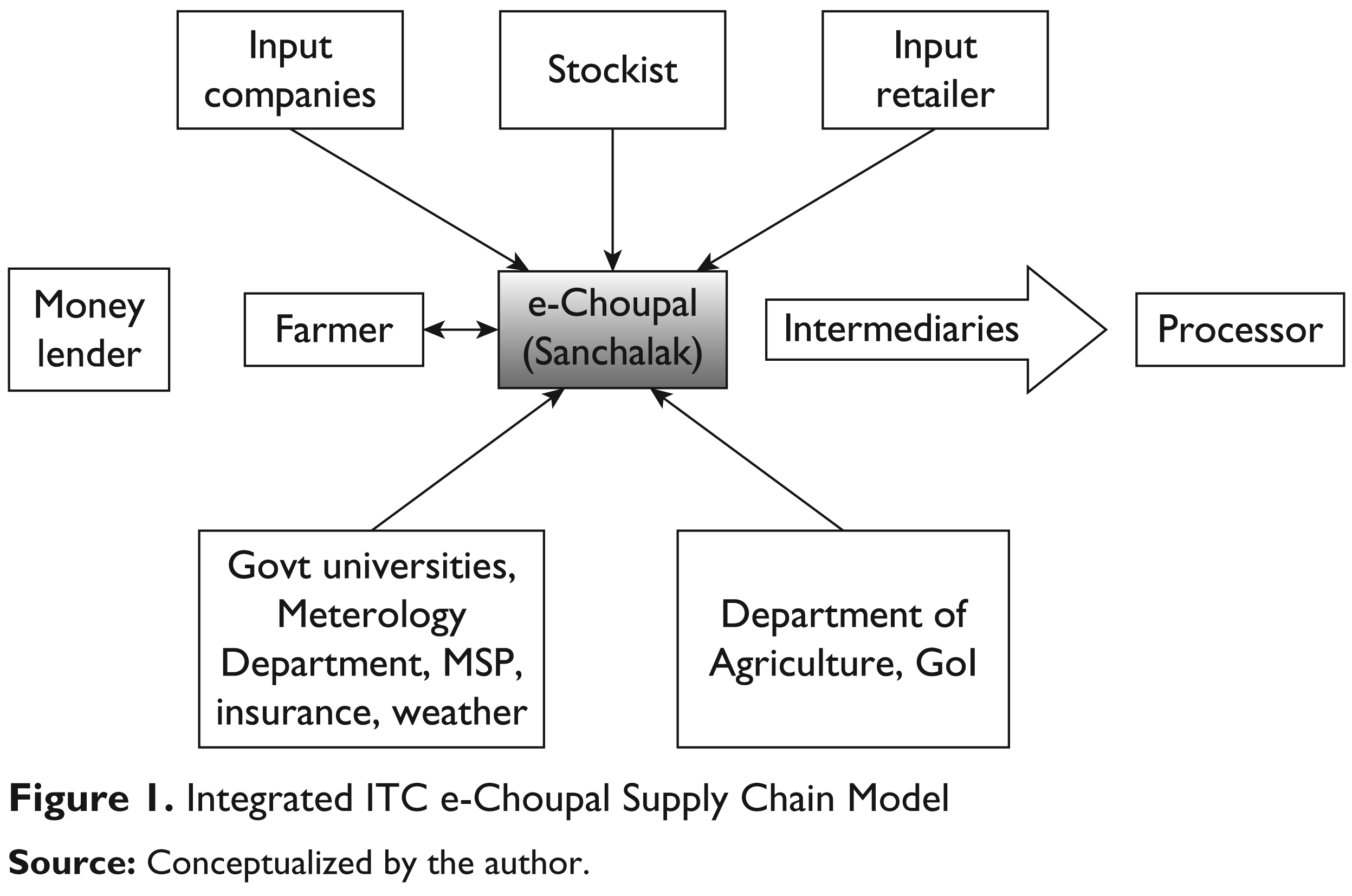
All information is customized according to local farmer’s needs and provided in the local language through the computer set-up established by ITC in Sanchalak’s house. As one can observe in Figure 1, the Sanchalak accesses this information and facilitates its dissemination to farmers which is generated through the information gathered from Department of Agriculture (GoI), Universities, Indian Meteorological Department (IMD), input firms, stockist, retailers and many more. Information regarding weather and scientific farming helps farmers to select the right crop and improve the productivity of their farms. Availability of market information helps farmers to become market oriented. They know what price ITC is quoting and the price prevalent in the local market (Mandi), thereby helping better price realization for farmers.
For establishing an efficient and effective supply chain system in Indian agriculture, there is an urgent need to improve the functioning of regulated markets and amend the Agriculture Produce Marketing Committee (APMC) Act established by the state government in India as per the model act on agricultural marketing suggested by the central government to ensure private participation in supply chain system in an organized and legal manner. This will enable private agro-processing units and business operators to link themselves with farming community directly, eliminating multiple intermediaries. For increasing efficiency in food processing segment, the process of raw material sourcing needs to be redesigned in an efficient organizational framework with proper backward linkages (Chandrashekhran, 2002). The emergence of agribusiness activities and food retailing are providing both opportunities and challenges to policymakers. Assessment of existing policies affecting the agricultural supply chain and modifying them as per the requirements of market forces, with proper regulatory mechanisms to protect the interest of all the stockholders in the chain, is the need of hour.
Reliance Fresh Supply Chain Framework
Reliance Fresh was the first foray into retailing by behemoth known as Reliance Industries Limited (RIL). Reliance Fresh is somewhat different from the business model of ITC e-Choupal, mainly in terms of use of information technology as a tool for increasing productivity by assisting farmers, which is major part of ITC e-Choupal model. However with Reliance Fresh, it is more about procuring the material, processing it and then distributing it to various retail outlets for timely availability of the food produce in most efficient and effective form by utilizing information technology tools such as Enterprise Resource Planning (ERP) and SAP software in best possible way. Reliance Fresh launched by opening retail stores in Hyderabad on November 2006 then it opened 12 ‘Fresh’ outlets in Chennai, increasing the total store count to 40. Reliance was testing its retail concept by controlled entry, beginning in the southern states.
There were three basic reasons for RIL choosing foods and vegetables for entering the retail sector with Reliance Fresh. First, it wanted to go after the very core of the great Indian retail opportunity in terms of agriculture-based business. Second, its aim was to build a high-profitability business and food was perhaps the best place to start. Third, the grossly inefficient food supply chain provided a well-resourced and well-managed organization like RIL with an opportunity of amending the flaws which would also make business sense and to materialize that it has increased the number of stores to around 1,500 as of June 2013, from 1,150 in 2010.
Reliance Fresh has been contracting farmers, and being linked to the Reliance Fresh supply chain to ensure availability and that number will grow to millions. By going to the farmer directly, Reliance Fresh hopes to disintermediate the supply chain and eliminate waste. They have been, through contract farming, assisting farmers in procuring high-quality seeds, fertilizers and other essential raw materials to ensure quality of agricultural produce, collect the produce through collection centre and then send it to the city processing centre which works as central hub.
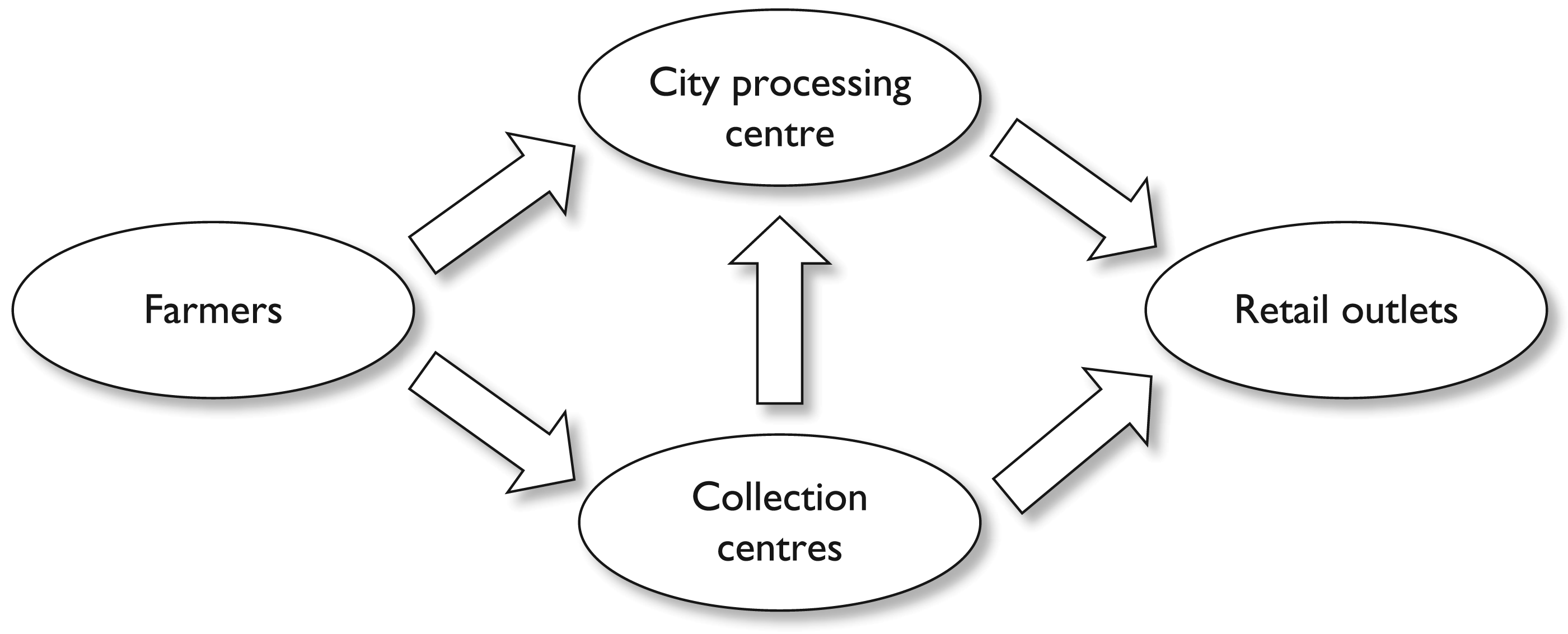
As Figure 2 suggests the source is the farmers and city processing centre and collection centres work as the intermediary part of the chain who make the produce available at the retail outlets. Farmers also see advantage of quantity procurement by Reliance from them and they can go there and get there consignment graded at their collection centre. The centre would get the price band and quantity of vegetables it needs to collect that particular day. Reliance Fresh provides a good example of a successful case that demonstrates improvement in the economic conditions of the farmers through their network, rising income levels and more opportunities (Drescher, 2000).
Contract farming, unlike corporate farming, brings farmers into the mainstream of the economy by development of a hassle-free process, paying farmers the pre-agreed market price of the produce in advance and providing the transaction cost which leads to a rise in income resulting in greater accessibility to education and health facilities. In case of the corporate farming, farmers act as one of the factor inputs in production process and payment to farmers depends upon policy of firm, which is generally more profit-friendly and less farmer-friendly. Contract farming reduces farmer’s market risks by paying them pre-agreed market price irrespective of fluctuation in market, and enhances supply chain efficiencies by providing both knowledge and material inputs, whereas in corporate farming, a firm act to minimize its own risk. The Reliance Fresh model operates on a small scale, and is able to meet the administrative and infrastructural constraints to turn out to be a successful model for the firm and, to the certain extent, for the farmers. If this supply chain model is expanded, then the viability of it largely depends on the integration of variables and development of agricultural infrastructural facilities.
The supply chain mechanism of organizations like Reliance Fresh and ITC e-Choupal has given new lessons to the government agencies and corporates in the country in context of importance of supply chain mechanism in agriculture sector. By embarking on this initiative, ITC has shown that ICT platforms can benefit farmers and rural India.
Integration Is Vertical Food Supply Chain and Implementation
Whether the process for integration is vertical or virtual, the requirement for integration of supply chains is inherently strategic, and a potential source of competitive advantage for multiple trading partners. The nature of the integration model is an implementation issue that needs to be addressed with a view to consumer’s needs and other variables such as industry and market characteristics. One theme that appears to remain constant throughout the literature in this area is the importance of taking a holistic view, and the systemic nature of interactions between the participants. The recognition of the interdependence of all partners in a supply network appears to be an important catalyst for effective integration. In this sense, organizations moving to implement ISCM systems could be seen to be formalizing strategies to better manage this interdependence, and to leverage it to mutual advantage. At the same time, it is also apparent that this requirement to take such an holistic and systemic view of the supply chain acts as an impediment to more extensive implementation. The strategic nature of adopting a supply-chain-wide perspective, on the one hand provides significant potential benefit, and on the other requires trading partners to think and act strategically. The challenge for developing more effective and integrated networks is to encourage such a mindset, and use it to promote adoption and implementation of enabling technologies and methods. In other words, this review of the literature serves to highlight the interdependence between integration (technologies, logistics and partnerships), a strategic view of supply chain systems and implementation approach. All three need to inform and underpin each other in order for management of supply chains to be able to deliver on the promise of benefits for all trading partners (Singh, 2006).
Government Intervention Agricultural Prices
The price support system was introduced by government in 1965 by setting up Agricultural Prices Commission (APC) now renamed as Commission of Agricultural Costs and Prices (CACP). This provided the opportunities to farmers to sell their produce on Minimum Support Price (MSP) if the market price dropped below the MSP for that commodity. In such a situation, the government is supposed to procure all agricultural commodities for which MSP has been declared. The basic objective of foodgrain procurement by government agencies is to ensure remunerative prices to producer and reasonable prices to consumers, and to maintain price stability in market (Jha & Srinivasan, 1999).
Agriculture can realize its full potential by applying the principal of SCM by strengthening the collaboration between various stakeholders, non-exploitative vertical and horizontal integration, market reforms, precision farming, contract farming, demand-led diversification and the extensive and intensive use of information technology for real-time communication across the chain (Balakrishnan, 2006).
Integrated Knowledge Model for Agricultural Supply Chain
Strengthening vertical relationships between various stages of production and processing in agribusiness sector has always been an important area of empirical analysis by researchers and policy makers across the world (Gulati, Lawrance & Puranam, 2005; Kaabia et al., 2005; Lawrence, Rodes, Grimes & Hayenga, 1997; Martinz, 1999; Martinz & Reed, 1996; Mora & Menozzi, 2005). Vertical coordination in Indian agriculture sector is limited to some selected high-value commodities such as poultry product, milk, fruits and vegetables (Ali & Kapoor, 2005).
Empirical studies have suggested that vertically integrated agribusiness activities are reducing production cost among contract growers, as well as producer–consumer margins with a comparatively high involvement of smallholders (Birthal, Pratap, Joshi & Gulati, 2005; Landes & Maurice, 2004). However, the pace of change in supply chain integration and responsiveness of the production system towards a market-driven approach is slower in India as compared to elsewhere in the world (Deshingkar et al., 2003; Haan et al., 2003).
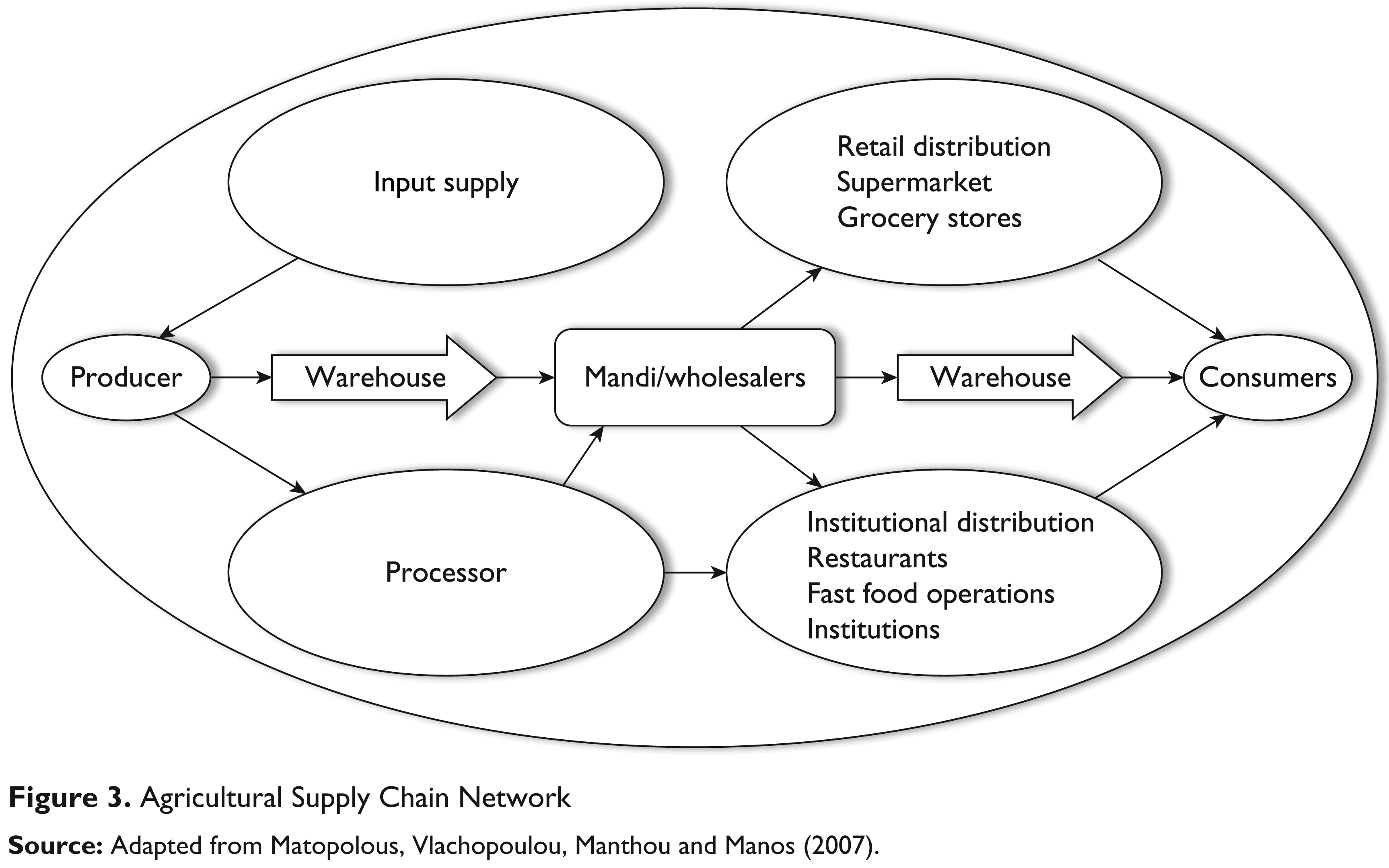
Farmers are still more comfortable growing the traditional crops, particularly rice and wheat, as they have already discovered the market for their marketable surplus—be it government procurement arrangement or private local traders. But the shift in market demand needs a balancing approach to meet the supply of deficit commodities such as pulses, oil seeds and high-value food items. This balancing of demand and supply can be ensured by strengthening buyer–supply relationships in an efficient way, and disseminating accurate and timely information to all the participants of the business chain. The major issues in Indian agricultural supply chain is lack of integration between different subsystems of the chain (Figure 3).
Each participant in the chain acts as an independent agent with a very low level of business relationship. The supply chain network (Figure 3) of the system and subsystems in traditional agriculture reveals that farmers produce the agricultural product by getting input material from input companies and most of time farmers have to bear the brunt of expenses of production process. It also suggests that Mandi and wholesalers act as prime middle intermediaries, who receive produce from farmers via warehouse and processing units. Then the produce or processed produce is distributed in the retail market and through institutional distribution which eventually leads to the ultimate consumer.
Based on practical experiences, Grimsdell (1996) proposed six fundamental requirements for an efficient supply chain between vegetable growers and major retail customers—scale of operation, strategic alliances, production flexibility, continuity of supply, quality control and communication. These parameters are very relevant while establishing a supply chain community between farming community, processors, handlers, government and consumers in the country to ensure a cost-effective and safe flow of agricultural commodities through the chain, which requires extended relationship between the supply chain stakeholders. Collaboration and relationship management along the chain is key instrument for integrating the supply chain system (Benton & Maloni, 2005) and the ability to establish effective relationship is necessary to reach supply chain success (Fearne & Hughes, 2000; Quinn, 2004). Several empirical studies have recognized that the increase need for collaboration is a way to construct even more efficient and responsive supply chains, in order to deliver exceptional value to customers (Gunasekaran, Patel & Tirtiroglou, 2001; Kampstra et al., 2006).
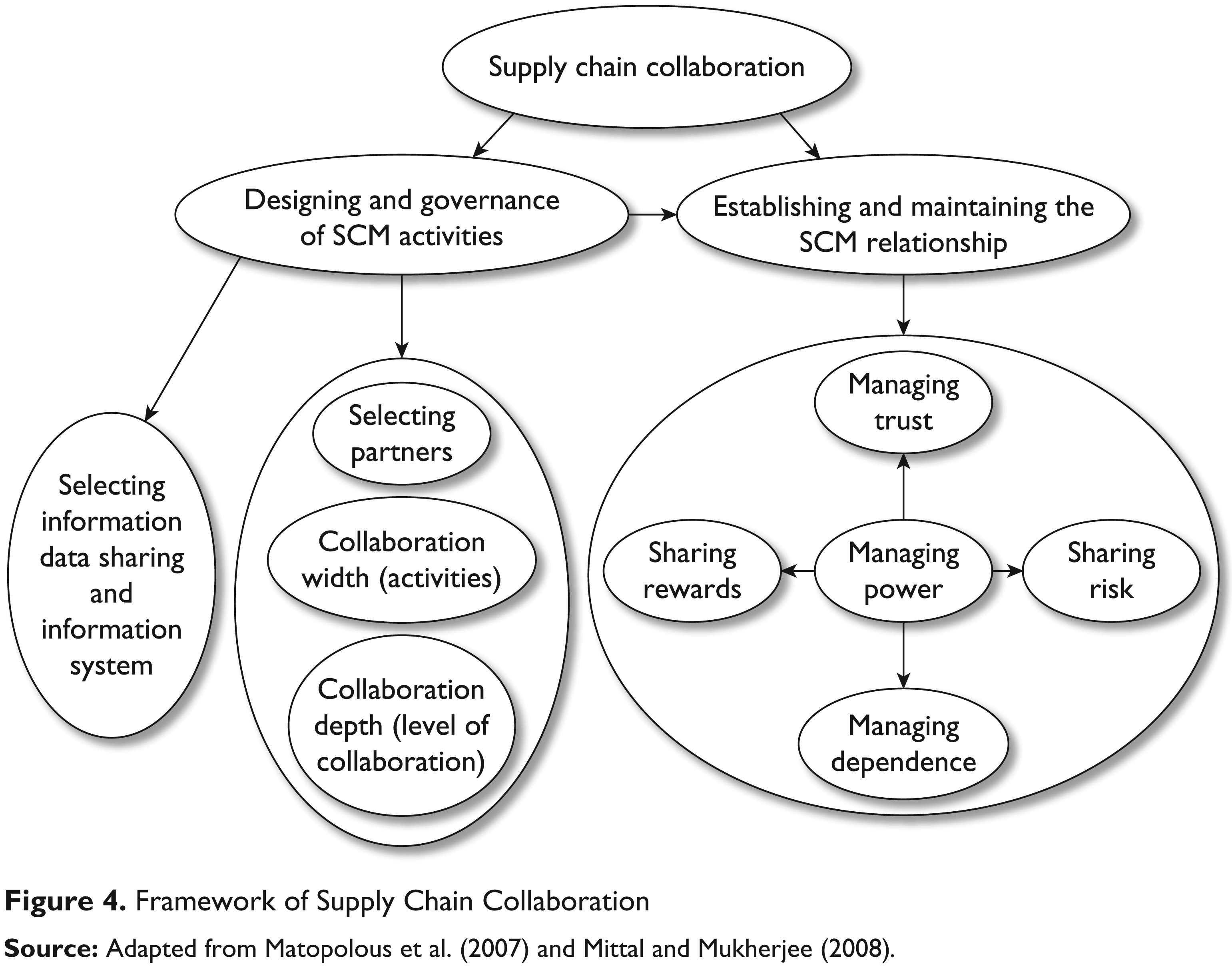
According to Matopolous et al. (2007) there are two major pillars of supply chain collaboration—the design and governance of supply chain activities, and the establishment and maintenance of supply chain relationship (Figure 4). By going through framework of supply chain collaboration (Figure 4), it is very much visible that supply chain collaboration provides an opportunity for integration among all the stockholders in agricultural supply chain system. It gives the picture that through supply chain collaboration a system can be established in which governance of SCM activities can be achieved by sharing information and in-depth coordination among partners and activities. Same-time maintenance of SCM can established through effective management of power via trust, rewards, risk and dependence among all the partners.
The success of collaboration depends largely on the physical structure of the chain flow and the way relationships among various channel members are maintained in the system. The recent policy changes and amendments in the existing APMC Act by state government provide an opportunity to private firms to extend their supply chain to the farm level. The design of supply chain governance system depends on an efficient flow of information on various aspect of the chain, such as numbers of participants required at each stage, that is, selection of partners; types of goods and services required to strengthen the relationship, that is, width supply chain activity; and level of decision-taking relationship required (Matopolous et al., 2007) (Mittal, 2007).
The sustainability of supply chain collaboration largely depends on how relationships are established and maintained among the chain partners. Generally, business relationships are maintained by adopting two basic approaches behavioural and economic. A balance between risk and reward considered to be an important economic factor for enhancing relationship (Matopolous et al., 2007). Similarly, trust among channel partners, power sharing and interdependence are other important factors for enhancing relationship in the supply chain system (Handfield & Bechtel, 2004). Empirical studies show that institutions play an important and potential role in strengthening the markets for produced commodities produced, bought and sold by smallholders; enabling collective action; and redressing missing markets.
Further Research and Development Opportunities in Agricultural Supply Chain
As our assessment indicates, there is a lack of empirical research on the significance and benefits of food SCM. Although a majority will agree to the importance and potential benefits of it, somehow food SCM does not seem to occur often enough in practice. Organizations appear to have significant difficulties in evolving from theory to the successful implementation and practice of SCM. This is a crucial, yet challenging, dilemma to solve (Sahay & Mohan, 2003). In many cases, food supply chain does not have seamless chains, optimized flows or networks of integrated organizations. In reality, the frameworks and their corresponding terminologies, once more elaborately illustrated, ultimately are dealing with companies trying to make dyadic relationships better. Therefore, Indian agriculture need methodical approaches to the implementation of supply chain system and we need sound, empirically based research to continue to develop the field and to explore the concepts related to supply chain. It will require significant efforts, applying both qualitative and quantitative research projects to further develop these concepts in order to advance both practical applications and academic theories.
The above points emphasize the need for a greater problem-oriented research which employs integrated approaches to solving post-harvest issues. Apart from missing links in our understanding and implementation of food supply chain, post-harvest technology, proper linkages must be established in agriculture and processing sector. Innovations in post-harvest technology and, particularly, in the development of infrastructure could help achieve this goal. The processing of fruits and vegetables for export and for domestic markets requires utmost attention in developing country like India. Waste generated by processing factories must be put to profitable usage, either through conventional technologies or through the adoption of biological processes (Verma & Joshi, 2000).
The need for further research to capture both the characteristics of successful implementation, and the factors determining the level of implementation is captured by Akkermans (1999) when he states:
…the Supply chain management literature has shown very little empirical evidence of successful strategic moves towards supply chain management [and later]…we do not yet have causal relationships between the various factors driving effective supply chain management and their interrelations with performance improvements in areas like inventory management, supply chain costs, and consumer satisfaction.
There has been some research into a range of barriers to extensive adoption, particularly with regards to cost, ease of implementation and conflicting standards being identified as restricting wider use. An emergent theme in the literature is the discussion of implementation in terms of extent (i.e., formal organizational links with suppliers and customers, application ICT tools to incoming goods, formal agreements with suppliers, etc.), focus (overall strategic plan) and expected benefit (source of competitive advantage). There is an opportunity to pursue a range of questions. What is the true extent of implementation of techniques and methodologies used for the management of the supply chain? Do organizations that implement SCM techniques progress from a basic implementation to a more extensive one over time? Are there significant geographic and demographic factors that impact on the decision to implement such as company size or industry sector? Can companies be distinguished from one another on the basis of this extent of implementation model? How has FCI been coordinating among its different sister units and different scheme run by government of India? All the different aspects of Public Distribution System (PDS) and contract farming require of further research work. Given the apparent contradiction in the literature between promised benefits and still limited evidence of extensive implementation, the examination of factors creating and reinforcing this apparent gap would appear beneficial.
One additional aspect that requires discussion is the challenge in designing, developing and managing cross-organizational processes when organizations are still struggling with internal process management. Few, if any, examples exist of truly process-oriented organizations. Yet process management is, in many ways, mentioned as a prerequisite for SCM. As a final thought, SCM is complex, it is often yet still poorly defined and it includes innumerable concepts and ideas that need clarification. The supply chain does not have clear roles or rules, nor does it have measurement or reward systems. How can such a structure possibly be managed?
Conclusion
While going through the assessment of infrastructure and food supply chain in Indian agriculture one can say that the upliftment and integration of agricultural system is utmost important. There is also lack of emphasis on both formal and informal risk management options available, although in practice, most analytical attention will likely focus on the scope for improving or supplementing formal mechanisms, including institutional and financial arrangements, technological changes, adoption of improved management practices, and/or investments in infrastructure. To the extent that the government is mainly focused on the position and welfare of poorer farmers, then greater attention would need to be given to alternative informal mechanisms and improving their efficacy. This study also suggests that little attention has been paid to areas categorized as ‘high vulnerability’, either for individual chain participants or the chain as a whole. The consideration of alternative (especially new) approaches/instruments should include at least preliminary coverage of expected costs and benefits, potential technical or regulatory constraints, possible distributional consequences and realistic scenarios for adoption and impact on underlying vulnerabilities. Review of agricultural infrastructure and supply chain has not been given its due and that should be undertaken on the needs/options for policy and regulatory reforms that affect farmer/agro-enterprise risk management as well as the possible revision/reform of governmental risk management instruments. Aspects like cold chain needs to be given more consideration as it could results in the reduction of losses and retention of the quality of horticultural produce. While the introduction of a cold chain facility nationwide due to some institutional, structural and financial constraints may not be immediately possible in India, attempts must be made to develop a cool chain. Food-loss reduction is less costly than an equivalent increase in food production. If efforts are not made to modernize the harvest handling system for horticultural crops, then post-harvest losses will continue to have a negative economic and environmental impact. There is no doubt that post-harvest food-loss reduction significantly increases food availability. An efficient collaboration between stakeholders will reduce risk, losses and greatly improve the efficiency to ensure food security and development.
Footnotes
Acknowledgements
I am grateful to the referees of the journal for their extremely useful suggestions to improve the quality of this article. This article has been prepared in good faith on the basis of information available at the date of publication. The views, opinions, findings and conclusions or recommendations expressed in this article are of the author.