



Abstract
This study discusses the fact that there are a host of possible associations that a firm can build in a brand. Not all associations need to be built but rather those that directly or indirectly affect consumers’ buying behaviour. The article identifies the associations in which the brands are positioned strongly and new associations for weaker or new brands to position themselves. The brand image has been studied using a technique called perceptual mapping, which can have any number of dimensions but the most common are two dimensions. Any more dimensions are a challenge to draw and confusing to interpret. Following that logic, the discriminant analysis of selected attributes that discriminate between objects is used. The brand Dettol is strongly positioned with the functional association of antiseptic nature and Lux with perfect fragrance. In the symbolic associations, Dove positioned itself as ‘Popular among friends’ and Cinthol for its ‘Attractive name’. For experience association, Dove and Dettol are positioned as brands for ‘more self-confidence’ and Lux for ‘Glowing skin’. The article helps in understanding the importance of brands and their features in evolving consumers’ world. It analyzes the significance of brand image building and the value it adds to consumer brand perception and association. The study highlights the effect of brand associations in brand positioning by identifying new associations for weaker brands (repositioning) or new brands to position themselves.
Introduction
In brand management literature, great attention is focused on brand image which is studied from companies’ and consumers’ perspectives. The approach of company emphasizes on strategies of brand positioning and retaining of a positive brand image. Consumers’ approach is based on their attitude towards the interpretation of brand image and brand equity. Brand image is a mix of associations related to the product, symbols, beliefs, attitudes, experiences and feelings that have come to be attached to it and helps consumers identify the product. It is also a foundation of word-of-mouth referrals. More so, it is a holistic assessment that is a way to engage shoppers and retain loyal customers and increase the scope of catching the attention of non-users of the brand. It certainly establishes the consumers’ perception of the brand. The significance of brand in the market is influenced by a company’s ability to evaluate the fact about how consumers interpret brand image and the company’s ability to manage the strategy of brand positioning, adequately revealing the brand’s equity to a consumer (Kotler, 2000).
Since the concept of brand image impacts the company’s macro- and micro-variables, it is imperative for the marketers to understand the concept and the underlying dimensions affecting it.
Literature Review
A lot of conceptions regarding the brand image are published in the marketing literature. The definitions in Table 1 present a compilation of brand image cognizance of various academicians and researchers. One school of thought refers to the concept of perceptions and associations, whereas several others take it as a total impression in the minds of the consumers as opposed to holistic assessment made on the basis of collection of functional, experiential and symbolic benefits. The discussion with regard to the array of brand across the globe is interminable.
There are a host of possible associations that a firm can build in a brand. Not all associations need to be built but rather those that directly or indirectly affect consumers’ buying behaviour. Product attributes (customer benefits) are an important class of associations, but there are others that can be important in some contexts (Drolet & Aaker, 2002).
Brand Image Cognizance

From the perspectives of organizations, branding enlarges consumers’ loyalty, increases sales and helps expanding and retaining the marketplace. The management of brand image becomes one of the most essential factors for the variable increase in a brand’s equity.
Brand Image Dimensions
In an attempt to understand how brand image dimensions are different, literature suggests several perspectives of the same. Some conceptions have been enumerated from the literature in Table 2. Since most authors and academicians believe it to be a bundle of perception and association, the dimensions also are subjective as related to the perception(s) and association(s).
Brand associations play a very important role in the development of brand strategy. A brand association is a specific perception, whether real or imagined, that a customer has about a product, service or an organization (Tiwari, 2010). Brand image associations are classified into concrete categories. Hankinson’s (2009) classification indicates various models of brand image. The widely used models group the associations into two categories: (i) functional associations, indicating tangible features of a good and (ii) emotional or symbolic associations, revealing intangible features, reflecting consumers’ effect on social approval, self-expression or self-esteem (de Chernatony, 1989; Hankinson & Cowking, 1993; Keller, 1998).
Other authors (Keller, 1998; Park et al., 1986) indicate the third category, defined as experience. The associations are linked with consumer judgement, experienced while consuming a good or a service and the stimulation of innate need or variety satisfaction (Park et al., 1986). Scholar D.A. Aaker (1997) claims that brand associations have meanings that need to be grouped. These meanings should determine brand positioning; therefore, brands that are well positioned provide an attractive set of strong associations.
The above perspectives of various researchers when implemented by marketers lead to a creation of positive word of mouth, increase in purchases and retention of customers as a result of these above findings involving brand associations at various concrete and abstract levels. Added to these benefits, assuming there is no noticeable difference between the products offered by different companies and their prices are the same, customers will be attracted to the stronger brand. A premium pricing strategy can be enjoyed by a strong brand, thereby evading price competition.
Brand Image Dimensions

Against this backdrop, this article makes an attempt to study the various conceptions of brand image and defines and measures the dimensions of brand image of selective brands of bathing soaps.
Research Methodology
Brands are used as external cues to taste, design, qualify, prestige, value and so forth and they provide functional, symbolic and experiential associations leading to brand personality, culture, customer relationship and user imagery. In the light of these benefits of creating a strong brand, this study investigates the brand image dimensions of bathing soap bars.
Demographic Profile of Respondents
The study was conducted in Amity Business School under the umbrella of Amity University, Noida. The population consists of 957 students. Out of which, 116 respondents were selected randomly. The sampling frame was the student database maintained by the academics department of Amity Business School. Out of the 116 respondents, 60 respondents were males and 56 were females. Elaborating on the professional qualification of the respondents, 49 per cent of the respondents were freshers, 45 per cent were having up to 5 years of industry experience and 6 per cent had a work experience of more than 5 years. The average age of respondents was 26 years.
Focus Group
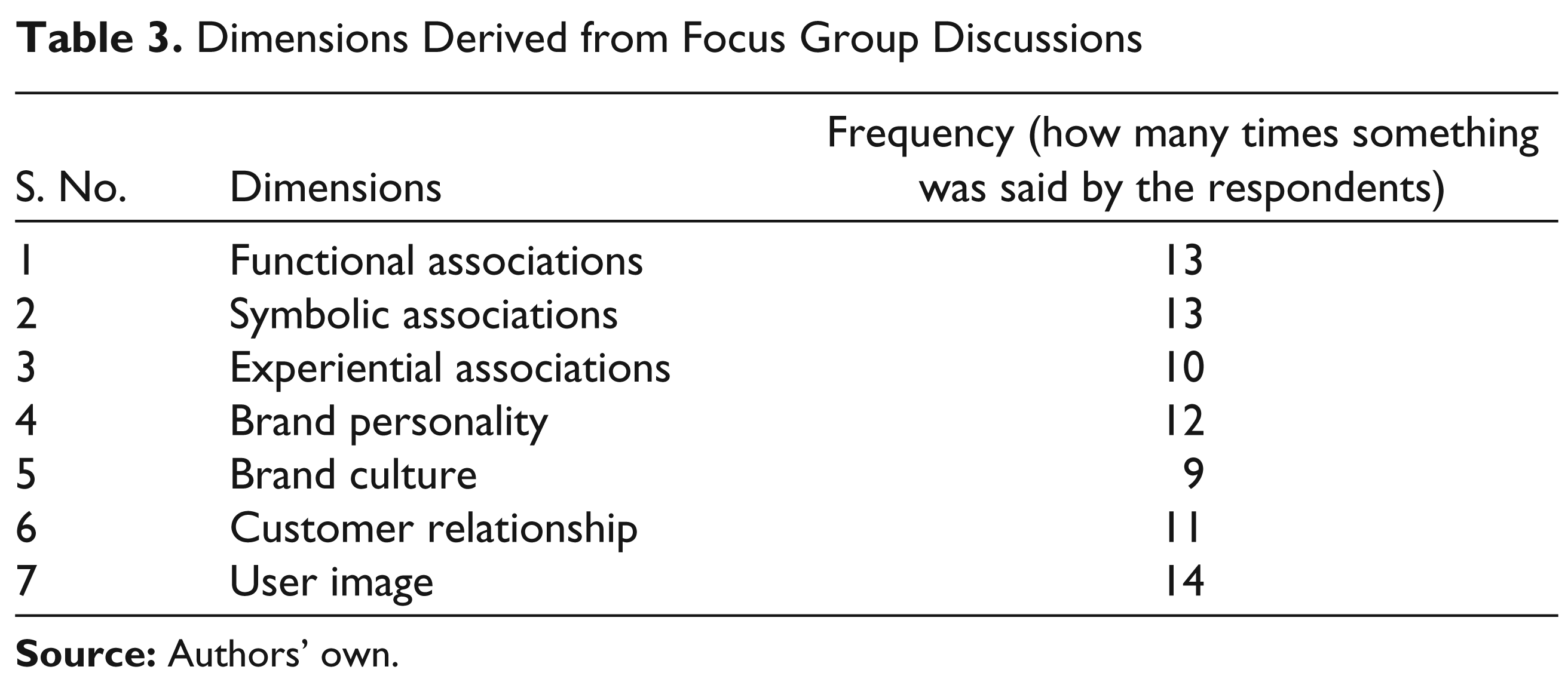
The existing literature regarding the dimensions was critically analyzed. In some cases, the dimensions were common amongst perspectives, whereas in others the feasibility to gather data from the customers was intricate. In order to overcome this problem, two focus groups of eight respondents each were chosen and studied. A moderator for the focus group was chosen amongst the faculty members on the basis of educational qualification and experience. The moderator had the expertise in inter-behavioural skills and psychometric testing. The moderator took notes during both focus groups. She prepared a brief written summary of the key points after the end of the focus groups in order to reach agreement. Themes were identified and agreed upon. The respondents were asked to explicitly respond to a range of open-ended questions regarding the parameters to be used for mapping the image of the soap brands. There were some common dimensions chosen by majority of the respondents to measure the brand image of the bathing soap brands. These listed dimensions were also seen in the literature studied above.
Taking all of the above into due consideration, Table 3 illustrates the dimensions, namely, functional associations, symbolic associations, experiential associations, brand personality, brand culture, customer relationship and user image.
The first three dimensions were also studied by Keller (1993) in terms of brand associations (Table 2). Keller (1993) postulated that brand image is defined by types of brand associations, which in turn are defined by attributes, benefits and attitudes towards the brand. Attributes are product related (ingredients necessary for performing the product or service) and non-product related (external aspects of the product or service that relate to its purchase or consumption: price, packaging and user imagery). Benefits are related to the personal value consumers assign to the product or service and consist of functional, experiential and symbolic dimensions. Functional benefits are related to intrinsic advantages of the product or service (often linked to physiological needs), experiential benefits relate to what it feels like to use the product or service and symbolic benefits are the extrinsic advantages of the product or service consumption (e.g., a need for social approval or self-esteem). Finally, brand attitudes are consumers’ overall evaluations of a brand.
Dimensions Derived from Focus Group Discussions
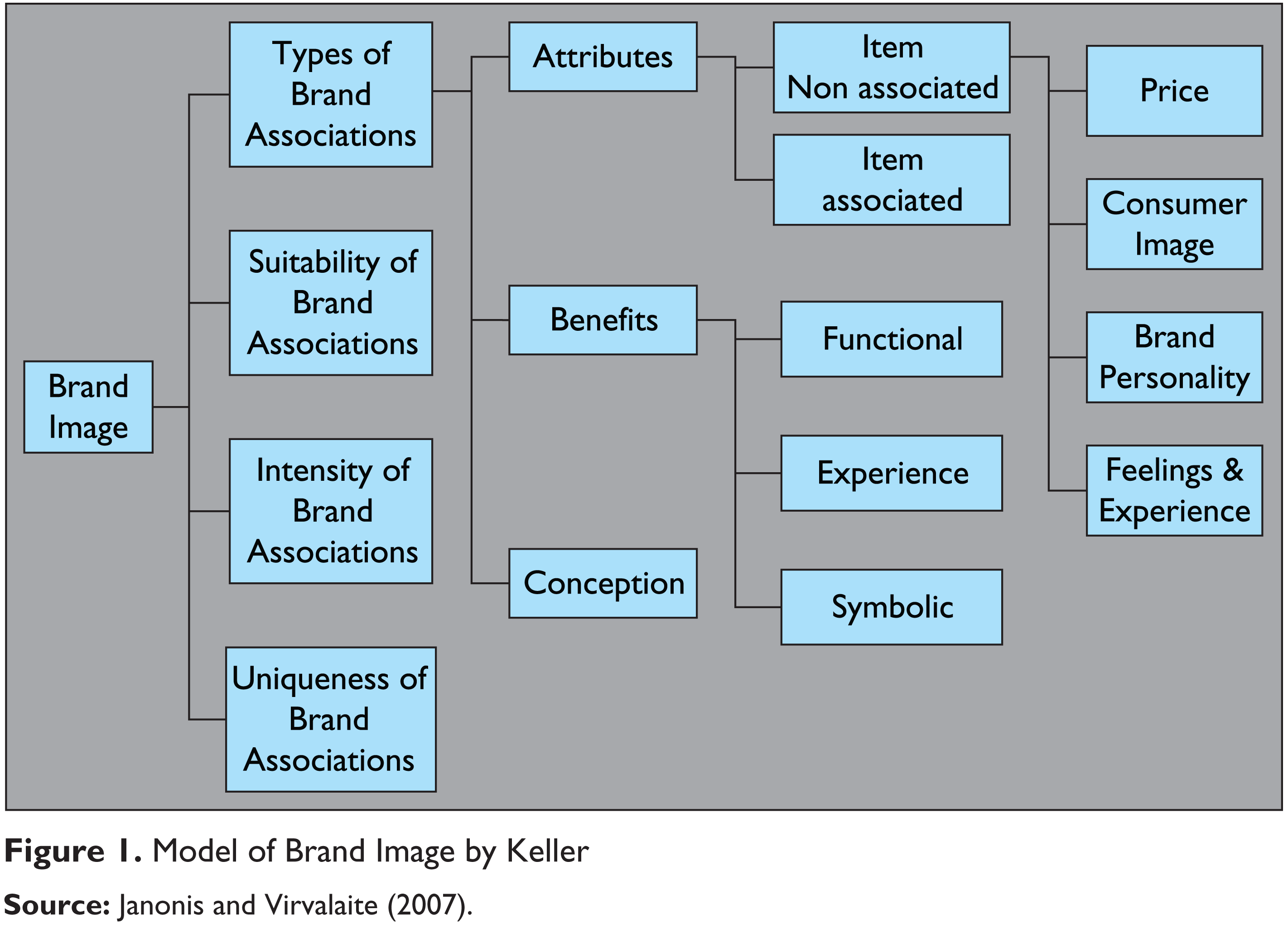
These linkages, or in Keller’s terminology ‘brand associations’, are developed from a variety of sources including brand and product category experiences, product attributes, price information, positioning in promotional communications, packaging, user imagery (e.g., typical brand users) and usage occasion (Figure 1 shows the model of brand image by Keller). From a theoretical point of view, Keller (1993) suggests that brand associations can be influenced when a brand becomes linked with a celebrity through an endorsement or linked with a sporting event through sponsorship activities.
Basis of Selection of Companies of Bathing Soap Brands
DSP Merrill Lynch Report (Share of the Pie, 2010) of market share of leading consumer goods companies (2008–2009) illustrates that the soap market share comprises three players (Table 4).
Also considered is the fact that this data is expounding and not exhaustive. Hence, for further research, based on the above data mentioned about the three companies, the sub-brands of the same are taken for the study.
Market Share of Leading Consumer Goods Companies (2008–2009)

Market Share Trends
Added to the data related to the leading consumer goods companies in 2008–2009, Table 5 shows the market share trends. In April 2010, the market share of Hindustan Unilever Limited (HUL) Soaps is 43.8, Godrej Consumer Soaps is 10.5 and ‘Others’ is 45.7. The chosen brands are also from the mentioned parent companies, HUL, Godrej and ‘Others’. The rationale for the selection of brands is given below in detail.
Selection of Brands
Brand image may not be everything, but is the only thing that speaks underneath a consumer’s perception of a brand. This is the perspective that this research article has aimed at discovering through research. In here, we specifically talk about six brands selected from the 100 Most Trusted Brands listed by ‘Brand Equity’ Survey 2010 of The Economic Times (31 August 2010).
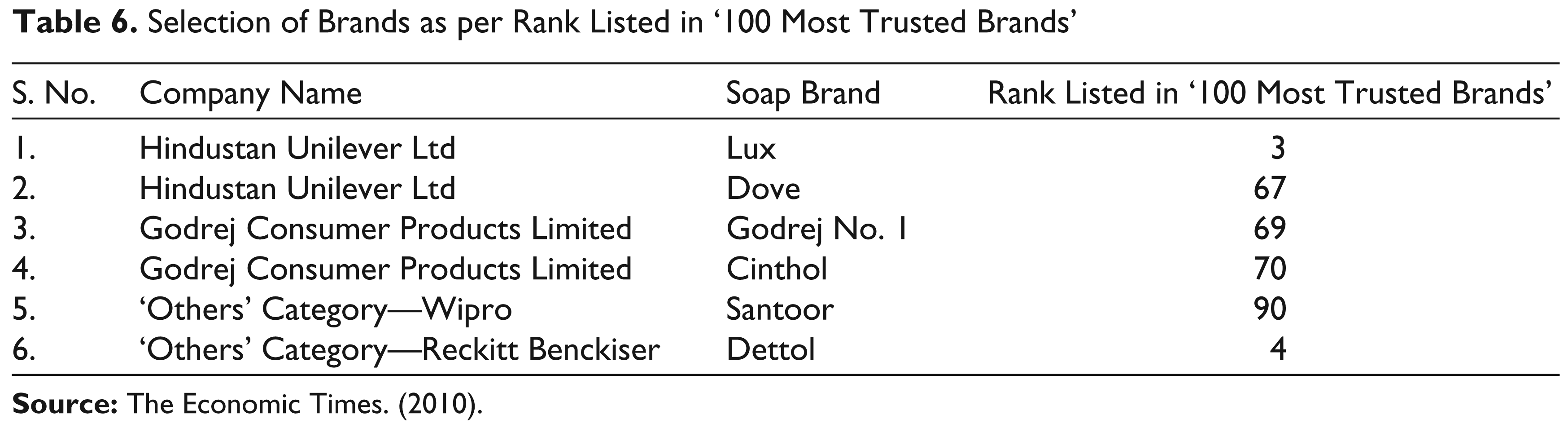
The soap brands from the HUL family tree listed in the survey were Lux, Lifebuoy, Dove, Pears and Hamam. Godrej No. 1 and Cinthol were listed from the house of Godrej Consumer Products Limited (GPCL). In the ‘Others’ category, Dettol by Reckitt Benekiser, Nirma by Nirma Consumer Care Ltd and Santoor by Wipro Consumer Care & Lighting were listed. In order to select six brands out of the listed soap brands, two from HUL (Lux and Dove) were randomly chosen. Both brands from GPCL were selected. In the ‘Others’ category, a pilot study with a sample of 35 was done to choose two brands out of the listed three (Dettol, Nirma and Santoor). It was seen that the consumers relate Nirma with Nirma Washing Powder and not with Nirma bathing soap. Hence, primarily based on simple random sampling and pilot study, top six preferred brands (Table 6), namely, Lux, Dove, Godrej No. 1, Cinthol, Santoor and Dettol, were selected for the study.
The brand image of the chosen soap brands was mapped consequently. Multidimensional scaling (MDS) was done for the purpose. The output of MDS is the location of the objects on the dimensions and is termed a perceptual map. Perceptual maps can have any number of dimensions but the most common are two dimensions. Any more dimensions are a challenge to draw and confusing to interpret. A well-defined attribute-based approach was used to analyze and develop the perceptual map. A thorough discriminant analysis was conducted to design the perceptual maps. It identified clusters of attributes on which the assorted objects differ. It attempts to visually display the perceptions of customers or potential customers. Typically, the position of a product, product line, brand or company is displayed relative to its competition. Following that logic, the discriminant analysis of selecting attributes that discriminate between objects was a sensible option. Since discriminant analysis is the most desirable for the data we have, the technique is applied and canonical and group centroid values for the variables and the brands are obtained. These canonical and group centroid values obtained after discriminant analysis were used to generate perceptual maps.
Market Share Trends

Selection of Brands as per Rank Listed in ‘100 Most Trusted Brands’
A second useful characteristic of discriminant analysis is that it provides a test of statistical significance. The null hypothesis of the research is that any two objects actually are perceived identically. The test will determine the probability that the between-object distance was simply due to a statistical accident. The third quality of discriminant analysis is that it will identify a perceptual dimension even if it is represented by a single attribute.
Since discriminate analysis was most suitable for the data we have, it was applied and the canonical and group centroid values for the variables and the brands were obtained. The canonical and group centroid values obtained in SPSS after discriminant analysis were used to generate perceptual maps using MS-Excel.
Apart from perceptual maps, other statistical tools, such as cross tabs, histograms and scatter plots were also used to analyze the data in order to generate visual aids to respond and support the primary research objectives undertaken.
Analysis of Results
Perceptual Map—Functional Association
Figure 2 represents the vectors for each of the attributes—cleans well, perfect fragrance, easily available, good lather/foam, attractive offers, good price, antiseptic nature and moisturizing property. These vectors represent the effect of discrimination on each dimension. Longer arrows pointing more closely towards a given group centroid represent the variable more strongly associated with that particular brand. Vectors pointing in the opposite direction from a given group centroid (brand) represent lower association with the concerned group.
Variables with longer vectors in a given dimension and those closer to a given axis (dimension represented by discriminant function) are contributing more to the interpretation of that dimension. Looking at all variables that contribute to a given axis (dimension), we can label the dimension as a combination of those variables.
As seen from the figure, the brands have their unique position on the map. In addition, on the same map, we have now plotted values of the attributes on the same two dimensions (each discriminant function represents a dimension). It is evident from the above figure that dimension 1 is antiseptic nature and dimension 2 is ‘perfect fragrance’ as the vector is closest to the vertical axis.

Brands and Their Association
Based on the above observed pattern of the perceptual map and results of the discriminant analysis, Dettol seems very strongly associated with dimension 1, ‘antiseptic nature’ and Lux seem strongly associated with dimension 2, that is, perfect fragrance. Santoor, Godrej No. 1, Dove and Cinthol seem to be week in both the dimensions.
Perceptual Map—Symbolic Association
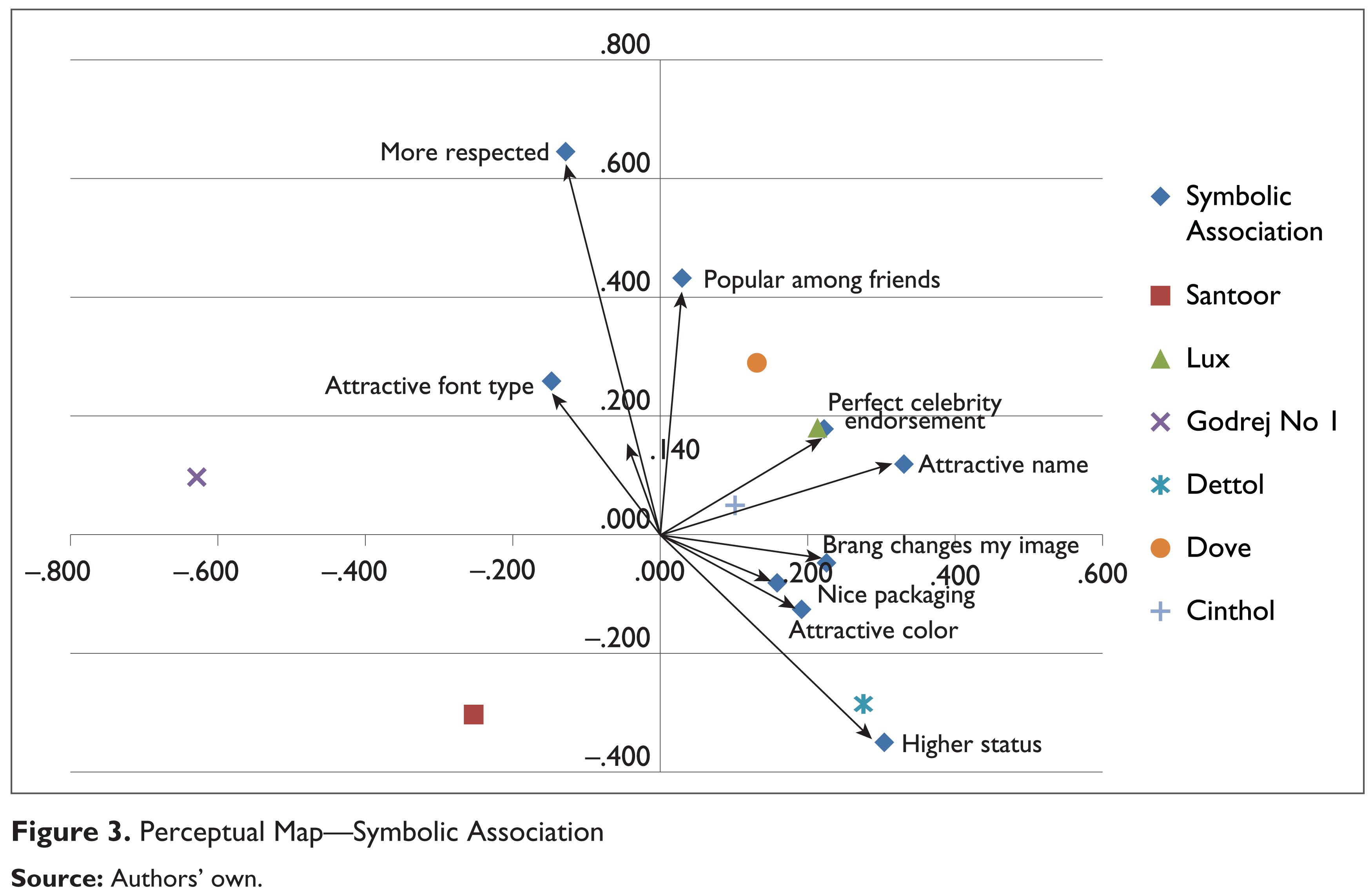
Figure 3 represents the vectors for each of the attributes—attractive name, striking logo, eye-catching font type, pleasing colour of soap, fine packaging, perfect celebrity endorsement, superior status, popular among peers, more respected and the brand changes my image. These vectors represent the effect of discrimination on each dimension.
According to the figure, dimension 1 seems to be sporting an ‘attractive name’. Dimension 2 seems to be ‘popular among friends’ as it is the vector that is closest to the vertical axis.
Brands and Their Association
Lux is very strongly associated with dimension 1, ‘attractive name’, and Dove is strongly associated with dimension 2, that is, ‘popular among friends’. Apparently, like we can observe, none of the other brands, such as Santoor, Godrej No. 1, Dettol and Cinthol, seem to have such strong symbolic associations with the deduced two dimensions.
Perceptual Map—Experience Association
Figure 4 represents the vectors for each of the attributes—more self-confidence, glowing skin, long-lasting fragrance, high satisfaction and convenient shape for using.
Dimension 1 is inferred to be ‘more self-confidence’ and being closest to the vertical axis, we can deduce dimension 2 to be glowing skin (see Figure 5).
Brands and Their Association
Dove and Dettol are stronger in dimension 1, that is, ‘more self-confidence’. While we closely observe, the brand Lux seems to be strong in dimension 2, ‘glowing skin’. On the other hand, Santoor, Godrej No. 1 and Cinthol are weak in both the dimensions compared to their competitors as they lie farther from the dimensions.
Brand Personality
The brand personality measurement instrument used most often is the one developed by Aaker (1997). She found five factors, namely, sincerity (sample item: honest), excitement (daring), competence (reliable), sophistication (upper class) and ruggedness (tough).
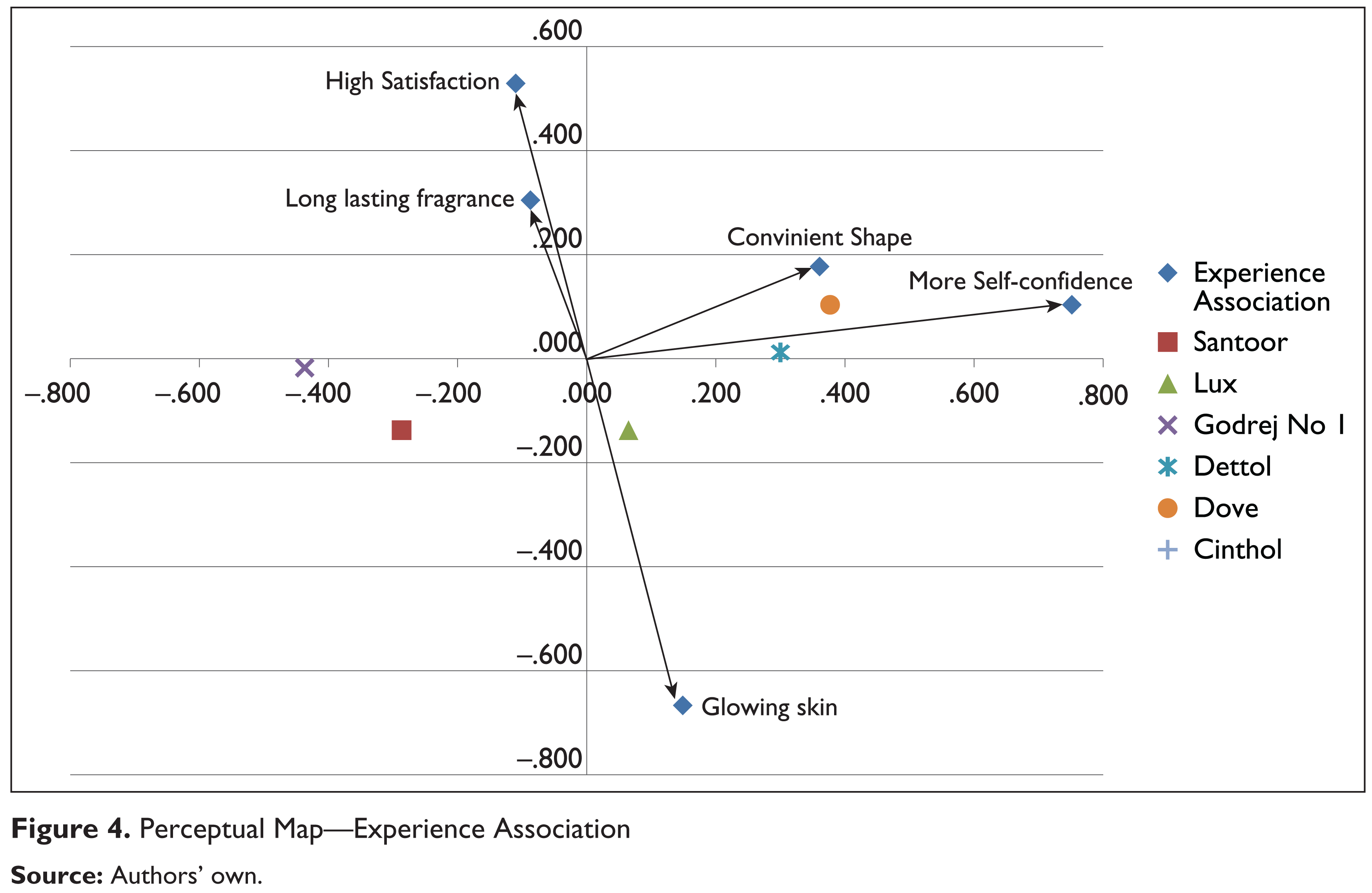
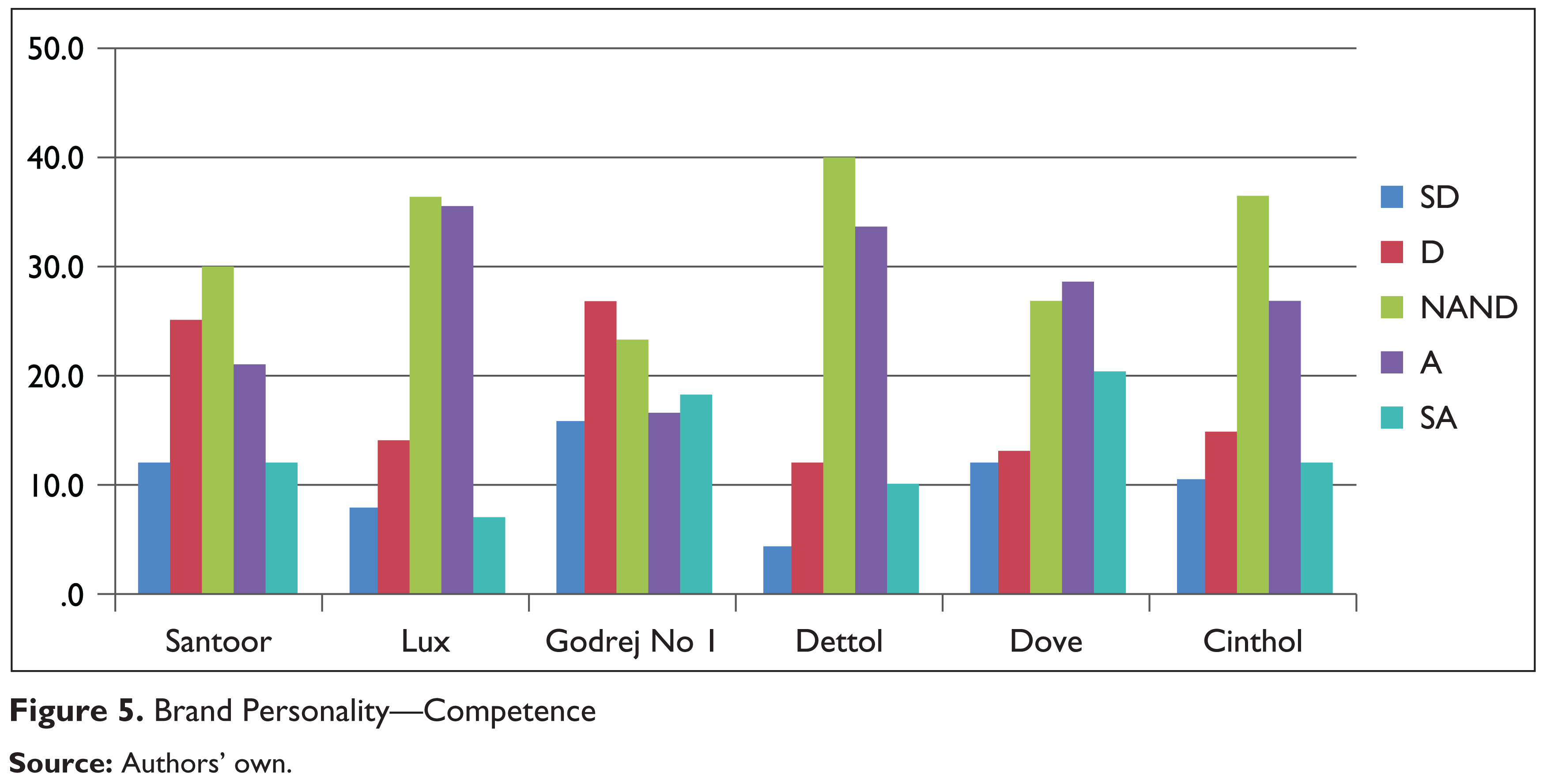
Figure 5 shows brand personality on the factor ‘competence’. Cinthol brand is strongly associated with the brand personality—sincerity, for which majority of the respondents strongly agreed on the association. Dettol and Dove also show good association with the brand personality on the factor ‘sincerity’. With the personality trait ‘excitement’, Dove and Dettol show strong association with this attribute and Godrej No. 1 shows the least association. Lux, Dettol, Dove and Cinthol score more when compared to Santoor and Godrej No. 1 for the brand personality on the factor ‘competence’ and ‘sophistication’. Dettol scores the highest and denotes a strong association for the brand personality on the parameter ‘ruggedness’.
Brand Culture
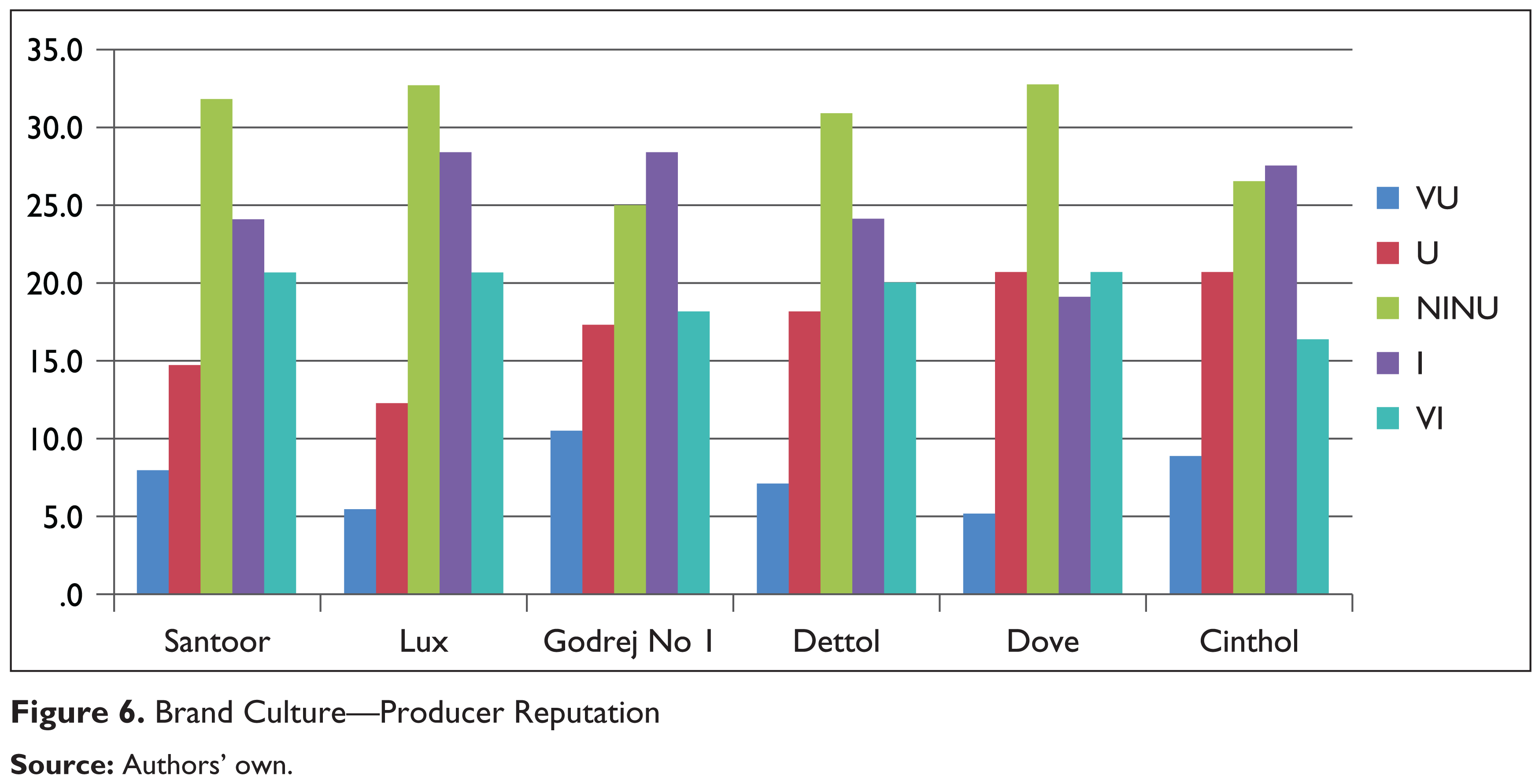
Almost all the brand culture attributes, such as producer’s reputation, company’s attitude to environment protection, participation in charity and support, employee interrelationship and quality of production process, show a trend of ‘Neither important nor unimportant’. Figure 6 shows the graph for brand culture on the factor producer’s reputation.
Importance of Customer Relationship
Majority of the respondents considered advertising as a very important factor for maintaining customer relationship. Contests and activities organized, price discounts, loyalty programmes and customer care centre are not considered that vital compared to advertising in maintaining customer relationship. Figure 7 shows the ‘Importance of Customer Relationship’ on the factor ‘advertising’.
User Image
Figures 8 and 9 show the user image of the brands Dove and Godrej No. 1, respectively. The peaks towards the left of 4 in the scale show prominence of the user images—masculinity, economical, soft, modern, formal, cheerful, relaxed and youthful. The peaks towards the right of 4 in the scale denotes the prominence of the user images—feminine, luxurious, rough, old-fashioned, informal, sad, tense and mature.

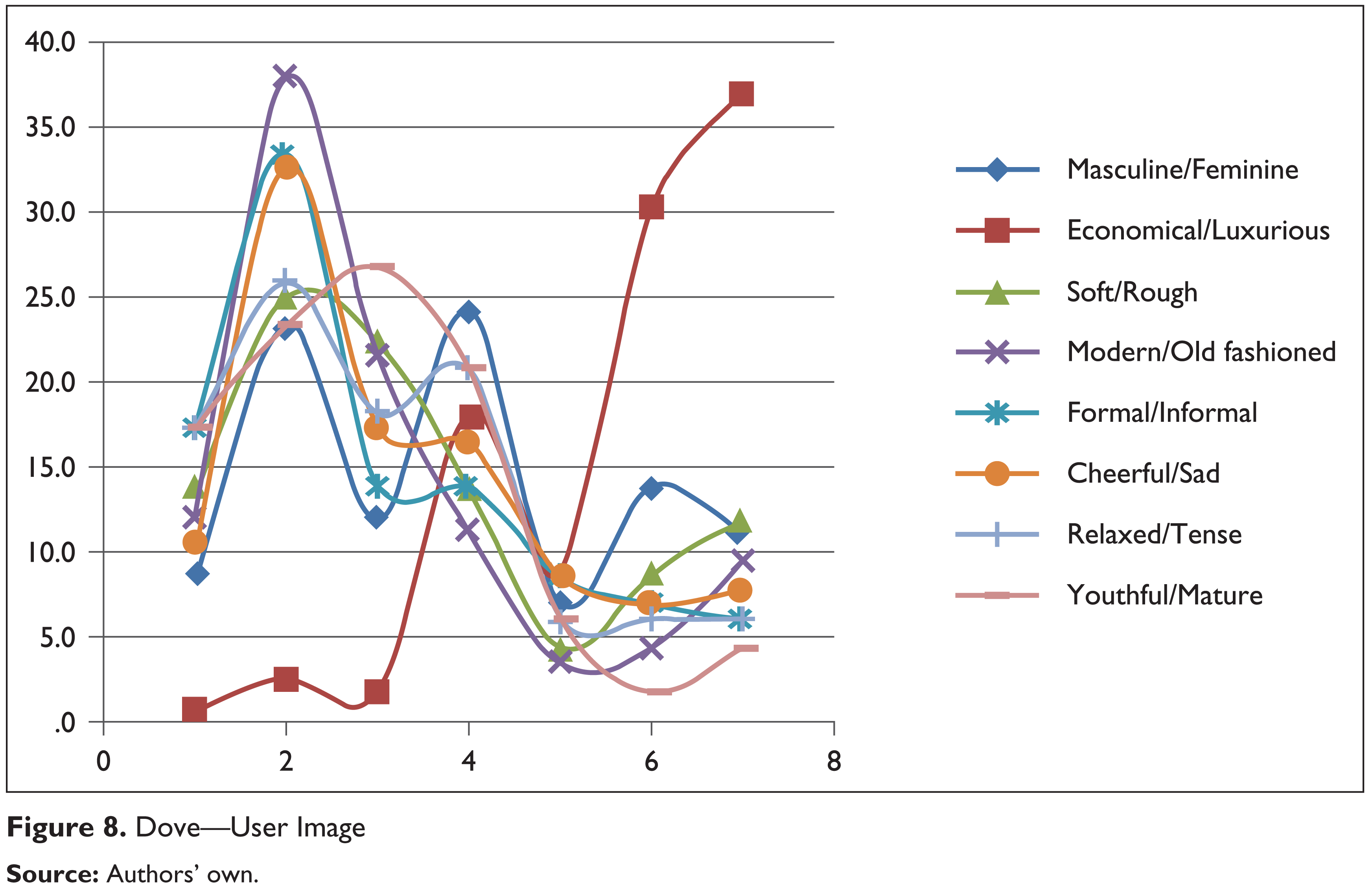
The general trend of user image is shifted towards the left or middle of the semantic scale, which portrays the brand users as masculine, economical, soft, modern, formal, cheerful, relaxed and youthful. The exceptions are Dove users, who are considered as luxurious. Dove and Cinthol users are considered to be feminine in nature, rather than masculine.

The user image which is prominent in the case of the brand Santoor is ‘economical’. ‘Lux’ users are considered as very ‘cheerful’. ‘Masculinity’ again showed prominence in the case of Godrej No. 1 users. Dove enjoys the unique position of being considered as the most modern and luxurious among all the other brands by the users.
Conclusions
It is widely acclaimed that a company that is determined to achieve better results in the market to be at par with the competitors needs to acquire a differentiated competitive advantage in order to sustain in the current rapidly growing market. Such a unique competitive advantage that no one can emulate is the brand image possessed by the company and its products.
From the secondary data it was found that Santoor, Lux, Godrej No. 1, Dettol, Dove and Cinthol are the most popular bathing soap brands. In the attempt to study and evaluate the brand image of these brands, it was found that Dettol is strongly positioned with the functional association of antiseptic nature and Lux with perfect fragrance. In the symbolic associations, Dove positioned itself as ‘popular among friends’ and Cinthol for its ‘attractive name’. For experience association, Dove and Dettol positioned as brands for ‘more self-confidence’ and Lux as ‘glowing skin’.
The perceptual maps helped in assessing the brand image of these brands and also to evaluate the extent to which these brands are associated with the functional, symbolic and experiential associations. This helped in identifying the associations in which the brands are positioned strongly and also in identifying new associations for weaker or new brands to position themselves. On the other hand, brand themselves cannot ensure the competitive edge of the product/brand in the market.
A study analyzing the dimensions important from a company’s perspective or brand strategists’ perspective (brand identity) and linking them with the dimensions important for the customers would be valuable in enhancing knowledge on how best to position the soap brands based on brand image dimensions. High-quality results are achieved by companies that are capable of managing their brands, reproduction of consistent brand identity, choosing the right brand elements and maintaining steady, one-of-a-kindness and equity. The initial development of a brand image as well as strengthening it from time to time in accordance with the fluctuations in the market and the dynamic strategies of the competitors help to rise or maintain a consistent position in the market for the company.
This article has analyzed the problem of how the chosen soap brands can build a positive brand image on the negative associations inferred from the research. Under the increasing threat of foreign brands and private labels, the concept of brand and the dimensions that revolve around it are going to be the core tools empowering every player in the evolving market. Hence, we can conclude that it is important to consistently improve the brand image because, at the end of the day, it is the factor that influences the consumers’ behaviour. Even though the ultimate decision-making lies in the consumers’ hands, we can use the brand image to seek consumers’ attention and aid them in making an informed decision.
Managerial Implications
The findings of the article offer actionable strategies for brand managers who want to leverage on positive brand associations. Having a strong brand image implies having an upper hand over competitors and thus preventing the brand from shifting their purchase intentions to other rival brands. The research demonstrates the importance of understanding and managing the perceptions and associations of the customers. Managers can strategically position the chosen brands to the nearest perception concluded from the study. Also before repositioning, managers may carefully examine certain brand elements (brand name, logo, colour and packaging). The findings suggest that Cinthol has an association of ‘attractive name’. If in near future, the brand manager of the brand Cinthol decides to reposition the brand for some reason, then it should be kept in mind that apart from the brand name, other brand elements and other associations less strong than the brand name can be changed or worked upon.
Footnotes
Acknowledgements
We are grateful to the anonymous referees of the journal for their extremely useful suggestions to improve the quality of the article. Usual disclaimers apply.