



Abstract
The purpose of this article is to explore the impact of brand experience dimensions on brand evaluation and brand loyalty. The study used convenience-sampling technique and measured the relationship between brand experience dimensions, overall brand evaluation and brand loyalty. Factor analysis confirmed that brand experience has two major dimensions: emotional brand experience and cognitive brand experience. Using structural equation modelling, the study reveals that emotional and cognitive brand experience dimensions affect brand evaluation, and brand evaluation influences brand loyalty. With the increased importance of brand experience, marketers need to understand various dimensions of brand experience and find how it influences other brand variables. With the growing importance to brand experience dimensions, the study will add value to the existing literature. The current study from the Indian context would benefit both academia and marketing managers. Future researchers can test the model for a specific set of products/service categories and specific set of customers. Researchers can also explore the relation among various brand experience dimensions and other brand constructs.
Keywords
Introduction
According to the American Marketing Association, ‘Brand is a name, term, sign, symbol or combination, intended to identify the goods or services of one seller or group of seller’ (Keller et al., 2012). A brand is a bundle of functional benefits delivered by products/services to customers. The role of a brand has evolved over a period. Today, customers tend to look much beyond functional benefits. They look for experience in the brand that they enjoy every day. Brand experience is the subjective, internal and behavioural responses evoked by brand-related stimuli that are part of a brand’s design, identity, packaging, communication and environment (Brakus, Schmitt & Zarantonello, 2009). According to Brakus et al. (2009), Hulten (2009) and Zarantonello and Schmitt (2010), brand experience comprises all types of consumer experiences, including emotional, contextual, symbolic and non-utilitarian aspects. The fields of cognitive science, philosophy, experiential marketing and spirituality lent support for comprehending brand experience. Although the concept of experience in terms of sense, feel, think, act and relate was available since ancient times, it was Holbrook and Hirshman (1982) who introduced the concept in marketing literature. Since then, brand experience has been studied by various researchers, such as Pine and Gilmore (1998), Schmitt (1999, 2003), Addis and Holbrook (2001), Shaw and Ivens (2002), Smith and Wheeler (2002), Carù and Cova (2003), Lasalle and Britton (2003), Chattopadhyay and Laborie (2005) and Brakus et al. (2009), from different perspectives.
The research on brand experience has gained much importance in recent years as the marketing practitioners have come to realize that understanding how consumers experience brands is critical for developing marketing strategies. There is also a realization that brands, which provide a greater experience to customers, thrive at the marketplace. With the increased importance of brand experience, marketers explore to understand the various dimensions of brand experience and discover its effect on other brand variables. Understanding the nuances of brand experience can help the managers to fine-tune their marketing strategies.
Brand and related topics are attracting the managerial attention. For example, in recent times, there is a considerable study of a brand in the context of brand trust (Punyatoya, 2014), brand personalities (Udomkit & Mathews, 2015) and brand image (Mohan Raj & Roy, 2015). There is a recent trend towards investigating various dimensions of brand experience. In the backdrop of increased interest towards brand experience dimensions, there is a strong need to investigate brand experience and its relationship with appropriate brand constructs. The current study, based on empirical examination, focuses on affective and cognitive brand experience. It explores brand experience dimensions in the context of the Indian brand and investigates the relationship among brand experience dimensions, overall brand evaluation and loyalty. While the study by Brakus et al. (2009) investigated the brand experience from the perspective of aggregated measures, we argue that investigation of individual brand experience dimension will enhance the understanding of how to improve overall brand evaluation and brand loyalty by adjusting the individual brand experience dimensions. The past researches have examined the relationship of brand experience with constructs, such as satisfaction, quality, trust and loyalty (Brakus et al., 2009; Iglesias, Singh & Batista-Foguet, 2011; Jung & Soo, 2012; Nysveen & Pedersen, 2014). Our study intends to fill that gap by examining the relationship of brand experience with overall brand evaluation and overall brand evaluation with brand loyalty.
The next section offers the review of literature wherein past studies relating to brand experience, brand experience scales and its relationship with brand constructs are discussed. Then the study provides objectives and rationale. Thereafter, the study provides a theoretical framework which serves as a basis for testing the model. The next section presents the methodology and analyzes the data using exploratory factor analysis, confirmatory factor analysis and structural equation modelling (SEM). Finally, the study concludes and offers limitations and scope for further research.
Review of Literature
Dewey (1922, 1925) studied brand experience from the philosophical point of view. He examined the influence of environment and observed that experience occurs from perception, feeling and by doing. Holbrook and Hirschman (1982) offered the understanding of consumption from an experience point of view. The emphasis was on hedonic consumption and the findings showed that consumers are interested in pleasure and enjoyment. Holt (1995) segregated consumption experiences as cognitive and emotional. Aaker (1997) found that brand experience dealt with actual sensation, cognition and behavioural response. Pine and Gilmore (1998) contributed by providing the detailed understanding of ‘experience economy’. Experiences were distinct economical offerings and were considered quite different from services, the way services differed from goods. In addition, experiences emerge as a progression of economic value. The progression moved from extracting commodities, make goods and deliver services and stage experiences. The findings revealed that brand experiences create differentiated competitive position and a premium pricing. Consumers developed affiliation to a brand from various perspectives, such as emotional, mental, spiritual and physical. Schmitt (1999) suggested five experiences in his research: sense, feel, think, act and relate, although the concept is in existence since ancient times as Indian religious literature considers it as panchvishays. Panchvishays has been discussed elaborately in spiritual texts—Bhagavad Gita and Vacahanamrut. While the ‘sense’s’ include aesthetic quality, ‘feel’ relates to moods and emotions, ‘think’ experience consists of convergent/analytical thinking, ‘act’ pertains to the behavioural dimension and finally, the ‘relate’ experience comprises social experience. After Schmitt (1999), many researchers studied experiential factors (cognitive, emotional, social, etc.) rather than functional benefits. Schmitt’s (1999) measurement construct was similar to the dimensions of Holbrook and Hirschman (1982) and Holt (1995).
Experiences affected consumers in an emotional, mental, social, spiritual and physical manner (Carù & Cova, 2003). Mascarenhas, Kesavan and Bernacchi (2006) divided customer experiences into a subjective and objective component where emotional, cognitive and social experiences are the dimensions of the subjective component, and behavioural and cognitive are part of the objective component. Understanding and delivering total customer experience influence lasting customer loyalty. Moreover, total customer experience is due to physical, emotional involvement and value chain moment. Gentile, Spiller and Noci (2007) studied the components such as sensorial, emotional, cognitive and relational and stated that they were similar to sense, feel, think, act and relate as proposed by Schmitt (1999).
Dubé and LeBel (2003) covered four pleasure dimensions: intellectual, emotional, social and physical pleasures. Emotional response, which was part of pleasure category, is at an implicit level. Pleasure, a hierarchical concept, is considered at various levels. Verhoef et al. (2009) examined customer experience as a holistic construct, containing cognitive, affective, emotional, social and physical response. Their findings suggested that prior customer experience influenced the future customer experience. Customer experience in the context of the social environment, self-service technologies and store brand played a crucial role in achieving growth.
Brakus et al. (2009) measured brand experience using sensory, affective, intellectual and behavioural dimensions. Sensory dimensions were related to making strong, visual impression on the customer; affective dimension induced feelings and sentiments; the intellectual dimension referred to the brand’s ability to make customers think; and behavioural dimension included bodily experiences, lifestyles and interaction with the brands (Jung & Soo, 2012; Zarantonello & Schmitt, 2010).
Brand experiences happen during various events of consumers associating with the brand, such as searching for products, shopping for products or services and consuming products or services (Arnould, Price & Zinkhan, 2002; Brakus et al., 2009; Holbrook, 2000). McAlexander, Schouten and Koenig (2002) suggested that brand community could be seen from customer experiential perspective and shared customer experience could help in strengthening the brand community. Hoch (2002) pointed out that the engaging aspects of experience attract consumers’ attention, and the engaging, non-partisan and pseudo-diagnostic aspect of experience affects product experience. Hui and Bateson (1991) studied service experience and concluded that perceived control is an important variable in mediating consumers’ emotional and behavioural response to service encounter.
Past studies explored various brand constructs such as brand attitude, involvement, brand attachment, customer delight, brand associations, involvement, customer delight and brand personality differed from brand experience. For example, attitudes were general evaluations based on beliefs or affective reactions (Fishbein & Ajzen, 1975; Murphy & Zjonc, 1993). Brand attachment is based on three dimensions of needs, values and interest (Thomson, MacInnis & Whan, 2005). Customer delight is an affective component of satisfaction. Keller (1993) defined brand image as ‘the perceptions about a brand as reflected by the brand associations held in consumer memory.’ There are three aspects of brand image: favourability, strength and uniqueness of brand associations. Schmitt (2009) suggested that as brand experience is different from key brand constructs and has emerged from cognitive, motivational and affective aspects, there was a need to examine the relationship in an empirical manner.
Brakus et al. (2009) explored how brand experience affects customer satisfaction and loyalty directly and brand personality mediates both customer satisfaction and loyalty. The study by Jung and Soo (2012), while investigating the relation among brand experience dimensions, such as brand trust, brand commitment and brand loyalty, observed that brand experience dimensions were confined to behavioural and affective brand experience. The finding suggested that affective brand experience influenced brand trust positively, behavioural brand experience affected brand commitment positively, brand trust affected brand commitment positively and brand relationship quality influenced brand loyalty positively. Researchers investigated the relationship of brand experience with other brand-related variables, such as brand personality, brand satisfaction and brand loyalty. Nysveen, Pedersen and Skard (2013) studied the influence of individual dimensions of brand experience on brand personality, brand satisfaction and brand loyalty and examined the brand experience for service brands where relational experience was identified as an additional component. Shamim and Muhammad (2013) indicated that brand experience influenced brand credibility more than brand attitude and customer-based brand equity. Various studies confirmed the relationship between brand experience and loyalty (Brakus et al., 2009; Iglesias et al., 2011; Nysveen & Pedersen, 2014). The study by Cleff, I Chun and Walter (2014) found that brand experience influences both brand image and brand awareness.
Objective and Rationale of the Study
The literature review revealed various studies on brand experience. These studies were focused on various perspectives from the point of view of philosophical orientation, hedonic consumption, experience economy, product and service orientation, experiential factors, cognitive and emotional dimensions and brand-related variables. The study covered the evolution of brand experience measurements and exploration of brand experience scale using factor analysis. Though there are studies on consumer evaluation of brand-related construct (Bapat & Panwar, 2009; Swaminathan, Fox & Reddy, 2001), the linkage of brand experience dimensions with overall brand evaluation needs investigation. In the past, extensive studies have examined the overall brand evaluation for brand extensions. Analyzing the consequences of brand experience would help the managers to create unique and memorable brand experience which can lead to improvement in brand loyalty. Hence, the study offers guidance to both researchers and managers.
This study explores the affective and cognitive brand experience dimensions in line with Holt (1995) categorizations of affective and intellectual brand experience dimensions. There is a need to analyze the relationship between brand experience and brand evaluation. Marketers can benefit by investigating the structural relationship of brand experience and consequences of brand experiences. It examines the mediation effect of overall brand evaluation between brand experience dimensions and brand loyalty.
We find that past studies were conducted in the context of developed countries wherein the brand selected happened to be the multinational brand; however, our study captures the brand with Indian origin and has a growing global presence. So the brand from an emerging country context adds to the existing body of literature. We decided to choose Amul brand which is well known in the fast-moving consumer goods (FMCG) category. The advertising of the brand through Amul Topicals is unique. The advertisement of ‘Amul Butter’ comes with contemporary topics which may relate to current affairs including politics, sports and events of public interest. The brand icon is Amul butter girl and is famous for the ‘utterly butterly delicious’ slogan. The campaign is popular and is the longest successful advertising campaign. The campaign makes the public to think and relate with the current affairs, invoking the cognitive component of the brand experience. The brand creates feelings as customers would like to associate with the brand. Since Amul is a success story for co-operative movement and is well known the world over, consumers are keen to associate with the brand and contribute in improving the lives of 3.37 million farmers.
Theoretical Framework
Effect of Affective Brand Experience
Many researchers have dealt with the aspect of emotion in customer experience in the past (Gentile et al., 2007; Holbrook & Hirschman, 1982; Holt, 1995). There is a realization that the emotional connection between brand and consumer plays an important role in building strong brands. This is applicable for both product and service brands. Emotional branding is referred as engaging the consumer on the level of emotions and feelings. It helps in forging a deep, lasting, intimate emotional connection and develops a holistic experience that leads to an emotional fulfilment so that the customer develops a special bond and trusts the brand (Gobe, 2001). Morrison and Crane (2007) investigated the role of brand experience in pre-purchase stage, purchase stage and post-purchase stage. Hwang and Kandampully (2012) suggested that affective attachment has the strongest impact on brand loyalty. Consumers elicit reactions when they associate with the brand (Pham, Cohen, Pracejus & Hughes, 2001). We argue that when the experience is positive, it results in positive brand evaluation. Therefore, we consider that emotional brand experience positively influences overall brand evaluation.
Effect of Cognitive Brand Experience
Holt (1995) considered intellectual or cognitive brand experience as one of the major consumption experiences. Schmitt (1999) explored how cognitive consistency, together with other dimensions, impacts consumer experience. Gentile et al. (2007) outlined the role of cognitive brand experience. Brakus et al. (2009) outlined that cognitive brand experience, among various responses, is one of the major brand experience components. The cognitive dimension includes the aspect of making consumers think or feel or curious. Using information processing, brand evaluation is based on new and existing information (Nurcahyo et al., 2011). We propose that interesting cognitive processing, based on existing and new information, may lead to a generation of positive brand evaluation. In case a brand enables the public to think, it results in higher cognitive brand experience. The thinking in positive direction will lead to higher brand evaluation and brand loyalty. So it is argued that cognitive brand dimension positively influences brand evaluation.
Brand Evaluation and Brand Loyalty
Overall brand evaluations determine consumers’ affective responses towards a brand, such as liking, trust and desirability (Sirianni, Bitner, Brown & Mandel, 2013). Past studies have examined brand evaluation in the context of brand extensions (Bapat & Panwar, 2009; Sood & Keller, 2012). Brand evaluation is based on information processing conducted by consumers and is based on past and new information with an objective to evaluate the brand (Nurcahyo et al., 2011). The study by Pham et al. (2001) found that consumers elicit reactions when they encounter the brand. These reactions can be in the form whether a brand is good, likable and favourable.
Since the work by Howard and Sheth (1969), the topic has evolved over the years. The topic of brand loyalty has assumed a lot of importance by both researchers and marketing managers. Consumers are likely to buy a brand again and recommend it to others (Mittal & Kamakura, 2001; Oliver, 1997; Reicheld, 1996). Brand loyalty consists of two components: behavioural loyalty (Jacoby & Chestnut, 1978) and attitudinal loyalty (Narayandas, 1997). Because of brand loyalty, consumers exhibit a commitment towards a brand. Since brand experience contributes to pleasurable outcomes, it results in brand loyalty (Brakus et al., 2009). The study by Iglesias et al. (2011) confirms that affective commitment mediates the linkage between brand experience and loyalty. Aaker (1991) found that brand loyalty offered various advantages, such as reduced marketing cost, more new customers and greater trade advantage. Dick and Basu (1994) suggest advantages in the form of positive word of mouth and greater attachment among loyal customers. A strong connection between a consumer and a brand leads to emotional brand attachment (Thomson et al., 2005). As a consumer indulges in increased experience with a brand, loyalty strengthens over a period of time (Park et al., 2010; Thomson et al., 2005). We posit that brand evaluation positively influences brand loyalty.
Methodology
Research Design
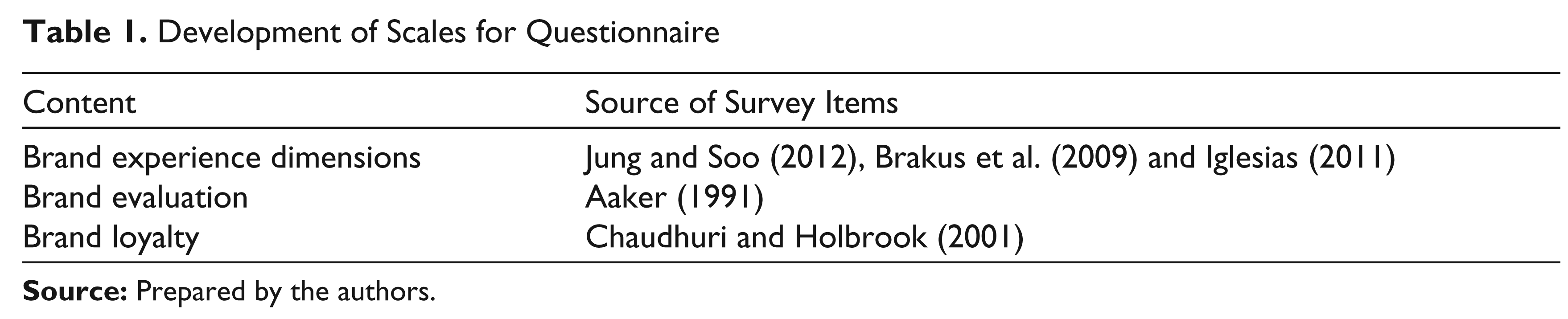
The study used quantitative research design. All the constructs were measured using multi-item scales adapted from the previous studies (Table 1). The scales had been earlier tested and used for their robustness in similar studies (Brakus et al., 2009; Iglesias and Bonet, 2012; Jung & Soo, 2012). Hence, it is suggested that the scale is appropriate for the current study.
Development of Scales for Questionnaire
The brand selected was Amul. Selection of the brand was based on two reasons: first, the brand is well known and second, it has evolved from offering the basic product to offering experience since the brand is present through retail outlets wherein it offers service experience. In recent times, Amul brand is available through exclusive Amul preferred outlets. This helps in providing experience to customers in addition to providing wide product varieties. By making products available and providing service experience, the researchers argue that there is addition in economic value. Further, focus group interview (10 participants) and marketing experts’ advice validated the selection. The brand Amul is popular in the processed food category with a presence in milk, UHT milk, butter, cheeses, chocolates, beverage, ice cream, milk powder, paneer, dahi, ghee, etc. Bapat and Panwar (2009) observed that brand awareness of certain product categories, such as butter, milk powder and milk, exhibits high product awareness.
The addition of the products and services, such as Amul Kool, Amul Café and Amul Retail outlets, targets the younger customers. The recent advertisement of Amul targets the younger customers with the greater participation of younger actors. As a result, it was decided to incorporate the views of younger customers since the outcome of the study can help the managers in understanding which dimensions need to be focused and will provide a futuristic orientation.
It is likely that Amul brand invokes cognitive and emotional brand experience. The peculiarity of Amul butter advertisement allows customers to think about the content of the advertisement and relate it to the current affairs. So there can be a linkage of cognitive brand experience dimension with the brand. The corporate brand campaign ‘Taste of India’ showed how the Amul brand cuts across various regions in India and Indian recipes. It is reasonable to argue that the campaign theme creates the emotional feeling for associating with the brand. Since Amul brand is associated with empowering millions of farmers who associate as milk producers, it can create a special feeling and attachment to the brand. So, it is argued that emotional experience will be invoked.
Questionnaire Design
The questionnaire measured the constructs and demographic details. The constructs measured were brand experience dimensions (cognitive and emotional), overall brand evaluation and loyalty. Brakus et al. (2009) deployed 12 items to measure brand experience, Jung and Soo (2012) used five items that relate to affective and behavioural dimensions. Brakus et al. (2009), Iglesias et al. (2011) and Jung and Soo (2012) scales were referred for developing brand experience scale. However, Iglesias (2011) used the same dimensions as that of Brakus et al. (2009), but maintained reverse polarity. Iglesias agreed with the scale formed by Holbrook (2000) and argued against reverse polarity. Conforming with the recommendations by Iglesias (2011), the study ignored reverse polarity. Chaudhuri and Holbrook’s (2001) loyalty scale and Aaker’s (1991) brand evaluation scales were used. Three marketing experts also validated the scales. The respondents were required to fill out a questionnaire indicating responses on a five-point Likert scale from 1 (strongly disagree) to 5 (strongly agree). Table 1 summarizes the theoretical development of the instrument.
Data
Self-administered questionnaires from respondents provided primary data in which 188 respondents participated in the study.
Data Analysis
The respondents comprised of 59 per cent males and 41 per cent females. The age profile of the respondents varied from 20 years to 26 years, with more than 90 per cent of respondents in the age group of 20–24 years. The researchers conducted both exploratory and confirmatory factor analyses. The model was tested using SEM.
Scale Reliability
Brakus et al.’s (2009) strict factor loadings were followed in this study. Items with factor loadings more than 0.70 and Cronbach’s score of more than 0.60 were retained. Since the values for other dimensions of brand experience were less than the acceptable values, we dropped the dimensions. Tables 2 and 3 present the reliability estimates for brand experience dimensions.
Selected Items

Endogenous Factors—Brand Evaluation and Loyalty

The endogenous variables selected were brand evaluation and brand loyalty.
Factor Analysis
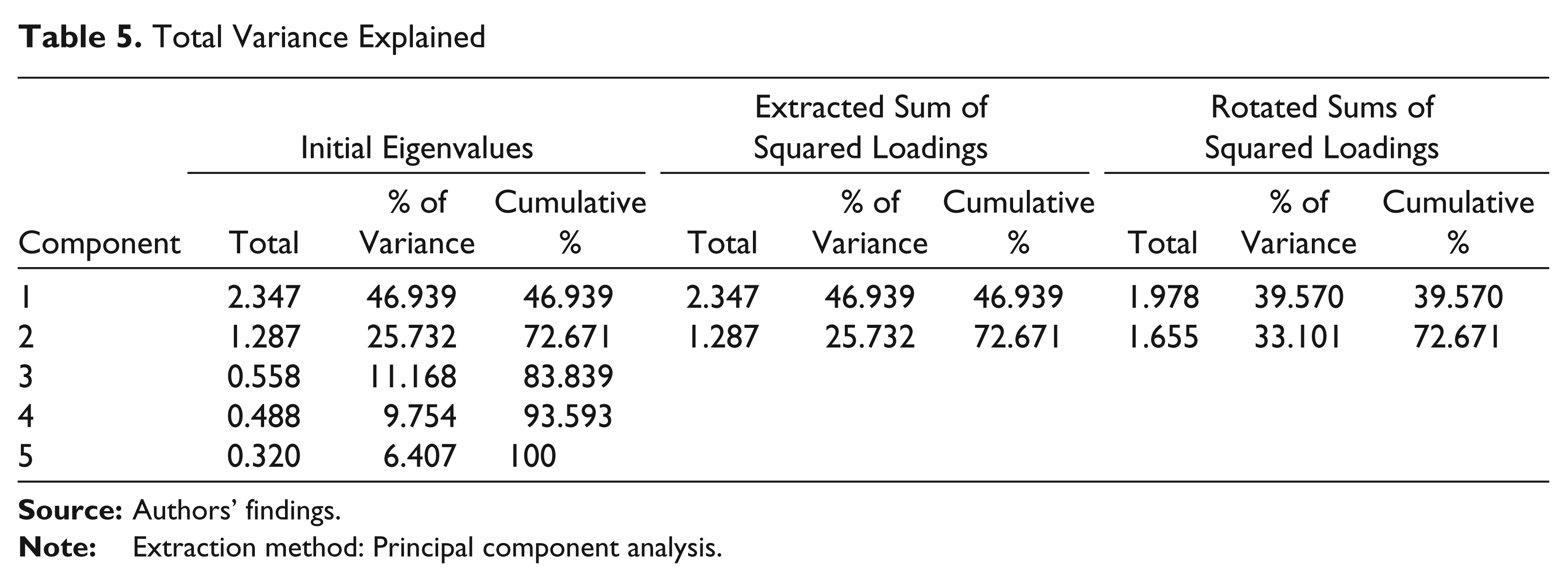
Researchers’ deployed exploratory factor analysis with an objective to reduce the items. Based on reliability measures, five items representing two factors were selected (items with the reliability scores above 0.75 were selected). Principal component analysis and varimax rotation technique were used.
Kaiser–Meyer–Olkin (KMO) value of more than 0.60 is considered as acceptable. In Table 4, it is observed that KMO value is acceptable value. Bartlett’s test of sphericity was significant (p < 0.000). It indicated that there is sufficient reason to proceed with the analysis. Since the significance value is less than 0.05, it is concluded that correlations in the data are appropriate for factor analysis (Table 4).
Table 5 shows two factors with eigenvalue more than 1. An eigenvalue of more than 1 was set as a basis for selecting the number of factors. Both these factors contribute to 72.67 per cent of the total variance. While factor 1 contributed 40 per cent of total variance, factor 2 contributed 33 per cent of total variance.
Table 6 describes factor solution using rotated component matrix. Three items were loaded on factor 1 and two items were loaded on factor 2. Factor 1 comprises affective aspects, factor 2 relates to cognitive aspects (Table 6).
KMO and Bartlett’s Test

Total Variance Explained
Rotated Component Matrix

(2) Rotation method: Varimax with Kaiser normalization.
Confirmatory factor analysis assessed the latent structure and it involved specification and estimation of one or more hypothesized models of the factor structure. Confirmatory factor analysis confirmed the factor structure.
Goodness of Fit, Reliability and Validity Test—Confirmatory Factor Analysis
The confirmatory factor model (Figure 1) revealed two-factor model with correlated factors. The fit model confirmed goodness of fit. Most of the values, such as chi-square to df ratio (CMIN/DF) = 3.35, comparative-fit index (CFI) = 0.91, goodness-of-fit index (GFI) = 0.943 and chi-square = 29.97, met the requirement of goodness of fit. Composite measure is the measure of the internal consistency of the construct indicators and is achieved when indicators are highly inter-correlated (Koufteros, 1999). The values from Table 2 showed composite reliability above the recommended values of 0.70 (Hair et al., 1998). Average variance extracted (AVE) captured the construct in relation to the amount of variance due to measurement error (Fornell & Larcker, 1981). Average variance extracted values of more than 0.50 are appropriate for any construct (Bagozzi & Yi, 1988; Hair et al., 1998). When AVE is more than 0.50, convergent validity is established (Fornell & Larcker, 1981). The current study had values more than 0.50 that satisfy the requirement of convergent validity. Discriminant validity refers to the extent to which measures of construct do not correlate highly with each other (Brown, Churchill & Peter, 1993). According to Fornell and Larcker (1981), there is discriminant validity when the squared correlation is less than their AVE. Table 7 provides evidence of discriminant validity.

Average Variance Extracted and Squared Correlations

Structural Equation Modelling
The researchers set the hypothesized model as shown in Figure 2. Affective and cognitive brand experience positively affects overall brand evaluation and overall brand evaluation positively affects brand loyalty. Figure 2 shows the proposed model for SEM.
Figure 2 shows the estimated model using path analysis. There are many goodness-of-fit criteria, such as GFI, adjusted goodness-of-fit index (AGFI), root mean square residual (RMR) and CFI, to assess an acceptable model fit. Among them, the CFI and normed fit index (NFI) are preferred measures (Bentler, 1992). The values of CFI, incremental fit index (IFI) and Tucker–Lewis index (TLI) are 0.98, 0.987 and 0.90, respectively. All these values are above the acceptable level of 0.90. Further CMIN/DF calculated at 1.684 is at an acceptable figure of less than five. There are internal consistencies for both endogenous and exogenous variables. All the path coefficients were significant at p < 0.05. The direct effect of overall brand evaluation on loyalty was positive and high (0.59). The direct effect of affective brand experience (0.39) was higher than that of cognitive brand experience (0.168).

Conclusions
This study examined the relation between brand experience and brand evaluations and studied how brand evaluations influence brand loyalty. Factor analysis, both exploratory and confirmatory factor analysis, resulted in two factors of brand experience dimensions which were affective and cognitive brand experience dimensions. The current study findings are in the line with Holt (1995) who categorized brand experience dimensions into affective and cognitive brand experience dimensions.
Consumers associate with their favourite brands through pre-purchase search, shopping, consumption and other ways. Consumers also relate with a brand through virtual and social media. Even if the respondents have not consumed the brand, they associate with the brand in an indirect manner. Customers develop feelings or sentiments and exhibit greater emotions with their favourite brand. In terms of experience, it is the affective experience. In addition, if the customers think more about the brand, it is cognitive brand experience. The study highlights affective brand experience and cognitive brand experience.
The study examined brand experience for a leading brand in FMCG category and selected Amul brand, which is one of the leading dairy brand in Asia-Pacific. We adapted and followed the recommendations of Jung and Soo (2012) and Iglesias et al. (2011) in arriving at the scale for brand experience. While Nysveen et al. (2013) and Brakus et al. (2009) linked brand experience with satisfaction, the current study established the relationship between brand experience and overall brand evaluation. It is observed that the overall brand evaluation in the context of brand extension is extensively investigated; the present study fills the gap by investigating in the context of brand experience. Since brand evaluation and brand satisfaction are different constructs, it is likely that differences may emerge in terms of its antecedents. The study by Jung and Soo (2012) highlighted that not all brand experience proposed by Brakus et al. (2009) influences brand relationship quality. While Jung and Soo (2012) focused on behavioural and affective brand experience dimensions, our study dealt with cognitive and affective brand experience. The study suggests that overall brand evaluation is antecedent to brand loyalty. In the earlier studies, satisfaction mediated the relationship between brand experience and brand loyalty, whereas in the present study, overall brand evaluation mediated the relationship.
It is important for brand managers to know which brand experience influences overall brand evaluation for their brand and should compare it with competing brands. Based on the study, it is suggested that brand managers place emphasis on affective and cognitive brand experience as it influences overall brand evaluation. While reviewing advertisement agency, brand managers can place targets for select brand experience dimensions before the campaign is released and assess its relationship with other brand-related constructs, such as evaluation, brand relationship quality and satisfaction. Since the ultimate objective of brand managers is to improve brand loyalty, it can be assessed by examining the relationship between brand-related constructs and brand loyalty.
Discussion
Using factor analysis, the study showed that brand experience dimensions covered two major components: affective brand experience and cognitive brand experience. These dimensions are consistent with the findings of Holt (1995) which focused on cognitive and affective brand experience. The study suggests that affective brand experience exhibits more importance than cognitive brand experience while relating to brand evaluation. This suggests that brand managers strive to build feelings and sentiments around the brand. The increased role of online communities has been a recent phenomenon that brand can leverage. For example, Amul advertisements, which have been the famous for the brand, create affective brand experience. The fact that the brand has been able to maintain high-quality standards contributes to the development. In the coming years, it is suggested that the brand, with the unique online campaign and mobile applications, can help the customers to find the Amul retail outlet, offer suggestions, provide likes and develop strong brand loyalty. The Amul Topicals is a thinking advertisement that has linkage with current affairs. While Amul continues to post the topical on its website, newspapers and hoardings, it can further create interest on social media which is attracting a lot of attention. The cognitive engagement can strengthen the overall brand evaluation, thereby positively influencing the brand loyalty.
There was an extensive investigation on overall brand evaluation pertaining to brand extensions in the past, but the relationship between brand experience and overall brand evaluation needed more examination. The past researches have examined the relationship between brand experience and satisfaction (Brakus et al., 2009; Iglesias et al., 2011; Nysveen & Pedersen, 2014). The current study fills the gap by examining the relationship of brand experience with overall brand evaluation and overall brand evaluation with brand loyalty. The findings indicate that affective brand experience dimensions and cognitive brand experience dimensions positively affect brand evaluations. Moreover, overall brand evaluation is a strong predictor of brand loyalty.
Limitations and Future Directions
Developing, validating and exploring the relationships using a quantitative measurement scale has certain limitations. Since experiences are process oriented, measuring them in different ways can be problematic. The researchers, therefore, suggest that future research may adopt other methodological approaches to measure the experience. Forthcoming researches can incorporate the effect of different brand-related stimuli for different types of brands. Since the study is based on self-reported experience, it is likely that the methodology has its inherent limitations. Future researches can study various brands in a different context and compare brand experience antecedents and consequences. It will be interesting to explore the difference among various types of brands and relate it with brand experience dimensions. Thus, future research may assess the differences among various types of brands: leadership brands, follower brands, functional brands and prestige brands. Furthermore, data were collected using convenience sampling and consist a predominantly younger sample. Hence, the generalizability of results requires further validation. It is suggested that further research can be performed with larger samples and differences can be explored between various age groups. The consideration of additional relevant construct can help in examining relationship with other branding and related constructs.
In recent times, there is considerable interest in online shopping. There are scales developed which are more relevant for online shopping. For example, the scale of online relationship quality (Brun, Rajaobelina & Line, 2014) that was recently developed. Research in the area of customer relationship (Bapat, 2012) is increasing in the context of online setting. The online environment is characterized by anonymous nature of setting, an existence of virtual contact and lack of available information. As a result, it is presumed that some of the brand experience dimensions may require a peculiar treatment. In the context of technology and online environment, the role of ease of transactions and usefulness may serve as an antecedent to brand experience dimensions. The issue is which dimensions are more affected. The investigation of the relationship is likely to generate higher interest among practitioners and researchers.
Footnotes
Acknowledgements
The authors are grateful to the anonymous referees of the journal for their extremely useful suggestions to improve the quality of the article. Usual disclaimers apply.