



Abstract
This study examines the determinants of exchange rate in Pakistan by using the time-series data from 1972 to 2013. The results of the autoregressive distributed lag bound testing co-integration approach, the Johansen and Juselius co-integration approach and the Gregory and Hansen structural break co-integration approach confirm the significant long-run relationship between a few considered variables. The estimations of the long run indicate a significant negative association of exchange rates with terms of trade, trade openness and economic growth. However, money supply and inflation rate have a positive and significant effect on exchange rates. The outcomes of the error correction model suggest the negative and significant relationship of the terms of trade and trade openness on exchange rates of Pakistan in the short run. However, all other variables are found insignificant in the short run. The Granger causality test confirms the presence of a bidirectional causal relationship of the exchange rate with economics growth and trade openness in Pakistan. However, the inflation, money supply and terms of trade possess the unidirectional causality which runs from the explanatory variable to the exchange rate of the country. The present study may guide policymakers in formulating conclusive monetary and fiscal policies to ascertain the less volatile and productive exchange rate for Pakistan to attain sustainable economic growth for a long span of time.
Introduction
The importance of exchange rate has been conversed massively in the literature due to its dominant role in economic prosperity and desirable acceptance from the outer world (Aghevli, Khan, & Montiel, 1991; Algieri, 2011; Eichengreen, 2008; Lane & Ferretti, 2002). Exchange rate of any country indicates its competitiveness in international economy and strengthens the inward stability of a country (Gala & Lucinda, 2006). The under and overestimation of home currency is mainly represented by the movement of exchange rates. It exhibits the value of the domestic currency in comparison of foreign currencies (Khattak, Tariq, & Khan, 2012).
Exchange rates are found to have enormous instability from the culmination of Bretton-Woods regime. Several researchers discussed exchange rates due to its global significance and influence on the economic stability, productiveness, trade patterns and investments (Ahmed, 2009; Algieri, 2011; Frankel & Rose, 1996; Meese & Rogoff, 1983; Mirchandani, 2013). Studies have been conducted to forecast the results of steady and unsteady exchange rates. Stability in exchange rates resulted in improved foreign investments, boost of exports and favourable change in balance of trade of the country (Berka & Devereux, 2010; Drine & Rault, 2006; Edwards, 1988; Khattak et al., 2012; Jawaid & Raza, 2013a). Unsteadiness in the trend of exchange rates enlarges the country’s trade deficit, increases inflation and cuts down the investment level (Eichengreen, 2008; Xiaopu, 2002).
What determines exchange rate is an unsettled matter in the literature. Balassa (1964) propose that the growth of an economy is supplemented with the appreciation of its home currency. Better economic growth and domestic production exhibit prosperity of a country. Rise of production indicates that the country is receiving their anticipated revenues. This improvement in revenues generates demand for the local currency and brings an appreciation in it (Bleaney, 1996).
In the process of exchange rate determination, the literature found trade openness to be connected with countries growth and exchange rates. The openness of trade reflects the degree of trade horizons between the countries and economies. Openness of trade has shown both negative and positive impacts on exchange rate of a country (Drine & Rault, 2006; Hau, 2002; Lartey, Mandelman, & Acosta, 2008; Xiaopu, 2002). The negative relationship of trade openness generally explains the lesser contribution of exports as compared to imports (Hsieh, 1982). Rising values of imports increase the demand of foreign currencies and devalue the home currency (MacDonald & Ricci, 2005).
Conversely, if the contribution of export is greater in a country’s trade openness, this will be reflected in the appreciation of the local currency. Likewise, the terms of trade can also contribute in the appreciation and depreciation of the home currency and also have an impact on the economic performance of a country (De Gregorio & Wolf, 1994; Diaz, 1982; Frenkel & Razin, 1992; Jawaid & Raza 2013b, 2015; Kumar, 2010; Roldos, 1990). Algieri (2011) suggested that for small open economy, enhancement in export prices augments terms of trade and boosts export revenues. This leads to a surge in spending on all goods, which raises domestic prices relative to foreign prices, resulting in the appreciation of exchange rate. For a large open economy, a rise in export prices will provoke a slump in revenues, if its demand for exports is elastic and cause devaluation of exchange rates but in the case of inelastic export demand, rise in export prices increases revenues and causes valuation in real exchange rates of the country.
Purchasing power parity regulates exchange rate through inflation. The theory states that in countries following fluctuating exchange rates, equilibrium will occur when these countries hold similar buying power. This concludes that if any one of the countries has a greater price level, the home currency of that country will be facing depreciation in exchange rates (Engel & Rogers, 2001). Higher inflation rates minimize the competitiveness of the country in international market. It reduces country’s export and decrease the demand of local currency (Smith, 1999). This ultimately results in a lower value of the home currency (Kulkarni & Ishizaki, 2002).
Another interesting determinant of exchange rate is the interest rate as indicated by interest rate parity approach (Dornbusch, 1983; Effiong, 2014; Frenkel & Razin, 1992). According to this approach, the country’s increasing interest rate experiences rise in the value of their domestic currency as compared to country’s regulating lower rates and faces devaluation (Clostermann & Schnatz, 2000). Greater return resulting from higher rates appeals investors and increases capital invasions. This resulted in improved demand for the home currency and upraises its value (Bailliu, Lafrance, & Perrault, 2005; Neumeyer & Perri, 2005).
The enlarged supply of money cuts down the interest rate by making money easily available and cheaper to acquire. This brings depreciation of domestic currency (Saeed, Awan, Sial, & Sher, 2012). Abundant money supply reflects the accessibility of funds in the market to purchase goods and services. In order to meet this excess demand, manufacturers will employ more workers. This will raise the cost of output and subsequently resulted in higher prices to meet the extra cost of manufacturing (Bleaney & Fielding, 2002). Higher price level ends up in devaluation of home currency (Abbas, Khan, & Rizvi, 2011; Khattak et al., 2012; Wilson, 2009).
Over the decades, Pak rupee (PKR) stumbled against dollar. Although the government made many alterations to the historical practices including excessive export incentives and change in the exchange rate regimes, they are unable to reverse the increasing trend in the exchange rate of US dollar (USD) in terms of PKR. Before 1982, Pakistan was having fixed exchange rate regime and USD/PKR rate was fixed at ₹ 9.90 during the period 1973–1981. In 1982, State Bank of Pakistan adopted floating exchange rate regime with the expectation of appreciation in the home currency. Contrary to the expectations, the change resulted in further depreciation in the value of PKR by ₹ 2.94. After that, there was no stopping in the depreciation of PKR against USD (Khattak et al., 2012).
Motivation of the Study
The literature has voluminous studies on the determinants of exchange rate due to its vital role in country’s prosperity but most of the existing studies utilize cross-country data (Amor et al., 2008; Cady & Garcia, 2007; Edwards, 1987; Joyce & Kamas, 2003; Odedokun, 1997). 2 Panel data are helpful in getting answers in a broader way but it lacks specification. In order to provide constructive insights and guidance to the local policymakers, time-series data assist in getting more specific and in-depth analysis of every individual country. The present research contributed to the literature in five distinctive ways by analyzing the dynamics and key determinants of exchange rate in Pakistan.
First, this study is an innovative attempt to investigate exchange rate determination of Pakistan. From the beginning of floating exchange rate regime, Pakistan is facing depreciation in its home currency. This indicated the presence of inconsistent policies and lack of sufficient understanding. The multidirectional efforts made by the government and policymakers lack specification. They failed to bring appreciation and stability in the value of PKR against USD. Therefore, it is crucial to explore in depth, the reasons of such impulsiveness of exchange rate in Pakistan.
Second, the current study makes use of long time-series data. The data comprise of 42 observations, that is, from the period of 1973 to 2013. The long sample period utilized in the study is after the separation of Bangladesh from Pakistan and entails the entire set of USD to PKR exchange rate data that will be helpful in better investigating the dynamics of exchange rate in Pakistan. Third, this study utilizes the pioneering statistical contribution of autoregressive distributed lag (ARDL) co-integration framework to analyze the long-run relationship among the considered variables. The methodology of ARDL co-integration has several underlying benefits. This approach makes its application possible regardless the considered variables are purely I(0), I(1) or mutually co-integrated (Pesaran & Shin, 1999). The approach has also processed better properties of small sample (Haug, 2002). Furthermore, ARDL co-integration makes sure the estimation even if the study has endogenous independent variables (Pesaran & Shin, 1999; Pesaran, Shin, & Smith, 2001). These benefits ensure that the empirical findings from ARDL co-integration method are reliable and more accurate than prior studies.
Fourth, in the literature, some conflicting evidence is available against the first-generation (without structural breaks) unit root tests and co-integration techniques. Researchers argue that these unit root tests and co-integration techniques provide misleading results due to their low size and power. These tests also failed to provide any information about the structural breaks stemming in the series and may provide doubtful results of long-run relationship among the considered variables. Therefore, to ascertain the findings of results, we also use Zivot and Andrews (1992) structural break unit root test and Gregory and Hansen (1996) structural break co-integration approach to identify the structural breaks in the series.
Fifth, this study is not constrained by any single econometric approach to estimate long-run coefficients as present in some past studies (Mirchandani, 2013; Razi, Shafiq, Ali, & Khan, 2012). In this research, to confirm the robustness of results, initial result is undergone through two sensitivity analyses. First, by undertaking the dynamic ordinary least square (DOLS) estimation and second using the fully modified ordinary least square (FMOLS) estimation method.
This article is arranged in nine sections. The second section sets light on the empirical literature of exchange rates determination. The third section comprises of the modelling framework; the fourth section displays estimations and results, the fifth section signifies the robustness of results through sensitivity analysis of DOLS and FMOLS, the sixth and seventh sections evaluate the long-run and short-run stability of coefficients using rolling window and CUSUM–CUSUM (Cumulative Sum) of square framework. The eighth section presents the results of Granger causality and finally the ninth section discusses conclusion and policy implications.
Literature Reviews
Several researchers and economists determine exchange rates with diverse approaches and theories. None of the model provided the exact parameter to foresee the dynamics of exchange rates in all environments; yet, altogether they are useful in helping and reducing its unpredictability by identifying the key determinants of exchange rates in diverse scenarios. Plenty of the literature focuses on the link of country’s trade to the exchange rates. Siddiqui, Afridi and Mehmood (1996) analyze the exchange rate behaviour in Pakistan by using the two-stage least square procedure during the period 1960–1994. The study concludes that openness of trade assists in the appreciation of exchange rate. However, the results evidence that terms of trade was insignificant to affect real exchange rate.
Elbadawi and Soto (1997) discuss the impact of macroeconomic determinants on real exchange rate of seven emerging countries 3 by using the data of 35 years from 1960 to 1994. The results of error correction model and co-integration technique reveal that larger degree of trade openness is assured by depreciated real exchange rates. The study also concludes that rising interest rates bring devaluation to it. Terms of trade also proves to be a significant determinant of exchange rates exhibiting both positive and negative relationships in studied countries.
Combining the linkage of terms of trade and degree of trade openness to the exchange rate, Ahmed (2009) studies the capital flows and real exchange rate overvaluation in Pakistan using time-series data from 1973 to 2007. The results from vector error correction model (VECM) evidence that terms of trade and trade openness are significant to influence equilibrium exchange rates and elaborate that unit increase in trade openness drops down the equilibrium exchange rate by 1.0 per cent. Kumar (2010) also investigates the determinants of exchange rate in India using ARDL approach. Quarterly data have been used from 1997 Q2 to 2009 Q2. Results indicate that terms of trade exhibits the negative significant relationship with exchange rate. The results also show that trade openness has a positive significant role in predicting Indian exchange rate in long run.
Focusing on terms of trade, Bergval (2004) investigates the contributing factor of real exchange rate in four Nordic countries.4 This study conducts Johansen’s co-integration technique and considers quarterly data from 1975 to 2001. Results confirm that terms of trade is significant and crucial to influence the long-term movement in exchange rate of all Nordic countries except for Finland. Similarly, Bahmani-Oskooee & Tanku (2006) also dissects the determinants of exchange rate of 38 African countries during the period 1970–1990. The results from panel regression highlight that improvement in terms of trade arising from the declining import prices improved the home currency although if the improvement is produced from the increased export prices, this brought depreciation in the exchange rates.
Emphasizing productivity and terms of trade to determine exchange rate, Joyce and Kamas (2003) studied the factors of real exchange rate in three Latin American countries5 by using data during the period 1971–1995. Results from Johansen’s co-integration witness the presence of a long-run relationship of exchange rate with terms of trade and productivity in Colombia, Argentina and Mexico. Conversely, when Milesi-Ferretti and Lane (2010) scrutinize the determinants of the Irish real exchange rate during the period 1970–1997, they find no evidence on the connection of terms of trade and exchange rate. Results from Johansen co-integration technique conclude a strong positive association between relative output and real exchange rates. However, the study is unable to find the substantial impact of terms of trade on the Irish exchange rates.
In India, Mallick (2010) studied the features that determine the movement of exchange rate in the presence of capital mobility regime considering the monthly observations from 1994 to 2007. Results from FMOLS suggest that real output growth exerts a significant impact on the appreciation of Indian rupee. Algieri (2011) explores the determinants of Russian foreign exchange rate by using VECM and Johansen co-integration during the period 1993–2010. Results indicate that trade openness has a negative long run association with exchange rate. The study suggests that more open economy tends to depreciate the Russian exchange rate.
Hau (2002) recognizes that movements of exchange rate decrease in more open economies by using data of 48 countries. Results show that trade openness is inversely related with real exchange rate. By consuming a model where economies were separated in tradable and non-tradable sectors, the findings display that more open economies were more flexible to the price levels which assist in declining unsuspected money supply and ultimately results in lower instability of exchange rate. However, the results were found truer for tradable goods sectors relative to non-tradable goods.
Emphasizing money supply as a determinant of exchange rate, Wilson (2009) analyzes the effective exchange rate of dollar with trading partners by using quarterly data from 1973 to 2008. Results from Johansen co-integration test indicate that money supply possesses a positive relationship with effective exchange rate and rise in money supply creates devaluation in the USD. Likewise, Saeed et al. (2012) analyze the determinants of exchange rate in Pakistan. Monthly data were collected from the period of January 1982 to April 2010. This study conducts empirical investigation by applying ARDL and error correction model. Results evidence that money supply is significant and affect positively to exchange rate in the long run; however, there is no short-run effects of money supply on exchange rates in Pakistan.
In South Africa, De Bruyn, Gupta and Stander (2013) investigate the role of the monetary model in exchange rate determination. The study utilizes a long set of data comprising 101 years, that is, from 1910 to 2010. Results from co-integration conclude the significant long-run association of money supply and real gross domestic product (GDP) with exchange rate of the country. Liew, Baharumshah and Puah (2009) also explore the relationship between exchange rates and its determinants considering monthly data from the period of January 1977 to March 2006. Results of Johansen co-integration technique indicate that interest rate and GDP are inversely associated with exchange rate in Thailand.
Khan and Qayyum (2011) investigate the determinants of exchange rate in Pakistan by considering quarterly observations from 1982 to 2008 and deploying Johansen and Juselius co-integration (J.J. co-integration) technique. The results specify that money supply and inflation differential are positive significant determinants of exchange rate in Pakistan and the rise in the variables tends to depreciate the PKR, whereas interest rate is found to be negatively co-integrated with exchange rates. In Pakistan, Khattak et al. (2012) also explored the factors affecting the nominal exchange rates using time-series data from the period of 1982 to 2008. Results show that money supply and inflation are positively significant, while real GDP and interest rates possess a negative significant relationship with exchange rates in Pakistan. The results from Granger causality also indicate a bidirectional association of real GDP and inflation with exchange rates. However, interest rates and money supply show a unidirectional relationship with exchange rates in Pakistan.
Performing the cross-country analysis, Gente and Ledesma (2006) scrutinize the dynamics of exchange rates in Korea, Singapore, Thailand and Malaysia from the period of 1980 to 2001. Results of Johansen co-integration technique conclude that rise in World’s interest rates tends to depreciate the equilibrium exchange rates of a borrower country and appreciate in a lender country. Agbola and Kunanopparat (2005) assess the determinants of exchange rate in Thailand from 1990 to 2002. Results from Johansen’s maximum likelihood (ML) Multivariate co-integration show that long-run association of exchange rate exists with per capita GDP and inflation differential.
Parveen, Khan and Ismail (2012) also explore the dynamics of exchange rate in Pakistan from 1975 to 2010. The results from regression technique show that inflation is the most important determinant for predicting exchange rate in Pakistan exhibiting negative relationship with PKR valuation. It is also found that economic growth measured by GDP growth rate is significant to cause variation in Pakistan’s exchange rates. This study recommends the harmonization of monetary and fiscal policies to get the effective link to influence and promote Pakistan’s trade.
Mirchandani (2013) studied the dynamics of exchange rate movement and concluded that interest rates and inflation are negatively correlated with exchange rate. The study also links GDP with exchange rates and finds a significant positive association of country’s economic growth with exchange rate. In Malaysia, Wong (2013) examines the link between exchange rate misalignments and economic growth from the period of 1971 to 2008. Result of ARDL approach indicates that devaluation of exchange rate augments growth of the country. The study also concludes that higher interest rates result in appreciation of home currency.
These findings have highlighted individual macroeconomic elements which could influence the dynamics of exchange rates. Hence, this study outspreads the analysis to the case of Pakistan and serves as a guide for estimation stage to facilitate the required theoretical foundation that would be beneficial for predicting exchange rates in Pakistani scenario.
Empirical Framework
After reviewing the theoretical and empirical work, the model to examine the determinants of exchange rate is derived by using the purchasing power parity approach and interest rate parity approach. Purchasing power parity regulates exchange rate through inflation. The theory states that in countries following fluctuating exchange rates, equilibrium will occur when these countries hold similar buying power. This concludes that if any one of the countries has a greater price level, the home currency of that country will be facing a depreciation in exchange rates (Engel & Rogers, 2001). According to the interest rate parity approach, the country’s increasing interest rate experiences rise in the value of their domestic currency as compared to country’s regulating lower rates and faces devaluation (Clostermann & Schnatz, 2000). Greater return resulting from higher rates appeals investors and increases capital invasions. This resulted in improved demand for the home currency and upraises its value (Bailliu et al., 2005; Neumeyer & Perri, 2005). The final model is derived by using the following framework:

where εt is the error term, ER is the currency exchange rate of Pakistan against the US currency, GDP is real gross domestic product as a proxy of economic growth, INF is inflation which is computed by using the consumer price index, INT is average annual interest rate, MS is the total money supply in the economy, TOT is terms of trade which represents the ratio of an index of a country’s export prices to an index of its import prices and TOP is trade openness which is measured by import plus export divide by GDP. All variables are used in the log linear form. Annual time-series data are used during the period of 1972–2013. All data are gathered from different issues of economic surveys of Pakistan.
Unit Root Analyses
The augmented Dickey–Fuller (ADF) and Phillips–Perron (PP) unit root tests are used to examine the stationary properties for a long-run relationship of time-series variables. The ADF (see Dickey & Fuller, 1979) test is based on the following equation:

where εt is pure white noise error term, Δ is the first difference operator, Yt is a time series, α0 is a constant and k is the optimum number of lags of the dependent variable. The ADF test determines whether the estimates of coefficients are equal to zero. The ADF test provides cumulative distribution of ADF statistics. The variable is said to be stationary if the value of the coefficient α1 is less than the critical values from fuller table. The PP (see Phillips & Perron, 1988) unit root test equation is given as follows:

The PP unit root test is also based on t-statistics that is associated with estimated coefficients of ρ*. In the literature, some conflicting evidence is available against the ADF and PP unit root tests. Researchers argue that these unit root tests provide misleading results due to their low size and power. These tests also failed to provide any information about the structural breaks stemming in the series. Therefore, to ascertain the results of unit root properties, we also use Zivot and Andrews (1992) structural break unit root test to identify the structural breaks in the series.
Co-integration Analyses
The ARDL method of co-integration developed by Pesaran and Pesaran (1997), Pesaran and Shin (1999) and Pesaran et al. (2000, 2001) is used with the help of unrestricted VECM to investigate the long-run relationship between workers’ remittances and imports. The ARDL approach has several advantages upon other co-integration methods. The ARDL approach may be applied irrespective of whether underlying variables are purely I(0), I(1) or mutually co-integrated (Pesaran & Shin, 1999). The ARDL approach has estimated better small sample properties (Haug, 2002). In the ARDL procedure, the estimations of results are even possible if the explanatory variables are endogenous (Pesaran & Shin, 1999; Pesaran et al., 2001). The ARDL model is developed for estimations as follows:
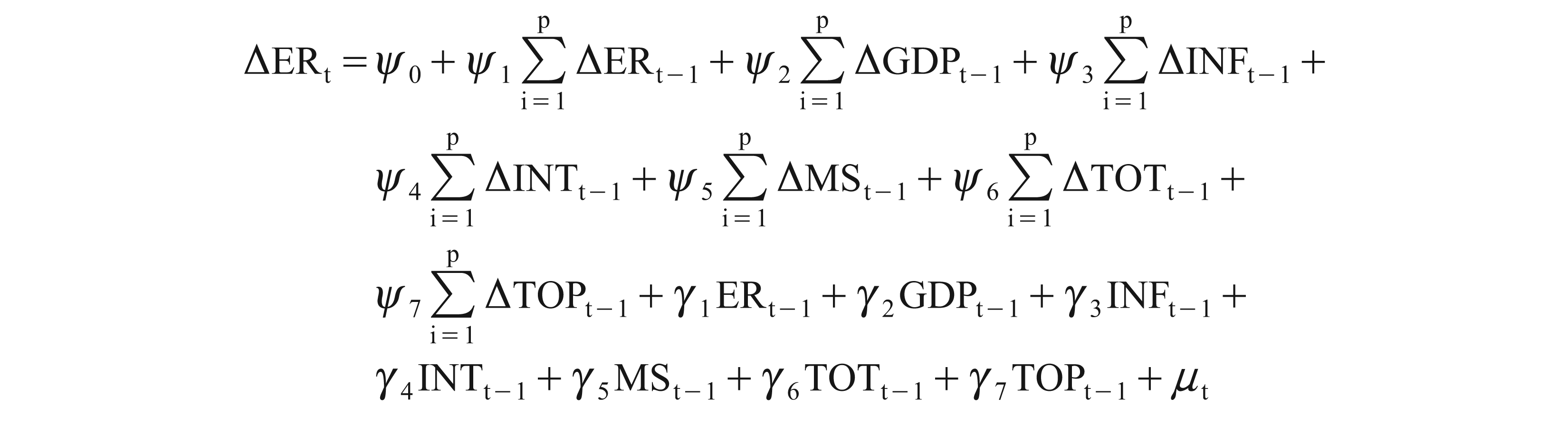
where Ψ0 is a constant and μt is the white noise error term; the error correction dynamics are denoted by the summation sign, while the second part of the equation corresponds to long-run relationship. Schwarz Bayesian criterion (SBC) is used to identify the optimum lag of the model. In the ARDL model, we first estimate the F-statistics value by using the appropriate ARDL models. Second, the Wald (F-statistics) test is used to investigate the long-run relationship between the series. The null hypothesis of no co-integration is rejected if the calculated F-test statistics exceeds the upper critical bound (UCB) value. The results are said to be inconclusive if the F-test statistics falls between the upper and lower critical bound. Finally, the null hypothesis of no co-integration is accepted if the F-statistics is below the lower critical bound. If the long-run relationship between the determinants of exchange rate is found, then we estimate the long-run coefficients. The following model will be used to estimate the long-run coefficients:
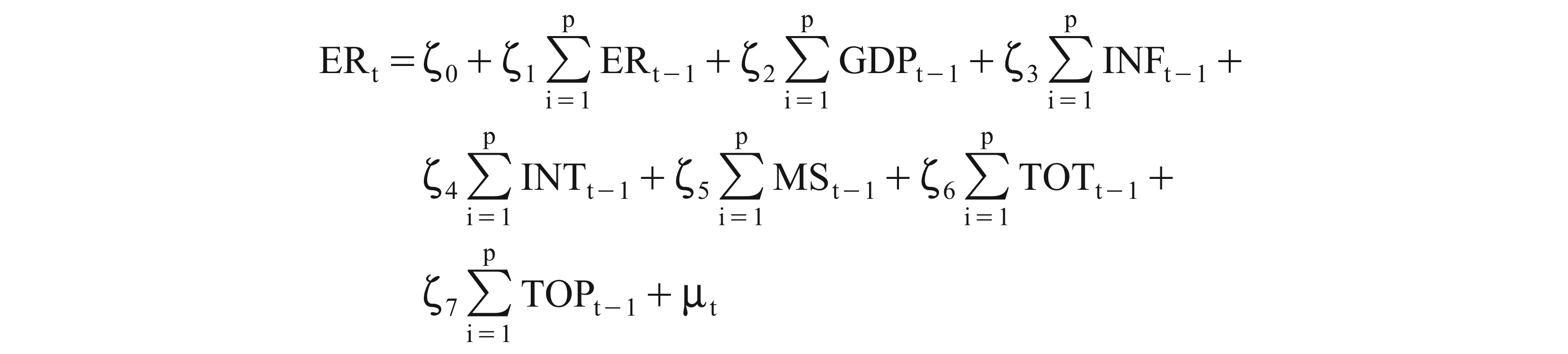
If we find evidence of long-run relationship between the determinants of exchange rate in Pakistan, then we estimate the short-run coefficients by employing the following model:
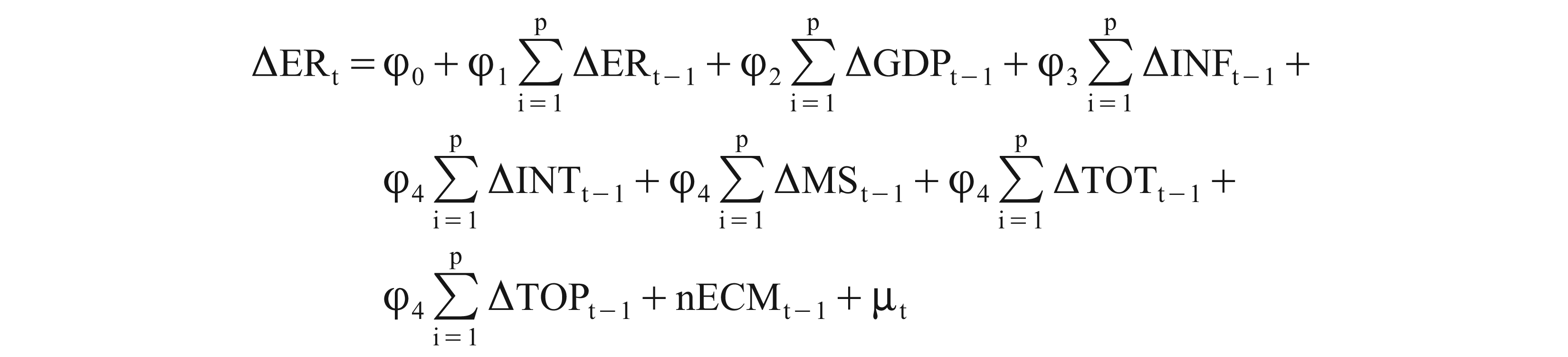
The error correction model shows the speed of adjustment needed to restore the long-run equilibrium following a short-run shock. n is the coefficient of error correction term in the model that indicates the speed of adjustment.
J.J. co-integration (Johansen & Juselius 1990) technique is also used to analyze the existence of long-run relationship between the determinants of exchange rate in Pakistan. The J.J. co-integration test is based on λtrace and λmax statistics. First ‘trace test’ co-integration rank r is as follows:

Second, λmax, that is, the maximum number of co-integrating vectors against being + 1 is presented in the following way:

The null hypothesis of the J.J. co-integration is that there is no long-run co-integration among the variables. If the null hypothesis is rejected, it means there is a significant long-run relationship among the series of variables and vice versa.
In the literature, some conflicting evidence is available against the J.J. and ARDL co-integration methods. Researchers argue that these co-integration approaches failed to provide any information about the structural breaks stemming in the series and may provide doubtful results of long-run relationship among the considered variables. Therefore, to ascertain the results of long-run relationship, we also use Gregory and Hansen (1996) structural break co-integration approach to identify the structural breaks in the series.
Long-run Stability and Elasticity
In this study, we use four different estimation approaches to analyze the long-run coefficients and stability of model to ascertain the robustness of the long-run relationship between the determinants of exchange rate in Pakistan. First by using the ARDL-based coefficient method, second by using FMOLS method, third by using DOLS method and fourth by using rolling window analysis procedure.
Causal Relationship
We have applied Granger causality estimation procedure to analyze the causal relationship between the determinants of exchange rate in Pakistan to ascertain the direction of the causal relationship among the considered variables. This ensures that our conclusions regarding the causal relationship of considered variables are accurate and more reliable as compared to past studies.
Estimations and Results
To check the stationary properties, we use ADF and PP unit root tests. Table 1 represents the results of stationary tests. First, these tests are applied on level of variables than on their first difference.
The results of Table 1 show that all variables are stationary and integrated at first difference in both tests of unit root. This implies that there is no issue of unit root, and the series of variables may be used for further long-run estimations. In past studies, some researchers argue that ADF and PP unit root tests provide misleading results due to their low size and power. These tests also failed to provide any information about the structural breaks stemming in the series. Therefore, to ascertain the results of unit root properties we also use Zivot and Andrews (1992) structural break unit root test to identify the structural breaks in the series. Table 2 represents the results of Zivot and Andrews structural break unit root test.
Stationary Test Results

The results of Table 2 show that all variables are non-stationary at level with intercept and trend but variables are found to be stationary at the first difference. This confirms that series of all variables are co-integrated at I(1). Results of all three unit root tests confirm the robustness of results that all variables are co-integrated at I(1) and we can use these series for further long-run estimation procedures.
Zivot–Andrews Structural Break Trended Unit Root Test

The ARDL method for co-integration is used to estimate the long-run relationship of considered independent variables with exchange rate in Pakistan. The first step is to determine the optimal lag length of the variables. The order of optimal lag length is decided by using the SBC. Table 3 shows the results of the ARDL co-integration method.
Lag Length Selection and Bound Testing for Co–integration

Co-integration Test Results of Exchange Rate Model

The ARDL results suggest the rejection of null hypothesis of no co-integration in the model because the value of the F- statistics is greater than the upper bound critical value at 1 per cent level of significance in favour of alternative hypothesis that the valid long-run relationship exists among the considered variables in Pakistan.
The J.J. co-integration method is also used to estimate the long-run relationship. The J.J. co-integration method is preferred over the Engle–Granger co-integration method. One of the shortcomings of literature’s well-used Engle–Granger single equation-based co-integration is seen in the cases when there are more than two research variables in the study. The provision for multivariate framework in J.J. co-integration allows us to work out more than one co-integrating vectors in the model. Table 4 represents the calculated and critical values of trace statistics and maximum eigenvalue statistics of J.J. co-integration method. Results indicate the rejection of null hypothesis of no co-integration in the model at significance level of 5 per cent in favour of alternative hypothesis that is the existence of one or more co-integrating vectors. The findings confirm the existence of long-run relationship between exchange rate and the predictors of the study.
In past studies, some researchers argue that ARDL and J.J. co-integration methods provide doubtful and misleading results due to the presence of structural break in a series. Therefore, to ascertain the results of long-run relationship, we also use Gregory and Hansen (1996) structural break co-integration approach. Table 5 represents the results of Gregory and Hansen co-integration approach. Results again confirm the valid long-run relationship among variables. Results of all three co-integration tests confirm the robustness of results that valid long-run relationship exists among considered variables. After having the valid evidence of long-run relationship between exchange rate and predictors of this study, we now estimate the long-run and short-run coefficients.
Gregory–Hansen Structural Break Co-integration Test

Table 6 shows the results of long-run estimations. Results of Table 5 show the negative impact of GDP on the exchange rate of Pakistan. The results are consistent with the findings of Mirchandani (2013) and are logical since increase in domestic production reflects that the manufacturers are getting their anticipated revenues which will generate the demand for the domestic currency and appraises it against the foreign currency (Bleaney, 1996). Likewise, long-run coefficients of terms of trade and trade openness are also statistically significant to determine exchange rates with the expected negative sign in Pakistani scenario. The trend of Pakistan’s trade is highly influenced by rising import values. This results in prominent contribution of imports in country’s trade openness and low ratios of terms of trade where exports are inadequate to finance imports. Exports of Pakistan are mostly comprised of primary commodities, whereas imports encompass necessary commodities such as oil and petroleum goods. In the last 10 years, petroleum products constitute 25 per cent of the total imports in Pakistan. The consistent rise in oil prices worsen the situation and resulted in increased demand of dollar and appreciation in exchange rates. The results are also consistent with Algieri (2011) and Ahmed (2009).
On the other hand, money supply and inflation have significant positive relationship with exchange rates in the long run. There exists a continuous increasing trend of money supply in Pakistan. Excess supply of money cuts down the interest rate by making money easy and cheaper to acquire. This creates devaluation of home currency. Also ample supply of money causes the availability of funds in the market to buy goods and services. To meet this additional demand, manufacturers employ more workers and end up with increased cost of production. The scenario pushes the prices to go up, decreases the global competitiveness of Pakistan and results in devaluation of home currency (Bleaney & Fielding, 2002).
Historically viewed, Pakistan’s experience in inflation rate over the last 25 years can be expressed in three distinctive phases. Inflation was at double digit in the first 7 years during 1990s. In the next 10 years from 1997 to 2007, inflation was contained to single digit in the range of 3–9 per cent. However, it remained very volatile during 2008–2012 and remained almost at double digit with varying magnitudes. The weight of foods and cereal items in the consumer price index of Pakistan remained around 40–55 per cent. The major portion of inflation is also coming from the foods and cereal items. Much of the reason for high CPI has to do with poor monsoon planning and inefficient structure of supply chain management in Pakistan. These findings are also consistent with Wilson (2009), Khan and Qayyum (2011) and Khattak et al. (2012). It is concluded that the GDP, terms of trade, trade openness, inflation and money supply are the important factors to dictate the changes in the pattern of official exchange rate of Pakistan. Interest rates show the negative bus insignificant impact on the exchange rates of Pakistan.
The ARDL-based error correction model (ECM) has been used to analyze the short-run relationship among the considered variables. Table 7 represents the results of the error correction model. Results indicate that the lagged error correction term for the estimated exchange rate equation is both negative and statistically significant. This confirms a valid short-run relationship between exchange rate and the predictors of this study in Pakistan. The coefficient of the error term showing the value of –0.297 suggests that about 30 per cent of disequilibrium is corrected in the current year. Results also indicate the negative and significant effect of terms of trade and trade openness on exchange rate in short run as well, while the results of GDP, inflation, money supply and interest rate are found insignificant in short runs.
Long–term Determinants of Exchange Rate

Results of the Error Correction Model of Exchange Rate

Sensitivity Analysis of Long-run Coefficients
In this section, to check the robustness of initial results of long-run coefficients, two different sensitivity analyses have been performed, namely, DOLS and FMOLS.
Dynamic Ordinary Least Square
The robustness of the relationship between dependent variable and explanatory variables is first tested through DOLS technique developed by Stock and Watson (1993). The estimation properties of DOLS are different from simple OLS in many ways as this method involves estimating the dependent variable on explanatory variable using the levels, leads and lags of the explanatory variable. This method resolves the issues of small sample bias, endogeneity and serial correlation problems by adding the leads and lags of the explanatory variable (Stock & Watson, 1993).
Table 8 represents the results of dynamic ordinary least square of the exchange rate model. We have run our model of DOLS by taking a lead and lag of 1. Results confirm that the coefficients of all determinants remain the same sign and significance after taking different lags and leads in the exchange rate model.
Fully Modified Ordinary Least Square (FMOLS)
The FMOLS technique developed by Phillips and Hansen (1990) is also used to analyze the robustness of our initial results of ARDL-based coefficients models. The FMOLS provides the optimal estimates of the co-integration equation (Bum & Jeon, 2005). The FMOLS modifies the OLS to control the problems of serial correlation and endogeneity in the regressors that results from the existence of a co-integrating relationship (see Hansen, 1995; Phillips & Loretan, 1991). The results of the FMOLS of the exchange rate model are also presented in Table 8. Results of the FMOLS confirm that the coefficients of all determinants remain the same sign and significance as in the ARDL-based coefficients model.
Results of Sensitivity Analysis

Results of both sensitivity analyses show that the coefficient of all the considered variables has remain the same sign and significance even the magnitude is also almost the same as in the ARDL-based coefficient model. These findings confirm that the initial results are robust.
Stability of Long-run Model: A Rolling Window Analysis
The stability of coefficients of the long-run model in the sample size is evaluated by using the rolling window estimation method. Figures 1–6 and Table 9 represent the coefficients of each year of all the considered explanatory variables by using the rolling window estimation method. Two standard deviation bands show the upper and lower bounds.
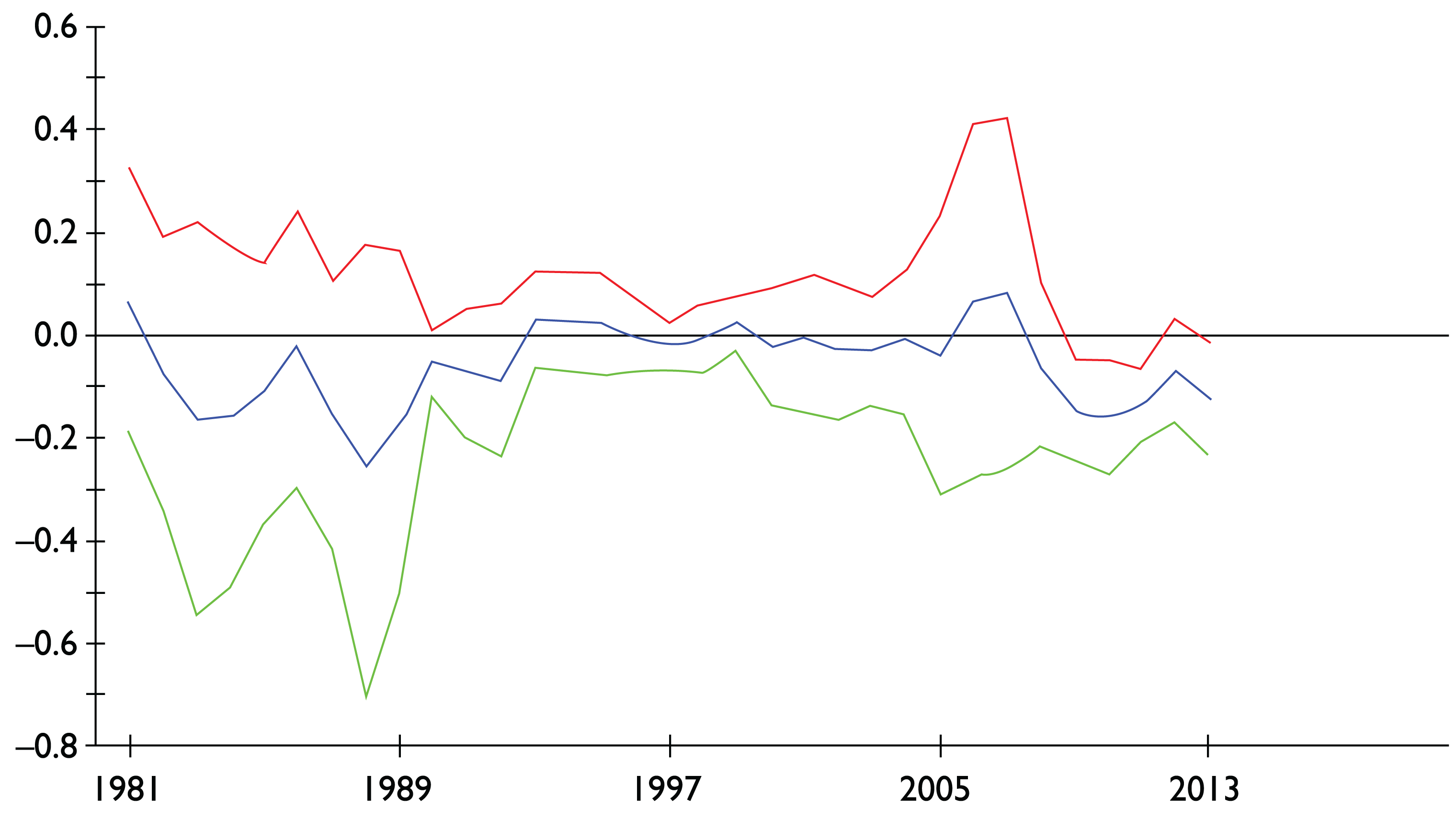
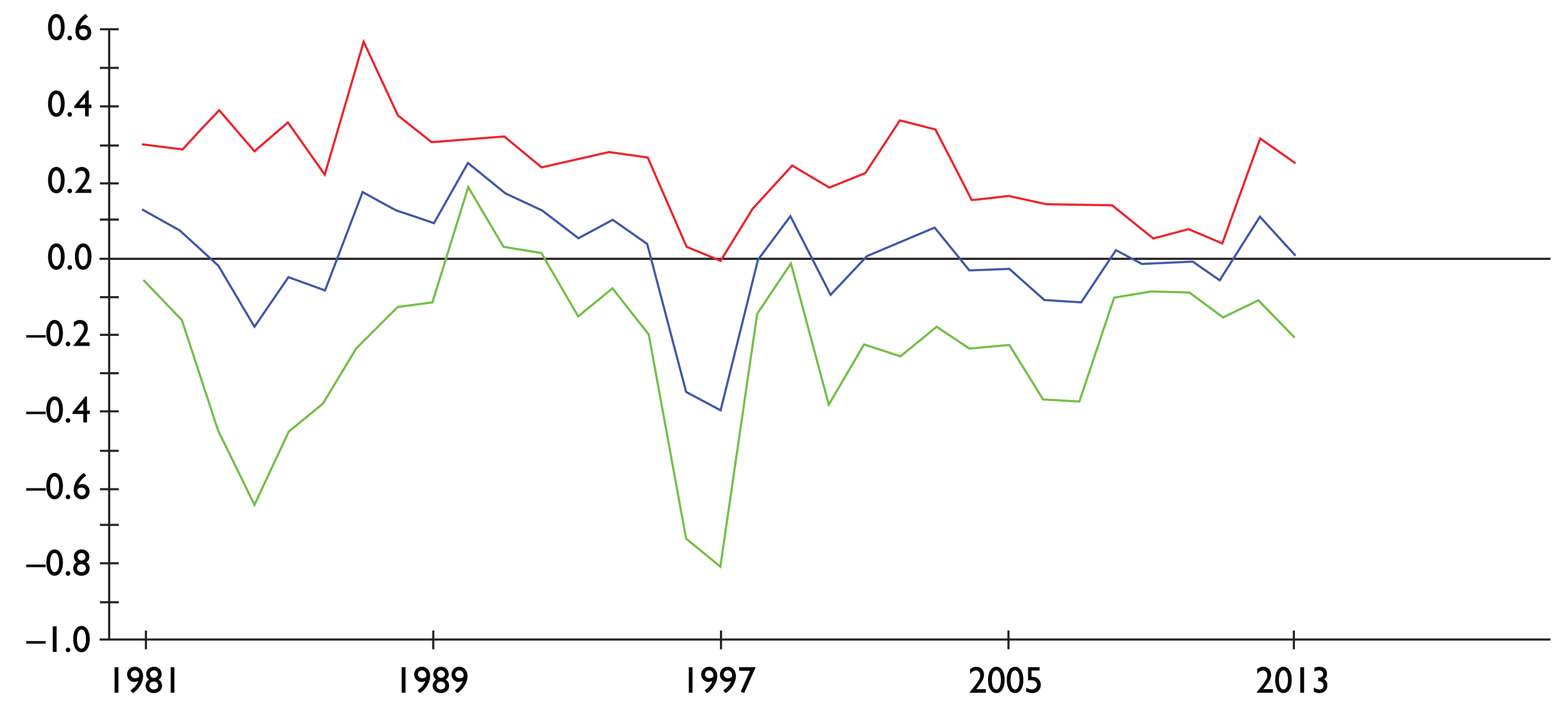
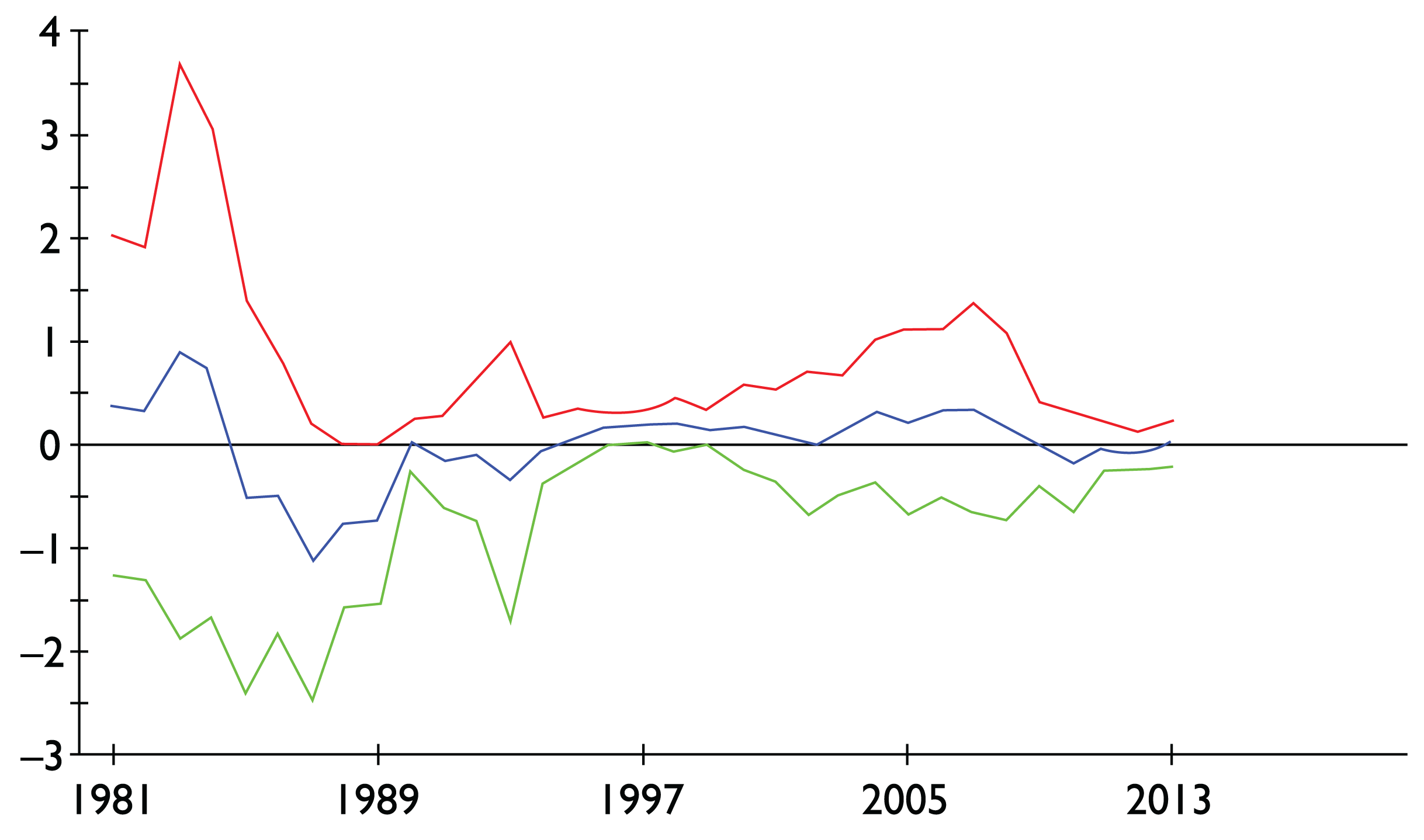
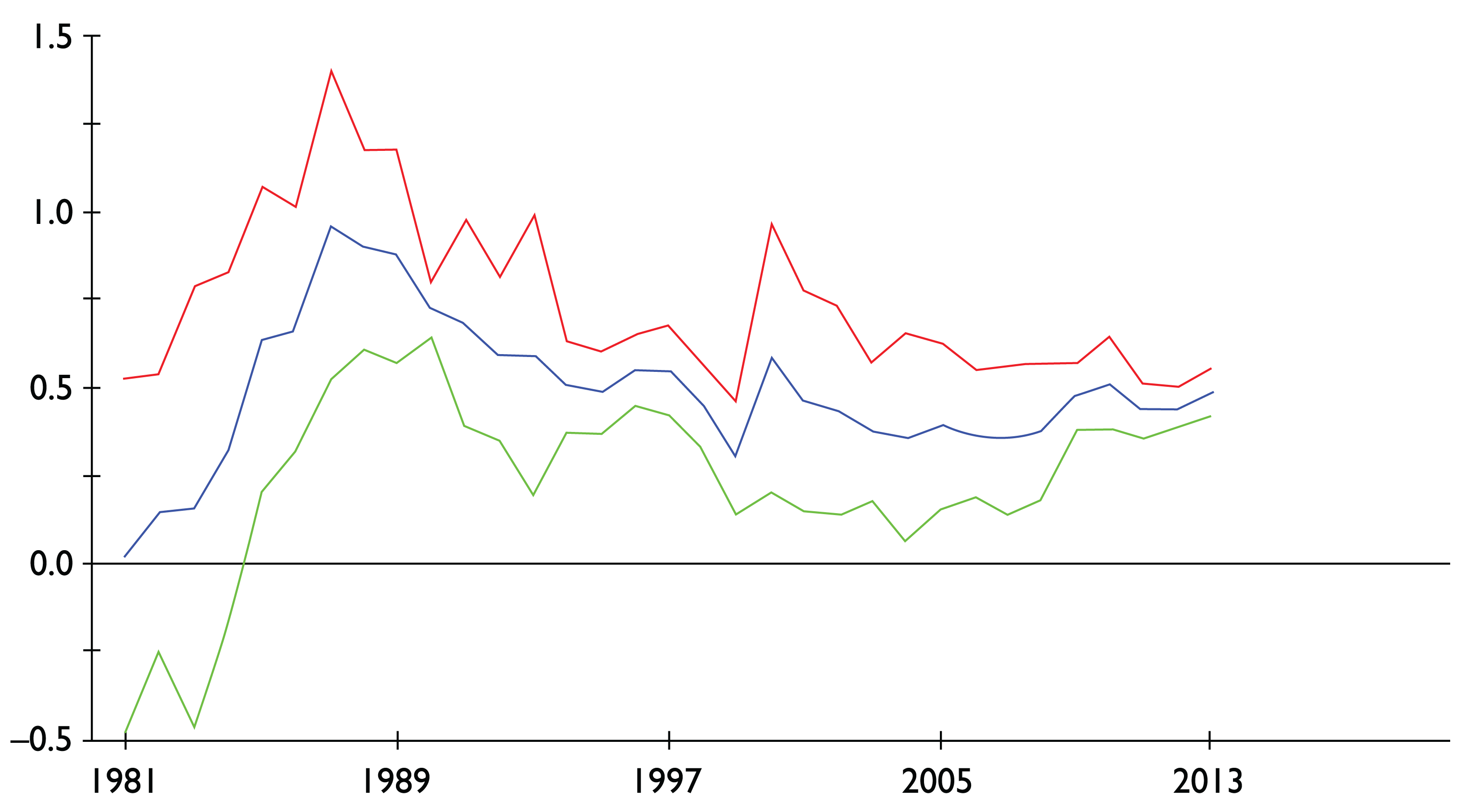
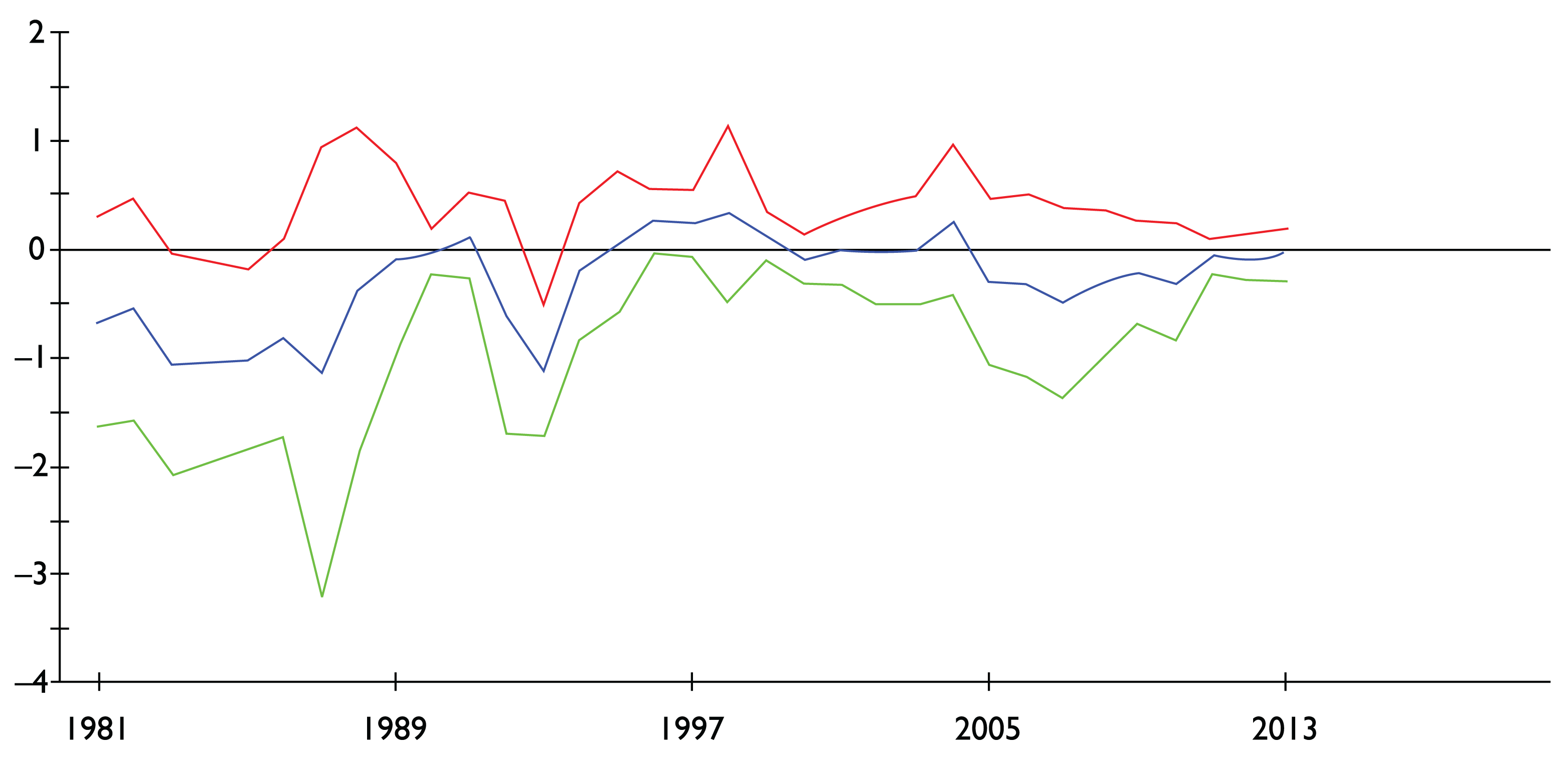
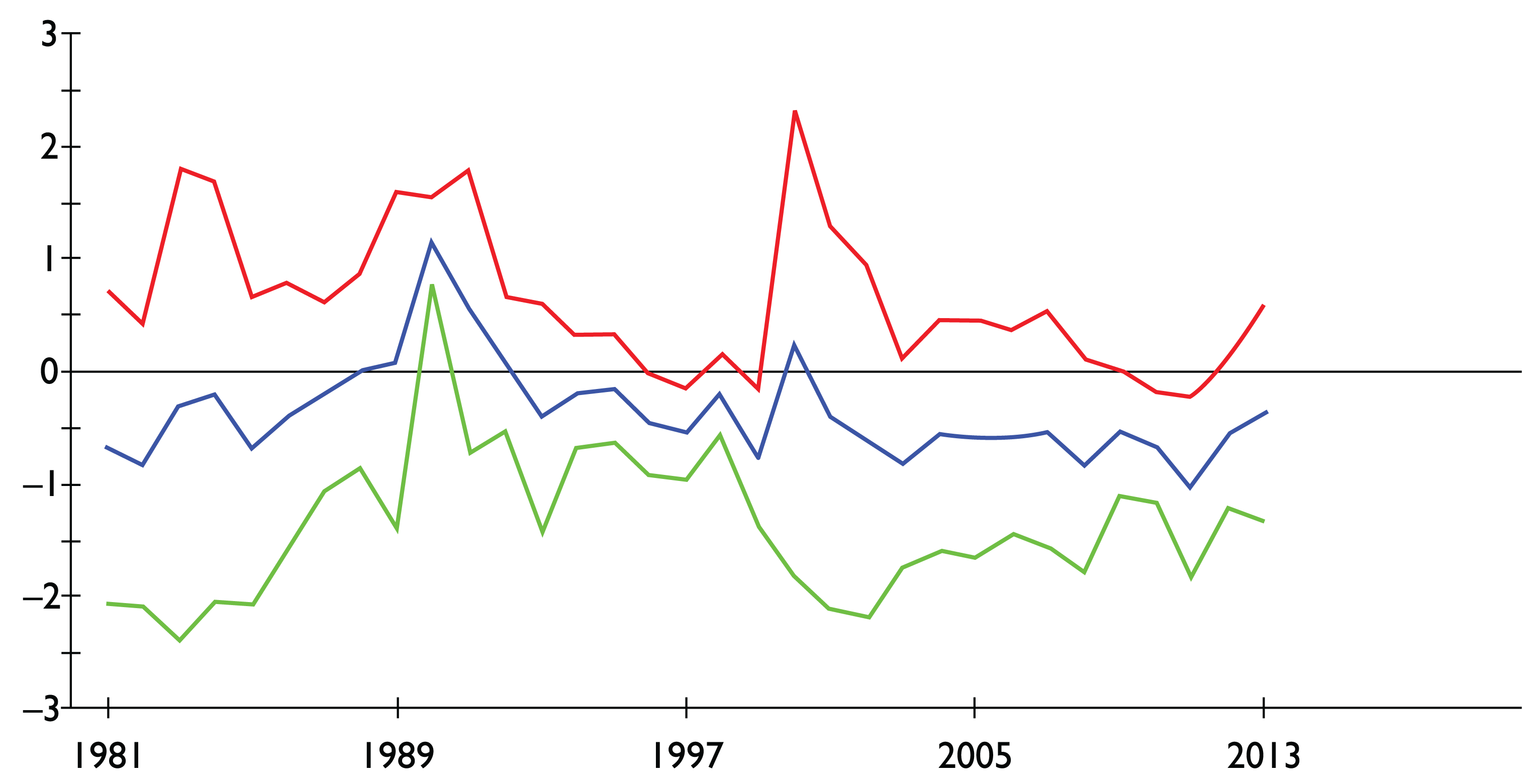
Results suggest that GDP is having a positive coefficient in only 7 years, that is, 1981, 1993, 1994, 1995, 1999, 2006 and 2007. The negative coefficient has come in 26 years which significantly influence the overall negative effect of economic growth on exchange rate in Pakistan. Results also suggest that the impact of money supply on exchange rate remained positive throughout the complete sample from 1981 to 2013. Results also suggest that the impact of trade openness on exchange rate remained positive throughout the sample apart from the years of 1989–1992 and 2000.
The outcome of the rolling window estimation method indicates the very mix effects of inflation on the exchange rate of Pakistan. Results suggest the negative impact of inflation on exchange rate in 15 years out of the total 33 years, while in 18 years, the coefficients are found to be positive which significantly influence the overall positive effect of inflation on exchange rate in Pakistan. Results suggest that terms of trade is having a positive coefficient in only 7 years, that is, 1991, 1995–1999 and 2004. The negative coefficient has come in 26 years which significantly influence the overall negative effect of terms of trade on exchange rate in Pakistan.
Long-run Coefficients

Stability of the Long-run Model
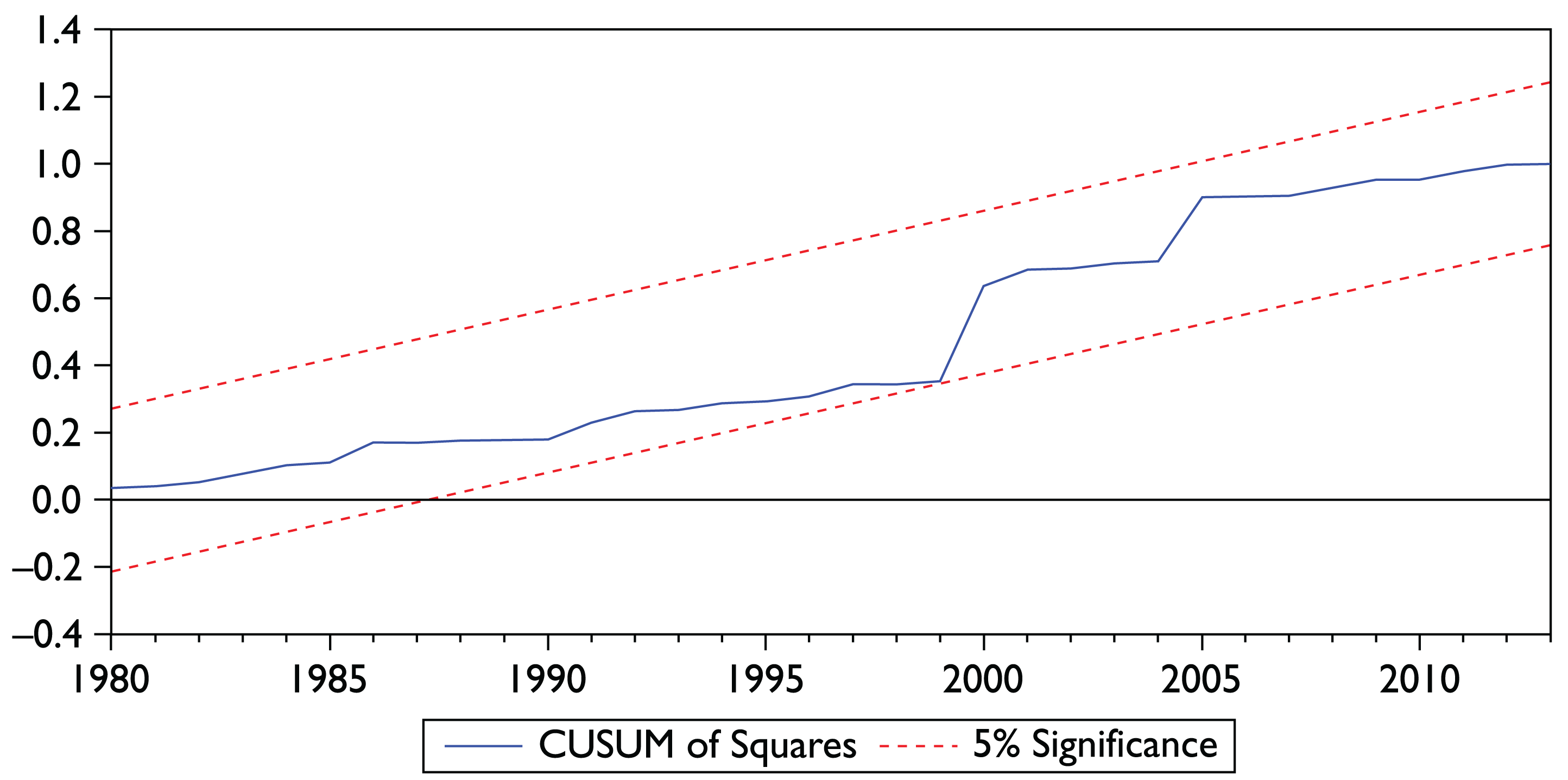
The evaluation of the stability of coefficient of the long-run model in the sample period is performed by CUSUM and CUSUM of square test on recursive residuals. The systematic changes from the coefficient of regression are detected using the CUSUM test, whereas the sudden changes from constancy of regression coefficients are detected using the CUSUM of square test (Brown, Durbin, & Ewans, 1975).
The findings from Figures 7 and 8 indicate that both CUSUM and CUSUM of square tests lie within the interval band at the level of significance of 5 per cent. This implies the absence of structural instability in the residuals of the exchange rate model in the short run.

Causality Analysis
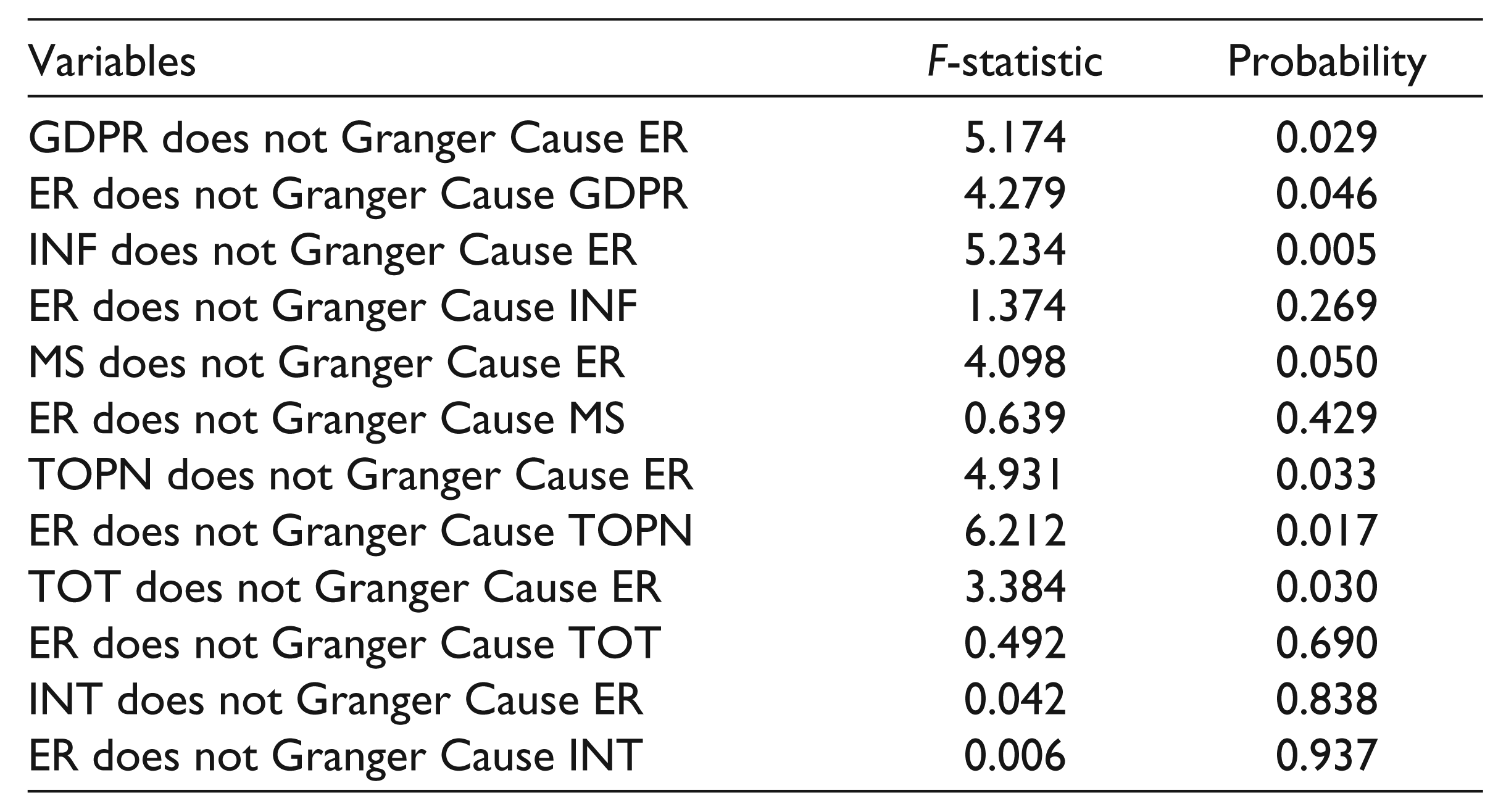
Granger (1969) causality test is a famous statistical approach to check the direction of causality between dependent and independent variables. The analysis of causality in the studied exchange rate model has been performed on lag one. In order to determine the optimal lag, Jones (1989) prefers the ad hoc selection method for lag length in Granger causality over other methods of estimations.
The findings of Granger causality presented in Table 10 have disclosed the presence of a bidirectional causal relationship of exchange rate with economic growth and trade openness in Pakistan. However, the inflation, money supply and terms of trade possess the unidirectional causality which runs from explanatory variable to exchange rate of the country.
Results of Granger Causality Test of Exchange Rate Model
Conclusion and Policy Implications
This study examines the determinants of exchange rate in Pakistan by using the time-series data from 1972 to 2013. The results of ARDL bound testing co-integration approach, J.J. co-integration approach and Gregory and Hansen (1996) structural break co-integration approach confirm the significant long-run relationship among the considered variables. The estimations of long run indicate the significant negative association of exchange rates with terms of trade, trade openness and economic growth. However, money supply and inflation rate have a positive and significant effect on exchange rates. The outcomes of the error correction model suggest a negative and significant relationship of terms of trade and trade openness on exchange rates of Pakistan in short run. However, all other variables are found insignificant in the short run. Results of sensitivity analysis through DOLS and FMOLS approaches also confirm the results of long run which proves that the initial results are robust.
Results of the rolling window estimation method and CUSUM and CUSUM-Q also show the stability of coefficients in long run as well as in short run. The Granger causality test confirms the presence of a bidirectional causal relationship of exchange rate with economic growth and trade openness in Pakistan. However, the inflation, money supply and terms of trade possess the unidirectional causality which runs from explanatory variable to exchange rate of the country.
In light of the above investigation, following policy implications are suggested. This study calls for the need to have an anti-inflationary plan since the empirical results indicated the strong positive correlation of inflation and money supply with exchange rate of Pakistan. Attempts to decrease the inflation level by stressing strict monetary measures supplemented by tight management of capital inflows will ultimately prevent appreciation of exchange rates. Capital inflows can be restricted by having credit controls. State Bank of Pakistan can accomplish it by selling government bonds or treasury securities in the open market. Selling bonds to public, financial institutions and commercial banks will help in withdrawing large amount of capital from vaults and restrain the currency from circulation.
In order to curb inflation and limiting money supply, State Bank of Pakistan can also increase the reserve requirements to restrict banks’ ability to create credit. If the percentage of deposits which a commercial bank is required to hold is raised, the banks have to hold that amount and thus that money cannot be circulated. In Pakistani scenario, the need to decline real consumption patterns especially in foreign goods sector would be fruitful. Restricted import values resulted by increased tariff and duties can improve terms of trade ratios. However, this should be accompanied by emphasis on the improvement of domestic goods industries. Since the present situation of infrastructure of the country is inadequate to instigate the advancement of domestic industry, improvement in power supply, transportation and communication and law and order situation will motivate the confidence of investors and bring prosperity in domestic production.
Emphasis on export is also required to boost trade liberalization and terms of trade ratios. In order to increase the contribution of exports in openness of the economy, there is a need to compete in global market with strengths of a country. Pakistan is a labour-intensive country. There is a need of priority for the production and export of labour demanding products such as textile. This will boost export and encourage reinvestment. Diversification is also a way to have prosperity in the domestic sector. The utilization of export revenues enables diversification by reinvestments in widespread sectors. Diversifying the industries in this way would result in making Pakistani economy less vulnerable to exogenous shocks. In addition, much of the success of monetary policy is dependent on how much government budget deficit is under control. Open market operation will not help if government does not follow fiscal prudence. Therefore, government should manage their revenue and expenses in the most efficient manner. The revenues should increase by enhancing the new investment opportunities in the country. Similarly, the government expenses should be utilized on profitable ventures.
The present research has witnessed the contribution of monetary and fiscal variables to determine exchange rates of Pakistan. A lot of plans and policies have been made to stop the increasing trend of exchange rates but the government has failed to bring depreciation in it. Inconsistency in policies is the major drawback for such a weak valuation of local currency in Pakistan. The shifts of preferences from the change of governments have led to nullify the effect of prior effective policies. The general awareness emphasizing long-term consistency in policies is required to get productive results. The present study may guide policymakers in formulating conclusive monetary and fiscal policies to ascertain the less volatile and productive exchange rate for Pakistan to get sustainable economic growth for a long span of time.
Footnotes
Acknowledgements
The authors are grateful to the anonymous referees of the journal for their extremely useful suggestions to improve the quality of the article. Usual disclaimers apply.