



Abstract
Very few studies have attempted to examine the relationship between international trade and human development. Some panel and cross-section studies have been done, but mostly Pakistan has not been included. This study examines for the first time ever the effect of aggregate and disaggregate trade on human development in Pakistan by using annual time series data from 1980 to 2013. This study contains five models in which human development with (a) total trade, (b) aggregate exports, (c) aggregate imports, (d) exports of primary commodities, semi-manufactured goods and manufactured goods and (e) imports of consumer goods, imports of capital goods, industrial raw material of consumer goods and industrial raw material for capital goods is considered. Cointegration test has been applied to check the long-run relationship between human development and trade. Sensitivity analysis confirms that initial results are robust. Causality analysis has also been done for the causal relationship between international trade and human development.
Introduction
There exists a complex relationship between trade and human development. 1 Literature states that trade can play a dominant role for enhancing economic growth but it is not enough for human development. Amplifying the opportunities particularly for poor people is also required for human development. Through international trade, any economy can enjoy market expansion, technological transfer, employment opportunities and information sharing; thus, it creates different prospects for economic growth and human development. However, international trade does not confirm human development. Even trade cannot ratify economic growth, and even its positive and neutral effect on growth is highly dependent on a country’s institutional and social conditions.
Side by side, economic growth is necessary but insufficient condition for human development. Growth can be jobless, ruthless, voiceless, rootless and futureless rather than job creating, poverty reducing, participatory, culturally protected and eco-friendly, respectively. These types of growth are not favourable for human development. 2 The contributions of trade in economic growth and contribution of economic growth in human development encourage us to examine the third side of the triangular relation, that is, human development-trade nexus.
In the previous studies, the impact of trade on human development is mainly examined using cross country or panel data. There are a few time series studies on the subject. Additionally, in cross-country studies, Pakistan is mostly not included. Moreover, this study will examine the effect of aggregate and disaggregate trade on human development in Pakistan.
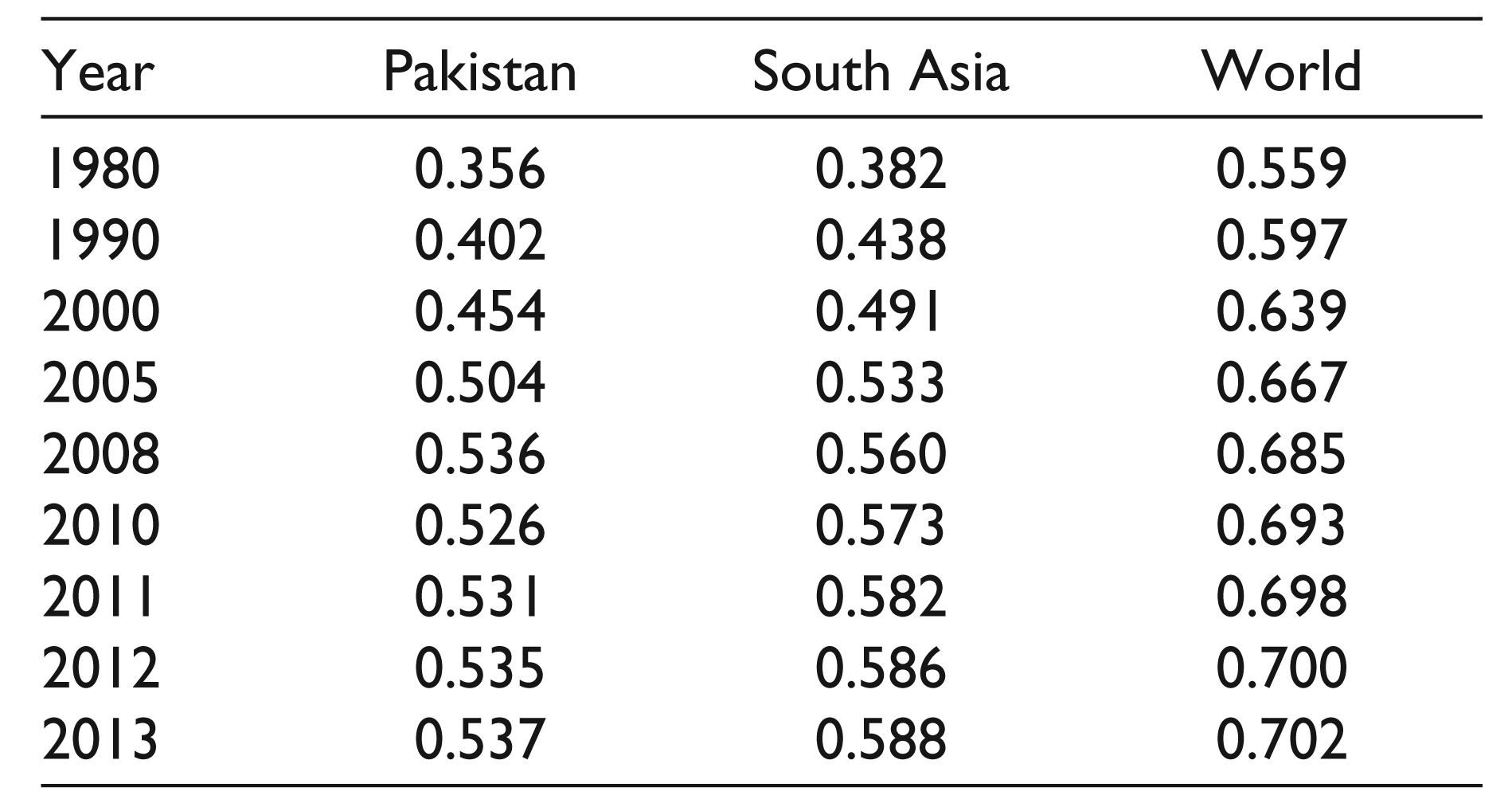
Pakistan is considered in low human development category in Human Development Report 2014 published by United Nations Development Programme (UNDP). Pakistan is at 145 among 187 countries. From Table 1, we can see that from 1980 to 2013, Human Development Index (HDI) is improving continuously in South Asian region and the rest of the world. On the other hand, in Pakistan, HDI has increased from 1980 to 2008. After 2008, HDI has decreased and attain almost the same level in 2013 as in 2008. This movement is unusual relating with South Asian region and the rest of the world. At the time of global financial crises in 2008, the current account balance deteriorated from −0.4 per cent of GDP in 2006 to −0.8 per cent of GDP in 2008 (World Bank, 2010). Drastic energy deficiency with deprived law and order condition on the ground caused severe deterioration in investment. These effects declined country’s terms of trade and aggravated overall macroeconomic balances of the country. Due to global financial crises, there was a significant decline in foreign capital inflows, more hampering domestic investment. Stock prices have also decreased in addition to foreign exchange reserves, triggering the exchange rate depreciation. After this crisis, global demand as well as domestic demand has also decreased causing adverse export demand (Haq, Khan, & Parveen, 2014).
HDI Trend of Pakistan, South Asia and World
Snapshot of Flood Damages and Reconstruction Cost in 2010

Flood damages in 2010 have also effected economic and human development of Pakistan. Table 2 shows the snapshot of these damages. This flood had a drastic impact on people’s home, livelihood and assets (Pakistan Economic Survey, 2011–12, p. 221). These aggravations ultimately affect human development in the country.
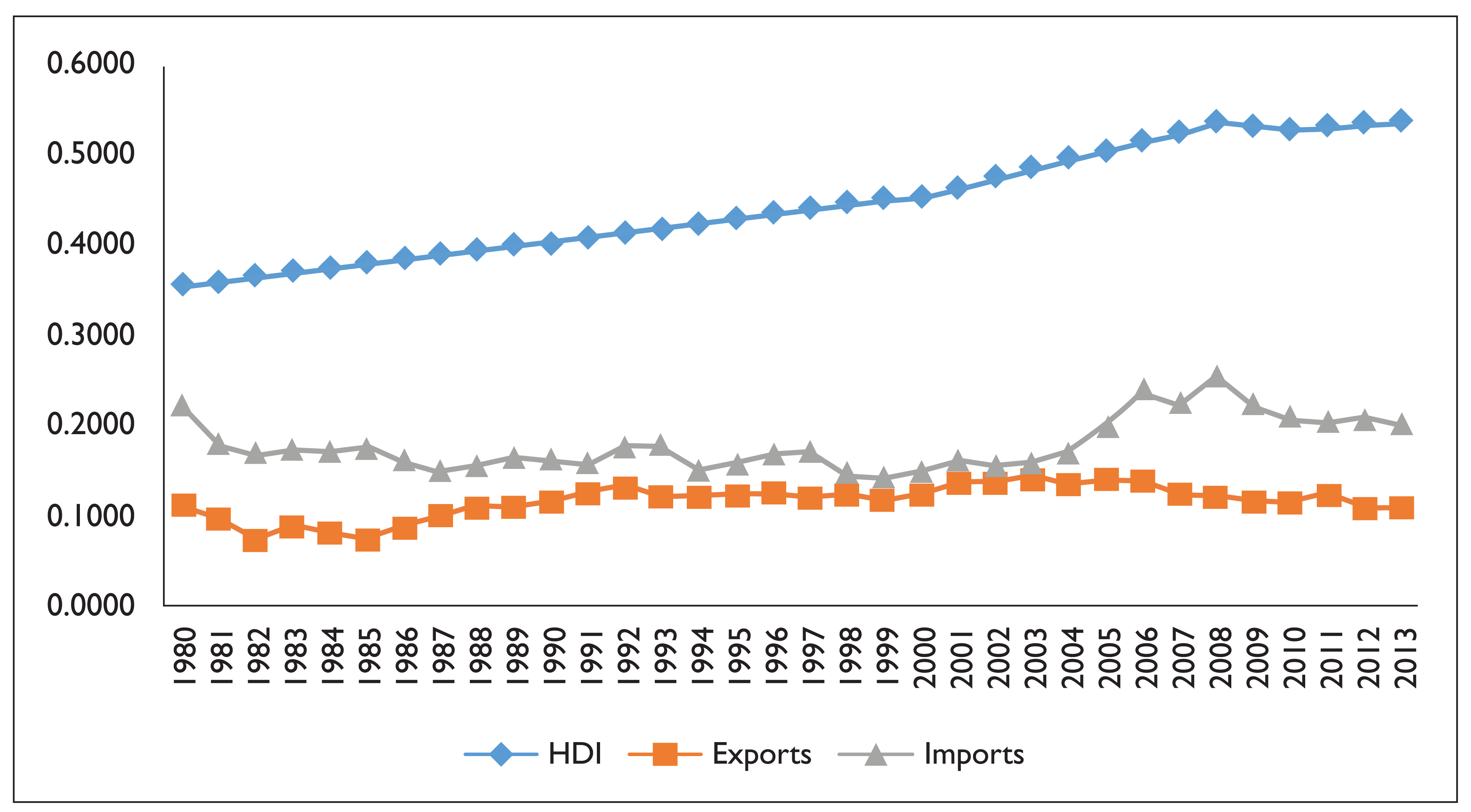
From Figures 1–4, it is clear that with the improving trend of HDI, movement in trade at aggregate as well as disaggregate level is uneven. In all the figures, trade is fluctuating, and in many years, we can see a lot of ups and downs. From above discussion and trend analysis, we are not coming up to a concrete conclusion about the relationship between human development and trade at aggregate as well as disaggregate level in Pakistan. Thus, this study intends to examine the effects of trade on human development in Pakistan using time series data and applying more rigorous econometric techniques.



The rest of the article is organized as follows. Following introduction, reviews of theoretical and empirical literature on the effects of trade on human development have been discussed in the second section. The third section discusses empirical framework of the study. The fourth section represents the model’s estimation and results. In the fifth section, rigorous sensitivity analysis has been performed to check the robustness of the initial findings. The sixth section contains stability analysis of all models. Causality analysis has been applied in the seventh section. Final section concludes the study, provides some policy implications and sets directions for further research.
Review of Literature
In this section, theoretical and some empirical studies have been discussed on the relationship between international trade and human development.
Here, we are going to discuss the conceptual framework between trade and human development presented in Asia Pacific Human Development Report (UNDP, 2006). According to this framework, growth rate and structure of the economy have been changed by trade which leads the employment in the country for both capital and labour. Skilled labour has been rewarded more than unskilled labour by trade. This can cause the adoption of capital intensive technology and consequently increase income inequality. Though, to safeguard the benefits of trade for human development can be done by government policies. Response round from human development to trade also exists which drives directly or is interceded through domestic policy framework. Response round works with the channel of higher income, higher technical competence, skills and authority of policymakers. As a final point, human development can also affect directly the structure of the economy, growth rate and trade.
The channel in which trade affects human development has been discussed above. Some empirical evidences have been discussed. Dollar and Kraay (2004) stated, in the 980s, that bsolute poverty has been weakening with open trade plans in developing countries. Trade openness leads to greater income and is considered as source of expenditure on social protection by the government, unemployment benefits, saving the economy from negative effects in business cycle, health requirement and environmental hazards. Eusufzai (1996) found positive relationship between trade openness and human development including HDI and other measures of human development considered by the UNDP. It also suggested that more open economies have higher level of HDI. Nourzad and Powell (2003) investigate the relationship between openness with economic growth and human development by using 5-year average data of 47 developing countries from 1965 to 1990. They found that trade openness can affect economic growth as well as human development. Adeyemi, et al. (2006) determine the factors affecting human development in 41 countries of Sub-Saharan Africa by using the data of the year 2003. Their cross-country regression analysis suggests negative but insignificant effect of international trade on human development.

Yasmin, et al. (2006) examine the effect of trade liberalization on economic development measured by per capita income, income inequality, poverty and employment by employing the data from 1960 to 2003. Two-stage least square estimation procedure has been used. Trade liberalization has significant positive effect on employment but significant negative effect on per capita income and income inequality. Interestingly, they found insignificant effect of trade liberalization on poverty in Pakistan. Akmal, Ahmad, et al. (2007) examine the effect of trade liberalization on poverty in Pakistan by using time series data from 1973 to 2003. They found negative association of trade liberalization with poverty in long run. Afzal, et al. (2009) examine the relationship between human development, export and economic growth in Pakistan by using annual time series data from 1971 to 2009. Result of autoregressive distributive lag (ARDL) bound testing approach indicates that export does not have significant affect on human development.
Khan and Sattar (2010) examine the causal relationship among trade, growth and poverty in Pakistan. Granger causality test suggests bidirectional causal relationship between trade and growth in long run. On the other hand, in growth poverty relationship, unidirectional causal relationship exists from growth to poverty in long run. They suggest that trade can influence growth and eventually reduction in poverty in Pakistan. Razmi and Yavari (2012) examine the effect of trade openness on human development by using panel data of 11 oil rich countries from 1998 to 2009 and found significant positive effect of trade openness on human development. Hamid and Amin (2013) investigate the relationship between trade and human development by employing panel data of 38 members in Organization of Islamic Council (OIC) countries. The ARDL model suggests significant positive relationship between trade and HDI.
From the above discussion, we observe that the relationship between trade and development (economic development and human development) is mixed. 3 Some studies show positive relationship between trade and human development, and some found insignificant relationship between them. In this study, a pioneer attempt to check the relationship between trade (aggregate and disaggregate level) and human development by using more rigorous econometric techniques.
Empirical Framework
After reviewing previous literatures, the model to find the effect of international trade on human development is derived from the function below:
HDI = f (RGDP, T)
Here HDI is human development index, RGDP is real gross domestic product and the effect of trade on human development is captured through T. In this study, both aggregate and disaggregated trades have been used. The models to estimate the effect of trade at aggregate and disaggregate level on human development in parametric form are defined as follows:





where HDI is human development index used as proxy of human development, 4 RGDP is real gross domestic product at constant prices (see Afzal et al., 2009), TT is total trade (export plus import) as a percentage of GDP, EXP is export as percentage of GDP, IMP is import as percentage of GDP, PE is export of primary commodities as a percentage of GDP, SME is export of semi-manufactured goods as a percentage of GDP, ME is export of manufactured goods as a percentage of GDP, CI is import of consumer goods as a percentage of GDP, CAI is import of capital goods as a percentage of GDP, RCI is import of industrial raw material for consumer goods as a percentage of GDP, RCAI is import of industrial raw material for capital goods as a percentage of GDP and εt, ξt, ζt, δt and ηt are the error terms. All models are estimated by using annual time series data from 1980 to 2013. All data are obtained from official website of the World Bank, various issues of human development report published by the UNDP and Pakistan Economic Survey (various issues).
Estimation and Results
For initial stationary analysis, augmented Dickey–Fuller (ADF; Dickey & Fuller, 1979) unit root test has been applied to check the stationary properties for long-run relationship of all variables of models 1–5. The ADF test has been applied on both level and first difference. Results of unit root tests are reported in Table 3.
From Table 3, it is confirmed that all variables are non-stationary at level and stationary at first difference. This implies that combination of one or more series may reveal long-run relationship in all considered models.
Stationary Test Results

Johansen and Juselius’ (1990) cointegration method has been applied to check the long-run relationship in all models. Two test statistics, namely trace statistics and maximum eigenvalue statistics, have been derived for cointegration. Results of both statistics in Table 4 show the rejection of null hypothesis of no cointegration in all models at 5 per cent level of significance. Thus, it is concluded that there exists long-run relationship of human development and trade in all models.
Johansan and Juselius Cointegration Test Results

For robustness of results of cointegration, ARDL method has also been applied to confirm long-run relationship in all models. The ARDL method for cointegration has been used by Pesaran and Pesaran (1997), Pesaran and Shin (1999) and Pesaran, Shin and Smith (2000, 2001) with the help of unrestricted vector error correction model. The ARDL method for cointegration has several benefits on other cointegration methods. 5 For the selection of optimum lag length, Schwarz Bayesian criteria (SBC) has been used. 6 From Table 5, results of ARDL cointegration also indicate that the long-run relationship exists in all models. Therefore, our findings of cointegration are not sensitive with the method of cointegration. 7
Lag Length Selection and ARDL Approach of Cointegration

From Table 6, it is clear that TT, EXP, IMP, PE, ME, CAI, RCI and RCAI have significant positive effect on human development in Pakistan. 8 The coefficient of TT is the highest among all coefficient. Most interestingly, the coefficient of IMP is greater than that of EXP which shows the imports (which is also used in exports and other domestic production) is more beneficial than exports. On the other hand, SME and CI have significant negative effect on human development in Pakistan.
Long-run Determinants of Human Development
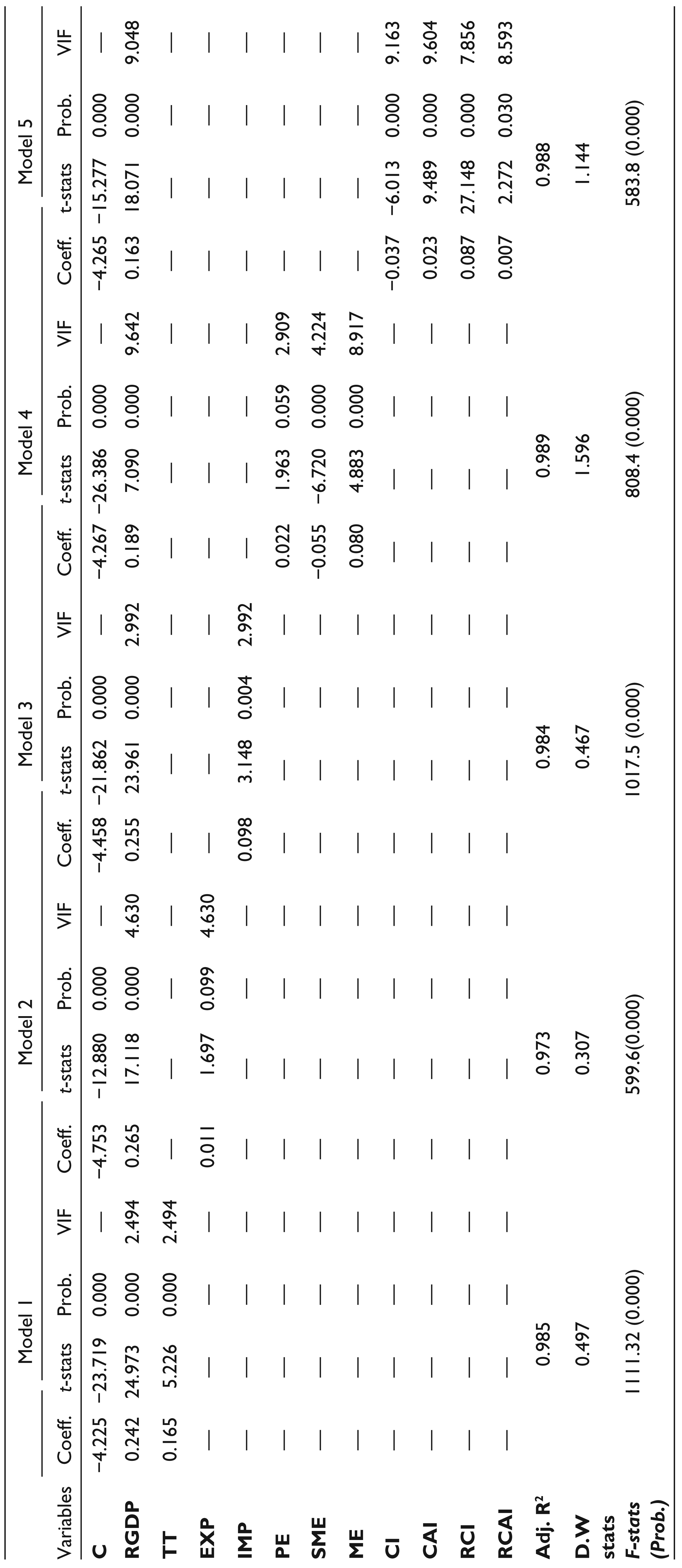
The negative effect of CI is logical because imports of consumer goods discourage domestic producers to produce these goods. If these imports are from a developed country, they have high technology and enjoy economies of scale than domestic producers. In this case, domestic producer will not be able to compete and shut down from the market. This shut down creates unemployment in the country which leads to increase poverty and decrease in human development in Pakistan. Side by side, the negative effect of SME is unexpected. The possible reason of negative effect is export of semi-manufactured goods have low price in international market. At the same time, price of imports of finish goods which are the extended form of export of semi-manufactured goods are very high in international market. This explains monetary outflow is greater than monetary inflow. This will lead to more expenditures of country than income. Thus, human development can decrease in the country. 9
Test for Robustness
Sensitivity analysis has been performed to check the robustness of initial results. This has been done with the help of fully modified ordinary least square (FMOLS) estimation. The FMOLS was developed by Phillips and Hansen (1990). This technique provides the optimal estimates of the cointegration equation (see An & Jeon, 2006). The FMOLS modifies the OLS to control the problems of serial correlation and endogeneity in the regressors (see Hansen, 1995; Phillips & Hansen, 1990). Results of FMOLS have been reported in Table 7.
Robustness of Long-run Coefficients by FMOLS

Results of FMOLS estimation confirm that the coefficient in all models has same sign and significance. Thus, it is clinched that the relationship between human development and trade in Pakistan is robust with initial result.
Stability Analysis
To check the stability of coefficient over the sample period, cumulative sum (CUSUM) and cumulative sum of square (CUSUMQ) tests have been applied. Brown, Durbin and Ewans (1975) stated that systematic change in coefficient of regression is detected by CUSUM test and sudden (unexpected) change in constancy of regression is detected by CUSUMQ test. The CUSUM and CUSUMQ tests have been applied in all models. Results are shown in Figures 6–15.


Figures 6–15 indicate that CUSUM and CUSUMQ statistics do not lie within the interval band of 5 per cent. This shows that parameters are instable and structural break exists in the economy. Chow breakpoint test has been applied to confirm the structural break in the country. Results are reported in Table 8.
From above results, existence of structural break has been confirmed and can be linked with the nuclear explosion of Pakistan in 1998. After the nuclear tests, Pakistan has faced number of sanctions internationally. Chow tests also confirmed the structural break in link with 9/11 in the USA. These two events are considered as major incidents that affected Pakistan’s economy.
Causality Analysis
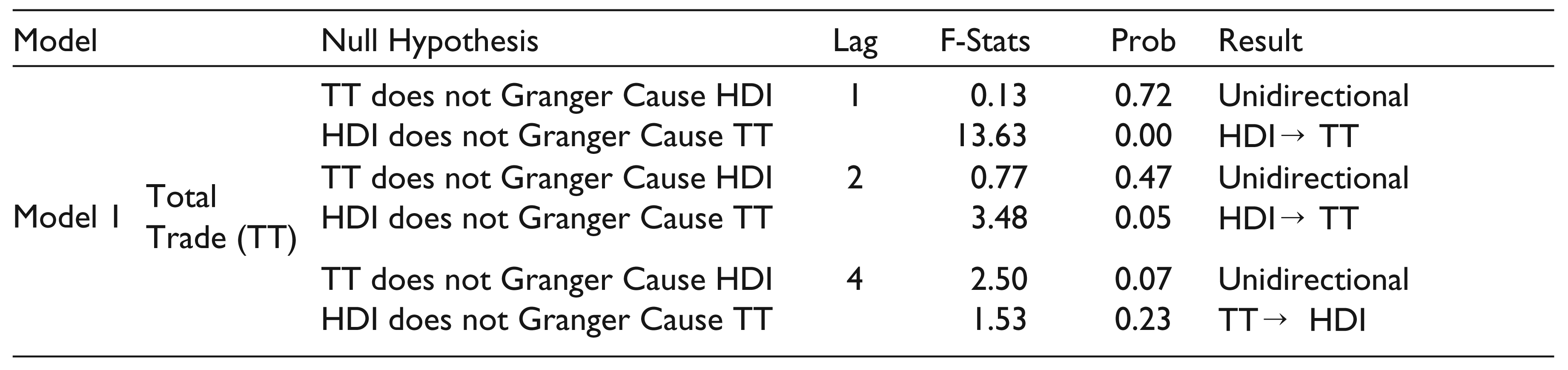
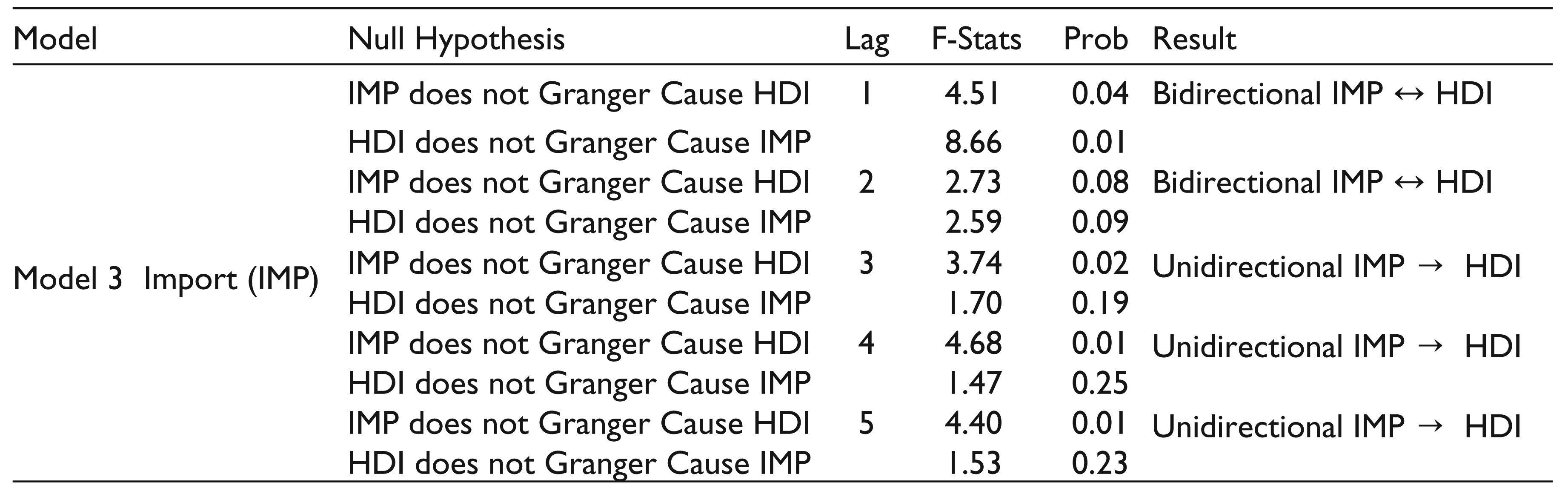
The direction of causality between trade and human development in Pakistan stays unspecified. This study fills this gap by using Granger (1969) causality test. It is argued that in Granger causality, ad hoc selection method for lag length is better than any statistical method to find optimal lag length (see Jones, 1989). In this study, test has been applied up to 5 lags to find the causal relationship between HDI and all variables of trade which are considered. 10 All significant results are reported in Tables 9–13.
Results of Chow Breakpoint Test

Granger Causality Test Results
Granger Causality Test Results

Granger Causality Test Results
Granger Causality Test Results

Granger Causality Test Results

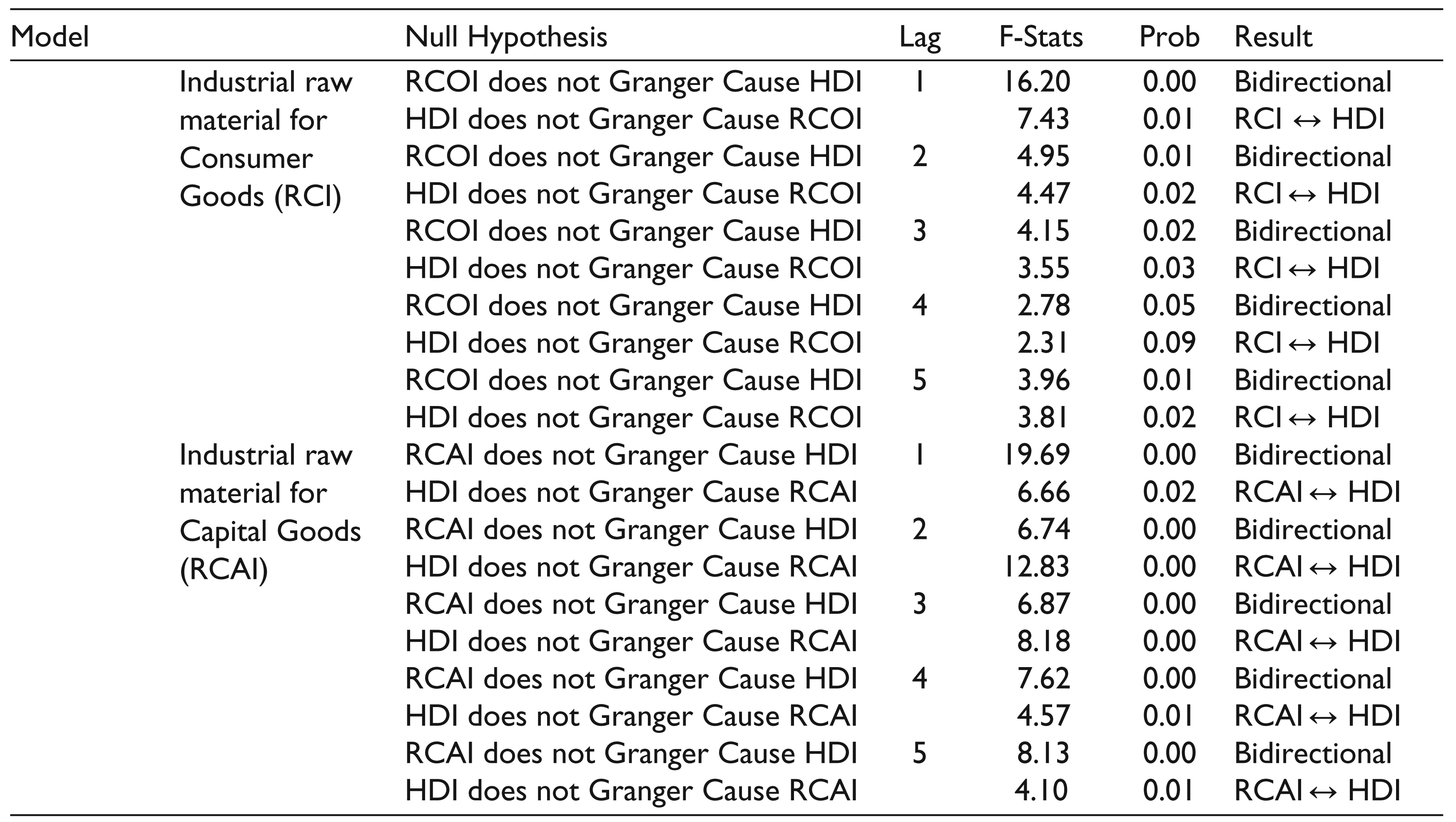
Results of Granger causality test show that in model 1, unidirectional causality exists at lags 1 and 2 running from HDI to TT. At lag 4, unidirectional causality exists running from TT to HDI. In model 2, unidirectional causality exists running from EXP to HDI at lag 1. In model 3, bidirectional causality exists between HDI and IMP at lags 1 and 2. At lags 3–5, unidirectional causality exists running from IMP to HDI. In model 4, bidirectional causality exists between HDI and PE at lag 1, and unidirectional causality exists running from HDI to PE at lags 2, 3 and 5. In the same model, unidirectional causality exists running from HDI to SME at lags 2, 3 and 5. Side by side, unidirectional causality exists running from ME to HDI at lags 1–5. In model 5, bidirectional causality exists between HDI and CI at lags 1 and 2, and unidirectional causality exists running from CI to HDI at lag 3–5. On the other hand, unidirectional causality exists running from HDI to CAI at lag 1, and bidirectional causality exists between HDI to CAI at lags 2–5. In contrast, bidirectional causality exists between HDI and RCI at lags 1–5. In the last, bidirectional causality exists between HDI and RCAI at lags 1–5. From the above analysis, in general, we can conclude that the unidirectional causality exists between HDI with TT and EXP. On the other hand, bidirectional causality exists between HDI and IMP.
Conclusion and Policy Implications
This study examined for the first time ever the effect of aggregate and disaggregate trade on human development in Pakistan by using annual time series data from 1980 to 2013. This study contained five models in which human development with (a) total trade (b) aggregate exports (c) aggregate imports (d) exports of primary commodities, semi-manufactured goods and manufactured goods and (e) imports of consumer goods, imports of capital goods, industrial raw material of consumer goods and industrial raw material for capital goods are considered. Cointegration and ordinary least square results suggest that all variables have significant positive relationship with human development except imports of consumer goods and exports of semi-manufactured goods. Sensitivity analysis confirms that initial results are robust. Error correction model shows that there is an insignificant relationship between trade and human development in all models. Stability analysis highlights that structural break exists. Chow test confirms the existence of structural break in 1998 and 2001. Granger causality tests show unidirectional and bidirectional causality with different lag length in above models.
In general, it is concluded that trade has positive impact on human development in Pakistan. More specifically, export of primary and manufactured goods and import of capital goods and industrial raw materials (for consumer and capital goods) should be encouraged by giving tax incentives, rebate and other subsidy policies. On the other hand, quality and value added of export of semi-manufactured goods should be improved to compete in international market and get higher price. Through this, the gap between prices of these goods and imports of finish form of these goods from international market will decrease, and this will benefit to decrease the negative effect of export of semi-manufactured goods on human development in Pakistan. Additionally, import of those items of consumer goods which are being produced by domestic producers should be discouraged to safeguard our employment and production, and ultimately it will affect human development in the country.
Footnotes
Acknowledgements
The authors are grateful to the anonymous referees of the journal for their extremely useful suggestions to improve the quality of the article. Usual disclaimers apply.