




Abstract
The present study aims to investigate the direct and indirect effects of emotional intelligence (EI) on knowledge sharing (KS) behaviour of employees via two mediating variables, namely organizational justice (OJ) and work engagement (WE). The authors collected data from 294 employees working in select public sector banks in India via survey and web-based modes. The two-stage approach which includes confirmatory factor analysis (CFA) and structural equation modelling (SEM) was used to validate the direct and indirect impacts of EI on KS behaviour. Results indicated that there exists a positive impact of EI on KS behaviour. This article provides important implications for organizations by showing that EI plays a pivotal role in stimulating KS behaviour of employees in Indian public sector banks. This study also corroborates the partial mediating role of OJ and WE between EI and KS behaviour. This research contributes to the academic literature of EI and KS in specific and extends the organizational research studies in general.
Keywords
Introduction
Emotional intelligence (EI) has garnered a lot of research attention from practitioners and scholars alike in the past two decades and become one of the widely discussed academic research topics in the area of psychology, education and management (Pradhan & Nath, 2012; Shapiro, 1997; Weisinger, 1998). EI is considered as one of the most expedient individual difference characteristic constructs in organizational research (Brackett, Rivers, & Salovey, 2011; O’Boyle, Humphrey, Pollack, Hawver, & Story, 2011; Schlaerth, Ensari, & Christian, 2013). Despite the growing significance of EI, little scholarly attention has been paid to the role of EI in predicting various individual outcomes (Maini, Singh, & Kaur, 2012; Meisler, 2013) in the workplace (Law, Wong, Huang, & Li, 2008). Day and Carroll (2004), Law, Wong and Song (2004) and Mikolajczak, Menil and Luminet (2007) advocated that most of the previous studies have documented only the direct impact of EI on work outcomes, whereas the role of mediating variables between EI and its outcomes have been meagerly investigated in the extant literature. Past research has shown that higher levels of EI have a profound impact on various work attitudes and behaviours such as job satisfaction, job performance, turnover intentions, organizational commitment, organizational citizenship behaviour (Anari, 2012; Jung & Yoon, 2012; Meisler, 2013; Meisler & Vigoda-Gadot, 2014). However, little is known about the function of EI in predicting KS behaviour of people. Although few studies have established a link between EI and KS behaviour (Arabshahia, Lagzianb, Rahimniab, & Kafashpourb, 2013), however, not much is known about the underlying mechanism through which EI affects KS behaviour of employees. Further, to the best of the author’s knowledge, there has been no study exhibiting the relationship between EI and KS behaviour in the Indian context. Researchers (Di Fabio & Palazzeschi, 2012; Meisler, 2013) have also advocated that a modicum body of research exists, displaying the empirical association between emotional intelligence and organizational justice (OJ), which warrants further investigation from researchers across different cultures and industries. In addition, the extant literature reveals that few studies have examined EI in the context of service sectors (Beigi & Shirmohammadi, 2011).
As a relatively new construct, work engagement (WE) has grabbed the attention of various parties such as academic researchers, practitioners and governments because of its contribution towards improving firm performance and gaining sustainable competitive advantage (Macey, Schneider, Barbera, & Young, 2011; Schohat & Vigoda-Gadot, 2010). However, the extant literature reveals that there is still a scarcity of research on this emerging concept of interest in the academic literature (Bhatnagar, 2007; Karatepe & Demir, 2014; Saks, 2006). Against this backdrop, this study is an endeavour to fill these gaps in the extant literature.
The remainder of this study unfolds as follows. The first section offers a review of pertinent literature on EI, OJ, WE and KS behaviour, and then the research framework is presented. The second section presents the objectives and rationale of the study. Afterwards, research methodology of the study is given. Next, the results of the study are presented. Finally, discussions, research implications, limitations, future research directions along with the conclusion of the study are mentioned.
Literature Review
Emotional Intelligence
The notion of EI is a much argued construct that has garnered enormous attention in the managerial behaviour writings. Petrides and Furham (2000) and Van Rooy, Viswesvaran and Pluta (2005) squabbled that there are two discrete looms to the conceptualization and operationalization of EI in the writings, that is, a mixed model of EI (Goleman, 1995, 2001) and an ability model of EI (Mayer & Salovey, 1997). The former concedes EI as a speckled set of motivational, dispositional, affective capabilities and attributes which influence one’s capability to cope up with various environmental (situational) hassles, whereas the latter describes EI as ‘a set of abilities that facilitate the assimilation, perception, appearance, understanding and regulation of emotions to promote poignant and intellectual growth’ (Day & Carroll, 2004, p. 1444). Preceding empirical research and narrative appraisals have posited that the ability model of EI has engendered strong educational interest among behavioural practitioners and scientists for three main reasons: (a) solid theoretical base; (b) originality of its measurement approach compared to other approaches; and (c) systematic estimation and support by pragmatic data from pure and functional research (Zeidner, Roberts, & Matthews, 2002). Furthermore, a string of editorials by Daus and Ashkanasy (Ashkanasy & Daus, 2005; Daus & Ashkanasy, 2005) have criticized the mixed model loom of EI for being too wide in scope and looking similar to (does not discriminate from) a personality-based representation rather than a constructive model of emotional ability. Nevertheless, these arguments, recent facts and claims (Van Rooy & Viswesvaran, 2004; Van Rooy et al., 2005) have hinted that both ability and mixed representations of EI are equally precious (and valid) in various organizational frameworks.
Organizational Justice
OJ is described as the sense of fairness within organizational personnel (Greenberg, 1990). Past studies have established that organizational fairness has three separate aspects. The first one is distributive justice, which is known as the perceived fairness of outcomes and resources one receives from the organization, in exchange of their inputs given to the work (Nowakowski & Conlon, 2005). It was first acknowledged by Adams (1965) who suggested that people determine fairness by their appraisal of the ratio amid their contributions (e.g., efforts or performance) and also their rewards (e.g., pay or promotion). The input–output ratio is matched up with that of a relevant referent to conclude whether fairness was sustained. The second aspect, procedural justice, refers to the fairness of the procedures connected with outcome distributions. The notion and study of procedural integrity emerged and raised out of prior exploration on dispute resolution measures. This research has shown that the arguments were not only imprudent to the outcomes they obtained but also to the actions (or processes) by which they attained these outcomes (Nowakowski & Conlon, 2005; Walker, Lind, & Thibaut, 1979). The third aspect, interactional justice, refers to the perceived fairness of interpersonal treatment from those who control the procedures used to determine the outcomes (Bies & Moag, 1986). Interactional justice appeared as an imperative component of managerial justice due to its prominence on the ‘human’ aspect in the organizational context.
Work Engagement
WE can be described as a positive and pleasing state psyche (Bakker, Demerouti, & Verbeke, 2004). By applying the term to the workplace, engagement can be described as positive feelings towards the job and work (Macey & Schneider, 2008). It connotes numerous meanings and incorporates a mixture of concepts, including (but not restricted to) job involvement, energy, satisfaction, dedication, organizational commitment and vigour (Macey & Schneider, 2008). The study on engagement advanced from a study on its polar converse, the construct of burnout (Schaufeli, Salanova, Gonzalez-Roma, & Bakker, 2002). This modifies the focus of researchers from unenthusiastic to enthusiastic, which is immensely influenced by the positive psychological movement (Schaufeli, Bakker, & Salanova, 2006; Schaufeli, Salanova, et al., 2002). By concentrating on engagement, researchers are competent to attend to the positive elements of work as divergent to the negative elements of work. The first study, on a sample of Finnish teachers, established that job resources (together with but not limited to appreciation, supervisor support and job control) reduced the effect of job demands (like student misbehaviour) on job engagement (Bakker, Hakanen, Demerouti, & Xanthopoulou, 2007). In the second study, all the instigators were testing a model of burnout (Demerouti, Bakker, Nachreiner, & Schaufeli, 2001). They did not find engagement directly but as a substitute, they investigated its contrary, disengagement. The researchers originated that job resources unconstructively related to disengagement from work. Given the verdict of the first case, this result makes good judgement and indirectly supports the thought that job resources may strengthen the engagement level of stress. The authors of the study were fascinated in investigating how the assumptions of depletion (that claims that a person has a predetermined amount of resources) and enhancement (which argues that possessing a large number of functional commitments may be helpful) affected engagement in job and family functions (Rothbard, 2001).
Knowledge Sharing Behaviour
Knowledge sharing (KS) is defined as a mutual course of knowledge generation (Van den Hooff & Ridder, 2004). Cummings (2004) defined KS as a means by which an organization gains the access to realize its inside and outside knowledge by the mode of exchanging. It assists the synergy of people who work in the direction of common aims (Boland & Tenkasi, 1995). This process is essential to change entity knowledge to organizational knowledge as knowledge exists only in the brains of people (Beveren, 2002). KS is a kind of communiqué process by which numerous parties are implicated in knowledge reassign, and its output is a fresh knowledge generation (Usoro, Sharratt, Tsui, & Shekhar, 2007). Knowledge complicated model has multiple meanings and labelling. Knowledge is valid and confirmed information owned by organizational heads in decision-making and actions to achieve success and competitive benefit that includes principles, ideas, skills, roles and trends that may help in decision-making. Knowledge can be shared and transferred between the right people and at the right time, which could increase organization’s prospects to advance the performance (O’Dell & Grayson, 1999). Knowledge and information can be used interchangeably, for example, Zander and Kogut (1995) have noted that information and knowledge can be transferred without losing its cohesion. Nonaka (1994) declares that information and knowledge are analogous in many cases; even they have differences in many aspects. Information is real, whereas knowledge is on commitments and viewpoints. KS can be defined as sharing the appropriate information, suggestions, thoughts and expertise with the remaining people in the organization. Similarly, it is a set of conducts that involves the swap over of information or serving others.
Emotional Intelligence and Knowledge Sharing Behaviour
EI was first coined by two scholars Salovey and Mayer (1990). Mayer and Salovey (1997) defined EI ‘as the ability to access and/or generate feelings when they facilitate thought; the ability to understand emotions and emotional knowledge; and, the ability to regulate emotions to promote emotional and intellectual growth’. High level of EI quotients has a positive correlation with certain workplace traits such as problem-solving, leadership skills, high motivation levels and knowledge sharing. Prior research has demonstrated the positive influence of EI on various outcomes such as job satisfaction, organizational commitment and organizational citizen behaviors (OCB) (Anari, 2012; Jung & Yoon, 2012), which in turn spurs KS behaviour among employees (Teh & Sun, 2012). Further, the relationship between knowledge transfer and management of emotions was explained by Matthews, Zeidner and Roberts (2004). Dogan and Vecchio (2001) explained the relation between EI and KS as a four-step model that is connected in a circular process such as knowing the individual, strategy development, reactive analysis and feedback. The linkage between tacit knowledge and EI was highlighted by Othman and Abdullah (2011). EI is all about the ability to understand the power and shrewdness of emotions and channelize them as a source of connection (Karkoulian, Harake, & Messarra, 2010). People in the top management have to first understand their own emotions and then try to understand others’ emotions, and this trickle-down effect would pave the way for effective KS. Carmeli (2003) and Turnispeed and Vandewaa (2012) found that EI is positively associated with altruism and helping behaviour towards colleagues. Consequently, this study proposes that employees’ EI will influence KS behaviour positively.
Organizational Justice as Mediator
OJ is the perception of fairness among employees with respect to various outcomes, processes and interactions (Di Fabio & Palazzeschi, 2012; Folger & Cropanzano, 1998). EI is basically the capability to observe and comprehend one’s own and others’ emotions and rationale to discriminate and define the differences and to channelize the patterns of thinking and behaviour. Successful corporate personnel always maintain a high EI on their interpersonal intelligence. A careful investment in building the EI skill set among the employees of an organization will impact the whole environment, justice and performance (Goleman, 1999). Further, Mayer and Salovey (1997) and Mayer (2001) posited that individuals with high EI understand their workplace happenings appropriately. This lessens the chances of misunderstandings and leads to better evaluation of the events as fair. Gulati and Bhal (2004) corroborated the positive influence of EI on employees’ justice perceptions in a study conducted in India among software professionals. Additionally, current literature underlines that EI has a positive impact on justice perceptions of employees (Di Fabio & Palazzeschi, 2012; Meisler, 2013). On the other hand, Kankanhalli, Tan and Wei (2005) and Wasko and Faraj (2005) established the positive linkage between perceived fairness of organizational activities and KS behaviour. Yu, Lu and Liu (2010) highlighted that sharing culture encompassing openness, identification and fairness affects KS behaviour of members. In a recent study, Li, Shang, Liu and Xi (2014) advocated that fairness within an organization affects KS behaviour of employees through developing a climate of affiliation. Yesil and Dereli (2013) corroborated the positive impact of OJ dimensions on KS behaviour. Moreover, a recent study conducted on nurses by Zhu et al. (2015) validated the mediating effect of justice perceptions between EI and WE. Against this background, we propose that OJ perceptions will mediate the relationship between EI and KS behaviour.
Work Engagement as Mediator
WE is defined as a positive work-related state of mind which includes vigour, dedication and absorption (Bakker, Tims, & Derks, 2012; Hakanen, Perhoniemi, & Toppinen-Tanner, 2008). It is highly believed that an engaged workforce outperforms the less-engaged workforce for the reasons being supervisory support, enthusiasm and physiological happiness (Bakker & Demerouti, 2008). Kahn (1990) attributed WE by two dimensions such as self-employment and self-expression. It implies numerous meanings and incorporates a mixture of concepts encompassing, but not restricted to job involvement, energy, satisfaction, dedication, organizational commitment and vigour (Macey & Schneider, 2008). Former studies have confirmed the positive influence of EI on employee engagement (Brunetto, Teo, Shacklock, & Farr-Wharton, 2012; Duran, Extremera, & Rey, 2004; Ravichandran, Arasu, & Kumar, 2011). On the other hand, the extant literature underlines that WE positively impacts the organizational citizenship behaviour of employees (Saks, 2006), which can also be attributed as the willingness of KS (Bock, Zmud, Kim, & Lee, 2005). Previous studies concluded that WE considerably increases the proactive behaviour of the employees, namely learning behaviour, citizenship behaviour and extra-mile efforts (Hakanen et al., 2008; Saks, 2006; Sonnentag, 2003). In addition, Chen, Zhang and Vogel (2011) found a positive association between WE and KS behaviour. Accordingly, the study proposes that WE will mediate the relationship between EI and KS behaviour.
Research Framework
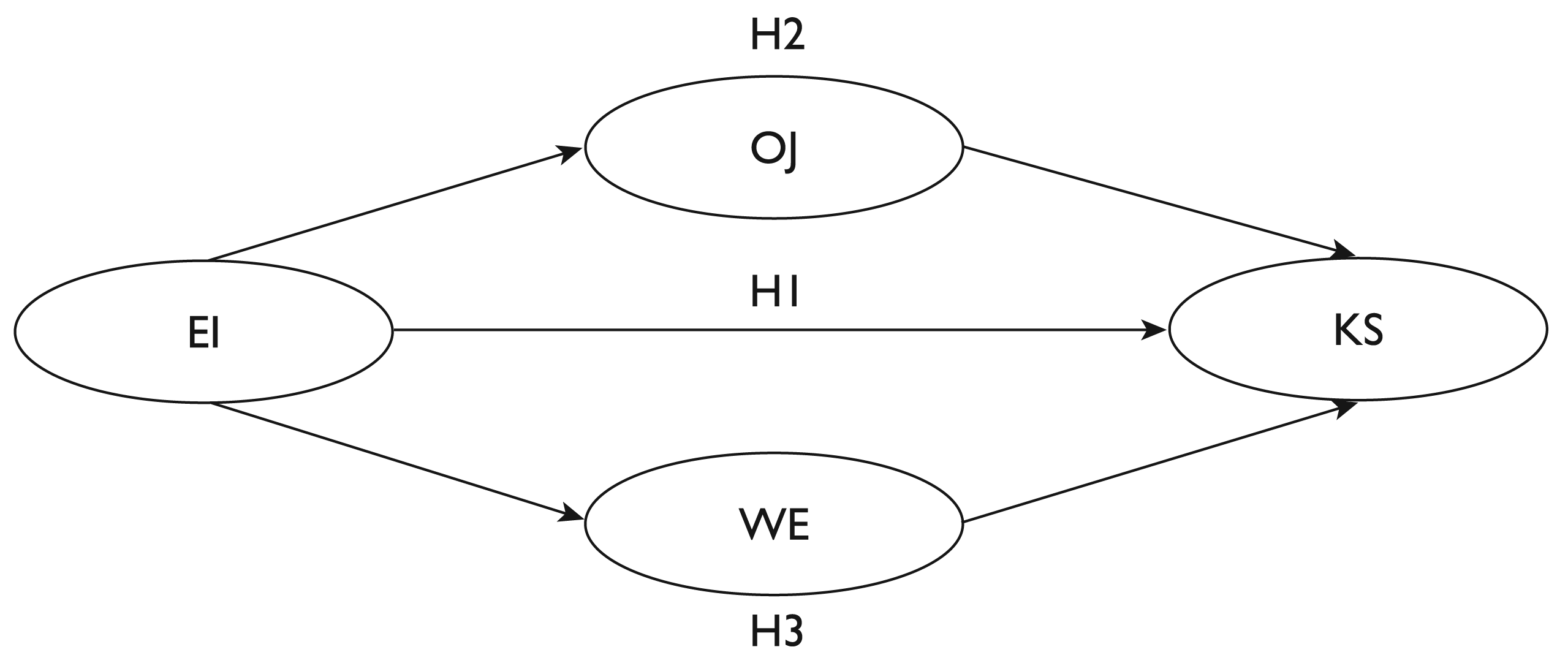
The research framework advocates that EI of employees will affect KS behaviour positively. The framework also proposes that OJ and WE act as mediators between the positive effects of EI on KS behaviour. The hypothesized relationships are presented in Figure 1.
Objectives
On the basis of the review of pertinent literature and the analysis of gaps, this study intends to fulfil the following objectives. The current research examines the influence of EI on the KS behaviour of employees. Another aim of this study is to examine the mediating effects of OJ and WE between EI and KS behaviour. In simple terms, this study examines both direct and indirect effects of EI on KS behaviour of employees in select public sector banks of India.
Rationale of the Study
In today’s knowledge-intensive economy, ‘knowledge’ has become a critical resource for all organizations, whether public or private, small or large (Barney, 1991). Managing knowledge is of utmost significance to organizations for success, survival and sustained competitive advantage. This makes knowledge management a crucial activity or process of every organization. Knowledge management is a combination of various processes, which includes creation, organization, storage, dissemination and application of knowledge. Among the various elements or processes of knowledge management (KM), KS is the most crucial one. Because of this significance, an understanding to improve employee KS has turned out to be critical. However, effective sharing of knowledge is a difficult and challenging task for firms because employees cannot be forced to do so. Several researchers (Dasgupta & Gupta, 2009; Yang, 2007; Yesil & Dereli, 2013) have acknowledged that KS among employees brings various benefits to organizations such as organizational innovation capability, organizational effectiveness and competitive advantage. Thus, it becomes imperative for organizations to find out the factors that could impede or foster KS of employees (Tangaraja, Ismail, & Samah, 2015; Van den Hoof & Ridder, 2004). Though previous research has documented several factors affecting KS in a variety of organizational settings, minimal research attention has been paid to personal factors (Chu, Krishna Kumar, & Khosla, 2014) as robust predictors of KS. Much of the previous research attention has been given to situational characteristics such as organizational culture, organizational structure and leadership (Dasgupta & Gupta, 2009; Kim & Lee, 2006) as predictors of KS behaviour. In addition, the extant literature reveals that there is a dearth of inquiry into the KS behaviour of employees in public sector organizations, particularly in banking institutions (Chatzoglou & Vraimaki, 2009; Sandhu, Jain, & Ahmad, 2011; Yusof, Ismail, Ahmad, & Yusof, 2012). Currently, banking industries, particularly public sector units, are facing numerous challenges due to the perpetual alterations in the business environment at several stages. These fluctuations along with ferocious competition from foreign and domestic players have pushed banks to look into KM for competitive advantage. Therefore, it is important to determine out whether EI of employees helps in simulating KS behaviour of employees in banking industries. Moreover, several researchers have suggested that investigating the relationship between emotional intelligence, justice perceptions, knowledge sharing and work engagement in non-Western settings would add valuable insights to the existing knowledge base as much of the research work has been performed in Western settings (Meisler, 2013; Yesil & Dereli, 2013).
Methodology
Sample and Procedure
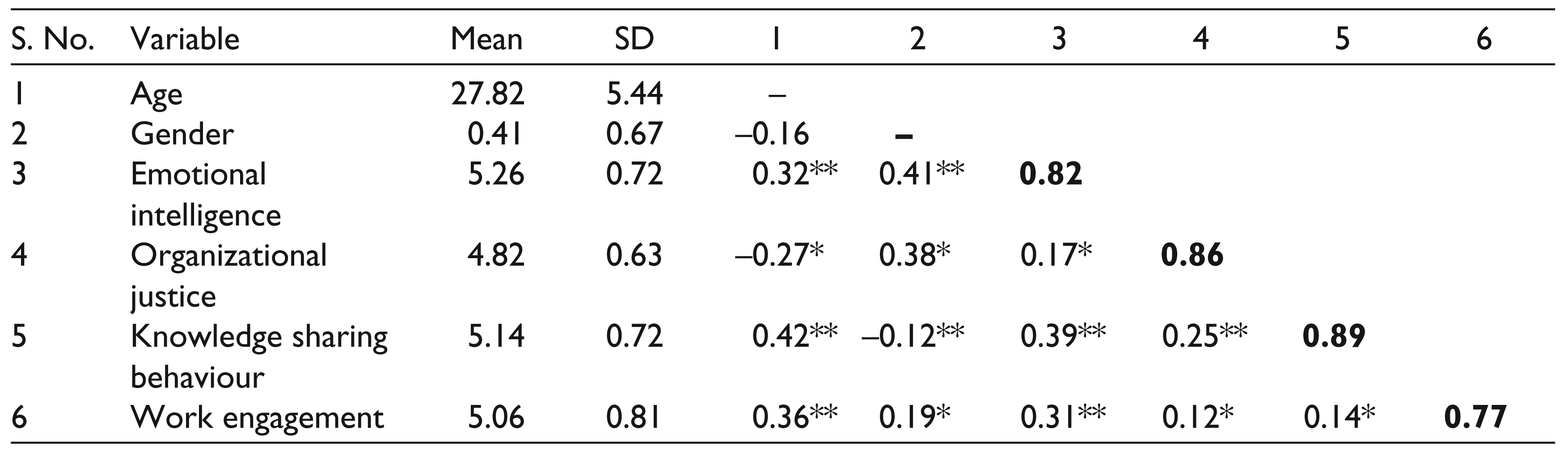
In order to validate the hypothesized model shown in Figure 1, data were collected from select public sector banking institutions (from the website of Reserve Bank of India) in the northern region of India. The participants were drawn from 42 branches of public banks, working at junior and middle level of management. Data collection was performed via both paper-based (during their remunerated working hours) and web-based channels, starting from February 2014 to May 2014. One of the authors had personally administered the entire process to avoid any glitches and ensure confidentiality of all the respondents. In a total of 466 respondents to whom the questionnaire was circulated to, the authors received 294 completely filled responses, reflecting a response rate of 63.09 per cent. The mean of the respondents was found to be 27.82 years, with a standard deviation of 5.44. The gender composition was 61.37 per cent and 38.63 per cent as male and female employees, respectively. Due to the very nature of multiple source design of the study and arrangement of items as questions at different parts of the questionnaire, there exists a possibility of the presence of common method bias (CMB), which in turn might impede the validity of the study results. In order to check the presence of CMB, the study used Harman’s single factor approach (Podsakoff, MacKenzie, Lee, & Podsakoff, 2003) using varimax rotation. The authors have found that more than one factor showcases the eigenvalues, which were greater than 1 and the first factor accounted for 22.54 per cent out of the total variance explained, 74.32 per cent. Therefore, the presence of CMB is not a potential threat in the present study. Table 1 represents the descriptive statistics of the response set, which includes the control variables and the four central constructs of the present study along with their inter-correlations and reliability coefficients.
Descriptive Statistics and Correlations
Measures
The questionnaire was designed on a 7-point Likert scale, carefully adopting from different past surveys and research papers. All the items related to the central constructs such as EI, OJ, WE and KS behaviour were arranged non-sequentially. The questionnaire was pretested among 30 respondents who belong to the main sample and the authors didn’t find any issues with regard to the face validity and content validity. Gender and age were used as control variables.
Emotional Intelligence
For many decades, the literature on intelligence mainly articulated on the adaptive use of cognition (Piaget, 1972). The notion of EI has become popular, soon after the work of Goleman (1995). The extant literature suggests that the people, who maintain high on EI quotients, would have better mental health, job satisfaction and be a potential leader. EI was assessed using the Wong and Law Emotional Intelligence Scale (WLEIS; Law et al., 2004; Wong & Law, 2002). The measure comprises of 16 items on a 7-point Likert scale and the reliability value was found out to be 0.82.
Organizational Justice
The three-dimensional construct of OJ was measured using a 20-item scale, developed by Niehoff and Moorman (1993) on a 7-point Likert scale. The selected scale was projected to measure the distributive justice with five items, procedural justice with six items and interactional justice with nine items. Distributive justice consisted of items assessing the fairness of job outcomes, including workload, pay level, work schedule, job responsibilities and rewards. Procedural justice scale included the items to assess the fairness in the decision-making process, justification of decisions and employees appeal process to challenge the supervisor’s decision. Interactional justice was measured using nine items assessing the degree to which library employees perceived fairness in supervisor’s treatment and adequate justification relating to job decision. The reliability value of the three-dimensional latent construct put together was found out to be 0.86.
Work Engagement
The construct of WE was measured with the 9-item version of the Utrecht Work Engagement Scale (UWES) developed by Schaufeli et al. (2002) on a 7-point Likert scale. It comprises of items on three underlying dimensions of WE such as vigour, absorption and dedication. UWES has been on the most widely used scales to measure the latent construct of WE. For instance, the items in the scale, namely I feel like going to work every morning (vigour); I am proud of the work I do every day (dedication); Most of the times, I find myself immersed in work (absorption) (Schaufeli et al., 2002). Higher scores on all three dimensions indicate high WE. The Cronbach’s alpha for this scale was 0.77.
Knowledge Sharing Behaviour
The latent construct of KS behaviour was measured on a 7-item scale adapted from Lee (2001). A sample item is as follows ‘I share work reports and documents with members of my organization’. The Cronbach’s alpha value was found to be 0.89.
Results
The authors adopted a two-step procedure (confirmatory factor analysis [CFA] and structural equation modelling [SEM]) given by Anderson and Gerbing (1988) to empirically validate linkages among the constructs in the research model. The goodness-of-fit indices of the confirmatory measurement model is a definite precursor to the structural equation model which is based on maximum likelihood estimation. IBM®, SPSS® and AMOS™ 20 were used as the statistical software to conduct the data analysis.
Measurement Model
The measurement model encompasses three significant aspects such as reliability, discriminant validity and convergent validity (Hair, Black, Babin, Anderson, & Tatham, 2006). The estimates of this model represent the latent constructs as a weighted sum of all the observed constructs, which are as part of the research model. CFA was used to access the sufficiency of convergent and discriminant validity of the four latent constructs. Fornell and Larcker (1981) suggested the procedures to test both validities of the respective scales. Discriminant validity was tested using the construct correlations (Kling, 2001). Convergent validity is defined as the degree to which the items of any two given latent constructs of the same research model, which are theoretically related and in fact related (Campbell & Fiske, 1959). Average variance extracted (AVE) is the sum of each squared factor loading divided by the number of indicators. Maximum shared variance (MSV) is measured by calculating the amount of covariance shared by a respective latent construct with another construct. Average shared variance (ASV) is the mean of the shared covariance by a latent construct with all the other constructs of the research model. The value of CR should be greater than AVE, and the value of AVE should be greater than both MSV and ASV (Hair et al., 2010). The results indicate that the composite reliability values of all the latent constructs are more than or equal to 0.7 and the AVE values are more than 0.5. The value of square root of AVE for a given construct was found out to be greater than its correlations with other constructs (Fornell & Larcker, 1981). This confirms the sufficiency of the discriminant and convergent validity of the data and the same is represented in Table 2. The goodness of fit of the model was tested by using χ2/df = 3.92, comparative fit index (CFI) = 0.93, root mean square error of approximation (RMSEA) = 0.068 and standardized root mean square residual (SRMR) = 0.073. All the path coefficients were significant at 1 per cent and 5 per cent level of significance and fit indices were within the acceptable limits as suggested by Hu and Bentler (1999).
Discriminant and Convergent Validity of Variables

Structure Model
Structural equation modelling (SEM) was adopted to test the mediating effects of OJ and WE between the EI and KS behaviour relationship. A step-by-step process was followed to validate this two mediator model. Initially, the direct effect of EI on KS behaviour was tested without involving either of the mediators. The standardized path coefficient for this relationship was found out to be (β = 0.14, p < 0.01) positively significant. Soon after this, the two mediators were invoked into the model along with the existing direct path. The results in Table 3 showed the adequate goodness of fit. OJ partially mediates the relationship between EI and KS behaviour (β = 0.27, p < 0.05), and WE also partially mediates the relationship between EI and KS behaviour (β = 0.32, p < 0.01). Figure 2 exhibits the research findings.
H1 postulates that EI will be positively related to KS behaviour. With β = 0.14 and p < 0.01, H1 is supported. H2 expects that OJ will mediate the relationship between EI and KS behaviour. With β = 0. 27 and p < 0.05, H2 is supported. H3 envisages that WE will mediate the relationship between EI and KS behaviour. With β = 0.32 and p < 0.01, H3 is supported.
Structural Model Fit Indices

Discussion
The aim of this study was to investigate a research model encompassing EI, KS behaviour, OJ and WE with respect to the junior-and middle-level management personnel from the select public sector banks in India. The result of the two-stage approach which includes CFA and SEM was used to validate the direct and indirect effects of the impact of EI on KS behaviour. Results indicated that there exists a positive impact of EI on KS behaviour. This finding is consistent with the previous findings of Arabshahia et al. (2013), Othman and Abdullah (2011) and Zeidner, Matthews and Roberts (2004). Furthermore, the study establishes that both OJ and WE act as partial mediators between the EI and KS behaviour. Employees with high emotional quotients would effortlessly deal with factors such as distribution, procedural and interactional justice, and this finding is in resonance with the findings of Zeidner et al. (2004) and Di Fabio and Palazzeschi (2012). The experience of justice and injustice can result in positive and negative emotions, respectively (Mikula, Scherer, & Athenstaedt, 1998). By maintaining their emotional responses, the employees would likely volunteer and also help to disseminate the implicit or explicit knowledge among their peers. This effect is just significant and to increase the impact of it, employees are to be consistently engaged and their perceptions towards the organizational setting are to be nurtured in an undeterred manner. OJ plays a crucial role in reducing the uncertainty of the employees vis-à-vis their employment, by directing their perceptions (Di Fabio & Palazzeschi, 2012); thus, results in an effective as well as productive workplace. The study also persuades that EI is an important factor affecting KS behaviour. The aforementioned findings are in alignment with the proposed hypothesis, which contributes to the existing literature on human resource management and strategic management at a broad level.

Implications
The study has both theoretical and practical implications. This study contributes theoretically in a number of ways. As mentioned previously, few studies have investigated the role of EI in the workplace (Law et al., 2008). Furthermore, the extant literature reveals that little is known about the effects of EI on KS behaviour of employees, and even less is known about the underlying mechanism that links EI and KS behaviour. Hence, the current research contributes to the existing body of knowledge and theory on the relationship between EI and individual outcomes, particularly KS behaviour and the role that OJ and WE play in the relationship between EI and KS behaviour.
This research also has significant practical implications for banking organizations. Banks are facing numerous challenges due to the fluctuations in the present business environment. One of the important resources for any organization is to cope up with these challenges is knowledge. Therefore, if an organization wants to survive and gain a sustainable competitive advantage they need to leverage this vital resource, that is, knowledge. To leverage this resource, KS among people should be encouraged. Results from this study depict that EI is an important predictor of KS behaviour. Based on the study results, it can be generalized that human resource managers need to monitor the EI levels of their respective employees from time to time. Moreover, to enhance the EI levels of employees, banks could conduct various training and education programmes. Furthermore, the organization could conduct various tests to examine the EI levels of job candidates at the time of recruitment and select those candidates who are emotionally sound. This practice of identifying capable candidates would give several benefits to the organization in the future. In addition, the organization should encourage activities or develop distinct mechanisms that increase employees’ justice perceptions and work engagement.
Conclusion, Limitations and Future Research Avenues
Like any other empirical study, the present study too suffers from few limitations. All the respondents were from the select public sector banking institutions in India, which possesses more or like similar organizational structure and leadership style. Therefore, the findings of the study cannot be generalized to other sectors and economies of the world. Further, the measures used in the study were adopted from various research works developed in the Western contexts. Even though the present study has tested face and content validities, the results might get affected. The study adopted a cross-sectional design, which means that data collection was performed at one point in time. Future studies can replicate the linkages among the study variables by conducting a longitudinal study and the results can be compared for a better generalization. Future studies could also examine other possible mediators such as job satisfaction, organizational commitment and trust between EI and KS behaviour relationship. Future scholars could also consider the moderating role of OJ and WE between EI and KS behaviour. The moderating role of OJ and WE could reveal how OJ and WE would affect the strength and direction of the relationship between EI and KS behaviour.
In conclusion, this study contributes to the extant literature of EI and KS behaviour in the Indian context. Moreover, despite the abundant literature, to the author’s best knowledge, no studies have examined the linkages between emotional intelligence, justice perceptions, work engagement and knowledge sharing behaviour in a single study. This study, therefore, is the first of its kind to be commenced in the Indian context. Further, this study spurs other scholars to continue this investigation into EI and KS behaviour in cross-cultural context.
Footnotes
Acknowledgements
The authors are grateful to the anonymous referees of the journal for their extremely useful suggestions to improve the quality of the article.