



Abstract
Determination of fish landing price is important, as the same contributes to the structure, conduct and performance of the fish market in Lake Victoria. Determination of relevant landing price is a gap to console between fishermen, agents (middlemen), processors and the government. The main objective of this study was therefore to examine fish price determination. Specifically, to examine the methods for fish price determination and analyse factors that affect fish landing price in Lake Victoria, a cross-sectional design was employed, and 300 respondents were randomly selected from two district councils, namely, Sengerema and Buchosa. Both qualitative and quantitative data were analysed using descriptive statistics and inferential analysis. Findings show that landing price is determined through formal negotiation with processors, consultation with other traders, informal negotiation with buyers and Beach Management Unit (BMU). The study concluded that these are the common methods used to determine landing prices. Also, distance from fishing to onshore landing centres, market information channels, age and experiences of the fishermen are the factors significantly found affecting landing price. It is recommended that the mechanism for setting up fishery price, fish market structure, fishery information and the formation of fishery regulatory body needs fishery policy and sector reforms that mark the determination of fish landing price.
Introduction
Worldwide, the determination of fish prices has been debated over the years. Different studies including studies by McConnell and Strand (2000), Hammarlund (2013), Lee (2014), and Gobillon, Wolff, and Guillotreau (2015) employed different approaches to ascertain factors that constitute fish prices. These studies were limited to specific species, whereas to some other fish species, the same leave inconclusive remarks on landing price. Landing price is a price of fish valued based on factors such as fish size, days spent on storage, storage vessels, fish grades and distance to landing centres before reaching the primary buyers. There are other factors such as the number of buyers, sellers and management facilities that determine the price and quantities sold which contribute to the determination of fish price among fishermen within the sector (Janssen, Zhou, & Söderberg, 2001).
However, in the fishery sector, fishing activities in Lake Victoria have been reported as one of the sources of income contributing to the well-being among fishermen (Luomba, 2013). The contribution is in part played to bring about achievement or helping something to advance (English Oxford Living Dictionaries, 2016). Moreover, in Tanzania, the fishery sector contributes 2.5 per cent of the real GDP (BOT, 2017) and employs more than 4,000,000 people in related activities. Africa’s fishery output stood at US$24 billion out of US$235 billion of world fishery outputs in 2011 (FAO, 2014; Phillips & Subasinghe, 2010). According to Kambewa (2007), fishermen are individuals who have fishing and trading experience ranging between and equal to 2 years and above, pursuing fishing activities as the main income-contributing source.
Following substantial contribution of the fishery industry to the economy, the Tanzanian government facilitated the construction of marketing centres. It facilitated installation of ice plants, refrigeration cold storage for fish, provision of vehicles and rehabilitation of fish markets in 20 centres surrounding Lake Victoria to enhance the market and influence better price (URT, 2014b). According to Hou and Westbrook (2014) the market enables fishermen to identify, communicate and maintain contact with buyers at a right price, thus attaining better per capital income. Besides construction of marketing centres, the government has also made some effort to ensure fishery sustainable markets in Lake Victoria (Roangead, 2013).
Despite the efforts on improvement of facilities, market centres and landing sites for market accessibility, fish selling price is associated with uncertainties. According to Kambewa (2007), these uncertainties were assumed due to methods used to set landing price. These may be through contractual arrangements enforced by agents, negotiations in price but dominated by buyers, catch volume and the type of buyer who basically contributes to the determination of fish market price. Market price is given as a function of tangible, intangible and other outside influencing factors. These factors also have a significant relation with income including price (Chandrashekar, 2014; Janssen et al., 2001; Monson, 2009; Phillips & Subasinghe, 2010). Given that there are various market prices, the focus of this study is the landing price/ex-vessel price.
Studies focused on other market prices only and leave the determination of fish landing price in Lake Victoria inconclusively. There is lack of evidence on how the fishermen–buyer relationship and other market features determine landing price in Lake Victoria which may contribute to policy for improving the well-being of fishermen. The landing price appears to be associated with the agent’s exploitation of fishermen, imbalance of negotiation power, limited access to production facilities, idiosyncratic preferences, lack of improved skills, use of latest technology, inadequate access to fishermen and control of assets. These are challenges which hinder meeting the best landing price among the fishermen (Kambewa, 2007; Luomba, 2013).
Further, fishermen were looking for profitable contractual arrangements, and these arrangements have been influenced by illiteracy, uncertainty of selling price, volume of catch, the type of buyer and loans (Mpenda, 2010; Sharma & Biswas, 2018). Moreover, studies rarely say that landing price is determined by fish quality characters which may also be exploited by the agent to set the price of that fish (Roheim, Gardiner, & Asche, 2007).
Furthermore, Henson and Mitullah (2003) argue that these prices were low, such that about 16 per cent of the regional income distribution came from fishermen due to low paid price, thus leading to low income earning. In some of the species like Nile perch, showed that onshore price paid to fishermen is between TZS 3,000 and 4,000 per kg. Meanwhile, consumers paid between TZS 7,000 and 11,000 per kg, respectively, depending on the market destination. Lee (2014) found out that fishermen received prices that are approximately US$0.20, equivalent to TZS 450, lower than the price of that fish if sold in the next largest market. Despite the price disparity due to capability in value addition among fishermen, fishermen experience low paid prices. The question here then is why they are still pursuing these fishing activities at landing sites while the actual price at district market centres is very high and even higher at destination cities such as Mwanza, Arusha and Dar es Salaam. Therefore, the focus of this article is on the determination of fish landing price in Lake Victoria, Tanzania. Consequently, it addresses the question on how fish landing price is determined in Lake Victoria. Hypothetically, the study assumed that there is no significant influence of factors on fish landing price. The rest of the article is structured in five sections. The second section explains the literature review. The third section discusses the methodology. The fourth section presents the empirical results and the fifth section presents the conclusion
Literature Reviews
Fishermen–Agent Market Relationship
The small-scale producer’s market revealed features of unsatisfactory markets if the structural analysis indicated that the seller’s concentration was high with high income difference. This was the result from the differences in their access to ownership and control of physical marketing facilities, funds’ availability, market structure and conducts (Taru, Jonathan, & Lawal, 2010). On the other hand, since the Lake Victoria fishery market is dominated by middlemen (buyers) while considering their relationship with fishermen, a decrease in input prices is expected not to be transmitted to the final fish prices offered by middlemen to the fishermen (Meyer & Cramon-Taubadel, 2004). This is due to the fact that market conducts of the buyers intend to maximize profits. Market conduct relates to the behaviour of the firms or decisions that firms make relating to their pricing and output policy and other competitive tactics. In other words, market conduct refers to actions which firms follow in adopting or adjusting to the market in which they buy and sell (Taru et al., 2010).
Regarding the fish market structure from various studies, the persistence of low-paid price to fishermen is due to the mechanism of fish price determination, inequality in profit share, disparity in prices due to market size, low price given to fishermen, size of the fish, demographic and fishery management of the system (Abila, 2015; Bergman, 2012; Gordon & Maurice, 2012; Hammarlund, 2013; Lee, 2014; Henson & Mitullah, 2003; Roangead, 2013). The market structure may be defined as features organized within the market that were formed by the number of buyers, sellers and product differentiation in terms of size, colour and quality as well as method of price determination (Olukosi, Isitor, & Ode, 2007). However, Lee (2014) points out that price determination of Cod was based on the buyer’s defined categories after sorting and being sold to a fish dealer or after being auctioned off. Also, this price determination was associated with volume and value in the fish vessel.
Moreover, in considering an increase of fishermen’s input prices which are facilitating quantity and quality of fish catches, middlemen may make use of market power and transmit a change in input prices to the other buyers and gain a required profit margin (Meyer & Cramon-Taubadel, 2004). This market power is often expected to lead to positive asymmetry. In this respect, it is assumed that middlemen may help to determine fish landing price by including any increases in input prices to the final payment per catches sold in accordance with price transmission theory, which examines how price change at one market level affects the prices at other market levels (Meyer & Cramon-Taubadel, 2004).
Additionally, if more fishermen increase, on the basis of a production theory, an increase of input factors may lead to increase of fish harvest/quantity caught. However, these may not have a helpful hand when it comes to fishermen earning with more fish harvest; still a lower fish price is expected at offshore and onshore landing sites in Lake Victoria. Gordon and Hussain (2015) used theory of derived demand and realized that the demand curve facing tuna fishermen is downward sloping and indicate that increased fishing effort to harvest more will be rewarded with lower ex-vessel prices, all else equal. Thus, a number of fishermen increase may be part of the factors affecting landing price.
Another relationship is the number of buyers against fishermen as stipulated by the law of diminishing and return; henceforth, if there are few buyers, it is more likely that they can dominate the market and reduce the landing price. Gordon and Hussain (2015) found that the structure of the tuna market is one with many small first-hand suppliers of fish sold to only a few processors. Such a structure empowers the processors with market power that can be used to reduce the first-hand price of fish. However, the adverse effect is that low price benefit high actors/processors (collector/mongers) with market power and fishermen earn lower prices (Sarkar et al., 2015). This narrows down the fishery market performance during interactions of buyers (middlemen) and fishermen in a market.
Composition of Factors Led to Landing Price
Empirically, Gobillon et al. (2015) found out that these are the main factors explaining variations in fish prices. These factors constitute size, presentation and quality, the seller’s unobserved effects, the buyer’s unobserved effects and seller–buyer matched effects. Janssen et al. (2001) conclude that a negative relationship exists between age and price of property; meanwhile, McConnell and Strand (2000) show that the fish’s physical characteristics (burn, fat, size, manner of harvesting and handling) influence grading of the fish, thus determining ex-vessel/landing prices.
Based on market size, Lee (2014) found out that fishermen received prices that are approximately US$0.20 equivalent to 450 TZS, lower than the price of that same fish if sold in the next largest market. Moreover, based on freshness, the fish cold catch that lasts for 4 days fetched a price of US$0.04 equivalent to 90 TZS, less than those catches on a given day and offloaded to the market. The trips that lasted for 10 days were paid less than US$0.15 equivalent to 337.5 TZS. Another factor is the management of a fish stock that changes the quantity of attributes as this will also change the prices of fish (Hammarlund, 2013).
Apart from the above studies done by Ibengwe (2013), Chandrashekar (2014), Bergman (2012), Roheim et al. (2007), Abila (2015) and Hou and Westbrook (2014), this article objectively focused on determination of fish landing price in Lake Victoria, Tanzania, specifically, examined methods for fish price determination and analysed factors that affect fish landing price in Lake Victoria.
Theoretical Framework
Therefore, this study employed the theory of price transmission which governs change of input price factors in a variety of areas including resource allocation, production technique, pricing adjustments and quantity produced to fishermen as a firm. Price transmission refers to the effect of prices at one end of the market to the other ends of the market. Minot (2010) described the percentage change in price at one end of the market given a 1 per cent change in the price at the other ends of the market. Price transmission from the market to producers may be due to a range of factors, for example, change of market power, subsidy and policy reform (Aguero, 2004; Meyer & Von Cramon-Taubadel, 2004).
Regarding the fishery community, price transmission due to fishery input compensation provided by agents and market opportunities affect the final price given to fishermen. This article conceptualizes that a change in independent variables such as distance to onshore and to offshore markets, storage facilities, weighted scale, the number of buyers, the availability of agents, middlemen, the cost of transporting fish, the number of market information channels available in the area and social demographic characters of the fishermen may contribute to a significant change on fish landing price.
Methodology
Data Source, Sample Frame and Empirical Model
The study focused on fishermen who live around Lake Victoria in Buchosa and Sengerema District Councils in the Mwanza Region. Mwanza Region is termed ‘leading market stop centre’ with seven fish processing industries for fish trading and exporting more than other regions around the Lake Victoria, and the two district councils are highly ranked when it comes to collection of quantity catches from different species. Moreover, there are about 285 landings sites whereby the study population are artisanal fishermen pursuing fishing activities as the main income-generating activity, making it a total of 52,942 fishers in Lake Victoria, Mwanza Region (URT, 2014a). According to FAO’s glossary, artisanal fishermen or small-scale fishermen are household fishermen who differ from commercial companies as they use relatively small amount of capital and energy, a relatively small fishing vessel (if any) and mainly provide for local consumption, subsistence or commercial. Although artisanal fishing is significant to subsistence, mostly the fishing by small-scale/artisanal fishers is largely market oriented in landing sites (Hoof & Kraan, 2017).
Since available resources were limited, only six landing sites were selected, three from each district council. Therefore, landing sites within the two councils were initially assigned numbers by using simple random number sampling, and three landing sites from each council district were randomly selected using a random number table. Out of 285 landing sites in Mwanza Region, the selected landing sites were Busisi, Kijiweni and Nyakalilo in Sengerema District and Kanyala, Itabagumba and Bulyaheke in Buchosa District. This study presumes sites as centres whereby initial buyers who may also be middlemen meet fishermen offloading fish species from the known sites.
A cross-section design was employed in this study because the data were collected from the two different districts at a single point in time. However, Cochran’s formula (1977) based on the level of precision, degree of confidence and variability of the population is expressed as follows:

where n is sample size, N is population size and e is the level of precision or sampling error estimated in percentages (5%) = 0.05. According to the information from the fishery statistics (URT, 2014a), Mwanza Region has 52,942 fishers. Therefore, the sample size calculated as follows:
According to Bailey (2009), a subsample size of 30 respondents is the minimum for studies in which statistical analysis can be done; therefore, a sample of 300 fishermen was selected. The sample size was reached by random selection of fishermen from stratified landing sites in the two district councils. Table 1 shows proportionate sampling of 0.1667 from each landing site and 0.5 from each council’s district of the total sample size required.
Summary of the Sample Size Selected

According to Ligtvoet et al. (1995), the small and medium landing sites were selected that constitutes canoes/boats at maximum of 15 in numbers of which each boat/canoe constitutes of maximum of 6 small scale fishermen. Therefore, a maximum sample size of 50 fishermen was selected randomly from each landing site based on a 0.1667 ratio of a 300 total sample size as shown in Table 1.
This study employed questionnaires, focus group discussions (FGDs) and key informant interviews to collect primary data while secondary data are the published documents collected from the Ministry of Agriculture, Livestock and Fishery, Finance and Economic Affairs and Tanzania Mini-Tiger Plan. On the questionnaire, a preliminary survey conducted by distributing copies of the questionnaire to 15 respondents (5% of total respondents) aimed to rectify unfamiliar terms in the questionnaire and a full survey was later employed. Out of the 300 questionnaire copies administered, only 289 (96%) were properly filled questionnaire copies that were used in data analysis which is the acceptable standard (Bailey, 2009).
Six FGDs were conducted, one from each landing site; each FGD consisted of five fishermen to give them enough manageable interaction to stretch their landing price information. Participants were selected in FGDs by using snowball sampling to identify fishermen with the ability to respond to key issues pertaining to this study.
Key informant interviews consisting of purposely selected three fishermen leaders, one buyer, one agent, two Beach Management Unit (BMU) leaders, two district fishery officers, one representative from Tanzania Fisheries Research Institute (TAFIRI) and two village executive officials made a total of 12 key informants. Since different vessels catch more than one species of a different size, data collected were from artisanal fishing based on subsistence, commercial and quantity marketed for more than one species (Hoof & Kraan, 2017).
Analysis
In this study, both qualitative and quantitative data were analysed using descriptive statistics and inferential analysis. Sample respondents were profiled using correlations, frequency, percentages and ranges. Descriptive statistics and regression analysis were used to determine and analyse factors affecting fish landing price, respectively. According to Rosen (1974), hedonic price function can only reveal something about attribute fish prices at prevailing quantities, since prices normally are determined by the demand as well as supply of attributes. The fundamental theory of hedonic price explains the price (P) of a commodity as a function of its features. Thus, for any given commodity, let us consider it factored by the set of jth specific attributes and it is denoted as

where X is a feature possessed by a fish, Xj is a set of features possessed by a fish that give its total value and n represents the total number of attributes for a fish.
This study regressed a function at a given landing price based on prevailing quantities and modifies the hedonic model to determine the factor affecting landing price and adopts Janssen et al. (2001) estimation techniques in the same approach. Therefore, the price depends on variables from X1 to Xp on the function stated in Equation (4).
A linear regression analysis employed price (P) which is regarded as a function of variables from X1 to Xp with the coefficients from β0 to βp to be estimated.

Therefore, price equation is as follows:

where the variables used in Equation (4) are discussed in Table 2.
Variable Definition and the Measurements

To ensure data reliability, all relevant data were captured from a target population, the study employed testing of the data collection tool, some questions were omitted and the concept intended to be captured on questions was improved. SPSS was used to harmonize missing values in the questionnaire. In the case of the absence of figures, suggested figures and data records by proper experts in the sampling frame were used.
The regression model was tested and the found covariance between two variables, one was omitted. The variance inflating factor (VIF) was found to be less than 1.5 which is not enough to confirm the presence of multicollinearity, and the coefficient of the selected variables is estimated (Gujarati, 2003). To ensure variable consistency, 60 per cent are continuous and their measurements are given in Table 2.
Discussion
The study gives a description of the results in qualitative and quantitative findings. It constitutes findings in socio-demographic characteristics of the respondents, common methods for determination of the landing price and factors affecting landing price which were resulted from multiple regression analysis.
Socio-demographic Characteristics of Respondents (n = 289)
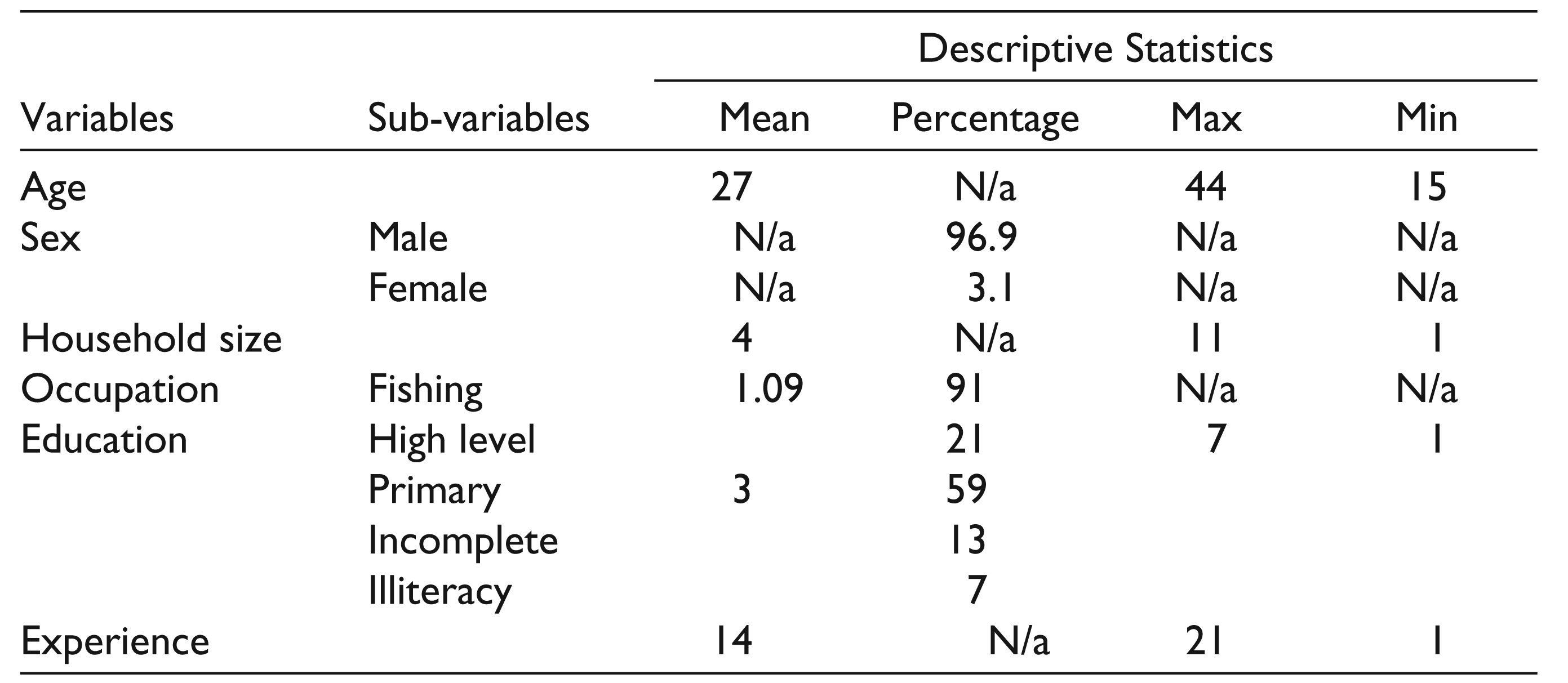
The descriptive statistics from the analysis of data shows that the mean average age of the fishermen is 27 years with a maximum of 44 years and a minimum of 15 years. Only 3.1 per cent of them were women and 97 per cent were men from the sample selected who were undertaking fishing activities. Moreover, 91 per cent of the respondents pursued fishing as their main income activity. With regard to level of education, the study found out that 79 per cent of all the fishermen had acquired primary education, incomplete or illiterate. The mean average fishing experience of the fishermen was found to be 14 years. Further details are shown in Table 3.
Socio-demographic Characteristics of Respondents (n = 289)
Common Methods for the Determination of the Landing Price
Artisanal fishermen face the challenges of landing price because of the existing behaviour of delays of payments for the requested landing price, and fishermen cannot reject a given selling price since fish are perishable goods. This poses a question on how landing price is determined. However, during an interview and FGDs with fishermen at landing centres, there are sorted methods used to determine landing price. These are informal negotiation with the fish processors, consultation with other traders in the landing centre, informal negotiation with buyers and a thorough price set-up by the BMU. These findings concur with those of Brummett (2000), Ngigi (2008), Kambewa (2007) and Lee (2014) and contrary with the studies by Gordon and Hussain (2015).
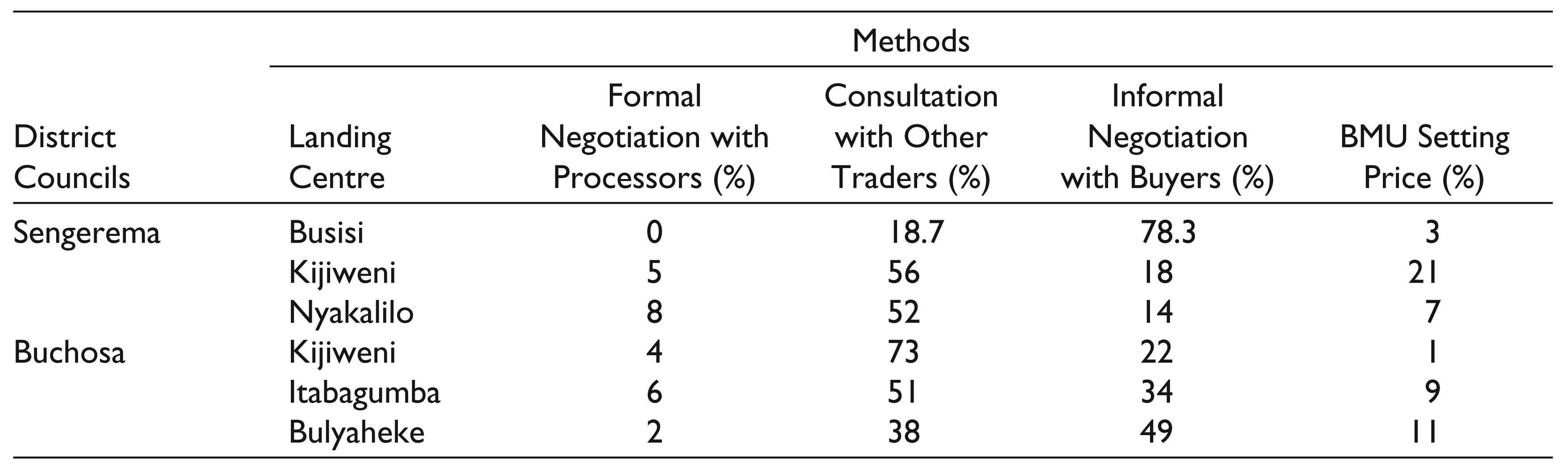
Table 4 indicates that less than 10 per cent of the fishermen managed to negotiate landing price with fish processors. This may be due to the low level of education and lack of fishing facilities to supply fish at quality conformed by processors and thus depends on initial buyers who are middlemen and other traders. A large percentage of the fishermen preferred landing price settings through consultation with other traders and informal negotiation with buyers. The two methods involve buyers and traders who are also middlemen, agents and mongers. However, during data collection, most of the BMUs were conducting general elections as directed by the district commission as a means to reduce the number of corrupted leaders colluding with buyers to exploit fishermen on the low landing price (Sharma & Biswas, 2018). A variation in percentage as shown in Table 4, for BMU role in different landing centres on setting a landing price, is due to leadership problems. During FGDs, one respondent from Kanyala said,
BMU leaders are thieves, they collude with buyers to set a price which is not a positive incentive, yet they are our relatives, that why DC call for re-election
In Table 4, over 50 per cent of the fishermen in Itabagumba, Kijiweni, Nyakalilo and Kanyala reached a selling price through market consultation with traders. Busisi has shown that selling price is reached through informal negotiation with buyers by 78 per cent. This indicates that being very close to township enables retailers (Machinga) access to fishermen. Moreover, during an in-depth interview, some of the fishermen reported that these methods will persist as long as daily fish price is not known until informed by middlemen or the BMU. This expected price is always low, and the major ground is that processors paid them low wages.
Methods of Determination of Landing Price (n = 50)
Factors Affecting Landing Price
The following subsections discussed the above findings as shown in Table 5 from the regression analysis of Equation (4).
Regression Results of Factors Affecting Fish Landing Price (n = 289)

Onshore Distance to Landing Price
During regression analysis on the coefficient of distance to onshore, distance from onshore to the landing centre was found to be statistically significant at 0.035, less than the p-value at 0.05. The coefficient is negative in relation to price change, implying that shorter distance contributes to the freshness of the fish, hence better price. With this result, complication in roads infrastructure and inspections for illegal fishing and fish transportations demotivate fishermen to reach other market centres in mainland. This tendency leave dominance to buyers who may have easily obtain fish permit and licenses which make it difficult to fishermen brought fish to the market centres without losing freshness. This finding is also supported in similar studies done by Brummett (2000), Lee (2014), whereby fishermen’s fresh fish were found to fetch higher prices in rural areas but not in urban markets and in shorter trips than in longer one due to the lack of storage mechanism.
Market Information Channels
Studies found that fishermen tend to increase the landing price when there are more market information channels. These are all stakeholders in the fishery sector interested in the growth of the fishing chain business. The results are positive and significant at p-value 0.0149, when p < 0.05. The increase in information about landing prices gives fishermen more power to negotiate the current price at the time of selling. Fishermen may meet more than one buyer at the time of selling. Supporting this was a qualitative finding response during FGDs which was as follows:
… before I sell to a marching guy, we usually make a call at two to three other different landing centers so that they can pass to us information about the current price of the fish …
A discussant explained the above quote at the Busisi landing centre during an FGD. This indicates that fishermen use other landing centres as information channels to set the landing price. Each of the landing centres has one BMU and acts as one formal channel of market price information. Ngigi (2008) finds that the market information unit established to collect price information and if capacitated lead to dissemination of relevant market information and thus stabilize market structure, conduct and performance.
Role of Fishermen’s Age on Landing Price
Furthermore, the analysis of the coefficient of age of the respondent shows that an increase of age that may lead to low power in bargaining and negotiation for landing price. The coefficient was significant at the 5 per cent level with a p-value of 0.02. With a mean age of 27 years, most of the young adults (aged 20–30) actively participate in fishing with the ability to negotiate landing price; however, the negative coefficient of age means that as the young one’s age increases, fishermen lose a control over landing price.
Fishermen’s Years of Experience
The years of experience of the fishermen have been found significantly affecting landing price with a coefficient of 0.002 at a 5 per cent level of significant. The implication shows that most of the fishermen are of a more advantage as they have more experience in fishing and thus are able to negotiate on landing price and recognize honest buyers. The new fishermen need support of the experienced ones in negotiating the landing price.
Distance to the Market Centres in the Mainland from Onshore/Offshore
This study also considers the effect of the distance to the market centres in the mainland during off-road to the other market locations if species where preserved for such purpose before met initial buyers. Therefore, the response from the findings showed that fishermen transported fish to the market from the landing centre at an average distance of 4 km. The coefficient has the p-value of 0.103 which is not statistically significant at p < 0.05, indicating that this distance does not affect the destination landing price. Similarly, a response from FGDs in the Nyakalilo landing centre supports the stated insignificant relationship:
… when I’m taking fishes to the market, already I know the price I’m going to be paid by a marching guy …
In relation to this, the insignificant effect of distance to the market centres, it implies that there is earlier communication between fishermen and buyers on determining landing price either formally or informally as stipulated in Table 4, and thus, distances from onshore to the market centres in the mainland may not affect landing price.
Availability of the Number of Buyers in Landing Centres
Findings show that the availability of the number of buyers for a given trip has a p-value of 0.776 which is not statistically significant at p < 0.05. This result implies that because of demand theory, as buyers increase, price will increase which is different from fishery markets where buyers dominate the market, and price determination has led to oligopolistic tendencies (Abila, Mbati, & Othiambo, 1997). However, the coefficient has a negative relationship with price indicating that artisanal fishermen meet with a number of agents or middlemen at landing centres who offer lower prices despite their numbers. Some of the fishermen during FGDs reported that middlemen and agents in their numbers colluded to set low landing prices. They also take the benefits of the lack of freezing, storage facilities and pricing information among fishermen to keep the landing price low. This is similar to Gordon and Hussain (2015) and Kambewa (2007) who also noted that middlemen (agents) collude and force fishermen to lower the prices.
Seasonality and Landing Price
The study also focused on the effect of seasonality towards landing price and the results were insignificant at p < 0.05. Seasonality captured if there is a change in landing price during rainfall, sundry and wind seasons throughout a year. This implies that rain, dry and wind seasons have no effect on the landing price as experienced by the fishermen. During changes in seasons, fishermen migrate to catch fish species that are varied in their availability per season. However, seasonality may affect change in the market price paid by consumers to middlemen due to market conduct of middlemen, which is not the focus of this study. A fisherman responded during an FGD at Kijiweni that:
You know, these Nile Perch likes wind, they like dancing with wind breezing, so we can’t say during the wind quantity catches diminishes. We get them easily.
This is consistent with Lokina’s work (2009) which argues that there might not be any significant variation in Nile perch availability at different times of the year, contrary to dagaa, whereas the peak and normal seasonal had a positive effect. Moreover, during an in-depth interview, artisanal fishermen argue that, as the season changes, fishermen also opt to catch species that are favourable in quantities, qualities and landing price as per that given season, whereby each species has its own seasonality advantage on landing price. Moreover, other seasons for small species were reported by fishermen and were given local names, such as Mwezi giza and Mwezitegeruko, meaning seasons for preparing catch and visiting home, respectively.
The Cost of Fishing Tools on Landing Price
Studies reveal that fishing tools were not a significant factor on landing price. This implies that fishing tools do not affect landing price. This may be due to the contract agreement with owners of fishing tools. As a result, each took a portion of fish as part of the agreement. Others may have to pay 60,000 TZS per month as a rent charge for a canoe.
Formal Education and Its Impacts on Landing Price
Moreover, the level of education does not influence landing price, and coefficient was insignificant at p-value, 0.867, which is greater than the 5 per cent level of significant. Knowledge and skills acquired at schools do not favour fishermen’s ability to get a better landing price. Moreover, according to 79 per cent of the respondents, their education level does not exceed primary education, meaning most of the fishermen are less knowledgeable in formal education which may contribute to less pricing and negotiation skills. The results state that formal education increases linkages and social networks among fishermen which provides opportunities in market linkage between themselves and buyers (middlemen) in Lake Victoria. This is consistent with studies by FAO (2005).
Conclusion
Therefore, by looking at the fish price determination methods and factors that affect fish landing price in Lake Victoria, formal negotiation with processors, consultation with other traders and informal negotiation with buyers and BMU are the common methods used to determine landing prices. Also, onshore distance trips, age, experiences of the fishermen and market information channels for landing price are factors that are found to statistically influence significantly fish landing price.
This study concludes that there are ways the fish price is determined in Lake Victoria. This price is affected by many factors. One of the ways fishes are priced is by mere agreement between fishermen and initial buyers. Artisanal fishermen tend to agree to the price offered by marching guys, agents, middlemen or relative. Fishermen usually believe sea fish will never perish and that they will sell at that given market price. This is by calling fishermen who are near the shore or landing sites..
During an in-depth interview and discussion study, findings showed that the fish price given to fishermen depends on a daily given price by the processors. Agents offer a price to fishermen after receiving information from the processors. When a daily given price is lowered by processors, that lowered price is down-streamed to fishermen by agents/middlemen, whereby fishermen are not connected to the up-streamed channels to explain their pricing problems. Thus, agents and middlemen gain more profit and lesser profits go to fishermen.
The effect of distance from onshore fishing to the landing centres has a positive effect to the landing price. Since at the end of day fishes need to be sold, the freshness of fish is very important for catch at a shorter distance. However, distance from onshore to the market was not significant to get a better landing price as most fishermen fear fish turning rotten due to lack of storage facilities. Moreover, usually fishermen found it costly in terms of transport facilities, storage facilities and likelihood of the availability of buyers to transfer fish to the consumer’s market. However, the change in the number of buyers did not affect the landing price since most of them were middlemen or agents and the price is determined by processing industries, and in their numbers, they may collude to set the landing price.
With regard to market information, different channels have been used by fishermen to get to know the landing price during their arrival from Lake. The coefficient was significant and positive such that fish landing price was useful to determine landing price. Others were the age and years of experience in fishing, and their coefficients were significant. Young adults with enough years of experiences were at an added advantage to get a better landing price.
It is recommended that the Ministry of Agriculture, Livestock and Fisheries facilitate fish price regulation in Lake Victoria. A regulatory body should be established and will monitor and guide the minimum price to be offered per kilogram (at the regional and export market price) or agreed amount on a given size of the fish. The emphasis needs to be done in collaboration with TAFIRI to develop a criterion for setting up a fish landing price. This will help the country achieve the UN Sustainable Development Goals’ 14 targets on providing access for small-scale artisanal fishers to marine resources and market. Fishermen should also be assisted with access to market and information channels by extending communication technology in the form of radio, television, cellular phones and computers in lake zones (FAO, 2005). Moreover, the increasing availability of microcredit services (SACCOS, VICOBA) and money transfer facilities may provide opportunities for improving fishermen’s access to more efficient fishing facilities and equipment to enhance better paid fish landing prices. The study generally concludes that fishery policy reforms must be in place for setting up fish market conditions with a responsible fishery price regulatory body.
Managerial Implications
The environment fishermen operate in does not support the market to be structured, and this has been influenced by players (agents, middlemen, buyers and marching guys); as a result, the conduct of the players has significant consequences in determining landing price, which leads to poor performance, and thus fish pricing does not thrive. These findings contribute to the structure–conduct–performance theory such that landing price could be easily determined if the fishermen decide to set a price as per input costs. Collusion may come in if they formulate fishery associations or co-operative societies. The information asymmetry theory is negatively to downstream players (fishermen and other labour men). This requires a formed and a reliable information system to monitor processors’/wholesalers’ selling price and distribute profits to the fishermen. Also, BMUs need to have a clear mechanism of landing price determination with support from local authorities linked with a developed market information system. Following a poor market structure, conduct and performance, the increase of buyers does not support demand theory because of collusion. The policymaker may restructure methods in determining fish prices and price information policies and provide skills to fishermen on various selling tactics that achieve specific market results at their landing centres.
Limitations and Future Research
This research was conducted by considering price factors which are easily identifiable by the fishermen. However, some other factors such as consumers’ preference on certain fish species, purchasing power by processors and export market price may affect demand thus affect landing price. The survey was based on fishermen’s cognition of landing price and not buyers or other domestic consumers in Sengerema and Buchosa; thus, the results could not be generalized to entire Lake Victoria, Tanzania. Future research should be based on the effect of consumers’ and processors’ choice in relation to landing price.
Declaration of Conflicting Interests
The authors declared no potential conflicts of interest with respect to the research, authorship and/or publication of this article.
Funding
The authors received financial support for the research, from Moshi Co-operative University(MoCU), Moshi- Tanzania.
Footnotes
Acknowledgements
The authors are grateful to the anonymous referees of the journal for their extremely useful suggestions to improve the quality of the article. Usual disclaimers apply.