



Abstract
Retaining employees in the organization has become very crucial especially in tough times. Losing skilled and experienced employees affect the overall productivity, profitability and product quality. While numerous studies have been carried out on this subject and the majority centre on turnover due to organizational approach, only a few studies have been done on intention to stay. Thus, the main purpose of this article is to examine the relationship among fit organization, organizational commitment and employee’s intention to stay in information and communication technology (ICT) industry in Malaysia. Quantitative method with self-administered questionnaire approach is followed targeting information technology (IT) managers of ICT with stratified random sampling of 105 IT professionals of ICT companies in Malaysia, based on the analysis using partial least square structural equation modelling (PLS-SEM) (PLS 3.0) to establish both measurement and structural model. From the empirical findings, it was revealed that there is a strong relationship between organizational commitment and intention to stay. The result also found that religiousness in the employees makes them to stay in the organization. This shows that while remunerations are crucial for the intention of employees, employee’s commitment is much higher than the intention initiatives.
Introduction
Information and communication technology (ICT) is more than just an essential sector in Malaysia’s economic development (Nurul, Norzanah & Roshidi, 2014). ICT is not just the industry which stands by itself, but also complements and supports the development of other industrial sectors. It is the enabler of development and increasingly critical to the government, private sector and the people of Malaysia. Even though the function of ICT has been extended from being merely an industry by itself to that of a vital, enabling component of every aspect of the economy, the intention to stay of information technology (IT) professionals is the main problem in this sector. In the years between 2011 and 2012, ICT industry was found first in the list according to the maximum turnover rate statement by Malaysian employment statistics. The turnover in the ICT industries was 75.72 per cent, which is the highest percentage as compared to the other industries in Malaysia. Researchers immediately need to pay their attention to reduce this big gap as well as to stay the employee in their existing organization. Thus, there is a need of immediate attention by the organization as well as research scholars to fill this gap of employee intention to stay in this sector. To get the real reasons, human resource departments have to determine and alert people’s observation. Sometimes the high wages or satisfying working situation cannot guarantee employees to stay in the organization. Hence, there are other issues that pressure people’s intention to stay in the organization. If the industry bears not as much of employee turnover, the intent of employees to stay in the assured industry is higher than others (Continue & Edeh, 2015; Sanjeevkumar, 2012).
Since organizations will not be able to function properly with insufficient IT workers, it is important for the organizations to prevent this problem from continuing. In addition, organizations need to recognize what factors influence the intention of ICT professionals to stay. Thus, the main objective of this article is to examine the influence of fit organization on the intention of IT professional to stay in the ICT industry. This article also examines the mediating effect of organizational commitment between fit to organization and intention to stay. The variables selected were conceptualized based on studies such as intention to stay (Ajzen & Fishbein, 1980; Woon, Tan & Nasurdin, 2017), fit organization (Mitchell, Holtom & Lee, 2001) and organizational commitment (Meyer & Allen, 1991).
The examination of relationship related with intention to stay is important because there is a great potential for managers to develop interventions that may facilitate the intention to stay in organizations and subsequently prevent the costs associated with staff turnover. It is important for the ICT organizations to know about how fit organization affects employees’ intention to stay. Furthermore, the relationship among fit organization, organizational commitment and intention to stay in Malaysian ICT industries has not yet been studied elsewhere. This has created a literature gap. Therefore, this study will try to find proffer solution to these challenges by looking at the relationship among fit organization, organizational commitment and employee’s intention to stay. There was two basic purposes to conduct this study first to evaluate the reliability and validity of the instrument and second to review the situation which allow the researcher to expect conceivable issue or problems.
Literature Review
Intention to Stay
Intention to stay is the propensity of employees to remain employed with their present organization (Naim & Lenka, 2017). It is a psychological procedure of connection with the organization (Hunjra, Ali, Chani, Khan & Rehman, 2010). Employees’ intention to stay has been a major discourse in the field of management and requires urgent attention on how best to make talented employees to remain as employees in a given organization. According to Rissanen (2017), intention to stay reflects employees are devoted to their jobs and organization to stay employed for long-term basis (Rissanen, 2017). There are different predictors of intention to stay which are categorized as individual-related, work-related, organization-related and exterior environment-related (Woon et al., 2017).
However, Woon et al. (2017) stated that there is diversity between employees’ retention and employees’ intention to stay in the organization. Two different strategies for employees are a pull strategy (i.e., what does the organization do to keep hold of its employees) and a push strategy (i.e., what are the essential factors that increase the motivation of employees to stay).
The main goal of every business is to render service and make profit to which the industry is no exception. This goal cannot be successfully achieved without the contributions and support of qualified talented employees. Continue and Edeh (2015) found a positive relationship between social intelligence and employees’ intention to stay. According to Radford, Shacklock, and Meissner (2015), personal factors (such as age, location of the job, health and family commitments) and organizational factors (such as job satisfaction, perceived supervisor support, job embeddedness, working environment, pay, career opportunities and job stability) have influence on intentions to stay.
Without employees, organizations will not be able to produce business results, achieve organization goals or meet its financial objectives (Continue & Edeh, 2015; Johanim, Tan, Zurina, Khulida & Mohamad, 2012). Thus, employee’s intention to stay or remain in an organization is very significant for the progress and success of the organization. From the early stage of modern human resource, human capital is one of the most important properties for the organization. The managers need to recognize the value of their employees by encouraging them to remain for their resource talent to be used and also discourage them from looking elsewhere for better opportunities. As a result, the organization would be able to utilize the knowledge of talented employees. To reduce the expenses of employee turnover, it is important for an organization to maintain a stable workforce so that the goal can be achieved successfully. As a consequence, employee’s intention to stay has steadily become a central part of an organization’s general commerce.
Most of the studies have paid attention on turnover-related concerns, whereas very few studies have focused on employees’ intention to stay. Thus, this article attempts to investigate the key dimensions of fit organization that influence employees’ intention to stay.
Fit Organization
Over the years, the concept of fit organization was commenced by Mitchell et al. (2001), on the dimensions of job embeddedness research. In job embeddedness theory, fit, links and sacrifice are mainly focused on employee’s intention to stay. A cross survey of literature by the authors exposes that there are a few studies that have mainly examined the power of the fit components on employee’s intention to stay. This theory stated that an employee’s personal values, career goals and plans for the future must fit with the demands of his or her immediate job. Fit describes an employee’s perceived compatibility or comfort with a community, an organization and a job. Therefore, the better the fit, the more chances to attach in the job. Given the apparent importance of the fit components as a probable motivator, employees’ organizational commitment and intention to stay at work are also essential to examine its relationship on retaining employees.
Fit organization is the compatibility pattern of organizational values with personal values (Chatman, 1989). The targets of an organization can be achieved when everyone admires the values of an organization and tries hard to accomplish its aim. This will happen if the organization respects the goals and personal values of their employees, meets up their desires and replies to their requests, welfare and wishes. Organization fit is one of the most vital deviations in the employment atmosphere of an organization and has been considered by researchers and employees in recent years (Taghvaei-Keshtkar & Riahi, 2016). However, theory and research have exposed that personal values is one of the important factors to evaluate the organizational fit (Reisi, Bahrami, Safdari & Shafiei, 2013).
Studies have found a negative connection between the organization fit and turnover intention. Verquer, Beehr, and Wagner (2003), for example, who conducted a meta-analysis of 21 studies, found that the organization fit was negatively associated with the intention to quit. In addition, another meta-analysis of 121 studies (1967–2003) by Hoffman and Woehr (2006) revealed that the organization fit was related to turnover. A similar result was found in a study by Jung and Yoon (2013), investigating deluxe hotels in Korea. In general, these findings have consistently shown that individuals with a fit organization tend to stay longer in an organization.
Personal Values
Personal values are constant, such as persons’ individuality that establishes an individual’s decision-making, problem-solving and behaviours (Eva, Prajogo & Cooper, 2017). Likewise, Henrique and Matos (2015) stated that personal values have been considered as a key construct in understanding employees’ behaviour.
Personal values have been anticipated to have an important power on decision making (Rokeach, 1973). In particular, it may be a dispute that personal values may drive him or her to act in a moral or immoral manner (Baird & Zelin, 2007). Personal values, although unusual in nature, are mostly inclined by communal and intellectual factors and tend to vary across nations (Lan, Ma, Cao & Zhang, 2009). Research shows that personal values control human behaviour and attitude, and they sometimes do not match with the values held by surrounding people of the workplace. Values give the base for human’s opinions that guide to the improvement of decision-making behaviours. Values can be conceptualized to be converted into criteria for declarations, predilections and preferences. For this reason, values are the important determinant of human behaviour. Studies have shown that the organization helps to encourage the behaviours of a person when his or her positive values will present strong corresponding behaviours (Suar & Khuntia, 2010). In organizational structure, the literature needs to consider the role that organizational structure plays in reducing or assisting work behaviours (Somech & Drach-Zahavy, 2013). In this study, we used three of personal value subscales, which are honesty, self-control and religiousness, to the theoretical framework.
Honesty
Honesty means to do something of being honest (Adeyeye, Otusanya, & Arowomole, 2016). Honesty can be clarified to represent frank or capable of being confidence, not likely to steal, trick or lie. The person who had these qualities is believed to be honest. Babalola, Stouten, & Euwema (2016) reported that honesty is the most important features that differentiate ethical leaders. Like this, they generate a truthful environment which has an influence on employee’s happiness and loyalty. Honesty, fairness and responsibility mirror the ethical leader as an honest person. In their study, they have found feedback about personal experience of frequent change, and employees take action to leave their jobs.
Antonio Chirumbolo (2015) investigated honesty as a moderator of the job insecurity impact on counterproductive work behaviours. Results explained that honesty moderated this relationship, even after controlling for gender, age, type of contract and the other behaviour. For persons with low honesty, job insecurity was positively related to counterproductive work behaviours, while persons with high honesty job insecurity turned out to be unconnected to counterproductive work behaviours.
Personal values have been one of the most significant determinants of work ethic (Vadi & Jaakson, 2006). The Rokeach Value Survey (RVS) has been used for the measurement of factors that may influence ethical behaviour (Mudrack, 1994; Shafer, Morris & Ketchand, 2001). Finegan (1994) and Mudrack (1994) found that the value honesty was the only value among the RVS which was a significant predictor of ethical judgements. Honesty is a key element of the human qualities or uniqueness for a number of career and different organizational environment. According to Sanders’ literature overview, honesty was established to be a necessary value of the individuality of good police officers (Sanders, 2003). Similarly, it has been stated as an essential attribute in the parts of auditing and accounting (Shafer et al., 2001). When there is lack of honesty from the manager’s side, employees often experience danger during the process of evaluation (Bates, 2002).
Self-control
Self-control is the persons’ capability to revise their circumstances and reactions as well as exerting control over feelings, passions, impulse, desires and performance (Van Gelderen, Kautonen & Fink, 2015). In addition, it is measured to be the deliberate, aware and effortful subset of self-regulation that is essential to people’s capability to get along with others and achieve goals (Ahlquist & Baumeister, 2012).
On the one hand, self-control is another essential antecedent of ethical characteristics because of its property to function as a ‘moral muscle’ (Baumeister & Exline, 1999). On the other hand, the stronger one’s self-control, the more possible it is to act ethically. Self-control can be said as person’s capability to adapt in order to offer a better fit between oneself and one’s environment. Therefore, it is the capability to abstain from acting upon disagreeable and ethically uncertain behavioural propensities. According to a study by Bolin (2004), low self-control has a tendency to dishonesty, which in turn is real intellectual dishonesty. On the other hand, high self-control would guide to take away dishonesty. In consequence, self-control is an encouraging antecedent of at least one quality of moral characteristics and honesty and is likely an antecedent of the remaining moral characteristics personality as well. In addition, according to Geyer and Baumeister (2005), self-control is, in fact, the ability to act ethically by prevailing people’s tendencies to behave badly. It is seen as desirable so that persons might behave virtuously.
Van Gelderen et al. (2015) examined the roles of self-control and action-related emotions in explaining the intention–action gap. The results show that self-control positively moderates the relationship between intention and action. Rua, Lawter and Andreassi (2017) observed the relationship among symbolic and internal moral identity, self-control and ethical behaviour. Findings indicate that internal moral identity overrides symbolic moral identity in the relationship with self-control and that self-control fully mediates the relationship between internal moral identity and ethical behaviour.
Religiousness
According to Mamman and Ogunbado (2016), religiousness is described as a gathering of enriching and faith scheme and world views that related kindness to religion and at times to decent value. It is one of the most important parts that influence on marketing decisions (Terpstra & Saratha, 2000). In addition, religiousness is a set of values, policies and ideologies that present an ethical and proper structure for being considerate, for motivation and for good behaviour (Hassan, Mohammad, Mohd, Rozilah & Ali, 2015). However, the advantage of religiousness in the place of work is that persons and organization found it extra inventive, fruitful and adaptive.
Belief in God comes with a commitment to follow ethics supposed to be set by God called religiousness (Siguaw & Simpson, 1997). Religiousness provides to control customer performance during the construction of an educational subsystem, which provides to work as a determinant of ‘the value and attitude structure of a people’ (Delener, 1990). Not only a power aspect but also religiousness provides cohesiveness of nations and cultures like in countries Iraq and Iran. Definitely, structured religions promote people to believe religious system of belief as part of a socialization development and its leading effects mediate the pressure of other institutions (Wilkes, Burnett & Howell, 1986). Such sub-cultural power is constant and enveloping, and the ensuing consumption behaviours help ‘behavior that describes people’s culture’ (Delener, 1990).
Career Goals
As several careers, research works, career goals and career satisfaction are used as exchangeable in this study. A career goal of an employee is a very transparent picture of his or her own future, and it can give an aim that guides one’s dealings towards the fulfilment of important needs. Career satisfaction is frequently appraised as an individual career success (Joo & Ready, 2012). In addition to commencing the organization’s viewpoint, a career goal is thought to encourage successful job routine as well as provide as a source for useful human resource planning. Furthermore, an exact career goal can make tunnel image, parting employees, as a result they refuse to accept new information concerning the capability of goals (Greenhaus & Callanan, 1994). In reality, people can be so resolute by the desire to achieve the actual goal that they drop flexibility and adaptability. Career satisfaction is another major factor that determines employee intention to stay, which is opposite of employee’s turnover (Joo & Park, 2010). B. Liu, J. Liu and Hu (2010) researched with Chinese context and found that fit organization had a significantly positive effect on job/career satisfaction and a negative effect on turnover intention. Moreover, in organization fit, the compatibility between employees and organizations is emphasized (Kristof-Brown, Barrick & Stevens, 2005). In other words, the better the organization fit, the less likely the employees are to quit. Thus, we examined the role of career goals to determine fit organization on intention to stay in this study.
Organizational Commitment
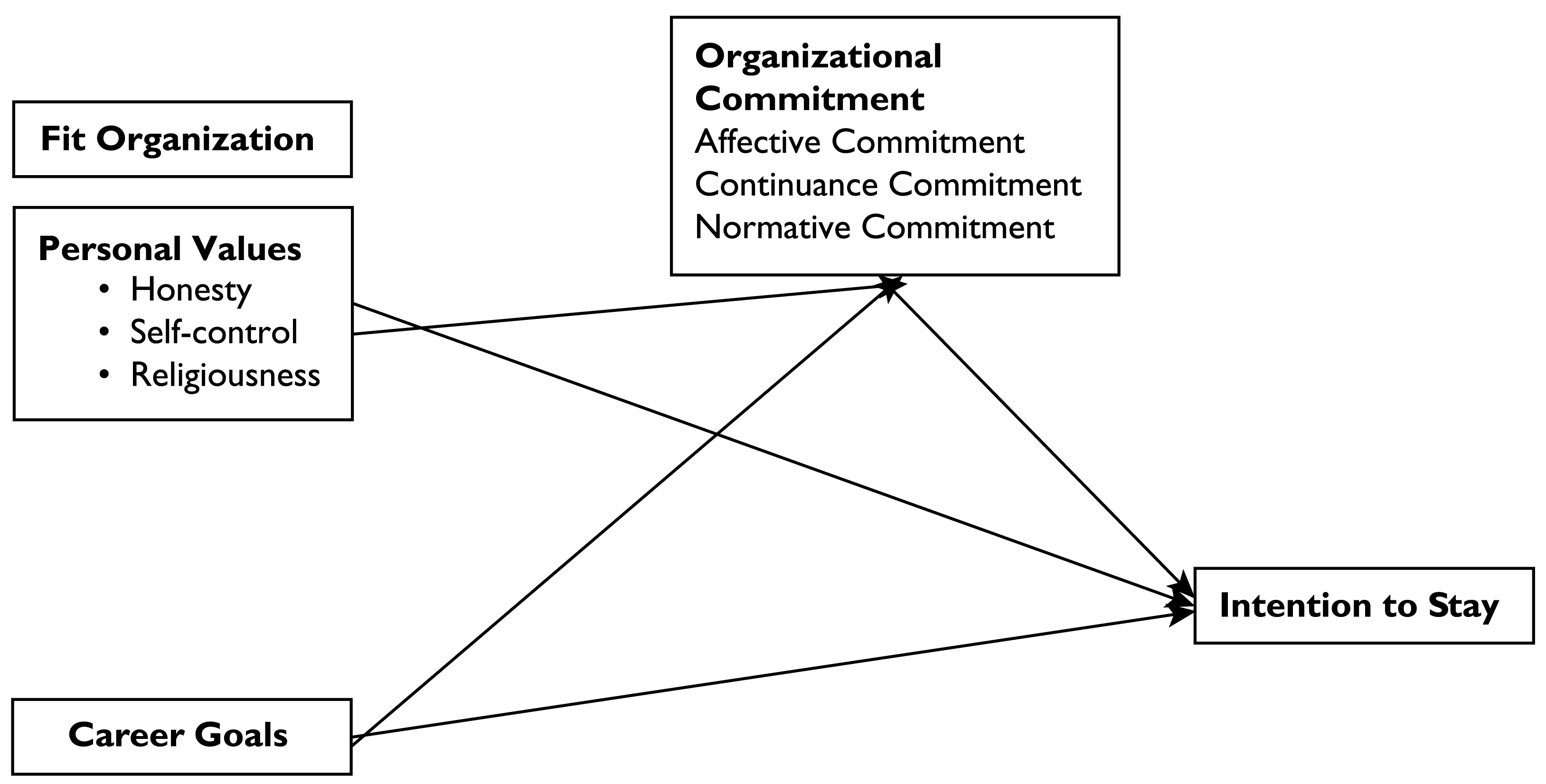
Organizational commitment influences an employee’s intention to stay or leave an organization. One of the goals of this study is to assess how organizational commitment relates to ICT professional’s intention to stay with a company. For a better understanding of this relationship, it is necessary to understand the concept of organizational commitment. Organizational commitment is an aspiration for an employee to be in the right place of an organization and motivation to put more effort for the profit of the organization (Sani, 2013). Similarly, Rubel, Rimi and Walters (2017) mentioned that there is a need of supportive working environment that will demonstrate employee’s commitment to empowerment, communication, participate and engagement with long-lasting relationship. In addition, knowledge transfer and acquisition have significant effect on human resource and employee’s intention to stay (Nguyen & Aoyama, 2014). Several years ago, the concept of organizational commitment has been designed by researchers. Organizational commitment is observed as an emotional bond that persons have with their association. It can also be described through a strong classification with the organization and aspiration to include the achievement of organizational goals (Meyer & Allen, 1997). Job satisfaction, organizational citizenship and intention to stay or leave are some of the workplace-related behaviours which are derived by organizational commitment. Currently, the problem is to retaining employees who are able to include significance to an organization (Balassiano & Salles, 2012). Therefore, Meyer and Allen’s (1991) three-component model of organizational commitment is relevant to this research. The authors’ classified organizational commitment is reflecting three core themes as follows: affective commitment, continuance commitment and normative commitment. Commitment can be seen as an affective point of orientation towards the organization (affective commitment), acknowledgement of the expenditure related to leaving the organization (continuance commitment) and an ethical liability to stay with the organization (normative commitment) (Meyer & Allen, 1991). Figure 1 shows the conceptual framework that is based on previous studies and underpinning theories related to employee intention to stay.
Research Method
Conceptual framework was developed as illustrated in Figure 1. Using this framework, the impact of fit organization on employee’s intention to stay and organizational commitment is investigated. The following hypothesis is proposed: Personal values have a positive effect on intention to stay. Career goals have positive effect on intention to stay. Organizational commitment mediates between personal values and intention to stay and mediates between career goals and intention to stay.
Research Approach
Survey Design
A quantitative analysis was conducted to ascertain the measures of variables through a self-administered questionnaire. The study adopted descriptive research design which is cross-sectional in nature. According to Sekaran and Bougie (2010), self-administered questionnaire helps the researcher to create more understanding with the respondents while introducing the survey. Unit of analysis was individual IT professionals. The sampling technique was divided into two steps. In choosing the participating organizations, simple random sampling used as the list of world-class status was taken from the Multimedia Super Corridor (MSC), which is obtained to represent the ICT professionals’ population of Malaysia. Then, the second step of sampling was purposive sampling, as there is no list of industrial staff. There are three important parts in the questionnaires. Part A is the demographic information, part B is personal values, career goals (fit organization), and part C contains intention to stay. A five-point Likert scale ranging from ‘strongly disagree’ to ‘strongly agree’ was used in the questionnaire. A total of 120 sets of questionnaires were distributed through stratified random sampling to the executives/managers of ICT companies in Malaysia. For purpose of this research, the PLS-SEM is chosen. The software Smart PLS 3.0 was utilized to perform the analysis (Ringle, Wende & Becker, 2015; Shah, bin Othman & bin Mansor, 2016). Smart PLS is one of the main applications for PLS-SEM. This software developed by Ringle, Wende and Will (2005) is a user friendly interface and has advanced reporting features.
Characteristics of Sample
Table 1 shows the demographic profile of 105 respondents in this study. They are working in different Malaysian ICT companies. Among this respondent, 79 per cent people are Malaysian. There are 57 females and 48 males among these respondents. The age limit of these respondents is from 26 years to 35 years, which is around 52 per cent of the total sample. Regarding the marital status, 59 participants were single, followed by 44 participants as married and 2 participants as others. In the case of academic qualification and job experience, 67 per cent respondents have the bachelor’s degree. Furthermore, regarding the job position, senior executives were around 49 per cent. In addition, 51 respondents were having 1–5 years of job experience. In total, 52 per cent of employees were on their job for 1–5 years in those companies. The salary range of 47 per cent respondent was RM 2500 to RM 5000.
In this study, a total of 120 questionnaires were distributed to the IT professionals, especially, executives/managers of ICT industries in Malaysia. Therefore, the outcomes of these attempts yielded 113 returned questionnaires. This gives a response rate of 94 per cent based on Jobbers (1989) definition of response rate. Of these 113 questionnaires, 8 were unusable because a significant part of those questionnaires was not completed by the participants and the remaining 105 usable questionnaires were used for further analysis. This accounted for 92 per cent valid response rate. Therefore, a response rate of 92 per cent is considered to be adequate for the analysis in this study because Sekaran (2003) suggested that a response rate of 30 per cent is sufficient for surveys (Table 2).
Data Analysis
Assessment of Measurement Model
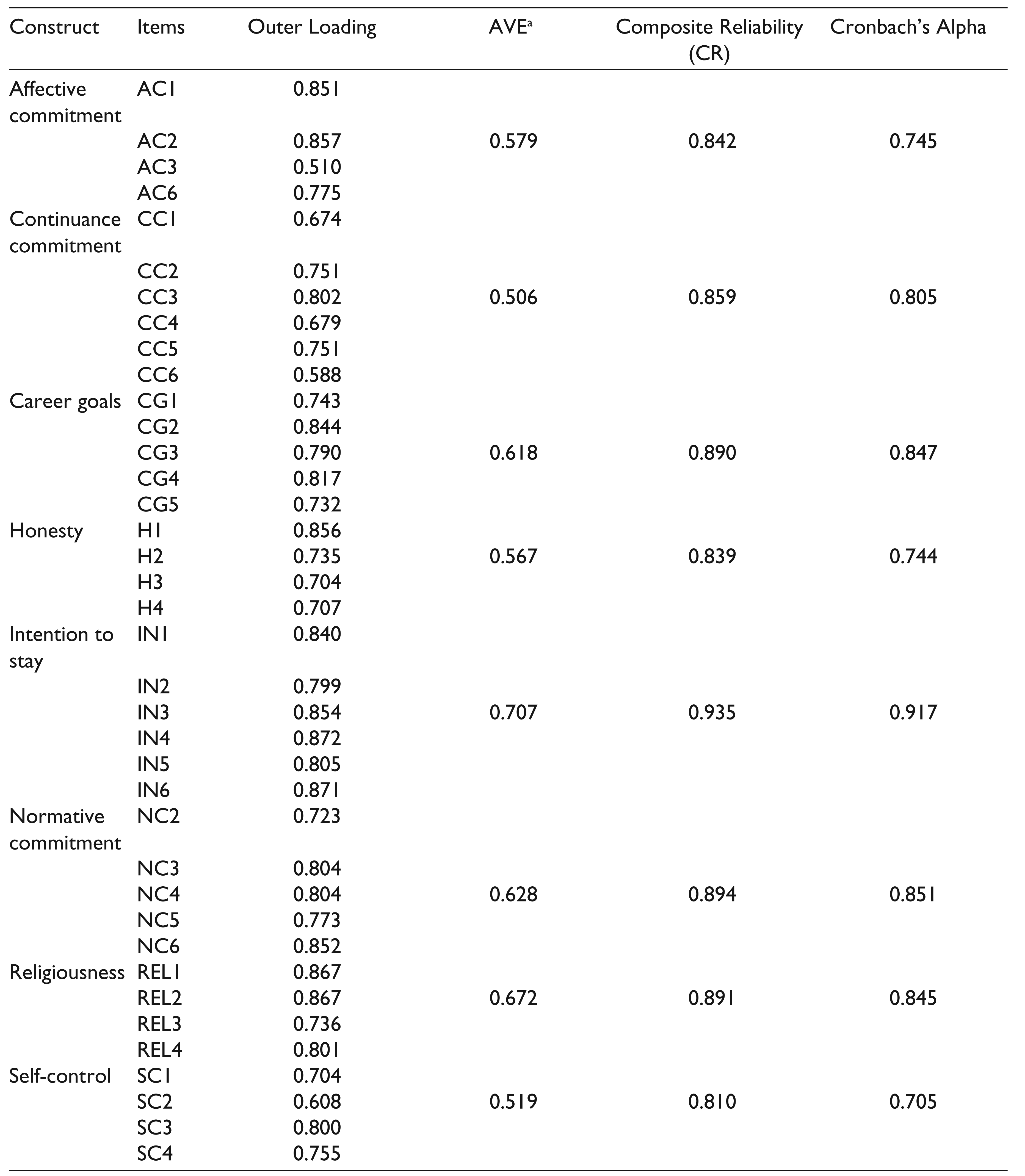
To organize measurement model, the study is reflected to affect the standard, which are anticipated by Hair, Hult, Ringle and Sarstedt (2013) and Wong (2013). According to the authors, composite reliability, outer loadings, Cronbach’s alpha, average variance extracted (AVE for convergent validity) and discriminant validity, which is determined by heterotrait-monotrait (HTMT) data ratio, Fornell–Larcker criteria were assessed to examine the measurement models. Discriminant validity is achieved when the model and its constructs are free from redundant items (Panigrahi, Zainuddin & Azizan, 2014). This is in line with the criterion that a Cronbach’s alpha coefficient of 0.60 is considered as an average reliability, while a coefficient of 0.70 or higher indicates that the instrument has a high-reliability standard (Hair, Black, Babin & Anderson, 2010; Sekaran & Bougie, 2010). Hair, Ringle and Sarstedt (2011) suggest that the composite reliability coefficient should be at least 0.70 or more. The closer the value is to 1, the more reliable the instrument is and shares a high internal consistency. Meanwhile, Fornell and Larcker (1981) suggested that the AVE score should be 0.5 or more. They further stated that to achieve adequate discriminant validity, the square root of the AVE should be greater than the correlations among latent constructs.
Summary of Respondents Demography

Response Rate of the Questionnaires

Table 3 shows that Cronbach’s alpha of the variables used in this study ranged from 0.70 to 0.91 and the composite reliability coefficient of the variables ranged from 0.81 to 0.93, which showed that internal consistency reliability of the measures used in this study is above the minimum acceptable level of 0.70, which also suggests adequate internal consistency reliability of the measures for further analysis (Peterson & Kim, 2013). Likewise, the AVE values for the constructs ranging from 0.50 to 0.70 are more acceptable than the threshold value of 0.50. It indicates that the measures are capable of explaining more than 50 per cent of the constructs’ variances. Furthermore, majority of the outer loadings of the constructs are well above the minimum threshold value of 0.70 (Table 5). Indicators with outer loadings below the threshold of 0.5 were deleted. However, according to Neupane, Soar, Vaidya and Yong (2014), Wong (2013) and Lew and Sinkovics (2013), if the research is exploratory, the loading scores should be at least 0.40 or greater than this score. Therefore, according to these authors, the loading scores are well above the minimum value.
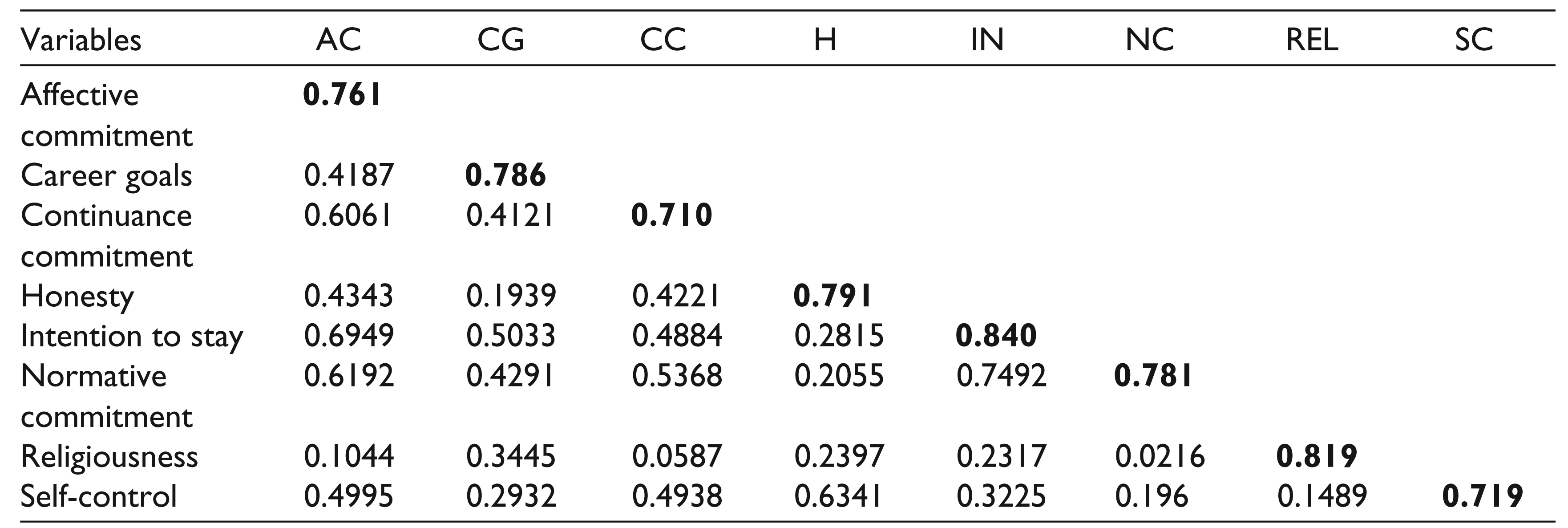
Conversely, discriminant validity was evaluated using the criteria suggested by Fornell and Larcker (1981). The authors suggested that discriminant validity is achieved when the square root of each construct’s AVE is higher than the correlation of the construct to other latent variables. Table 4 showed that the correlations between the variables and the values of the square root of the AVE, which clearly indicates that all the diagonal values are greater than the correlation among the variables, suggesting adequate discriminant validity (Fornell & Larcker, 1981). In addition, a new approach in assessing discriminant validity of variance-based SEM is HTMT ratio of correlations (Henseler, Ringle & Sarstedt, 2015).
As shown in Table 5, the maximum HTMT value is 0.844, and this is below 0.85 (Kline, 2011), which is the most conservative critical HTMT value. Hence, the result further confirms that the discriminant validity has been established.
Assessment of Structural Model
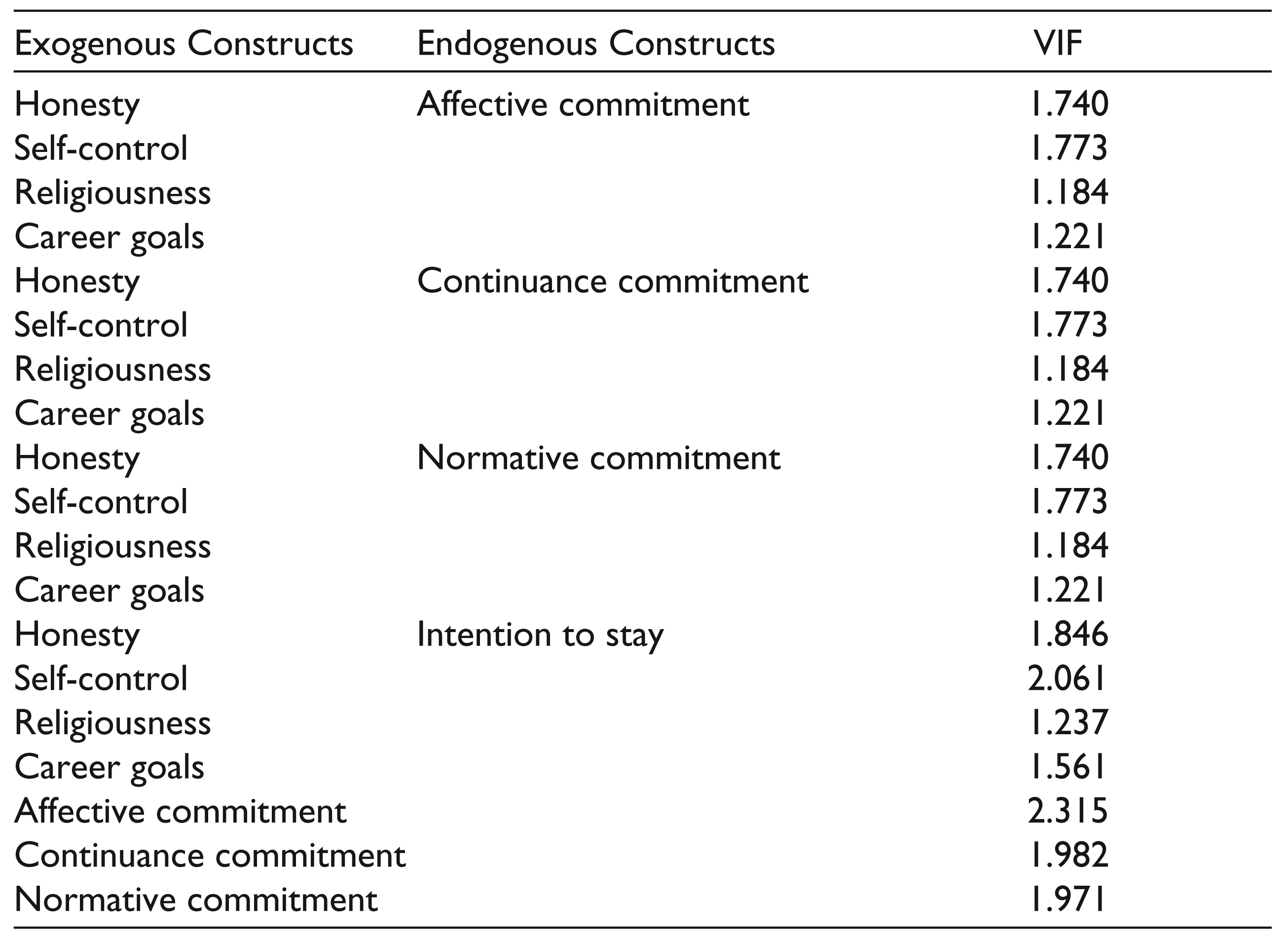
The next step, assessment of structural model, is to examine the collinearity of the predictor constructs through variance inflation factor (VIF) (Ng, Kuar & Cheng, 2016). Therefore, the study examined collinearity problem by Smart PLS 3.0 version, and the results indicate that the values of the predictor constructs were lower than tolerance level, which is VIF value of 5.00. Following this step, the structural model was assessed. Table 6 indicates that the VIF values for all the predictor variables are far below the threshold of 5 (Hair, Black, Babin & Anderson, 2014), indicating no problem of multicollinearity.
Construct Validity
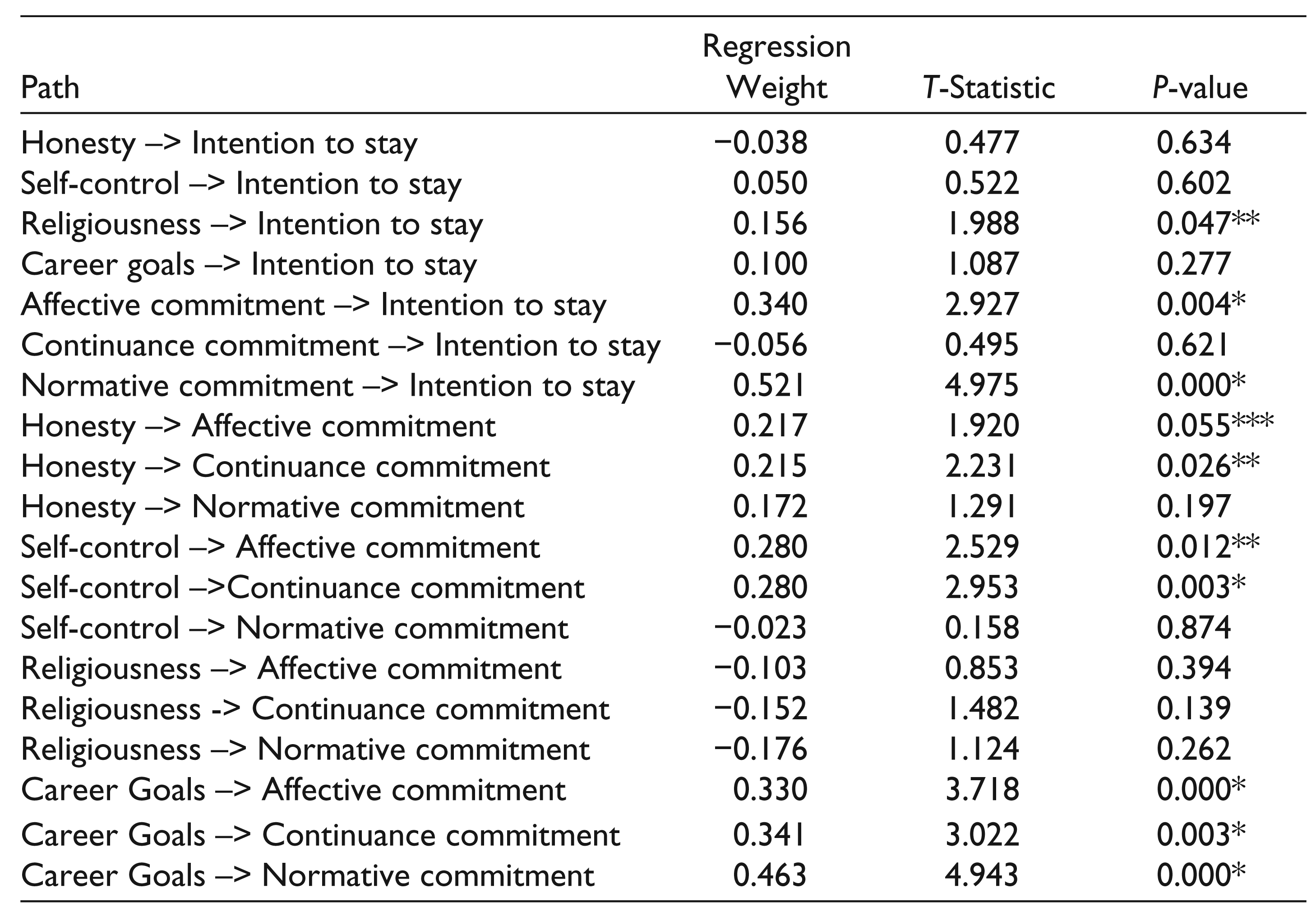
In PLS-SEM, structural model’s validity is assessed through the strength of regression weights, t-values, p-values for significance of t-statistics as well as effect sizes of independent variables on the dependent variables.
In this study, the results of structural path model to test the relationship of variables have been shown in Figure 2, which are the relationship of personal values between intention to stay and honesty (ß = −0.038, t = 0.477), not significant, self-control (ß = 0.050, t = 0.522) not significant and religiousness (ß = 0.156, t = 1.988) significant. In particular, it indicates that personal values were significantly influenced on organizational commitment, honesty to affective commitment (ß = 0.217, t = 0.055), honesty to continuance (ß = 0.215, t = 0.026), self-control to affective commitment (ß = 0.280, t = 0.012), self-control to continuance commitment (ß = 0.280, t = 0.003) but honesty to normative commitment (ß = 0.172, t = 1.291) and (ß = −0.023, t = 0.158) are not significant. In addition, the relationship of career goals was significant influence, career goals to affective commitments (ß = 0.330, t = 3.718), career goals to continuance commitment (ß = 0.341, t = 3.022) and career goals to normative commitment (ß = 0.463, t = 4.943) with organizational commitment. But career goals to intention to stay (ß = 1.00, t = 1.087) is not significant. On the other hand, the relationship of religiousness is significant with intention to stay so that organizational commitment is also not significant (Figure 2).
Discriminant Validity Results Based on Fornell–Larker Criterion
Discriminant Validity Results Based on Heterotrait-monotrait (HTMT) Ratio of Correlations

Collinearity Values among Exogenous Constructs
The result from Table 7 showed that personal values (honesty and self-control) insignificantly influence and religiousness significantly influence intention to stay; career goals are insignificantly related with intention to stay. For organizational commitment, affective commitment is not significant and continuance commitment is also not significant, but normative commitment significantly influence intention to stay. On the other hand, personal values are related with organizational commitment; honesty is significantly related with affective commitment and continuance commitment but not significant with normative commitment. Self-control is significantly related with affective commitment and continuance commitment but not significant with normative commitment. Likewise, religiousness insignificantly influence affective commitment, continuance commitment and normative commitment. Moreover, career goals significantly influence affective commitment, continuance commitment and normative commitment.
The measures of R-square are the analytical power of the structural model in PLS analysis. The analytical power of every independent variable and their respective dependent variables was conducted by eliminating each of the dependent variable in question, one at a time in an iterative process. The effect size is estimated as shown in Table 8.
This implies that the dependent variable intention to stay and organizational commitment are jointly calculated as intentions and adopted significantly. Table 8 shows the results of R2 versus Q2. The effect size of dependent variable intention to stay R2 = 0.691 with a Q2 values is 0.442, which is large, affective commitment R2 = 0.362, Q2 = 0.186 is medium, continuance commitment R2 = 0.361 with the value of Q2 = 0.158 is also medium and normative commitment R2 = 0.226, Q2 = 0.120 is weak, which recommends significant effect sizes. In accordance with Hair et al. (2013) in SEM models, predictive relevance (Q²) values must be greater than zero for a particular construct (using cross-validated redundancy is recommended). Following performing blindfolding procedures, all predictive relevance values in the model are significantly above zero, which supports the model’s predictive relevance for the endogenous constructs.

Results of Structural Path Model
Results of R2 and Q2

Discussion
In this study, we found that fit organization, personal values, career goals and organizational commitment influence employee’s intention to stay. The findings represent one of the most critical issues faced by Malaysian ICT industries nowadays. Even though there are many researches carried out on intention to stay over the world, in Malaysian context, this subject of study is the smallest. For that reason, this study measured fit organization as a suitable model in Malaysian background. The results of this study have pointed out the significance of more in-depth study on employee’s intention to stay in Malaysia.
The relationship among fit organization, intention to stay, personal value subscale named honesty and self-control is negative but religiousness is positive with intention to stay. Some of the researchers (Ji, 2004; Sapp & Gladding, 1989; Thomas, 1997) have found that there is a positive relationship between the personal value of religiousness and ethical decision making. On the other hand, in their study, Alleyne et al. (2013) originated that personal value subscales (honesty, intellectualism, self-control and religiousness) were negatively related to intentions to engage in unethical behaviour. Finally, the study established that honesty and self-control predicted intentions to engage in unethical behaviour among the overall sample. In addition, honesty and self-controls are significantly related with organizational commitment (affective commitment and continuance commitment) but not significant with normative commitment. Although religiousness is in negative relation with organizational commitment, the result also unsuccessfully validates the experiential link between career goals and intention to stay in this study. This signifies that intention to stay among the respondents is not attributable to the presence of meaningful work, opportunities to upgrade their capability as well as promotion opportunities. This result was similar to the findings in past studies of Johanim et al. (2012), where they found negative relationship between career development and intention to stay. Furthermore, this study attempts to investigate a relationship among fit organization, organizational commitment and employee’s intention to stay. The overall results showed that fit organization has no direct relationship with intention to stay. However, there was positive relationship between fit organization and organizational commitment. Therefore, this study suggested that three dimensions of organizational commitment can make high fit organization and intention to stay.
Conclusion
This study obtained statistical evidence on the cross-sectional study having affective commitment influencing 35 per cent influence on intention to stay and 15.6 per cent influence by religiousness towards intention to stay. The result of this study indicated that fit organization with the mediating role of organizational commitment comes out to have a good relationship on ICT professionals’ intention to stay in the organization. The higher the fit organization and commitment that the ICT professionals are having, the higher their intention to stay will be. Fit organization that could lead to employees’ intention to stay is an area that is still unknown, especially in the Malaysian environment. Throughout the examination of these relationships on intention to stay, an absolute understanding of the best approach to retain employees will be achieved.
Managerial Implications
In terms of implication, the present study will contribute new information to the body of literature especially one that related to employee’s intention to stay. The findings will be providing with empirical evidence on the direct relationship among fit organization, organizational commitment and intention to stay. This study will be the first attempt in evaluating the direct effect of employee fit to organization and intention to stay in Malaysian IT sector. Because IT sector plays a crucial contribution to the country’s economic growth (Zhao & Rashid, 2010), the findings of this study will provide fruitful implications for both HR practitioners and academics alike. On the academic front, this study makes a significant contribution to the HR management literature related to the IT sectors in developing countries of Asia. It is expected that results from the study will encourage new thinking among the managers on how to retain their skilled worker.
Footnotes
Acknowledgements
Authors would like to acknowledge University Malaysia Pahang, Malaysia for providing financial support through the project GRS130371. We are also grateful to the anonymous referees of the journal who have provided extremely useful suggestions to improve the quality of the manuscript.