



Abstract
This study empirically investigates the impact of institutional ownership on stock liquidity; we used a sample size of 84 non-financial companies listed on Karachi Stock Exchange (KSE). Data were gathered for the period of 10 years, starting from 2005 to 2014. This study employs turnover ratio to measure stock liquidity while institutional ownership is measured by dividing number of shares kept by institutions from total number of outstanding shares. The fixed effect model shows that the degree of stock liquidity in Pakistani-listed firms tend to significantly increase for the firms where institutions hold a significant amount of share of that particular firm. This study also finds that ownership by bank and investment companies are positively associated with liquidity, while relationship between ownership by insurance companies and stock liquidity is found to be insignificant. Our evidence supports that many but not all institutional investors play a positive role to improve stock liquidity in Pakistani capital market. The results of this study are important for dealers, traders and brokers, in the sense that they can facilitate investors in efficient resource allocation.
Introduction
Institutional investors are considered as a common feature of modern capital market. They play an important role to bring stock liquidity in financial markets. Although institutional ownership has been considered as a stabilizing factor in emerging markets, questions have been raised about the impact of institutional ownership on stock liquidity. Much has been written in the field of finance that examines the effect of ownership structure on stock liquidity (refer e.g. Agarwal, 2009; Lee, 2011; Liu, 2013; Rubin, 2007). Many early studies have focused on developed markets; research on liquidity in emerging markets is attracting increased attention. The growing body of research in emerging market is important for many reasons.
First, developed markets are more advanced and progressive markets, which differ from developing markets. Emerging markets have higher information asymmetry, different market dynamics, different ownership structure, limited access to debt financing and nature of businesses (Ma, Anderson & Marshall, 2016). Second, while doing research on the institutional investors and stock liquidity relationship, most studies have considered institutions as both identical and total ownership. However, in fact all institutions are not completely similar and usually differ according to their features. Institutional investors differ with respect to their types and functions and even have different investment time frames (Bushee, 1998).
We investigated this premise by observing the effects of institutional ownership on stock liquidity. For this study, we used non-financial firms of Pakistan as our empirical setting because of two important reasons. First, capital market of Pakistan is leading among the emerging markets in terms of institutional ownership. Most of the shareholders are intuitional investors in the sense that a large number of shares are owned by institutions from a total number of outstanding shares. Second, the capital market of Pakistan has achieved major development status in term of regulatory changes, market performance and improved management. These developments in financial market and firm performance make this topic under investigation; particularly it is interesting to investigate the impact of different types of institutional ownership on liquidity. Institutional investors play a major role in the development of Pakistani capital market.
Moreover, recently the shares owned by the institutional investors have increased considerably in Pakistan (Shaikh, Iqbal & Shah, 2012). It is frequently argued in the literature that institutional ownership plays a significant role in financial market to stabilize liquidity; there exists a relationship between the institutional ownership and stock liquidity (Attig, Fong, Gadhoum & Lang, 2006). Though liquidity is important for making investment decision, yet it is not clear whether institutional investor could affect liquidity or not in emerging markets. However, institutions might play a pivotal role in managing financial risk (Agarwal, 2009). Generally, investors expect positive return (premium) from their chosen stocks and want certain level of stock liquidity so they can buy or sell their securities without any significant loss. Many institutional investors evaluate their investments on the basis of liquidity and liquidity risk; the value of a security means nothing if they cannot find a buyer for that security in the market (Pastor & Stambaugh, 2003). Therefore, stockholders like to look at liquidity as an instrument to measure expected return of stock, how easy it would be to sell the asset or security in stock market. Recent studies predict institutional ownership could affect liquidity of stock (Lee, 2011).
Economic theory suggests that institutional ownership and stock liquidity have a positive relationship. While studying relationship between institutional ownership and liquidity, researchers mainly focus on two important hypotheses, for example, trading hypothesis and adverse selection hypothesis. The trading hypothesis suggests that when investors trade frequently or shuffle their portfolios more often, it reduces transaction costs, which ultimately increase stock liquidity (Merton, 1987; Schwartz, 1988). On the other hand, adverse selection hypothesis posits that when buyers and sellers have access to different information, investors with better information of stock (e.g. informed shareholders, insiders and institutional investors) will gain more advantage compared to outsiders, which increases asymmetry and reduces liquidity (Kyle, 1985; O’Hara, 2003). It has been also reported that higher stock liquidity leads to improved sharing of financial risks by affecting stakeholder’s risk management and other trading decisions (Sadka, 2010).
This study has thoroughly examined the relationship between institutional ownership and stock liquidity. We further shed light on the behaviour of investor type and stock liquidity by analysing the relationship between these two variables. We suggest implications using finance theories that link ownership characteristics to liquidity and find how institutional investors influence liquidity of stocks and whether these results vary with institution types.
This study makes significant contributions to the literature connecting liquidity and institutional ownership. Agarwal (2009) finds that institutional ownership positively affects stock liquidity. Liu (2013) shows that increase in the number of institutional investors lead to increase in stock liquidity. Whereas Cao and Petrasek (2014) find that institutional ownership reduces liquidity risk of stock. We contribute to this literature by investigating the relationship between stock liquidity and ownership by different types of institutional investors, such as banks, investment companies and insurance companies. Our main innovations to the literature is that we considered institutional ownership as a heterogeneous group while other studies have deliberated institutional ownership as homogeneous (collective) group, without decomposing it to the different types of institutions. Results of this study are important for dealers, traders and brokers, in the sense that they can facilitate investors in efficient resource allocation and investment decision-making.
The remainder of this article is organised as: Second section presents an overview of previous literature related to the study. The third section describes the methodology used for this study, which means how the research is being conducted and briefly introduces other control variables. And the fourth section describes results and findings obtained via Eviews and MS-Excel. Finally, this study gives conclusion and recommendations.
Literature Review
Current literature is enriched with theoretical studies and empirical explanations on liquidity and institutional ownership. Finance literature documents liquidity as the ability to quickly sell securities without any significant loss and with no price impact; whereas institutional ownership is the proportion of outstanding shares owned by different type of institutions such as banks, mutual funds, hedge funds, investment and insurance companies vice versa (Bushee, 1998). Various studies have been conducted to investigate the impact of institutional ownership on stock liquidity starting with a paper of Rubin (2007); this study explains the relationship between ownership structure and stock liquidity of NYSE-listed firms. Results of this study show that ownership by institution is more significantly associated with liquidity than individual ownership.
Similarly, Agarwal (2009) argued that institutional ownership affects both the variation in stock liquidity and market liquidity. He also reported that liquidity is significantly influenced by institutional investors because they have more information and may influence stock liquidity in two ways: they lower liquidity due to low information symmetry, which is called adverse selection hypothesis, and the other is improving stock liquidity resulting from the rivalry of price stability process among different institutions, which is known as information efficiency effect. It has been also argued that institutional ownership statistically and significantly affects stock liquidity (Blume & Keim, 2012). Institutional investors are considered as more informed traders due to their high investment, and being a part of an institution, they get more private information (Fehle, 2004).
There are different perspectives about the effects of institutional ownership on stock liquidity. Cao and Petrasek (2011) argued that institutional investors increase stock liquidity by affecting the sensitivity of stock’s return to change liquidity in financial market. Similarly stocks with larger increase in the number of institutional investors tend to be less illiquid than other stocks. Institutional ownership leads to increased stock liquidity because active and more informed investors exert higher impact on liquidity than any other investors (Liu, 2013). Moreover, findings of Yaghoobnezhad, Roodposhti and Zabihi (2011) reveal that institutional ownership can affect stock liquidity in two ways because of their various advantages: First, increase in liquidity risk due to the higher information asymmetry which is called adverse selection effect or hypothesis. Second, decrease of liquidity risk due to the increase of price recovery caused from the competition among institutional investors. They also argue that the percentage of institutional ownership is positively associated with stock liquidity, while ownership concentration is inversely associated with liquidity of stocks.
Others argue that institutional ownership affects stock liquidity in the opposite direction. For instance, Rhee and Wang (2009) have investigated the relationship between liquidity and institutional ownership by particularly examining the effects of institutional investors on the stock liquidity in Japan. Findings reveal that ownership by institutions has an inverse impact on stock liquidity and positive impact on liquidity risk. However, recent studies document that insider investors, financial institution and financial experts have more information than individual investors. Individual investors have less access to information as compared to institutions; shares held by institutions have greater liquidity than those held by individuals (Zhou, 2011).
Furthermore, other types of institutional investors such as investment companies, hedge funds, mutual funds and bank ownership could also affect stock liquidity. Typically, bank ownership has the unique ability to trade against liquidity risk because they have experience of cost and other funding that covers negative market-wide liquidity. Therefore, bank ownership could increase stock liquidity (Gatev & Strahan, 2006). Syamala, Chauhan and Wadhwa (2014) studied the impact of institutional ownership on stock liquidity and showed that the inverse relationship between these variables is typically driven by commercial banks and foreign ownership. Whereas the relationship between retail ownership and sock liquidity is found to be positive and institutional investors tend to hold higher liquid securities as compared to other investors; institutional investors substitute for informed investors and prefer to invest in liquid stocks to avoid illiquidity cost. Moreover, Syamla et al. (2014) also evidenced that institutional investors like to hold liquid stocks because they act as informed traders.
Similarly, Cao and Petrasek (2014) found a negative relationship between bank ownership and liquidity risk of stock; stocks held by banks are more exposed to market liquidity than similar stock held by other institutional investors or individuals. Sias (2004) argues that mutual funds and hedge funds could decrease stock liquidity. Mutual funds herd trading behaviour of investor while hedge funds use high level of leverage. Ajina, Lakhal and Sougne (2015) show that ownership by insurance company increases stock liquidity because they use hedging techniques to overcome financial risk and trade against negative market liquidity. In contrast ownership by investment companies is positively associated with liquidity risk (Cao & Petrasek, 2014). This implies that investment companies positively affect stock liquidity in the cross section.
Several factors can affect liquidity of stocks. Glosten and Milgrom (1985) argued that one source of liquidity is the presence of insider ownership. They are more informed traders than others, which suggests that the level of insider ownership in a firm may influence liquidity of the stock. Active shareholders may reduce liquidity of stocks by spending more time and money in monitoring manager’s actions. Moreover Liu (2013) argued that higher institutional ownership leads to increased stock liquidity. Institutional ownership increases stock liquidity as institutional investors have more access to information, potential ability to trade against liquidity risk and they are less likely to be motivated by sentiments than individual trades (Baker & Stein, 2004). Stock liquidity also lowers cost of equity issuance (Sharma & Paul, 2015).
Many other trading patterns of institutional ownership could also affect stock liquidity in the cross section, each associated with a different type of institutional ownership. Uno and Kamiyama (2010) reported that a firm’s ownership structure can influence stock liquidity. Their finding suggests that both adverse selection cost and investment horizon of firms stocks have negative effect on market liquidity. They also found an inverse and significant relationship between concentration ownership and stock liquidity. Furthermore, Lee and Chung (2015) observed that the percentage of shares held by foreign ownership increases the price impact of trades and the result of large foreign ownership is a decrease in bid-ask spread. Foreign investors bring an advantage to the market, in that they lower transaction costs by increasing competition in the price discovery process. Overall increase in the number of foreign investors in emerging markets after the global financial crisis brings higher price impacts and lower spreads in the financial market.
Likewise, Lee and Chung (2015) find that foreign ownership increases stock market liquidity, which supports the trading hypothesis. Moreover, the possibility that decreases in liquidity or increases in marginal costs in the financial market may limit foreign investors who are liquidity providers in the market. Yosra and Sioud (2011) found that ultimate structure of ownership remains concentrated in the mainstream of the Tunisian Stock Exchange-listed firms. They also showed that market liquidity of stock significantly decreases with concentrated ownership.
Recently, Ajina et al. (2015) reported that the percentage of institutional investors is significantly and positively associated with stock liquidity, which endorses the signal theory and the trading hypothesis of liquidity. However, their results do not prove any significant relationship with the adverse selection element of information asymmetry. Their results also reveal that pension funds increase stock liquidity because they manage assets, which reduce transaction costs and increase liquidity in the market. Institutional ownership predicts higher equity returns and the stock prices of stock with higher institutional ownership should reflect a greater part of future profits (Yan & Zhang, 2009).
Methodology
Sample and Data Collection
Our sample consists of 84 non-financial companies listed on KSE (Karachi Stock Exchange) from 2005 to 2014. Financial data related to stock prices and shares traded are retrieved from the business recorder and other electronic sources (e.g. KSE website, State Bank of Pakistan). Data related to institutional ownership for three different institutional investors (Banks, Investment companies and insurance companies) are collected from annual reports of 84 selected firms.
Measurement of Stock Liquidity
Liquidity is an elusive concept, which contains broad-based meaning and numerous explanations. It cannot be observed directly. Due to this ambiguous nature of liquidity, researchers have suggested many proxies in different dimensions to measure stock liquidity. This study used turnover ratio to measure liquidity which is proposed by Datar, Naik and Radcliffe (1998). This measure has been used in the studies of Aitken and Forde (2003), Barinov (2014) and Prommin, Jumreornvong and Jiraporn (2014). Although other liquidity measures require CRSP data, bid-asked data, calculation of microstructure data on transactions and quotes that are unavailable in Pakistani market for long periods of time, this measure outperformed other methods such as Roll (1984) measure, LOT measure (Hasbrouck, 2004), Amihud measure (2002) and Effective tick spread (Goyenko, Holden, & Trzcinka, 2009). Due to the availability of data and their high correlation with stock liquidity, Datar et al. (1998) measure is considered as one of the appropriate methods for this study. Formula and method of calculation is described in the following:

Measurement of Institutional Ownership
Institutional ownership is calculated by summing the total shares held by different institutional investors at time t divided by the total number of shares outstanding at time t, which determines the share of institutional investors in a company for that year. Following formula has been used to measure institutional ownership:

Ownership for each type of institution is calculated as the ratio of shares or stocks held by each firm in period t to the total number of outstanding shares of company in time t.
Control Variables
Literature suggests following variables beyond institutional ownership that can affect liquidity of stock in the cross sections.
Price volatility could affect stock liquidity in the cross section. For instance, Heflin and Shaw (2000) and Chae (2005) have found a positive relationship between illiquidity and the price volatility of stock. Therefore, we include price volatility as a control variable, and it is calculated by using the annual average of the standard deviation of equity return.
Firm leverage is also used as a control variable because high-leveraged firms are considered to be monitored by debt holders that can affect stock liquidity (Harris & Raviv, 1991). Use of high leverage exposes illiquidity because lenders can suddenly withdraw their finance at any time (Cao & Petrasek, 2014). Many studies find that higher firm leverage is cross sectionally associated with higher spreads and illiquidity. In literature, different proxies are used to measure the firms’ leverage. Titman and Wessels (1988) used book value of debt over book value of debt plus market value of equity as measure of financial leverage. However, this study used ratio of interest-bearing debt over total market value of equity to measure firms’ leverage.
Model Specification
In order to empirically examine the relation between institutional ownership and stock liquidity, we used a linear multivariate regression, which is extensively used in previous finance literature. This study used lag term to investigate the effect of previous period of predictors on current year stock liquidity.
TURNOVERi, t =β0 +β1 INSTITUTIONAL OWNERSHIPi,t–1+ β2 CONTROLSi,t–1+ ε i,t
Definition of Variables used in this Study


Turnover i, t= liquidity of different stock at time t
β0 = intercept
β1InsOi,t–1= Lag term of Institutional ownership
PV i, t–1 = Lag term of control variable Price volatility
β3LEVi,t–1 = Lag of control variable Firm leverage
εi,t = error term
We conduct collective and individual level analysis, control for stock characteristics that are associated ex ante with stock liquidity. Specifically, we estimate cross sectional regressions of firm-level liquidity (turnover ratio) on past period institutional ownership while controlling for a wide range of lagged stock characteristics. Institutional ownership is further divided into following institutions:

where Turnover i, t= stock liquidity for the ith stock in year t, β0 = intercept β1InsOi,t–1= vector of the fractions of shares held by insurance companies at the end of the year t for the stock i, β2InvOi,t–1 = vector of the fractions of shares held by investment companies at the end of year t, for the stock i β3BOi,t–1 = vector of ownership by banks at the end of the year t for the stock i, β4PV i, t–1= vector of control variable price volatility at the end of the year t for the stock i, β5LEVi,t–1 = vector of control variable leverage at the end of the year t for the stock i, and εi, t = error term.
Fixed Effects Model
To investigate the impact of institutional ownership on stock liquidity, we employed fixed effects model because it is a reasonable method to do with panel data, and also it provides reliable results. Fixed effects is selected as the best fit model for the investigation by employing both Hauseman and Likelihood test to panel data which depicts a significant chi-square value for fixed effects model. Results of both Hauseman and Likelihood test showed that fixed effects model is the best fit model.
Empirical Results
Descriptive Statistics
Table 2 exhibits the statistical behaviour of the data for the period of 2005-2014, which shows descriptive statistics on stock liquidity and institutional ownership (ownership by banks, investment and insurance companies) and other control variables (price volatility, leverage). The mean ranges from 0.049 (insurance companies) to 0.0913 (stock liquidity). Standard deviation, which is the measure of dispersion or deviation from the mean, ranges from 0.07 (insurance companies) to 0.7166 (Firm leverage). Skewness indicates that most of the values are positively skewed, whereas kurtosis shows that the data are tall and have high tail.
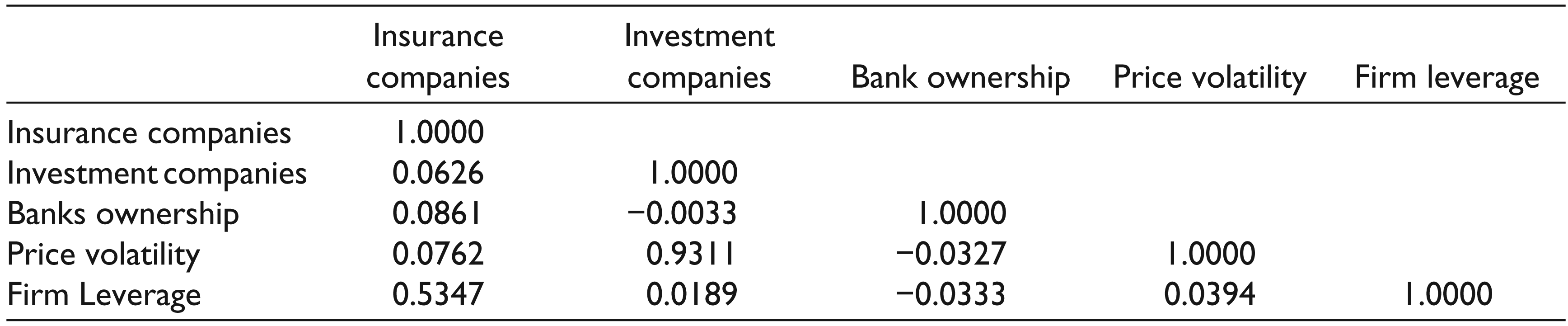
Table 3 reports correlations between stock liquidity and explanatory variables, which stay at around 0.2. Pearson’s correlation is used to investigate whether endogeneity problems exist or not in between the independent variables. In Table 3, we can see that there is no problem of multicollinearity and endogeneity exists in between all independent variables. Values of all variables are below the limit of 0.80, the high value is even below 0.20 limits. The overall result indicates that ownership by insurance companies is positively correlated with all other predictors. Likewise, results also reveal that ownership by investment companies is positively correlated with other variables but bank ownership is negatively correlated with investment companies’ ownership. Similarly, correlation among bank ownership, price volatility and firm leverage is negative.
Descriptive Statistics

Correlation Matrix
Regression Analysis
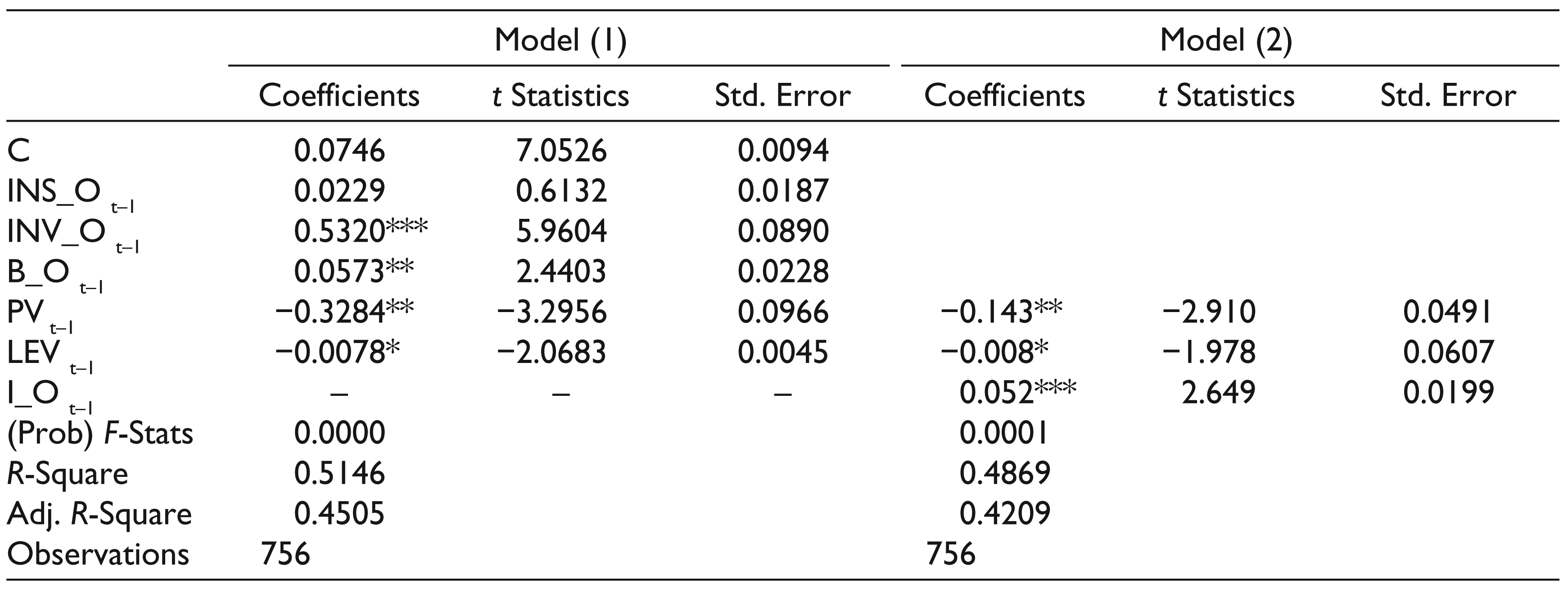
To estimate the impact of institutional ownership on liquidity, we applied fixed effect model (FEM) as the data were panel data. This was further selected as the best model for the estimation by applying two tests which rolled the dice in favour of Fixed Effects Model. Following two models have been tested for collective and individual level analysis. In the first model, three different types of institutional ownership were regressed with stock liquidity, and then in the second model, regression analysis was applied to the combine institutional ownership with stock liquidity.
Model 1 in the below table indicates that an increase of 1 point in investment companies and bank ownership leads to 0.53 and 0.057 points increase in stock liquidity, respectively. The coefficients of investment companies and bank ownership are positive and statistically significant, whereas t-statistic of insurance companies is 0.61, which implies that relationship between insurance companies’ ownership and stock liquidity is positive and insignificant. Model 2 reveals that institutional ownership affects stock liquidity even after controlling for other variables. These results are consistent with Hypotheses 1, 3 and 4 while inconsistent with Hypothesis 2. In general, institutional ownership is likely to improve stock liquidity. These results are consistent with the findings of Liu (2013) and Lee (2011) that institutional ownership is positively associated with stock liquidity. The increased participation of institutional investors in stocks increases liquidity of that stock in the cross section. This result is also consistent with the trading hypothesis, that is, long-term institutional investor trades aggressively which decreases transaction cost and improves liquidity of securities.
Moreover, we distinguish between the ownership of different types of institutional investors such as investment companies, insurance companies and banks. Model 1 shows insignificant relationship between insurance company’s ownership and stock liquidity. Whereas previous studies like Chao and Petrasek (2014) and Ajina et al. (2015) reported that ownership by insurance company could affect liquidly of stocks, these varying findings indicate that the results of this hypothesis cannot be generalized; it will depend on the context where it is being examined.
Model 1 also shows that bank ownership has a significantly positive relationship with stock liquidity. This result is in line with the finding of Baker and Stein (2004) and Gatev and Strahan (2006); they found a positive relationship between bank ownership and liquidity. This shows that bank ownership has potential ability to influence firm management decision, thereby improving liquidity of stock. Model 1 also reveals that there exists a positive relationship between investment companies’ ownership and liquidity. This result is consistent with the findings of Chao and Petrasek (2014). They showed that the increased participation of investment companies’ investors in stock holding leads to higher stock liquidity, whereas model 1 and 2 both depict that price volatility and leverage are inversely related with stock liquidity.
Furthermore, in Table 4 value of R2 is 0.5146, it implies that 51.46 per cent stock liquidity is explained by model 1 (combination of predictors), whereas model 2 explains 48 per cent variation in the dependent variable. Moreover, value of F-statistics (probability) is highly significant, which shows that both models are correct. The independent variables, except ownership by insurance companies, significantly affect stock liquidity in the cross section. The result shows that there exist a significant relationship between ownership by institutions (except insurance firms) and stock liquidity. This implies that our finding is consistent with the previous studies, where the prediction is that institutional ownership improves stock liquidity comparatively.
Fixed Effect Model
(i) I_O—Institutional ownership
(ii) B_O—Bank ownership
(iii) INS_O—Ownership by insurance companies
(iv) INV_O—Ownership by investment companies
(v) PV—Price volatility
(vi) LEV—Leverage
Conclusion and Policy Recommendations
This study examines the relationship between institutional ownership and stock liquidity. We used a sample size of 84 non-financial companies listed on the Karachi stock exchange for a period of 10 years, starting from 2005 to 2014. Turnover ratio has been used to measure the stock liquidity, whereas institutional ownership is measured by dividing the number of stocks held by institutions from total number of outstanding shares. This study employs fixed effect model which shows that magnitude of institutional ownership in Pakistani firms tend to significantly increase stock liquidity in the cross section. This study also finds that as institutional ownership increases, liquidity of stock improves in Pakistan. This is consistent with the trading hypothesis that increase in institutional ownership leads to decrease in liquidity risk and increases stock liquidity by reducing transaction costs.
Second, we find that ownership by investment companies is positively associated with stock liquidity and negatively related to liquidity risk, which is in line with the findings of former studies. Subsequently, we find insignificant relationship between ownership by insurance companies and liquidity in Pakistan; this is not consistent with previous literature. It is due to the fact that former researches carried same study in developed markets, whereas emerging markets have different preferences than advanced markets. Finally, we show that bank ownership is positively related with liquidity of stock, which is consistent with previous findings.
Generally, our evidence supports that many but not all institutional investors play a positive role in improving stock liquidity in emerging markets. Previous literature on the relationship between institutional ownership and stock liquidity primarily concentrated on institutional ownership as a homogeneous group, whereas some studies document that not all institutions are the same in terms of their effect on liquidity and considering total institutional ownership can produce inappropriate outcomes. We recommend that the relationship between institutional ownership and stock liquidity is conditional on institution type because we expose that not all institutions effect liquidity in the same way. Furthermore, we argue that the positive relation between total institutional ownership and stock liquidity reported in previous literature is mainly driven by the homogenous institutional ownership. The results of this study are important for dealers, traders and brokers, in the sense that they can facilitate investors in efficient resource allocation and in making investment-related decisions.
Based on the facts and information, it is recommended that regulating authorities should enable the firms to show and disclose relevant information regarding their financial performance. This will reduce information asymmetry in the financial market and encourage small investors. Institutional owners perform the role of watch dogs in any organization, so, institutional ownership should be enhanced. It is also recommended that corporate law authorities should encourage shareholders and due protection should be given to them in a crisis situation. This could be done by formulating strategies and events through which investors can approach responsible organizations in case of any mismanagement in a firm’s affairs.
Footnotes
Acknowledgements
The authors are grateful to the anonymous referees of the journal for their extremely useful suggestions to improve the quality of the article. Usual disclaimers apply.