




Abstract
Organizations around the world are shifting from processes that exploit the environment towards environmentally friendly processes. Today, there is extreme enthusiasm among practitioners and academic researchers for green management. The fundamental factor of such enthusiasm is that people expect managers to utilize resources wisely and responsibly and make minimum use of air, water, minerals and other materials in the final product. Green management has certain significance on the normative or moral scale. A self-administered questionnaire was distributed to collect data. The G* (where* represents general stand-alone nature of this application in statistical tests across social and behavioral research) power programme suggested a minimum of 43 observations assuming a significance level of 5 per cent, the effect size of 0.15 and a statistical power of 80 per cent with five predictors (Faul, Erdfelder, Buchner, & Lang, 2009, Behavioral Research Methods, 41(4), 1149–1160). A convenience purposive sampling technique was employed. The reliability of instrument was checked through values of Cronbach’s Alpha. The normality of data was checked through the Shapiro–Wilk test. The normality plot was used to find the outlier in collected data. Andrew Hayes’s methodology was employed to investigate the moderating role in the statistical package for social sciences (SPSS) (Hayes, 2012, PROCESS: A versatile computational tool for observed variable mediation, moderation, and conditional process modeling, Lawrence, KS: University of Kansas). This study confirms the significant moderating role of green human resource management (GHRM) over the scale of the employees’ green behaviours (EGBs) and environmental sustainability. Going forward, researchers recommend more research like this, illuminating the role of GHRM activities in enhancing and perhaps even driving environmental management initiatives.
Introduction
Organizations are facing environmental challenges such as climate change, global warming and resource conservation, which have direct influence over the best business practices. Such challenges have a detrimental impact on the environment, society and economy. There is urgent need to replenish sustainability needs of depleting resources (Kumar, Rahman, & Kazmi, 2013). Presently, organizations face significant pressures from government, non-government stakeholders, consumers, environmental activists and employee unions to operate in environmentally friendly ways. Environmental sustainability is a top concern among organizations in the context of current environmental conditions and business markets with an increasing focus on environmental sustainability. The interpolation of employees’ green behaviours (EGBs), green human resource management (GHRM) practices and environmental sustainability creates new ways of performance in organizations with a focus on sustainability. The competitive nature of markets forces organizations to respond to external factors, adapt and change according to circumstances. To implement a business strategy, organizations form strategic capabilities to transform its resources and gain a competitive edge. With increasing levels of environmental sustainability as strategic objectives, there is a greater emphasis on researching the role of GHRM.
Presently, environmental sustainability affects organizations such as energy cost and climate change. The rise in energy affects market dynamics as supply is struggling to keep up with demand. Rising energy costs require organizations to change the ways they operate. Adaptations to energy resources, transportation and building efficiency can take years or decades. Similarly, global climate change is a big challenge to business organizations. Historically, variations in the global climate have happened slowly, but human activities have accelerated this process dramatically and have caused an exacerbating shift in the atmosphere, temperature, sea levels, storms and ocean acidification changes (US EPA, 2012). Researchers are conscious about large, unforeseeable storms and significant changes to the environment that affect plant growth, human lives, wildlife and agriculture (Dilchert & Ones, 2011). These conditions have severe and direct impacts on organizations. Moreover, the investment community, insurance and governments endeavour to decrease the speed of climate change with much of their efforts concentrated on managing carbon emissions. Risks and initiatives associated with the global climate affect the business environment and provide a competitive edge for those organizations that effectively manage these challenges. As such, adversity offers opportunity.
The top management of organizations views sustainability as being crucial to their success (Kell & Lacy, 2010). Organizations have started to disclose their sustainability performance (Apotheker, 2010). Laszlo and Zhexembayeva (2011) advocate that three factors will force organizations to address sustainability, namely, declining resources, increase in expectations and fundamental transparency. These three trends are creating significant changes in the business climate. Currently, HRM literature lacks an influential voice in sustainability with there being a larger role for HRM to play in sustainability initiatives (Jackson & Seo, 2010). In response, organizations are developing and adopting new methods and processes to mitigate the deleterious effects of their operations to maintain environmental sustainability. This requires multiple stakeholders to address deficiencies in work processes and add green jobs to the existing HRM. The field of GHRM is currently growing. It is currently relatively small and needs improvements to provide a sustainable working environment. The study is explained as follows: the next section elaborates the extant literature about GHRM, EGBs and environment sustainability; the third section explains research framework, methodology, sampling method and variables used in this study. The fourth section deals with analysis and findings of the study, and finally, the main conclusions are discussed at the end.
Literature Review
Renwick, Redman and Maguire (2013) coherently described the concept of GHRM in their research covering sustainable HRM practices in small, medium-sized and large firms. According to them, GHRM is a set of specific HRM practices that stand for a proactive approach to environmental management and high performance in environmental sustainability and other business objectives. The literature suggests that performance is a function of ability, motivation and opportunity (Ones & Dilchert, 2009). Renwick et al. (2013) have classified all specific HRM practices into three broad groups: (a) developing green abilities; (b) motivating green employees and (c) providing green opportunities. Nearly all 35 practices mentioned by Renwick et al. (2013) have a vital role in the formalization, complexity and sophistication of HRM understanding.
Research shows a positive increasing trend among US graduates to apply for the job relevant to environment sustainability and that the probability of selecting green-friendly employers is very high (Renwick & Rocca, 2015). It has also been concluded that job seekers and acceptance of the job are directly proportional to social and environmental values (SEVs) of any organization and the higher values of organization associated with the society and environment (Gully, Phillips, & Castellano, 2013). Organizations arrange training and development of their employees in order to bring about certain changes in the sustainable environment. Organizations develop the requisite staff competencies and performance evaluation criteria (Jackson & Seo, 2010). Although research shows that eco-mindedness is lacking among employees, it means workers lack the proper knowledge and awareness of environmental issues (Andersson, 2013). In China, the top management has observed that the senior staff of manufacturing departments is highly environmentally proactive because of their high vulnerability to the environment (Ji, Huang, Liu, Zhu, & Cai, 2012). Intervention-based approaches are used to enhance the competencies of employees (Wiernik, Ones, & Dilchert, 2013). Some researchers also see the significant role of environmental knowledge for sustainability of environmental performance (Thorn, Kraus, & Parker, 2011). Robertson and Barling (2013) concluded that transformational leadership has a positive impact on the pro-environmental behaviour (PEB) of employees with positive emotion playing its role as the mediator (Andersson, 2013). Executives are now showing concerns for environmental sustainability and are hiring for the post of chief sustainability officer (Wiernik, Ones, & Dilchert, 2013). Lining environmental activities with performance management and appraisal (PMA) systems is a pre-requisite for corporate social responsibility (CSR) (Andersson, 2013). PMA practices and leadership competencies are necessary to control the progress towards achieving environmental sustainability goals (Renwick & Rocca, 2015). In the UK Civil Aviation Department, the management is implementing policies relevant to green behaviours (Harvey, Williams, & Probert, 2013). Research also suggests that it is very hard to attract the senior management towards environment sustainability based on indirect benefits. A change in financial awards has an influential impact on the pro-environment behaviours of employees (Renwick & Rocca, 2015). In UK universities, Higher Education Funding Council of England (HEFCE) has linked funding with environmental management and withholds 40 per cent of funds if any university fails to produce a trustworthy environmental plan (Kane, 2011).
The relationship of workplace environment with employees in terms of environmental management is underexplored (Harris & Tregidga, 2012). The importance of workforce environment for environmental performance cannot be ignored (Wiernik, Ones, & Dilchert, 2013). Nevertheless, management involvement is common and influences employees to indulge in PEBs (Zibarras & Coan, 2015). A study of Spanish firms revealed that high-involvement work practices (HIWPs) mould employees towards proactive environmental strategies, which, in turn, mediate HIWPs and environmental performance in green strategies (Renwick & Rocca, 2015). A study of 5220 French firms highlighted how labour productivity was higher among firms that maintained environmental management standards than those that did not (Andersson, 2013). Another research in the UK Civil Aviation Department found that the downsizing of staff makes it more difficult for employees to display green practices (Harvey et al., 2013). Research in two Australian-based organizations found that participation in the environmental initiative is associated with employee engagement and green performances (Renwick & Rocca, 2015). Employees with different values (i.e., egoistic and altruistic employees) are inclined towards PEBs (Andersson, 2013). Employee engagement and its connection with an organization are associated with EGB (Wiernik, Ones, & Dilchert, 2013). Work–life balance plays its role as a facilitator in environmental behaviour both at the home and at the office (Jackson, Renwick, & Jabbour, 2011). Psychology theories may help businesses create green schemes and understand staff behaviour in order to execute change for environmental issues (Zibarras & Ballinger, 2011). volunteer employees’ green behaviours (VEGBs) can be used to understand the personality traits of individuals and encourage employees to engage in PEBs (Kim & Mauborgne, 2014). The Marxist social and employment relation’s theory is very useful in understanding the changing behaviours of employees in different climates (Renwick & Rocca, 2015). According to attribution theory, employees make use of sense while deciding about the importance of environmental management issues (Thorn, Kraus, & Parker, 2011).
Employees’ Green Behaviours and Environment Sustainability
Environmentalism is considered as a worldwide phenomenon. Organizations have started responding to environmental challenges by practising green strategies (Jain & Kaur, 2004). Sustainability refers to approaches in meeting the present needs without compromising on the ability of future generations to fulfil their needs. The sustainability model is based on three aspects: economic, social and environmental. It is referred to as the triple bottom line of profit, people and planet, as suggested by Elkington and Fennell (1998).
The long-term interest of an organization encompasses environmental sustainability while short-term goals concern economic profit (Dubois & Dubois, 2012). Friedman (1970) explained that the social responsibility of a business is to use only its resources and avoid making profits in non-sustainable ways. Environmental sustainability creates changes in organizations that are different from the changes spurred by other factors like globalization and advancing technology. Entrenching environmental sustainability into an organization requires changes in the thinking and behaviour of all employees throughout the organization (Laszlo & Zhexembayeva, 2011). Embedding environmental sustainability in an organization requires real-time considerations of economic, social and environmental sustainability. The triple bottom line requires connecting the silos of functional efficiency with that of organizational effectiveness and sustainability (Dubois & Dubois, 2012). Environmental sustainability has received little focus in HRM literature. Most of the extant literature talks about economic sustainability. A substantial literature also includes social sustainability that addresses the issues of diversity, safety and health, organizational justice and, more recently, CSR (Kolk, 2004).
Any big change demands an attitudinal and behaviour change of the people or the community. But changing behaviour is a challenging task, as generally behaviours are culturally directed and rigid in nature (Singaiah & Laskar, 2015). Green Behaviour (pro-environmental behaviour) is defined as behaviour that has a positive impact on the environment (Unsworth, Dmitrieva, & Adriasola, 2013). According to Stern (2000), intentional behaviour that plays its role in the reduction of negative impacts of actions of HR on the environment is called green behaviour. Eight construct-problem awareness, internal attribution, social norms, feelings of guilt, perceived behavioural control, attitudes, moral norms and intentions have been found to interact with PEB (Bamberg & Moser, 2007). The impact of these eight constructs over the environment is highly dependent on the certain context. Research affirms that EGBs are significantly associated with environmental sustainability (Qaisar & Siti Hasnah, 2017). Whenever proactive environmental behaviours are taken in the context of an individual’s job, they become EGBs. The green taxonomy of Wiernik, Ones and Dilchert (2013) encompasses the behaviour type and shows no relationship between green behaviour and job descriptions. There is a significant difference in the ways one adopts common tasks to make it greener. It is when a person goes beyond their roles to enhance environmental sustainability. Bissing-Olson et al. (2013) distinguished between an EGB that is directly related to job descriptions and optional, more proactive behaviour. They proposed a task-related PEB which is the ‘extent to which individuals complete their tasks in environmentally useful ways’. Proactive PEB is concerned with the initiatives taken by employees that go beyond the sphere of their required work task in order to sustain the environment. This approach suggests that there are different levels of employee involvement with the EGB. Some employees may do what is perceived necessary for his work, while others go beyond what is required and engage in a more proactive EGB. The difference between choosing one, both and neither behaviour may be connected to the motivations to engage in an EGB. Researchers are interested in the behaviours of employees at the workplace. Both positive and negative behaviours can affect environmental performance.
For this purpose, the taxonomy of behaviour is mandatory. This need has been fulfilled by Ones and Dilchert (2012) who developed a model of employee behaviour that classifies behaviour into psychologically meaningful categories. There are five broad functional categories of employee behaviours (Dilchert & Ones, 2012). First, the conserving category of EGBs covers all those actions that are prime causes of PEBs’ reusing, recycling, repurposing and reducing. Although, individuals actively focus on waste reduction, the economical use of raw materials and conservation of energy in their personal lives (Wiernik, Ones, & Dilchert, 2013). Second, work sustainably is concerned with the performance of one’s job duties and responsibilities in such a way that it has a positive environmental performance. This category of behaviours is relevant to both the workplace and the work itself. People in this category are constantly in search of optimization or set processes to minimize the environmental impact. They also look for more sustainable products and services (Wiernik, Ones & Dilchert, 2013). Third, avoiding harm is associated with avoidance and cessation of negative environmental behaviours at work. The positive side of these behaviours contains behaviours that reduce pollution or enhance the ecosystem. The negative side of this category is a lack of prudence and being motivated by financial gains. Positive EGBs that avoid environmental harm tend to be driven by altruism, feelings of responsibility to future generations and a general concern for the future (Klein et al., 2012). Fourth, influencing others stands for the extent to which employees educate, engage and motivate individuals to minimize environmental impacts and participate in pro-environmental initiatives. These behaviours encompass a variety of stakeholders with a focus on employees. These behaviours do not have any direct or immediate environmental benefit but have a significant potential to affect the environmental bottom line by influencing multiple organizational members (Wiernik, Ones, & Dilchert, 2013). Finally, taking initiative is measuring, understanding and influencing employees’ risks for environmental benefits. Behaviours in this category reflect the initiating and entrepreneurial spirit of the employee’s action as the seed for a respective initiative or programme. Actions that involve self-sacrifice are also included. Taking initiative behaviours include other behavioural categories as well. For example, employees who lobby for or organize an organizational recycling programme are not simply conserving resources—they are taking an active step to take a bigger, long-lasting change than what they could achieve by engaging in the behaviour on their own. Employees who engage in these kinds of activities are change agents on an interpersonal and organizational level.
The five broad categories of EGBs described here are conceptually and empirically distinguishable. Many of the conceptual distinctions arise from the functions that behaviours in each category serve as well as the psychological basis of the respective behaviours. Moreover, functional motives and individual difference characteristics that determine people’s engagement in each type of EGB vary. Even though the different types of green behaviours can be distinguished, and even though employees within the same organization and job will differ in terms of which behaviours they typically engage in, they are positively intercorrelated, in part due to common antecedents (Dilchert & Ones, 2011).
Moderating the Role of Green Human Resource Management
Green behaviours that are concerned with the required job descriptions of employees are regarded as EGB. These green behaviours include complying with organizational policies, new methods of work, the selection of responsible alternatives and the creation of sustainable products and services. Green behaviours associated with the personal initiative for the betterment of the environment are known as voluntary green behaviours. These behaviours include the initiation of environmental programmes and encouraging others to show green behaviours. While taxonomies implicitly accept the presence of required as well as voluntary behaviour, the categories themselves are not mutually exclusive, thus allowing behaviour to belong to more than one group. Autonomous and controlled motivations are used to engage employees in certain behaviours. Autonomous techniques see organizations leave their employees to work independently and with choices of alternatives. Autonomous motivation is a significant predictor of citizenship performance (Gagne & Deci, 2005). The performance of dull or boring tasks, such as those that might be required as part of an employee’s role, depends on the perception that the desired outcome (e.g., obtaining a reward, avoiding punishment) is contingent on performance (Gagne & Deci, 2005). Controlled motivation features a sense of pressure and the experience of obligation. Thus, the subsequent behaviour is likely to be driven by a sense that the actor must behave in a way.
Specific HR policies within the context of GHRM are aligned with environmental sustainability—social, environmental and economical (Yusoff, Ramayah, & Othman, 2015). HR managers play a pivotal role in the generation of awareness about the utilization of natural resources, and green movement among employees working for the organization, which is ultimately helpful in maintaining the proper environment and retaining natural resources (Mathapati, 2013). HR promotes the greening performance of the organization through enhancing a sense of environmental sustainability among employees, recruitment of the employee’s commitment to the environment, by training, evaluating and rewarding performance based on greening criteria and concentrating on the continuous improvement initiatives on environmental management activities (Jabbour, Santos, & Nagano, 2010; Renwick, Redman, & Maguire, 2008). The green credentials of organizations enhance HRM activities which ultimately work as a benchmark for environmental performance (Renwick, Redman & Maguire, 2008). GHRM can contribute to the green performance of the firm via PMA that ‘measure environmental performance standards’ and by ‘developing green information systems and audits’ (Geraint, Karen, & Jane, 2013). Thus, GHRM will have a significant moderating impact on the association of EGB and environment sustainability.
Objectives
Research is required on the connections of training and development measures with environmental sustainability (Ji et al., 2012). Jackson and Seo (2010) concluded that a comprehensive research work might improve the relationship of EGBs with environmental outcomes on the basis of green practices. Keeping in mind this suggestion and the literature, it is significant to expose to what extant GHRM is influencing the association of EGBs with environmental sustainability. Thus, we raise the question as to whether GHRM moderates the relationship of EGB with environmental sustainability or not.
Rationale of the Study
Management scholars have shown deep interest in the promotion of business practices compatible with environmental sustainability. The Academy of Management has added a new unit named Organizations and the Natural Environment (ONE) to attract scholars interested in environmental sustainability. The UN Global Compact in collaboration with Advance Collegiate Schools of Business has developed the Principles for Responsible Management Education (PRIME) to encourage scholars and practitioners to work jointly on environmental sustainability. Besides these developments, literature is lacking in environmental sustainability. HRM is one of the nominally explored areas in the name of environmental sustainability. An extensive literature review by Renwick et al. (2008) suggests that little work has been done in the field of HRM concerning environmental sustainability.
Theoretical Framework
Renwick et al. (2008) and Huffman et al. (2009) explored the interaction of many HRM fields (training, staffing, performance management and compensation) with environmental sustainability. All five dimensions of EGB (conserving, avoiding harm, working sustainably, influencing others and taking initiative) are significant predictors of environmental sustainability. The literature confirms the strong influence of EGBs on environment sustainability (Iqbal, Hassan, Akhtar, & Khan, 2018). Guiding this commentary is a conviction that GHRM effectively assists managers in responding to strategic problems (Jackson & Seo, 2010). Addressing environment sustainability brings an opportunity for researchers to look for problem-focused approaches. Environmental sustainability addresses the current concerns of managers and ultimately directly enhances organizational effectiveness.
The independent variable in current research is EGB, composed of five dimensions, namely, conserving, working sustainably, avoiding harm, influencing others and taking initiative. Environment sustainability is the dependent variable in current research. In addition, this study examines the moderating effect of GHRM on the relationship between EGBs and environmental sustainability.
Research Methodology
This study is based on the positivistic approach because this study has empirically investigated the relationship between the variables of interest from a set of hypotheses. Furthermore, researchers have used deductive reasoning to develop a research model and hypotheses, which is consistent with the application of positivism. This study is correlational in nature.
Population, Sampling and Data Source
The population of our study constitutes employees working in the banking sector of Pakistan. Purposive and convenience sampling were employed to gather data through a self-administered questionnaire. Data were collected from employees of MCB Bank Ltd and HBL located in District Attock. G* power programme suggested a minimum 43 observations assuming a significance level of 5 per cent, the effect size of 0.15 and a statistical power of 80 per cent with five predictors (Faul, Erdfelder, Buchner, & Lang, 2009).
The instruments in the questionnaire were pretested for clarity and to improve content validity of the items. The Google application was employed to create an online link for data collection. A pilot study was conducted with 30 respondents to identify the consistency of the questions and their response to the questionnaire. A reliability test was performed to know the internal reliability of the items used in the questionnaire based on Cronbach’s Alpha. Researchers collected data from 125 respondents with a response rate of 75 per cent. Before performing analysis, researchers checked data for missing values and outliers. The Shapiro–Wilk test was performed to check the normal distribution of data. The Shapiro–Wilk test is applicable for the normality test where the data sample is less than 50 and can be applied in a situation where data are less than 500. Correlation coefficient and regression analysis were employed to check the association of EGB with environmental sustainability in organizations. Andrew Hayes’s methodology suggests the moderating role of GHRM in the statistical package for social sciences (SPSS) (Hayes, 2012).
Measurement Scales
A 27-item descriptive norms scale developed by McConnaughy (2014) has been adopted in this study. This scale measures all the five categories of EGB—conserving, working sustainably, avoiding harm, influencing others and taking initiative. Cronbach’s Alpha value of EGB is 0.88. A scale developed by Khan, Dewan and Chowdhury (2014) having 15 items has been adopted to measure environmental sustainability. This scale measures sustainability in terms of economic, social and environmental aspects. Cronbach’s Alpha value of environmental sustainability is 0.80. GHRM is measured using a 5-point Likert scale on the basis of five questions (Jenkins, 2006; Wayne & Nuttaneeya (Ann), 2015).These questions are based on (a) environmental training for employees; (b) investing in people; (c) the creation of good work–life balance and family-friendly employment; (d) improving employee health and safety; and (e) employee participation in the decision-making process. Here, the first item is used to measure ‘developing green abilities’, the middle three items represent ‘motivating green employees’ and the last item is used as a proxy for ‘providing green opportunities’. Cronbach’s Alpha of GHRM is 0.79.
Data Analysis
Shapiro–Wilk Test and Normality Plot
The normality of data was checked through the Shapiro–Wilk test. According to the Shapiro–Wilk test, when a value of p is greater than 0.05, then data are normally distributed. In another case, collected data violate normal distribution.
Test of normality shows that value of p for green HRM is greater than 0.05 that is, p = 0.111 > 0.05 (Table 1). Hence, data relevant to GHRM are normally distributed. In Figure 1, the normality plot shows that there is no outlier in collected data of GHRM. The test of normality shows that collected data linked to EGB is normally distributed, that is, p – value = .707 > 0.05. In Figure 1, the normality Plot also reveals no outlier in the data of EGB. The normality test of environment sustainability shows that data are normally distributed, that is, value of Shapiro – Wilk Test, p – value = 0.491 > 0.05. As shown in Figure 1, the normality plot exhibits no outlier associated with collected data relevant to environmental sustainability.
Correlation Coefficient
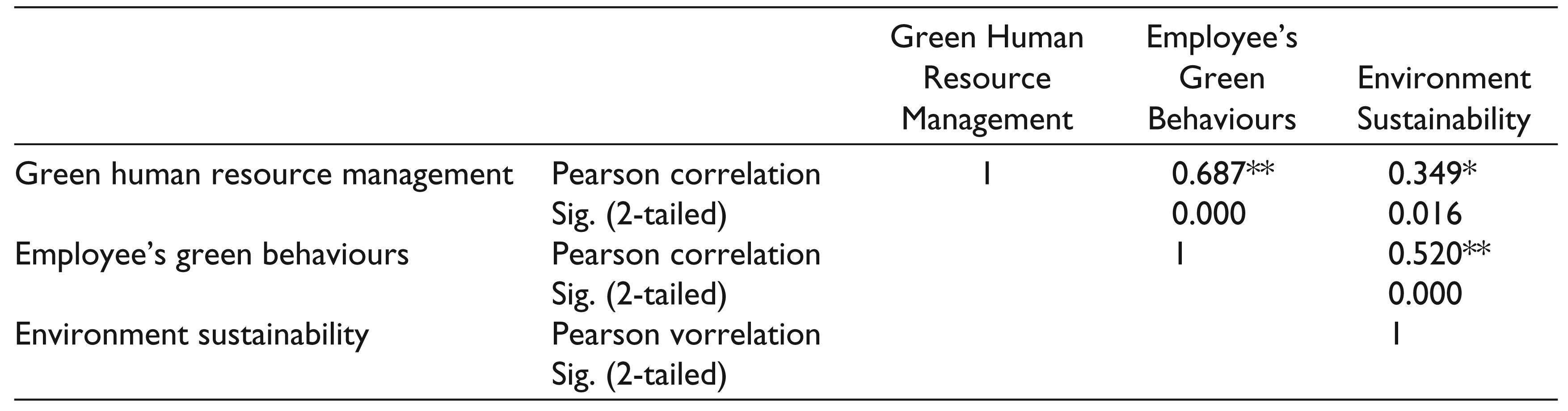
Correlation analysis—Table 2—shows a strong uphill linear relationship between GHRM and EGBs, that is, γ = 0.69. EGBs have a moderate uphill linear relationship with environment sustainability, that is, γ = 0.52, and a weak uphill linear relationship exists between GHRM and environmental sustainability, that is, γ = 0.35. Researchers conclude that EGB has a significant positive relationship with GHRM.
Tests of Normality


Correlations Analysis
Moderation Analysis
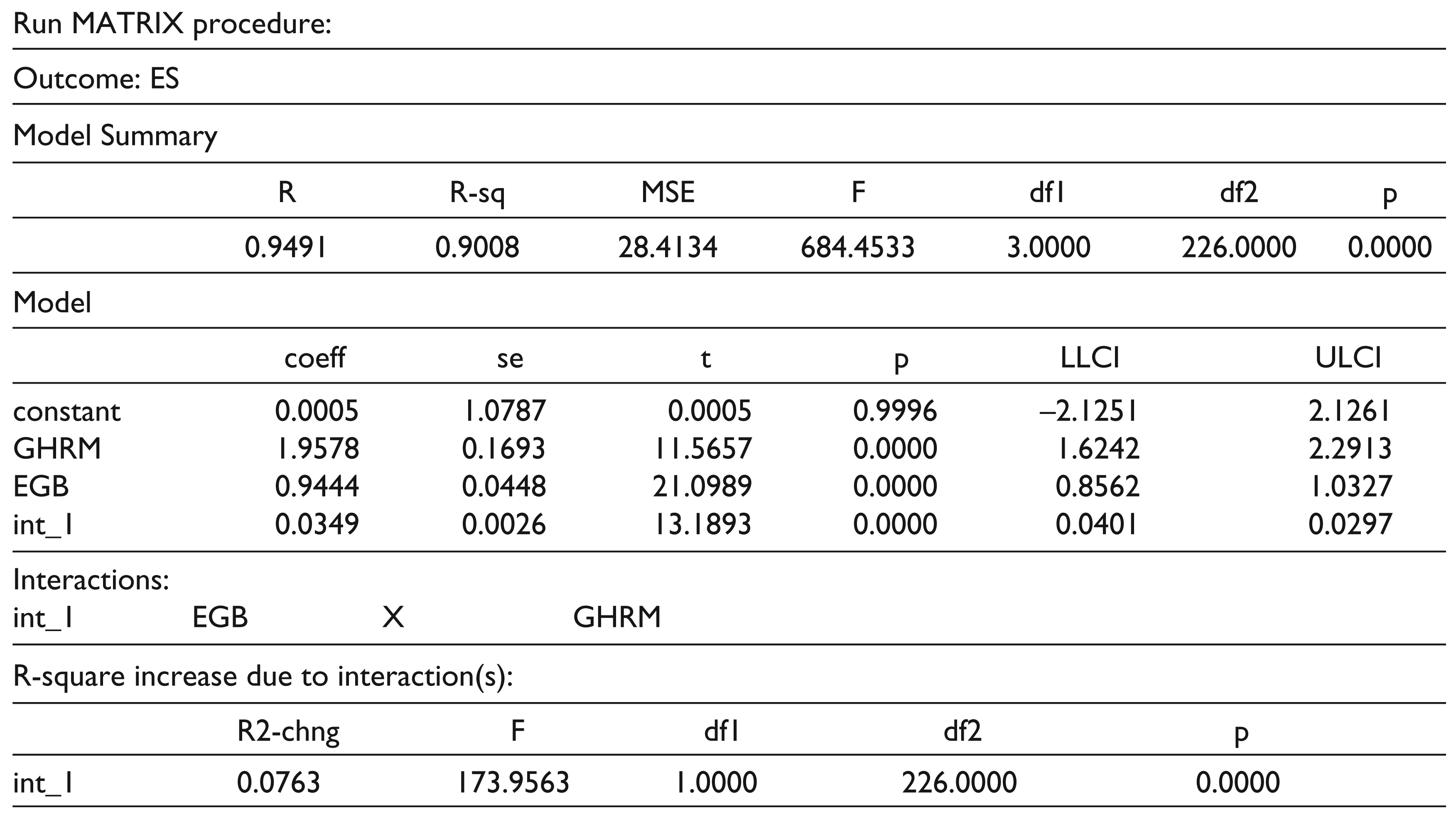
The overall model of this study is significant, that is, F = 684.45, p < 0.000, R Square = 0.9008, R Square Change = 0.0763. There is a significant moderation of GHRM. GHRM has a significant association with environmental sustainability, that is, b = 1.96, t = 11.57, p = 0.000. EGBs are also significantly associated with environmental sustainability, that is, b = 0.94, t = 13.19, p = 0.000. For a one-unit increase in EGBs, there is a 0.94 unit rise in the environmental sustainability of organizations. For the interaction term of EGBs and GHRM, there is a significant impact on environment sustainability, that is, b = 0.034, t = 13.19 and p = 0.000. Therefore, it is concluded that GHRM is the moderating association of EGB and environmental sustainability (Table 3).
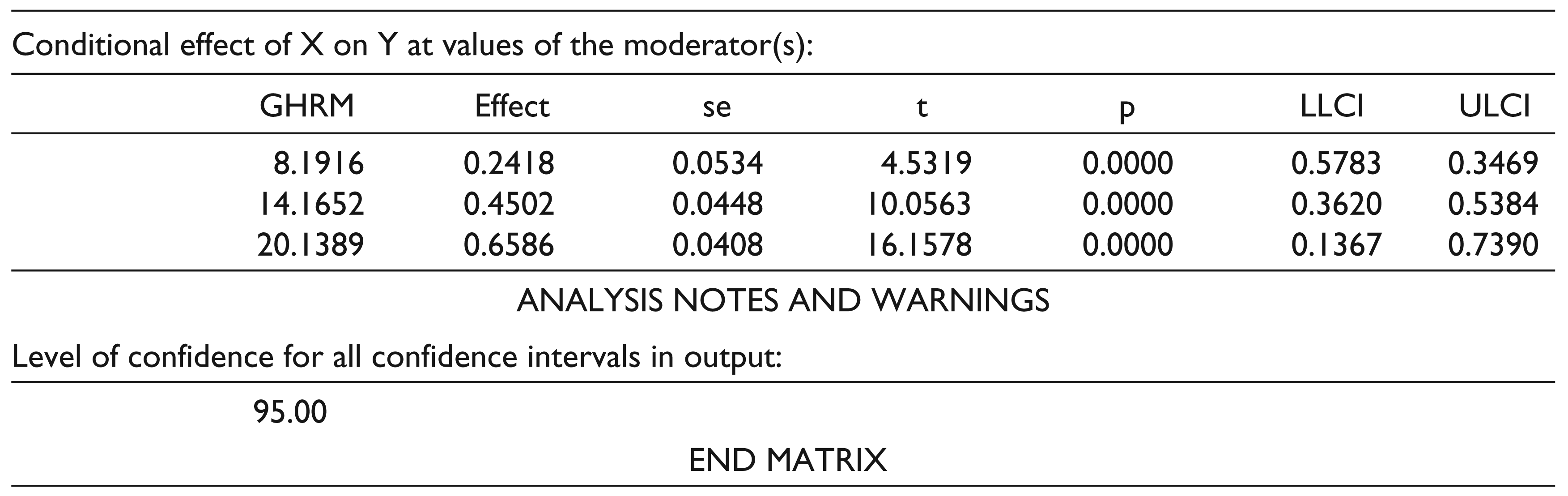
The conditional effect of X on Y presents impacts of EGB under the low, medium and high values of GHRM practices. The low, medium and high values of GHRM are 8.19, 14.17 and 20.14, respectively. For low GHRM practices, each EGB gives rises to 0.24 units in environmental sustainability, that is, β = 0.24, t = 4.54 and ρ = 0.00. For medium values of GHRM, the EGB has β = 0.45, t = 10.06 and p = 0.00. For high values of GHRM, EGBs have a significant impact on environment sustainability, that is, β = 0.66, t = 16.16 and p = 0.00. Therefore, it is concluded that with each one unit of EGBs under high GHRM practices, there is a 0.66 unit rise in the value of environmental sustainability. Hence, this study confirms that GHRM moderates the association of EGBs with environmental sustainability.
Figure 2 shows that as EGBs and GHRM practices increase, the environmental sustainability of organizations improves. At low EGBs, environment sustainability is also low. Employees with a high attitude for green behaviours and high GHRM practices have a high impact on the performance of environmental sustainability of organizations.
Moderation Analysis

Discussion
This study confirms that GHRM significantly moderates the relationship of EGBs with environmental sustainability. The blue ocean strategy can be employed in any business sector. GHRM not only reduces the operating and business expenses of an organization but also enhances the relationship of EGBs with environmental sustainability. Hence, GHRM creates a better image of the organization in the eyes of customers. The research concludes that GHRM can work as the blue ocean strategy in the saturated market. A standard economic assumption suggests an indirect association of green spending with productivity. Sroufe, Curkovic, Montabon and Melnyk (2000) affirm that by encouraging organizations to economize has an indirect influence on green spending, competitiveness and productivity levels. Organizations earn from green management practices once they have acquired green competencies. The roots of green competencies are somewhat different from the roots of other business competencies. General business competencies generate private benefits, so organizations are self-motivated to acquire them. Green competencies are likely to have other causes that bring them into existence (Marcus & Anderson, 2006). Green management is a type of public good so an organization cannot determine its appropriate value (Teece, 2007). Academic researchers argue that green management increases the cost of management and has no economic payback (Salzmann, Ionescu-Somers, & Steger, 2005). Consumers will reject those green products that are costly and deliver nothing in return.
Conclusion
Green management is different from other strategic initiatives, that is, strategic planning, internationalization, mergers and acquisitions. The risk is associated with any strategic initiative. Proponents of strategic planning argue that a well-developed plan provides a concise and concrete approach to meet organizational objectives. A structured approach reduces the external threads and directs the organization to better meet its encounters (Alfred & Adam, 2009; Ketokivi & Castaner, 2004). Researchers claim that the time and expense incurred over strategic planning is higher than its benefits. Evidence suggests an inconsistent association between strategic planning and its performance. With hundreds of mergers and acquisitions in a fiscal year, there is still question as to whether these dealings enhance the value of a company or not. Academic literature in the management and finance fields concludes the activity of mergers and acquisitions as trifling. The ‘buyers beware’ approach extends from poor valuation in the pre-acquisition stage to hazards within the post-acquisition phase. There is a consensus among researchers about a decrease in the value of organizations once acquired. The benefits associated with internationalization are also controversial. Some researchers suggest that there is an enhancement in the performance of firms with internationalization. There is no correlation between internationalization and firms’ performance (Alfred & Adam, 2009; Geringer, Tallman, & Olsen, 2000). Geringer et al. (2000) suggest a negative correlation between these two. Green management behaves differently to these strategic initiatives. The risk in green management is likely to be lower than the risk of other organizational strategic initiatives.
Whether green management practices pay or not, society likes to have green management. Nature has an intrinsic value provided human beings do minimum harm to it (Staib, 2009). By extracting water, air, energy and other materials, human beings are making the ecosystem fragile. According to utilitarianism, there must be superior benefits as substitutes to future generations. Attempts to carry out cost–benefit analysis are highly commendable. However, a residual risk exists whatever human beings do. Points to ponder are which discount rate is applicable where costs to the environment are immediate and benefits far off. The Earth carries a limited capacity of resources, and human beings are extracting at the expense of future generations. Green management is not about earning benefits but thinking about our future generations. Current competitive markets exert pressure on organizations to perform under sustainable conditions.
Managerial Implication
Different pollutants are deteriorating and depleting natural resources rapidly. It has become imperative to defend and improve the environment for present and future generations (Shaikh, 2010). This study has provided empirical evidence from the perspectives of GHRM as the moderator. Though GHR is still in its infancy, this study encourages organizations to embrace environmentally friendly HR practices. Most employees show concern about the environment and exhibit greater commitment and job satisfaction towards an organization that is ready to go ‘green’. The effects of GHRM practices are multifaceted. As such, organizations need to monitor their impact on employees. The HR managers are responsible for generating awareness among the employees of the organization about GHRM, the utilization of natural resources and the green movement to be more sustainable.
Footnotes
Acknowledgements
The authors are grateful to the anonymous referees of the journal for their extremely useful suggestions to improve the quality of the article. Usual disclaimers apply.
Declaration of Conflicting Interests
The authors declared no potential conflicts of interest with respect to the research, authorship and/or publication of this article.
Funding
The authors received no financial support for the research, authorship and/or publication of this article.