



Abstract
The prevalence of mobile data services has intensified competition and structured the market for mobile telecommunication services, resulting in decreased revenue particularly from voices services and high churn rate. Mobile service providers therefore seek ways to increase revenue by attracting and retaining mobile data users. This study investigates the determinants of customers’ brand choice and continuance intentions with mobile service providers in the context of mobile data service. This study also captures the impact of past experience on behavioural outcomes. Data were collected from 304 customers of mobile data service firms and analysed using regression analyses. Results indicate that mobile service quality, pricing structure and promotion, but not brand image, affect brand choice, whereas continuance intentions are affected by the mobile service quality, brand image and price. Customers’ past experience relates significantly and negatively to brand choice but not continuance intention. The contribution and implication of the study are discussed.
Introduction
Globally, the telecommunications industry has been undergoing major transformation in the last decade. This transformation is precipitated among others on mobile data explosion and the emergence of smart devices such as smartphones, tablets and iPads (Ericsson Mobility Report [EMR], 2015; Latouche, Reuschen, Oszabo, Creusat & Belman, 2013). According to Chanana, Agrawal and Kumar Punia (2016), ‘The overall teledensity in India has reached 79.98 per cent in March 2014’ (p. 137). They highlighted further that 'the teledensity in urban areas in India stands at 149.70 per cent and in rural areas at 48.66 per cent (Chanana et al., 2016, p. 137)’. Against this background, the possibility for government institutions to use mobile technologies to deliver electronic services to the public is being explored by the Indian government (Chanana et al., 2016). Mobile data is growing exponentially in Africa. The rate of growth is faster than in any other region of the world (TVBEurope, 2014). Estimated to grow by 9.8 per cent as against global rate of 6.3 per cent, Africa’s data traffic has risen from 808 million in 2013 to 851 million as at the end of 2014 and projected to reach 1.23 billion by the end of 2019 (Ovum, 2014). Mobile data services refer to wireless access to digitalized contents via the Internet on mobile devices (Kim & Han, 2009). Mobile data services are digital services ranging from communication (e.g., e-mail, instant messaging and social networking), information (web browsing, researching, location-based services), commerce (e.g., banking, mobile payments and shopping) to entertainment (videos, pictures, music, games) (Al-Debei & Al-Lozi, 2014; Lee, Shim & Lee, 2009). The pervasiveness of mobile data services is brought about by the shift of mobile phone use from voice to data services (Ahmed, 2009). Mobile data service is predicted to be the major source of revenue for mobile operators (Latouche et al., 2013) and has therefore attracted the attention of researchers and practitioners in recent times.
These developments have restructured and intensified the competitive landscape of mobile telecommunications industry. Mobile operators now compete with direct competitors and other content providers in the value chain (Latouche et al., 2013). Accordingly, mobile operators are realigning their strategies and investing massively in building technical infrastructure to achieve sustainable growth (Boakye, 2015; Kim, 2012). Traditionally, mobile service portfolio consists of voice services, SMS, Internet and personalized contents (Ahmed, 2009). However, the voice and text service market has reached its saturation in the face of endless price wars among mobile operators and high churn rate among subscribers (Al-Debei & Al-Lozi, 2014; Kim & Han, 2009). Moreover, revenue from mobile voice service has continued to decline despite high growth of mobile data subscription (EMR, 2015). Hence, mobile operators are seeking ways to shore up revenue by driving the uptake of smartphones and mobile data service subscription, thereby mitigating falling voice revenue (EMR, 2015). The foregoing suggests the need for mobile service providers to understand consumer decision criteria in a dynamic mobile data environment for acquiring and retaining mobile data service users (Hau, Kim & Kim, 2012).
Previous studies in the context of mobile data service have examined the adoption and post-adoption behaviour of consumers (Choi, Choi, Kim & Kim, 2005; Hong, Thong, Moon & Tam, 2008; Kim & Han, 2009; Kim, Chan & Chan, 2007; Lee, Shin & Lee, 2009), customer satisfaction with mobile data service (Hau et al., 2012) and mobile data contribution to quality of life (Choi, Lee, Im & Kim, 2007), whereas extant studies on customers’ choice and behavioural outcomes in mobile telephony have been construed to be evaluated based on service quality, network size, price, brand image, customer services, value-added services, promotion, perceived risk and satisfaction (Alamro & Rowley, 2011; Correa & Parente-Laverde, 2017; Khan & Rohi, 2013; Srinuan, Bohlin & Madden, 2012; Tripathi & Siddiqui, 2010).
Despite the plethora of studies in mobile telephony in general and mobile data services in particularly, a gap still exists in the mobile telephony literature on how mobile operators can sustain its long-term viability and profitability in the face of increasing market competition. This study contributes to the mobile telephony literature by focusing on mobile data services in an emerging country context such as Nigeria. It is important to understand the factors that drive customers’ brand choice with regard to mobile data services and also ascertain whether the same factors affect continued usage intention with mobile data service providers given the unique need mobile data satisfies compared to voice services and its trajectory as the major revenue earner for mobile service providers.
Mobile data services are considered in most part as a value-added service to voice and text services offering by mobile service provider; however, we conceptualize it as a unique offering worthy of investigating based on the following arguments. First, mobile services are characterized by high churn rate and since mobile numbers which are unique identifiers in voice and text services are less important in mobile data service, it is more susceptible to churn. Second, mobile data services require a unique set of technology such as 3G, 4G and Wi-Fi networks, smart device and mobile contents which hitherto where not available on traditional mobile services requiring additional investment and the need to recoup such investment. Finally, though mobile service providers are generally examined on the same factors (e.g., service quality, price, value) irrespective of the service offered, they both satisfy distinct consumer needs (Gerpott, 2010). Therefore, it is plausible that the weight of each of these factors on mobile service provider selection differs for voice and data services.
The rest of the article is organized as follows: after literature review, the research objectives and rationale for the study is presented. Thereafter, the research method and the results are presented. The findings and their implications for practice are discussed. Finally, the last section concludes the article, identifies its limitations and suggests areas for further studies.
Literature Review
Following the decision to adopt a new service, customers are usually inundated with the choice of a service provider and the consequent intent to continue with the provider or switch. Determining these choice factors is a puzzle service providers are yet to decipher (Valette-Florence, Guizani & Meruka, 2011). Customers’ choice indicates the extent a designated service brand is favoured and selected based on a bundle of attributes over competing brands. Continuance intention on the other hand is the propensity to continue primary service subscription from the same organization rather than competing firms (Abbas & Hamdy, 2015). Prior studies show that brand choice criteria and behavioural influences in mobile telephony focused on such attributes as service quality, price, value-added services, customer services, complaint handling, brand image, promotion and satisfaction (Alamro & Rowley, 2011; Khan & Rohi, 2013; Olatokun & Nwonne, 2012; Rahman, Haque & Ahmad, 2010; Srinuan et al., 2012; Tripathi & Siddiqui, 2010). This study examines the attributes of mobile service quality, price, promotion, brand image and past experience on customer choice and continuance intention in the context of mobile data services. Figure 1 aptly depicts the determinants of customers’ brand choice and continuance intentions with mobile service providers in the context of mobile data service. The factors were extracted from extant literature.
Mobile Service Quality
The concept of service quality has been extensively studied in the literature. Typically, service quality is defined in relation to discrepancies between customers’ expectation and performance of services (Dabholkar, Shepherd & Thorpe, 2000). However, in the context of mobile data service, the concept is yet to be empirically examined (Vlachos & Vrechopoulous, 2008). Following Grönroos (1984), we conceptualize mobile service quality to be closely related to functional quality and technical quality. Technical quality refers to the quality of service output, while functional quality refers to the interactions between customers and service provider. In other words, mobile service quality is defined as that consisting of network quality and functional quality.
Network quality refers to the download and upload speed, system response time, coverage, reliability of network and network availability (Vlachos & Vrechopoulos, 2008). In mobile telephony for voice services, network quality refers to call quality, excellent coverage, voice clarity and absence of drop calls (Gerpott, Rams & Schindler, 2001). Network quality is one of the major parameters of evaluating service quality in mobile telephony and has been found to influence choice of service provider (Gralla, 2016), customer switching (Nokia, 2016) and overall service quality (Kim & Yoon, 2004; Lai, Griffin & Babin, 2009). In addition, network quality has been found to influence satisfaction in mobile voice services (Lin & Ding, 2004) and Internet services (Gerpott et al., 2001). In mobile data services, when providers upgrade the connection speed of its broadband, it attracts more users, and as the users continue usage without moderation, it creates congestion on the mobile network which may lead to dissatisfaction. On the other hand, we define functional quality as the helpfulness and responsiveness of customer service representatives. Functional quality is achieved when customers perceive interaction with contact staff as easy and efficient (Chae, Kim, Kim & Ryu, 2002). The perception of stable network quality and helpful and responsive interaction with contact staff should create a favourable assessment for mobile data service provider and therefore influence selection and continuance intention.
Price
Price refers to the amount of economic outlay buyers must give up to acquire a product or use a service (Lichtenstein, Ridway & Netemeyer, 1993). Price is critical in the telecommunication industry. In fact, it has been the basis of ‘war’ among players in acquiring and retaining customers. In the context of mobile data service, price is an indicator of what consumers must pay to access data services, and this includes the initial cost of acquisition of smart device and mobile subscription and the ongoing cost such as data plans and/or bundles (Erevelles, Srinivasan & Rangel, 2003). In addition, payment methods, flexibility and variability in pricing options offered by mobile data service providers are all pricing options for consumers. Price is negatively associated with the probability of purchase (Lichtenstein et al., 1993) and has been empirically demonstrated to relate negatively with the intention to adopt mobile data service (Kim et al., 2007) and strongest predictor of mobile data service user behaviour (Kim, Choi & Han, 2009). However, price has been found to be an important choice determinant for Internet service provider (Erevelles et al., 2003) and the most important consideration for mobile service provider for voice and text services (Nokia, 2016) and a strong driver of customer satisfaction (Nielsen, 2014). Customers in the context of this study are likely to be very sensitive to price; therefore, the pricing structure of mobile data services will affect brand choice and continued usage intention.
Promotion
Promotions are marketing stimuli and tools designed to stimulate quicker and greater purchases for a limited period of time (Valette-Florence et al., 2011). Typically, sales promotions are temporal incentives targeted at encouraging product or service trial (Delvecchio, Henard & Freling, 2005; Kotler & Amstrong, 2003). With the avalanche of products and services available and the commoditization of services, marketers are constantly attempting to get consumers to notice and select their brands (Dadzie & Boachie-Mensah, 2011; Nagar, 2009). Promotion is used as a means of communicating with the consumers with respect to product offerings, thereby generating strong impact on consumption behaviour (Rahman et al., 2010). In other words, promotion communicates a brand and provides a reason to buy (Nagar, 2009). The use of promotion as a competitive weapon in the context of mobile telephony is widespread and intense. Mobile operators attract customers to their data service offerings using incentives such as free megabytes, bonuses, free calls and special bundles among others.
In the literature, promotion has been demonstrated to affect consumers’ brand choice (Delvecchio et al., 2006). Particularly, consumers rely on promotion as decision heuristics when choosing between brands that are equally attractive (Valette-Florence et al., 2011). However, promotion adversely affects brand equity and brand image and encourages brand switching (Buil, de Chernatony & Martinez, 2013; Nagar, 2009). Moreover, Delvecchio et al. (2006) demonstrate that promotion either increases or decreases brand preference. With regard to continued usage, scholarly discussions on the effect of promotion on continued usage are scarce. There is evidence to suggest that mobile service firms employ promotional incentives such as discounted mobile phones to lock-in customers into continued usage (Malhotra & Molhatra, 2013). Moreover, following promotion enhancement theory which suggests the saliency and consumers’ responsiveness to promotions once consumers are familiar with the product category and the usage dominance theory which suggest that personal usage experience will diminish responsiveness to promotional activities (Bridges, Briesch & Yin, 2006), promotion will affect consumers brand choice, but the continued usage intention will not be affected by promotional activities of mobile data service providers.
Brand Image
Brand image pertains to consumers’ perception of a product or service, regardless of how accurate the perception is and regardless of what the company wants them to be (Alamro & Rowley, 2011; Keller, 2003). It refers to consumers’ subjective perception of brand attributes and associations from which consumers derive symbolic value (Patterson, 1999). According to Foxall and Goldsmith (1995), brand image is the mental picture a brand evokes in the mind of consumers as a result of the brands’ previous performance, marketing stimuli and social stimuli (cited in Ballantyne, Warren & Nobbs, 2006). Consumers form brand image through exposure to advertising, promotions, observation of use situations and the kind of people who use the brand (Patterson, 1999).
Consumers ascribe meaning to brands across a range of criteria through accumulated purchase and consumption experience over time (Andreassen & Lindestad, 1998; Cretu & Brodie, 2007). Thus, brand image is considered important in the overall evaluation of service and companies. With the proliferation service brands, consumers rely to a great extent on the brand image to differentiate between competing brands and make a purchase especially when service attributes are difficult to evaluate (Andreassen & Lindestad, 1998; Ballantyne et al., 2006; Zhang, 2015). Generally, brand image generates value by simplifying information processing, differentiates a brand, provides a reason to buy and gives positive feelings (Aaker, 1991; Sondoh, Omar, Wahid, Ismail & Harm, 2007). Previous research demonstrates the impact of brand image on brand choice (Alamro & Rowley, 2011), customer retention (Andreassen & Lindestad, 1998), perceived quality (Andreassen & Lindestad, 1998; Cretu & Brodie, 2007) and customer loyalty (Andreassen & Lindestad, 1998). In the context of mobile data services, mobile operators deploy marketing communication tools (e.g., advertising, PR, publicity) to create a favourable image as the mobile data network of choice in order to attract new and keep existing customers.
Past Experience
The role of past experience as one of the antecedents of consumer loyalty is recognized in a recently published paper in Global Business Review by Krishnakumar (2018). Krishnakumar investigated the mediating effect of past apparel buying behaviour and past apparel buying experience on future apparel buying intention. The results of the study showed that there were partial mediating effects of past apparel buying behaviour and past apparel buying experience on future apparel buying intention. Experience relates to the subjective mentality consumers form after consuming a product. According to Wang, Harris and Patterson (2012), experience takes two forms, experience with the focal service and product-norm experience. Focal service experience refers to customer past experience using the service under investigation (i.e., mobile data services) and product-norm experiences: defined as customer experience using a range of mobile services (e.g., voice services, SMS) (Wang et al., 2012). Because consumers’ brand experience is more diagnostic than external information source, consumers are more likely to rely heavily on their past experience when making a purchase (Bridges et al., 2006; Kopalle & Lehman, 2006).
Past experience adjusts the amount and type of information consumers need when making choices and influences the product-related cognitive development of an individual (Kwuh & Oh, 2006). Accordingly, past experience shapes intentions, affects preference and influences attitudes and behaviour in a variety of ways (Taylor & Todd, 1995; Wang et al., 2012). Furthermore, the cognitive dissonance theory (Festinger, 1957) suggests that past experience with a brand influences the change that occurs in consumers’ perception of the brand such that the predictors of brand choice may not be the same as continued usage (Kim, Choi & Han, 2009). However, following dissonance reduction theory (Festinger, 1957), consumers tend to place a higher value on a previously chosen alternative and rechoose the same alternatives even when there are better alternatives due to inertia or brand familiarity (Kwuh & Oh, 2006).
In the literature, past experience is operationalized using the experienced/inexperienced or expert/novice dichotomy (Kim et al., 2009; Taylor & Todd, 1995) or proxy with satisfaction (Huang, 2006). In the context of mobile data services, Qi, Li, Li and Shu (2009) argued that voice experience is a precondition for using mobile data service. However, we argue that mobile data use can be independent of voice services. Thus, we define past experience as consumers’ experience using voice and SMS services of mobile service provider. Due to the proliferation of multi-SIM (Ojiaku, Aihie & Fjellstrom, 2017), mobile service customers should be sufficiently familiar with service providers and therefore inform their brand choice and continued usage intention based on their past experience.

Objectives and Rationale of the Study
The main objective of this study is to investigate the determinants of customers’ brand choice and continuance intention with mobile data service providers. Specifically, the focus of this study is on the effect of mobile service quality, price (i.e., cost of data plan), promotions and brand image on customers’ choice and continuance intention with mobile data service provider. In addition, building on cognitive dissonance reduction theory (Festinger, 1957), this study seeks to empirically investigate the effect of past experience on the choice and continuance intention with mobile data service provider. Since mobile data service users are service consumers, it is natural they choose a service provider (Kim et al., 2007) with the intent to continue usage or switch. To the best of our knowledge, this is the first scholarly article to empirically investigate the determinants of mobile data service provider selection and continuance intention.
Methodology
Sample
This study generally employed a survey design of a descriptive nature to collect data and empirically test the hypothesized relationship. Sample for this study was drawn from a population of students in a Southeastern University in Nigeria. The use of students as respondents was informed for a number of reasons. First, students are young and active users of innovative technologies. Following Rogers (2003), early adopters of technology are young and educated, and it is expected that uptake of mobile data services will be more prevalent among students. In addition, mobile data service consumption is larger among young adults (Boakye, 2015; Kim & Han, 2009). Students are more involved with mobile commuting, and they spend more time on Internet communications than other consumers. Data were collected from a sample size of 320 respondents using self-administered questionnaire. The respondents were randomly selected from students in the University’s main campus. For the pretest, data were collected from a convenience sample of 60 respondents. The items were face-validated by senior academics in the Faculty of Management Sciences.
Measures
Measures used in this study were mostly adapted from existing scales or constructed from themes in the literature. The wordings were modified to conform to the context of mobile data services. The questionnaire consists of five items measuring mobile service quality adapted from Bell et al. (2005), six items measuring price (i.e., cost of data plan) adapted from Kugyte and Sliburyte (2007) and developed items developed for this study. Promotion was measured using a six-item scale adapted from Kugyte and Sliburyte (2007) and themes from the literature, while brand image was measured using three items adapted from Kugyte and Sliburyte (2007). In this study, past experience is operationalized as customers knowledge and their perception or assessment of the service provider following experience with voice services. It was gauged using a three-item scale developed for this study and continuance intention measured using three items adapted from Kim (2010). All items were measured on a five-point Likert-type scale anchored between 1 (strongly disagree) and 5 (strongly agree). The questionnaire also sought data on mobile data service use and demographic information. The questions consist of closed-ended and open-ended questions.
Analysis
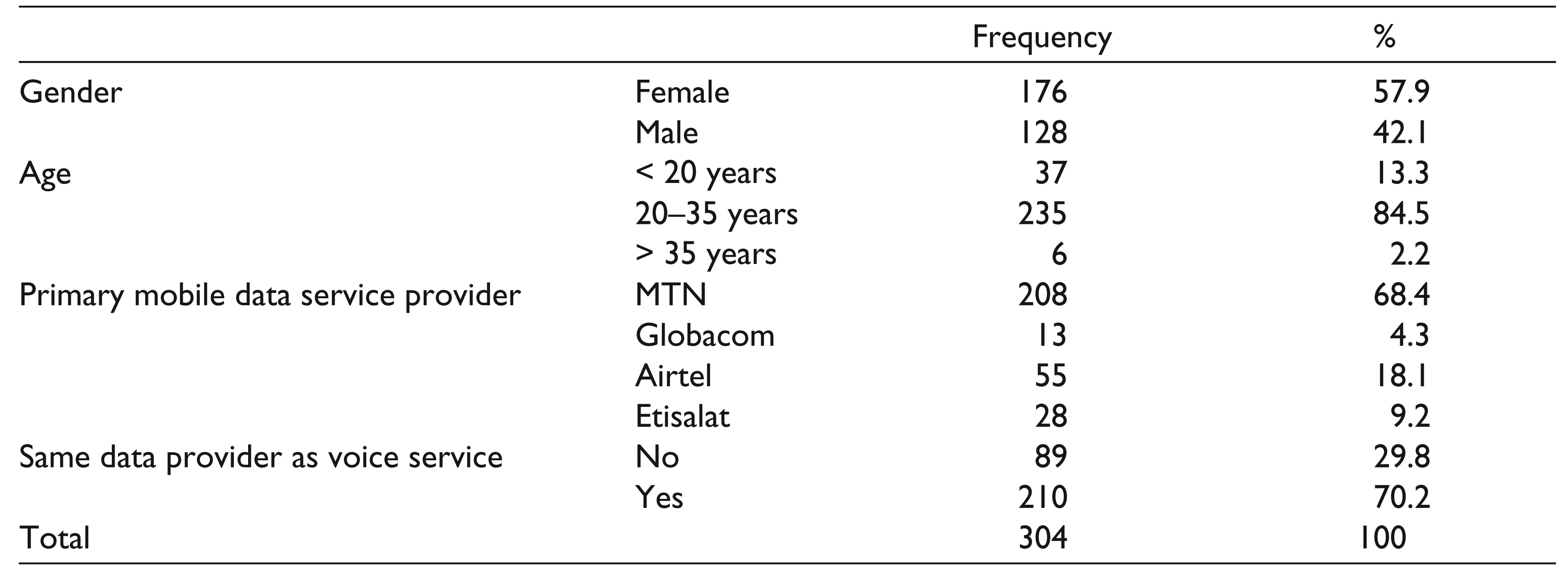
Statistical analysis was computed based on 304 usable responses out of the 320 copies of questionnaire distributed generating a response rate of 95 per cent. Following Kwuh and Oh (2009), the proposed models were tested using multiple regressions. SPSS 15 statistical software was used to conduct the empirical analyses. Of the 304 questionnaires, 57.9 per cent of the responses were from male respondents, while 42.1 per cent were from females. The majority were between 20 and 35 years (84.5%). Most of the respondents use Mobile Telecommunication Network (MTN) (68.4 per cent) as their primary mobile data service provider and about 30 per cent of the respondents use different service providers for voice and data services. Table 1 shows the demographic profile of the respondents in the final sample.
Respondents Profile
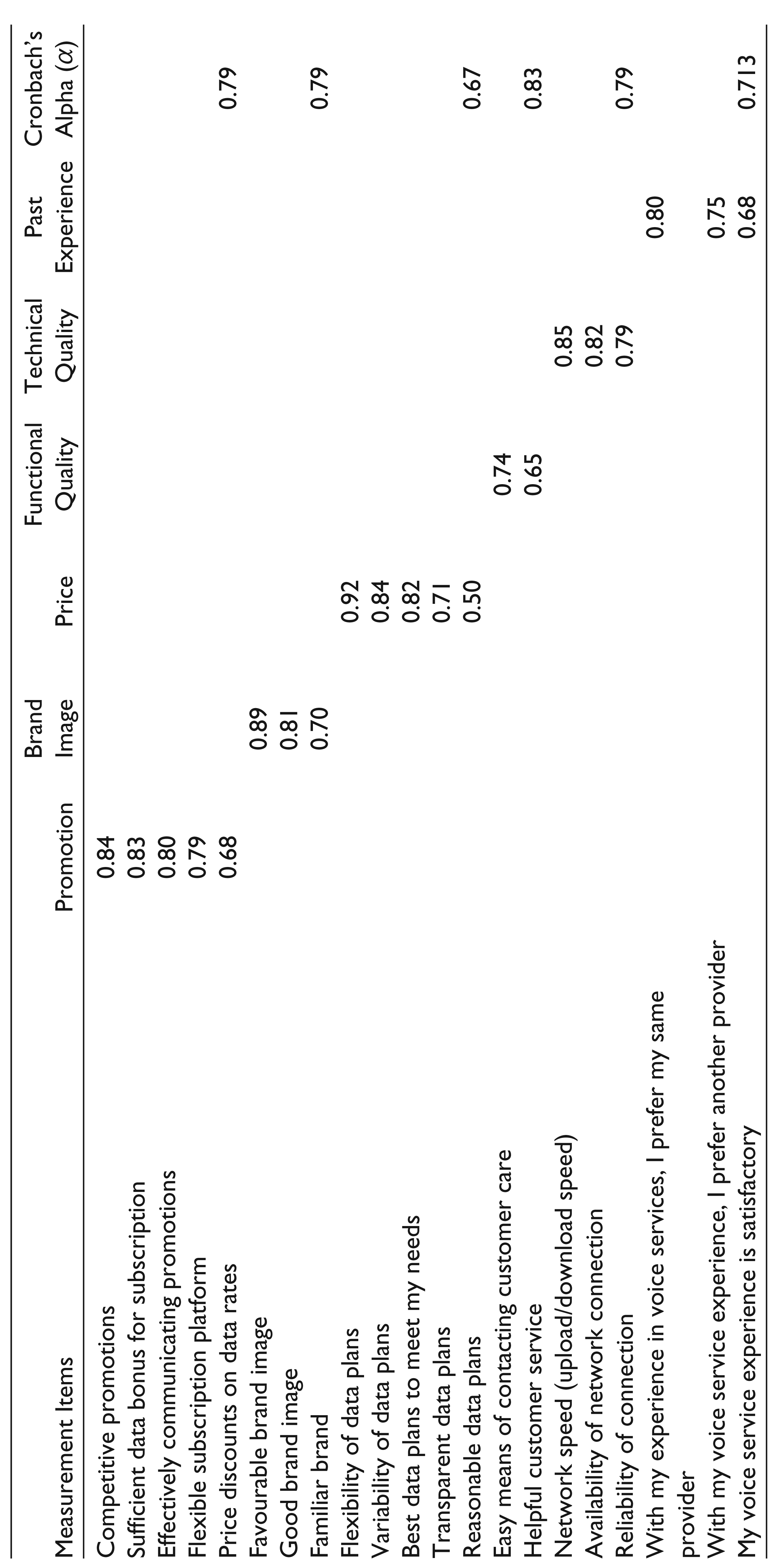
Factor analysis with varimax rotation was performed for the purpose of data reduction and subsequent use in regression analyses. In addition, reliability analysis was performed using Cronbach’s alpha at a benchmark of > 0.070 (Nunnally & Bernstein, 1994). The items converge into six factors. The first factor promotion consists of five items, and the third factor price consists of five items after dropping one item. The three brand image items converge into the second factor label brand image. The fourth (functional quality) and fifth factors (network quality) were related to mobile service quality items consisting of two and three items, respectively. The Cronbach’s alpha values for each measure range from 0.66 to 0.83, indicating that the measures were internally reliable in most cases (refer Table 2).
Factor Analysis and Reliability Result
2. Rotation method: Varimax with Kaiser normalization.
3. Rotation converged in 16 iterations.
The hypotheses were tested using regression analysis. The regression analysis was conducted to examine the effect of the predictor variables: promotion, brand image, price, mobile service quality and past experience on the outcome variable brand selection and continuance usage in series.
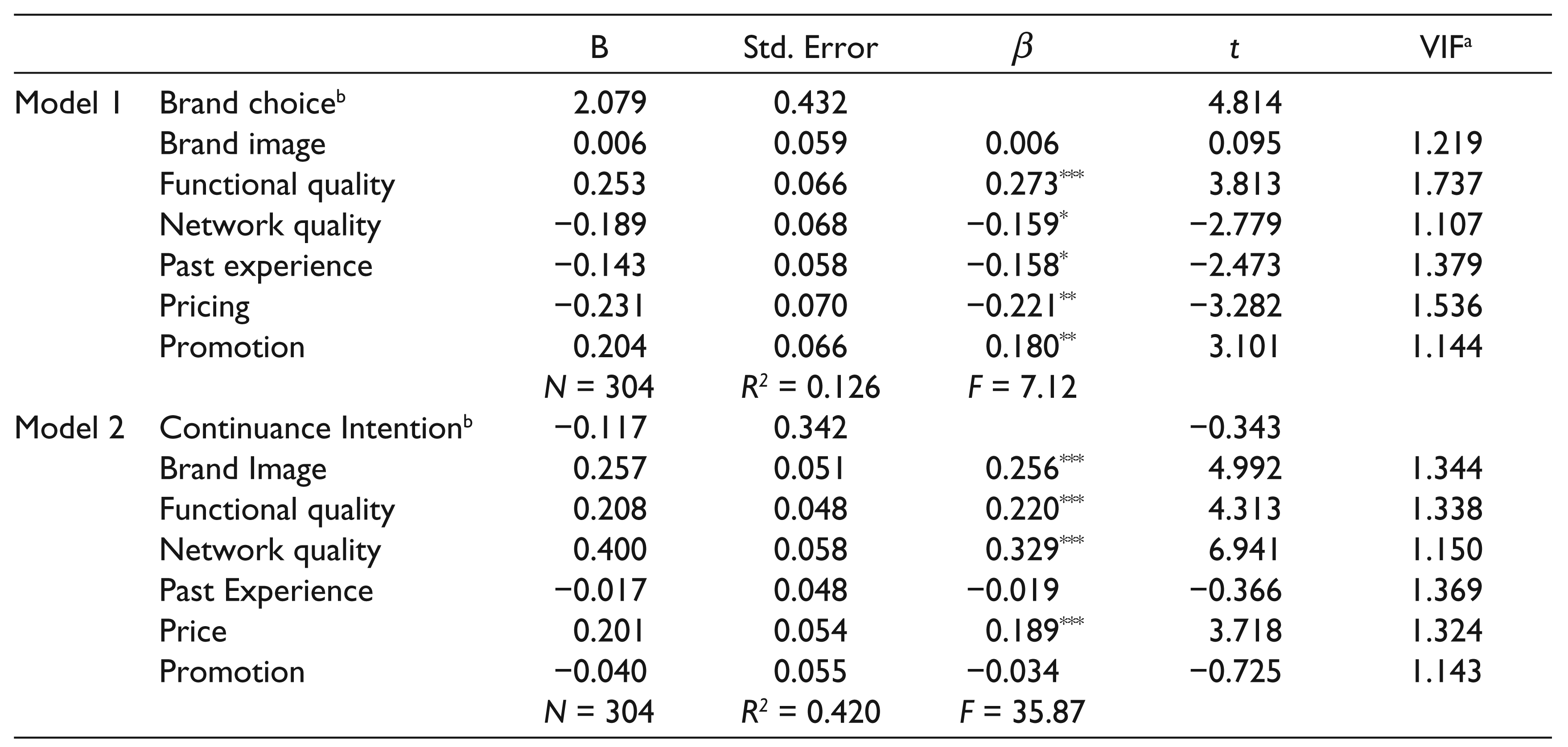
In model 1, we tested the effect of the predictor variables on brand choice. Table 3 shows the results of the regression model on brand choice and continuance. The result shows that the functional quality and network quality significantly affect brand choice, but the direction of the relationship for network quality was negative. For price, the result indicates a negative and significant effect on brand choice. In terms of promotion, the result also reveals a positive and significant effect of promotion on brand choice. Similarly, previous voice service experience shows a negative and significant effect on brand choice. Functional quality (β = 0.27, p < 0.001) produced the strongest prediction while brand image (β = 0.06, p = 0.924) produced the weakest prediction on brand choice. Overall, the model predicts 12 per cent of the variation on brand choice. The F-ratio (F = 7.12) shows that the overall brand choice model is a moderately good fit.
Regression Model for Brand Choice and Continuance Intention
a Variance inflation factor.
b Dependent variables.
In model 2, we tested the effect of the predictor variables on continuance intention with mobile service provider. The result indicates that mobile service quality, that is, network quality and functional quality, has a significant and positive effect on continued usage intention. Similarly, price of mobile data services significantly affects customers’ continuance intention. In addition, the result shows a positive and significant effect of brand image on continuance intention. However, for promotion and past experience, the findings reveal that both promotion and past experience have negative and insignificant effect on continued usage intention. Overall, the model is a good fit (F = 35.87) and predicts 42 per cent of the variation in continuance intention. Network quality (β = 0.40, p = 0.001) shows the strongest prediction and past experience (β = −0.02, p = 0.924) had the least effect on continuance intention.
Discussion
Based on mobile service provider selection model (Alamro & Rowley, 2011; Kugyte & Sliburyte, 2007) and cognitive dissonance theory (Festinger, 1957), this study investigates the determinants of customers’ choice and continuance intention with mobile data service provider by incorporating the impact of past experience with voice and SMS services on customers’ brand choice and continuance intentions with mobile data service provider.
It is pertinent to mention that the results presented in a recent article published in Global Business Review by Krishnakumar (2018) showed that there were partial mediating effects of past apparel buying behaviour and past apparel buying experience on future apparel buying intention. Furthermore, an important finding of our study is that the factors that attract a customer to a mobile service provider are significantly different from what keeps customers with that provider. For instance, while customers past experience significantly influenced choice of a mobile service provider, its impact was not significant on continuance intention. The insignificant effect of past experience on continuance intentions is not unexpected. It suggests that customers rely on past experience in selecting a brand, but their continued usage of the brand may not be influenced by such past experience. This result is in line with the cognitive dissonance theory. This finding supports Qi et al.’s (2009) study, where voice experience was found to influence behavioural intentions. In addition, we found that about 30 per cent of the respondents use different providers for data and voice service, confirming that data service usage could be independent of voice services. While the majority of customers who use the same provider for mobile data services and voice services is in line with the cognitive dissonance reduction theory. The implication of these findings for managers suggests that mobile service providers may cross-sell mobile data service to customers following their past voice experience. In addition, they can emphasize on the (dis)satisfactory voice experiences in their strategy to attract or retain customers.
The findings also show that brand image significantly impacts on continuance intentions. This finding confirms previous studies by Alamro and Rowley (2011) but contradicts Andreassen and Lindested (1998). Conversely, its effect on brand choice was not significant confirming previous studies in mobile voice services (Olatokun & Nwonne, 2012). A possible explanation is that notwithstanding the distinct need mobile data service and voice service satisfy (Gerpott, 2010), mobile data services are mostly value-added services. In other words, consumers have formed mental pictures of the service brands based on voice service experiences. Consequently, customers brand choice is not influenced by the portrayed brand image of mobile service providers. This result implies that emphasizing brand image, perhaps as the ‘the mobile data network’ or the ‘mobile data grand master’, may not be an effective strategy for customer acquisition but rather may be important for customer retention. In other words, customers may not choose a mobile data service provider for its perceived brand image, but customers’ intention to continue with a mobile service provider will strongly be affected by the perceived image of the mobile data service provider brand.
Promotion positively and significantly affects brand choice. Promotions, such as, free megabytes, price discounts and data bonus, affect customers’ choice of a mobile data service provider. This confirms previous studies by Alvarez and Casielles (2005) but contradicts the findings of Olatokun and Nwonne (2012). However, the effect of promotion on continuance intention was negative and insignificant. In other words, consumers’ responsiveness to the promotions of a current brand decreases with continued usage. This finding is in line with the promotion enhancement and usage dominance theory (Bridges et al., 2006). To the best of our knowledge, this is the first study that investigates the relationship between promotions on continuance intention. In a related study, Omotayo (2011) found a significant relationship between promotion and customer retention in mobile telephony. A possible explanation for these findings is that following promotion enhancement theory, consumers are more likely to respond to brands on promotions to make a choice, insofar they are sufficiently experienced with the product category. In addition, following usage dominance theory, once consumers choose a brand, their continuance intention is less susceptible to promotional offers from their current provider (Bridges et al., 2006). In other words, promotional offers may not determine the continuance intentions with a mobile data service brand once consumers make a brand choice but the direct usage experiences with respect to network quality and value-added services. The implication of this finding suggests that mobile service operators may aggressively offer promotional incentives to attract customers. However, managers should not rely on the use of promotional incentives for retaining customers; at best, managers should match competitive actions to prevent customers from switching.
The significant effect of mobile service quality on brand choice and continuance intention confirms earlier studies by Malhotra and Malhotra (2013) and Andreassen and Lindested (1998). Mobile service quality was also found to be the strongest predictor for mobile data service provider brand choice and continuance intention. Specifically, functional quality was found to be the strongest predictor for brand choice. This finding suggests that as consumers adopt mobile data services, it is important they access help in resizing SIM cards, installing mobile applications and accessing information on data bundles and pricing plan. On the other hand, the continued usage of mobile data services with a service provider is most importantly predicted by network quality. In other words, once customers choose a provider for mobile data services, the network speed—including upload and download speed, reliability of connection and network availability—becomes key considerations for continued usage. If customers’ expectations with respect to network quality are not met, they are likely to become dissatisfied quickly and switch immediately (Nokia, 2016). For managers, this finding suggests that they understand the importance of customer service including self-help services in customer acquisition. For example, managers can provide mobile data pricing information as soon customers activate a new SIM and suggest mobile applications following customers’ subscription data. In addition, investing and deploying infrastructure to improve network quality is an important strategic consideration for customer acquisition and retention.
Finally, price shows significant impact on brand choice and continuance intention. The relationship between price and brand choice was negative, suggesting that as price increases, consumers are less likely to choose a brand. This corroborates earlier findings by Alamro and Rowley (2011) and Al-Debei and Al-Lozi (2014). Counterintuitively, the relationship between price and continuance intentions was found to be positive and significant suggesting that customers intend to continue usage of their chosen brand irrespective of price changes. It is quite possible that customers attach importance to price at the point of choosing a brand such that providers perceived to charge higher prices are deselected while a provider perceived to charge lower prices is selected. However, once customers select a brand, and the service provider is able to meet or exceed customers’ expectation by improving the quality of service and offering value-added services, customers become less susceptible to price changes. In other words, price becomes less influencing factor for continue usage.
Conclusion and Implications
This study contributes to scholarly discussion on mobile data service adoption and post-adoption behaviour. A brand choice-continuance intention model was developed considering past voice experience. The study demonstrates that all the factors (i.e., mobile service quality, price, promotion and past experience) except brand image affect brand choice. In addition, continuance intention decision criteria include mobile service quality, brand image and price, respectively. Functional quality and network quality predict brand choice and continuance intention decisions, respectively, the most. Consumers’ voice service experience impacts on the adoption decision of mobile data services. Therefore, as mobile data service evolves, an understanding of the determinants of customers’ brand choice and continued usage has strategic implications for customer acquisition and retention in the mobile telecommunication industry. Despite the significance of this research, there are a number of limitations to the study. First, as with most studies with student samples, care should be taken in generalizing the findings since students may not be adequate representatives of mobile data service users. Also, students may control limited resources to make brand choice. Future studies should include non-student samples. Second, the factors examined may not be exhaustive of all the decision criteria use in mobile service provider selection. Future studies may examine the effect of satisfaction, value-added services and inertia on behaviour outcomes. Finally, the direct effect of past experience was investigated; future studies may examine its indirect or moderating effect with behavioural outcomes using more robust statistical techniques such as structural equation modelling.
The implication of this finding for managers is that they understand that customers are price sensitive when adopting mobile data services as such offering monetary incentives may be a potent competitive tool in attracting customers and preventing them from switching to more attractive alternatives. But retaining customers may require meeting and exceeding their expectations even if it means increasing prices.
Declaration of Conflicting Interests
The authors declared no potential conflicts of interest with respect to the research, authorship and/or publication of this article.
Funding
The authors received no financial support for the research, authorship and/or publication of this article.
Footnotes
Acknowledgements
The authors are grateful to the anonymous referees of the journal for their extremely useful suggestions to improve the quality of the article.