




Abstract
In the midst of budget constraints, marketers need to plan their choices of messages and communication tools appropriately and efficiently. As studies exploring both factors and their interactions are rare, this study uses the advertising, sales promotion and public relations messages of a retail outlet, to study the effects of two different types of message variation: cosmetic and substantive and three choices of communication tools on consumer response on the messages and on the brand. An experiment of 198 subjects under six conditions reveals significant main effects and an interaction for consumer response on the messages. However, only message variation significantly affects consumer response on the brand. Customers generally seek for the types of messages and communication tools that can increase the amount of information and perceived value to make an informed purchase decision. Discussions of the results and implications for marketing communications are provided.
Introduction
Marketers often face a dilemma when they plan a marketing communication campaign especially when they need to select the appropriate messages that fit the communication tools. They often have a choice of keeping the message consistent with minor variation, that is, cosmetic message variation, or differentiate the messages substantially to provide variety for the target audience, that is, substantive message variation. Moreover, they can use one single communication tool such as advertising or sales promotion or decide to use several tools at the same time. As there is no previous study exploring these two variables at the same time, this study attempts to investigate whether cosmetic and substantive message variations, and a single communication tool of advertising or sales promotion and multiple communication tools of advertising, sales promotion and public relations affect consumer response on the messages and on the brand. As messages are generally designed specifically for each communication tool’s purposes and the decisions for the messages and the communication tools depend on each other, we expect there should also be an interaction of different types of message variations and communication tools on consumer responses. We also intend to come up with insights and guidance for marketers to design their messages and select the appropriate communication tools to maximize the marketing communication efforts.
Review of Literature
Earlier research finds message variation is effective as it is easy to remember and more persuasive than the repetition of the same ads (Gorn & Goldberg, 1980; Grass & Wallace, 1969; McCullogh & Ostrom, 1974; Unnava & Burnkrant, 1991). This is attributed to the encoding variability theory which believes messages can be retrieved best if they are in a variety of different contexts (Melton, 1967). It happens because the audience has a chance to expose to a large number of retrieval cues such as nearby word lists, task relevant thoughts and so on (Anderson & Bower, 1972).
To investigate more on message variation, Schumann, Petty, and Clemons (1990) classify message variation into two types. Cosmetic variation is the message variation of minor elements that are peripheral cues, for example, fonts, background colours, illustrations and so on, and substantive variation is the message variation of elements relevant to the product or service such as the theme of ads and major features of the products. They find cosmetic variation affects attitudes when motivation to process the ads is low but substantive variation has stronger impact on attitudes when the motivation to process is high. The results support the elaboration likelihood model (Cacioppo, Petty, & Morris, 1983; Petty & Cacioppo, 1986).
For communication tools, marketers often face choices of a single tool or multiple tools. The single tool is generally appropriate for certain communication objectives, for example, advertising for awareness, knowledge, liking or preference while sales promotion and direct marketing for purchasing actions and so on, or for certain types of businesses, for example, sales promotion for the retail business and so on (Belch & Belch, 2015). Some of the studies on the single tool effects are as follows.
Vakratsas and Ambler (1999) review more than 250 journals and books to study the effects of advertising and find intermediate effects of advertising on beliefs, attitudes and behaviour without the temporal sequence. They suggest advertising should be explored by cognition, affect and experience with consideration of context, target market, advertising goals, product category, competition, environment, stages of product life cycle and other marketing mix elements. For sales promotion effectiveness, immediate price reduction is obviously more effective on brand choice selection (Alvarez & Casielles, 2005). Several findings concur monetary promotions are more effective for utilitarian products and nonmonetary ones for hedonic products (Chandon, Wansink, & Laurent, 2000; Santini, Sampaio, Perin, & Vieira, 2015). Huynh (2016) confirms the same finding and adds that urban consumers prefer non-monetary promotions while rural people like the monetary ones. Palazn-Vial and Degado-Ballester (2005) discover non-monetary promotions have a stronger impact on long-term brand knowledge. Most researchers agree the product type is a significant factor affecting sales promotion effectiveness (Chandon, Wansink, & Laurent, 2000; Huynh, 2016; Santini et al., 2015). For instance, premiums that are appropriate for the product category are seen as less manipulative (D’Astous & Landreville, 2003) and can result in longer effect after the promotion (Jones, 2008).
Even though the effectiveness of public relations is difficult to assess, there are studies in the industries that show the effectiveness of PR on sales and its ability to elevate the performance of other communication tools such as advertising and sales promotion (Moyer, 2011). Ries and Ries (2004) study 91 new product launches and find those that utilize public relations are more successful than those that do not. Public relations campaigns are generally applicable to business firms through social marketing and corporate social responsibility, linking what the company believes in with the public and reflecting in the behaviour of all the company’s members (Gupta, 2012), building relationships with customers and strengthening brand value (Kumar & Pathak, 2016; Singaiah & Laskar, 2015).
The use of multiple tools is expected to provide the synergistic effects of multiple communication tools proposed by integrated marketing communication (IMC) researchers such as Duncun and Everett (1993) and Schultz (1996). Some also propose that IMC can result in stronger sales performance, brand equity and loyalty (Duncun & Moriarty, 1998; Eagle & Kitchen, 2000). Studies on the effects of multiple tools and their integration are rare. However, there are some studies on the integration of sales promotions with advertising focusing on the use of advertising when distributing samples (Hoch & Ha, 1986; Levin & Gaeth, 1988; Smith, 1993) and the synergistic effects of publicity and advertising when publicity is placed before advertisements (Jin, 2004) and on attitude of the ad and attitude of the brand (Stammerjohan, Wood, Chang, & Thorson, 2005). An integrative strategy of advertising and sponsorship has a better impact on attitude, recall and information processing of a campaign than the non-integrative one (Navarro, Sicilia, & Delgado-Ballester, 2009). The combination of advertising, personal selling and direct marketing can increase marketing performance of a trade show campaign (Tafesse & Korneliussen, 2013). Although there are studies covering the effects of single tools and multiple tools, no study compares the effects of both at the same time.
The studies on message variation have been conducted on each communication tool specifically, even though the messages of sales promotion and public relations can be varied, as there are many types of sales promotion and PR campaigns that can be implemented together at the same time along with advertising. Apart from the Schumann et al.’s (1990) finding on advertising, there are studies showing different types of messages affect the ad effectiveness differently, for example, new messages are found to be more effective than old repeated ones for new target audience (Eastlack & Rao, 1989). Advertising messages have an impact on the introductory products and attitude change (Lodish et al., 1995) and advertising message theme affects the ad wear-out rates (Bass, Norris, Majumdar, & Murthi, 2007; Campbell & Keller, 2003). For sales promotion, monetary and non-monetary promotions are differently effective for different types of products and consumers (Chandon, Wansink, & Laurent, 2000; Huynh, 2016; Santini et al., 2015), representing different types of messages for different products and target audiences. For public relations, the interaction of different types of messages in health concern (preventive or detective) and types of audience moods (positive and negative) has an influence on communication effectiveness (Anghelcev & Sar, 2011). Freberg (2011) finds the intent to comply with the PR of food recall message is significantly stronger for messages from the organizations than from the ones users generate but is not varied by message reliability. James (2011) concludes repetition of key messages is necessary for a PR campaign and inconsistency can damage credibility of the message.
Two aspects of consumer response on the messages and on the brand are investigated in this study. First, we explore the consumer response on the messages covering all the communication tools’ messages, not just advertising, consisting of seven attributes: credibility, expectation, well organization, familiarity, relevance, good communication and attitude change. These attributes have been borrowed from previous studies, adapted to avoid biases and developed to cover the types of messages from other communication mix besides advertising. We will explore all the seven attributes from the previous studies that include them. Credibility relates to the believability and trustworthiness of the messages and is generally included in the attitude towards the ad (Drolet, Williams, & Lau-Gesk, 2007; Lawrence, Fournier, & Brunel, 2013; Sirianni, Bitner, Brown, & Mandel, 2013). Relevance is the extent that the target audience perceives the messages are linked with the brand (Drolet et al., 2007; Keshari, Jain, & Jain, 2012; Lawrence et al., 2013). Good communication is generally judgement of the target audience over the quality of the messages (Kulkarni & Yuan, 2015; McGrath, 2005). Attitude change is the persuasiveness of the message exploring whether the target audience views the messages can change their attitude (Keshari, Jain, & Jain, 2012; Kulkarni & Yuan, 2015; Loken & Pitney, 1988). Attitude change must be explored as part of consumer response on the messages because persuasive messages, through rational and emotional appeals, can lead to enduring and temporary attitude change, respectively (Cacioppo et al. 1983; Petty & Cacioppo, 1986). Thus, we include attitude change to explore the messages are persuasive enough to change the subjects’ attitude. Well organization intends to let the subjects judge whether the messages are consistent and well-coordinated (Navarro, Sicilia, & Delgado Ballister, 2009). Familiarity with the previous exposure of the messages is the psychological processes of message exposure that can be affected by the consumer’s familiarity with the previous message in other media and this should be explored as other communication mix elements may also carry the same or similar messages (Bendixen, 1993; Edell, 1993). Expectation is the new attribute we decide to include as sales promotion can create the expectation of the messages resulting from previous exposure to the promotion especially on price discount (DelVecchio, Krishnan, & Smith, 2007). Expectation can also be applicable to the advertising and public relations messages especially during the time of crisis or ongoing corporate social responsibility activities (Gupta, 2012).
Second, the study explores the consumer response on the brand. The three components of the communications response model, cognitive, affective and conative, are investigated. The model has been used in assessing consumer behaviour and advertising effectiveness in marketing (Lavidge & Steiner, 1961). Later research that explores these components includes: understand (Jin & Lutz, 2013; Rose, Clark, Samouel, & Hair, 2012); liking (Aggarwal & McGill, 2012; Homer, 2009; Sirianni et al., 2013); preference (Patterson & Richards, 2000) and purchase intention (Alain, 2007; Patterson & Richards, 2000; Wu & Newell, 2002). Since this study’s main focus is not on the sequences of the three components, the consumer response’s components are randomly placed in the questionnaire and investigated separately.
Even though we explore the three components of the response in this study, that is, cognitive, affective and behaviour, the awareness of the brand will not be studied here as the respondents are all aware of the brand since the subjects report that they visit the store on average about once a month. Therefore, we will focus on the understanding, liking, preference and purchase intention in this study.
Objectives and Rationale of the Studies
The literature review reveals significant gaps of studies on other communication tools besides advertising. Most of the previous studies focus on the effectiveness of advertising on consumer response. However, empirical studies on the effects of sales promotion are fewer than those of advertising and those of public relations are almost non-existent. Comparative studies of effects between two tools are scarce but the comparison between the single tools and multiple tools cannot be found. For message variation, most studies also focus on a single tool and empirical studies on multiple tools are virtually none. Consequently, there is no study of interaction between message variations and communication tools choices, which are general factors for marketers to make in their daily marketing communication decisions, in the previous studies.
Therefore, this study intends to investigate the roles of message variation and communication tools choices and their interactions on consumer response on the messages and the brand. Thus, we have borrowed, adapted and developed a construct of consumer response on the messages appropriate for all communication tools, not just advertising as we witness in previous studies especially attitudes towards the ad. The attributes of the consumer response on the brand are also borrowed and developed to reflect the sequence of responses from the hierarchy of effects and fitted to all communication tools’ objectives. It is expected that the different types of message variations and the choices of communication tools will influence the consumer response on the messages and the brand and there should also be an interaction from these two factors.
Methodology
Research Design and Subjects
The study is an experiment of 2 (cosmetic message variation, substantive message variation) × 3 (advertising only, sales promotion only, a combination of advertising, sales promotion and public relations) between-subject factorial design. The study was conducted using real marketing communication messages of a large retail store in Thailand. Thailand is selected partly because the hypermarket business is dominated by only two players. The retail store in the study has branches all over the country and the brand name is well known among the population and is familiarized to all of the subjects in this study. To rule out the effects from reproduction of new messages and new brand name learning, using an existing brand in the market with only one main competitor would enable us to study the effects on consumer response that requires a comparison between the store and its competitor more effectively. These effects include attitude change, preference and purchase intention.
Questionnaire Design
Pictures from previous marketing communication campaigns of the stores were derived from a search engine. The subjects expose to the same number of messages (6). Six versions of the messages were used for six treatment conditions. All the pictures have the same size and are printed on an A4-sized paper with a four-color inkjet printer. The six pictures were randomly assigned a number but they were not stapled, allowing free movement similar to normal message exposure.
Version 1: Advertising with cosmetic message variation. Four pictures depict a hand grabbing a fish, a squid, a crab, a lobster in the water and two pictures consisting of a chicken and a fish in a plastic wrap. They have no verbal description.
Version 2: Advertising with substantive message variation, including an announcement of bus ticket sale at all branches, fresh produce from farms, gifts for Christmas, a teaser ad for an event at the store, the number one for lowest prices and a back-to-school event.
Version 3: Sales promotion with cosmetic message variation. All messages are about the low prices for different promotional items. They have the same green background colour, size and layout.
Version 4: Sales promotion with substantive message variation, including a promotion using all transportation tickets as a coupon worth 40 Thai baht (USD 1.10), the low price leader in navy blue, a sweepstake, point accumulation for two movie tickets, a low price leader in a green background and a special promotion for school vacations.
Version 5: Advertising, sales promotion and public relations (two each) with cosmetic message variation. Two pictures are randomly selected from version 1 (a hand grabbing a fish and a hand grabbing a squid) and version 3 (two green background sales promotion messages), respectively, while both of the public relations messages are on reducing the use of plastic bags.
Version 6: Advertising, sale promotion and public relations (two each) with substantive message variation. Two pictures are randomly selected from version 2 (the teaser ad for an event at the store, the number one for lowest prices), version 4 (the low price leader in navy blue and a special promotion for school vacations) and version 5 (reducing the use of plastic bags) and a PR for giving shoes to the poor students.
Each subject received two envelopes with a set of questionnaire titled the Study of Marketing Communication in the Retail Business inside each envelope. For the first envelop, the subject rated all the six pictures on a scale of 1–10. Then, they were instructed to put the questionnaire back to the envelope. This was to ensure the subjects had an opportunity to explore the pictures in details. Then, the subjects answered the second questionnaire on a 9-point Likert scale from strongly disagree to strongly agree in the second envelope. Seven questions were on consumer response on the messages (credibility, expectation, well organization, familiarity, relevance, good communication and attitude change) and four on the brand (understanding, liking, preference and purchase intention). The questions were randomly placed. Questions on familiarity and relevance were negative statements intended to avoid a halo effect. They were converted to positive for statistical analysis and report.
Questions on detailed recalls and demographics were on the second page. The subjects spent 20–25 minutes in the experiment, and then they were debriefed. All participants were informed that the study was not funded by the retail store.
Data Analysis
A total of 198 subjects from graduate-level marketing classes were randomly assigned to the experimental conditions. The graduate students have never had any exposure to marketing communication concepts. About 90 per cent of the subjects have a job and they report that they shop at the retail store of this study about once a month. Most (60.2%) are female and the average age is 27.24 years old.
Scale Reliability
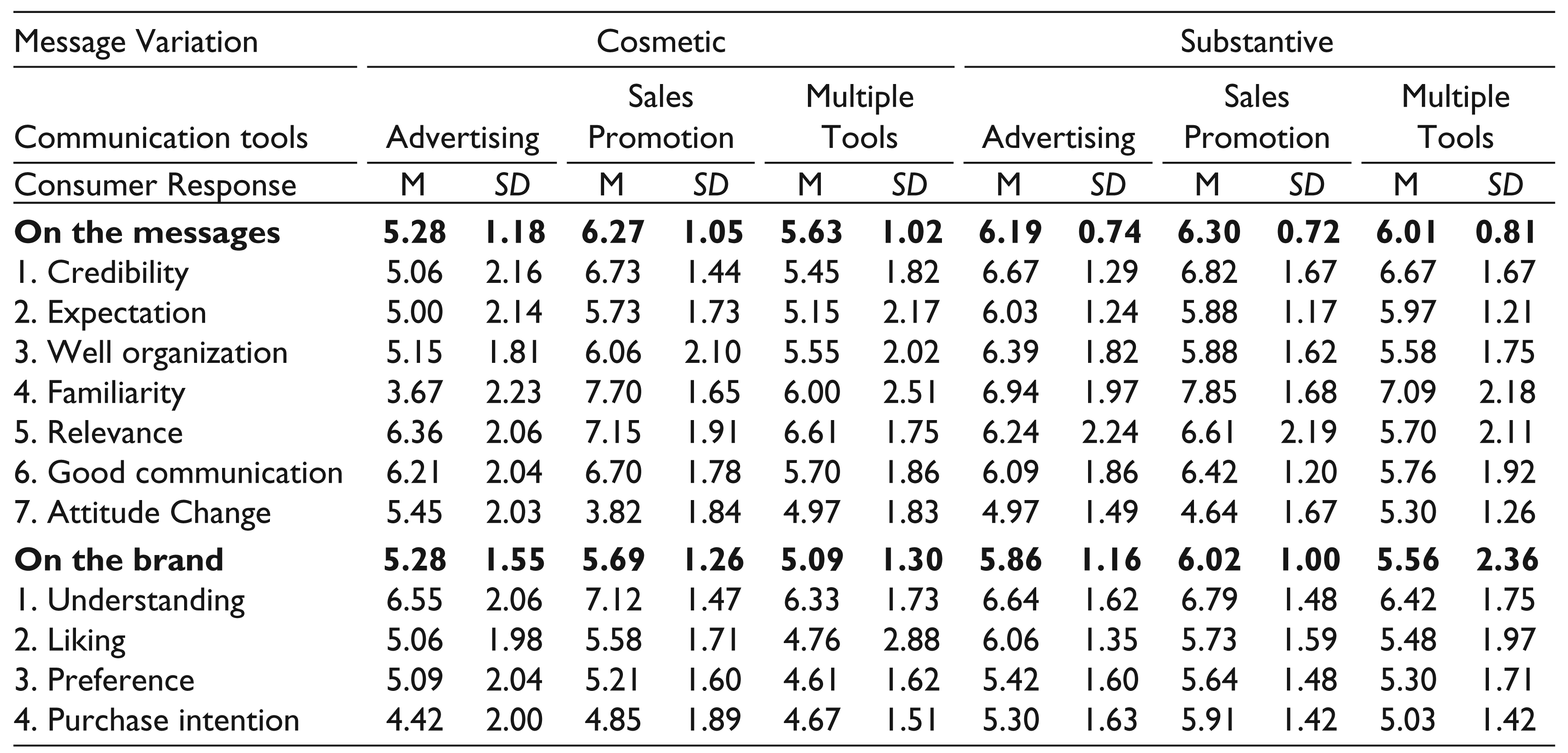
The Cronbach’s alpha correlation of the seven components that form the construct of consumer response on the messages is 0.70 and the Cronbach’s alpha of the consumer response on the brand formed by the four components is 0.79. The data analyses reveal the results as indicated in Tables 1 and 2.
Means and Standard Deviations of the Consumer Response
Results of the Main Effects and the Interactions on the Consumer Response
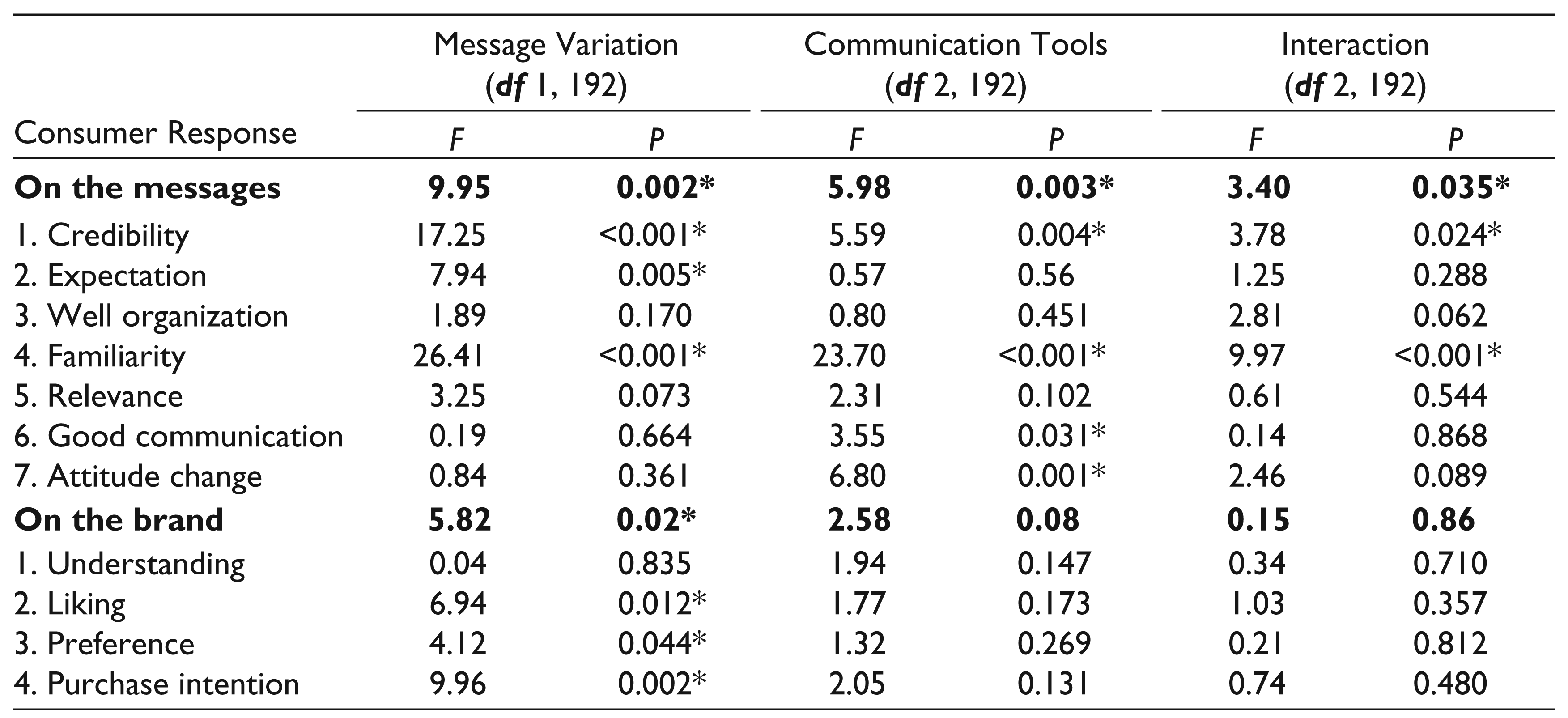
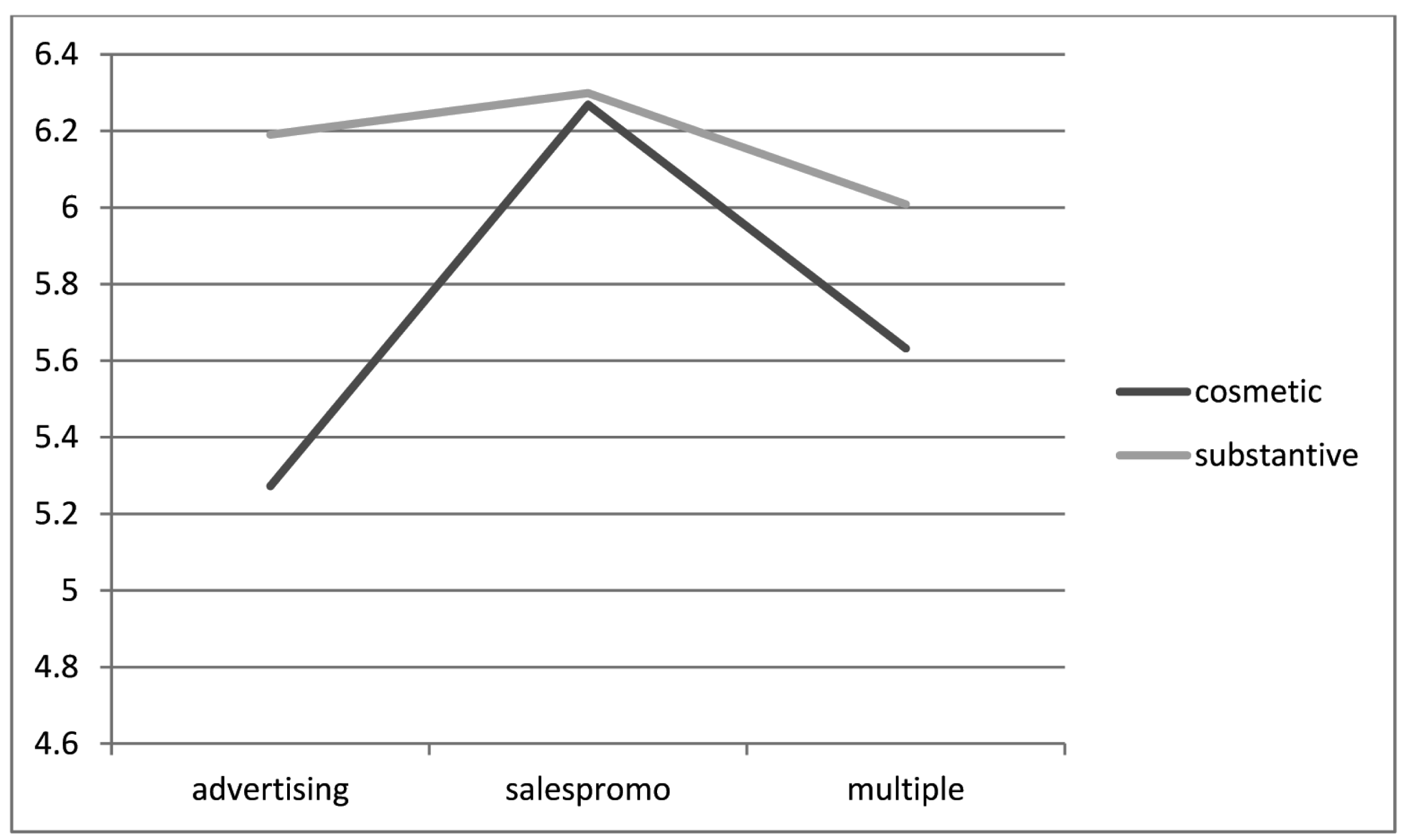
For consumer response on the messages, as shown in Figure 1, there are significant main effects of message variation (F[1,192] = 9.95, p = 0.002) and communications tools (F[2,192] = 5.98, p = 0.003). All the substantive variation groups have higher scores than all the cosmetic ones. All the sales promotion groups have higher scores than any other tool. There is also a significant interaction between the message variation and communication tools choices (F[2,192] = 3.40, p = 0.035). The same findings apply for credibility and familiarity. The substantive message variation groups have significantly higher scores than the cosmetic ones (credibility: F[1,192] = 17.25, p < 0.001; familiarity: F[1,192] = 26.41, p < 0.001). There are differences between communication tools choices (credibility: F[2,192] = 5.59, p = 0.004; familiarity: F[2,192] = 23.70, p < 0.001). Moreover, there is an interaction between message variation and communication tools choices (credibility: F[2,192] = 3.78, p = 0.024; familiarity: F[2,192] = 42.31, p < 0.001). The means of credibility and familiarity for the sales promotion with substantive message variation groups are the highest (M credibility = 6.82 and M familiarity = 7.85).
For expectation, the only significant main effect is message variation (F[1,192] = 7.94, p = 0.005). All the substantive variation groups have higher scores than the cosmetic ones. On the contrary, the only significant main effect for good communication is communication tools (F[2,192] = 3.55, p =0.031). Sales promotion is higher than multiple tools (Tukey’s HSD q-statistics = 3.77, p < 0.05). No significant main effects and interactions are found on well organization and relevance.
The most surprising result of this study is on attitude change where there is a significant main effect from communication tools (F[2,192] = 6.80, p = 0.001). The highest attitude change comes from the advertising with cosmetic message variation, while the least comes from the sales promotion groups with cosmetic (M = 3.82) and substantive message variation (M = 4.64). When exploring further, advertising yields higher attitude change than sales promotion (Tukey’s HSD q-statistics = 4.69, p < 0.05) and the multiple communication tools are significantly higher than sales promotion (Tukey’s HSD q-statistics = 4.33, p < 0.05).
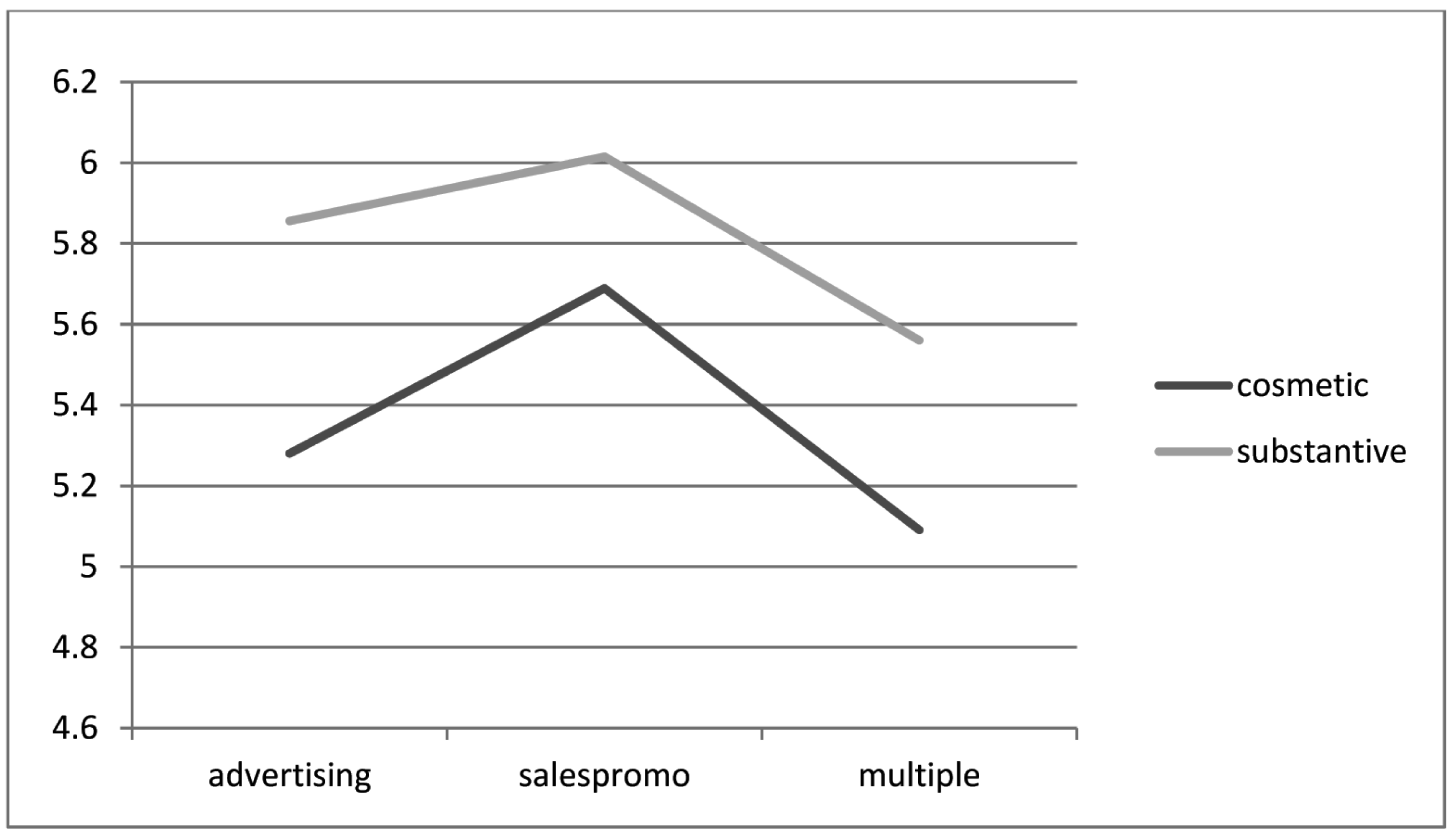
For consumer response on the brand, as shown in Figure 2, the significant main effect is from message variation only (F[1, 192] = 5.82, p = 0.02). The scores of all substantive variation groups are higher than the cosmetic ones. No significant main effects and interaction are found on understanding. Substantive message variation groups are significantly higher than the cosmetic ones on liking (F[1,192]) = 6.49, p = 0.013), preference (F[1,192] = 4.12, p = 0.044) and purchase intention (F[1,192] = 9.96, p = 0.002).
Conclusion
There are significant main effects and an interaction of message variation and communication tools choices for consumer response on the messages as expected. Substantive message variation scores are all higher than the cosmetic ones but the only significant difference is found on advertising (M substantive variation for advertising = 6.19 vs. M cosmetic for advertising = 5.28; Tukey’s HSD q-statistics = 5.35, p <0.05). Almost no differences can be found between message variations groups in sales promotion (M cosmetics/sales promotion = 6.27 and M substantive/sales promotion =6.30). For communication tools, sales promotion is significantly better than advertising (M = 6.27 vs. M = 5.28, Tukey’s HSD q-statistics = 5.81, p < 0.05).
The significant interaction between both factors reminds us to consider the appropriate message variation and communication tools. For message variation, substantive message variation can result in significantly higher scores for advertising and is better for multiple tools also. For communication tools, sales promotion, regardless of the types of message variations, is significantly more appropriate than advertising and yield stronger consumer response on the messages than multiple tools. We will explore consumer response on the messages along with those of credibility and familiarity as they all have similar results.
For credibility and familiarity, there are significant interactions of message variation and communication tools choices. For credibility, substantive variation is significantly better than cosmetic one for advertising (Tukey’s HSD q-statistics = 5.62 p < 0.05) and for multiple tools (Tukey’s HSD q-statistics = 4.24, p < 0.05). For familiarity, only substantive variation of advertising is significantly better than the cosmetic one (Tukey’s HSD q-statistics = 9.12, p < 0.05). Like consumer response on the messages, both types of message variations have almost the same results for sales promotion on both credibility and familiarity. Sales promotion groups also have significantly higher scores than advertising and are better than multiple tools for credibility and familiarity. The higher scores of sales promotion may result from the types of products or services which is the significant factor for using sales promotion as found in earlier studies (Chandon, Wansink, & Laurent, 2000; Huynh, 2016; Santini et al., 2015). In this study, the retail business depends mostly on sales promotion. Moreover, the subjects in this study rate sales promotion especially the cosmetic variation with the highest scores of relevance (M = 7.15) indicating the messages are relevant to the brand.
Sales promotion calls for consumers to take immediate purchasing actions. The information is mostly about the high value for money and price-based promotion, requiring the consumers to make a rational decision, and this could contribute to the higher scores of consumer response on the messages. Moreover, it is the rational nature of sales promotion that results in significantly higher credibility scores than advertising and multiple tools. For familiarity, it is possible that the participants link what they normally expose in the retail promotion which consists of a large variety of messages and they can relate to the information much better by using sales promotion. On the other hand, advertising and multiple tools can also add the amount of information through substantive message variation to increase the perceived value as we can witness from the higher scores on consumer response on the messages, credibility and familiarity. This is supported by later findings on consumer response on the brand that message variation becomes the only significant factor for affective and behavioural stages.
Substantive message variation can lead to higher expectation because when marketers provide a large variety of information about a brand to consumers. These messages allow marketers to meet consumers’ expectation much better and they render more essential information for the consumers to make an informed purchasing decision.
For good communication, the sales promotion groups have the highest scores for both cosmetic (M = 6.70) and substantive message variation groups (M = 6.42), followed by the advertising ones. The least scores belong to the multiple tools groups. To compare the difference of communication tools, the significance difference exists between the sales promotion and the multiple tools groups (Tukey’s HSD q-statistics = 3.77, p < 0.05). This implies that sales promotion is typically used and regarded as an appropriate communication tool for the retail store. Most consumers are familiar with it.
For consumer response on the brand, we only find the significant main effects of message variation. Varying the messages substantively results in higher consumer response on brand in all communication tools choices as substantive variation increases the information and value that customers are seeking for. Investigating more specifically, we can see the effects are stronger towards affective and behavioural stages as we find no significant difference on understanding. This may be because the nature of the retail messages is not too difficult to understand. Substantive message variation groups are significantly higher than the cosmetics ones on liking, preference and purchase intention. The results are interesting as the means of sales promotion with substantive message variation groups on preference (M = 5.64) and purchase intention (M = 5.91) are the highest. However, for liking, the advertising with substantive message variation (M = 6.06) is the highest. This suggests that advertising is appropriate for communicating the hedonic aspects of the brand and for creating affective responses. However, the difference of the communication tools choices is not statistically significant here. In fact, it is worth noticing that multiple tools do not lead to any highest scores of consumer response on the message and score the lowest on the brand. This might be because the effects of the individual tools are possibly diluted in the multiple groups where we limit each tool to only two pictures, instead of six in the single tool treatments.
The results for attitude change are interesting as the lowest attitude change scores come from the sales promotion groups. The mean of both sales promotion groups is the lowest (M = 4.23) while the mean of the advertising ones is the highest (M = 5.21) and the difference is statistically significant (Tukey’s HSD q-statistics = 4.69, p < 0.05). Moreover, the mean of the multiple tools for both types of message variation (M = 5.14) is significantly higher than the sales promotion groups (Tukey’s HSD q-statistics = 4.23, p < 0.05). This indicates the important roles of advertising in attitude change.
Advertising can bring about attitude change better than sales promotion alone. In this study, the advertising only with cosmetic message variation group (M = 5.45), consisting of all the hedonic pictures showing the freshness of foods in the store, has the highest score. Moreover, the multiple tools are also better than sales promotion alone for attitude change. This can be attributed to the ability of advertising to convey the hedonic brand experience which can help brand evaluation and leading to brand loyalty (Bapat & Thanigan, 2016). It is the peripheral route to persuasion according to the elaboration likelihood model. The hedonic messages are more appropriate for the low involvement products (Akbari, 2015) such as the retail business in this study and they can enhance the emotional value which leads to possible purchase intention (Kashi, 2013) Moreover, the advertising messages can have an effect on attitude through transformation in three stages: suggestiveness, persuasiveness and relationship building, resulting in the similar effects of public relations when they are combined in the multiple tools. This also supports Isaid and Faisal’s (2015) finding that the significant attitude components are those that can enhance a person’s reputation and social contexts which occur frequently in advertising and PR messages. Thus, the low price promotion and any other type of sales promotion combined are not as effective as advertising or the multiple tools in changing attitude.
Managerial Implications
The results from this study have shed some lights for marketers to plan their marketing communication budget as IMCs often take time and resources to build brand image in the mind of the consumers (Banerjee & Siddhanta, 2015). Communication tools choices and message variations are significant factors for overall consumer response on the messages, credibility and familiarity. Sales promotion with cosmetic or substantive message variation provides better results as it fits the products type in this study. Sales promotion increases the cognitive brand experience through a large amount of savings, increasing the overall brand value (Bapat & Thanigan, 2016). From the findings of this study on consumer response on the brand, substantive message variation is more effective than the cosmetic one for the affective and behavioural responses as consumers value a large variety of information, bringing more insights and experiences to their purchasing decisions especially when the messages are not too difficult to understand. The findings support the encoding variability hypothesis. We can conclude that customers give the priority to the communication tool that can provide highest value for their purchase based on the types of products or services. Substantive message variation can increase the perceived value for other tools and bring them to purchase consideration. The more information they receive, the better perceived value and responses on the messages and the brand.
The finding on attitude change helps us understand its processes much better as it requires a different tool from the one that marketers typically use and the totally different message strategy, in this case from substantive to cosmetic message variation. This complete change we term the dramatic switch to a different message and communication tools strategy is expected to shift the consumer’s mind from normal mode to the new mode. This may include the shifting of attention and the aspects of consumption, in this case from utilitarian (sales promotion/substantive) to hedonic (advertising/cosmetic). The dramatic switch of message and communication tools will be beneficial when the marketers encounter crisis situation when they need to change the consumer’s attitude from negative publicity or when they are facing with tough competition.
The quest for customers to have a wide variety of message choices has led us to think about the most basic human consumer products, that is, food. Food is similar to messages. Both are appealing to human perception and both need varieties. In this case, it is different tastes within each dish. Customers generally do not like the same taste, for example, sour, bland, salty, sweet and so on. Human being can witness this heterogeneous preference in almost all consumption. For food, it may be the demand of our body to take various minerals and substances to function and survive. For messages, it is the demand of our mind to get more information to make a purchase decision.
Communication tools are similar to types of foods served during different stages of the meals, for example, appetizer, main course, dessert and so on. Human mind is programmed to respond to the sequence of foods we classify during different stages of the meals and we learn to take them in sequence. In seldom circumstances do we mix or rearrange the sequences. The selection of communication tools is significant when we plan for certain consumer responses, for example, credibility, familiarity, good communication and attitude change, and should be used one tool at a time. Choosing a communication tool is like when we serve an appetizer. We should not serve a main course and a dessert at the same time.
For attitude change, the dramatic switch of messages and communication tools is similar to providing a dish with delicious spicy tastes or a simple salty or bland taste for the whole dish. Consumers will definitely be alerted and are likely to change their attitude to either positive or negative from such action.
Limitations and Future Research
Even though the study uses real messages from a retail outlet, the nature of the retail business which focuses more on sales promotion may affect the results. Future studies can investigate the use of message variation and communication tools in different types of businesses. While prior studies have investigated the results of message variation in advertising, this study explores sales promotion and the combination of advertising, sales promotion and public relations. Future research can incorporate more tools, for example, direct marketing, personal selling, digital marketing, social media and so on. The dramatic switch of message and communication tools should be explored using different message variation and communication tools besides advertising and sales promotion.
The study opens a door for marketing researchers to explore further on new challenges as we are facing with tight budget constraints but with a variety of messages and communication tools to choose from.
Declaration of Conflicting Interests
The author declared no potential conflicts of interest with respect to the research, authorship and/or publication of this article.
Funding
The author received financial support for the research from NIDA Business School, National Institute of Development Administration.
Footnotes
Acknowledgements
The author is grateful to the anonymous referees of the journal for their extremely useful suggestions to improve the quality of the article. Usual disclaimers apply.