



Abstract
The article investigates whether Malaysian initial public offering (IPO) firms engage in real and accrual earnings management (AEM) and examines the impact of leverage on the earnings management’s discretionary behaviour of the firms for the period of 2003–2013. The Dechow, Sloan, and Sweeney (1995, The Accounting Review, 70[2], 193–225) cross-sectional modified Jones model was used to estimate discretionary accruals, while Roychowdhury’s (2006, Journal of Accounting and Economics, 42[3]), 335–370) cross-sectional models were used to investigate abnormal real activity discretionary behaviour. The results indicate Malaysian IPO firms engage in real and accrual discretionary behaviour. The graphical presentations of the earnings’ management proxies indicate higher real and AEM for high-leverage firms. Similarly, the multivariate analysis indicates a positive relationship between leverage and earnings management, which is in tandem with the agency cost of free cash flow theory and debt hypothesis. It is also consistent with the pecking-order theory of capital structure. This study suggests that regulatory agencies and standard setters should continue to improve quality of accounting reports in order to protect investors’ invested capital.
Introduction
At the beginning of the twenty-first century, the global finance and accounting scene dramatically changed. First came the Internet debacle in 2000; then, hitherto bullish stock markets became bearish. Companies engaged in pernicious earnings management and tried to obscure their accounting reports through various earnings management’s practices. The corporate meltdown that followed culminated in heavy losses for investors. These scandals weakened the integrity of the capital market in the eyes of investors and other stakeholders. Governments worldwide intervened through the enactment of accounting standards, corporate governance codes and securities listing rules and regulations, to mention a few. As a result, accrual earnings management’s (AEM) discretionary behaviour was reduced to the minimum. However, companies with the desire to manage earnings in the face of tightened regulations typically revert to real activity manipulation, which is difficult to detect by auditors and accounting standards (Cohen & Zarowin, 2010; Graham, Harvey, & Rajgopal, 2005; Gunny, 2010; Roychowdhury, 2006; Tabassum, Kaleem, & Nazir, 2015; Zang, 2012).
Earnings management’s discretionary behaviour became an important research area in the Malaysian corporate setting due to several motivations. First, the independent Malaysian economy has been steadily growing but suffered an economic crises between 1997 and 1998, which resulted in too many companies experiencing dwindling earnings (Norman, Takiah, & Mohid, 2005). Because earnings is a signal device of a firm’s value to investors, management has considerable discretion in reporting earnings (Ahmad-Zaluki, Campbell, & Goodacre, 2011; DuCharme, Malatesta, & Sefcik, 2004). Moreover, Malaysian listed firms listed on the main board of Bursa Malaysia, the second board or NASDAQ (now ACE) markets are governed by the same economic, legal and accounting regimes, but they are subjected to different listing requirements and supervisory monitoring. As the rules and regulations on the second board are less stringent, companies may engage in earnings management’s practices. However, the two boards have been merged since 3 August 2009 but are still relevant as the period of existence of the second board covers part of the sample period. Therefore, Malaysia as an emerging market having a good environment to conduct research on earnings management and IPO because of the uniqueness of its corporate setup (Kalgo, Bany-Ariffin, Nahar, & Siti, 2015).
The objective of this article is to investigate whether Malaysian IPO firms contemporaneously engage in real and accrual earnings and to examine the impact of leverage on real and accrual earnings’ discretionary behaviour of IPO firms in Malaysia. Despite increasing significance of earnings management’s discretionary behaviour, there appear to be limited studies that contemporaneously examined the impact of leverage on real and accrual-based earnings management in the context of the Malaysian initial public offering (IPO) corporate event. Previous studies (e.g., Agrawal & Chatterjee, 2015; Aini, Takiah, Pourjalali, & Teruya, 2006; Bany-Ariffin, 2010; Fung & Godwin, 2013; Ghosh & Moon, 2010; Jelinek, 2007; Wasimullah, Toor, & Abbas, 2010) applied accrual methodology and different corporate events but with conflicting results. This study builds and extend this line of research in the literature.
For many years, earnings management has received significant attention, but prior studies focused mainly on understanding whether AEM exists, the explanations thereof and the potential factors that restrain it, with very little attention paid to real earnings management’s discretionary behaviour. Most earnings management studies have relied on accruals as the only proxy for earnings management, but scholars such as Fields, Lys, and Vincent (2001) assert that only investigating accrual or real earnings management techniques individually rather than contemporaneously, cannot present the clear cumulative impact of earnings management’s discretionary behaviour. In particular, if managers use real activity manipulation- and accrual-based earnings management as substitutes for each other, examining either type of earnings management activities in isolation cannot lead to definite conclusion. A more recent study (e.g., Graham et al., 2005; Roychowdhury, 2006) suggests that managers prefer to manage earnings via real economic decisions rather than accounting accruals in order to meet an earning target.
The contribution of this study is twofold. First, unlike previous studies, it uses both individual and aggregate measures (abnormal cash flow from operations, abnormal production cost, abnormal discretionary expenses and two aggregate real earnings measures, RM1 and RM2). This is because taking either an aggregate or individual accounting choice may not provide an accurate picture and, therefore, obscure the overall effect of earnings management’s discretionary behaviour. The significance of examining specific accounting choices and real transactions is that it becomes easier and possible to separate earnings management arising from the use of judgement in reporting, and that emanating from real transactions. The caveat here is that qualitative accounting standards and reputable auditors can minimize earnings management arising from accounting discretion (i.e., accrual earnings) but not earnings management stemming from real transactions. Second, unlike past studies, which used firms with heterogeneous earnings management motives, the IPO-sampled firms have the same or homogeneous earnings management motivations.
The remainder of the article is organized as follows: the second section describe the literature review and hypothesis development. The third section focuses on the methodology. The fourth section reports the results. The fifth section concludes the article.
Theoretical Framework
Leverage and Earnings Management
Two different strands of literature have had an impact on the relationship between leverage and earnings management’s discretionary behaviour. Early studies suggest that firms with high leverage aggressively manage their earnings (Mohrman, 1996; Watts & Zimmerman, 1990). DeFond and Jiambalvo (1994) assert that firms about to experience repayment default engage in income-increasing earnings management to delay their technical default. Managers of highly leveraged firms are enticed report high discretionary accruals in order to increase reported earnings to avoid debt covenant violation (Beatty, Weber, & Yu, 2008). Furthermore, leveraged companies tend to be more likely to use income-increasing accounting methods than companies with a low leverage, even though some of these results are inconclusive. Gu, Lee, and Rosett (2005) reported that variability of accrual is positively related to leverage.
The second perspective adopts Jensen’s (1986) control hypothesis, which suggests that debt creation reduces a manager’s opportunistic behaviour. This implies that high leverage may restrict a manager’s ability to manipulate income-increasing accruals. According to Jelinek (2007), leverage involves debt repayment, which reduces cash available to management for non-optimal spending, and the firm is subjected to the scrutiny and covenant restrictions of spending by lenders. The study examines the impact of leverage increases on earnings management over a five-year period for firms that undergo leverage increases and a control group of consistently highly leveraged firms. The results suggest that increased leverage is associated with a reduction in earnings management. However, this study, as with other prior studies (Wasimullah et al., 2010), only examined the impact of leverage on AEM without examining the impact on real activities, which is fatal to the validity of their results.
Dechow and Skinner (2000) reported that firms with high accruals are characterized by low leverage. Likewise, Iturriaga and Hoffmann’s (2005) results reveal a negative relationship between debt financing and earnings management’s discretionary behaviour. Other studies fail to find significant results (Chung & Kallapur, 2003), while others provided mixed findings (Shen & Chih, 2007). Some prior studies have assumed a positive relationship between debt and earnings management, which support the financial distress theory. However, the empirical evidence for financial distress theory is mixed. Another stream of studies argues that lenders of short-term debt play a monitoring role over management, especially when the firm’s creditworthiness is not in doubt. Both arguments are supported by theoretical evidence, but neither has an undisputed answer. Therefore, the impact of leverage and earnings management is not a priori clear and therefore a subject for further investigation.
Moreover, the level of leverage has been shown to constrain earnings management’s discretionary behaviour in different corporate events, such as mergers, acquisitions, seasoned equity and so on, in developed economies (Ghosh & Moon, 2010; Jelinek, 2007; Jensen, 1986). Other studies as elucidated earlier provided evidence of a positive relationship (Beatty et al., 2008; Dichev & Skinner, 2002). The impact of leverage on earnings management is therefore, a priori not clear as both arguments are supported by theory. However, most of the evidence is limited to AEM’s proxy only. Thus, this study expects a positive relationship between leverage and real and AEM in Malaysian IPO firms.
Literature Review
Earnings management occurs when firms inflate reported earnings through the use of provisions allowed in generally accepted accounting principles (GAAP) to alter reported earnings with underlying cash flows unaltered, which is often termed as AEM or misreporting (Aini et al., 2006). It also could take place through manipulating and constructing economic events (i.e., real earnings management) that affect cash flows. Early scholars such as Healy and Wahlen (1999) assert that earnings management is used in restructuring transactions and altering of financial reports to mislead stakeholders about a company’s actual performance in order to influence contractual outcomes that depend on reported accounting numbers. This has been traced to agency theory. The conflict of interests between managers and shareholders due to separation of control and ownership is a well-known agency problem (Jensen, 1986). Managers could manage earnings to window dress financial statements with the aim of improving their financial positions (Iturriaga & Hoffmann, 2005).
Scholars have advanced several managerial incentives to manage earnings. These include influencing share or stock prices, meeting earning benchmarks to satisfy capital market expectations, protecting lending agreements, obtaining bonuses through management compensation contracts (Dechow & Skinner, 2000; Healy & Wahlen, 1999) and so on. In advanced economies, studies indicate there is a positive relationship between leverage and earnings management, which is in tandem with the agency cost of free cash flow theory. It also is consistent with the pecking-order theory of capital structure, which asserts that, due to earnings management, a firm’s external financing costs are increased; therefore, external equity financing becomes more expensive than debt when external funding is needed for investment.
One of the consequences of IPO is that a firm becomes more diffused in terms of ownership; therefore, accounting assumes the important role of communication with present and future shareholders. This public exposure of a financial report, according to Ball and Shivakumar (2008), creates a stakeholder demand for high-quality reporting and therefore restricts earnings management. Investors would be reluctant to supply capital to firms with low-quality financial statements or demand a higher cost of capital if financial statements were of low quality (Burgstahler, Hail, & Leuz, 2006). Contrasting with this view are a number of studies providing evidence that IPO companies manipulate earnings, in order to influence share prices, around corporate events such as equity issues (e.g., Ahmad-Zaluki et al., 2011).
Methodology
The sample consists of 476 companies that have made an IPO, subsequently listed on Bursa Malaysia from the period ranging from 2002 to 2013. This period is devoid of any co-founding effects of the Asian financial crises of 1997–1998. In addition, the deregulation and liberalization of the Malaysian stock exchange took place during this period. The sampled IPO companies satisfy the following requirements: first, the offer includes only ordinary shares but excludes preference shares, loan stocks and debentures. The offer also excludes listings by introduction. Second, the companies are listed on the main board, the second board or MESDAQ (ACE) markets of Bursa Malaysia. Moreover, the sample includes only financial data that are available on Capital IQ database and Standard and Poor (S&P), from 2002 to 2013. This is the period when all listed companies on Bursa Malaysia started mandatory adoption of the Malaysian corporate governance code (MCGC) provisions in their annual reports. Companies from the finance, trust or closed-end funds sector, which are regulated through the Banking and Financial Institutions Act of 1989, were excluded due to different statutory requirements in preparing a company’s annual reports and disclosure rules. Finally, companies with change in financial year and incomplete data also were excluded. The final sample stood at 220 IPO firms.
Measuring AEM
In accordance with the trend in previous earnings management studies, the Dechow, Sloan and Sweeney (1995) cross-sectional modified Jone’s model was used to calculate accrual discretionary behaviour (Ahmad-Zaluki et al., 2011; DuCharme et al., 2004; Roosenboom, Tjalling van der, & Gerard, 2003). Appendices A1–A1.5 provide details of these calculations. Dechow et al. (1995) models employed in past studies are used to measure real earnings. The real earnings’ measurement uses abnormal discretionary expenses defined as the sum of abnormal selling, general and administrative expenses, abnormal cash flow from operations (CFO), advertising and research and development. Third, abnormal production cost defined as ‘the sum of abnormal change in inventory and cost of goods sold’ which makes it applicable by definition to nonmanufacturing firms.
Following Cohen, Dey and Lys (2008), to test the total effects of real earnings’ discretionary behaviour, aggregate real earnings management’s proxy measures (R1 and R2) were developed. RM1 is estimated by multiplying abnormal discretionary expenses DDISCEXP by −1 plus abnormal production costs (DPROD), which is consistent with Zang (2012). RM2 is estimated by multiplying abnormal cash flow from operations (DCFO) and abnormal discretionary expenses by −1 and aggregating them. 1 This is in contrast with the single REM proxy used in Zang (2012) and Cohen and Zarowin (2010). The aggregated variables may dilute the empirical results and have different implications. Previous studies, Zang (2012) and Gunny (2010), support the evidence of the construct validity of the models and their proxies. Details of the models adopted are in Appendix A2 (A2.1–A2.4).
Real and Accrual Earnings and Leverage
To test the relationship among real earnings, AEM and leverage, the following regression equation is used:
Firm-specific characteristics found from previous studies to have an impact on real and accrual earnings’ discretionary behaviour in IPO setting were controlled. These factors include age, auditors, size and capital expenditure growth (CAPGWTH). It is a considered opinion that, as companies become older, their accounting systems becomes matured with very low level of information asymmetry (Ahmad-Zaluki et al., 2011). The implication of this is a negative association between the level of earnings management and company age. Prior research confirms that higher-quality auditors play a significant monitoring role in detecting and mitigating accrual-based earnings management, and that this leads firms to further engage in real earnings management’s discretionary behaviour (Cohen & Zarowin, 2010). Size attracts the need for monitoring through high-quality auditors, thus reducing the potential for earnings management’s discretionary behaviour (Ahmad-Zaluki et al., 2011). CAPGWTH is a proxy for growth. Uncertain growth opportunities make it difficult for investors to appraise a firm and easier for managers to manipulate earnings to mislead investors. Beneish (1997) provided evidence to the effect that fast-growing firms are inclined to misreport financial statements to allay the possibility of growth perception declaration. Year and industry dummies also are included to control for systematic differences in firm characteristics and time-period variances.
Table 1 defines the dependent, independent and control variables:
Variable Measurement

Measurements of Low- and High-leverage Firms
According to Bradley and Jarrell (1984), Matemilola, Bany-Ariffin, and Azman-Saini (2013) and Purkayastha (2013), leverage significantly differs depending on the industrial sector. Fama and French (1997) provided evidence that leverage varies over time and industry. Following these studies, the sample is decomposed into industrial sectors based on which an average leverage ratio is calculated for each industry and year for the sample period to arrive at industry-adjusted leverage proxy. The overall sample median (31%) value is then used as a benchmark for segregating lower-leverage firms from higher-leverage firms. Graphical presentation is used to investigate the mean difference of the earnings management proxies of low- and high-leverage firms.
Findings and Discussions
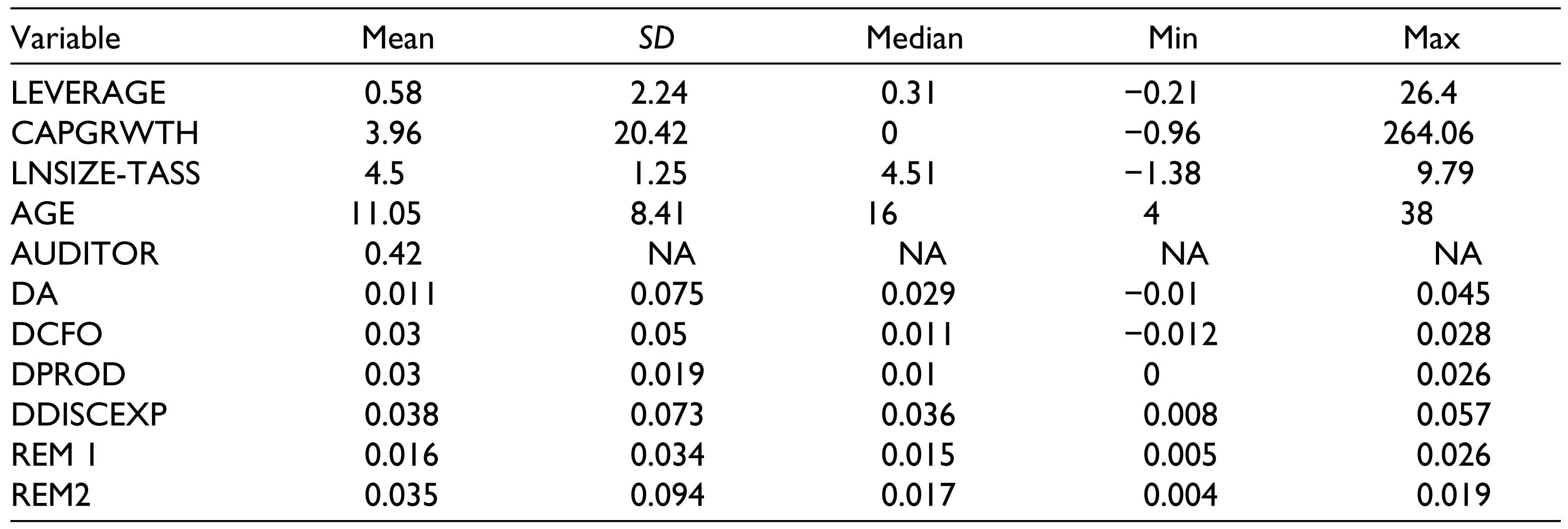
Table 2 features descriptive statistics of explanatory variables and earnings management’s proxies. The average leverage ratio of Malaysian IPO firms stood at 58 per cent with a median value of 31 per cent. This is high and in sharp contrast with earlier findings of Booth, Aivazian, Demirguc-Kunt and Maksimovic (2001) and Claessens, Djankov and Lang (2000), which classified Malaysia as a low-debt country.
Descriptive Statistics
All other variables are as previously defined.
These statistics are, however, not surprising with rapid growth and development of the Malaysian economy coupled with deregulation and globalization of the stock exchange that have witnessed substantial growth of the capital market in the last 10 years. Listed companies have risen from 795 in 2001 to 941 by 2012. In a recent report from the World Economic Forum (WEF) in Geneva, ‘the Global Competitiveness Report 2013–2014’ ranked Malaysia as the 24th most competitive nation among 148 countries.
The statistics indicate Malaysian IPO firms are engaged in accrual and real earnings management’s discretionary behaviour with abnormal production cost (DPROD) and abnormal (DICEXP) recording the highest mean in real activity, which is in line with the expansion in manufacturing and information technology sectors and that constitute more than 45 per cent of the sample. The low abnormal discretionary accruals (11%) can be explained by the tightening of rules and regulations in addition to increased surveillance by regulatory agencies in the Malaysian corporate sector. New corporate governance code was introduced in 2003, and most of the provisions of International Financial Reporting Standards (IFRS) adopted in Malaysian reporting standards. The auditor quality is 42 per cent, which shows that local auditing firms are equally regarded as reputable and engaged by IPO firms. The average age of a Malaysian IPO firm is put at 11 years and compares favourably with previous studies (Ahmad-Zaluki et al., 2011).
Table 3 shows the Spearman correlation matrix between earnings management’s proxies and explanatory variables. A significant positive correlation exists between leverage and aggregate real activity behaviour in abnormal cost of production and aggregate real earnings (RM1 and RM2). There is also a positive relationship between abnormal discretionary accruals and leverage. It is instructive that the auditor quality is positively associated with real earnings’ discretionary behaviour. This is untestable because auditors can hardly constrain real activity discretionary behaviour.
Spearman Rho Correlation Matrix

High- and Low-leverage Firms and Earnings Management
To test the actual impact of leverage on real and AEM, the sample was decomposed into low- and high-leverage firms, individual accounting items and aggregate real earnings. 2 The descriptive statistics in Table 4 confirms earlier findings that the Malaysian IPO firms engage in real and accrual discretionary behaviour. The result is consistent even after decomposing abnormal production (i.e., into abnormal change in inventory plus abnormal cost of goods sold) and discretionary expenses into their individual accounting items. It is quite revealing that the mean earnings management’s discretionary proxies also are higher for high-leverage firms. The negative mean discretionary accruals and abnormal cash flow in the case of low-leverage firms in the Malaysian case may explain the high underpricing of IPOs with high initial returns and subsequent lower returns (Yong, 2013).
Descriptive Statistics of Low- and High-leveraged IPO Firms
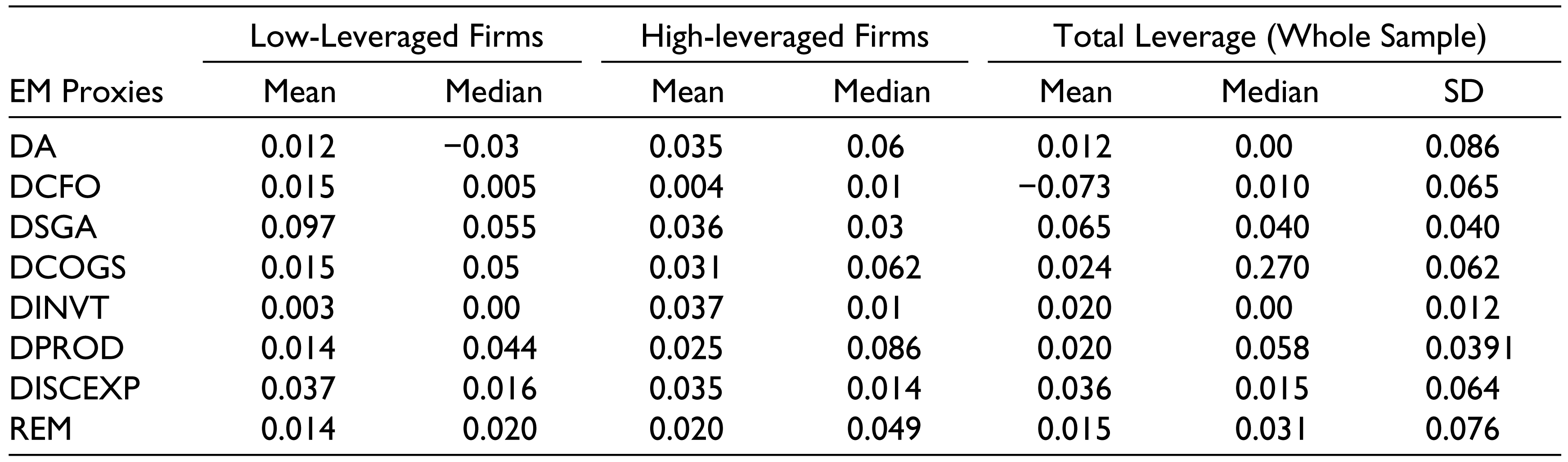
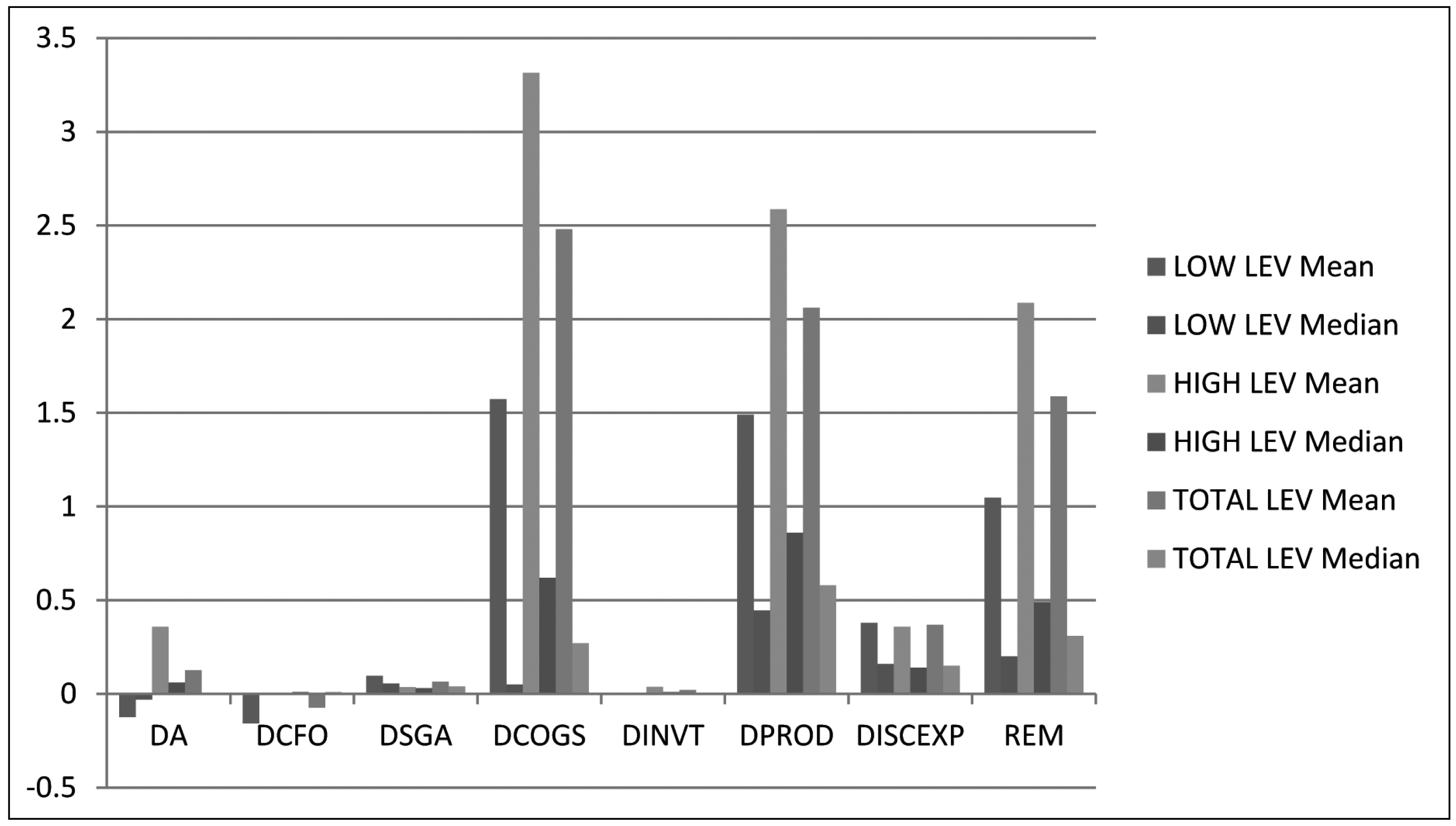
A casual observation indicates high-leverage firms are more engaged in earnings management’s discretionary behaviour than lower-leverage firms. This is further buttressed as indicated in the graphical presentation of mean and median earnings management’s discretionary proxies in Figure 1.
Multivariate Analysis
Table 5 is the result of regression of each earnings management’s proxies, the explanatory and control variables. Similar to the correlation analysis, the result indicates that the earnings management’s proxies are significantly and positively associated with leverage, which is consistent with the findings in previous studies (Beatty et al., 2008; DeFond & Jiambalvo, 1994; Dichev & Skinner, 2002; Watts & Zimmerman, 1990) consistent with the financial distress theory and technical default hypothesis. Managers of highly leveraged firms are enticed to report high discretionary accruals in order to increase reported earnings to avoid debt covenant violation (Fung & Goodwin, 2013). It also has been supported by debt covenant avoidance hypothesis, which asserts that firms with high leverage are more inclined to income-increasing discretionary behaviour because of pressure to repay debt, thereby ensuring successful completion of the IPO (Aharony, Lin, & Loeb, 1993; Beatty et al., 2008; Dichev & Skinner, 2002). Firms tend to avoid reporting losses; thus, (Burgstahler et al., 2006) suggested that investors would like to observe a positive earning. Therefore, firms with higher-leverage ratios have higher incentives to manage their earnings because they must present good results to justify refinancing of the firm’s debt.
Earnings Management Proxies and Leverage
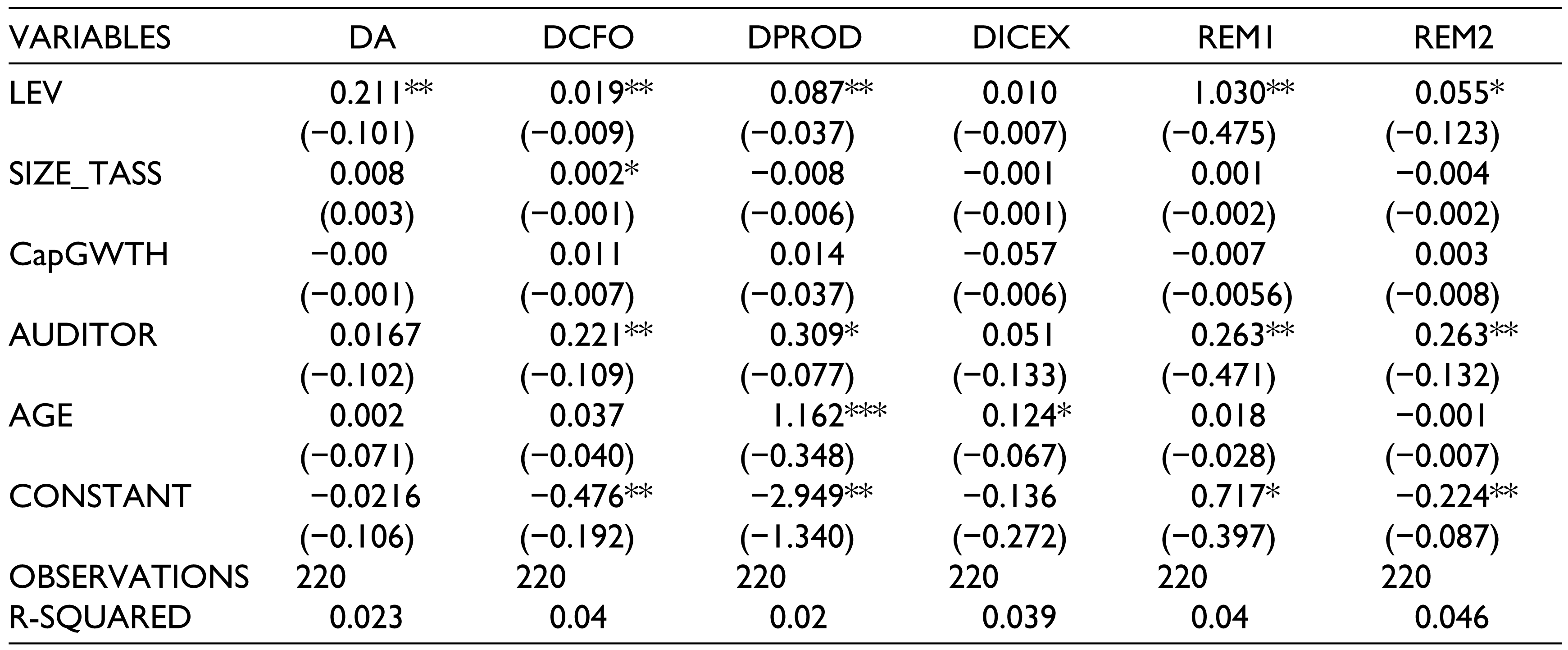
DA = Abnormal discretionary accruals, DCFO = Abnormal cash flow from operations, DPROD = Abnormal production cost, DDISCEXP = Abnormal discretionary expenses, REM 1 = DDISCEXP × (−1) + DPROD and REM2 = DCFO × (−1) + DDISCEXP.
All the discretionary earnings management proxies are winsorized at 1 per cent and 99 per cent to avoid the influence of outliers.
The results of regression of the equation below for earnings management proxy named in each column:
All variables are as previously defined.
The results also indicate a positive association between auditor reputation and real earnings management’s proxies. Prior studies (Zhou & Elder, 2004) provide evidence that IPOs audited by reputable firms engage less in earnings management. However, the counterargument is that managers who want to engage in income-increasing earnings management to affect their IPO valuation may engage low-quality auditors who are unlikely to detect the manipulation (Ahmad-Zaluki et al., 2011). At any rate, real earnings manipulation may neither be detected by auditors, regulators or even accounting standards.
Conclusion
This study represents one of the limited studies that examine real and AEM contemporaneously and its association with firm capital structure in the context of the Malaysian IPO corporate event. Moreover, this study resolves the seemingly conflicting findings and mixed results in previous studies based on accrual methodology only. The results from univariate and multivariate analyses indicate there is a positive association between leverage and real and AEM’s discretionary behaviour of the IPO firms.
When the sample was decomposed into high- and low-leverage firms, the results indicate higher earnings management’s discretionary behaviour for high-leveraged firms than low-leverage firms. The result was consistent and robust, even when the real earnings’ proxies were decomposed into an individual line accounting item and a single aggregate real earnings measure. The positive relationship between leverage and earnings management is in tandem with the agency cost of free cash flow theory and debt hypothesis. It is also consistent with the pecking-order theory of capital structure.
Managerial Implications
The study has several policy implications. First, our results have implication for Malaysian and global managers. Specifically, the positive relationship between earnings management and leverage implies that managers of highly leveraged firms are likely to report high discretionary accruals to increase reported earnings, thereby avoiding debt covenant violation. Furthermore, managers of highly leveraged firms are likely to engage in income-increasing discretionary behaviour due to pressure to repay debt, thereby ensuring that the IPO is completed successfully. Moreover, the positive effects of auditor’s reputation on real earnings management imply that IPOs audited by reputable firms engage less in earnings management.
Second, although there is some evidence of income-decreasing accrual discretionary behaviour perhaps due to tightening of regulations and accounting standards, this study suggests that regulatory agencies and standard setters should continue to improve the quality of accounting standards and accounting reports. Improving quality of accounting standard would discourage earning management activities and ensure that firm managers’ report accurate information to the general public and users of accounting reports in particular. Moreover, regulatory agencies should continue to strengthen accounting standards to frustrate real activity discretionary behaviour which is on the increase after the adoption of most of the provisions of the IFRS in Malaysian accounting standards. Third, this study provides a coherent source of information to investors, when deciding their investment strategies. As investors become more willing to invest in firms operating in environment with better accounting standards that minimize earnings management’s activities. Besides, institutional investors should continue to play their gatekeeping role to prevent earnings management’s practices, especially in the Malaysian case.
Limitations
One drawback of this study is that IPO companies are not homogeneous groups. They differ with respect to management ownership, ownership concentration and the likelihood that the company becomes a target for a hostile takeover, the homogeneous earnings management’s motivation notwithstanding. These and other factors may have an impact on accounting choices. Furthermore, measurement errors are associated with earnings management research. This study, therefore, inherits all the limitations of the models used and acknowledges the need to use several models for robustness of the result. The study is limited to only the IPO corporate event, thereby limiting its generalizability.
Declaration of Conflicting Interests
The authors declared no potential conflicts of interest with respect to the research, authorship and/or publication of this article.
Funding
The authors received no financial support for the research, authorship and/or publication of this article.
Footnotes
Acknowledgements
The authors are grateful to the anonymous referees of the journal for their extremely useful suggestions to improve the quality of this article. Usual disclaimers apply.