



Abstract
Abstract
The study investigates the impact of culture on environmental performance across 78 countries. The article explores the possible relationship with two datasets of international indices: (a) the six dimensional index of national culture proposed by Hofstede and (b) the environmental performance index (EPI) published by Yale Center for Environmental Law and Policy. It is widely established that population and economic development of a country play significant role in the improvement of environmental performance. In our study, we examine the impact of population growth rate and per-capita gross domestic product (GDP) on environmental performance using structure equation modelling. The results show that environmental performance is significantly influenced by the culture of the country. Per-capita GDP and population growth rate have a positive and negative relationships on the environmental performance. By measuring the cultural dimensions and their impact on global environmental performance, countries could identify the favouring cultural dimensions and design appropriate strategy to optimize the environmental performance. The article proposes the practical implication of results and strategies to improve environmental performance. The study is among the first in studying the cultural dynamics on environment and identify its favourable and adverse relationships for an optimum strategy.
Keywords
Introduction
Rapid environmental changes are a situation of crises and a threat for sustenance. Factors such as globalization and over-exploitation of resources is responsible for the crisis. The impact of damage to the environment is regularly highlighted in the media and is attributed for ecological changes such as global warming and related environment disasters (Punyatoya, 2014). The concern of climate change is the single biggest threat to development, and the effects of climate change put disproportionate weight on the developing and vulnerable nations (United Nations SDG, 2016). The severity of the issue warrants action to fight climate change and its impacts to construct resilience to climate-related threats and natural disasters. The severity of the issue is given notoriety by including climate change as among the Sustainable Development Goals (SDGs). To achieve all the SDGs, it is imperative to design policies that support economic development and reinforce policies to attain other goals. Although economic development is identified to be necessary to achieve the SDGs, it is also identified that increased economic activity results in environmental degradation (Park, Russell, & Lee, 2007).
The impact of businesses on environment holds two conflicting hypotheses, these being the pollution-haven hypothesis and the pollution-halo hypothesis. The pollution-haven hypothesis argues that attributes such as trade liberalization, free or open market, foreign direct investment and multi-national enterprises (MNE, hereafter) will inspire the movement of low-technology and polluting businesses to emerging countries and initiate a ‘race to the bottom’ in environmental performance (Goldsmith, 1997; Park et al., 2007; Tonelson, 2000; Xing & Kolstad, 2002). The pollution-halo hypothesis, proposes that foreign direct investment or trade liberalization fortified by the MNE may essentially assist in elevating environmental standards globally through the shift of well-organized and capable technologies, and application of renowned management practices (Blackman & Wu, 1999; Dowell, Hart, & Yeung, 2000; Eskeland & Harrison, 2003; Gentry, 1998; Park et al., 2007). Researchers argue that MNE and businesses are key contributors to several environmental problems, and they should play a pivotal role in addressing such issues (Parboteeah, Addae, & Cullen, 2012; Senge, 2007). As MNEs are increasingly involved in sustainability initiatives, it is important to understand how a nation and its culture will perceive such efforts.
On an individual front, it is perceived that if individuals are more culturally aware of environmental situations, a greater extent of environmental performance as a metric of environmental health can be achieved, and any damage to the environment can be quickly restored. Researchers argue that the motivation and ability to guard the environment are rooted in socio-cultural factors (Park et al., 2007). Therefore, national culture is expected to shape individuals attitude and behaviours towards utilization of natural resources, and minimization of wastages. Hence, it is important to have an empirical examination of national culture and environmental performance.
There is a dearth of research examining national culture and environmental performance. Earlier studies focused on national culture, and conceptual learning (Dunning & Fontanier, 2007), examining multiple country data (Husted, 2005; Parboteeah et al., 2012; Park et al., 2007) and single country data (Nwankwo, Phillips, & Tracey, 2007). These studies have used gross domestic product (GDP) (Husted, 2005), population growth (Husted, 2005) or education (Park et al., 2007) as controlling variable and have increased the understanding of environment sustainability. However, as businesses are involved in various cross-border trade at increasing rate, there is an increasing need to understand environmental performance for a number of countries. Also, governments are tasked to accomplish ‘climate change’ as one of the SDGs which can be realized by understanding and designing the culturally relevant policies. Although the climate change threat is perhaps the gravest threat that our earth faces, the issue has not got much attention by top journals in relevant fields (Goodall, 2008; Parboteeah et al., 2012). It is, therefore, important to undertake scholarship that can have both theoretical and practical implications. In terms of theoretical implications, the study adds to the literature by not only supporting and validating previous studies but also extending the scope and updating the results. In terms of practical implications, the study explores to what extent businesses, governments and policymakers are required to consider cultural background while designing environmental performance initiatives.
We demonstrate a statistical relationship between two datasets of environmental performance and cultural dimensions, which includes all six cultural dimensions of Hofstede’s model, with additional control variables of population growth rate and per capita income. This study has three important contributions to make. First, this study has examined the impact of all six cultural dimension on EPI. It also assesses the interaction effects of six cultural dimensions and economic development on environmental performance. This helps in theory building and answers the why of theory building. Second, this study uses multiple regression by employing structural equation modelling (SEM) that minimizes the measurement error and provides results with reduced errors. Third, this study will be the first to use a large dataset of 78 countries, results of which helps in generalizing the outcome. This article also segments countries using hierarchical clustering and proposes specific strategies for each cluster to design achievable environment-related policies.
Rest of the article is organized as follows: the second section reviews the literature on national culture, environmental performance and their relationship. The section also includes research model. The third section presents the research methodology and data. Data for cultural dimensions is collected from Greet-Hofstede website and for environmental performance index is collected from ‘Global Metrics For The Environment 2016’ published by Yale Center for Environmental Law and Policy (YCELP), Yale Data-Driven Environmental Solutions Group at Yale University (Data-Driven Yale), the Center for International Earth Science Information Network (CIESIN) at Columbia University, in collaboration with the Samuel Family Foundation, McCall MacBain Foundation and the World Economic Forum. The article also uses population growth and GDP per capita as an additional variable for analysis for which data is retrieved from the World Bank. The fourth section analyses the data and offers results. The fifth section presents the discussion. The sixth section discusses implications and strategies. The last section provides the conclusion of the study.
Review of Literature
Environmental Performance and Its Components
The emergence of the importance of environment in recent years is reflected in the outgrowth of literature and world forum focused on the environment. The Paris Climate Conference in 2015 marked the historic agreement, which sets the platform for aspiring climate action by all signing countries to ensure that worldwide temperatures rise no more than 2°C (United Nations SDG, 2016). There are several SDGs which directly or indirectly set to achieve a sustainable environment.
We have selected environmental performance index (EPI, hereafter) as an indicator of environment health in our study because of threefold reasons. First, EPI was preceded by environmental sustainability index (ESI) since 1999. EPI has established itself over a long period which has been the sole source of information on environment performance, ensuring its wide validity and applicability. Second, there are many studies (Husted, 2005; Park et al., 2007; Peng & Lin, 2009), which have included ESI into their work, validating its applicability into research world. Also, the EPI uninterruptedly acclimatizes to global proceedings, technological break-through and political improvements to remain relevant in a dynamic global landscape. Third, EPI indicators are aligned with the SDGs which provide a reference line for assessing the performance of a nation and can guide its proximity to global targets.
A study by Hsu et al. (2016) on EPI has ranked nation’s performance on high-priority environmental concerns in two broad areas: (a) protection of human health and (b) protection of ecosystems. Within these two areas, the EPI scores nation performance in nine subject areas consists of 20 indicators. The EPI indicators assess countries’ closeness to globally established targets or in the case of undecided goals, how individual countries associate with the best-performing nation. EPI consists of two parameters environmental health and environmental vitality carrying equal weights of 50 per cent each. Environmental health comprises of three components health impacts (33%), air quality (33%) and water and sanitation (33%) whereas environmental vitality consists of water resources (25%) agriculture (10%), forests (10%), fisheries (5%), biodiversity and habitat (25%) and climate and energy (25%). Weightage of each factor is represented in the parenthesis.
National Culture and Its Dimensions
Researchers define culture in a variety of ways. The study (Sørnes, Stephens, Sætre, & Browning, 2004) suggests that there are more than 400 definitions of culture. The prevalent belief among these definitions is that culture of society influences, nurtures and shapes the values shared among its members. We have decided to choose Hofstede’s cultural dimensions because of two reasons. First, Greet Hofstede’s work is most cited work in studies relating across various domains and cultures. Second, dataset for Hofstede cultural dimensions are available for many countries. It is the most suited cultural model for requirements of a large database necessary for establishing a statistical relationship. Hofstede (2011) defines culture as ‘the collective programming of the mind that distinguishes the supporters of one group or category of people from another group.’ Hofstede proposed a four dimension model to realize the national culture (Hofstede, 1980). Following which many researchers have come up with alternative approaches for cultural evaluation. For instance, Hampden-Turner and Trompenaars delivered cultural values for various countries. However, data for their study is based on individual items rather than indices (Bagchi, Hart, & Peterson, 2004; Gong, Li, & Stump, 2007). Another study by Inglehart, Basanez, and Moreno (1998) provided values for 43 countries and ethnic groups. We, therefore, account the need for evaluation based on indices and data from larger sample of countries in examining Hofstede’s (2001) model for a comprehensive analysis.
Hofstede and Bond (1988) added a fifth dimension of ‘Long-Term versus Short-Term Orientation’ to Hofstede’s (1980) model. Further, Hofstede, Hofstede, and Michael Minkov (2010), in addition to a different estimation of the fifth dimension added a sixth dimension to the model. The model then assumes the six dimensions of power distance, individualism, uncertainty avoidance, masculinity, long-term orientation (LTO) and indulgence (Hofstede, 2011).
Environmental Performance and National Culture
Culture, which influences the collaboration and pro-social conduct, can significantly alter the perception of citizens towards the environment. Every country has established identity and culture with particular history, language and religious traditions. All these experiences combined shapes the way members of a country see themselves and the world (Bagchi et al., 2004; Gong et al., 2007). Consumers’ belief is reflected in their attitude (Nath, Kumar, Agrawal, Gautam, & Sharma, 2013) which is shaped by the culture of the country. Parboteeah et al. (2012) use GLOBE cultural dimensions for the study of cultural influences and sustainability initiatives. The study found that cultural dimensions are positively related with sustainability initiatives in terms of collectivism, future orientation and human orientation. Cultural dimensions are negatively related with sustainability initiatives on the fronts of performance orientation and assertiveness and are neutral on uncertainty avoidance. Researchers indicate that once the culture is set in place, it affects nations’ response to world events including the acceptance of new initiatives in its own way.
There is limited understanding of the impact of national culture on environment performance and necessitates further examination. Extant studies that focus on the impact of national culture on environment performance of Hofstede’s cultural dimensions provide a theoretical framework to examine the relationship and to test whether national culture has an impact on country’s social and institutional capacity for sustainability (Husted, 2005). The study by Husted (2005) uses four dimensions of Hofstede culture and environmental sustainability index report 2001 for 52 countries and uses correlation and regression statistical tools for analysis. The results indicate that individualism is positive whereas power distance and masculinity is negatively related. In another study, Park et al. (2007), employed same data as used by Husted (2005) but added education as an additional dimension for 43 countries. The results by Park et al. (2007) indicates that ESI is significantly negatively related to power distance and masculinity, while education is positively related.
Addressing the extant research, we identify four major contributions through our study. First, this study uses data from latest EPI which is a modified indicator of environmental performance having replaced ESI employed by Husted (2005) and Park et al. (2007) in their studies. The methodology to arrive at EPI has evolved over more than 15 years. Since EPI is dynamic in nature, the study uses EPI dataset which is also more closely aligned towards SDG. We assume that these methodological changes in measurement may impact the direction or intensity or both with which they have influenced in previous studies. Second, Husted (2005) and Park et al. (2007) use four dimensions of Hofstede culture whereas our study uses six dimensions of Hofstede’s (2011) model for culture. We assume that addition of the fifth and sixth dimensions may impact the environment performance and it may also affect the intensity of their impact on other dimensions as reported in previous two studies. Third, we are using SEM approach for analysis which takes into account the measurement error. The parameters estimated using SEM are more accurate (Bagozzi & Yi, 2012). Also, using a six dimensional construal of culture, this study uses the largest dataset of 78 countries for analysis which helps in generalization to wider cultural contexts. Finally, we are examining the multi-level effect of economic development on environmental performance when GDP interacts with cultural dimensions. Apart from Interaction, we have also used hierarchical clustering to segment countries and proposed strategies for each cluster with policy implications.
Research Model
Figure 1 refers to the proposed model for this study. The model includes all six cultural dimension of Hofstede, environmental performance index, demographic variable of population growth rate and economic variable of per-capita GDP. Controlling variables GDP per capita and population growth rate are shown in dotted line in Figure 1. The dotted line from GDP towards cultural dimensions represents the interaction effect of GDP and cultural dimensions on environmental performance.

Power distance (PD) has been defined as the degree to which the relatively less powerful individuals of organizations and institutions agree and expect that power is distributed unequally (Hofstede, 2011). In high power distance countries, it is easy to focus on internal politics rather than focusing on the merit of solving a problem. High respect for authority leads to fewer chances for an open forum debate and leads to reduced responsiveness towards any social issues including environmental challenges. Therefore, we propose that small power distance countries positively influence the environmental performance.
Individualism is the degree to which people in society are integrated into groups. On the individualist culture, we find cultures where the ties between individuals are not strong (Hofstede, 2011). In individualistic countries, like-minded people form interest groups which play a vital role in any social issues including environmental movement (Husted, 2005). Environment interest groups activity appears to be more widespread in the highly individualistic nations than collectivistic nations. Therefore, we propose that individualistic countries positively influence the environmental performance.
Masculinity (MAS) refers to the extent to which values are distributed between the genders. The assertive pole is termed as ‘masculine’, and the modest, caring pole is termed as ‘feminine’ (Hofstede, 2011). In high masculine countries, there is a preference to material wealth than to the quality of life. A pursuit towards material wealth leads to faster economic growth and slower responsiveness towards finding a solution for environmental problems. Usually, in high masculine culture, the high cost involved in adopting technology for better environmental performance outweigh the benefits of faster growth and leads to poorer attention towards the environment. Therefore, we propose that low masculine countries positively influence the environmental performance.
Uncertainty avoidance (UA) refers to the extent to which the society accepts tolerance for ambiguity. It measures the level of comfort among the members of a community in unstructured situations (Hofstede, 2011). It is also related to the degree of stress in a community in the case of an unknown situation. Uncertainty avoiding countries try to minimize the chances of unknown, unstructured, surprising situations by a strict behavioural code of conduct, laws and rules. As a consequence of environmental degradation, countries may face unusual and unfamiliar situations. Therefore, high uncertainty avoidance countries focus more towards environmental performance. Therefore, we propose that high uncertainty avoidance countries positively influence the environmental performance.
Long-term orientation (LTO) refers to the extent to which it affirms the belief that most essential happenings in life will occur in the later future. Hofstede (2011) classified LTO as thrift and perseverance focused, large saving quote, funds available for investments, open to learning from other countries, shared task in families, adaptable traditions (Hofstede, 2011). LTO is the least verified cultural dimension in cross-culture studies (Gong et al., 2007). Countries with LTO believe that most important thing in life will occur in future. Also, long-term oriented countries adapt to changing circumstances and learn from other countries. It indicates that as many countries are focusing towards environmental sustainability, long-term oriented countries will learn from other countries and change their behaviour to adopt the changing circumstances. Therefore, we propose that long-term orientated countries positively influence the environmental performance.
Indulgence (INDL) refers to the extent to which a society that allows relatively free gratification of fundamental and natural human desires related to enjoying life and having fun (Hofstede, 2011). This dimension is newly added to Hofstede culture and least tested in studies. Countries with indulgence believe in the free gratification of basic and natural desire. These countries consider the freedom of speech as a fundamental desire of life and represent an educated population with higher birth rates. As education is found to be positively related to environmental sustainability (Park et al., 2007), we propose that high indulgence in countries positively influences the environmental performance.
Economic Variable (GDP per capita)
Economic development of a country alters the country’s attitude towards environmental sustainability. National variables such as gross-national product (GNP) or GDP per capita are the leading indicators of economic performance of country (Barro, 1996). Hofstede (2001) argued that if hard variable such as economy or technology predicts a national variable better, the cultural dimension is redundant. Hofstede encourages researchers to use a national variable as a control variable to observe the exclusive and profound effect of culture (Bagchi et al., 2004; Gong et al., 2007). However, controlling the national variable and accessing the impact on culture is a conservative approach. The empirical cross-sectional study shows that there is the positive relationship between culture and national economy (Inglehart & Baker, 2000). This study uses GDP per capita as an additional variable to examine the impact of culture on environmental performance. However, as we understand that developing countries are less likely to invest in technological research for better environmental performance, these countries are likely to have lower environmental performance. Therefore, we propose that countries with high GDP per capita positively influence the environmental performance.
Demographic Variable (percentage of population growth)
A rapid increase in the world population is often quoted as the main reason for environmental degradation (Husted, 2005). This study uses the percentage of population growth as an additional variable in the study. Larger population need a larger pool of resources which ultimately imposes a greater threat on natural resources. Developing nations with a higher population growth pose a greater environmental challenge than developed nations with similar population growth rate. Therefore, we propose that countries with low population growth positively influence the environmental performance.
Objective of Study
Relationships between culture and environment are little studied in general and their impact on nations and their interactions with economy are inadequately understood in particular. In our study we bridge this gap by investigating the extent to which culture influences the environmental performance. We also intend to segment countries based on their cultural and environmental performance measure so that broader strategies can be recommended to increase the adoption of environment-related initiatives.
Rationale of the Study
Environmental performance is much talked about but is inadequately researched. The Paris Agreement 2015 deals with saving the earth from repercussion of climate change by achieving several sustainable development goals on different fronts. Countries and businesses are initiating many sustainability initiatives to restore environment, but these initiatives will not achieve their goals unless supported by individuals. The study examines on how the culture of a country impacts its environmental performance. There are no comprehensive indices for complete assessment of environment that incorporates several other directly influencing economic and demographic variables. GDP is an economic indicator whereas population growth is a demographic indicator. The interface between cultural, economic and ecological dimensions is required for addressing issues interlaced with environmental performance. We therefore make use of cultural and economic factors using Hofstede’s model for culture and GDP per-capita for nations respectively, to gain a first-hand insight and assessment of an integrative framework to look into this interplay.
Methodology
Data Source
Data for this study is collected from three different sources. Data for GDP per capita for 2015 is retrieved from the World Bank which calculates GDP per capita as GDP divided by midyear population. GDP is computed without including deductions for depreciation or depletion of natural resources. Data for population (PPL) growth rate is taken from the World Bank 2015. It is derived from a total population. Population sources are (a) United Nations Population Division, World Population Prospects; (b) United Nations Statistical Division, Population and Vital Statistics Report (various years); and (c) census reports and other statistical, data of GDP per capita (current US$) (GDP, hereafter) and population growth percentage are available for all 193 countries.
Data for all six cultural dimension PD, INDV, MAS, UA, LTO and INDL is taken from Geert-Hofstede website. Data retrieved from
Data for Environmental performance for corresponding 78 countries is taken from 2016 environmental performance index published by Yale, World Economic Forum and other institutions. EPI indicators measure how nations equate to one another with respect to global targets.
Empirical Model
Figure 1 refers to the model comprising of cultural dimensions, EPI, demographic and economic variables. The study uses the correlation and regression, which is supported by previous studies (Husted, 2005; Park et al., 2007) to analyse the impact of culture on EPI. The study also uses the interaction effect to examine the impact of the interaction of economic development and cultural dimension on environmental performance. A study (Bagozzi & Yi, 2012) argues that researchers using multiple regression often assumes that component specific to systematic error (m) and a component specific to each measure (s) are much small in comparison with a random component (e) and therefore, can be ignored. But this assumption is seldom true. This may give rise to spurious meaning, which refers to adulteration of empirical meaning and exist in one or more of three sources: random error (e), systematic error (m) and measure specificity (s). The three sources of spurious meaning can be represented as

where δ and ε are termed as errors in variables or measurement error.
Researchers argue that it is best to estimate the magnitudes of the sources of error, which is possible in many structure equations models (Bagozzi, Yi, & Nassen, 1998; Bagozzi, Yi, & Phillips, 1991). Therefore, this study will use LISREL Maximum likelihood estimates to carryout multiple regression. This is an important contribution to literature by this study. It offers a superior mechanism for data analysis that helps in achieving more unbiased results. The study also segments countries into four groups with respect to their relationship among different variables. Hierarchical cluster analysis is used to segment the countries.
Analysis
Pearson Correlations Result

Second, among cultural dimensions, power distance, individualism, uncertainty avoidance and LTO are found to be significantly and strongly correlated with EPI. Power distance (−0.49) is negatively correlated whereas individualism (0.60), uncertainty avoidance (0.21) and LTO (0.38) positively correlated with EPI. Masculinity and indulgence are not significantly correlated with EPI. The result indicates that countries with low power distance, high individualism, high uncertainty avoidance and LTO show a positive behaviour towards environmental performance. Countries with LTO perceive that maintaining a good environmental performance will help them to reap benefits in future.
Based on statistical analysis using correlation matrix, we can say that small power distance, individualistic, high uncertainty avoidance and long-term orientated countries positively influence the environmental performance. Also, countries with high GDP per capita and low population growth positively influence the environmental performance.
Thirdly, GDP is found to be strongly negatively related to power distance (−0.63) whereas positively related to individualism (0.65), LTO (0.28) and indulgence (0.30). The positive relationship between LTO and GDP indicates that countries with LTO understand that to plan for a better future, they need to have good economic development. The relationship between indulgence and GDP indicates that free gratification of fundamental and natural human desires related to enjoying life and having fun is impacted by per capita income. Population growth is negatively correlated with individualism (−0.28), uncertainty avoidance (−0.26) and LTO (−0.50), but positively correlated with indulgence (0.30). Countries with high individualism, uncertainty avoidance and LTO understand that growth in population results in increasing use of resources and thereby endangering the future prospect of the nation.
Lastly, among cultural dimension there exist many relationships of different intensity and directionality. Between power distance and individualism exist a negative relation (−0.66) which has also been observed by Hofstede. Hofstede argues that relationship of power distance and individualism disappear if economic development is held constant (Husted, 2005). Power distance shows a negative correlation with INDL (−0.28). It indicates that countries with high power distance show a restraint behaviour thus, control the gratification of needs by social norms. Individualism shows a positive correlation with LTO (0.27) which indicates that countries with individualistic culture have a greater LTO. There exists a negative correlation between LTO and indulgence (−0.44) which is acknowledged by Hofstede (2011).
To measure the interaction effect, we created interaction terms for GDP and six cultural dimensions. It is found that high level of multicollinearity among the variables exists. To determine the extent to which multicollinearity effects interaction and regression, the variance inflation factor (VIF) was calculated for each variable. The VIF is a measure of the influence of the other independent variables on the variance of the regression coefficients. All the VIF values are found to be very high and beyond the commonly acceptable cut-off value of 10 (Hair, Anderson, Tatham, & Black, 1992). The problem of multicollinearity was treated by transforming the data using the centring or de-meaning procedure as recommended by Aiken and West (1991). Centring the variables brings the means of all the variables to the intercept. After transformation, VIF is calculated to check the extent of multicollinearity. After transformation, all the values of the VIF were below the commonly suggested cut-off of 10. The problem of multicollinearity was addressed after transformation.
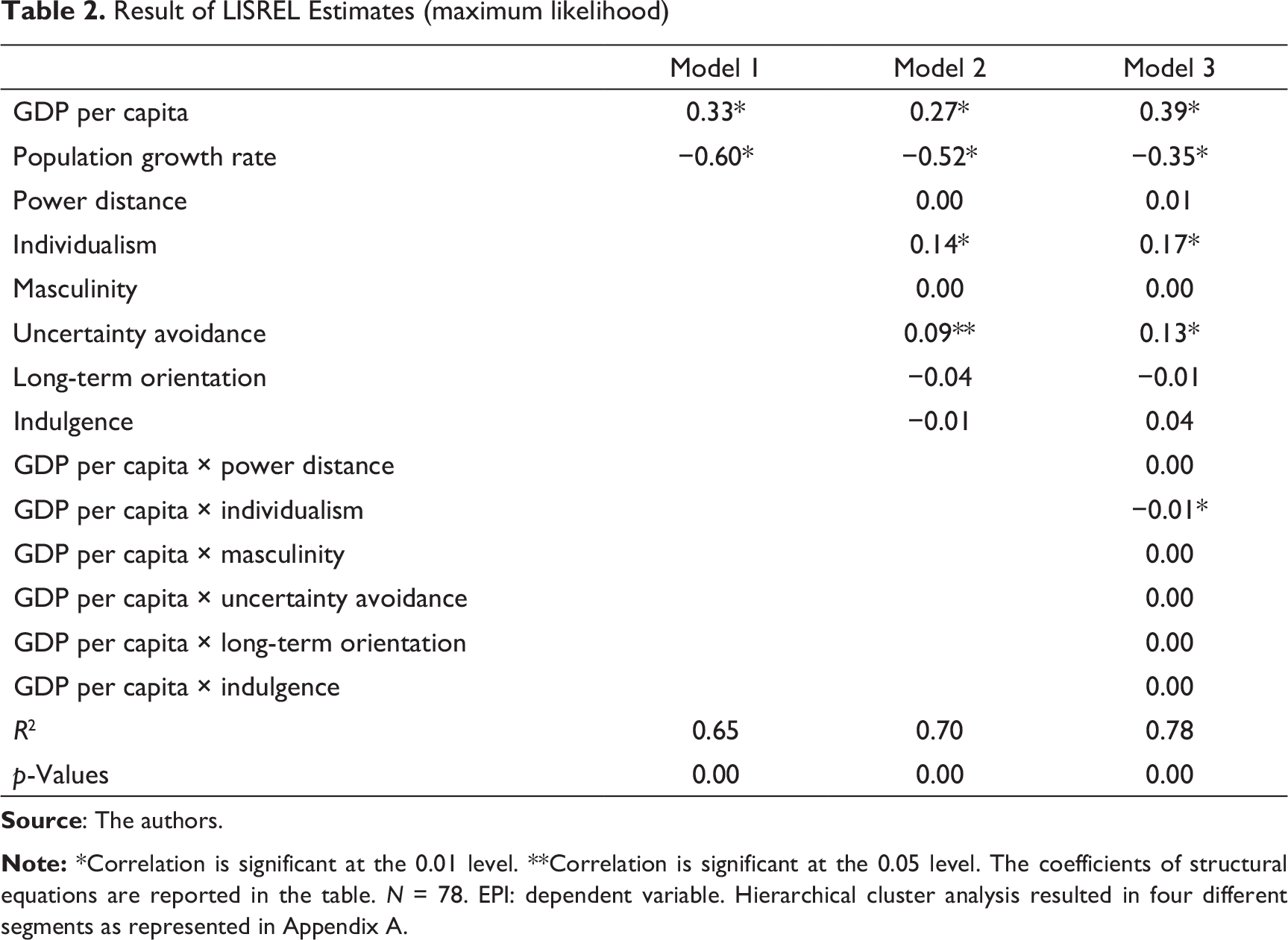
We have used LISREL 9.2 for multiple regression. Table 2 shows the result of LISREL maximum likelihood estimates. Figure 2 represents the path diagram for different models. Model 1 examines the impact of control variable only. Both GDP and population growth rate are significant and are in the expected direction. Model 2 introduces the cultural dimensions. Individualism and uncertainty avoidance are found to be significant with coefficients 0.14 and 0.09, respectively. No other cultural dimension is found to be significant with EPI. It indicates that only individualistic countries and uncertainty avoidance countries focus more towards environmental performance. Based on a significance level of coefficient of structural equations of model 2, we can say that individualistic and high uncertainty avoidance countries positively influence the environmental performance. However, the study cannot establish support for low masculine and high indulgence countries as it is not significantly influencing the environmental performance.

Result of LISREL Estimates (maximum likelihood)
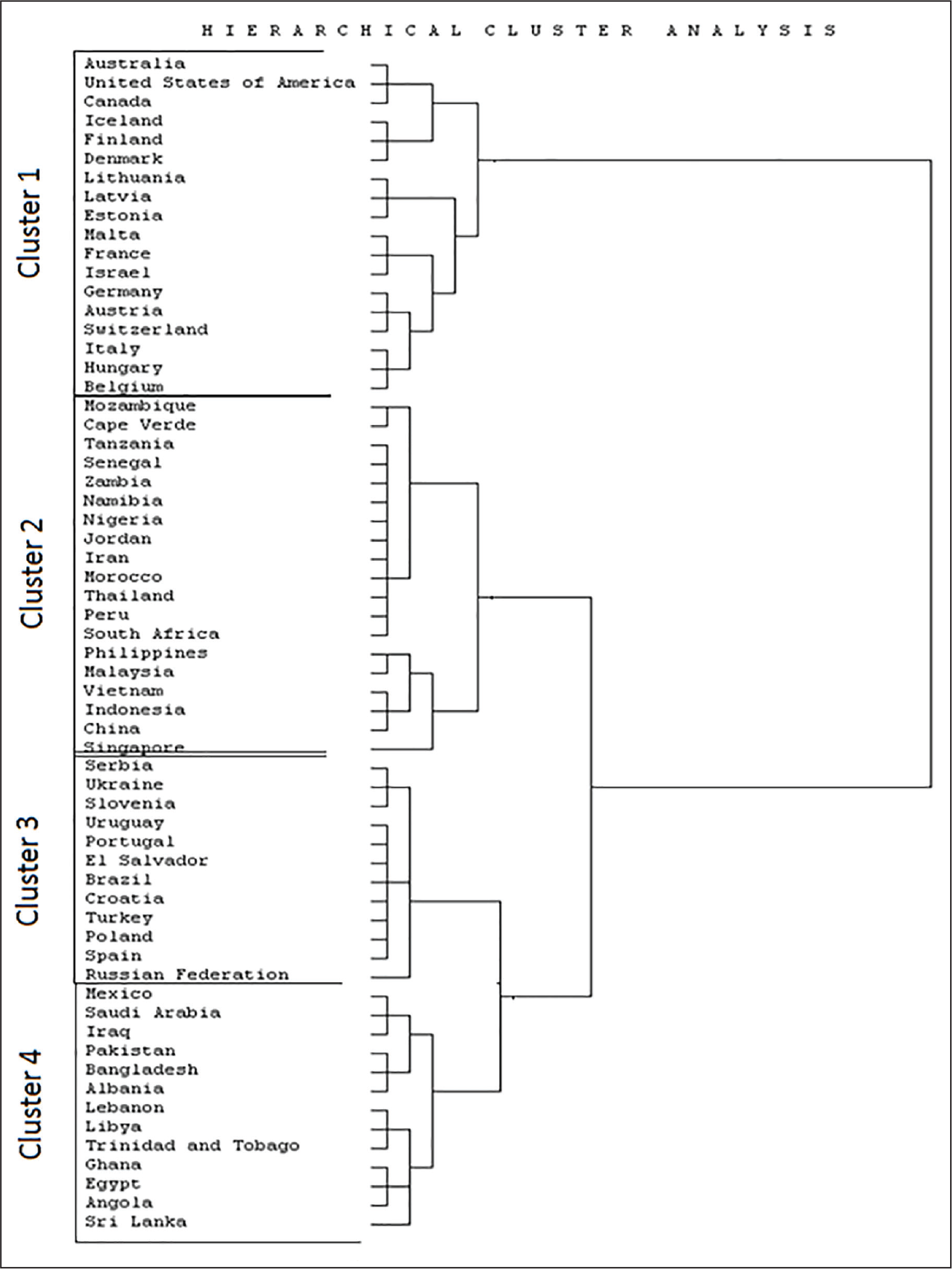
We performed hierarchical cluster analysis with EPI, GDP, six cultural dimensions and population growth. Appendix A shows the result of cluster analysis. We have identified four clusters. In each cluster, different factors are responsible for higher environmental performance.
Discussion
The result of correlation and regression indicates that individualistic countries tend to show improved environmental performance. Countries such as the USA, Australia and the UK rank higher in individualism and show higher environmental performance, thereby support the findings. This result is also supported by Husted (2005) but not supported by Park et al. (2007) and Parboteeah et al. (2012). Uncertainty avoiding countries also show enhanced environmental performance. This result is in contrast to the previous studies in which uncertainty avoidance is not supported. Countries such as Greece, Portugal and Uruguay ranks higher in uncertainty avoidance and support the finding by displaying a better environmental performance. Our correlation result indicates a negative relation with power distance which is supported by Husted (2005) and Park et al. (2007). Austria, Denmark and New Zealand score lower in power distance but score higher in environmental performance. Correlation result also indicates that long-term orientated countries show improved environmental performance. Countries such as Estonia and Germany rank higher in LTO and also rank higher in environmental performance, therefore support the findings. Our explanation for the finding is that countries with long-term culture tend to have a forward thinking mindset, they are more prone to environmental initiatives because they can see the benefits in maintaining a healthy environment in the long run. Statistical analysis of LTO and indulgence extend previous studies and fills the knowledge gap. This study fails to support any relationship between environmental performance and masculinity, and indulgence. In addition, the result shows some inconsistencies with previous studies, such as uncertainty avoidance is not supported by our study whereas it is supported by Husted (2005). These inconsistencies indicate that there may be other factors that need to be considered while examining the relationships. Economic development and population growth impact the environmental performance with the same intensity but opposite directionality, that is, a country with higher GDP per-capita indicates higher environmental performance whereas a country with higher population growth indicated lower environmental performance, and vice-versa.

Table 2 represents the result of model 3. It indicates that GDP and individualism both have direct positive impact on environmental performance, but the interaction indicates a negative impact. Effect of interaction is best visualized in the graph as shown in Figure 3 which is negative (−0.01). The result can be interpreted as follows. As countries get wealthy, individuals in such countries begin to emphasize on healthy environment. A larger pool of resources by such nations would be available for investment and maintenance of better environmental performance. The incremental improvement in environmental performance is much higher for countries with low per-capita GDP when compared to countries with high per-capita GDP. This implies that poor countries should improve their per-capita GDP to enhance environmental performance and rich countries with high per-capita GDP need to focus on cultural dimensions such as individualism for better environmental performance.
Conclusion
The study concludes that culture shows a significant relationship with environmental performance. Among cultural dimensions individualism is found to be most significantly and positively influencing the environmental performance. Also, individualism has multilevel effect on environmental performance. As the countries gets wealthier, the influence of individualism become more intense than the influence of GDP per capita. For poor countries, improvement in GDP per capita will yield better environmental performance whereas improvement in individualism will yield healthier environmental performance in rich countries. Other cultural dimensions also have significant impact on environmental performance. Power distance negatively influence the environmental performance whereas uncertainty avoidance and LTO positively influence the level of environmental performance in a country. However, the study could not establish any relationship between masculinity and indulgence with environmental performance. Economic development has significant impact on positive development of environmental performance whereas population growth rate negatively influences environmental performance. Each country has its set cultural values and identity which are influenced by its history, language and religious traditions. These cultural values affect any environmental initiatives undertaken by multinationals or governments to restore the environment. Governments and policymakers need to identify the favouring cultural dimension, which is different for each country and design policies around these dimensions. For example, favouring cultural dimensions for rich countries includes individualism. Environmental initiatives and policies fostering individualism or such favourable cultural dimensions would easily be accepted by citizens thereby advancing one step closer in accomplishing the goal. Therefore, policymakers must design the culturally congruent policies for better execution and their easy acceptance by citizens.
Managerial Implications and Strategies
Higher economic development and lower population growth play a vital role in maintaining healthy environmental performance. It indicates that environmental policies must not only provide economic motivation to the organizations for environmental initiatives but also motivate individuals towards maintaining the population growth. Given the adaptive nature of the culture, we consider that relationship between culture and environmental performance is not one way but two way. It indicates that culture gets shaped in the process of improving environmental performance.
For example, maintaining a sustainable environment brings individuals and government together thereby shortening the power distance. Cluster analysis (Appendix A) indicates that there exist four groups of countries in which environmental performance is attributed to different factors. Therefore, we recommend that countries must not directly copy one successful strategy from any country and try to implement it. We propose following strategies for a policymaker to address environmental issues:
Policymakers must design environmental policies by including citizens into the process of decision-making. This activity not only ensure an improved reception of policies but also help to reduce inefficiencies and improve accountability. Strategy for cluster 1: If citizens of a country are aware of environmental issues and show active participation to save the environment, environmental policies should provide economic motivation to the individuals, organizations and institutions for environmental initiatives. Countries belonging to cluster 1 may adopt this strategy. These countries rank very high in EPI with high GDP per capita and low population growth. To improve further, policies of these countries must motivate individuals and organizations to invest in newer technologies. Strategy for cluster 2: Countries of cluster 2 rank poor in EPI with low GDP and high population growth with very low LTO. Utilizing strategic management perspective, to improve the LTO as long-term provide a clear goal and a road map for EPI to improve. Policies of these countries focus on improving LTO along with reducing power distance and fostering individualism. Strategy for cluster 3: Countries of cluster 3 ranks average in EPI with low GDP, decent population growth rate and very high uncertainty avoidance. Policies of these countries should not only enforce high uncertainty avoidance but also reduce power distance and improve individualism. Developing an integrated policies including educational programs will tend to improve environmental performance. Strategy for cluster 4: Countries of cluster 4 rank very poorly in EPI with very low GDP per capita and high population growth. Environmental policies of these countries must foster the use of technologies such as mobile, internet and social media to reduce the power distance. These countries are collectivistic in nature. Therefore, environmental educational programs must show that degradation of environment will severely impact friends and family. It must also represent that saving environment as socially accepted behaviour so that others may follow it.
Limitations
The study has some limitations. First, this study uses Hofstede cultural model. Although Hofstede work is most cited, it has some limitations (Hampden-Turner & Trompenaars, 1997; McSweeney, 2002). Hofstede collected data by using highly structured questionnaires and identified the dimensions the culture. But every culture has inherent some peculiar characteristics which are difficult to examine through Hofstede’s cultural dimensions. Future research should include the help of society specific scholars who can help in a precise analysis of the relationship of culture and environmental performance. Second, the study uses the correlation and regression as a statistical tool to establish a relationship but, unavailability of cultural dimensions for many countries may affect the accuracy and generalization of results. Future research should move from statistical analysis of country level indices to individual level analysis by using different methodologies such as survey, interview and ethnographic study.
Appendix A
Footnotes
Acknowledgement
The authors are grateful to the anonymous referees of the journal for their extremely useful suggestions to improve the quality of the article. Usual disclaimers apply.
Declaration of Conflicting Interests
The authors declared no potential conflicts of interest with respect to the research, authorship and/or publication of this article.
Funding
The authors received no financial support for the research, authorship and/or publication of this article.