




Abstract
Working mothers worldwide find it hard to deal with expectations about their maternal responsibilities and work. The challenges faced by women across nations are perceived to be similar in nature. However, the known diversity in terms of culture, political scenario, educational framework, economic situation, legal policies and employment guidelines are unavoidable factors which may directly impact the challenges faced by women in their respective workplace. This research, therefore, attempts to identify the challenges faced by working mothers in India in their careers including different industrial sectors in the present scenario. A mix of qualitative and quantitative techniques is used for data collection. On the basis of in-depth interviews, grounded theory approach and exploratory factor analysis, three broad categories of challenges faced by working Indian mothers are identified. Post the empirical identification of perceived career barriers for working mothers, organizational interventions to address their concerns are discussed.
Introduction
Motherhood is a beautiful yet critical phase in a woman’s life. It becomes all the more critical for working women who need to strike a balance between family and work. Often working mothers face the guilt of being stuck in a meeting when the child is sick. Or one of those days when the kid nonchalantly declares that you are a bad mother. In the hustle of striking a balance between family and work, working mothers need to make a choice every time. And making a choice is the most difficult thing; the hardest part is living the choices amidst the everyday guilt, judgement and the chaos of daily life (Behera & Padhi, 1993).
Consequently, all over the world, to look after their family, there is a rising trend of working mothers leaving their works (Vanderkam, 2005). As per the Social Development Foundation of Assocham (2015), 25 per cent of first-time Indian mothers quit jobs to raise children. The motherhood dilemma is the reflection of a societal norm, which suggests that the woman must sacrifice career progression and earnings for raising a child. The fact that women may face repercussions due to this set of minds in the course of their careers is nothing but an extension of the narrative that men are primarily responsible for the financial well-being of the family, while women are seen as secondary income earners. There are no easy and efficient ways of modifying these social norms and attitudes. In fact, bringing about a change in the society may take years altogether and may not be the only challenge faced by working mothers. Our research is an attempt to gain a holistic understanding of the real challenges that working mothers in India face. To some extent, this may enable organizations to create work–family policies that recognize, reduce and redistribute childcare responsibilities and enable women to make progress in their careers.
Empirical evidence suggests that career aspirations of women are negatively correlated with their age (Harmon, 1989; Kerr, 1993). India has total employment of 131.29 million persons, where 74.83 per cent were male and 25.17 per cent were female (Sixth Economic Census). This gender ratio gets further skewed at senior levels and in leadership roles (Hewlett, Luce, & West, 2005).
The Maternity Benefit Amendment Bill 2016 stipulates a 6 months benefit with the option of flexible working. Nevertheless, there is a considerable gap in the legal, effective coverage of maternity benefits that can be availed by women in employment (ILO, 2017).
As per the Women in Workplace 2017 report by LeanIn.org and McKinsey & Company, a much lesser proportion of women as compared to men show an interest in moving into top positions because the rising work pressure and responsibilities that come with such positions will adversely impact a mother’s dual responsibilities. Maternity phase, therefore, creates a big dilemma for women, making them believe that they can either be good employees or good mothers.
Therefore, women opting out of the workforce due to maternity are detrimental for their own careers and the organizations. The ex-chairman of the Tata group, Cyrus Mistry states ‘in the workplace when women are represented insufficiently, they lose out on 50 per cent of the talent pool’. In a situation where, human capital creates all the difference between failure and success, this is an immense loss which corporate and countries can ill-afford, thereby clearly laying down the negative impact of women workforce attrition. But sometimes the most tried and tested policies around women’s workforce participation fail to bear results in the face of the unkind reality of attrition caused due to maternity. Thus, organizations need to set their priorities right and provide interventions that would help curb women attrition. This study, therefore, is trying to investigate the real challenges faced by working mothers, which can help organizations in India to create effective maternity policies. This study also explores whether their determination, family support or organizational support helps them take charge of their career trajectories. Furthermore, the study provides implications for policymakers to come up with appropriate interventions that keep women motivated and engaged during their maternity phase.
Literature Review
Challenges Faced by Working Mothers
Several research studies have identified that, in paid employment, family care and motherhood affect the continued women participation (Killingsworth & Heckman, 1986). While the glass ceiling effect due to gender orientation and stereotyping of leadership roles as a male construct are some reasons that could explain the presence of few women leaders across the globe (Chugh & Sahgal, 2007), there is also a rising trend of women quitting their jobs to raise their children (Vanderkam, 2005). It is for this reason that Schwartz (1989) conceived a new term ‘mommy track’, which means the career path that working mothers opt to allow them greater job flexibility and shrink work time, with a trade-off which blocks or slows advancement of career (Budhapriya, 2009). To care for their dependent parents, others also get into ‘daughter track’, choosing out of jobs late in life (Gross, 2005).
Researchers identified that, although the female’s role and structures of family vary across countries, some women continue to be responsible for their families (Webster, 2002). While several mothers give a greater value to childcare and family compared to a job, some women place a higher value on work and career (Crompton, 1999). Childcare decisions of working mothers are highly affected by the support of family, and organization (McRae, 2003). Some authors investigated the causes of working mothers leaving the job and identified that a significant number of women quit their career because of their family responsibilities (Cabrera, 2007).
When it comes to prioritizing between work and family, a woman mostly selects family (Verma, 2018). As a result, women managers report considerably higher family–job conflict that is often accompanied by higher mental and physical burden than their male counterparts. The higher the work–family conflicts women managers report, the greater the stress, depression and irritation (Greenglass & Burke, 1988). This indicates that, despite equal career demands for both the genders and greater challenges, women managers rarely get the support and help from their society and organizations (Davidson & Cooper, 1986; Madhavi & Vimala, 2011). Researchers also established that family responsibilities including but not limited to household activities, marriage and childcare can slow down women managers’ career achievements (Gutek, Repetti, & Silver, 1988). So, working mothers take a back seat of careers because of parenthood, and it becomes imperative to understand the challenges and investigate the vital role of support systems of organization in maintaining a good work–life balance and in helping women to uninterruptedly continue in their careers (Voydanoff, 2002).
Literature Review Summary
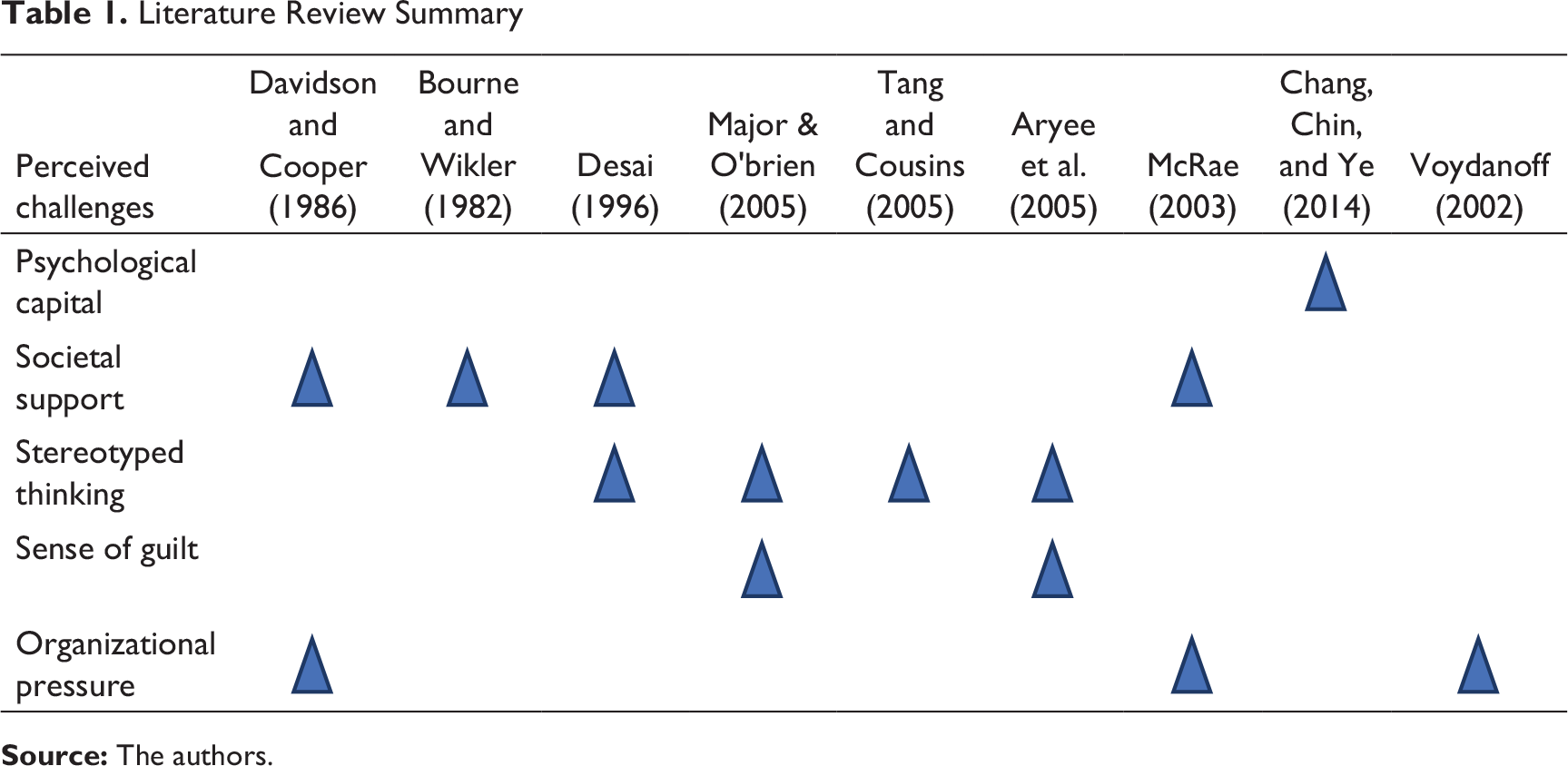
The literature review of this paper presents the difficulties of work–life disparity for working mothers while highlighting the similar challenges faced by them across all nations. By virtue of problems related to awareness of rights, implementation, informality and social exclusion and discriminatory practices, only 28.2 per cent of women employed worldwide are effectively protected by benefits during maternity and half of those women covered are living in developed economies (ILO, 2017). Consequently, in the event of childbirth, it is assessed that only 330 million women employees globally receive financial support. In the recent era, working mothers are more ambitious in their career, compared to their colleagues. They do not want to compromise the opportunities in their workplace for their maternity breaks. This raises the fundamental question of understanding the possible reasons and real challenges during maternal phase experienced by working women. There is a dearth of research and an effective scale to identify the challenges faced by women professionals in India. This study attempts to capture the real challenges because it is beneficial for organizations to develop and use policies that encapsulate this career aspect of working mothers (Chang et al., 2014) in alignment with the socio-economic conditions of the country.
Research Methodology
A mixed methodology—qualitative and quantitative—is used in the study to overcome the shortcomings of both the methods. In-depth interviews were conducted in person and on call. Based on the discussion with participants and literature review, a total of eight categories of challenges were identified and measured using a Likert scale. The main themes emerged from in-depth interviews and literature review includes psychological capital as positive psychological state of development of individual, that is characterized by having self-efficacy, optimism and resilience, and high levels of the hope (Luthans, Avolio, Avey, & Norman, 2007); social support as having family and friends, to turn to in times of crisis or needs to give you a positive self-image and broader focus; stereotype thinking as a way of thinking on the intended behaviour of a certain group that may or may not be true. Maternity is often looked upon as an impediment to a women’s career, and she is constantly reminded of the same by her friends, family or society in general; sense of guilt as the feeling of committing an implied offence or crime. Working mothers are often caught in the dual guilt cycle of not being good mothers or employees; organizational pressure as culture and practices that cause the individual anxiety, restlessness and irritation; physical fitness as the state of health or well-being that enables one to carry out daily tasks without undue fatigue; supervisor’s support as the extent to which leaders understand and value their employees’ contributions and care about their well-being and nature of work as the type of work that an employee does, including their roles and responsibilities, working hours, etc.
Sample
A semi-open questionnaire was administered to new and expecting mothers in the metro cities. The women were approached through Facebook groups, WhatsApp and hospitals. The sample size includes working mothers having infants in the age group 0–5 years. Totally 123 data points have been collected which is inclusive of mothers expecting their first child in next 6 months. Responses were collected in both electronic and paper forms. Most of the sample mothers were expecting in next 5–9 months (approximately 60%) and rest 20 per cent were having kids between 0 and 12 months and 20 per cent had kids under the age of 1–5 years.
Measurement Scale
Scales were constructed to measure psychological capital, social support, stereotype thinking, sense of guilt, organizational sensitivity, supervisor/leader’s sensitivity, physical fitness and nature of work. Each scale consisted of some items to which respondents ranked their agreement on a scale from 1 (strongly agree) to 5 (strongly disagree). For psychological capital, the study has used a scale developed and validated by Lorenz, Beer, Pütz, and Heinitz (2016). While the social support scale used in the study has been developed and validated by Kliem et al. (2014). The items have been developed for other identified themes from the interviews taken as stereotype thinking, sense of guilt, organizational pressure, supervisor’s support and physical fitness.
Item Generation
The questionnaire is generated using in-depth interview technique and review of available literature. Reviewing the existing literature helped to identify scales to measure two constructs, that is, psychological capital and social support, but we did not find any significant scale to measure the other six constructs, that is, stereotype thinking, sense of guilt, organizational sensitivity, supervisor/leader’s sensitivity, physical fitness, and nature of work. To measure these constructs, we applied the deductive approach method on the data collected from an in-depth interview of expecting and new mothers along with other fragments of information available in the existing literature. The method generated overall 37 items measuring eight categories of challenges (constructs) faced by working Indian mothers.
Content Validation
To establish the scale’s content validity, the scale was evaluated by two industry experts and two academicians. The rates were chosen on the basis of their knowledge and expertise in this area of research. They provided necessary inputs for the improvement inappropriateness and language of the items. Items were improvised and reframed based on their feedback. Additionally, to determine inter-rater agreement, the Kappa value was calculated. For a given questionnaire, a Kappa value equal to or greater than 0.70 indicates an acceptable level of conformity between two proficient (Kongerud, Vale, & Aalen, 1989). The Kappa value obtained for this scale was 0.75 at a significant level (p < 0.05). This establishes content validity and reaffirms the consensus of experts on the items representing the defined construct. None of the items were dropped at this phase. All 37 items in the developed scale measuring challenges faced by Indian working mothers had content validity.
Data Analysis and Results
Exploratory Factor Analysis
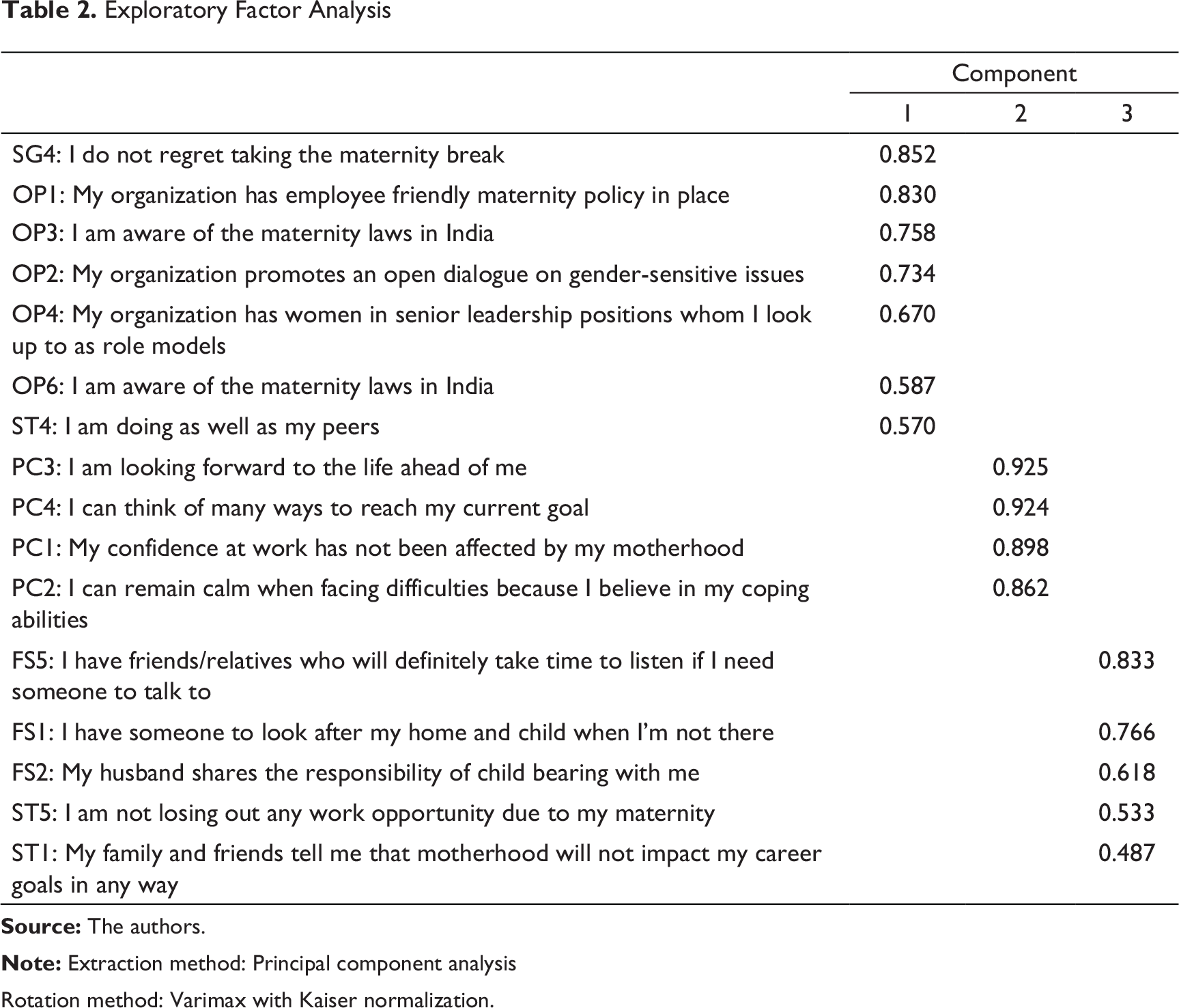
Rotation method: Varimax with Kaiser normalization.
Sample Adequacy
Sample Adequacy Measures

Reliability Scores
Reliability
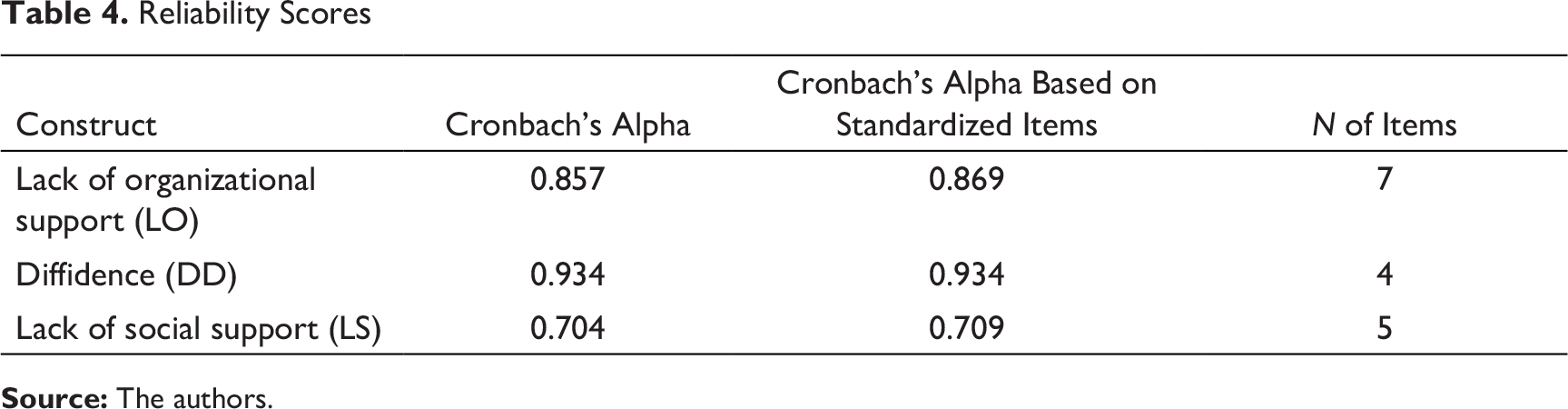
The reliability of a scale is the ability to consistently measure the event or phenomenon that it is intended to assess (Selltiz et al., 1959). Using the appropriate option in SPSS, reliability can be calculated. The most commonly used reliability coefficient is Cronbach’s alpha which indicates the items’ internal consistency that defines a measure. Cronbach’s alpha values for three deduced factors, that is, lack organizational support (LO), diffidence (DD), lack of social support (LS) and the overall reliability are depicted in Table 4. A value above 0.7 is considered good for a new scale to be considered acceptable (Yi & Gong, 2013). In our study, Table 4 shows that the reliability score for all the three factors above 0.7.
Construct Validity
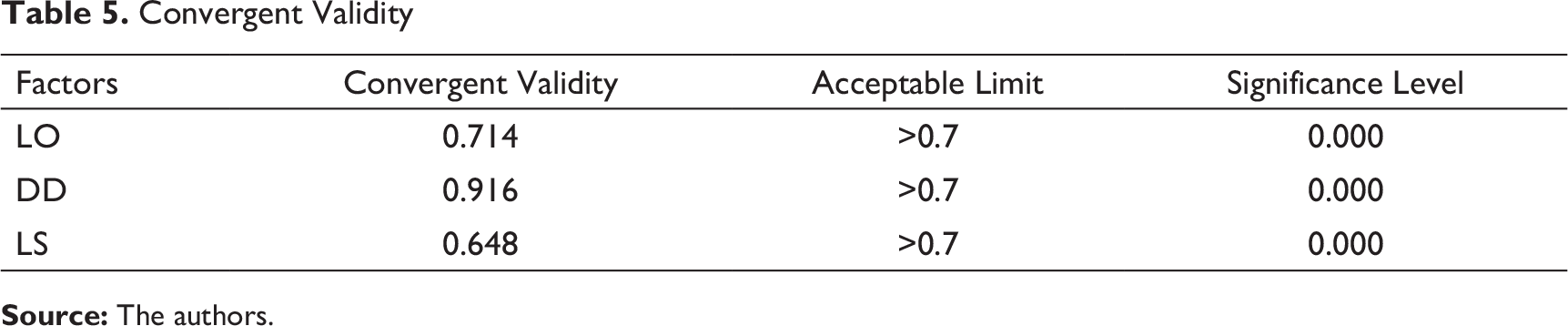
Construct validity provides evidence that a test truly measures that it purports or claims to measure (Kaplan & Saccuzzo, 2012). Construct validity consists of convergent and discriminant validity. These can be accounted for by evaluating the connection between the scale being developed with the same existing measures and tests.
Convergent Validity
Convergent Validity
Discriminant Validity

Discriminant Validity
When the measure has a low correlation with the tests that are not measuring the same construct, discriminant validity can be obtained. Hence, it is measuring a unique construct. However, it also indicates that the measure does not in any way delineate a construct other than the one for which it was meant to be developed. Discriminant validity is ensured by measuring that there are zero cross-loadings, inter-correlation among the factors is low and it is lower than the variance extracted between the factors (Table 6).
Discussion and Conclusion
Several organizations have introduced new policies to reduce attrition among women employee post maternity over the last few years. From flexible-work to phase-back programmes, no stone has been left unturned. Yet, as per the ILO report—Women of Work Trends (2016), unemployment gender gaps remain high, especially for women on a maternity break and they continue to be affected by considerable pay gaps, thus making their careers more vulnerable. In order to address gender employment and associated pay gaps, an understanding of key challenges and subsequently a well-curated set of policies and practices is vital.
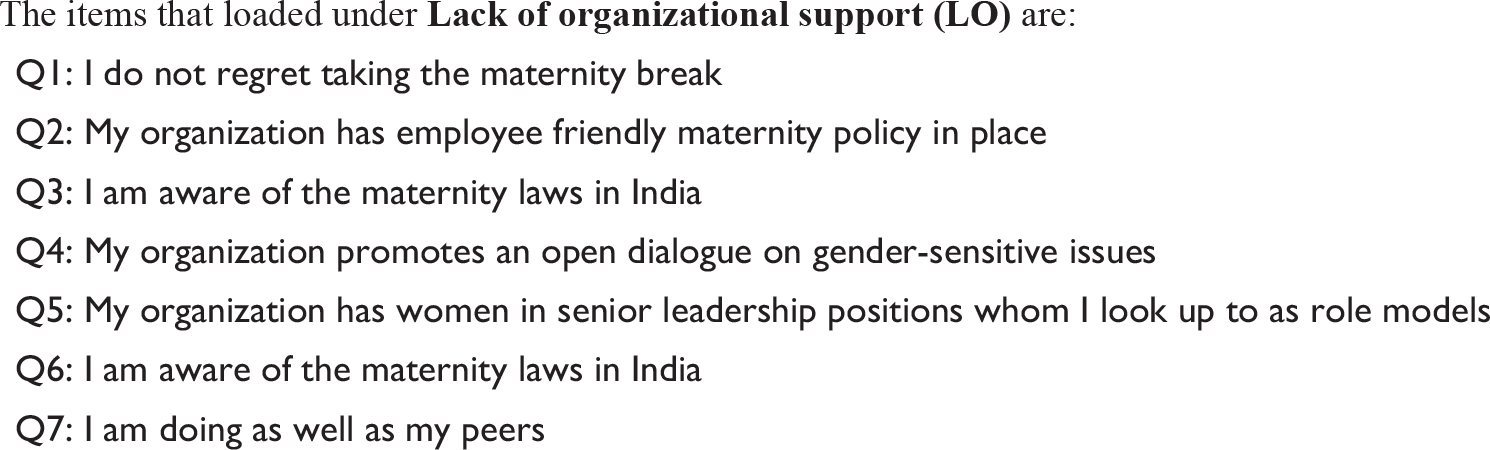
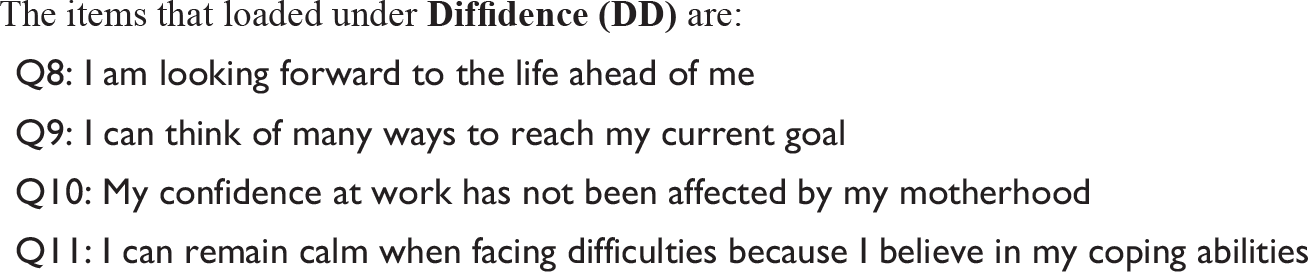
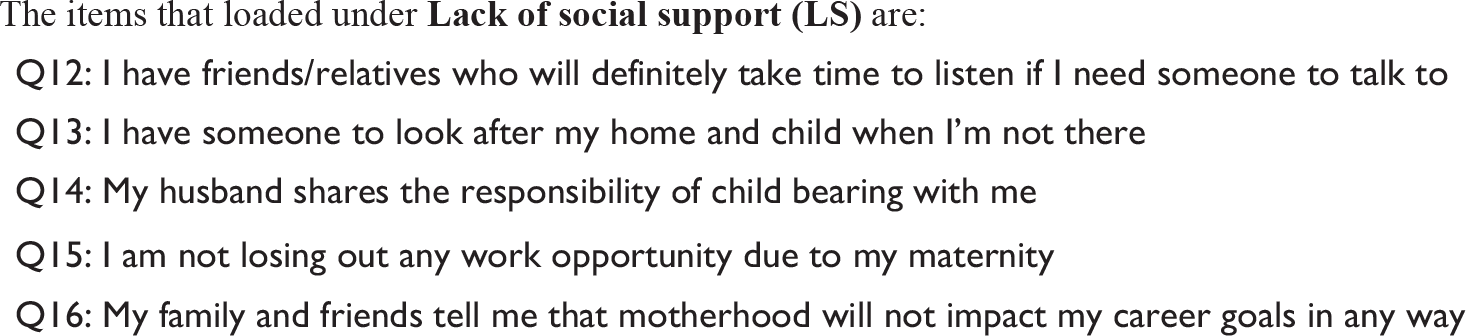
This study with subsequent development of a scale to measure the key challenges faced by working mothers in India with considerable psychometric properties has implications for both women professionals and organizations. The scale development has followed a structural approach of extracting items from in-depth discussions, developing items having good validity and reliability scores. Following a mixed methodology eliminates the limitations of using only one of the quantitative and qualitative methodologies. The challenges identified are specific to the Indian context. The three concrete challenges that have emerged are lack of organizational support, diffidence and lack of social support.
The standardization of scale for a sample comprising various industrial sectors has contributed to the generalizability of the scale. The grounded theory approach also enabled a comprehensive understanding of the concept. The review of existing literature presented a myopic view of the challenges specific to countries and industrial sectors. To reduce this, enriching discussion with working women professionals and those on a career break during the process of scale development was translated into items (or questions) and challenges were identified in a realistic manner. The outcome of this study will prove to be useful for Indian organizations across all sectors. It would help policymakers to develop better and improved human resource policies and foster a gender inclusive culture in the organization.
Managerial Implications
An overview of the main policy interventions for supporting and retaining working mothers in India, as implied from the interactions, data findings and analysis, can be taken forward as important implications of this study. Since difference (self-doubt) is one of the biggest challenges perceived by new mothers, organizations need to focus on providing coaching and mentoring to help women to overcome self-doubt. The solution lies in providing customized support to the women employees during their maternal phase because not every woman needs a longer maternity break or a lesser challenging project. After maternity, a key barrier to a woman’s career advancement is the lack of family support. Thus, there is a need to promote and motivate fathers to avail parental leaves, so that they can equally share the responsibility of parenthood with their wives. From the analysis of discussions and open-ended questions, it emerges that majority of Indian women feel that lack of quality day care facility in their offices is a major deterrent to continuing working post their delivery. Implementation of gender-sensitive programmes and informal discussions on maternity law in India and policies in the company is important to ensure that women are aware of their rights and entitlements. Having top-level women executives in the middle-level professionals foresee their career ahead in the company and remain motivated. Organizations should emphasize the importance of mentorship programmes for new mothers. Women can get a long-term career view on how to handle many of the critical career milestones from their mentors. A quality day care or crèche facility within the office premises is one of the most desirables things for most of the working women. Thus, organizations must try to provide this facility to its employees. A vast majority of women feel scheduled at work post their maternity break, thus companies should come up with some special inclusion programmes to make such women feel more welcome and included at work. The facility of availing some dedicated fitness programmes like yoga, aerobic, etc., should be provided for new mothers because at least 45 per cent of women surveyed feel that their fitness has been impacted due to motherhood.
Limitation and Future Scope
The sample size and the representativeness are the major limitations of this study. The target of this paper is mostly middle-level women employees who are either expecting or new mothers. This study’s conclusion may not be applicable to blue-collar female workers. The future scope of the study includes conducting a confirmatory factor analysis with a bigger sample size to establish the accuracy of developed scale to identify the challenges faced by working mothers.
Appendix A
The items that loaded under Lack of organizational support (LO) are:
The items that loaded under Diffidence (DD) are:
The items that loaded under Lack of social support (LS) are:
Footnotes
Acknowledgement
We would like to extend our gratitude to all the busy mothers who shared their experiences and expectations with us during the in-depth interviews and answered the questionnaires. Without their support, this research would have not been possible.
We are also thankful to the institution IMI, New Delhi, and its fraternity for providing us an opportunity to undertake a study in the area of our interest. Last but not least, we are grateful to the anonymous referees of the journal for their extremely useful suggestions to improve the quality of the paper. Usual disclaimers apply.
Declaration of Conflicting Interests
Funding
The author received no financial support for the research, authorship and/or publication of this article.