



Abstract
Multiple roles at both work and family result in both negative (work–family conflict) and positive (work–family enrichment) spillover, which has their reflections on employees’ job and family outcomes. Research on work–family integration has been largely dominated by studies conducted in the USA and other Anglo countries, and barely a few studies have been conducted in non-Western contexts, especially in collectivistic societies of India, where family roles presume more prominence. This study scrutinized the combined effect of work–family conflict and work–family enrichment on turnover intention, among selected bank employees, from both private sector and public sector banks in India. Data were collected using self-reporting standardized scales that measured work–family conflict and work–family enrichment in both directions. Results were in line with the ‘matching-domain’ hypothesis in work–family research, as family to work direction of spillovers was not found to be significant predictors of turnover intention. Multi-group analysis using WarpPLS 6.0 revealed that gender and the sector of employed bank significantly moderated the relationship between variables under focus. The present study delivers indication that simultaneous experience of lowered work–family conflict and higher enriched experiences at the workplace will offer tangible benefits and long-standing yields to the organizations, in the form of lowered intentions to quit the organization, with particular emphasis on the matching-domain hypothesis of work–family research. The implications of these results for theory and practice are also discussed.
Introduction
Over the preceding decade, the banking sector in India has endured a huge leap of transformation, especially in the context of demonetization and related policies (Makkar & Basu, 2017; Rajput, 2016). Firm competition from private banks and paradigm shift to customer-centric business has transformed the way banks operate. With banking sector reporting a high attrition rate of 17.4 per cent (Sayak, 2018), human resource managers at banks face the challenges of increasing the competencies, motivation levels, personal effectiveness and enthusiasm of their employees to achieve competitive advantage in the contemporary dynamic business environment (KPMG in India’s Annual Compensation Trends Survey, 2017). Fluctuating work environments have placed escalating demands on the employees, who find it tough to strike a balance with both work and family roles, which is of imperative significance in a collectivistic society like India (Jain & Nair, 2016; Kumar & Sundaram, 2014). The (in)effective combination of work and family roles has been pointed as one of the main factors contributing towards different job attitudes and outcomes like job satisfaction, organizational commitment, job involvement, employee engagement, organizational citizenship behaviour and task performance (Cooklin et al., 2014; Mauno, Ruokolainen, & Kinnunen, 2015; Rubel, Kee, & Rimi, 2017). Numerous studies have investigated the negative relationship between work–family conflict and different job outcomes (Aboobaker, Edward, & Pramatha, 2017b) while focusing less on the positive interaction between work and family. Studies have identified that the spiral gain and loss of resources could occur simultaneously (Mauno, Ruokolainen, & Kinnunen, 2015), but empirical studies on the same remains largely understudied. Social roles and gender role orientations too play a significant role in predicting work–family interface and its outcomes (Drummond et al., 2017; Hagqvist, Gådin, & Nordenmark, 2017). The aim of the present study is to investigate the collective influence of both work–family conflict and work–family enrichment, on an employee’s intention to quit the organization and the moderating role of various demographic factors too is explored.
Literature Review
Work and family have become more and more antagonist poles, demanding equal amounts of energy, time and responsibility. The modern-day workplace is characterized by long working hours, shorter deadlines, higher competition, lesser holidays, frequent tours and job transfers. Work–family conflict (WFC) has been defined as ‘a form of inter-role conflict in which the role pressures from the work and family domains are mutually incompatible in some respect’ (Greenhaus & Beutell, 1985). Kahn, Wolfe, Quinn, Snoek, and Rosenthal (1964) define WFC as a form of inter-role conflict in which the role pressures from the work and family domains are mutually incompatible, and, in some respect, WFC occurs when the demands of work comes in conflict with the time or consideration given to the family. Various workplace factors such as total working hours, overtime requisites, inflexible work schedules, unaccommodating peers and an uncongenial organizational culture create conflict between the work and family roles (Baral & Bharghava, 2010; Carlson, Kacmar, & Williams, 2000). Similarly, family–work conflict (FWC) arises out of inter-role conflicts between family and work and results in lower life satisfaction and greater internal conflict within the family unit. Conceptually, the conflict between work and family is bi-directional. Studies differentiate between WFC and FWC (Aboobaker & Edward, 2017b; Boyar, Maertz, & Pearson, 2005; Carlson et al., 2000; Netemeyer, Boles, & McMurrian, 1996). WFC occurs when experiences at work interfere with family life, such as asymmetrical or rigid work hours, work overload and other forms of job stress, interpersonal conflict at work, extensive travel, career transitions, unaccommodating supervisor or organization (Greenhaus et al., 1989; Ru Hsu, 2011). FWC occurs when experiences in the family impede with work life such as the presence of young kids, elder care responsibilities, interpersonal divergence within the family entity and uncooperative family members (Haar, 2017; Luk & Shaffer, 2005; Valk & Srinivasan, 2011).
Many prominent researchers have associated WFC with numerous negative outcomes such as domestic violence, poor physical activity, poor eating habits, poor emotional health, excessive drinking, substance abuse among women, decreased marital satisfaction, decreased emotional well-being and neuroticism (Grzywacz et al., 2005; Luk & Shaffer, 2005; Powell & Greenhaus, 2006; Zhang, Griffeth, & Fried, 2012; Salanova et al., 2014). Conflict between work and family is associated with increased occupational stress and burnout, intention to quit the organization, lower health and job performance, low job satisfaction and performance, high absenteeism rates, reduced career commitment, increased psychological distress, increased parental conflict and marital distress, increase in child behaviour problems, poor parenting styles and lower satisfaction with parenting (Aboobaker et al., 2017b; Dettmers, Bamberg, & Seffze, 2016; Voydanoff, 2005).
More recently, in line with the positive psychology movement, researchers have gained interest in the positive side of work–family relationships or the beneficial outcomes that result from the occupation of multiple life roles. The emergent focus on enrichment complements the prevailing conflict perspective that characterized work–family research in the past decades and, henceforth, contributes to a balanced view of the work–family interface. Work–family enrichment (WFE) is seen as the perceived ease of fulfilling work and family demands, owing to beneficial skills, support and resources gained from participation in the other (work or family) domain. This is based on the role expansion and accumulation theories, according to which multiple roles provide benefits in the form of privileges, status security, psychological energy and psychological growth, which in turn facilitate performance and expand individual resources (Marks, 1977; Sieber, 1974). Similar to WFC, WFE is divided into enrichment arising from work-related resources improving the quality of life in the family domain (work-to-family enrichment, WFE) and enrichment arising from family-related resources improving the quality of life in the work domain (family-to-work—FWE enrichment) (Greenhaus & Powell, 2006; Shockley & Singla, 2011). WFE has been proved to be positively related with employee behaviours and outcomes like higher job satisfaction, organizational citizenship behaviour, organizational commitment, work engagement, subjective well-being and lower intention to quit the organization (Akram, Malik, Nadeem, & Atta, 2014; Mauno et al., 2015; Tang, Siu, & Cheung, 2014; Timms et al., 2015). Researchers have recognized that by focusing on the outcomes of WFC and WFE separately, the fact that experiences of conflict and enrichment together constitute the experience of work–family interface (WFI) within an individual is neglected (Mauno & Rantanen, 2013; Rantanen, Kinnunen, Mauno, & Tement, 2013), and few studies have identified that WFC and enrichment can be experienced simultaneously and at the same level of intensity (Rantanen, Kinnunen, Mauno, & Tillemann, 2011).
Turnover intention (TI) is one of the most powerful predictors of actual turnover (Griffeth, Hom, & Gaertner, 2000). Higher rates of turnover incur a lot of cost to the company (Allen, Bryant, & Vardaman, 2010; Hancock, Allen, Bosco, McDaniel, & Pierce, 2013), and reducing attrition is in the interest of both managers and top management alike. For the long-term sustainability of the organization, managers constantly inquire into strategies that are aimed at improving the job attitudes and thus reduce the TI of employees (Agarwal & Gupta, 2018). Understanding the WFI of employees, both the positive and negative side of boundary interaction could help managers develop policies and procedures aimed at improving the state of affairs. To the best of researcher’s knowledge, no study has been conducted to examine the combined effect of WFC and work–family enrichment in predicting the TI of employees, especially in a collectivistic society like India. This research endeavour attempts to investigate the simultaneous influence of WFC, work–family enrichment on TI, and attempts to explore the moderating effects of individual differences like gender, age educational qualification, years of work experience, position in the organization and sector of the bank. The study also seeks to understand whether demographic factors like gender, age, number of children, parental support, and income state of spouse would contribute towards the variations in WFC, work–family enrichment and TI.
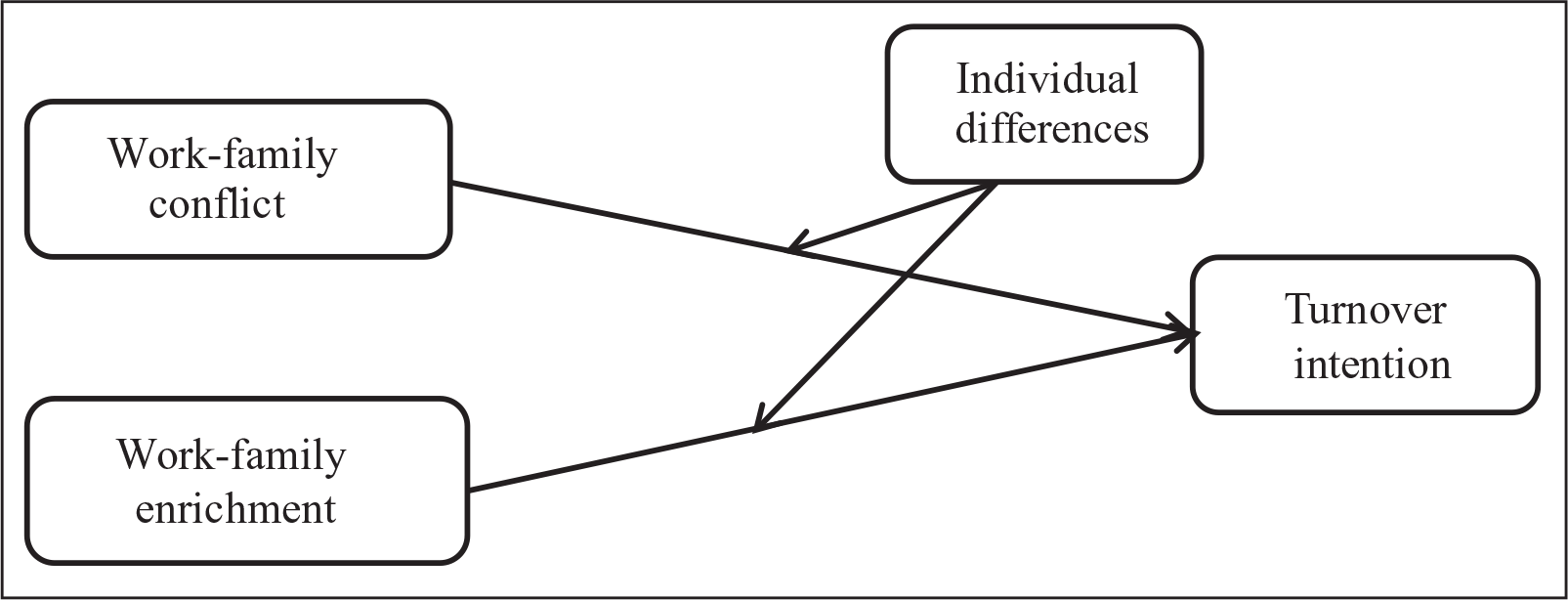
Accordingly, we hypothesize that WFC, FWC, WFE and FWE will have a significant combined influence on employee TI. Also, drawing from existing literature (Aboobaker & Edward, 2017c; Cerrato & Cifre, 2018; Hardy et al., 2018), it is also hypothesized that various personal and contextual factors like gender, age, number of children, parental support, income state of spouse, educational qualification, total years of work experience, position in the organization and sector of bank (public/sector) would contribute towards variations in WFC, WFE, and TI. The study also proposes that the aforementioned factors would moderate the simultaneous relationship between WFC and WFE and TI (Figure 1). The study adds to the scholarly literature by detailing the influence of personal and contextual factors on the focal constructs themselves and also, on the inter-relationships among the constructs. These aspects have not been examined in the existing literature. This study, therefore, aims to enhance managers’ understanding of the collective influence of negative and positive spillover effects of work and family roles on job attitudes.
Research Methodology
Overview of Sample and Procedures
This study was descriptive in nature and was conducted among a sample of employees working in banking institutions, operating in both public and private sector. To ensure an effective measure of the constructs, employees who had a minimum of 1-year experience with the current employer were alone selected. The data were collected by administering self-reporting questionnaires among the sample respondents, who were selected through purposive sampling method. An online version of the questionnaire was also sent to the respondents who could not be easily contacted. Of the 200 questionnaires distributed, 116 usable responses were obtained for final data analysis (Table 1).
Sample Demographic Profile

Measures
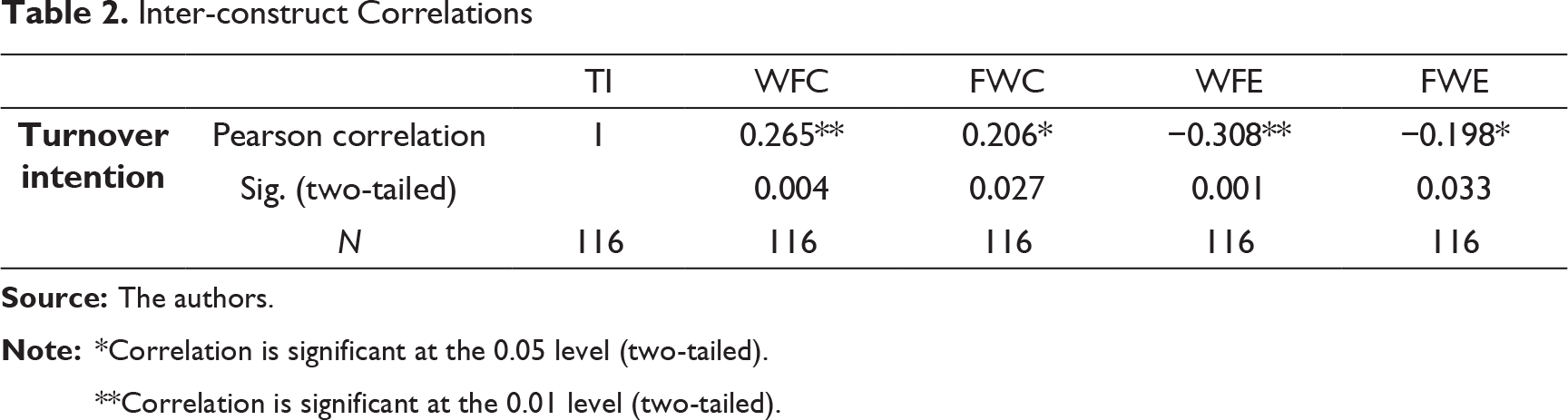
Inter-construct Correlations
**Correlation is significant at the 0.01 level (two-tailed).
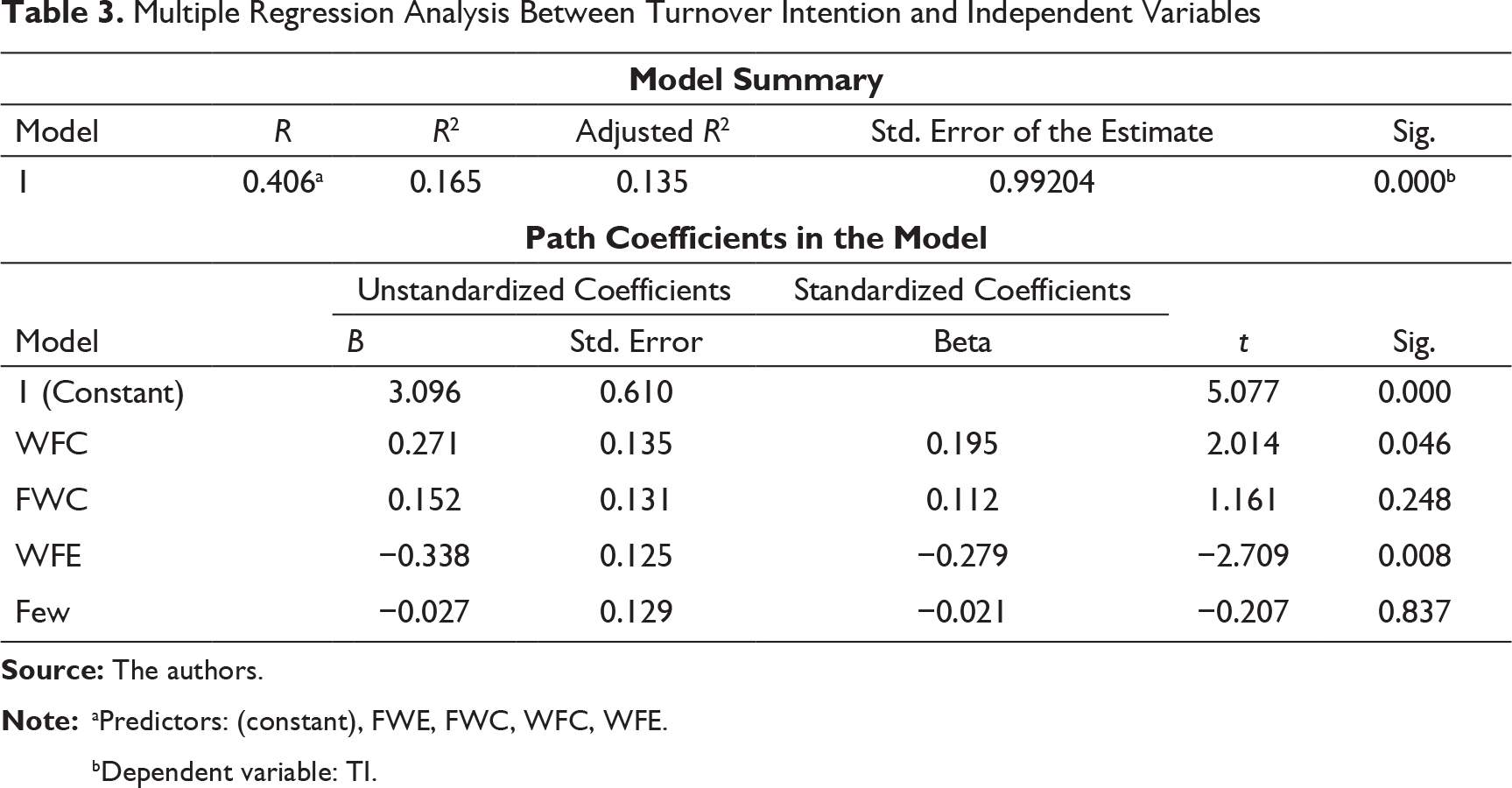
Multiple Regression Analysis Between Turnover Intention and Independent Variables
bDependent variable: TI.
Analysis
Tests of correlation revealed that WFC was significantly associated with TI (correlation coefficient = 0.265*), and FWC was also positively associated with the TI (correlation coefficient = 0.206*). WFE was negatively and significantly associated with TI (correlation coefficient = −0.308**) and FWE was also significantly associated with TI (correlation coefficient = −0.198*) (Table 2).
Multiple regression analysis (Table 3) revealed that the independent variables (WFC and WFE) simultaneously explained 13.5 per cent of the variance in TI (R2 = 0.135). WFC (β = 0.195) and WFE (β = −0.279) had significant influence on TI. Family to work direction of both conflict and enrichment had no significant influence on TI, and these results are in line with the recent ‘matching-domain’ perspective in work–family research.
Hypothesis Testing Between WFC, WFE, TI and Demographic Variables


The research model was tested for moderating effects using the structural equation modelling (SEM), a multivariate technique that allows the simultaneous estimation of multiple equations. An SEM using partial least squares (PLS) via WarpPLS 6.0 statistical software was used for the analysis, and it performs simultaneous multiple regression analysis of paths specified in the model (Hair, Hult, Ringle, & Sarstedt, 2014). PLS assesses the relationships between constructs and their measurement items and enables simultaneous analysis and empirically confirms hypothesized relationships. The conceptual model was tested for moderating effects of all demographic variables captured in the questionnaire (Table 1). Only gender and the sector of the employed bank showed significant moderation effects. Figure 2 demonstrates all the path coefficients and significance values with gender as moderator and Figure 3 illustrates the path coefficients and significance values with a sector of the employed bank as moderator.
Furthermore, multi-group analysis of the model was done using WarpPLS 6.0 to understand how the significant moderators (Gender and Bank_Sector) influenced the relationships. It was revealed that the WFC and WFE predicted TI more among females than among males (R2 [female] = 0.31 and R2 [male] = 0.17) (Figure 2) and more among private sector employees, than those employees in public sector banks (R2 [private sector] = 0.49 and R2 [public sector] = 0.13) (Figure 3). Results revealed that the relationships between WFC and TI and WFE and TI are stronger for women. Women experienced both WFC and WFE, and it translated more into TI among them. Among males and females, the path coefficient between WFE and TI varied only slightly (β = −0.30 and β = −0.33, respectively), whereas the path coefficient between WFC and TI varied to a greater extent (β = 0.25 and β = 0.44, respectively). Comparing with respect to the sector of the employed bank, among private sector employees, the relationship between WFC and TI was very strong, when compared to public sector bank employees (β = 0.52 and β = 0.22, respectively), and the relationship between WFE and TI showed only slight variation (β = −0.25 and β = −0.44, respectively) (Table 5).
Discussion
The main objective of this study was to examine the simultaneous influence of WFC and WFE on TI of employees. Evidences from the study suggest that the WFI continues to be a strong predictor of an employee’s intention to quit the organization. Consistent with existing literature, there was a significant positive relationship between WFC and TI, and WFE significantly lowered TIs (Aboobaker et al., 2017b). The most noteworthy results were with reference to the emerging ‘originating-domain versus receiving-domain’ perspective in work–family research. This perspective proposes that though WFC and WFE are theoretically defined as bi-directional in nature, with negative/positive spillover from work–family domain affecting quality of life in other domain family–work, meta-analysis of empirical work in this area reveals that it is the work-to-family direction of conflict that influences job attitudes the most (Amstad, Meier, Fasel, Elfering, & Semmer, 2011; Shockley & Singla, 2011; Nohe & Sonntag, 2014). In line with the originating-domain (otherwise known as ‘matching-domain’) hypothesis, our study also found that TI was more significantly influenced by conflict and enrichment that originated in the domain of work itself.
Gender differences and variations in the relationship with respect to bank sector reveal that only no tailor-made work–family policies will prove effective in dealing with employee job attitudes and outcomes (Bennett, Beehr, & Ivanitskaya, 2017; Singh, Zhang, Wan, & Fouad, 2018). As with the current demographic characteristics of India, millennials constitute the larger working population in our study, with less experience of WFC. 1
Table 4 delineates the variations of work-to-family conflict (WFC), work-to-family enrichment (WFE) and turnover intention (TI) with respect to different demographic factors. Results of one-way ANOVA among the sample participants show significant difference (p < 0.05) for millennials for these constructs.
Multi-group Analysis: Gender and Sector of Employed Bank

The practical significance of the present investigation stems directly from its research implications. It is well established that high-quality jobs are those associated with higher levels of WFE and lower levels of WFC (Allen, Hersts, Bruck, & Sutton, 2000; Eby, Casper, Lockwood, Bordeaux, & Birinley, 2005; Greenhaus & Powell, 2006; Rubel et al., 2017). Results reveal that TI is more significantly associated with conflict and enrichment in work-to-family direction, thus providing evidence for the emerging matching-domain hypothesis in work–family research. Job designs that optimize opportunities for WFE, ultimately improving family environments, are characterized by manageable workloads, reasonable hours, flexibility, optimal supervisor support, job security and a sense of control/autonomy over work (Gronlund, 2007; Strazdins, Shipley, Clements, Obrien, & Broom, 2010). In order to develop organizational initiatives and intervention strategies that foster positive employee outcomes, practitioners must understand the factors that drive these outcomes. That is, the types of programmes that would be implemented to target WFC/WFE, like flexible work arrangements (Shockley & Allen, 2007), may differ considerably from those meant to affect FWC/FWE, such as dependent care supports. This study was an attempt at introspection into many such personal and contextual factors that have potential influence on WFC and WFE. These insights gained from this study can help managers frame personalized policies and tools that would improve individual, team and organizational functioning.
Conclusion
The study is a pioneering attempt to understand the collective influence of WFC and WFE on employee TIs. In addition, more focus was on elaborating the individual differences and its influence on the relationships. In line with the results of the study, it is proposed that practitioners should develop intervention strategies and organizational initiatives that are more precisely targeted, specifically to reduce the extent that work interferes with family or enhance the extent that work enriches the family. Previous research suggests that flexible work arrangements, supervisory support, family-supportive cultures and resource-rich job components enable positive work-to-family outcomes. Such interventions may not only effectively foster work–family interactions but, in turn, will also positively impact the employee and thus the organization and society at large. Providing employees with flexibility, being lucid and focused on outcomes as well as encouraging an open and supportive culture can have a positive effect on their well-being. It also helps in engagement levels and lowers TIs, particularly in the case of highly dynamic industry sectors like banks.
Limitations and Further Scope of the Study
Though the results of this study are illuminative with respect to both theory and practice, there are a few limitations worth mentioning. Though procedural remedies were taken to rule out common method bias, it remains a limitation, especially with the case of work–family constructs. Further research should attempt to collect data on WFC/WFE from spouse/partner too. The influence of other personal and contextual factors, that the researchers might have overlooked, should be examined. Also, the theoretical model could be tested in a different sample, across nations or as longitudinal studies. Such studies will help further deepen our understanding about work–family indicators and its underlying mechanisms.
Footnotes
Acknowledgement
The authors are grateful to the anonymous referees of the journal for their extremely useful suggestions to improve the quality of the article. Usual disclaimers apply.
Declaration of Conflicting Interests
The authors declared no potential conflicts of interest with respect to the research, authorship and/or publication of this article.
Funding
The authors received no financial support for the research, authorship and/or publication of this article.