



Abstract
This article examines and contrasts the long-run relationship between the working capital management and profitability of South African firms in the retail and construction industries over the period 2004–2015. Techniques used in the study included the cointegration technique as well as a Granger causality test. The study found evidence of a long-run relationship between working capital management and the profitability of a firm in most of the cases. Further to this, the presence of both unidirectional and bidirectional causality between working capital management and profitability was found. In addition, results presented in this study indicate that working capital management has a greater impact on the profitability of retail firms than construction firms. The value of the study lies in the fact that management in different industries should realize that working capital management will have an impact on different profitability measures, for example, inventory management in the construction industry will have the biggest impact on return on assets, whilst in the retail industry the impact of inventory management will be most significantly on the gross profit margin compared to other profitability ratios.
Introduction
The role of working capital (WC) in enhancing the profitability of firms has received increased attention recently from both management of an organization and academics. WC is an integral part of short-term financial management and it plays a key role in a company’s profitability, liquidity and shareholders’ value (see, for instance, de Almeida & Eid, 2014). This study focused specifically on the relationship between working capital and the profitability of South African firms, particularly in the context of two industries, namely, retail and construction.
The importance of working capital and its relationship with the profitability of firms is not new in corporate financial literature. There are several books and articles that stress that the effective management of working capital will have a positive impact on a profitability (Deloof, 2003; Jang & Park, 2011; Louw, Hall, & Brümmer, 2016; Mun & Jang, 2015; Ukaegbu, 2014; Vahid, Elham, Mohsen, & Mohammadreza, 2012). Literature also suggests that the different components of working capital can have a profound impact on corporate profitability, for instance, Mun and Jung (2015) stated that cash holdings have a significant impact on profitability, while studies by Vahid et al. (2012), Ukaegbu (2014) and Louw et al. (2016) concluded that of all working capital components, inventory has the most significant effect on a firm’s profitability. Most of these studies were conducted on a heterogeneous group of firms.
It is evident from these empirical studies that careful consideration should first be given to the role that working capital and its components have on profitability, and second, that the relationship between working capital management (WCM) and profitability could be investigated in an industry-specific context. For the latter, it is also important to consider the country of the sample, as its economic status will have an effect on working capital investment decision-making. The South African economy is ranked as a middle income, or developing, economy by the World Bank (WDR, 2016). To the best of the researchers’ knowledge, limited studies have been conducted to investigate if there is a difference in the working capital variables of companies in the various industries of a developing economy, particularly South Africa.
Most of the past studies used a production function approach to study the effect of working capital on profitability (see, for instance, Enqvist, Graham, & Nikkinen, 2014; Mun & Jang, 2015; Ukaegbu, 2014), thereby indicating a supply-leading approach of the WC-profitability nexus. But in reality, the profitability of firms can also affect the level of working capital, thus leading to a demand-following nexus. This means there may be bidirectional causality between working capital and profitability. Therefore, this article makes a novel contribution towards working capital research in that the influence of profitability on working capital is investigated at the hand of unique statistical models and analyses. In addition, in contrast to previous studies, no other past study has used a pure economic-based value creation measure (economic value added) to measure the result of working capital management.
In this article, we add to existing literature by investigating whether working capital acts as a catalyst for the profitability of firms, or whether the flows of working capital are simply a consequence of improved profitability. Another contribution of this study is the comparison made between companies of two different South African industries, namely the retail industry (where intuitively stock turnover should be an important driver of profitability) and the construction industry (where intuitively debtors’ management should be a critical element of working capital and profitability). The results of the analysis should prove that, for different industries, there are different elements of working capital that affect profitability, which will influence the working capital management of companies in those industries. The implication of analyzing two different studies will result in that more specific recommendations regarding working capital management can be made. As a result, this could open up an avenue for much more detailed research in the field of working capital management and in this way contribute to the body of knowledge.
The remainder of this article is organized as follows. The second section provides the theoretical basis of the relationship between working capital and profitability; the third section presents the research methodology; the fourth section provides the empirical results and discussion; and the fifth section contains the summary and recommendations.
Literature Review, Objectives and Theoretical Framework
Working Capital Management and Profitability
Efficient working capital management is recognized as an important aspect of financial management in all organizational forms (see, for instance, Enqvist et al., 2014). The literature on working capital management, which has evolved through many theoretical and empirical contributions, indicates that it directly affects corporate liquidity (Kim, Mauer, & Sherman, 1998; Opler, Pinkowitz, Stulz, & Williamson, 1999), profitability (Akinlo, 2012; Deloof, 2003; Sharma & Kumar, 2011; Shin & Soenen, 1998; Ukaegbu, 2014; Wasiuzzaman, 2015) and solvency (Berryman, 1983; Peel & Wilson, 1994). However, as the focus of this study is on the relationship between working capital and profitability, we will discuss only those studies relevant to this topic.
Baños-Caballero, Garcĩa-Teruel, and Martĩnez-Solano (2014) claimed to have discovered the existence of an optimal level of investment in working capital that balanced costs and benefits, thereby maximizing the value of firms. Their findings suggested that managers should increase their investment in accounts payable, without incurring interest and without affecting the firm’s credit risk, which could impact negatively on the firm’s value. Similar findings were made by Mun and Jang (2015) who investigated the effect of WC on the profitability of restaurants during the economic recession of 2007–2009. De Almeida and Eid (2014) suggested that a reduction in working capital investment can enhance company value, based on the results of their study of listed Brazilian companies over a 15-year period (1995–2009). Historically, Brazilian firms experienced constraints on access to long-term financing, which negatively affected the relationship between WC and company value. The authors argued that working capital is an important tool for creating shareholder value.
Ukaegbu (2014) studied the relationship between WCM and profitability in African developing countries, including South Africa. His study of industrial firms covered a period of 5 years (2005–2009). The results indicated a positive relationship between net working capital (measured by the cash conversion cycle—CCC) and profitability (measured by gross operating margin), which suggested that managers should reduce their investment in net working capital to improve profitability. A study Akinlo (2012) also show that reducing the CCC improves the profitability of firms in Nigeria. Sharma and Kumar (2011) found in a study of Indian firms that inventory days and accounts payable days are negatively correlated with profitability, and accounts receivable days have a positive relationship with firm profitability.
Enqvist et al. (2014) analyzed WCM in Finnish firms during periods of economic downturns and economic booms. The relationship between CCC and its three individual components were independently regressed against two profitability measures, namely return on assets and gross operating income. Results of the study suggested that inventory and accounts receivables were managed more effectively during economic downturn periods (Enqvist et al., 2014). Garcĩa-Teruel and Martĩnez-Solano (2007) presented more evidence that the effective management of the different components of working capital will improve profitability. They found that when managers reduced investments in inventory and accounts receivables, the profitability improved. However, no significant relationships were found between the outstanding days of accounts payables and the profitability of a firm. In a sample of Belgium firms, Deloof (2003) found that shareholder value could be improved if managers reduced the value of accounts receivable and decreased their inventories to a reasonable minimum.
Studies of South African firms that investigated the effect of working capital on a firm’s profitability were conducted by Erasmus (2010) and Smith and Fletcher (2009), with both studies focusing on the South African industrial sector. Louw et al. (2016) conducted a similar study but focussed on the retail industry. Results from these studies were unanimous, indicating an inverse relationship between net working capital and profitability. These studies are significant as they highlight the importance of investigating an issue not only in the context of a certain country but also in a specific industry. As the first objective of this study is to study the relationship between working capital and profitability, the first set of hypotheses will test this relationship and is presented in section ‘Research Methodology’ of this article.
Working Capital Management in Different Industries
The retail industry is the third largest industry in South Africa and contributes approximately 16.3 per cent to the GDP (Stats SA, 2015). It can therefore be classified as a substantial contributor to the country’s economic growth and job creation. Another sector that plays a key role in the upliftment of local communities is the construction industry, due to the integral impact of social housing on the South African economy. The construction industry contributes approximately 4 per cent to the GDP of South Africa (Stats SA, 2015).
One of the major differences between the WCM of construction and retail firms is that of the time period of projects. With construction firms, the long gestation period of projects could have an influence on the firm’s profitability (due to an expensive financial carrying cost of financing the project) and this, in turn, could have an influence on the survival of the organization (Zakaria & Amin, 2013). However, in retail companies, the investment cycle in working capital is relatively short, as finished goods are purchased by the retailer and, then, resold to the public, in most cases for cash. Due to mounting political pressure to speedily convert the informal settlements around cities into formal housing suburbs (Neil, 2009), the construction industry has become vital to the South African economy. Apart from mass social housing projects, South Africa experienced significant growth in the construction industry during the past decade, mainly due to the preparations for the 2010 Soccer World Cup, which was hosted by South Africa (Neil, 2009).
Firms in the retail industry have a significant investment in their inventory, and the management thereof should form an integral part of their short-term financial management. International studies focused on the importance of inventory management in retail companies. Choudhary and Tripathi (2012) and Goel (2013) in the Indian retail industry and Gosman and Kelly (2003) on data in the US retail industry highlighted the impact of WCM on the profitability of firms. Evidence from the South African retail industry indicated that of all the working capital components, effective inventory management will have the most significant impact on profitability (Louw et al., 2016).
Kandpal (2015) investigated the effect of the working capital of Indian construction firms on their profitability. The findings suggested that if managers could reduce investments in working capital profitability would improve. Another study on WCM within the construction industry was that of Zakaria and Amin (2013). Similar to the Kandpal (2015) study, Zakaria and Amin (2013) measured the investment in net working capital using the CCC. They included an in-depth analysis of the effects that the different components of working capital had on profitability. Zakaria and Amin (2013) provided evidence that a more effective management of creditor payments (by negotiating longer payment periods, streamlining the billing process, as well as speeding up the debtors’ collection process) will improve profitability. These findings are confirmed by the results of studies on working capital management in the construction industry by Makori and Jagongo (2013), Ugochukwu and Tobechukwu (2014) and with Mezek and Polewski (2006) who found that the construction industry requires further specific factors to be included in their working capital practices, namely the organization of the investment processes, organization of production processes and logistics. It is clear from past studies that working capital components in different industries do have different effects on profitability. The second objective of this study is to investigate the effect of working capital management on profitability in different industries. The hypotheses that will be tested in this regard will be presented in the next section of the paper.
All of the above-mentioned studies used the production function approach to observe the relationship between working capital and profitability. However, to the best of our knowledge, there are no studies on the feedback relationship between profitability and working capital. On the one hand, working capital affects the profitability level of firms; on the other hand, it is the profitability of firms that may affect the working capital of firms. This means that, in practice, working capital and profitability can affect each other, an aspect that this study will analyze and which will be a contribution to the existing body of knowledge. Such relationships can be organized into four groups: (a) the supply-leading hypothesis (SLH) of the WC-profitability nexus, where working capital Granger causes profitability of firms; (b) the demand-following hypothesis (DFH) of the WC-profitability nexus, where it is the profitability of firms that Granger causes working capital; (c) the feedback hypothesis (FBH) of the WC-profitability nexus, where both working capital and the profitability of firms Granger cause each other; and (d) the neutrality hypothesis (NEH) of the WC-profitability nexus, where working capital and profitability remain independent of each other. The formulas of these four hypotheses and their empirical tests are described in the next section.
Research Methodology
In this section, the hypotheses, data source, variables and empirical model to determine the causality between working capital and profitability are described. Specifically, we tested the validity of the above-mentioned four proposed hypotheses, namely the supply-leading hypothesis of the WC-profitability nexus; demand-following hypothesis of the WC-profitability nexus, feedback hypothesis of the WC-profitability nexus; and the neutrality hypothesis of the WC-profitability nexus. Econometrically, we intended to test the following two sets of hypotheses:
H1A0: Working capital does not Granger-cause profitability of the firms.
H1A1: Working capital Granger-causes profitability of the firms.
H1B0: Profitability of the firms does not Granger-cause working capital.
H1B1: Profitability of the firms Granger-causes working capital.
The rejection of H1A0 ensures the acceptance of the supply-leading hypothesis, the rejection of H1B0 ensures acceptance of the demand-following hypothesis, the rejection of both (H1A0 and H1B0) ensures the acceptance of the feedback hypothesis and the acceptance of both (H1A0 and H1B0) ensures the acceptance of the neutrality hypothesis of the WC-profitability nexus.
The novice of this study lies also in the statistical techniques applied, namely (a) a Granger causality approach is used to examine the nexus between working capital and profitability and (b) sophisticated econometric tools are used—and certain empirical approaches that had not been used in the literature studied—to answer questions concerning the nature of Granger causal relationships between working capital and profitability, both in the short run and long run. In addition, these relationships are studies in two different South African industries, namely the retail and construction industries.
List of Variables
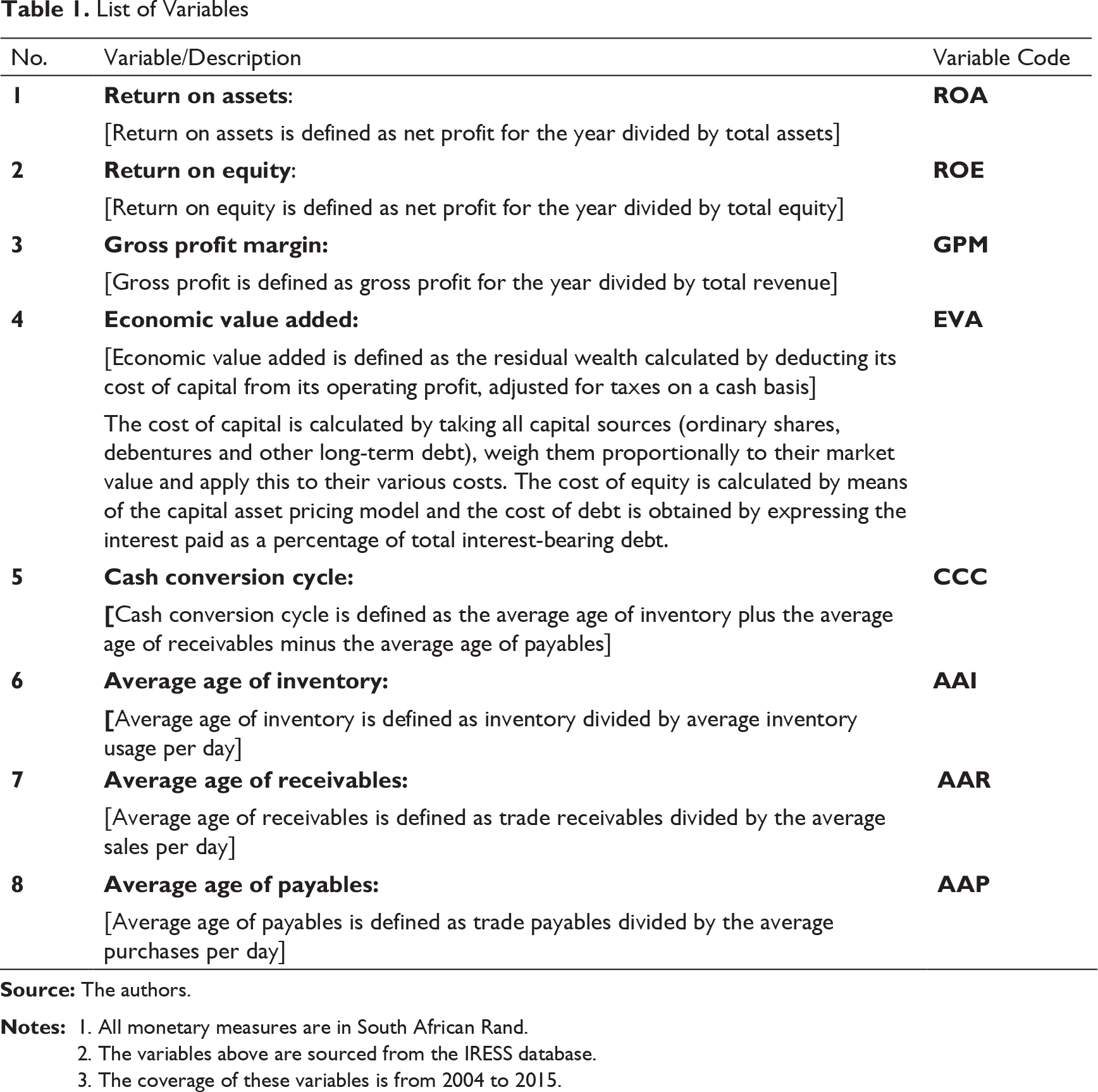
2. The variables above are sourced from the IRESS database.
3. The coverage of these variables is from 2004 to 2015.
Summary Statistics for the Variables and the Correlation Matrix

2. Values reported here are the natural logs of the variables in Table 1. Natural log forms are used in our estimation.
A sample of two types of South African firms (retail and construction) is used to investigate the validity of both H1A,B and H2A,B. The empirical investigation used annual data sourced from IRESS (a reliable supplier of financial data) for the period 2004–2015. The study deployed cointegration and Granger causality (Granger, 1986, 1988) to validate the above two null hypotheses (H1A0 and H1B0).
Three different cases to validate these two hypotheses are created, particularly with reference to the three different panel data structures. Case 1 contained retail firms, case 2 contained construction firms and case 3 contained both retail and construction firms. Under each case, there were four different structures, depending on the deployment of the four WCM indicators. In each structure, there were four different situations, depending on the involvement of the four PRO indicators. The four analysis structures were as follows: structure 1, dealing with CCC and PRO; structure 2, dealing with AAI and PRO; structure 3, dealing with AAR and PRO; and structure 4, dealing with AAP and PRO.
Following Holtz-Eakin, Newey, and Rosen (1988), succeeding regression models are used to identify the long- and short-run causal relationships between working capital management and the profitability of South African companies in two industries.

The testable hypotheses were:
H0
HA
The testable hypotheses were:
H0
HA
where
i = 1, 2, …, N represents a firm in the panel;
t = 1, 2, …, T represents the year in the panel;
p and q are the lag lengths for the estimation;
∆ is the first difference operator; and
ECT is error correction term, which is derived from the long-run cointegration equation.
ε1t and ε2t are the independent and normally distributed random errors with a zero mean and a finite heterogeneous variance.
This study used the Hannan-Quinn Information Criterion (HQIC) statistic to select the optimum lag length (Brooks, 2014). Moreover, the choice of a particular model (with/without ECT) depended on the order of integration and the cointegrating relationship between working capital and profitability. Therefore, in the first place, the unit root test and cointegration test for identifying the order of integration and the presence or absence of cointegrating relationships between the two sets of variables, is deployed.
The Im-Pesaran-Shin (IPS) panel unit root test (Im, Pesaran, & Shin, 2003) was used to establish the stationarity of the variables, while the Kao panel cointegration (Kao & Chiang, 2000) was deployed to establish the long-run relationship between the two. Appendices A and B provide the details about these two tests.
Analysis and Discussion
The discussion of the empirical results begins with the order of integration and cointegration between working capital management and profitability. Using the IPS panel unit root test, the null hypothesis of unit root at the first difference is rejected but not at the level data. Table 3 presents the unit root test results for the three cases, namely the retail firms, the construction firms and both retail and construction firms. The results indicated that working capital (WCM: CCC, AAI, AAR and AAP) and the profitability of firms (PRO: ROA, ROE, GPM and EVA) were non-stationary at the level data but were stationary at the first difference. This was true for all three panels, namely retail, construction and both retail and construction. The findings suggested that both working capital and profitability are integrated of order one (i.e., I [1]), which unlocks the possibility of cointegration between the two sets of variables.
Results of Unit Root Test
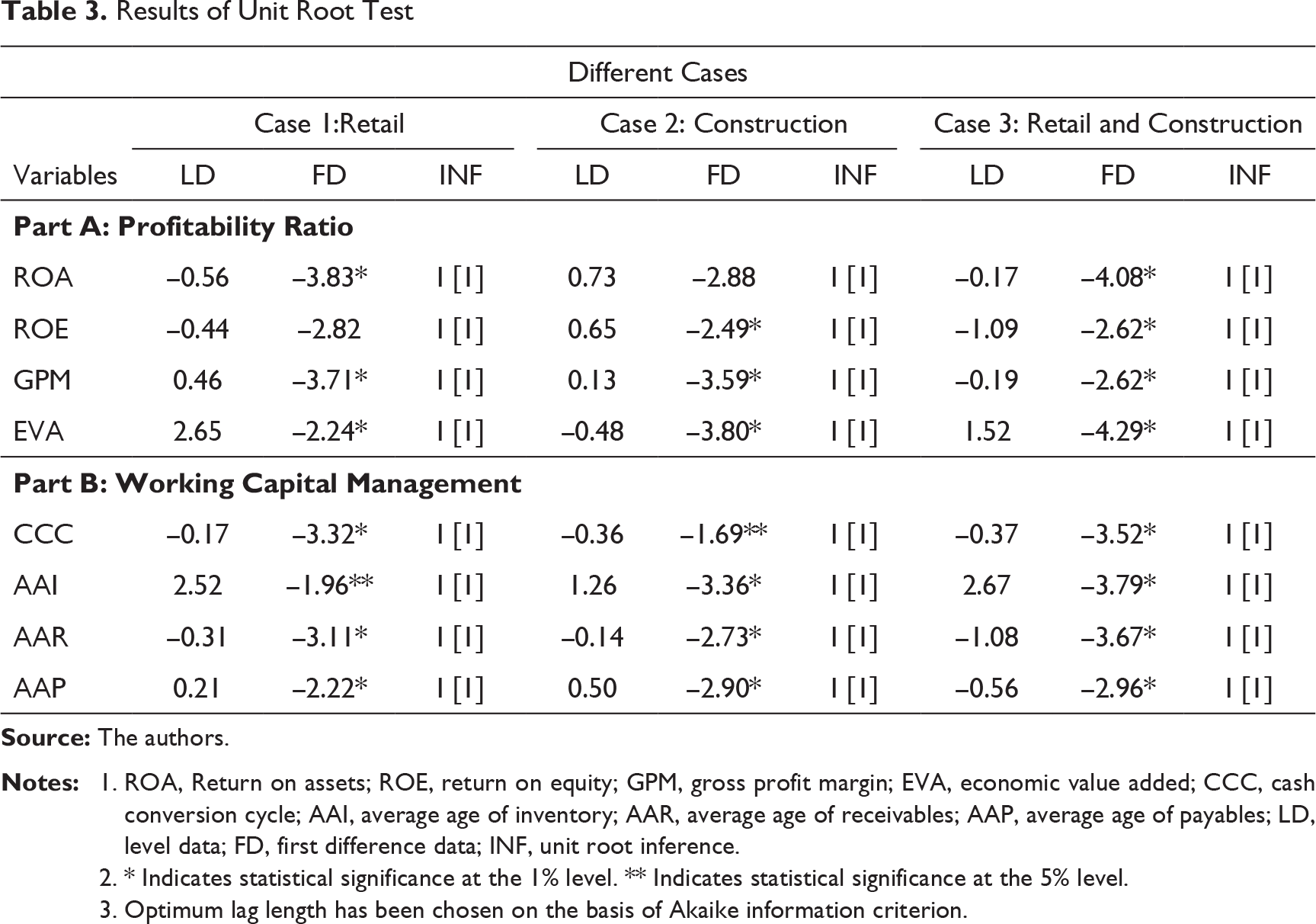
2. * Indicates statistical significance at the 1% level. ** Indicates statistical significance at the 5% level.
3. Optimum lag length has been chosen on the basis of Akaike information criterion.
Results of Cointegration Test
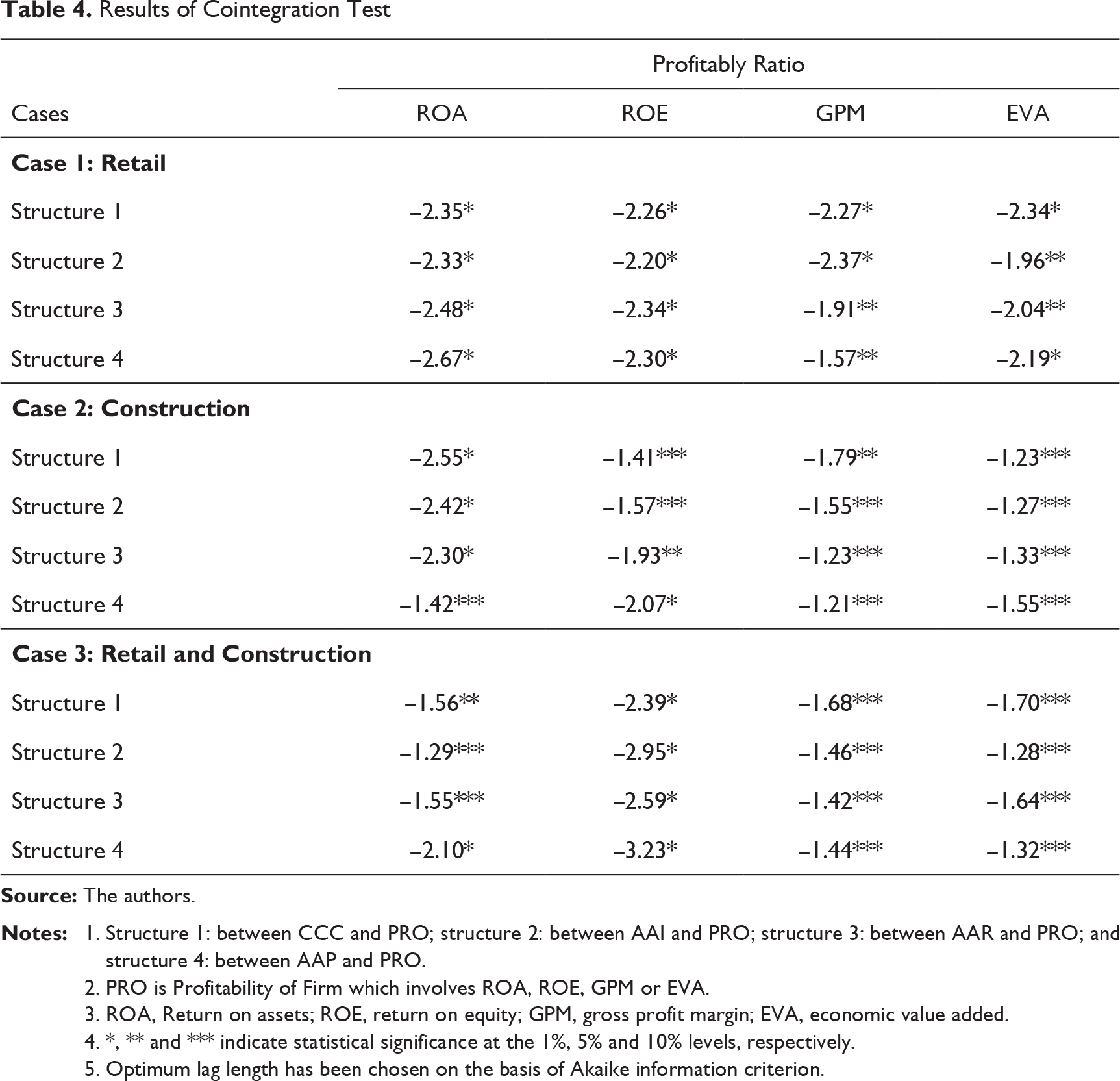
2. PRO is Profitability of Firm which involves ROA, ROE, GPM or EVA.
3. ROA, Return on assets; ROE, return on equity; GPM, gross profit margin; EVA, economic value added.
4. *, ** and *** indicate statistical significance at the 1%, 5% and 10% levels, respectively.
5. Optimum lag length has been chosen on the basis of Akaike information criterion.
Results of Panel Granger Causality Test for Various Specifications and Cases

2. PRO is profitability of firm which involves ROA, ROE, GPM or EVA.
3. ROA, Return on assets; ROE, return on equity; GPM, gross profit margin; EVA, economic value added; CCC, cash conversion cycle; AAI, average age of inventory; AAR, average age of receivables; AAP, average age of payables; ECT, error correction term.
4. *, ** and *** indicate statistical significance at 1%, 5% and 10% levels, respectively.
5. Optimum lag length has been chosen on the basis of Akaike information criterion.
Case 1: Retail Firms
In this case, four structures of four working capital indicators were used, namely CCC, AAI, AAR and AAP. Within each structure, there were four different profitability indicators, namely ROA, ROE, GPM and EVA. In total, there were 16 different opportunities to observe the direction of causality between working capital and profitability. The results confirmed the occurrence of supply-leading [WCM ⇒ PRO], demand-following [PRO ⇒ WCM] and feedback [WCM ⇔ PRO] relationships between working capital and profitability. However, the predominant relationship was the supply-leading hypothesis, that is, the Granger causality from working capital management to profitability. The implication of this finding is that better working capital management (faster stock turnover, reducing the debtor’s collection period better and slightly delaying creditor’s payment) do have a positive impact on a firm’s profitability (off course, the opposite will also be true). If one observes the impact of working capital on the individual profitability ratios, the GPM shows the biggest impact, followed by the EVA, ROA and then ROE. At a 1 per cent confidence level, the WCM indicators, namely, CCC, AAI and AAP, have an effect on the profitability ratios. This confirms the importance of effectively managing inventory and accounts payables in the retail industry. In addition, the relationship between inventory and the gross profit margin (through cost of sales) further enhances the recommendation of managing inventory as well as the price mark-up thereof to arrive at the selling price with the utmost care in the retail industry. Furthermore, retail firms should carefully monitor and manage marked down prices on sales and marketing campaigns. The results of the present study are similar to those of Choudhary and Tripathi (2012) and Louw et al. (2016), who found that inventory management should be a core component of WCM in a retail company. The management of accounts receivables only shows significance at the 5 per cent confidence level. This relative low importance of accounts receivables could be attributable to the predominantly cash sales nature of the retail industry.
In summary, retail firms need to manage their working capital by optimizing investments in inventory and delaying payments to creditors to improve their profitability. Debtors have a relative low influence on the profitability of retail firms.
Case 2: Construction Firms
As with the previous case, four structures of WCM indicators were observed, namely CCC, AAI, AAR and AAP. Within each structure, there were four different PRO indicators, namely ROA, ROE, GPM and EVA. In this case, the occurrence of supply-leading [WCM ⇒ PRO], demand-following [PRO ⇒ WCM], feedback [WCM ⇔ PRO] and neutrality [WCM <#> PRO] relationships between PRO and WCM were found. However, the frequency was highest in the case of the supply-leading hypothesis, that is, the Granger causality from working capital management to profitability. Additionally, in the construction industry, working capital has the biggest impact on ROA, followed by GPM, EVA and ROE. Therefore, in the construction industry, the management of current and non-current assets (used to calculate ROA) is more important than in the retail industry where the gross profit margin was found to be more important. In the construction industry, inventory is more slow-moving and can take longer to be converted into accounts receivables. It is therefore recommended that construction firms should manage their inventory carefully, keep it at a low level and insist on a payment for ‘materials on site’ from their clients. The most significant working capital components to influence profitability in the construction industry were inventory and creditors, with debtors only showing significance at the 5 per cent confidence level.
In summary, construction firms should manage their working capital by reducing investments in inventory (to a ‘just in time’ basis) and delaying payments to creditors to improve their profitability.
Case 3: Retail and Construction Firms
As with the previous two cases, here there were also four different WCM indicators (CCC, AAI, AAR and AAP). Within each structure, there were four different PRO indicators (ROA, ROE, GPM and EVA). The results of this case were similar to the retail industry (case 1). There was a presence of the supply-leading [WCM ⇒ PRO], demand-following [PRO ⇒ WCM] and feedback [WCM ⇔ PRO] relationships between working capital and profitability. The predominant relationship was again the supply-leading hypothesis, that is, the Granger causality from working capital to profitability.
As is evident from the results of these three different cases, it can be deduced that the nature of causal relationships between working capital and the profitability of firms is industry-specific and indicator-specific. For example, whereas the retail industry use inventory for virtually immediate re-sale for cash (with little or no accounts receivable present), inventory in the construction industry is converted into physical assets that are in turn converted into accounts receivables to debtors. In addition, the accounts receivables for the construction industry can many times consists of any of the three levels of government (local, provincial and national), and government institutions is unfortunately in South Africa, notoriously late in making payments to their customers. As a matter of fact, the South African government, and more particularly the Department of Trade and Industry, has embarked on a programme to speed up payments to business enterprises (Parliamentary Monitoring Group, 2015).
Overall, the results of the combined data of retail and construction firms indicated that the repeated occurrence of the supply-leading hypothesis is significant. This means that working capital management has a positive effect on the profitability of South African firms in both the retail and construction industries, thereby confirming hypothesis H1A1 that working capital Granger causes profitability in both the retail and construction industries.
Conclusion
Studies showed that the level and structure of working capital should not be ignored, because it plays an imperative role in enhancing the profitability of firms. The objective of this study was to explore the Granger causal nexus between working capital and the profitability of South African companies in the retail and construction industries using time series data from 2004 to 2015.
The pivotal message for management, policymakers and academics alike, is that implications drawn from research on profitability that disregard the dynamic interrelationships between WCM and profitability will be imperfect. It is the conjoined back-and-forth relationships between working capital and profitability that defined the present study and which should stimulate future research on this topic.
The study acknowledges the mixed evidence on the relationships between working capital and profitability in South African companies in two different industries, both at the individual level and at the group level. In some instances, working capital influences to profitability, lending support to the supply-leading hypothesis of the working capital-profitability nexus. In other instances, it is profitability that regulates the level of working capital, lending support to the demand-following hypothesis of the working capital-profitability nexus. There are also circumstances where the firms’ working capital and profitability are mutually interdependent. In this situation, both are self-reinforcing and offer support to the feedback hypothesis of the working capital-profitability nexus. Additionally, there are also cases where working capital and profitability are independent of each other. In this situation, both are neutral and offer support to the neutrality hypothesis of the working capital–profitability nexus.
However, the supply-leading hypothesis is predominant in the working capital–profitability nexus. The dominance of the supply-leading hypothesis is more evident in the retail industry than in the construction industry, with most profitability indicators reflecting a relatively high impact from working capital factors in the retail industry compared to the construction industry. Whilst the ROA is a performance measurement that is influenced by working capital in both industries, the other profitability ratios are markedly more affected by WCM in the retail industry (gross profit margin) than in the construction industry (return on assets).
Managerial Implications
The findings of the present study emphasize the fact that organizational working capital management differs depending on the specific industry involved—which confirms our hypothesis that working capital influences profitability. Results further suggested that, of the different components of working capital, inventory and accounts payables are the most important factors for improving profitability, followed by accounts receivables. This finding was confirmed by the fact that the gross profit margin (and relation inter alia between inventory and purchases from creditors) was found to have been the performance measurement most influenced by working capital management in the retail industry. Therefore, for the retail industry (more than for the construction industry), the mark-up policy on inventory, stock levels, purchase prices and creditor payment arrangements are of utmost importance. However, whilst inventory is the most important working capital component in both the construction and retail industry, accounts receivables were found to be significant in the construction industry but not in the retail industry. Therefore, for the construction industry, in order to enhance profitability, the management of debtors (by means of stipulating, managing and enforcing debtors’ contracts for payment) is of utmost importance.
The study’s results suggest that, in order to improve profitability, attention must be paid to policy strategies that promote effective working capital management. Given the possibility of reverse causality, or bidirectional causality in some cases, policies that increase profitability should be implemented, which could, then, provide more working capital for companies. Consequently, it is suggested that financial managers should play a more positive role in fostering and integrating working capital with profitability, such as pursuing optimal stock levels, improving purchasing ordering techniques as well as the efficient management and payment of creditors. In recent times, many firms, including South African companies, have recognized the importance of working capital for profitability. Consequently, they have intensified their efforts to optimize working capital management in their firms. Nonetheless, on a macro level, governments should strive to create a stable business environment to promote the link between working capital management and profitability.
Appendix A: Panel Unit Root Test
It is well known that the traditional unit root tests involve low power problem for nonstationary data. Panel data are a good alternative for increasing the number of observations, and thus the power of the tests (Kim, Oh, & Jeong, 2005). Levin and Lin (1992) initially initiated study on the panel unit root with heterogeneous dynamics, fixed effects and an individual-specific determinant trend. However, they assume the homogeneous autoregressive root under the alternative. On the contrary, Im et al. (2003) proposed the between-group panel unit root tests that permit heterogeneity of the autoregressive root under the alternative. The IPS test will be considered more important because it is appropriate for a heterogeneous regressive root under an alternative hypothesis. Hence, this article uses the panel unit root test of IPS. The basic equation for the panel unit root tests for IPS is as follows:

where series Yit (i = 1, 2,…, N; t = 1, 2, …, T) is the panel series (i.e., country i over time period t), pi is the number of lags in the ADF regression and the error term εit is assumed to be IID (0, σi2) for all i and t. The IPS test relaxes the assumption of homogeneity of the coefficient of the lagged dependent variable. The procedure tests the null hypothesis that each series in the panel has a unit root for all cross-section units against the alternative that at least one of the series is stationary.
H0: γi = 0 for all i, is tested against the alternative,

The IPS test develops two statistics: LM-bar test and the t-bar test. The IPS t-bar statistics is calculated using the average of the individual Dickey-Fuller τ statistics.


Assuming that the cross sections are independent, the IPS test proposes the use of standardized t-bar statistic. This is as follows:

The term
Appendix B: Kao Panel Cointegration Test
The technique ‘cointegration’ is relevant to know the existence of a long-run relationship between variables. The basic idea behind cointegration is simple. If the difference between two non-stationary series is itself stationary, then the two series are said to be cointegrated. If two or more series are cointegrated, it is possible to interpret the variables in these series as being in a long-run equilibrium relationship (Granger, 1988). On the contrary, the lack of cointegration suggests that the variables have no long-run relationship; thus, in principle, they can move arbitrarily far away from each other (for more details, see Pradhan et al., 2018).
When a collection of time-series observations becomes stationary, only after being first-differenced, the individual time series may have linear combinations that are stationary before any differencing. Such collections of series are generally termed to be cointegrated (Granger, 1988). When the variables are integrated of ‘order one’ [i.e., I (1)], we can employ cointegration technique in order to establish whether there is any long-run equilibrium relationship among the set of such possibly ‘integrated’ variables. The Kao panel cointegration technique (Kao, 1999) is used to determine the existence of cointegration among these two series. Kao tests the residuals ‘εit’ of the OLS panel estimation by applying DF- and ADF-type tests. This is as follows:

and

The procedure tests the null hypothesis of no cointegration, H0: ρ = 1, is tested against the alternative hypothesis of stationary residuals, H1: ρ < 1. See Adedeji and Thornton (2008) for more details.
Footnotes
Acknowledgement
The authors are grateful to the anonymous referees of the journal for their extremely useful suggestions to improve the quality of the article. Usual disclaimers apply.
Declaration of Conflicting Interests
The authors declared no potential conflicts of interest with respect to the research, authorship and/or publication of this article.
Funding
The authors received no financial support for the research, authorship and/or publication of this article.