



Abstract
Organizations consist of numerous tangible and intangible factors. Many of these factors were individually studied in relation to each other, but several factors still need a more thorough investigation. This study aims to examine the direct and indirect effects of organizational culture (OC) on organizational innovation (OI) through the management control system (MCS) as a mediating factor. To achieve this aim, studies were comprehensively conducted in regard to the effects of OC on OI, the effects of OC on the MCS and the effects of MCS on OI. This study attempts to focus on the effects of OC and the MCS as mediating factors for OI among universities in Saudi Arabia. In this study, SmartPLS was used to validate the measurement model and relations between variables. The study results found that OC was significantly and directly related to OI, and it was significantly and indirectly related through the MCS as the mediating factor. This finding confirmed previous findings and supported the important roles of both constructs in university improvements.
Introduction
The dynamic nature of today’s contemporary world depends on a rapidly competitive society. An organization that is capable of adjusting to change and transformation is of great value. Innovation management is essential to ensure that the organization has a competitive edge over its competitors (Tohidi & Jabbari, 2012). Innovation plays an essential role in the competitiveness (Hartono & Kusumawardhani, 2018). For this purpose, successful organizations, particularly those with efficient managers, give top priority to the development of tools and systems to achieve greater innovations. It is an indisputable fact that organizational innovation (OI) is a significant factor to ensure future improvement and survival in any business. Innovation helps institutions to synchronize with changes in the market, customer needs and the environment. However, there are internal factors that will influence OI, namely organizational culture (OC; Acar & Acar, 2012; Valencia, Valle, & Jiménez, 2010) and management control system (MCS; Lopez-Valeiras, Gonzalez-Sanchez, & Gomez-Conde, 2016). Due to the intricate nature of contemporary organizations, OC may have an impact on OI. The impact of OC on innovation has already been studied by previous researchers (Abdi & Senin, 2014; Adelekan, 2016; Barbosa, 2014; Büschgens, Bausch, & Balkin, 2013; Martins & Martins, 2012; Shahzad, Xiu, & Shahbaz, 2017; Smit, 2015; Yeşil & Kaya, 2012).
However, the research in both OC (e.g., Cameron & Quinn, 2011; Schein, 1984) and MCS (e.g., Burns & Design, 1996; Ouchi, 2006; Tessier & Otley, 2012) focuses on achievement of organizational aims with corresponding individuals goals on one hand, while fostering employee creativity, empowerment for innovation and commitment to change on the other hand. While OI is a much more organization-oriented type of innovation than the others, it is an impressive field for investigating the OC (the pattern of fundamental assumptions that emerge from a set of norms, values, beliefs and attitudes) and also the role of the MCS (Janka, Heinicke, & Guenther, 2019). Where the MCS employed the information based on the procedures, processes and routines by the managers to ensure that the behaviour of employees and the decisions made are associated with organizational goals (Merchant & Van der Stede, 2012).
OI is a method of creating or selecting a new idea in order to provide services, products, processes and structures that are unique to the organizations (Li, Bhutto, Nasiri, Shaikh, & Samo, 2018). Innovation is necessary not only for competitiveness but also for social development and economic prosperity (Alharbi, Jamil, Mahmood, & Shaharoun, 2019). Innovation is one of the most important factors integral for vision-oriented organizations in a competitive environment that OC can encourage or discourage, which finally affects the overall performance of universities, institute, firms and other sectors (Naranjo-Valencia, Jiménez-Jiménez, & Sanz-valle, 2016). Moreover, it was also considered that MCS might be contributing to promoting the development of innovation (Simons, 1995, 2000). Despite the close relationship between OI and these factors, the management literature did not examine the nature of the relationship between OC, MCS and OI.
In recent years, empirical researchers have begun to focus on the relationships between OC and MCS (e.g., Bhimani, 2003; Heinicke, Guenther, & Widener, 2016; Henri, 2006), because the OC consists of norms and values for clarifying the structures and tools of control (Anthony & Govindarajan, 2007). For instance, Henri (2006) finds that organizations in a high degree of OC stability use performance measurement as part of MCSs, which is consistent with Heinicke et al.’s (2016) study, where they found that there is a link between flexible culture and control system. Therefore, this study assumes that organizations employ MCSs for a mediating role in the relationship between OC and OI.
Nevertheless, universities are critical in today’s society, where change is continual and every change is affected by innovation (Fritsch & Slavtchev, 2007; Vlok, 2012). However, the economy can barely achieve success if innovation is absent. According to the new World Economic Forum report 2018, it was found that around 133 million new jobs will be provided by 2022, and 75 million jobs are shifting to technical innovation (WEF, 2018). Moreover, the McKinsey report reveals that around 84 per cent of managers recognized that the success in future is based on innovation, which allows organizations to succeed and contribute to economic growth in competitive markets (Myllylä, 2019). Therefore, universities should not be isolated from their role in social and economic growth, but they should be involved in development through investment in scientific research, and the consequence would be progress in innovation, society and economy (Viana-Baptista, 1999). The theoretical discussions and empirical studies on the relationship between OC and OI are slightly ambiguous, and it may be affected by the role of the MCS (Janka et al., 2019). Therefore, the aim of this study is to examine the mediating effect of the MCS on the relationship between OC and OI in Saudi universities, which finally this study contributes to the literature by expanding the empirical research on OI (Crossan & Apaydin, 2010; Keupp, Palmié, & Gassmann, 2012).
Literature Review
Innovation was studied at different levels, such as individual, national and organizational levels, including products, services and marketing innovations (Ganzer, Chais, & Olea, 2017; Kjellberg, Azimont, & Reid, 2015; Lee, 2007; Mothe & Thi, 2010). Although these studies contributed to the growth of innovation literature, they also obscured in-depth knowledge on the subject. The fundamental proposition of RBV theory is that the organizations are different in terms of the strategic resources they hold and control, where is focused on the basic questions of why nations or organizations are different, and how organizations sustain a competitive advantage by using their available resources and how organizations thrive (Poazi, Tamunosiki-Amadi, & Fems, 2017). The OC and control system are considered as resources to the organization. No doubt, the resources are the bases of organizations. In other words, resources are permanently linked to the organization (Maijoor & Witteloostuijn, 1996). Therefore, in this study, the innovation analysis was done at an organizational level. The RBV theory will be used for the formulation of hypotheses and the structural model as follows:
Organizational Culture and Organizational Innovation
Innovation is an important factor for organizations in a competitive environment, and the OC can encourage or discourage the innovation, which finally may affect the overall performance of organizations, firms, institutions and universities (Naranjo-Valencia et al., 2016). According to Szczepańska-Woszczyna (2015), members in organizations are recognized as assets and can also be considered as liabilities. OC is embodied in values, beliefs, assumptions, attitudes, artefacts and behaviours of members (Gochhayat, Giri, & Suar, 2017). However, if the OC is hard, closed and difficult to comply, it may resist new thoughts, preventing creative minds, therefore discouraging innovation processes (Li et al., 2018).
OC is one of the main parts of contemporary organizations. Many scientists have observed how OC affected OI. For example, Martins and Martins (2012) studied how OC can support creativity and innovation. The study found that management support, trust in relationship, workplace environment and customer orientation affected the degree at which employees will become creative, and thus lead to OIs. Similarly, Adelekan (2016) investigated the effects of OC on the innovative capacity of small and medium-sized enterprises (SMEs) in Nigeria. The study found a significant and positive relationship between OC and the innovative capacity of SMEs. However, the extent of the effect varied from the least effective (culture of the hierarchy) to the most effective (clan culture). Therefore, with regard to family businesses, Laforet (2016) analyzed the effects of OC on the performance of OI in SMEs. The study used a postal survey of small and medium businesses in various sectors in the UK. The study found that the types of patriarchal culture and founder were not positively related to the performance of a family enterprise innovation. However, a culture that was similar to a flexible, active and long-term business initiative had positive effects on innovation. These results corresponded to those found by Yeşil and Kaya (2012) in a study conducted on OC and its effects on OI. Their results showed that the adhocracy form of OC was positively and significantly associated with OI. Moreover, Abdullah, Shamsuddin, Wahab, and Hamid (2014) studied the impact of OC on SME innovation in southern Malaysia. The study involved 36 small companies at different OC dimensions; it was found that mission, consistency and involvement were greatly related to product innovation.
All studies in this section unequivocally showed that the relationship between OC and OI was extensively studied from different perspectives and contexts. However, as shown in the following section, other studies had considered other variables that mediate the relation between OC and OI.
Organizational Culture and Management Control System
Schein (1984) explains OC as
the pattern of basic assumptions that a given group has invented, discovered, or developed in learning to cope with its problems of external adaptation and internal integration and that have worked well enough to be considered valid, and, therefore, to be taught to new members as the correct way to perceive, think, and feel in relation to those problems.
OC is a factor that has an indirect effect either on a group or on an individual behaviour, whereas MCS is shown as a mechanism that directly affects the behaviour to achieve organizational goals (Flamholtz, Das, & Tsui, 1985).
The current empirical researchers have begun to examine the relationships between OC and MCS (Bhimani, 2003; Heinicke et al., 2016; Henri, 2006) because the OC consists of norms and values for configuring the structures and control tools (Anthony & Govindarajan, 2007). However, the studies on the relationship between OC and management control are still very rare. A scholar of OC, like Hofstede (2011), noted that the MCS is based on culture, where culture is observed as an element that creates particular forms of control (Andersen & Lueg, 2016). Cultural aspects and management of individuals, with control techniques, played an important role in achieving the organizational goals, which is consistent with the findings of Child, Faulkner, and Pitkethly (2003) and Larsson and Lubatkin (2001). A study by Calori, Lubatkin, and Very (1994) investigated the impact of national culture on the mechanisms of integration and control of 75 transnational acquisitions in the UK and France. The study indicated that the control system in these transactions was heavily influenced by experience and the managerial structure of home countries, which were the national culture. The study concluded that there was an insufficient study on the relationship between OC and MCS. A study on the impact of OC on post-acquisition MCS of a Brazilian company showed that changes in the post-acquisition MCS were based on the oriented culture changes (Jordão, Souza, & Avelar, 2014).
Management Control System and Organizational Innovation
The relation between the MCS and OI was studied by Bisbe and Otley (2004), and it was found that the MCS did not have an interaction effect to favour innovation. Nevertheless, they claimed that this was seemingly the case in organizations with a weak innovation, whereas organizations with a strong innovation will have positive influences. Furthermore, Lopez-Valeiras et al. (2016) examined the interactive MCS that affected the process and OI. The study surveyed 230 organizations. The results revealed that the interactive use of the MCS promoted the process and OI. Likewise, Frezatti, de Souza Bido, da Cruz, and Machado (2017) investigated the relationship between the MCS and process innovation using the model offered by Simons (1995). The study showed that there were impacts exerted by external dynamic and stimuli tensions in the way of innovation strategies.
A review article by Haustein, Luther, and Schuster (2014) was on the relation between the MCS and OI. The study was expanded into many aspects of the MCS. It found that there were 11 specific external and organizational determinants and OI-specific contingency factors on the MCS in innovative organizations. The study eventually proposed a contingency model of the MCS, which expected the impact of the MCS on OI.
All studies reviewed here examined the relationship between the MCS and OI. This indicated that there was a moderate amount of literature on these two variables.
Mediating Organizational Culture and Organizational Innovation
As described in the previous sections, there was insufficient literature on the direct effects of OC on OI. However, there were several studies that recognized these effects as indirect and were not directly affected as shown in the studies mentioned in previous sections (Abdi & Senin, 2014; Janka et al., 2019).
The effect of OC on OI is mediated by different factors. Abdi and Senin (2014) examined learning as a mediating factor in the relationship between OC and OI. The results indicated that there was a positive mediate impact of organizational learning on the relationship between OC and OI, although OC and OI had a direct effect.
Also, Janka et al. (2019) examined that managerial innovation is influenced by OC and MCS. The study found that the stability in OC has a negative relationship with managerial innovation, while a positive relationship exists between the MCS and managerial innovation.
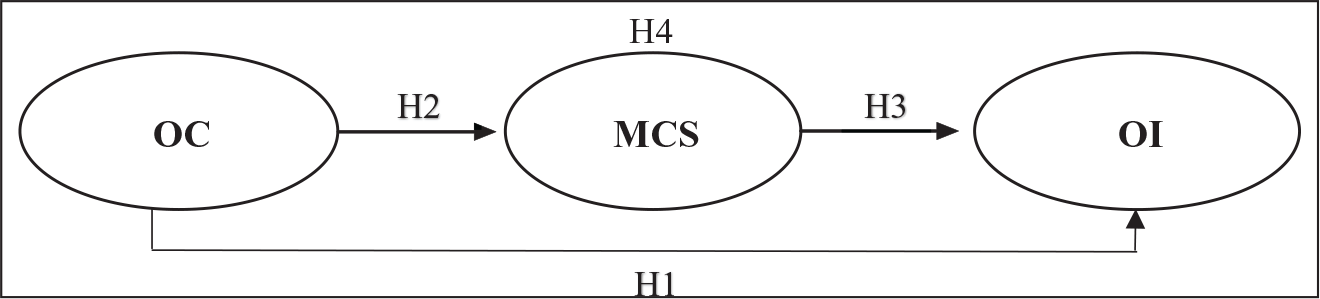
Finally, it has been shown that there is a mediating effect of different variables on the relationship between OC and OI. This meant that OC might have some direct and indirect effects on OI. In this study, the MCS employed a mediating role between OC and OI to fill the gap in the literature. The framework of this study is presented in Figure 1.
Method
Survey Design, Administration and Sample
The present study followed an empirical approach that analyzed the relationship between OC and OI among high-level managers and the management control choices that these managers adopted. The study applied probability sampling (Sekaran & Bougie, 2013). The target sampling is (top managers) in Saudi universities. The data were collected as part of a large research project by means of an online survey from July to September 2018. Participants were in top-level management from governmental universities in Saudi Arabia. The questionnaires were distributed randomly among Deans and Vice Directors of seven universities in Saudi Arabia. Out of 300 distributed questionnaires, only 181 were responded. A total of 181 members participated in the study with a response rate of 60.3 per cent. Respondents were mostly males (79.6%), followed by females (20.4%). The majority of them are in the age range of 41–50 years (52%), 51–60 years (30%), 31–40 years (16%), and more than 60 years old (2%). All of them have PhD degree. The majority work in college (70.2%), followed by deanship (24.8%), whereas only a few are in university agency (4.9%). Most of them are Deans (85.1%), followed by those who are Vice Directors (14.9%). In terms of experience, 35.9 per cent have experience of 3–5 years, followed by 21.5 per cent with an experience of 6–10 years. In addition, 18.2 per cent of respondents have more than 15 years of experience, followed by 13.8 per cent with less than 3 years of experience. Only 10.5 per cent of respondents have 11–15 years of experience. They were selected based on their general understanding of the organizational processes’ nature and their privilege in decision-making.
Variable Measurement
The main variables were measured as latent constructs with multiple indicators. The measures of the OC survey were adopted from Denison’s Model (Denison, Janovics, & Young, 2006). This model includes 60 items, all of which are 5-point Likert scales with anchors ‘strongly disagree’ (=1) to ‘strongly agree’ (=5). The MCS included 20 items measured by two main dimensions, like formal and informal control. The formal control consisted of actions and results control, and 10 items were adopted from Hutzschenreuter (2009), Wargitsch (2010), Widener (2007). The informal control consisted of personal and culture control, with 10 items adopted from Hutzschenreuter (2009) and Jaworski and Macinnis (1989), all of which were 5-point Likert scales with anchors ‘strongly disagree’ (=1) to ‘strongly agree’ (=5). The measurement of the OI was adopted from the model T&B by Tidd and Bessant (2009) which included 40 items, all of which were 5-point Likert scales with anchors ‘strongly disagree’ (=1) to ‘strongly agree’ (=5). The model in T&B has conceptualized the five major innovation traits as second order. Eight items measure each one of these five major components. In adopting the questionnaire, the items in the original questionnaire were first translated into the Arabic language by academic and back-translated into English by another academic to make sure the validity of the contents.
Data Analysis
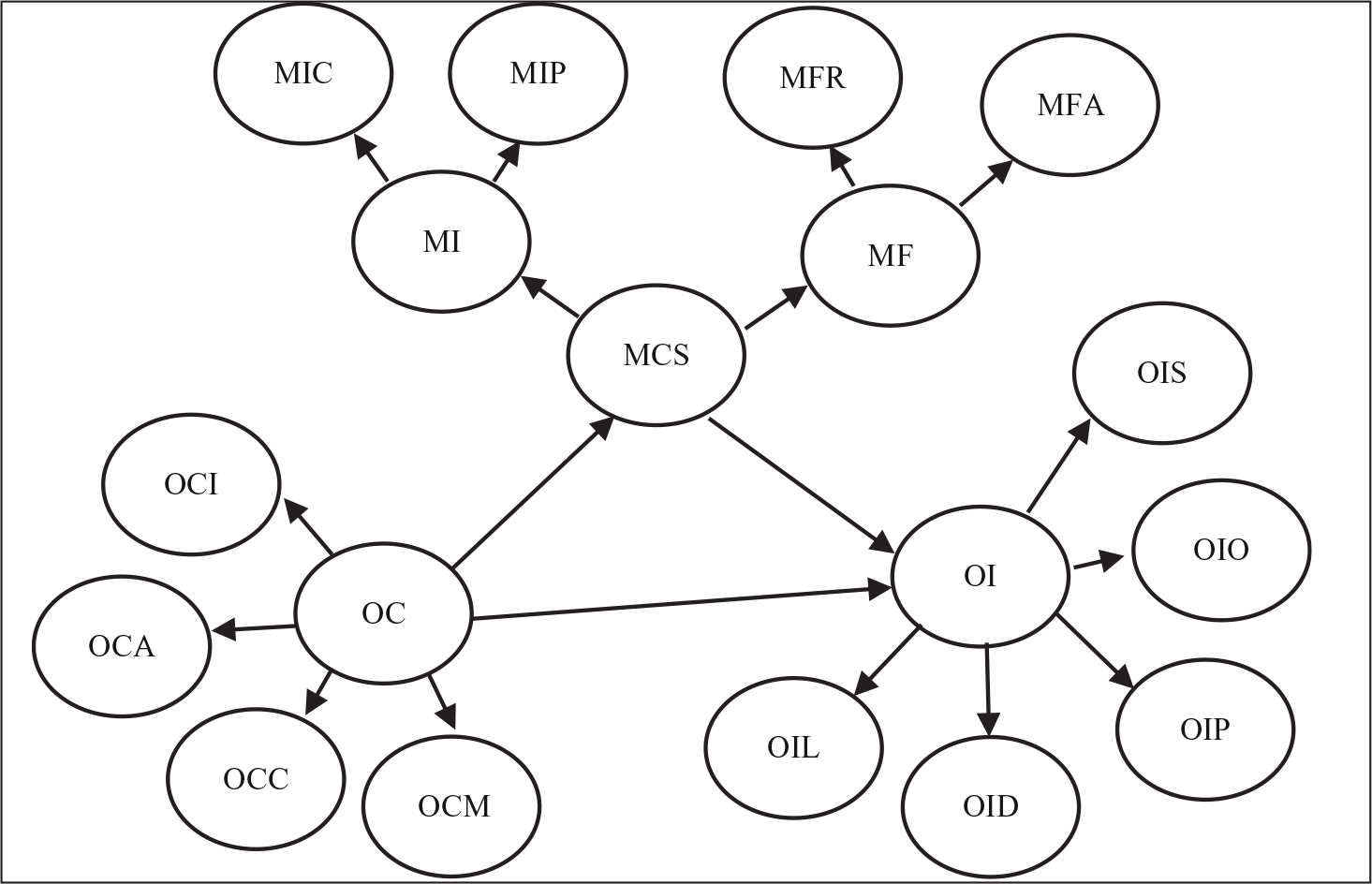
This study used partial least squares (SmartPLS), which is a variance-based approach of structural equation modelling (SEM) used to analyze and test multiple construct relation between variables. SmartPLS is a non-parametric method that is used, especially when the available data are non-normal distribution (Hair, Hult, Ringle, & Sarstedt, 2017; Ringle, Sarstedt, & Straub, 2012), and the model is to be tested for (a) a number of latent variables with indicators (Hair et al., 2017), and (b) high-order constructs (Becker, Klein, & Wetzels, 2012). Moreover, SmartPLS is used in causal predictive research contexts. It is applied when the empirical and theoretical knowledge about the relation between causal constructs is still fluid (Hartmann, Naranjo-Gil, & Perego, 2010). The model of OC, MCS and OI analyzed by SmartPLS 3 is represented in Figure 2.
Results
Measurement Model
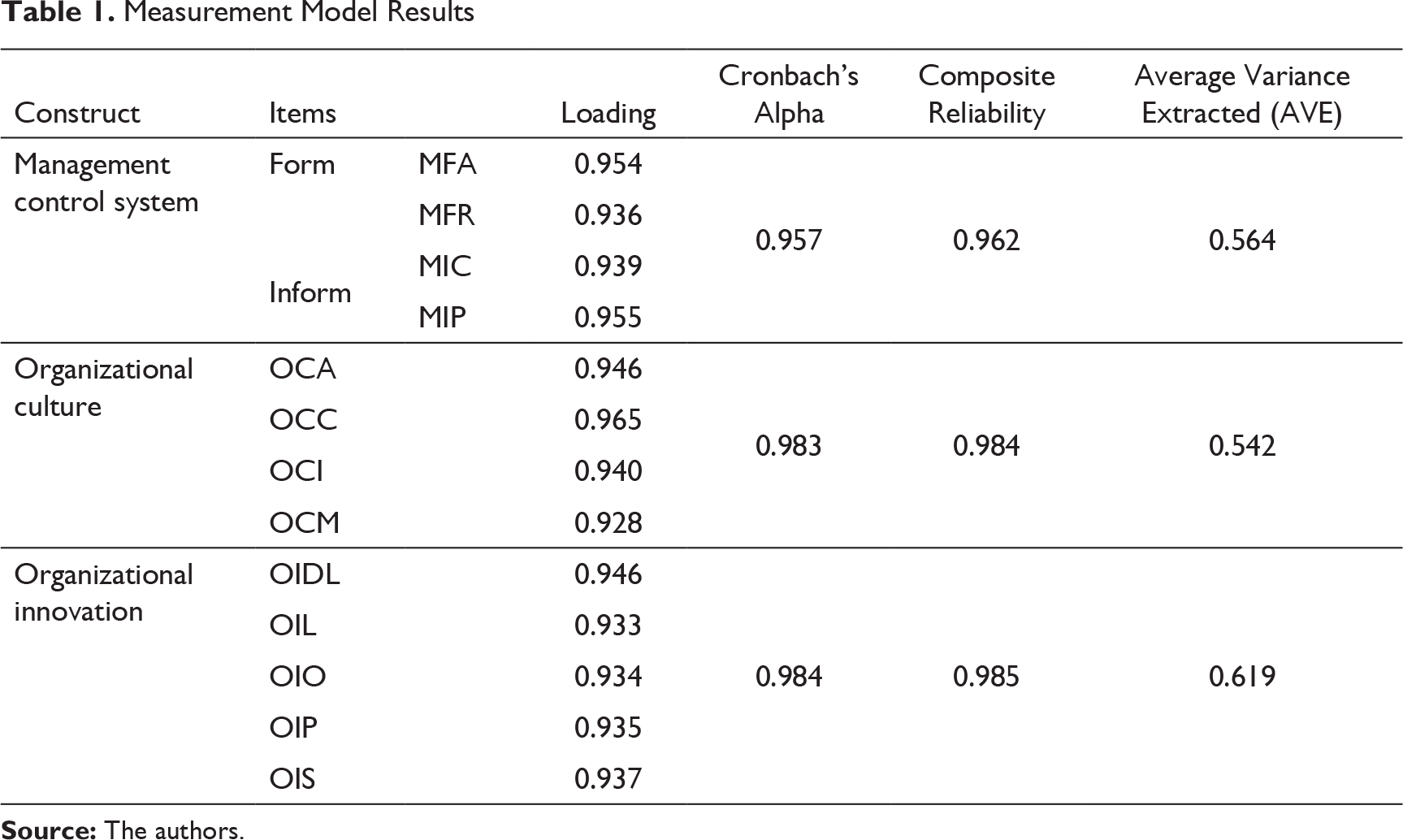
Measurement Model Results
HTMT Analysis

Structural Model
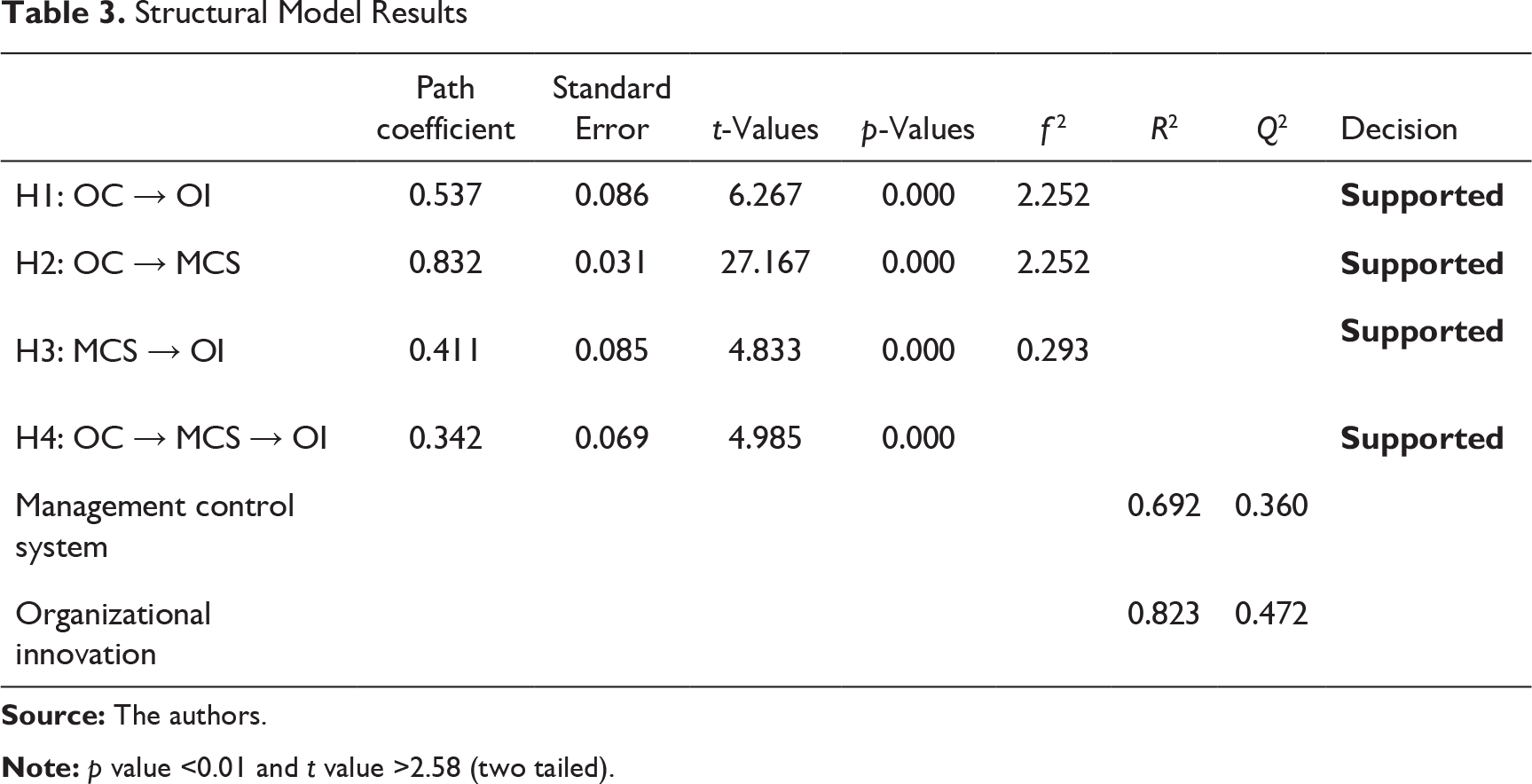
Structural Model Results
Discussion and Conclusion
Earlier, scientists have proposed that OC is a determinant of organization innovativeness (e.g., Naranjo-Valencia, Jiménez-Jiménez, & Sanz-Valle, 2011). They also claimed that organizations profit from their OC, which tends to have fewer problems and reduced dependence on coordination and formal controls. However, there has been limited research that examines the effect of OC on OI, which uses MCS as a mediating factor between these two concepts, and the issue remains that OC and MCS would bring or hinder about innovation.
The management literature contained a rich body of research, indicating that OC has an effect on OI. At the same time, management scholars claimed that MCSs served as important tools in influencing OI. Despite potential overlaps between the constructs of research, advancements of knowledge are often made in isolation. The objective of this article is to combine both streams of research by providing a model of the direct effect of OC on OI and the indirect effect of applying MCS as a mediating factor between the two conceptuses.
The study has contributed to recent literature. First, the results of this study showed that OC had a direct positive and significant effect on OI. Second, the results of this study showed that OC also had a positive and significant effect on the MCS. Third, the results of this study showed that the MCS had a positive and significant effect on OI. Finally, the MCS acts as a significant mediating factor between OC and OI. Thus, the OC has an impact on OI, but it enhances when MCS is used.
This study unlocks the doors for several opportunities since an understanding of strength can strengthen competence. Therefore, without understanding the OC, MCS and other factors in innovative organizations the organizations could not compete.
Limitations and Future Research
Generally, it is difficult to measure OC through only a quantitative approach as it is instilled in an individual’s perceptions, values and beliefs, while a qualitative approach would complement the quantitative approach. Moreover, this study chose a small sample size, whereas a large sample size with other blended factors can provide a better picture of how to accelerate OI. Furthermore, the results of this study could not be generalized. In addition, this study has focussed on OI as a whole. Therefore, this will be the subject of recommending future research.
Future research could discriminate between different types of innovation and types of OC as well as incorporating other organizational factors of organizations, focussing deeply on the generational effects of OC that may affect OI in universities using a qualitative approach. Moreover, it is recommended for examining other internal factors (e.g., flexible structures, technology adoption, continuous improvement, etc.). Finally, this study can be applied in deferent sectors or countries to discover deferent organizational cultural values.
Footnotes
Acknowledgements
The authors are grateful to the anonymous referees of the journal for their extremely useful suggestions to improve the quality of the article; also special thanks to our supervisors in UTM university in Malaysia for their guidance and motivating, besides we do not forget a special gratefulness to the Community college, Deanship of Scientific Research, Taibah University, Medina, Saudi Arabia for their supporting usual.
Declaration of Conflicting Interests
The authors declared no potential conflicts of interest with respect to the research, authorship and/or publication of this article.
Funding
The authors received no financial support for the research, authorship and/or publication of this article.