




Abstract
Employees’ poor performance within the banking sector has become evident in recent times, and studies on how leadership styles affect employee commitment in the Ghanaian banking sector is scanty. The purpose of this article is to examine the effect of leadership styles on employee commitment after controlling for demographic and institutional factors. The study also examines whether there is a difference in the leadership style due to the gender of leaders and determines the dominant leadership style among bank managers. A sample of 160 leaders and subordinates were selected from 10 commercial banks. The study employed hierarchical regression as well as independent sample t-test techniques. Financial organizations were chosen because much of the existing studies on leadership styles have focussed on non-financial sectors. The findings of the study indicate that transactional leadership is the most dominant leadership style practised within the banking sector. After controlling for demographic and institutional variables, laissez-faire and transformational leadership behaviours have significant positive effects on employee commitment. Although transactional leadership style is dominant, it contributes only 4.8 per cent to employee commitment as compared to 51 per cent by transformational leadership style in eliciting employee commitment. There is an evidence that, married employees are more likely to be committed employees than the unmarried, but as the employee’s number of children increases, commitment level falls. Although all the three leadership styles have positive effects on employee commitment, transactional and laissez-faire leadership styles are most significant. This is the first study in Ghana to show that there is no significant difference between the sexes when it comes to exhibiting leadership styles in the banking sector. The findings of this study provide useful information for policy-makers to improve employees’ commitment levels and their performance by means of stimulating the right leadership styles in the managers.
Introduction
Organizational leadership concept has received much attention in both literature and practice in recent times. This is because the behaviour of every leader has an effect on the attitude of employees in an organization. This is due to the fact that managers (leaders) generally play important roles in managing the affairs of employees within the workplace to the extent that employees begin to look up to them as not just role models, but also satisfiers of basic necessities such as acceptance, love and affection, leading to the facilitation of conducive and friendly working environment (Northouse, 2010). These go to confirm that leaders worldwide have an enormous task of driving their employees in a particular direction (Malhotra & Rangnekar, 2016). A behaviour that tells much about a leader is the leadership style: the way such managers handle task and drive employees in accomplishing a particular task.
Employees also play a critical role in how the leadership processes work, and their behaviour is one of the surest ways to measure the leadership effectiveness of a superior within an organization (Aaker, Kumer, & Day, 2012). Against this backdrop, the commitment of employees is a very sensitive issue to discuss when employees are expected to give off their best to accomplish organizational goals in both the short run and the long run. Organizational commitment shows the psychological attachment of an employee to the organization which then translates into several organizational outcomes such as improved performance (Alanzi, 2010). Leadership behaviours of managers play a critical role in employee job commitment.
Although there can be differences due to specific situations, measuring leader effectiveness depends on the degree to which individuals in the organization achieve their goals. It also depends on how the leader fulfils the followers’ basic needs (Yukl, 2001). It has been noted that subordinates’ commitment, performance and satisfaction are key variables used in determining leader effectiveness (Yukl, 2001). Leadership therefore plays a role in organizational performance by engendering employee commitment in various sectors including the banking sector (Bhat & Rainayee, 2019; Makkar & Basu, 2019).
The banking industry is a service industry where performance is mostly evaluated based on the number of customers acquired and retained for business, and this can be achieved by providing superior customer service, a function of employee satisfaction and commitment. Hence, all employees of a particular bank play a major role in achieving the overall goal of the firm. What this implies is that, factors which enhance the commitment of employees are very critical for employee performance.
Boahen (2015) and Tuffour and Owusu (2018) suggested the Ghanaian banks’ managers should step up their relationship with employees, as such behaviours positively affect organizational performance (Tuffour, Banor, & Akuffo, 2015). In order to stay relevant in the highly competitive industry, bank managers need to ensure that their employees are sensitive, attentive and operative when carrying out their roles. These employees need to be motivated to show their fullest commitment potential (Ejimifor, 2012). Besides, Boahen (2015) asserted that the behaviour of employees in the Ghanaian job setting is basically the result of a leadership style.
The abysmal performance of employees within various organizations including the financial sector in Ghana is indicated in some empirical studies conducted (Aryeetey, 2010). This problem has been attributed to various factors such as the lack of motivation and inappropriate work structure. However, other studies within the field of employee outcomes have proved that, the behaviour of employees is a nexus between dominant factors such as the level of commitment (emanating from employee satisfaction) at a particular point in time and leadership style of managers (Boahen, 2015). This has been prudently affirmed that employees who are not satisfied will not put out the best outcomes such as improved commitment and other employee citizenship behaviours (Boahen, 2015).
In addition, there is an outcry from the general public towards employees of the banking sector in Ghana. The general public from time to time continues to accuse workers of not putting up their best as the level of commitment to work is low, thus leading to poor customer service. This problem calls for the attention of organizational researchers to enquire about the leadership style of managers in relation to employee commitment in the banking sector. Other studies have shown that transformational leaders elicit most variance in employee outcome (Boahen, 2015; Connor, 2002; Popli & Rizvi, 2016; Pradhan & Pradhan, 2016). However, all these studies were conducted in areas other than the banking sector.
There have been cases where high-performing workers leave one financial institution to the other or look for an alternative job (Dankwa, 2013). Commitment to an organization has been looked at as the strength of an individual employees’ involvement, willingness to exert needed effort and to remain in the organization (Raja & Palanichamy, 2011). When this rate to leave the organization exists, it is an indication that, all or some of these three elements may not be in place. Thus, it suggests that, psychologically some employees have moved on looking for new opportunities. Thus, there is the need to examine the possible factors that could turn this around.
Further, previous related studies (Boahen, 2015; Puni, Ofei, & Okoe, 2014; Tuffour et al., 2015) on Ghana have not emphasized the socio-cultural dynamics of the Ghanaian setting, where the values placed on marriage and child birth are high as well as the gender differences. This omission in empirical Ghanaian studies creates a critical gap in determining the commitment levels of employees. This study, by way of solving the gap, contributes to the field of leadership style, by assessing the role of key demographic variables such as marital status and number of children in influencing commitment. Moreover, a gender analysis gap exists; previous studies have omitted to ascertain whether there is any difference between the leadership styles exhibited by the sexes. We posit that, there is no significant difference between the leadership styles exhibited by male and female managers.
Also, various studies (Eswaran, Islam, & Yusuf, 2011; Liden & Maslyn, 2013) conducted on leadership styles and levels of organizational commitment have revealed differences in conclusions. While Nunnally (2014) and Crawford (2014) find a positive relationship between transformational leadership style and all the three dimensions of commitment, Connor (2002) identifies that only for continuance commitment. Kesari and Verma (2018) found that, transactional leadership style has a negative influence on employee outcomes. The current study therefore seeks to affirm or refute the findings of earlier studies in the field of leadership style and employee commitment outcome for relatively less research financial sector in Ghana.
Studies have been conducted to consider how managers’ leadership style is linked to the commitment characteristics of employees. These include the extent to which basic needs are met (Yukl, 2001), the extent to which employees are motivated (Boahen, 2015), whether leaders are low or high on directive behaviour (Akinbode & Fagbohungbe, 2012), etc. As ascertained by Boahen (2015) that the behaviour of employees in the Ghanaian setting is basically the results of leadership style, however, the type of leadership style is not known. This gap in literature needs to be filled. The present study addresses this gap. The rest of the article is structured as follows. The second section contains literature review while the methodology is in the third section. The results and discussions are in the fourth section and the conclusion as well as policy recommendations are in the fifth section.
Research Objectives
The broad objective of the study is to examine the effect of leadership styles on employee commitment using selected banks in Ghana. Specifically, the objectives of the study are to: (a) determine the effect of leadership styles on employee commitment, (b) determine the relative contribution of different leadership styles to employee commitment, (c) examine whether there is a difference in leadership style due to the gender of leaders and (d) determine the dominant leadership style among bank managers.
Rationale of the Study
There seems to be some level of inconsistency in literature about the relationship between the specific components of leadership styles and employee commitment. There are differences in conclusions in the literature (Eswaran et al., 2011; Liden & Maslyn, 2013) about the effect of leadership styles on employee commitment. While Nunnally (2014) and Crawford (2014) conclude that leadership styles and types of employee commitment are positively related, Connor (2002) identifies that for continuance commitment, and Kesari and Verma (2018) indicate a negative effect of transactional leadership style on employee outcomes. Also, there is no recent study in the banking sector of Ghana as new regulations of corporate governance have been instituted to strengthen the banking sector. The poor financial performance of some of the banks in Ghana has been attributed to the leadership style of managers, poor management of staff and its associated low staff commitment to work. Boahen (2015) revealed that the attitude of employees in the Ghanaian setting is basically the results of leadership style. However, the type of leadership style that causes this low commitment is not known. From empirical literature, leadership studies in the Ghanaian banking sector are lacking. The empirical evidence of leadership style and employee commitment relationship in the Ghanaian banking sector context is rather limited. The research hopes to add to this body of research.
Review of Literature
Theoretical Literature Review
The approach for classifying and studying leadership styles and around which this research revolves is the Full Range Leadership theory (Bass & Riggio, 2006; Sosik & Jung, 2010). In this approach, leadership is conceptualized by the behavioural areas from laissez-faire style (passive avoidant leadership), through transactional leadership style (which hinges on reward system and punishments), to transformational leadership style (which is based on inspiration and behavioural charisma) (Avolio & Bass, 1995). Employee commitment is an individual’s relative ability and involvement in a certain organization (Chaturvedi, Rizvi, & Pasipanodya, 2019; Nayak & Sahoo, 2015) while leadership style is the method of providing direction, implementing plans and motivating people (Northouse, 2015). In the view of employees, leadership style is seen as it includes the pattern of explicit and implicit actions performed by their leader (Irwin, 2014).
It is noted that ‘transformational leaders inspire their followers to exert more than their normal share of efforts and demonstrate unflinching loyalty towards the organizational goals’ (Pradhan & Pradhan, 2016, p. 1). In transformational leadership, the leaders take active interest to raise their subordinates’ motivational development and to help them go beyond their own self-interests for the benefit of the gathering, the firm or society. Such leaders persuade their subordinates to take a more elevated amount of accomplishment. This is done through the use of inspiration and motivation. The transformational leaders motivate followers to do more than what was originally intended, often more than either the leader or follower thought was possible.
Besides, transformational leaders encourage their workers to go beyond conventional desires by addressing their needs and values they hold. Transformational leadership stretches out value-based leadership to accomplish more elevated amounts of subordinate execution (Chaturvedi et al., 2019), yet accomplishes this expansion by using different motivational techniques (Organ & Lingl, 1995). Organ (2006) found that subordinates’ hierarchical duty was decidedly associated with the transformational leadership practices of their managers. Studies such as Nunnally (2014), Crawford (2014) and Pradhan and Pradhan (2016) have identified significant association between transformational leadership and commitment dimensions. Thus, the hypothesis that follows and which is tested is:
Transformational Leadership Style Has a Significant Positive Effect on Employee Commitment.
According to Brook and Price (2006), transactional leadership style is dependent on the traditional bureaucratic process. Transactional leaders entice subordinates to perform to their best. As they achieve desired outcomes, the promised rewards and benefits due to them for the accomplishment of given tasks assigned are offered (Goldberg, 2015; Nunnally, 2014). Goldberg (2015) states that the transactional leader relates with the subordinates in three stages. First, the leader recognizes subordinates’ needs from the work they do and ensures that they get exactly those needs satisfied when their performance is satisfactory. Second, subordinates are rewarded in exchange for their effort. Lastly, the leader fulfils subordinates’ immediate needs if and only if those needs can be met through completion of tasks.
From the above, it implies leadership works to clarify the goals of the organization, work principles and assignments to be done. To achieve employee performance, transactional leaders evaluate the extent of task completion and compliance. This serves as the basis for organizational reward and punishment. Thus, rewards are contingent on subordinates’ completion of roles and assignments as defined by the leader (Van Dyne, Graham, & Dienesch, 2013). Related studies (Cheung & Wong, 2011; Lam & O’Higgins, 2012; Popli & Rizvi, 2016) have indicated that the use of transactional leadership promotes employee commitment. Thus, we hypothesized that:
Transactional Leadership Style Has a Significant Positive Effect on Employee Commitment.
A laissez-faire leader may not intervene in the work affairs of subordinates. In other words, such leaders may completely neglect their responsibilities as leaders. They are unlikely to build a relationship with subordinates (Avolio & Bass, 1995). Malatesta (2002) portrays this as the place the supervisor watches subordinates’ function admirably. The supervisor permits subordinates’ flexibility of activity, to do as they think best and not to meddle; but rather is promptly accessible if help is required. The nature of laissez-faire leadership posits that employee commitment is hampered (Connor, 2002). It is hypothesized that:
Laissez-faire Leadership Style Has a Significant Negative Effect on Employee Commitment.
Irrespective of the fact that organizational commitment has a lot of diverse definitions, the generalized description used is the employee’s mental and psychological connection with the firm. Thus, this is the mental bond that binds the employee and the firm (Feidler, 2009). Employees who have a strong bond with the firm have the tendency of being loyal to the firm as compared to employees who have less or no mental bond at all with the firm (Gosling, 2003).
For organizational commitment, Myers and Allen (2012, p. 106) utilized a tri-dimensional model to conceptualize hierarchical duty in three distinct degrees. These are affective, continuance and normative commitment types. Affective commitment dimension is the feelings an individual appends to an association. Myers and Allen (2012, p. 11) opined that feeling of duty is the representative’s enthusiastic connection to, and identity with an association. As a general rule, full of feeling workers see their associations to be in agreement with themselves regarding their objectives and visions for their own lives (Grant & Cashman, 2012).
For continuance commitment dimension, responsibility is gotten from the way the individual sees a more serious hazard in losing a specific occupation on the grounds that there may not be a superior open door somewhere else (Mannheim & Halamish, 2008). Zembylas and Papapnastasiou (2004) attest that ‘representatives whose essential connection to the association depends on continuation responsibility remain in light of the fact that they have to do as such’. People remain in the association since they need to. Continuation duty can be viewed as an instrumental connection to the association, where the individual’s relationship with the association depends on an evaluation of financial advantages picked up (Lyons & Schneider, 2009), and the apparent expenses of leaving the association (Lee & Allen, 2002).
The last measurement of the authoritative responsibility model is regularizing duty—Normative Commitment Dimension. For normative commitment, the representatives stay since they ought to do as such or it is the best possible thing to do (Kouzes & Posner, 2007). Liden and Maslyn (2013, p. 86) depict normative responsibility as the work behaviour of people, guided by a feeling of commitment and reliability towards the firm.
Empirical Literature Review
Earlier findings have indicated that organizational commitment affects the firm positively in a very significant way. This is because, when employees have strong bond with the firm, the propensity of them not coming to work on time or regularly is very close to zero. Also, they will make sure they get tasks not only done well but also done on time (Gouldner, 2011). Leaders who show behaviours that are in tune with employees stand the chance of reaping good rewards such as increased commitment. Nevertheless, this is not always true for all industries due to certain situational factors. Graen and Casman (2015) further revealed that, leaders who exhibited transformational leadership skills purportedly get more contented and devoted subordinates than those who practise a non-transformational style of leadership (Graen & Casman, 2015). This study corroborated the findings of works conducted by other researchers that principals’ leadership styles impact a lot on the working environment and for that matter the employees’ job satisfaction (Lee & Allen, 2002).
Connor (2002) enquired about the effects of various leadership styles on employee commitments. One of the findings of the study is that transformational leadership style correlates positively with both affective and continuance commitment levels. Also, for transactional leadership style, the study revealed that it has significant positive association with employees’ normative commitment. Laissez-faire leadership style had significant negative relationship with employees’ affective commitment as indicated by Connor (2002).
The results of Nunnally (2014) show that there is a significant positive relationship between each of transformational and transactional leadership styles and all dimensions of organizational commitment. Crawford (2014) results indicate that transformational leadership style has significant positive relationship with each of affective, normative and continuance commitments. For transactional leadership, a weak but significant positive relationship with normative commitment was revealed. A contrary result was obtained by Kesari and Verma (2018) where transactional leadership style was revealed to have a negative influence on employee outcomes. A similar result (weak but significant negative correlation) was obtained between laissez-faire and each of affective and normative commitment levels. Crawford results suggest that leadership styles are important in determining levels of affective, continuance and normative commitment. Various studies (Eswaran et al., 2011; Liden & Maslyn, 2013; Popli & Rizvi, 2016) conducted on leadership styles and levels of organizational commitment validate this finding. The current study therefore seeks to affirm or refute the findings of earlier studies in the field of leadership style and employee commitment outcome for relatively less research financial sector, and further contribute to the field of leadership by assessing the role of demographic variables such as age, marital status, number of children, gender and level of education.
Methodology
Approach, Design and Sampling
The primary objective of the present study is to determine the effect of leadership styles on employee commitment in selected banks in Ghana. In view of this, a quantitative approach is used, which is in congruence with the stated objective for the study (Creswell, 2014). The study adopted a multi-stage sampling technique in selecting the banks, bank branches, branch managers as well as the subordinates. First of all, the study purposefully identified through the data from the Bank of Ghana Annual Report (2017), those banks that occupy the first 10 performing banks in Ghana. The choice of top performers stems from the fact that, all the banks in Ghana follow one central bank and are governed by common monetary policies. Thus, these banks have more or less similar organizational environment. The next stage involved selection of branches of these banks that have been in operation for the last 10 years.
Furthermore, purposively sampling technique was employed in selecting the leaders. The leaders in the bank branches are mainly the branch managers and branch operations managers. This meant that their corresponding subordinates were also selected in order to measure their commitment perspective. In all, a total of 160 respondents were chosen. The sample size was deemed appropriate for the study based on the recommendations of Tabachnick and Fidell (2007). 1 Therefore, the sample size of 160 respondents more than satisfies the recommended sample size for the purpose of the present study, based on three key independent variables.
Constructs, Instruments and Interpretation
The study employed the widely used Multifactor Leadership Style Scale developed by Avolio and Bass (2004) and validated by Crawford (2014) and Graen and Casman (2015) to identify the leadership styles (transformational, transactional and laissez-faire) of the various branch managers. It is a 45-itemized questionnaire that is rated from 0 to 4. Thus, 0 being ‘not at all’ to 4 which is interpreted as ‘frequently, if not always’. The Multifactor Leadership Questionnaire is scored based on the responses selected by the rater. The summation for items relating to the various leadership styles is noted and the leadership style that gives the highest value is interpreted as the dominant leadership style of that leader.
Employee commitment, however, is measured using the scale developed by Spector (2009). It is a 12-itemized scale measured on a 5-point Likert scale. The results of respondents’ scores are computed by summing up the respondents’ answers to the items based on the recommendations of Connor (2002). Demographic factors such as gender, age, education, marital status, experience, number of children and remuneration/working conditions of subordinates are included as control variables because literature has found such characteristics to influence the interaction between supervisors and subordinates, and thus affect the employee job commitment (Nunnally, 2014; Russ & McNeilly, 1995; Tuffour, Akuffo, Kofi, Frimpong, & Sasu, 2018; Wiener, 2001).
Model Specification and Analytical Techniques
The study used regression analysis to ascertain the effect of leadership styles on employee commitment. Theoretical literature (Crawford, 2014; Graen & Casman, 2015) and empirical literature (Crawford, 2014; Nunnally, 2014; Singh & Rangnekar, 2019; Tuffour et al., 2015) have opined that leadership style influences employee commitment. Within this framework, the regression model is specified as:

where,
EC = Employee commitment
Tfs = Transformational leadership style
Trs = Transactional leadership style
Lfs = Laissez-faire leadership style
X* = a set of control variables (gender [Gen], experience [Exp], level of education [Edu], age, number of children [NC] and marital status of subordinates [Mar])
Y = the state of remuneration
εt = random error term
β1, β2, β3 β4 and β5 are the coefficients of regression, it is expected that β1 > 0; β2 > 0; β3 >/< 0, β4 >/< 0 and β5 > 0.
Specifically, regression analysis is used to ascertain the effect of leadership style on employee commitment. Furthermore, in order to identify whether there is a difference in leadership style due to the gender of leaders, an independent sample t-test is employed.
Analysis and Results
Demographic Characteristics of Respondents
Data collected from the respondents affirmed that majority of the respondents were males (57.2%) as compared to females (42.8%). However, most of the respondents were between the ages of 36 and 40 years (51.67%). Furthermore, majority of the respondents have attained a maximum of an undergraduate degree (46.1%). Respondents who were married were 61.67 per cent. Besides, most of the respondents have been with their organizations for a period of 1–5 years constituting 50.56 per cent. In terms of the number of children respondents have, most of the sampled respondents have at least one child.
Data Quality: Normality, Reliability and Validity
The preliminary data exploratory examination conducted prior to the main analysis was done in a three-stage process. First, the normality of the salient variables in the study were assessed using the skewness and kurtosis, which indicate the amount of asymmetry and relative concentration of values in the centre of the distribution, respectively, and the threshold between +1.96 and −1.96 was used as the basis (Tabachnick & Fidell, 2007). Table 1 shows that all the constructs are normally distributed.
Normality and Cronbach’s Alpha Test for Study Instruments
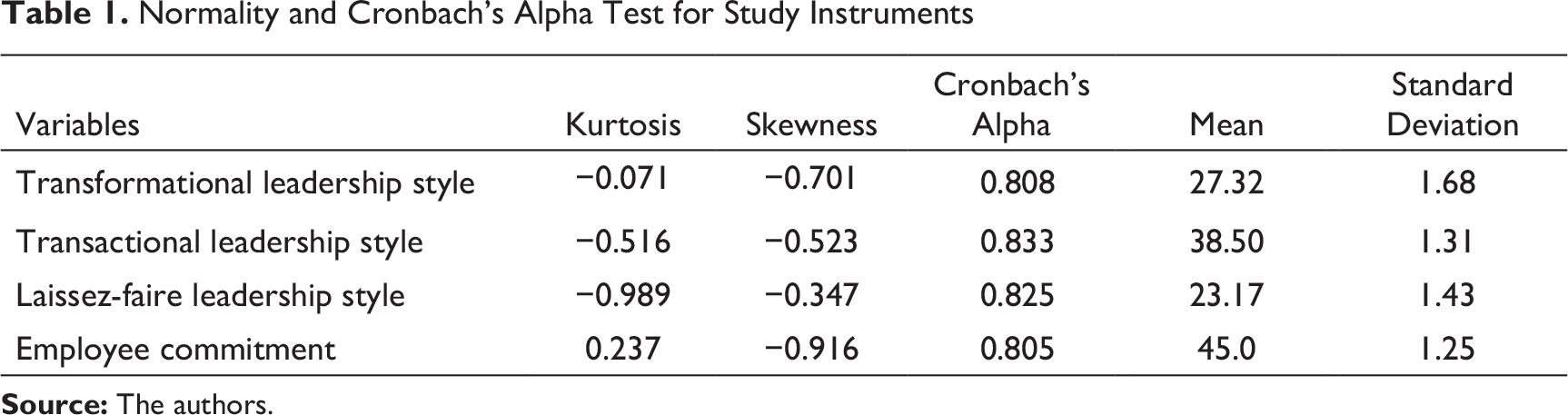
In order to justify data aggregation of leadership style at group level, inter-rater reliability analysis was applied. In order to ensure that the scales used for collection of data are internally reliable and consistent, an internal reliability analysis was conducted using Cronbach’s alpha. Accordingly, Nunnally (2014) opined that an alpha value of 0.60 or above constitutes a reliable scale. Table 1 shows the results of reliability, where all alpha values are greater than 0.8.
Multicollinearity of Key Study Variables
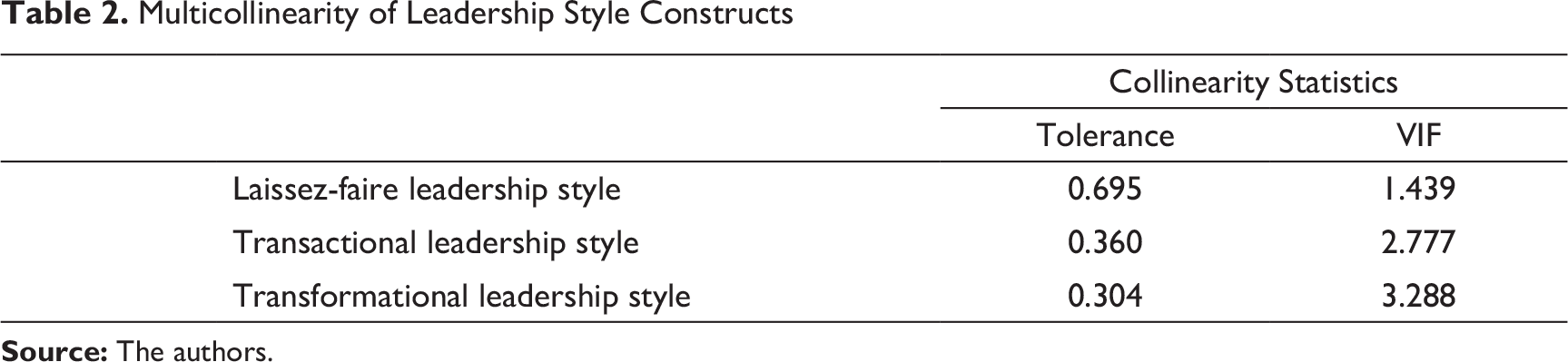
One of the critical assumptions that must be met for a regression analysis to be done is the multicollinearity assumption (Tabachnick & Fidell, 2007). More robust (Tandoh, 2011) techniques preferred are the Tolerance and Variance Inflation Factor (VIF). The VIF is supposed to be less than or equal to 10 (and Tolerance values greater or equal to 0.1) (Tandoh, 2011). Table 2 indicates that all the predictor variables have VIF below 10.
Multicollinearity of Leadership Style Constructs
Identified Dominant Leadership Style of Managers
Mean Distribution of Leadership Styles of Leaders

From Table 3, majority of the leaders exhibit the transactional leadership style (Mean = 3.93 with a relatively smaller standard deviation). This goes to affirm the fact that majority of the leaders relate with their subordinates on a strict work basis, and subordinates have targets to meet and barely discuss issues outside of work with their leaders. This was followed by transformational leadership behaviour (Mean = 3.32). This implies that there are situations in which the leaders go beyond the workers’ reward system to seek their social well-being. This means that some leaders could be quite strict on their subordinates, whiles others are not. Generally, the most dominant leadership style among the respondents was transactional leadership style. Northouse (2013) supported this view that, being structured is a set of behaviour of most leaders in the financial sector. They added that, not all leaders are highly organized, structured and strict in their behaviour towards their followers. However, this skill must be worked on alongside the value of showing interest in subordinates’ life outside of work. Leaders stand to gain when they are perceived to be sociable, and approachable with matters not only directly related to work, but issues outside of work as this helps to increase the quality of relationship.
Correlation Analysis and Discussion
The correlation matrix (Table 4) reveals a positive relationship between transformational leadership style and employee commitment (β = 0.714 with p = 0.000). Furthermore, transactional leadership style has significant positive relationship with employee commitment (β = 0.690; p = 0.000). This suggests that when the managers’ leadership styles or behaviours make the employee satisfied, there will be effective employee commitment. Similar results have been found by Cheung and Wong (2011) and Lam and O’Higgins (2012). For instance, leaders’ ability to handle organizational employee issues such as compensations, incentives, adequate good working conditions, promotions, training and educational opportunities, career development, job security, communications between leaders and subordinates as well as employee maltreatment would cause subordinates to have the tendency to be committed and eventually not leave the organization (Connor, 2002). Therefore, leaders need to be conscious of their behaviour towards employees in order to decrease negative behaviours related to employee non-commitment, and rather dwell on identified positive behaviours such as building relationships. Within the banking sector, laissez-faire has significant positive relationship with employee commitment. This is possible due to the fact that there is a bit of flexibility in the performance of some aspects of work.
Pearson Correlations of Leader’s Leadership Styles and Employee Commitment

**Correlation is significant at the 1% level (2-tailed)
EC: Employee commitment, Tfs: transformational leadership style, Trs: transactional leadership style, Lfs: laissez-faire leadership style, Y: remuneration, Gen: gender, Age: age of subordinates, Edu: level of education, NC: number of children, Exp: experience, Mar: marital status of subordinates.
With respect to the control variables, the correlation test results in Table 4 show that education and experience have significant positive relationship with commitment. However, age and number of children have positive relationship with commitment but not statistically significant. Also, married workers in the banking sector are less likely to be committed than non-married workers. In terms of gender, females are more likely to be committed than males.
Regression Analysis and Discussion
The study further enquired about the effect of leadership styles on employee commitment after controlling for some relevant demographic and firm-specific variables, which are supported by the literature. This was assessed using hierarchical regression after controlling for demographic effects such as age, gender, level of education, marital status, level of experience, number of children and remuneration. Dummy variables were created for demographics that were dichotomous in nature such as gender and marital status. From the results in Table 5, it is evident that being married was significant in determining employee commitment but negatively related. Thus, as people get married, the urgency to cater for bigger responsibility forces them to have divided attention for their work.
Hierarchical Regression of Managers Leadership Style on Employee Commitment

2. Sig: significant level of the independent variables.
3. t-Stat: t-statistic of the independent variables.
4. Std. error: standard error of estimates.
5. EC: Employee commitment, Tfs: transformational leadership style, Trs: transactional leadership style, Lfs: laissez-faire leadership style, Y: remuneration, Gen: gender, Age: age of subordinates, Edu: level of education, NC: number of children, Exp: experience, Mar: marital status of subordinates.
6. B: unstandardized coefficients and beta: standardized coefficients.
Furthermore, the results revealed that there is a negative, though insignificant, effect of the number of children employees have on commitment level towards the organization. Thus, the number of children employees have relatively influenced their commitment to work. This was in line with the assertions of Boahen (2015) who indicated that external factors outside of the organization such as the state of employees’ family demands including the number of siblings the employees have plays important role in their attitude towards work, especially in most developing countries where there are high occurrences of single parenting.
With respect to the demographics, the marital status and number of children of subordinates were found to negatively influence their commitment in the organizations. That is, the number of children an employee has affects the way they respond to their organizations due to the need to be responsible towards their families (Crawford, 2014). There was also an evidence that females are less likely to be committed employees contrary to the findings of Singh and Rangnekar (2019). Thus, males are more likely to be committed than female.
The level of education and experience are both insignificant but positive in their effect on employee commitment. However, Singh and Rangnekar (2019) conclude that, there is no significant difference in the mean scores of reasons for employee loyalty and employment-related factor of total work experience. As people become more experienced and advanced in educational attainment, the less committed they become since the probability of being poached and getting higher post with higher remuneration elsewhere increases. The age of subordinates have negative effect on employee commitment contrary to the findings of Salami (2008) and Suliman and Lies (2000). In the view of Kaiser (2005), younger employees may be more eager to change jobs. This has become more socially acceptable for them in recent years. The results indicate that, remuneration has a positive effect on the level of commitment of employees.
Transformational leadership style was significant to employee commitment as indicated earlier by Crawford (2014), Graen and Casman (2015), Popli and Rizvi (2016), Pradhan and Pradhan (2016) and Chaturvedi et al. (2019). Furthermore, laissez-faire leadership style has a significant effect on employee commitment. This conforms to the results of Connor (2002) and Crawford (2014). In line with a meta-analysis by Baer (2014), transactional leadership style was insignificant to employee commitment after controlling for demographic variables. Thus, transformational and laissez-faire styles elucidate commitment from employees. Bushira, Usman, and Naveed (2011) asserted that in most developing countries, outspoken leaders may be perceived as authoritative and hence subordinates in those areas may not give off their best since they will want to do everything within their means to fight against that perception of authoritativeness. What this also implies is that, in some situations where the leader employs a laissez-faire style, being passive may also be interpreted as respectful and good, and based on the social learning theory, such a leader is likely to receive a replication of commitment from satisfied employees.
The effect of individual leadership styles (transactional, transformation and laissez-faire) on employee commitment was assessed using the hierarchical regression. This is to reveal the sole effect of individual leadership styles on employee commitment. From the results in Table 6, it is evident that transformational leadership style accounts for 51 per cent variance in employee commitment. Besides, a look at the coefficients output reveals that this variance is positive and significant. The implication is that, transformational leadership behaviour positively influences employee commitment as supported by Pradhan and Pradhan (2016), Popli and Rizvi (2016) and Chaturvedi et al. (2019).
Hierarchical Regression of the Leadership Styles

b Predictors: intercept, transformational leadership style, transactional leadership style
c Predictors: intercept, transformational leadership style, transactional leadership style, laissez-faire leadership style Adj. R2: adjusted R2.
Furthermore, transactional leadership contributes a small change of 4.8 per cent variance in employee commitment. Although the variance caused by transactional leadership is very small, it is still significant. Kesari and Verma (2018) found that transactional leadership style has a negative influence on employee outcomes in the Indian steel industry. The final leadership variable introduced into the model was the laissez-faire variable. From Table 6, it can be deduced that laissez-faire leadership style brought about 11.3 per cent change in employee commitment.
Independent t-Test of Gender of Leaders Results and Discussion
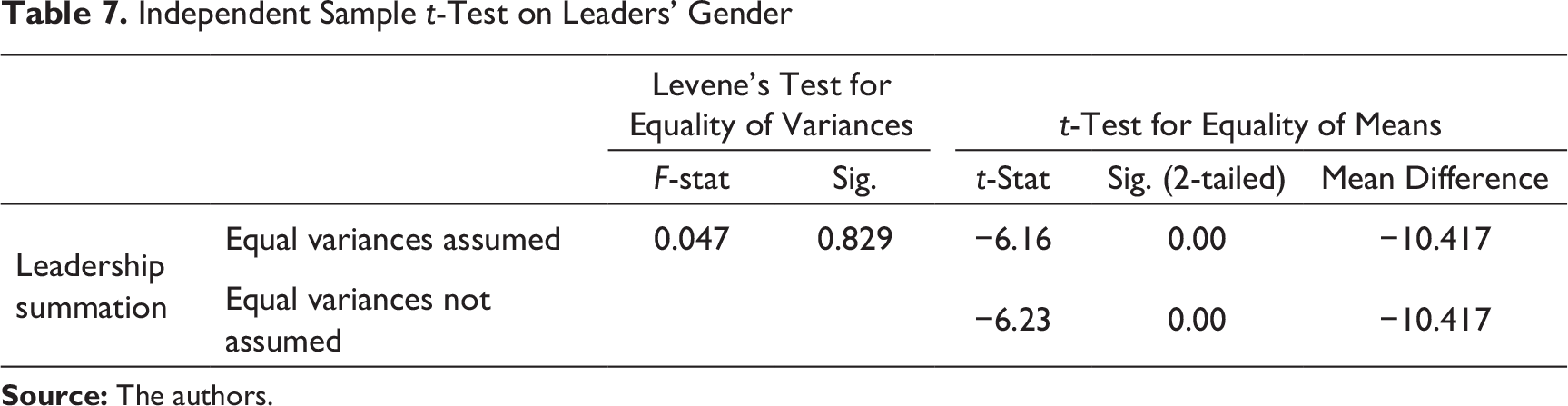
To assess whether there is a difference in leadership style due to the gender of leaders, an independent sample t-test is used. The results of the analysis are given in Table 7. From the results in Table 7, it can be inferred that, there is no statistically significant difference in the mean scores of leadership styles of males and females as indicated by t = −6.16 and p = 0.00 (with Levene’s test for equality of variance: F-stat = 0.047 and Sig = 0.829). That is, there is enough statistical evidence to conclude that there is no difference in leadership style due to the gender of leaders. On the account of leadership and gender, the study revealed that the leaders’, irrespective of gender, exhibit similar leadership style. There is not enough statistical evidence to conclude that, there is a difference in leadership style due to the gender of leaders. Hence, our hypothesis is supported. It has also been concluded that gender can be very ambiguous to study as there are several males who tend to exhibit female characteristics and vice versa (Organ & Lingl, 1995).
Independent Sample t-Test on Leaders’ Gender
Conclusion
Based on the findings of the study, it can be concluded that transactional leadership appears to be the most dominant leadership style exhibited by managers in the selected banks in Ghana. This is due to the transactional nature of their work. Furthermore, it must also be stated that when leaders exhibit transformational leadership behaviours, it impacts the most on the commitment behaviour of their employees towards the organization. However, transformational and laissez-fair leadership styles translate into eliciting significant effect on employee commitment. Besides, employee demographics such as gender, number of children and marital status play a huge role in determining the degree to which employees are committed to their organization. Thus, married employees with higher number of children were found to show reduced commitment towards their organizations. Finally, the leadership style of supervisors is not necessarily determined by their gender as several situations may alter the style a particular leader exhibits.
Implications and Recommendations
It is recommended that leaders show care and concern for workers’ well-being while giving them the flexibility to operate to achieve results. Organizations must not only recognize the impact of transformational behaviours but should also take steps towards encouraging those behaviours among their leaders. To do this, there is the need to organize leadership programmes to train their managers and employees about transformational behaviours of leaders in order to result in more employee improved outcomes. Moreover, organizations should also take note of the kind of traits they seek in people they are either promoting to leadership positions or recruiting as leaders. That is, aptitude tests could be geared towards asking questions that elicit the leadership composition in the individuals. Such questions must cover areas as transactional and transformational traits. Furthermore, there is the need, based on the findings of the study, for organizations to integrate the mode of communication towards transformational leadership behaviours. Award and motivation in the forms of public praise could also be exhibited towards managers who exhibit such behaviours in their field of work.
Limitations of the Study
The most obvious limitation of the study is its cross-sectional design as firm conclusions about the direction of causality implied in the model should be taken with caution. A more robust causal inference could be drawn through testing models using longitudinal data. This is particularly important for studies like the effect of leadership styles on employee job satisfaction and commitment in the Ghanaian banking industry. Also, the study has relied on only quantitative data collection and analytical approach without involving qualitative techniques which provides more detailed and wider perspectives. Therefore, future studies should consider mixed approach which integrates the two methods to provide more detailed and wider scope to studies of this nature, thereby giving the study a holistic view.
Areas for Further Studies
The present study was descriptive and cross-sectional in nature and given the corresponding results, there are some drawbacks. Longitudinal studies should be conducted in future to test the proposed model so as to re-assess directions of causality among the study variables. Though the instrument shows scientific reliability and validity, yet this is the first study for which it has been used in the banking industry in Ghana and more studies are required for general acceptability. Furthermore, other studies could also look at how employee demographic characteristics affect the various sub-dimensions (affective, continuance and normative) of commitment.
Footnotes
Acknowledgements
The authors are grateful to the anonymous referees of the journal for their extremely useful suggestions to improve the quality of the article. Usual disclaimers apply.
Declaration of Conflicting Interests
The authors declared no potential conflicts of interest with respect to the research, authorship and/or publication of this article.
Funding
The authors received no financial support for the research, authorship and/or publication of this article.