



Abstract
Since the modest beginning as a banner ad, online advertising has evolved from just an element of the promotion mix to a powerful strategic tool. Today, online advertising accounts for a significant share in the total advertising spending, globally as well as in India. As online advertising proliferates, understanding consumers’ perception of it becomes important. However, Internet users are not a homogeneous group. This study acknowledges this diversity among the Internet users and investigates the relevance of the effect of demographic factors on consumers’ perception of online advertising. A purposive survey was conducted to collect the primary data from a sample of 318 respondents from Delhi—National Capital Region (NCR) and analyzed with multiple regression. Results show that demographic factors have a significant effect on the consumers’ perception of online advertising.
Introduction
The last century has observed many technical enhancements in the media along with many changes in the field of marketing and advertising. Internet is the latest and most contemporary media for communication. Internet has changed the ways business processes are done in unimaginable ways (Kohli, 2017). It has also joined television and the radio as a tool of advertisement. Rapid growth in online advertising revenue indicates the possibility of Internet as an alternative to traditional media for advertising. In the last decade, online advertising has grown by leaps and bounds, from just 12 per cent of the total global spend in the year 2008 to 41 per cent in the year 2018 (Jha, 2018). The Internet has a very high growth potential for online advertising. To actualize the potential of Internet as an advertising media, the researchers and practitioners should refine their understanding of online advertising (Wang, Zhang, Choi, & D’Eredita, 2002).
Unlike traditional advertising, online advertising is more under the control of the consumers. It allows consumers to decide when, whether, and how much commercial content they intend to view (Schlosser, Shavitt, & Kanfer, 1999). Advertising to be effective must improve consumers’ attitude towards the brand and the ad, urge some behavioural response from them and create a desire to buy the advertised product. To make this possible, an advertisement should provide relevant information, should be pleasant to watch and credible (Mukherjee & Banerjee, 2017). Thus, for online advertisers, it is very important to make their ads relevant and appealing to the customer so they themselves pull for the ads. But the consumers using Internet do not form one homogeneous marketing group. They are different in every aspect, and these differences are likely to affect their perception towards online advertising.
Traditionally, many studies have linked demographic factors to the use of Internet and related technologies. Gefen and Straub (1997) and Eastman and Iyer (2004) suggested a significant role of age in the attitude towards the use of Internet; Vijayasarathy (2003) acknowledged a significant influence of age, gender and income on online shopping intent. Mostafa (2006) found positive impact of education level and negative impact of age on Internet use. Some recent studies also highlighted the role of users’ demographics in their Internet and related technology consumption. Chen et al. (2017) verified the moderating effect of gender on the perceived enjoyment, pastime and conformity of smartphone addiction. Tarhini, Elyas, Akour, and Al-Salti (2016) empirically demonstrated that age and gender have moderating effects on behavioural intention and technology use. But very few studies (Assael, 2005; Coursaris, Sung, & Swierenga, 2010; Dutta-Bergman, 2006; Shavitt, Lowrey, & Haefner, 1998; Wolin, Korgaonkar, & Lund, 2002) have addressed the effect of demographic on consumers’ perception of advertising.
As India is continuously ascending in the rankings of the world’s largest economies, its consumer market is growing rapidly, and by the year 2025, it is expected to reach $3.6 trillion (Livemint, 2019). Presently, the digital advertising market in India is around ¡₹10,819 crore ($1.3 billion) and is expected to reach at ₹24,920 crore ($3.52 billion) by the year 2021 (Biswas, Ahuja, Vira, Shrof, & Shah, 2019). Thus, we can say that online advertising in India has a long way to go. Considering this, the present study aimed at understanding the relevance of the simplest and basic demographic characteristics in consumers’ perception of online advertising under highly dynamic, complex and challenging marketing environment.
Review of Literature
Consumer’s perception of online advertising can be termed as a complex cognitive practise by which they organize and interpret advertising stimuli to understand and give meaning to it. There exist two views regarding perception and attitude: the first considers perception and attitude towards advertising as identical and swappable both operationally and conceptually (Schlosser, Shavitt, & Kanfer, 1999), while other suggests that perception of advertising is an antecedent of its attitude (Ducoffe, 1996). The present study is based on the second view as it seems to be gaining popularity in the recent research on the topic. Brackett and Carr (2001) discussed that perception of advertising is antecedent of attitude towards advertising (ATOA). An understanding of advertising perception and attitudes is essential as these affect their purchase intentions (Lee & Cho, 2019). Previous studies agree that consumers’ perception of online advertising can significantly affect their purchase intentions (Souiden, Chtourou, & Korai, 2017; Tsang, Ho, & Liang, 2004; Wolin & Korgaonkar, 2003). Thorough understanding of the dynamics of ATOA becomes important when companies are not only using but, in some cases, completely shifting to online advertising (Voorveld, Neijens, & Smit, 2011).
To be effective, online advertising should have some value to the consumers. The advertising value can be explained as its perceived value to the consumers. Many studies in the past have studied how these perceptual dimensions are related with the likeability of advertising. Aaker and Stayman (1990) and Ducoffe (1996) reported that the informativeness of an ad is the most significant factor in determining favourable attitude towards an ad, followed by offensiveness and entertainment value. The perceived entertainment value, informativeness, trustworthiness and offensiveness all impact the way consumers assess them (e.g., Azeem & Haq, 2012; Jung, Shim, Jin, & Khang, 2016; Lee & Cho, 2019; Lin, Hsu, & Lin, 2017; Schlosser et al., 1999; Shavitt et al., 1998; Wang et al., 2002). The central idea of these studies lies in the assumption that consumers’ traits including their demographics can influence their perception of online advertising.
The use of demographics in marketing studies has a relatively long history. Over a period of years, factors such as age, income, gender and education have emerged as reasonably good predictors of buyer behaviour and other market-related activities in both micro and macro contexts (e.g., Gilbert & Warren, 1995; Hou & Elliott, 2016; Pol, 1991; Vilčeková, & Sabo, 2013). Kwon, Joshi, and Jackson (2007) found a significant influence of consumers’ demographic variables on their perception.
Age has been found to have a significant effect on consumers’ attitude towards advertising. Coursaris et al. (2010) reported that older users have lower perceptions of entertainment and information associated with the mobile ads than younger users.
Gender has always been one of the most significant factors for market segmentation. It has been found that gendered advertising beliefs, attitude and consumer behaviour patterns exist; therefore, it becomes important for the advertisers to identify, understand and use these patterns to design gender-specific advertisement. Gong, Liu, and Wu (2018) verified that the effects of the antecedents of trust vary across gender in the context of mobile SNS. Bačík, Fedorko, Rigelský, Sroka, and Turáková (2018) found a significant difference in the perception of advertising among the categories of gender–generational characteristics. Yang and Lee (2010) suggested that mobile data services can be gendered in terms of utilitarian value and hedonic value. Dutta-Bergman (2006) also found a negative effect of education on the decision-making value of advertising, as less educated people were found to think that advertising helps them in better decision-making. Therefore, they trust advertising more than their more educated counterparts. Wolin et al. (2002) indicated that respondents with higher education and income level have more negative attitude towards online advertising. Income level has been previously found to have a significant effect on consumers’ perception of online advertising. Income was found to have a negative effect on information value of advertising (Dutta-Bergman, 2006). Consumers in lower income groups are less likely to feel offended by advertising (Shavitt et al., 1998).
The relationship between demographic characteristics and consumers’ perception towards advertising has been researched in different contexts. It has been found that consumers’ perception of online advertising varies as a function of demographic factors. Thus, based on previous research relevance, the present study concentrated on evaluating the effect of age, gender, education, income level on consumers’ perception of online advertising.
Objectives of the Study
Demographic Profile of the Respondents
Rationale of the Study
Internet as an advertising media is gaining importance and is an important element in the marketing mix of every advertiser’s marketing mix. It is therefore important to understand what consumers perceive of online advertising. Moreover, the cyber community is not a single homogenous group. It is diverse in every possible sense. In the present study, an attempt was made to approach the issue by exploring the effect of demographic differences on consumers’ perception online advertising. Thus, it will help marketers and advertisers to use online advertising more effectively and efficiently in their marketing communication efforts.
Methodology
The present study was conducted among the Internet users in Delhi and National Capital Region (NCR). Inhabited by people from across the country, with diverse cultural background, Delhi and NCR provide valuable data from which findings with high generalizability can be derived. Purposive sampling was used to collect the data. To achieve the specific objective, a structured questionnaire was distributed among 700 respondents and 357 filled questionnaires were received. After data cleaning, only 318 questionnaires were found suitable to be included in the study. To meet the objective of the study, the questionnaire was divided into two sections. The first section recorded the demographic variables on a nominal scale. The second section of the questionnaire assessed the consumers’ perception towards online advertising in terms of information value, trustworthiness, entertainment value and offensiveness with a set of 18 items. The scale to measure perception of online advertising was developed from the study of Shavitt et al. (1998). All the five perceptual measures under study were measured on a 5-point scale, ranging from ‘strongly disagree’ to ‘strongly agree’. In the present study, multiple regression is applied to find the effect of selected demographic variables (age, gender, education and monthly personal income) on consumers’ perception of online advertising. As the predictors are categorial, for the analysis dummy variables were created for each of the demographic factors understudy. Age was recorded in four categories (18–34 years, 35–44 years, 45–54 years and 55 and above) and three dummy variables were created. In this the age group, 18–34 years is selected as the reference group and the remaining age groups were compared with it. For gender only, one dummy variable was created, and males were taken as the reference group. Three dummy variables were created for each, the educational qualification and the monthly personal income by taking post-graduation and ₹20,000–50,000 as the reference group, respectively.
To measure the consumers’ perception of online advertising, the following multiple regression equation was formed:
Consumers’ perception of information value of online advertising = α + β1 × 18–34 vs. 35–44 + β2 × 18–34 vs. 45–54 + β3 × 55 years and above + β4 × males vs. females + β5 × postgraduate vs. undergraduate + β6 × postgraduate vs. graduate + β7 × postgraduate vs. others + β8 × ₹20,000–50,000 vs. below ₹20,000 + β9 × ₹20,000–50,000 vs. ₹50,000–100,000 + β10 × ₹20,000–50,000 vs. ₹100,000 and above.
Demographic Profile
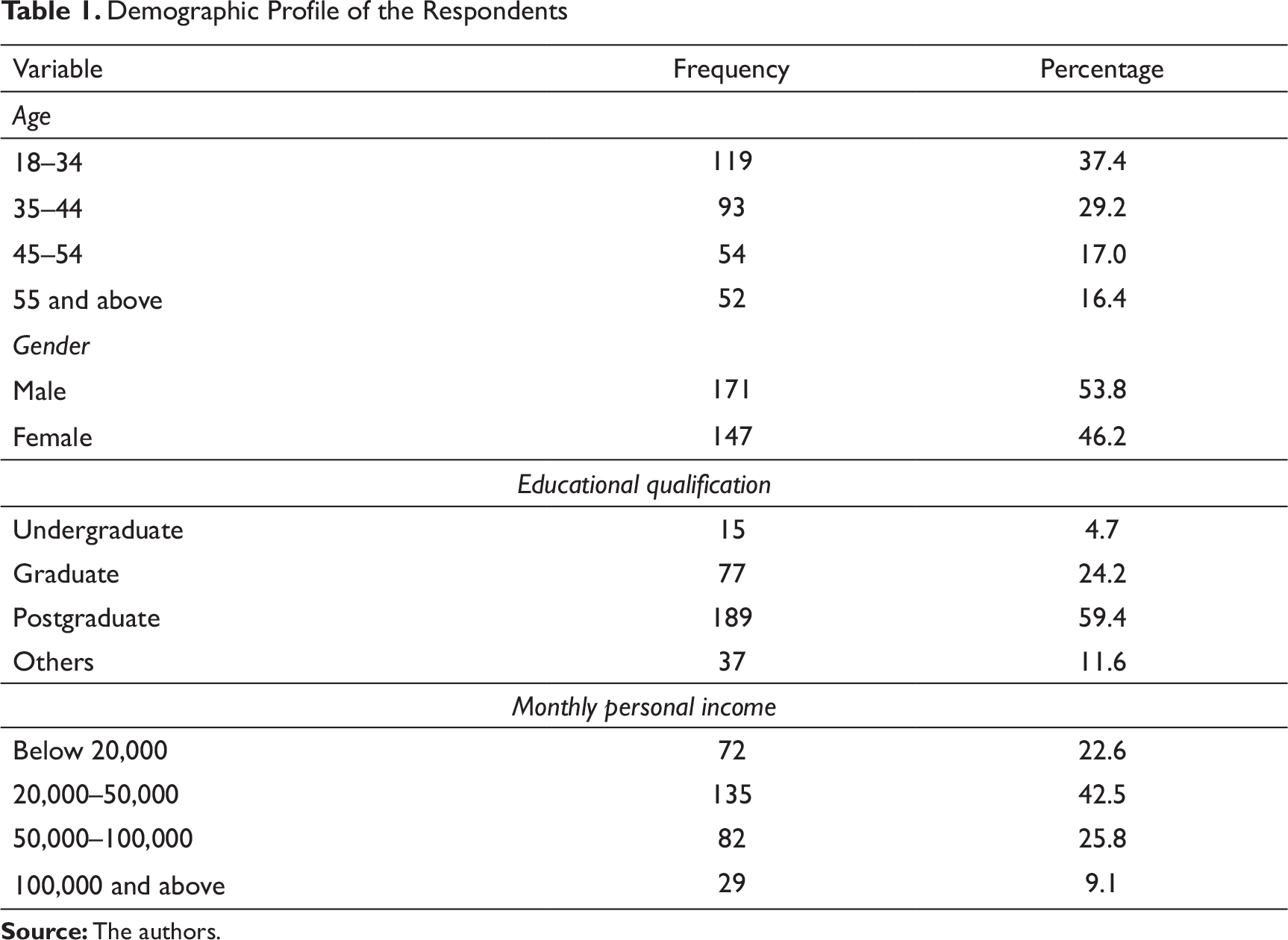
Table 1 reports the demographic profile of the respondents. It was observed that 38 per cent of the respondents were in the age group of 18–34 years, followed by 29 per cent in the age group of 35–44 years. Respondents in the age group of 45–54 years and 55 years and above accounted for 17 per cent and 16 per cent, respectively. Gender wise, 54 per cent of the respondents were males and 46 per cent of the respondents were females. Educational qualification wise 59 per cent of the respondents were postgraduate, 24 per cent were graduates, 12 per cent were with other degree and only 5 per cent were undergraduate. Monthly personal income wise majority of the respondents, that is, 42 per cent fell under the category of ₹20,000–50, 000, followed by 26 per cent in the category of ₹50,000–100,000. Twenty-three per cent respondents had less than ₹20,000 monthly income, while only a few, that is, 9 per cent of the respondents had more than ₹100,000 monthly personal income.
Analysis
Table 2 reports the regression analysis of effect of demographic factors on consumers’ perception of information value of online advertising.
Regression Analysis While Demographic Factors as Independent Variables and Information Value of Online Advertising as the Dependent Variable
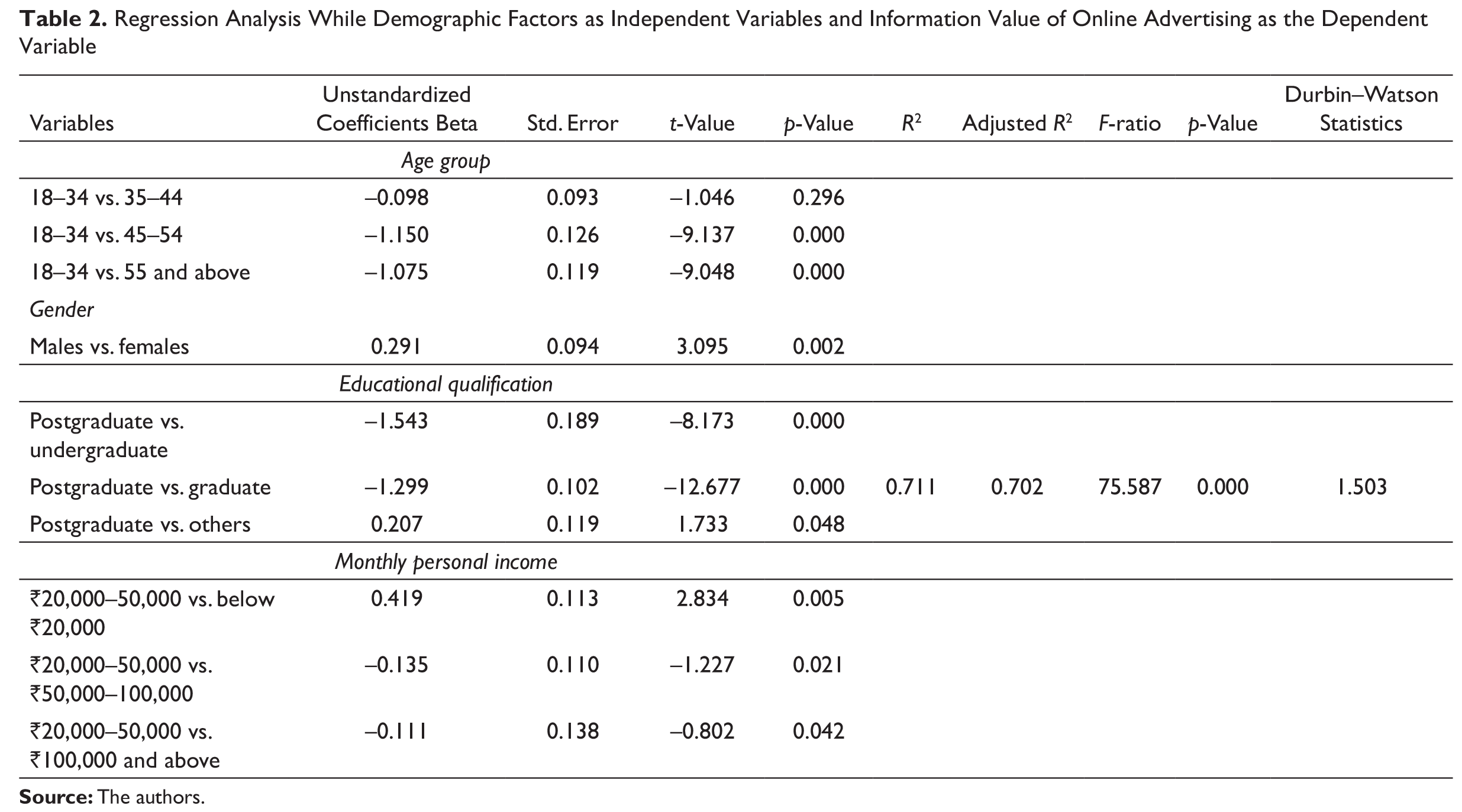
The estimated mean perception of information value of online advertising for 18–34 years, males, postgraduates with a monthly personal income between 20,000 and 50,000 is 3.98. The perceptual difference for information value of online advertising between the age group ‘18 years–34 years’ and ‘35 years–44 years’ is insignificant as the p-value is 0.296. The perceptual difference for information value of online advertising between the age group ‘18 years–34 years’ and ‘45 years–54 years’ is 2.83 (3.98 + −1.150) and between the age group ‘18 years–34 years’ and ‘55 years and above’ it is 2.87. Thus, it can be said that age has a negative relationship with the perception of information value. Young respondents perceived online advertising as more informative than old respondents. There is a significant difference in the perception of information value of males and females. The females have an estimated mean perceived information value of online advertising 0.29 points more than males. Educational qualification had a statistically significant positive impact on the consumers’ perception of information value of online advertising. Undergraduate and graduate respondents perceived online advertising less informative than the postgraduate respondents with a mean perceptual information value of −1.54 and −1.30, respectively. On the contrary, respondents with other higher educational qualification perceived online advertising more informative than the postgraduate respondents with a mean perceptual value of 0.207. The results signify that highly educated respondents perceived online advertising as more informative than the less educated respondents. Respondents who were earning below ₹20,000 monthly perceived online advertising more informative than who are earning between ₹20,000 and ₹50,000 with a mean value of 0.419. The mean perceptual difference in the information value of online advertising between the income groups ₹20,000–50,000 and ₹50,000–100,000 is −0.135 and between the income groups ₹20,000–50,000 and ₹100,000 and above is –0.111. It indicated that respondents in higher monthly income groups perceived online advertising less informative. t-Statistics associated with β-value for all the categories of age groups, gender, educational qualification and monthly personal income are significant except that for one category of age group ‘18–34 years vs. 35–44 years’, signifying that these categories of demographic factors are making a significant contribution to the model. In the above table, demographic factors account for 71 per cent of the variation in the consumers’ perception of information value of online advertising. The difference in the values of R2 and adjusted R2 is 0.009, signify that if the models were derived from the population rather than a sample, it would account for approximately 0.9 per cent less variances in the outcome. The F-ratio is 75.587 significant at p < 0.001, indicating that the regression model results in significantly better prediction of effect of demographic factors on consumers’ perception of information value of online advertising. Finally, the Durbin–Watson statistics is 1.503 signifying that the assumption of independence of error has certainly been met.
Table 3 illustrates the results of multiple regression of effect of demographic factors on consumers’ perception of trustworthiness of online advertising.
Regression Analysis While Demographic Factors as Independent Variables and Trustworthiness of Online Advertising as the Dependent Variable
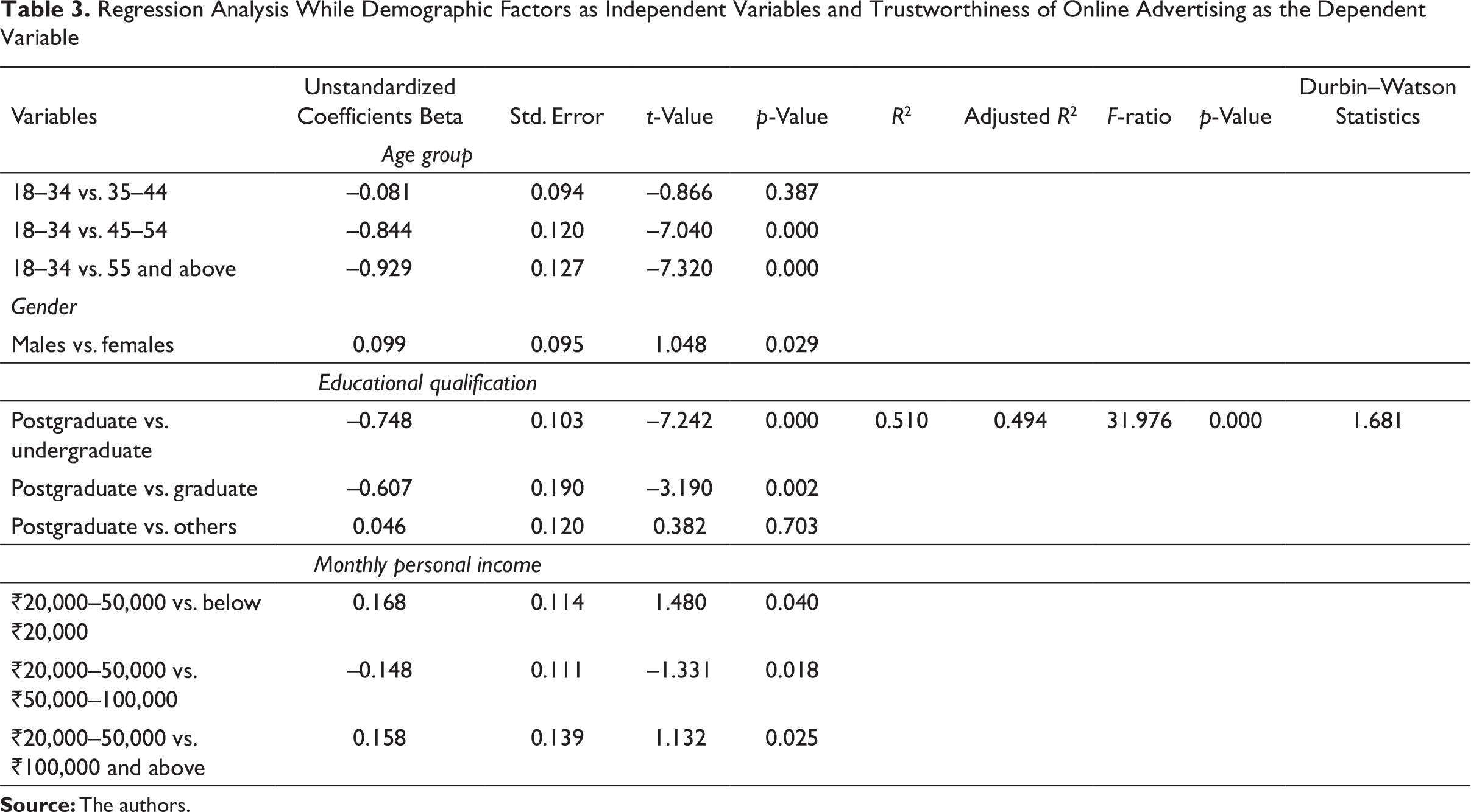
The age had a significant negative effect on consumers’ perception of trustworthiness of online advertising. Respondents in the age groups ‘45–54 years’ and ‘55 years and above’ perceived online advertising less trustworthy than young respondents’ in the age group of ‘18–34 years’ with a mean perceptual difference of −0.084 and −0.93, respectively. The perceptual difference for trustworthiness is insignificant in the age group of ‘18–34 vs. 35–44 years’. Females perceived online advertising 0.099 points more trustworthy than male respondents. Educational qualification also had a significant effect on consumers’ perception of trustworthiness of online advertising. Undergraduate and graduate respondents perceived online advertising less trustworthy than postgraduate respondents with a mean perceptual difference of −0.75 and −0.60, respectively. The perceptual difference between postgraduate and other qualifications for trustworthiness is insignificant. Income wise respondents in the lowest and the highest monthly income groups of less than ₹20,000 and ₹100,000 and above perceived online advertising as trustworthy with 0.168 and 0.158 more points, respectively. While respondents in the monthly income group of ₹50,000–100,000 perceived it −0.148 points less trustworthy than the respondents in the reference income group. The standard error associated with the β-values indicates the extent to which these values would vary across different samples. t-Statistics associated with β-values for all the categories except that for ‘18–34 vs. 35–44 years’ and ‘postgraduate and other’ represented a significant contribution to the model. The results revealed that demographic factors predicted 51 per cent (R2 = 0.510) consumers’ perception of trustworthiness of online advertising. If the models were derived from the population rather than a sample, it would account for approximately 0.10 per cent less variances in the outcomes. The significant F-ratio tells that the models are a significant fit to the data overall. The assumption of independence of error has been met.
In Table 4, the results of regression analysis with demographic factors (age, gender, educational qualification and monthly personal income) as independent variables and consumers’ perception of entertainment value of online advertising are illustrated.
Consumers’ perception of entertainment value of online advertising = 3.82 + (−0.092 × 18–34 vs. 35–44) + (−0.990 × 18–34 vs. 45–54) + (−0.948 × 55 years and above) + (0.205 × males vs. females) + (−1.189 × postgraduate vs. undergraduate) + (−1.026 × postgraduate vs. graduate) + (0.195 × postgraduate vs. others) + (0.228 × ₹20,000–50,000 vs. below ₹20,000) + (−0.015 × ₹20,000–50,000 vs. ₹50,000–100,000) + (0.142 × ₹20,000–50,000 vs. ₹100,000 and above)
Regression Analysis While Demographic Factors as Independent Variables and Entertainment Value of Online Advertising as the Dependent Variable

Regression Analysis While Demographic Factors as Independent Variables and Offensiveness of Online Advertising as the Dependent Variable

Table 5 showcases the results of multiple regression for the effect of demographic factors on consumers’ perception of offensiveness of online advertising.
Consumers’ perception of offensiveness of online advertising = 2.253 + (−0.028 × 18–34 vs. 35–44) + (0.597 × 18–34 vs. 45–54) + (0.704 × 55 years and above) + (−0.050 × males vs. females) + (0.382 × postgraduate vs. undergraduate) + (0.124 × postgraduate vs. graduate) + (−0.014 × postgraduate vs. others) + (0.073 × ₹20,000–50,000 vs. below ₹20,000) + (0.067 × ₹20,000–50,000 vs. ₹50,000–100,000) + (−0.307 × ₹20,000–50,000 vs. ₹100,000 and above).
All the categories of age group, except the age group ‘18–34 years vs. 35–44 years’, were found to have a statistically significant positive effect on consumers’ perception of offensiveness of online advertising. Gender had an insignificant effect on consumers’ perception of offensiveness of online advertising. Under educational qualification, all categories except ‘postgraduate vs. others’ had a statistically significant negative effect on consumers’ perception of offensiveness of online advertising. Under monthly personal income category, only one category ‘₹20,000–50,000 vs. ₹100,000 and above’ had a statistically significant negative effect on consumers’ perception of offensiveness of online advertising. The results of the study revealed that demographic factors predicted 16 per cent (R2 = 0.164) variance in the consumers’ perception of offensiveness of online advertising. If the model was derived from the population rather than a sample, it would account for approximately 0.10 per cent less variance in the outcome. The F-ratio is also significant at p < 0.001, signifying that the models is a significant fit to the data overall. The assumption of independence of error has also been met.
From the results of Multiple Regression, it can be stated that demographic factors significantly affect consumers’ perception of online advertising.
Discussion
Internet users are not a homogeneous online community as people from diverse backgrounds use Internet. Marketers should acknowledge these differences while developing their online advertising campaigns and should customize their ads according to the demographic characteristics of consumers. As these factors have been found to affect consumers’ perception of online advertising significantly. Age is negatively related to consumers’ perception of information value, trustworthiness and entertainment value. While it is positively related to the perception of offensiveness. Consumers in older age groups perceive online advertising less informative, less trustworthy, less entertaining and more offensive. While consumers in younger age groups rely more on online advertising for information, they find online advertising more entertaining and trustworthy. Young consumers do not feel offended by online advertising. Though the perceptual differences between the age groups 18–34 and 35–44 years have been found to be insignificant. The findings of the study are supported by the findings of Ünal, Ercis, and Keser (2011), Coursaris et al. (2010), and Shavitt et al. (1998). As age is found to have a negative effect on consumers’ perception of online advertising, marketers targeting the older consumer segments should focus on strength of argument and information quality in their online advertising. They should design simple e-ads with underlying trust, by avoiding confusing, silly, deceptive, trivial and unethical implications.
Significant differences exist among male and female consumers regarding their perception of consumers’ perception of online advertising in terms of information value, trustworthiness and entertainment value (Coursaris et al., 2010; Shavitt et al., 1998). Females perceived online advertising more informative, trustworthy and entertaining. While it has an insignificant effect on consumers’ perception of offensiveness of online advertising. Significant gender differences have been observed in the perception of online advertising. Marketers should acknowledge these differences while developing online advertising campaigns for males and females. It also emphasizes the importance of exploring the effect of gender on consumers’ perception to know the direction of these perceptual differences.
Educated consumers perceive online advertising more informative, trustworthy, and entertaining as compared to less educated consumers. These results are supported by the earlier study of Assael (2005). The education level of the consumers does not have any significant effect on consumers’ perception of offensiveness of online advertising.
Consumers in higher income groups perceived online advertising less informative, trustworthy and entertaining as compared to consumers in lower income groups (Alwitt & Prabhakar, 1992; Dutta-Bergman, 2006; Wolin, Korgaonkar, & Lund, 2002). While it has an insignificant effect on consumers’ perception of offensiveness of online advertising.
Change is the only constant, so is true with human personality. Demographics of one’s life keep on changing over time. Thus, marketers must continuously monitor these changes in their target consumers for effective e-adverting.
Conclusion
As the Internet has emerged as a prominent advertising medium, investigating consumers’ perception of online advertising is fundamental. But, the Internet users do not form a homogeneous group and their perception of online advertising is also unique. Hence, the results provide useful insights for both the academicians and practitioners interested in the study of consumers’ perception of online advertising. In this study, the effects of demographics factors on consumers’ perception of online advertising are explored. Consumer demographics were found to be significantly influencing consumers’ perception of online advertising. Demographic factors can enrich the user profiles for effective online advertising.
Managerial Implications
The present study has some useful practical implications for the industry. Today’s marketplace is highly competitive and to stay in the competition relevant and clear understanding of the consumers is important. The current study offers a clear understanding of the factors affecting consumers’ perception of online advertising to the e-marketers so that they can design effective and appropriate online advertising to target their present and potential customers. Moreover, the study will empower the global marketers in creating more effective online advertising by providing a better understanding of consumers’ perception of online advertising. Thus, the study will help them in creating better marketing strategies to serve the consumers from an emerging and thriving market like India.
Limitations and Future Scope of the Study
The study is not free from limitations. First of all, it is acknowledged that the small sample size and limited area of Delhi and NCR limit the universal application of the results of the study. Due to time and financial constraints, the researcher could not select a very large sample size. Only a few, not all demographic, have been considered for the study. As the scope of the study was very vast and the collected data offered huge information; consequently, the researcher might present some other valuable results. But the results have been confined within the scope of the objectives of the study. But it is ensured that all the essential information for rationalizing the results of the study are covered.
The present study leaves a number of questions unanswered which should be further investigated. First of all, to increase the universal application of the study further studies covering large sample size and area should be undertaken. Second, as only a few demographic factors have been included in the study, future studies may explore the role of remaining demographic factors in their perception towards online advertising.
Footnotes
Acknowledgement
The authors are grateful to the anonymous referees of the journal for their extremely useful suggestions to improve the quality of the article. Usual disclaimers apply.
Declaration of Conflicting Interests
The authors declared no potential conflicts of interest with respect to the research, authorship and/or publication of this article.
Funding
The authors received no financial support for the research, authorship and/or publication of this article.
