




Abstract
Present study identifies Indian seniors’ intention to use the internet and actual usage along with influence of age, gender, education and experience as moderators. This study proposes modifications in unified theory of acceptance and use of technology (UTAUT) model while adding education as moderators and also studied relationship between facilitating conditions (FC) and behavioural intention. The proposed research model was empirically tested by data collected from 371 Indian seniors above the age of 50 years through offline survey. The collected data were analysed using structural equation modelling (SEM) and multiple moderation analysis. The result revealed that performance expectancy (PE), effort expectancy (EE), subjective norm (SN), technology anxiety (TA) significantly influence elders’ behavioural intention (BI) to use and adopt internet except FC. Further BI resulted in actual system use which is also determined by FC. Actual system use is predicted by three variables: learning, place of access and health conditions. In this study only age and gender were emerged as moderators. Findings of the study have important implications particularly to understand determinants of Indian seniors’ intention to use the internet and actual usage along with influence of moderators.
Introduction
Growth of Internet in India
The year 2015 marked the internet users cross 3 billion worldwide (Meeker, 2015). However the growth has not been uniform. Europe leads the growth story, followed by the America. Arab states, Asia Pacific and Africa are below the world average among the internet users. The growth story of the Indian internet space is phenomenal (Meeker, 2015). According to market research agency Kantar IMRB there will be 627 million internet users in India by 2019 out of which share of rural will be 290 million (PTI, 2019). Data, however, are unavailable, specifically for seniors using the internet in India.
Seniors in India
Globally, the seniors constitute about 11.5 per cent of the world population of 7 billion and are expected to increase to 22 per cent by 2050 (United Nations Population Fund [UNFPA], 2017). India is aging fast and increase in seniors’ population is posing major social challenge. Census 2011 reveals 35.5 per cent growth in seniors’ population since 2001 (Ministry of Statistics and Programme Implementation [MOSPI], 2016). Thus India accounts for a large proportion of the world’s seniors and their population is projected to increase from current 8 per cent to 19 per cent by 2050 (UNFPA, 2017). Internet is getting popular among seniors due to various internet-based services such as social security schemes. Internet connects seniors with these schemes so that they may get benefited while sitting in their home. Apart from access to the schemes, they may also have access to banking operation via internet in either from desktop or from smartphone which frees them from temporal, official and spatial limitations (Kumar, Lall, & Mane, 2017). Zickuhr (2014) and Juznic, Blazic, Mercun, Plestenjak, and Majcenovic (2006) found that seniors are using internet to fulfil their multiple needs. This results in favourable attitude to learn and operate internet (Eastman & Iyer, 2004). The structure of the article is as follows. The article starts with introduction section. After the introduction, review of literature is presented in the next section followed by objectives, rationale, methodology, analysis, discussion, conclusion, managerial implications and limitations and future research directions respectively.
Review of Literature
Theoretical Framework on the Adoption of Technology
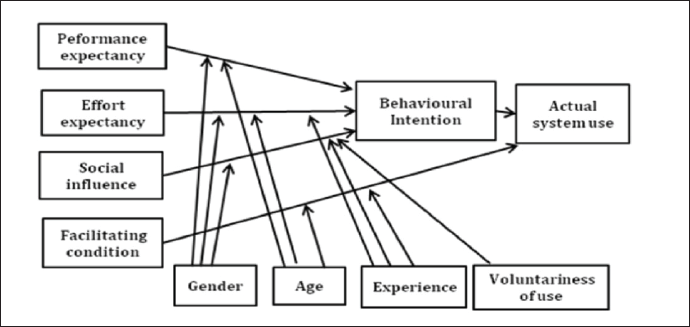
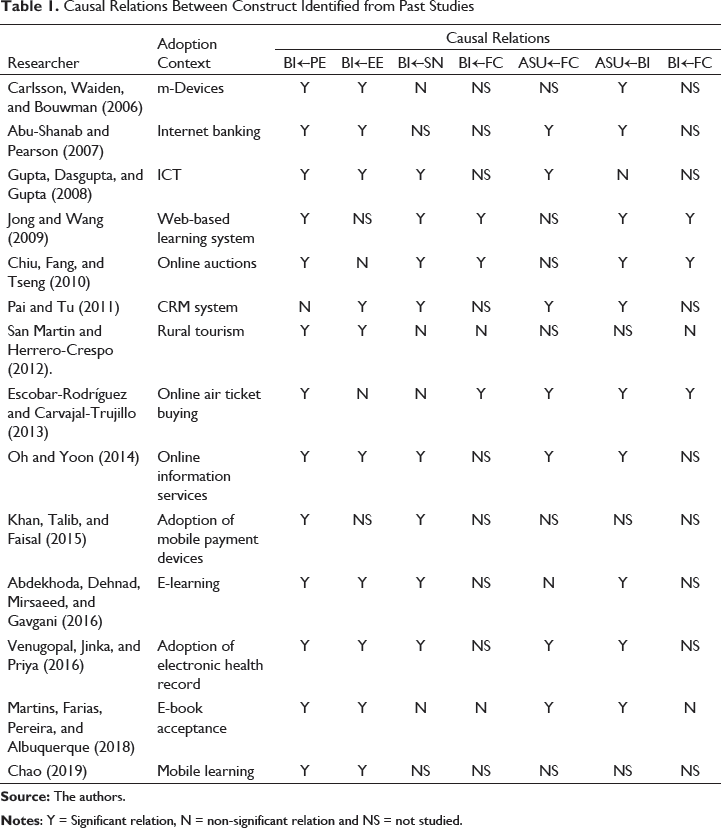
Most recognized technology adoption studies include technology adoption model (TAM) and unified theory of acceptance and use of technology (UTAUT). TAM explains why people use or do not use technology (Legris, Ingham, & Collerette, 2003), but it fails to explain the other contexts. The UTAUT is valid and reliable model across contexts (Anderson & Schwager, 2004). Table 1 provides an overview on the extent to which these have been considered in past studies pertaining to varied technology adoption contexts. Therefore, we used UTAUT model (Figure 1) proposed by Venkatesh, Morris, Davis, and Davis (2003) with certain modifications to understand the internet adoption behaviour among seniors in India.
Overview of the Constructs
UTAUT model captures constructs from diffusion of innovation theory (DIT) of Rogers (1995), theory of reasoned action (TRA) of Fishbein and Ajzen (1975), theory of planned behaviour (TPB) of Ajzen (1985), social cognitive theory (SCT) of Bandura (1986), technology adoption model (TAM) of Davis (1989), model of PC utilization (MPCU) of Thompson, Higgins, and Howell (1991), the motivation model (MM) of Davis, Bagozzi, and Warshaw (1992) and technology adoption model 2 (TAM2) of Venkatesh and Davis (2000).
Performance Expectancy
It is the degree to which an individual believes that using the internet will help improve his performance. Evolution of performance expectancy (PE) is traced from relative advantage (IDT), outcome expectation (SCT), perceived usefulness (TAM and TAM2), job fit (MPCU) and extrinsic motivation (MM) (Venkatesh et al., 2003; Wu, Yu, & Weng, 2012). PE significantly influences BI in technology adoption studies especially in case of online context (Koufaris, 2002); web-based learning (Al-Gahtani, 2016; Chu & Chen, 2016; Merhi, 2015); wireless application protocol (WAP), phones (Nysveen, Pedersen, & Thorbjørnsen, 2005b) and mobile commerce (Marchewka & Kostiwa, 2014).
Effort Expectancy (EE)
It is the ease with which an individual could use the system. Effort expectancy (EE) relates efforts put, performance achieved and rewards achieved (Ghalandari, 2012). Evolution of EE is traced from perceived ease of use in TAM/TAM2, ease of use in DIT and complexity in MPCU (Venkatesh et al., 2003). EE significantly influences BI in technology adoption studies (Davis, 1989; Moore & Benbasat, 1991; Venkatesh et al., 2003). However EE failed to predict BI in some studies conducted by Chau and Hu (2002) and Yu (2012).
Subjective Norm
It is defined as ‘the degree to which an individual believes or perceives that people important believe he or she should use the new system’ (Venkatesh et al., 2003). Subjective norm (SN) was found to be a popular measure and widely cited in the literature (Pan & Jordan-Marsh, 2010). SN was used in IDT, TRA, TPB, TAM, MPCU and it is considered similar to image in IDT and social factor in MPCU (Venkatesh et al., 2003). SN significantly influences BI (Foon & Fah, 2011; Jeong & Yoon, 2013) especially in case of adoption of email (Hsu & Lu, 2004) and internet banking (Riquelme & Rios, 2010) and information system acceptance (Taylor & Todd, 1995).
Technological Anxiety
Brosnan (1998) and Leso and Peck (1992) define technology anxiety (TA) as fear of using computers. We study TA with respect to use of internet. Anxiety has been studied by other researchers in different contexts (Jackson, Ervin, Gardner, & Schmitt 2001; Meuter, Ostrom, Bitner, & Roundtree, 2003). Cody, Dunn, Hoppin, and Wendt (1999) and Laguna and Babcock (1997) found higher anxiety on the part of seniors.
Facilitating Conditions
Facilitating conditions (FC) are defined as technical infrastructure to support the system use (Venkatesh et al., 2003). According to Venkatesh et al. (2003) FC is evolved from perceived behavioural control (TPB), FC (MPCU) and compatibility (IDT). FC significantly influences the senior citizens intention with respect to internet use (Pan & Jordan-Marsh, 2010). According to Schaper and Pervan (2004), and Garfield (2006) FC influences actual use of technology instead of behavioural intention (Venkatesh & Zhang, 2010; Venkatesh et al., 2003; Yu, 2012). Whereas, FC influences BI in the context of information system (Banerjee & Dey, 2013) and e-learning (Chu & Chen, 2016).
Behavioural Intention and Actual Use
Behavioural intention (BI) significantly influences actual usages in the context of technology adoption (Tarhini, Hone, & Liu, 2013b; Venkatesh & Zhang, 2010; Venkatesh et al., 2003; Yu, 2012) and internet banking (Im, Hong, & Kang, 2011; Yu, 2012). BI and use behaviour were derived from the TRA. BI was predicted using PE, EE, SI and FC in original UTAUT model, which further determines actual use or use behaviour.
Moderators
Gender
Gender affects technology adoption and usage (Pan & Jordan-Marsh, 2010) even with increasing age (Wagner, Hassanein, & Head, 2010). Moderating role of gender was studied by Venkatesh et al. (2003), Nysveen, Pedersen, and Thorbjornsen (2005a), Khraim, Al Shoubaki, and Khraim (2011) and Yu (2012). We therefore study role of gender as moderator.
Age
Seniors generally get disadvantaged with age due to several reasons. Lindberg, Näsänen, and Müller (2006), Wagner et al. (2010) found increasing use of computers with increase in age. Age was studied as moderators in different contexts: mobile banking (Chawla & Joshi, 2018; Riquelme & Rios, 2010), mobile healthcare system (Faqih & Jaradat, 2015) and mobile learning (Wang, Wu, & Wang, 2009). We therefore investigate the impact of this moderator.
Experience and Voluntariness of Use
Experience is considered as the past use of internet. Voluntariness is defined as the ‘the degree to which use of the innovation is perceived as being voluntary, or of free will’ (Moore & Benbasat, 1991). We consider for the purpose of our study experience as moderator and ignore voluntariness. Experience was studied as moderators in different contexts: IT adoption (Venkatesh et al., 2003) and mobile banking (Chawla & Joshi, 2018).
Education
Causal Relations Between Construct Identified from Past Studies
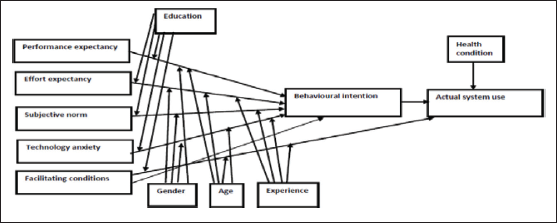
Thus, the researchers propose following research model for the present study as shown in Figure 2.
Objectives of the Study
The current study endeavours to study the relationship between PE and BI, EE and BI, SN and BI, TA and BI, FC and BI, FC and actual system use (AU), BI and AU. It also aims to study moderating effect of age, gender, education and experience level on relationship between each independent variables (IVs) and dependent variables (DVs).
Rationale of the Study
Previous studies address internet penetration and digital divide, but do not represent seniors (Dutta & Das, 2016; West, 2015). In this study researchers attempt to study what drives the seniors’ intention to use the internet and converts to actual usage moderated by age, gender, education and experience of seniors. This study is unique in certain ways. First, no study was conducted in Indian context about seniors’ intention to use the internet. Second, this study provides a background to understand the usage of internet in accessing of various services and facilities. Third, this study makes important contributions to studies on aging and technology, especially in India. Fourth, it applies modified UTAUT model for the first time to examine seniors’ internet adoption, not widely explored in literature.
Methodology
Data Source and Collection
The term older is used in different contexts (Wagner et al., 2010). Developed countries accept age of 65 years for elderly (Pan & Jordan-Marsh, 2010). However Pan and Jordan-Marsh (2010) use chronological age of 50 in their study, while Peacock and Künemund (2007) use 55. For the purpose of our study, we refer to 50 years as our definition of seniors. We did not distinguish between seniors who were working or not working. Data were collected from primary source. The sample frame includes seniors aged 50 years and above from whom the data were collected. The survey was done in multiple Indian cities. The participants were asked to complete the questionnaire.
Construct Measurement
Construct and Scale Items Used in the Research

Analysis
The researchers analysed the response of 317 internet users and the relationship between variables as per the research model shown in Figure 2. Further moderation effect of age, education, experience and gender was tested. A moderation effect occurs when a third variable changes the relationship between two variables.
Demographic Analysis
Demographic Profile of the Respondents
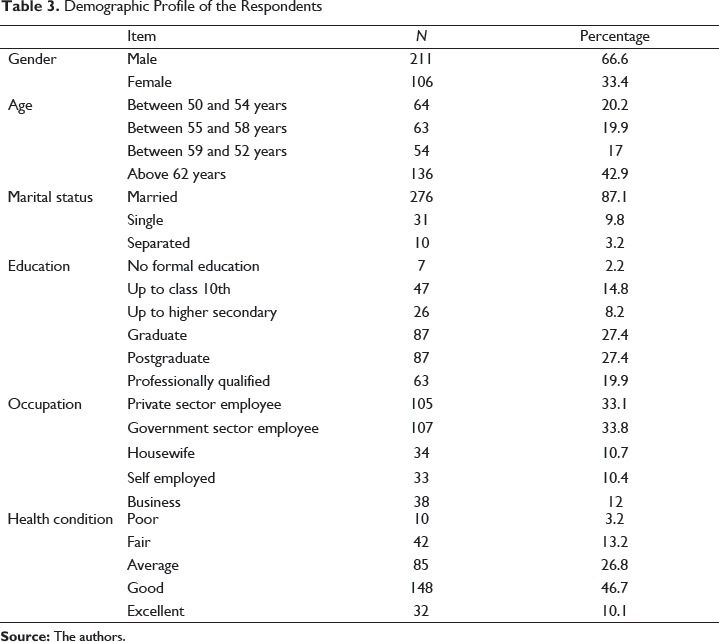
The majority of the respondents were males (66.6%) and rest were females (33.4%). In terms of age, 42.9 per cent respondents fall in the age group ‘above 62 years’, followed by 50–54 years (20.2%), 55–58 years (19.9%) and 59–62 years (17%). Majority of the respondents were married (87.1%), followed by single (9.8%) and separated (3.1%). With respect to level of education, 27.4 per cent respondents were graduate, 27.4 per cent were post graduate followed by professionally qualified (19.9%), up to class 10th (14.8%), higher secondary (8.2%) and no formal education (2.2%). In terms of occupation/previous occupation, 33.8 per cent respondents were government sector employees, followed by private sector employees (33.1%), business (12%), housewives (10.7%) and self-employed (10.4%). In terms of health condition, 46.7 per cent respondents health condition were found good, followed by average (26.8%), fair (13.2%), excellent (10.1%) and poor (3.2%).
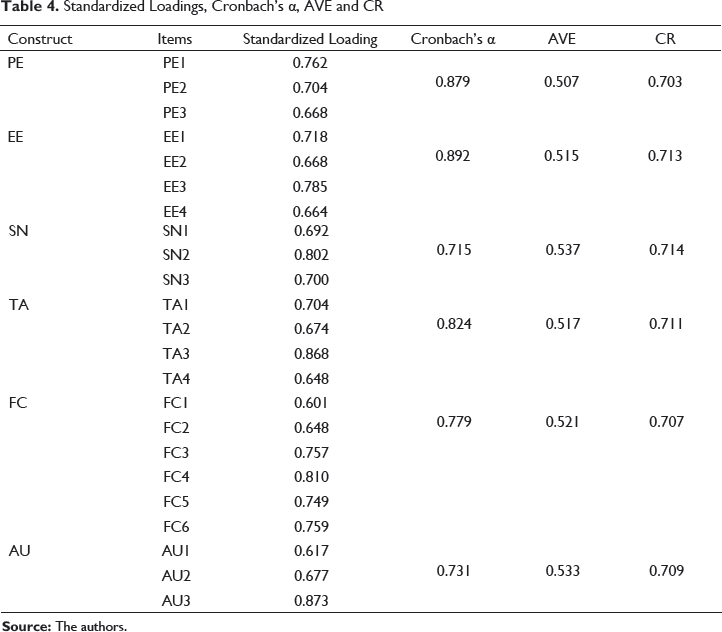
Reliability and Validity Analysis
Standardized Loadings, Cronbach’s α, AVE and CR
Construct Cross Correlation and Discriminant Validity for the Measurement Model

In Table 5, square root of AVE from observed variables are shown in diagonal in parentheses, whereas off-diagonal shows correlations between constructs which are significant (**p < 0.01 and *p < 0.05).
Structural Equation Modelling
Relationship between variables (shown in Figure 2) was examined through structural equation modelling (SEM) considering the guidelines of Anderson and Gerbing (1992) and Schumacker and Lomax (2010). On the basis of mean, skewness and kurtosis values of all the constructs data were considered normal and suitable for conducting SEM. AMOS 21 software was used to perform SEM. Model fit statistics were appropriate (shown beneath the Figure 3) as per the recommendation of Byrne (2013) and Hair et al. (2010).
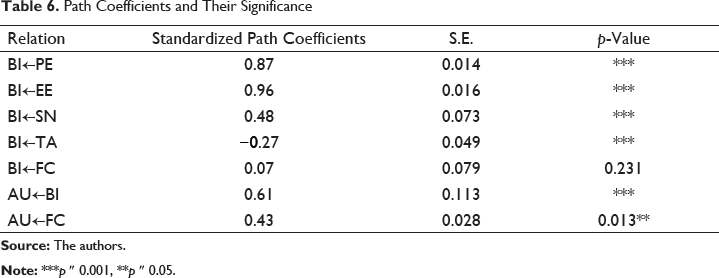
Structural model was considered significant as value of R2 is 0.688, which explains 68.8 per cent actual usages of internet on the part of seniors. As shown in Table 6, six out of seven path coefficients are statistically significant. It was found that PE (β = 0.87, p < 0.001), EE (β = 0.96, p < 0.001), SN (β = 0.48, p < 0.001) positively impact BI, whereas TA (β = −0.27, p < 0.001) negatively impact BI. However, path coefficient reflected that FC has insignificant impact on BI. It was also found that BI (β = 0.61, p < 0.001) and FC (β = 0.43, p < 0.05) positively impact AU and AU is determined by learning (AU1) (β = 0.81, p < 0.05), place of access (AU2) (β = 0.74, p < 0.001) and health condition (AU3) (β = 0.31, p < 0.001).

Path Coefficients and Their Significance
Summary of Moderation Test Between PE, EE, SN, TA and BI

Moderation Analysis
Moderated multiple regression (MMR) was conducted to analyse the moderation effect of moderators.
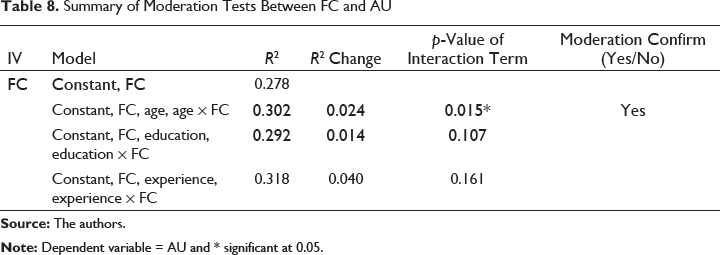
Summary of Moderation Tests Between FC and AU
Effect of Gender Groups on Relationship Between PE and BI

There were four moderators reported in Table 7 and one moderator in Table 8. The conditional effect of these moderator’s levels were probed on corresponding relationship between IV and DV and reported in Tables 9–13. Methodology suggested by Aguinis (1995) was followed to control the impact of unequal moderator subgroups on outcome.
Table 9 reveals that females influenced more the relationship between PE and BI than males. Above 62 years age group had lower influence on the relationship between PE and BI as per Table 10.
Effect of Age Groups on Relationship between PE and BI

Effect of Gender on Relationship Between EE and BI

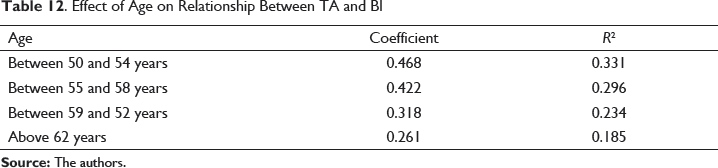
Effect of Age on Relationship Between TA and BI
Effect of Age on Relationship Between FC and AU

The age group which caused least influence on relationship between TA and BI was above 62 years as shown in Table 12.
The age group which caused least influence on relationship between FC and AU was above 62 years as shown in Table 13.
Discussion
This study empirically tested the revised UTAUT model with respect to hypothesized relationship between the constructs that act as determinants of internet adoption and actual system use among seniors in India. In our study EE was found as the strongest determinant within the model which contradicts the earlier research of Venkatesh, Thong, and XU (2012), Tarhini, Hone, and Liu (2013a) and Ezzi (2014), where they found PE as the strongest determinant. However Wang and Shih (2009) and Wang et al. (2009) found EE as strongest determinant for seniors, as it denotes ease with which an individual could use the system.
The influence of PE on BI was found significant, which were consistent with the findings of Wang and Shih (2009) and Wang et al. (2009). Significant relationship between PE and BI could be due to seniors belief that internet will be useful in performing various activities. The influence of EE on BI was found significant, which were consistent with the research of Moore and Benbast (1991) and Venkatesh et al. (2003). Although findings were inconsistent with those of Yu (2012) and Koenig-Lewis, Palmer, and Moll (2010). Significant relationship between EE and BI could be due to seniors growing interest in using internet because of its perceived usefulness and ease in use created through user friendly interface. The influence of SN on BI was found insignificant, which contradicted previous research of Venkatesh and Davis (2000), Venkatesh et al. (2003) and Pan and Jordan-Marsh (2010). Insignificant relationship between SN and BI found in this study could be due to seniors’ hesitation to take advice from persons in their surroundings. The influence of TA on BI was found significant, which were consistent with the research of Cody et al. (1999) and Venkatesh and Davis (2000), where they found TA negatively influences intention to use internet. Significant negative relationship between TA and BI found in this study could be because of seniors’ anxiety to use the internet due to fear of unknown. The influence of FC on BI was found not significant, which were inconsistent with the previous research of Thompson, Higgins and Howell (1991) and Pan and Jordan-Marsh (2010). Non-significant relationship between FC and BI could be due to the fact that seniors are interested in using internet but proper training and system availability are acting as barriers in turning their wish into reality. The influence of FC on AU was found significant, which were supported by research of Venkatesh et al. (2003) and Hung, Chang, and Yu (2006). Significant relationship between FC and AU could be due to the fact that seniors are interested in using internet subject to availability of system and guidance.
MMR was performed to find out the effect of moderators. In this study age and gender emerged as moderators, which were in line with the earlier research done by Venkatesh et al. (2003). Experience and education did not emerge as moderators in this study. Age emerged as moderator impacting relationship between PE and BI, TA and BI, FC and AU, particularly respondents above 62 years age group had lower influence on the relationship in comparison to other age groups 50–52 years, 55–58 years and 59–62 years. The possible reason behind lower influence exerted by respondents above 62 years age group on relationship between PE and BI could be due to the fact that they feel and believe themselves disadvantaged in using internet due to physical and psychological condition such as fading memory (Czaja et al., 2006), visual impairment and dexterity (Charness & Holley, 2004). Respondents above 62 years age group exert lesser influence on relationship between TA and BI, which could be due to their hesitation and fear of making mistakes that may result in loss of data, etc. According to Wagner et al. (2010) lower confidence and anxiety reduces internet usages on the part of seniors. Respondents above 62 years age group exert lesser influence on relationship between FC and AU, which could be due to the fact that they are either retired from their respective job or near retirement hence there is less willingness to learn internet due to lack of information and proper knowledge to use internet. They also find difficulty to understand the usage of internet even when they have necessary support and information from their reference group, particularly from their children and family members. For seniors, lack of internet access, lack of training, information or material availability, costs of acquiring and operating, technology designed with the seniors in mind could be a major deterrent to internet use (Eastman & Iyer, 2004; Morrell, Mayhorn, & Echt, 2004; White & Weatherall, 2000).
In the present study gender impacted relationship between PE and BI & EE and BI, particularly females exercised more influence in comparison to males, which were supported by the findings of Wagner et al. (2010). However Francis (1994) contradicts it. The possible reason behind this phenomenon could be due to the fact that females find internet useful and easy to use as they can perform various task through internet while sitting in the home. According to Ong and Lai (2006) and Venkatesh et al. (2003) ease of use is one of the major determinants that women consider with respect to technology both in short and long term.
Conclusion
The study investigates determinants of internet adoption among seniors in India. There is no study available to explore determinants of internet adoption among seniors in India. For this purpose revised UTAUT model was used by researchers. Most of the path coefficients in the proposed model were found statistically significant except the path from FC to BI. Results show that PE, EE, SN and TA significantly influence seniors’ BI to use and adopt internet except FC. Further BI resulted in AU which is also determined by FC. AU is predicted by three variables: learning, place of access and health conditions. Moderating effect of age, gender, education and experience was examined. In this study only age and gender were emerged as moderators. Age moderated the relationship between PE and BI, TA and BI, and FC and AU, whereas gender moderated the relationship between PE and BI, and EE and BI.
Managerial Implications
The study provides understanding of the internet adoption pattern of Indian seniors which may help marketers to devise their strategies for convincing them to adopt and use other self-service technologies. Moderating effect of age was found least influential among respondents above 62 years between TA-BI, PE-BI and FC-AU. Therefore in this respect marketers need to make suitable strategies for reducing seniors’ technology anxiety and make them technology friendly. In this respect seniors’ awareness and their ability to use internet may act as critical success factors for companies. If seniors’ are unaware about internet and unable to use it just because of complexity, adoption of internet will be very slow. Chawla and Joshi (2018) advocated companies should highlight convenience and security aspects to reduce technology anxiety. These efforts will also be useful in enhancing PE and EE of the seniors which may further result in BI to use internet. Zajicek and Hall (2000) advocated for designing senior friendly interface of internet so that FC may result in to AU. Marketers may extend their assistance and support to seniors while communicating benefits and instructions to use internet which will enable them to adopt internet soon and reduce seniors’ resistance to adopt internet. Further, Parasuraman and Colby (2001) advised companies to support customers about technology-based product and services.
Limitations and Future Research Directions
This study is limited only to find out seniors’ internet adoption in India. According to our search and knowledge, no study is conducted in India about seniors’ internet adoption. Future studies may be conducted to find out post-adoption behaviour of Indian seniors with respect to internet, particularly preference, usage pattern, satisfaction and likelihood to continue the usage of internet. Future researchers may carry out research to find out seniors’ technology anxiety, and obstacles faced by them while adopting and using internet. Future studies may be conducted to identify adoption, preference and usages of seniors with respect to other technologies like mobile banking, mobile payments, mobile shopping and generalize findings across various other self-service technologies. Although samples were obtained from seniors residing in different cities of India based on non-probabilistic sampling technique so our sample may not be representative. Future studies should ensure proper representation of seniors residing in rural areas with a larger sample size to get overall picture of seniors’ internet adoption in India and this will increase generalizability of the findings. Future researchers may conduct longitudinal study to track changes in seniors’ internet adoption in Indian. Impact of seniors’ health condition on use of internet was studied in general. Future researchers may study the effect of mental and physical health of seniors on the use of internet. This study included UTAUT model to identify seniors’ internet adoption and also studied moderation effect of age, gender, experience and education. The future studies may study moderation effect of other variables like income, occupation and residence to identify seniors’ internet adoption.
Footnotes
Acknowledgements
The authors are grateful to the anonymous referees of the journal for their extremely useful suggestions to improve the quality of the article. Usual disclaimers apply.
Declaration of Conflicting Interests
The authors declared no potential conflicts of interest with respect to the research, authorship and/or publication of this article.
Funding
The authors received no financial support for the research, authorship and/or publication of this article.
