



Abstract
This study aims to examine the mediation of employee engagement on the relationship between employee psychological empowerment and employee job satisfaction, which helps to retain more customers with better service. An empirical analysis was done on Maldivian resorts, and 243 employees were randomly selected from different resorts in the Maldives. The proposed model was tested using IBM SPSS AMOS 25. The results indicate that psychological empowerment had a significant effect on job satisfaction of the resort employees through employee engagement. The Maldivian economy is based on the tourism sector, and a significant amount of gross domestic product (GDP) depends on the tourism sector. Resorts and guesthouses are the power hubs for the economic development of the country, and employees are the primary source of service providers to tourists, which helps the resorts to retain their tourists. Hence, this study concludes that employees’ psychological empowerment and employees’ engagement are crucial to improve employee satisfaction.
Introduction
Psychological empowerment is an intrinsic motivation that an individual derives from autonomy at work. It comprises of four dimensions, that is, meaning, impact, self-determination and competence. It is recognized as a critical contributor to organizational success. When employees are empowered at work, it will lead to better job performance and organization commitment (Lee et al., 2018). Empowerment of employees most often helps them to change their attitude towards their jobs and about their organization (Ghaniyoun et al., 2017). Job satisfaction and engagement are directly influenced by empowerment (Dewettinck & van Ameijde. 2011). Conger and Kanungo (1988) define psychological empowerment as ‘a process of enhancing feelings of self-efficacy among organisational members through the identification of conditions that foster powerlessness and through their removal by both formal organisational practices and informal techniques of providing efficacy information’. Conger et al. (2000) state that psychological empowerment is a progression of persons’ insight into their success in contrast with the relevant others in their organization. Empowerment is an intrinsic task motivation manifested in a set of four cognitions: meaning, competence, self-determination and impact (Thomas & Velthouse, 1990). Meaning refers to the employees understanding the value of the task based on their standards or ideas. It is mainly based on the interest of the task that includes job requirements and employees’ values and beliefs (Hackman & Oldham, 1980; Spreitzer, 1995). Competence is related to the employee’s ability to perform the task with skills. Self-determination is reflecting the work behaviour of the individual who has a sense of autonomy to regulate the work (Chawla et al., 2017; Deci & Ryan, 1985). Impact refers to the level of individual influence on strategic, managerial or functional outcomes at work. The impact highly positively influences organizational performance; employees who believe they can affect the organizational system and outcomes are inclined to be more positively motivated. Empowerment at the workplace is essential for organizations to respond quickly to the changes in the organizational environment (Jha, 2010; Morin et al., 2016), which directly leads to enhanced job enrichment (Moura et al., 2015; Yang & Lee, 2009).
Employee engagement concept was evolved from the burnout concept and characterized from self-efficacy, involvement and energy of the employees which are negatively related to burnout dimensions such as exhaustion and self-disengagement (Schaufeli et al., 2008; Taris et al., 2017). Employee engagement is defined as linking the members of the organization to the employment role (Maslach & Leiter, 2016; Schaufeli et al., 2008; Schaufeli & Bakker, 2010). Vigour, dedication and absorption are the three characteristics of employee engagement (Bakker et al., 2008; Gupta & Sharma, 2016). Vigour is explained by mental resilience in the job, high level of energy and willingness to invest more effort in handling difficulties in the job. Dedication is explained by a sense of meaning, interest, motivation and challenge. Absorption is when an employee is focused and engrossed in his or her job and finds it very difficult to be detached at work. From this, it can be concluded that employee engagement is the central concept to improve the organizational effectiveness (Christian et al., 2011; Harter et al., 2002; Mishra & Mohanty, 2016; Stander & Rothmann, 2010).
Problem Statement
In Maldives, tourism accounts for more than 28 per cent of the gross domestic product (GDP) and significantly contributes to the economic development of the country. It plays a significant role in generating foreign exchange revenue and creates employment in the tertiary sector of the country. In recent years, Maldivian companies have been experiencing numerous accounts of employee dissatisfaction. The local news has reported multiple cases of employee strike across the Maldives (Mansoor & Hassan, 2016). This discontent seems to derive mostly from the hotel and tourism industry, which is the primary source of income for the country. These complaints and discontent range from unfair distributions of service charges, disappointing accommodations, differences in salaries, neglect, disrespect, discrimination and disputes with management. This openly indicates that the hospitality and tourism industries have specific areas for improving the management in employee expectations. It seems very relevant and essential to acquire knowledge on employee engagement as well as how to introduce a culture of engagement in a long-standing and manageable way. Another reason for this study is that Maldives is going to the next phase of tourism development, which will attract more international brands to the sectors. For this reason, employees are considered as the greatest asset in this sector (Küçükergin & Dedeoğlu, 2014). The total tourist satisfaction is created by all services and products associated with tourism destination. In the tourism and hospitality industry, the tourist experience is created by both product and services (Pizam & Ellis, 1999; Pizam et al., 2013). The competitive advantage of many tourism destinations is increased by an increase in tourist satisfaction level (Belias et al., 2017; Kandampully & Duddy, 2001; Khalili et al., 2016; Molina-Azorín et al., 2015), and it helps the Maldivian hospitality industry to maintain long-term relationship with tourists (Armenski et al., 2018; Rahimi & Kozak, 2017). Also, the need of empowered employees in tourism sector is increasing as it is one of the important factors which affect their job satisfaction (Tetik, 2016).
Employment in the tourism sector was of significant concern for academics and policymakers in developing and developed countries. However, it was not appropriately addressed in the Maldives with proper empirical evidence, mainly in the tourism and hospitality sector. Managers in hospitality industry are facing challenges in attracting, selecting, motivating and retaining workforce, which are imperative for providing a high-quality product and services to the increasingly discerning and demanding tourists. Hence, there is a need to understand the employee engagement and how hospitality sector employees’ engagement affects their psychological empowerment and job satisfaction.
Aim and Objective
This study aims to address the few selected human resource (HR) issues (psychological empowerment of employee, employee engagement and job satisfaction) that have to be undertaken in order to maintain a competitive advantage for the tourism sector in Maldives. This study will be beneficial for both literature and tourism and hospitality industry representatives, by addressing the mediating impact on employee engagement in enhancing the relationship between psychological empowerment and job satisfaction of the employees working in Maldivian resorts.
Review of Literature
Psychological Empowerment and Employee Engagement
Employee engagement and psychological empowerment are imperative in dealing through deviations at work and increasing organizational effectiveness (Kahn, 1990; Ugwu et al., 2014). When employees feel empowered at work, they display positive affective commitment, which leads to positive work engagement and lesser intentions to quit. When employees find meaning in their work, they display more attachment towards their work, which fosters engagement (Jose & Mampilly, 2014). Psychological empowerment has a positive correlation with employee engagement; the study also discovered that empowerment would increase team’s performance (Jose & Mampilly, 2014, 2015; Zhang & Bartol, 2010). Studies found that psychological empowerment estimates work engagement, and psychological empowerment leads to greater involvement in a primarily unexciting activity and increased positive feelings towards the activity (De Villiers & Stander, 2011; Moura et al., 2015). Therefore, psychological empowerment includes the beliefs of employees about the meaning of their work and their ability to successfully perform their job, their sense of autonomy and their capacity to impact the job outcome (Kruja et al., 2016; Sharma & Singh, 2018).
Psychological Empowerment and Job Satisfaction
Psychological empowerment has a significant impact on individuals and organizations. Highly empowered employees value their job, and the level of job satisfaction is high, and productivity will be greater (Fernandez & Moldogaziev, 2015; Hanaysha & Tahir, 2016; Pelit et al., 2011). Many studies conclude that employee satisfaction is one of the outcomes of employee engagement and employee psychological empowerment (Al-Ababneh et al., 2017; Harter et al., 2002; Lu et al., 2016). Psychological empowerment enhances job satisfaction. Studies conclude that employee psychological empowerment components have a significant and positive relation to employee satisfaction (Casey et al., 2010; Pelit et al., 2011; Schermuly et al., 2011). Some studies explain that turnover intentions were negatively influenced by employee psychological empowerment and employee engagement (Bhatnagar, 2012; Lu et al., 2016). However, job satisfaction is also negatively influencing turnover intentions (Ellickson & Logsdon, 2002; Hanaysha & Tahir, 2016). This discussion proves that both employee psychological empowerment and employee engagement act as a significant predictor of job satisfaction (Stander & Rothmann, 2010; Wong Humborstad & Perry, 2011). Few literatures argue that employee psychological empowerment acts as a mediator between the relationship between organizational context and job satisfaction (Carless, 2004; Choi et al., 2016; Fong & Snape, 2015; Krishnan, 2012; Shapira-Lishchinsky & Tsemach, 2014). Job satisfaction is the results of employees’ perceived feeling of psychological empowerment; impact and meaning dimensions of psychological empowerment help to increase the overall positive feelings of job satisfaction (Spector, 1997). When employees are meaningful to their job, they can derive a high level of satisfaction for their work (Laschinger et al., 2004; Wang & Lee, 2009). Employees’ outcome can be impacted by the personal feeling towards the organization, which helps to develop a sense of job satisfaction (He et al., 2010; Wang & Lee, 2009). Competence empowerment helps employees to understand their competence towards the job, which will help them to feel comfortable in their job (Al-Ababneh et al., 2017; Laschinger et al., 2004).
Employee Engagement and Job Satisfaction
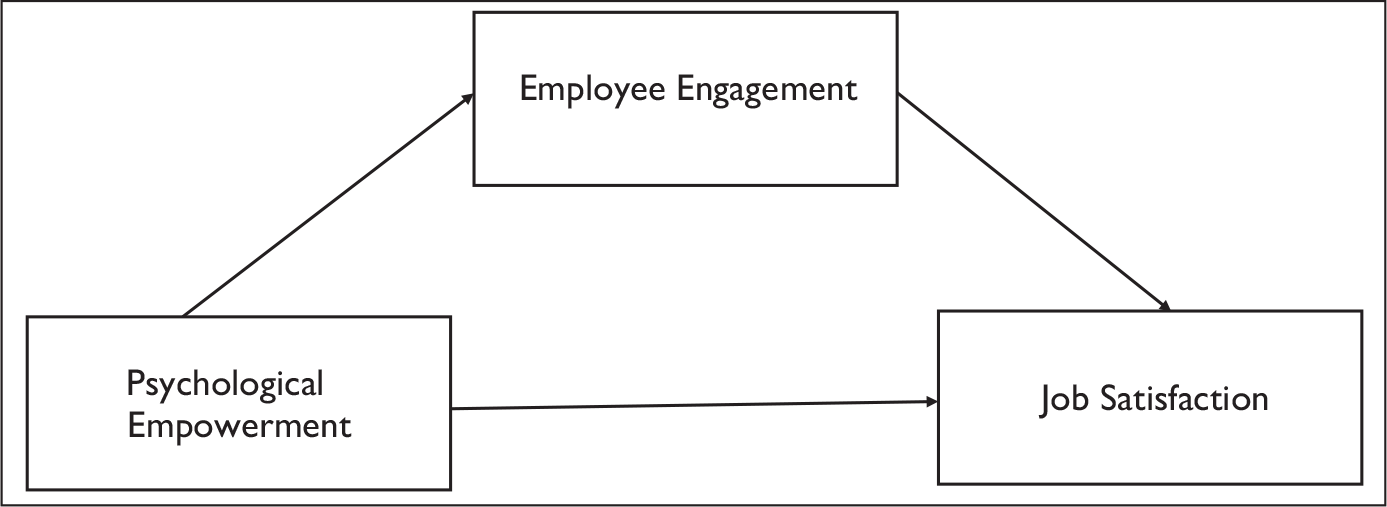
Employee engagement could be a better source to create competitive advantages (Macey et al., 2011; Noe et al., 2017). Many studies conclude that employee engagement acts as a mediator between organizational variables, such as leadership (Alfes et al., 2013), employee attitude (Popli & Rizvi, 2016; Yalabik et al., 2013), employee commitment (Gupta, 2017), organizational support (Biswas & Bhatnagar, 2013), employee psychological empowerment (Jose & Mampilly, 2014), personality (Sulea et al., 2012) and organizational performance (Muduli et al., 2016). Studies also conclude that job satisfaction is one of the antecedents of job performance (Hsieh, 2016). Highly engaged employees have a strong sense of belongingness with the organization, and their turnover intention is low. As we discussed already, job satisfaction is negatively related to turnover intentions (Memon et al., 2016). For higher productivity, higher performance and higher satisfaction, employee engagement is essential (Brunetto et al., 2012; Collini et al., 2015). In this competitive world, employee engagement can be attained positively in combination with employee psychological empowerment to yield higher employee satisfaction (Figure 1; Macey et al., 2011; Shuck et al., 2011).
Empirical Model
Research has often shown that when employees feel empowered at work, they are connected to better performance, job satisfaction and organizational engagement. Most organizations today still seek to empower their employees by delegating control and decision-making, sharing information and seeking their feedback (Lee et al., 2018). Recent studies have emphasised on the significance of providing autonomy and empowerment to employees at work; these techniques can be used to enhance employees’ performance in the organisation (Kundu et al., 2019). Empowered employees positively influence creativity much more effectively than repetitive job efficiency. Managers also are more likely to have faith in their subordinates by encouraging workers than managers who do not empower their employees, which also increases employees’ engagement and satisfaction (Wang & Lee, 2009). These literature discussions clear the relationship between psychological empowerment, employee engagement and employee satisfaction. The above-mentioned conceptual model was developed based on these discussions.
Methods
Measures
The scales administered in this research was adopted from previous literature, and it ensures content validity. The measurements for employee psychological empowerment were adopted from Spreitzer (1995) and includes four core dimensions such as meaning, competence, self-defemination and impact items, and each dimension includes three items, whereas the employee engagement items were adopted from employee engagement scale used by Rich et al. (2010) and adopted from Kahn (1990) consist of 18 items and categorized into three sub-scales, namely physical, emotional and cognitive engagement. Each engagement sub-scale includes six items. The job satisfaction items were adopted from the Minnesota Satisfaction Questionnaire developed by Weiss et al. (1977). This scale consists of 20 items, which are classified into three sub-dimensions, namely intrinsic satisfaction, extrinsic satisfaction and general satisfaction. Respondents were asked to rate their psychological empowerment and employee engagement using a 5-point Likert scale that ranged from ‘strongly disagree’ (1) to ‘strongly agree’ (5). The job satisfaction scale uses the five response choices starting from ‘very satisfied’ (5) to ‘very dissatisfied’ (1).
Sample Frame
The target population for this study is employees working in various departments in various Maldivian resorts. Every participant was informed about the aim and purpose of the research, and respondents were informed about the confidentiality, anonymity and data security. Participants’ official email IDs were taken from the resorts. The consent form was included in the first page of the online questionnaire, 322 participants responded to the online survey, only 242 completed and cleaned data were used for analysis purposes. From the sample, participants were predominately male (59%), and 52 per cent of the participants were between 26–35 years of age. Overall, 76 per cent of the participants had 0–5 years’ experience in the tourism industry, and their average monthly income was MVR 10,101.314. The validity and reliability of the constructs were tested using IBM SPSS AMOS 25. Since the sample size is relatively larger, and achieving multivariate normality is problematic, AMOS will be a useful application to evaluate the measurement model and structural model. Thus, the maximum likelihood estimation with bootstrapping was used to obtain an accurate estimation of standard errors (Arifin & Yusoff, 2016) as reflected in p values and confidence intervals with bootstrap samples of 2000. The bias-corrected confidence interval was set at the 95 per cent confidence level. For theory confirmation, covariance-based structural equation modeling (SEM) will be more suitable (Hair et al., 2014; Tenenhaus, 2008). Hence, SPSS AMOS 25 was used in this study. In this study, three different human resource management (HRM) concepts were used, and the validity and reliability were tested individually, and three measurement models were tested, and the detailed results are discussed in the following section.
Analysis
Maximum likelihood estimation method was used to analyse the measurement model and structural model, which is highly depending on multivariate analysis. Since the sample size is big, and achieving multivariate normality is problematic, the maximum likelihood estimation with bootstrapping was used to obtain an accurate estimation of standard errors (Arifin & Yusoff, 2016) as reflected in p values and confidence intervals with bootstrap samples of 2000. The bias-corrected confidence interval was set at the 95 per cent confidence level.
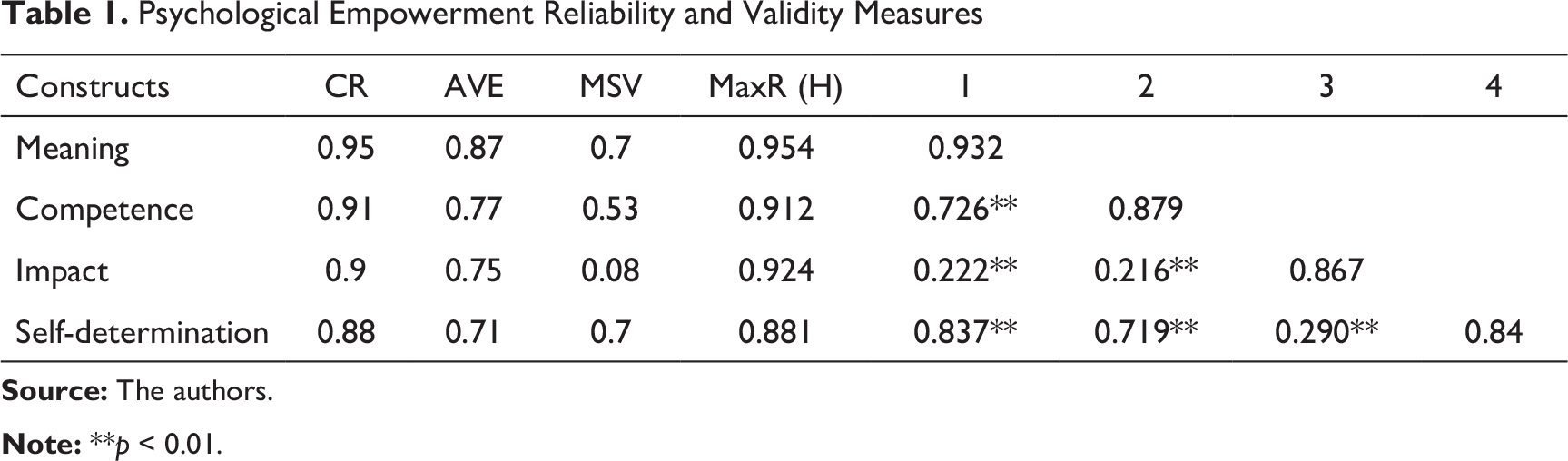
Psychological Empowerment Reliability and Validity Measures

Job Satisfaction Reliability and Validity Measures

Employee Engagement Reliability and Validity Measures
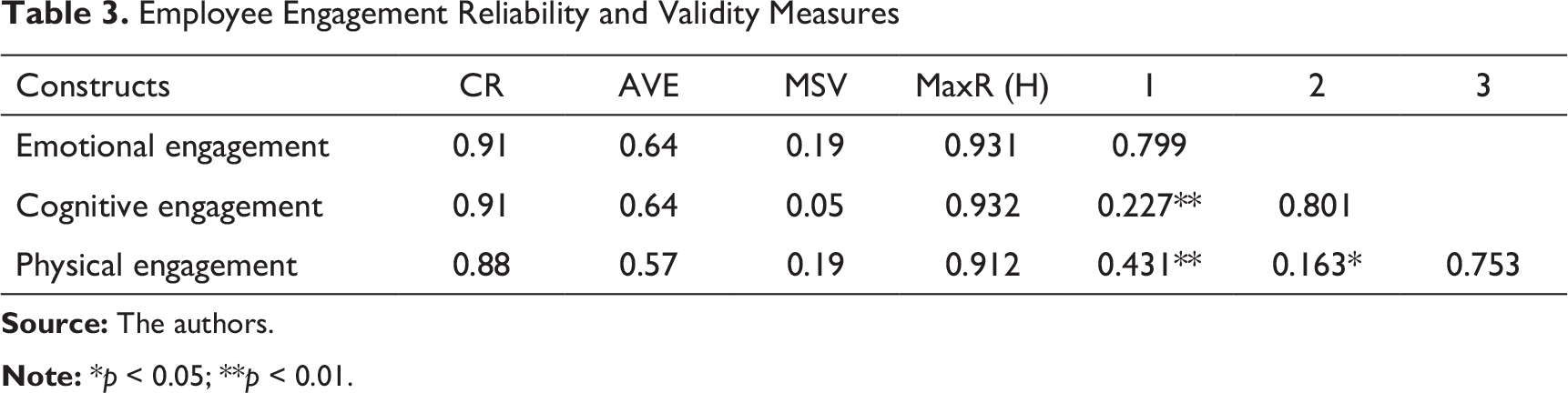


The measurement models show an adequate fit because the Chi-square/Df (c2/df) is between the cut of range 1–5. The Comparative Fit Index (CFI) values were closer to the threshold of 0.90. RMSEA and Root Mean Square Residual (RMR) values were less than the critical value of 0.08. The Goodness Fit Index (GFI) values were close to the threshold of 0.9, and Adjusted Good Fit Index (AGFI) values were higher to the limit of 0.8, and the results were supported by Hair et al. (2013) and Hu and Bentler (1999). The confirmatory factor analysis exhibits a satisfactory fit of the model to the data. The structural model results were shown in Figures 5–7. Based on the earlier discussion, the three structural models exhibit a satisfactory fit of the model to the data.
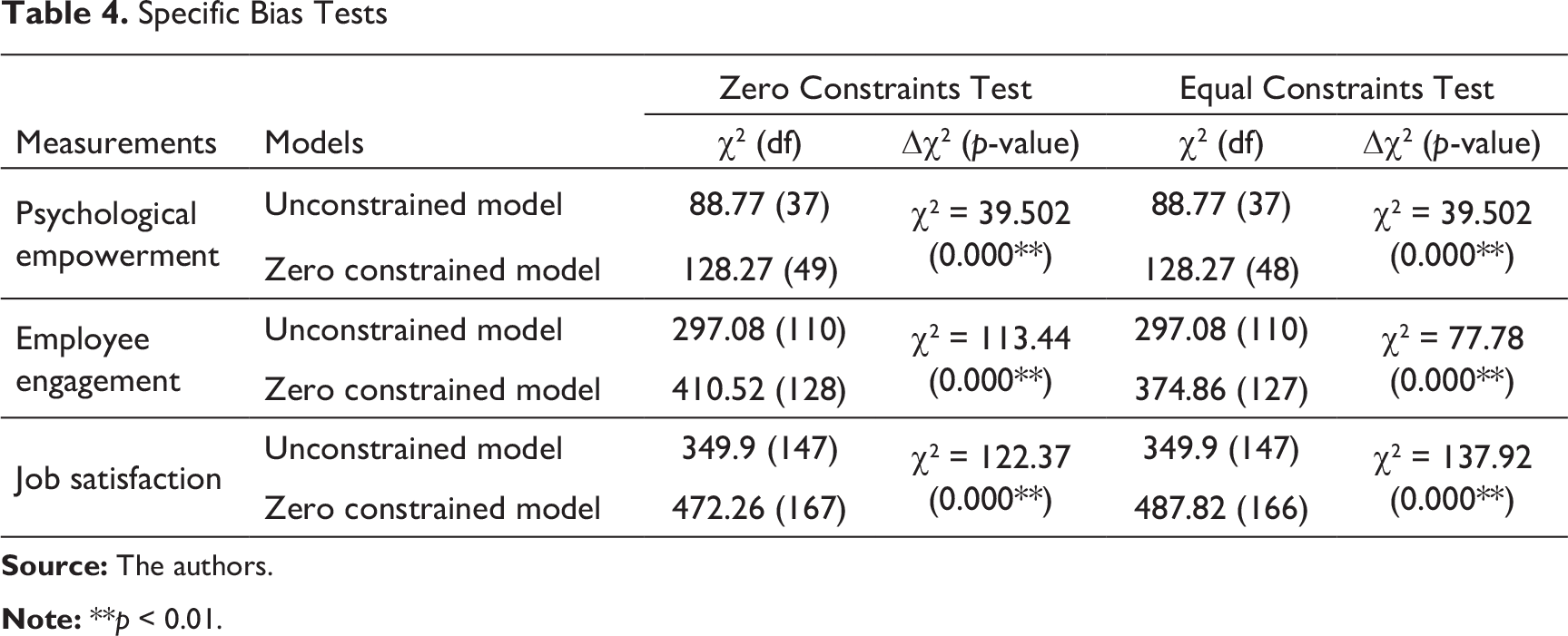
Common Method Variance (CMV) was defined as the ‘variance that is attributable to the measurement method rather than to the construct of interest’ (Bagozzi & Yi, 1991). Each research work should undergo checking for CMV. Presence of any unchecked CMV in research can undermine a study’s potential results and may be problematic in survey research (Craighead et al., 2011). Here, we did a post-survey analysis to check the CMV; in this article, the common latent factor was used to capture the CMV among all observed variables in the models (Lindell & Whitney, 2001; Podsakoff et al., 2012; Williams et al., 2010). The common latent variable was connected as a market variable. The specific bias test results in Table 4 conclude that the chi-square test for the zero-constrained model was significant (i.e., measurable bias was detected). Therefore, a bias distribution test was made (of equal constraints). The chi-square test is significant on this test as well (i.e., unevenly distributed bias); as per the literature, we should retain the common latent construct for subsequent causal analyses (Podsakoff et al., 2003, 2012). This equal specific bias demonstrated unevenly distributed bias.
The conceptual model was tested after verification of reliability and validity of the instrument. Before administering the mediation model, it is necessary to check the conditions recommended by Baron and Kenny (1986).
Those conditions are (1) independent variables have significant effects on the dependent variable and the mediator; (2) the mediator has a significant effect on the dependent variable; and (3) the impact of independent variables on the dependent variable diminish after the effects of the mediator are controlled for.
Specific Bias Tests
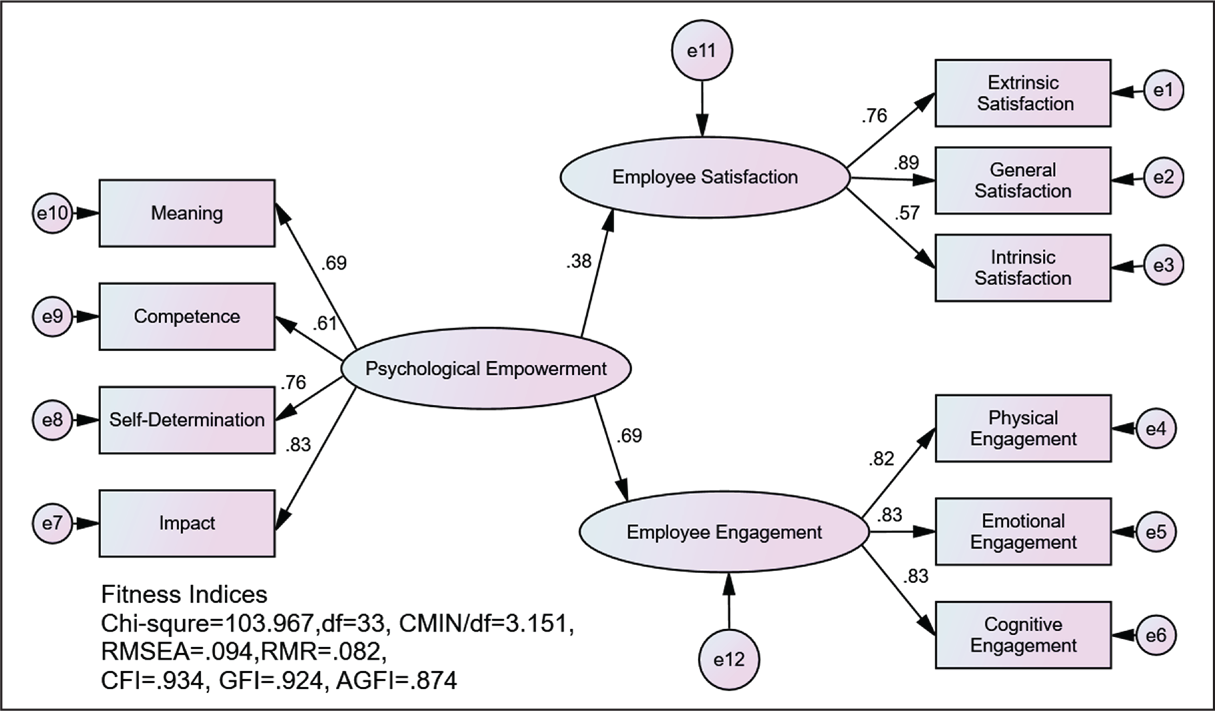
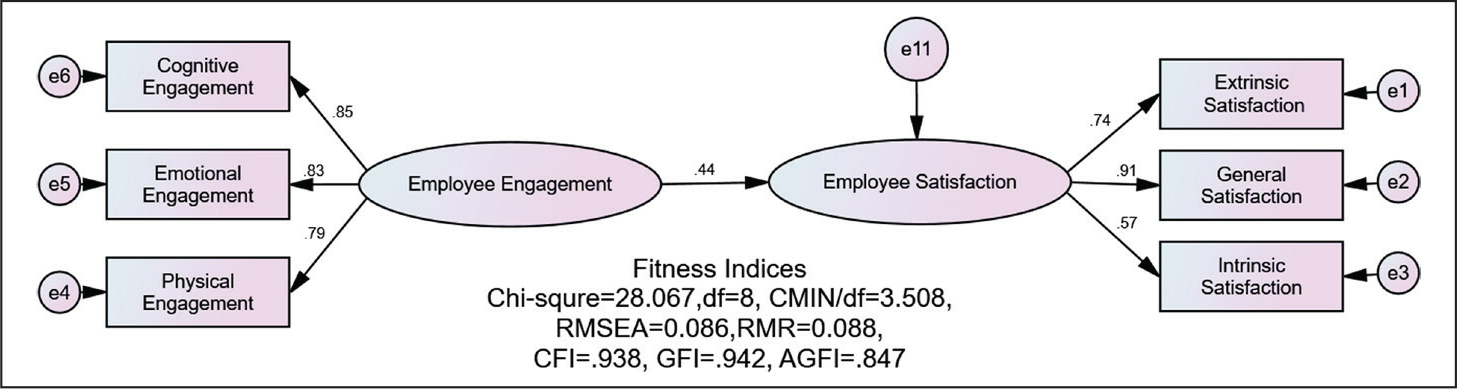
The direct effect concludes that the level of psychological empowerment of the employees have positive effect with job satisfaction (β = 0.385; p < 0.001, 95% CI [0.156, 0.511]), providing support to H2 and the direct model the level of psychological empowerment of the employees have positive effect with employee engagement (β = 0.689; p < 0.001, 95% CI [0.582, 0.777]), providing support to H1 and shows the adequate goodness of fit. The condition (1) was satisfied. To check the condition (2), the direct effect was tested to check the effect of employee engagement on employee satisfaction of the resort employees and the results indicate a positive effect of employee engagement on employee satisfaction (β = 0.440; p <0.001, 95% CI [0.311, 0.567]), providing support for H3 and condition (2).
To check the mediation effect of employee engagement, the mediation model incorporating engagement as a mediator was tested. According to the model fit indices, the model shows the adequate fit. The result indicates that psychological empowerment of the employees had a significant and positive effect on employee engagement (β = 0.671; p < 0.001; 95% CI [0.561, 0.760]). Besides, employee engagement had a significant and positive effect on employee satisfaction (β = 0.386; p < 0.001; 95% CI [0.178, 0.590]). The psychological empowerment of the employees does not have a significant impact on overall employee satisfaction (β = 0.069; p = 0.579). To check the condition (3), all the direct effects (Figures 1 and 2) were compared with those for the mediation model (Figure 3). With the inclusion of employee engagement in the direct model, the effect of psychological empowerment on employee satisfaction decreased from 0.385 to 0.069 and non-significant. The effect of the psychological empowerment becomes non-significant in the presence of the employee engagement as a mediator, and the effect of the psychological empowerment on employee satisfaction is said to be ‘fully’ mediated by the employee engagement.
These results indicate that psychological empowerment had a significant effect on job satisfaction of the resort employees through employee engagement. The finding suggests that employee engagement may be an essential factor in the relationship between employee psychological empowerment and employee satisfaction. Although psychological empowerment of employee had some direct effects, the results suggest that resorts should promote employee’s engagement better. Based on employee engagement as a full mediator, the resorts can enhance job satisfaction.
This study aims to examine the mediation of employee engagement on the relationship between employee psychological empowerment and job satisfaction of employees. An empirical analysis was done on Maldivian resorts to test the proposed conceptual model. The results indicate that psychological empowerment has a significant and direct impact on employee engagement and employee satisfaction. For the mediation model, employee engagement had a full mediating effect on the relationship of employees’ psychological empowerment to their outcome, namely employee job satisfaction. These results highlight the role of employee engagement in the psychological empowerment of resort employees.

Discussion
When employees have a high level of employee engagement in their jobs, it enables the resorts with superior performance and, in turn, help the resorts to create competitive advantage. Furthermore, highly engaged employees learn more and respond faster and are more creative. Engaged employees are resort ambassadors, and they can provide better service to the guests. Harter et al. (2002), Frank et al. (2004), Saks (2006) and Bailey et al. (2017) studies proved that employee engagement is the significant predictor of employee satisfaction, and our results are consistent with the literature. Engagement helps motivated and committed employees to the next level. Employees with a high level of engagement focus on the organizational goals and the results that the organization demands from them. Firms have the feeling that employees really can commit to the success of the firms, and that all their skills are being employed. Employee engagement and psychological empowerment serve potent approaches to improve productivity and profitability. Valued employees are satisfied employees, and pleasant employees encourage company success. Employees who do not seem happy or satisfied with the job will try another profession (Ugwu et al., 2014). This appears more often than most employees would prefer to admit. When employees seem empowered, the possibilities of employees’ intention of leaving are considerably decreased (Jose & Mampilly, 2014, 2015). Possibly most significant is that employees who are empowered are satisfied, fulfilled and engaged (Stander & Rothmann, 2010).
Implications
This study has significant managerial implications. From the above-stated discussions, it is clear that employee psychological empowerment begins with an increase in job satisfaction and increased engagement, suggesting that resorts should enhance the capacity to make decisions about when they work, how work gets done and what their priorities are (Karatepe, 2013). Because of the critical role performed by employee engagement, resorts should promote employees’ empowerment and develop a link between leaders and employees as strategic objectives. This study also suggests employing the management’s ability to influence employee engagement strategies in an organization. The use of efficient employee engagement strategies may support management in successfully engaging employees and sustaining profitability (Berens, 2013). The resorts should invest more in improving employee engagement strategies, after understanding the link between employee engagement and job satisfaction. Well-developed employee engagement strategies could fill the gap between employee motivation and job performance by including employee requirements (Bedarkar & Pandita, 2014; Shuck & Wollard, 2010). Even though this research was done in the Maldivian tourism sector, these study results could be generalized to other service-related industries like lodging, food and beverage service, event planning, transportation, telecommunication and additional fields within the hospitality industry. Since the tourism and hospitality industry plays a significant role in the Maldivian service industry, these HR practices (psychological empowerment of employee, employee engagement and job satisfaction) could be used as benchmarking strategy by other service industries to improve their performances. The present study has provided new insights into the mediating role of employee engagement on the relationship between psychological empowerment and employee satisfaction with regard to the service sector.
Conclusion
Maldives is primarily based on the tourism sector, where a significant amount of GDP depends on the tourism sector (The World Bank Group, 2019). Resorts and guesthouses are the power hubs for the economic development of the country, and employees are the primary source of service providers to tourists, which helps the resorts to retain their tourist population (He et al., 2010; Lin et al., 2017). Hence, this study concludes that employee psychological empowerment and employee engagement are crucial to improve employee satisfaction.
Limitations and Future Research
This study has a few limitations. There are more than 100 operating resorts in Maldives and result generalization is limited by the sample size, and therefore, it is challenging to form generalized implications. In this regard, further research should focus on more samples from different levels of resorts and guesthouses, which may help produce more precise implications of the missing link. The second limitation of this study is mediator usage. In this study, employee engagement was used as a mediator; there might be some other variables, which could be used as mediator such us employee commitment (Han et al., 2016), organization trust (Ugwu et al., 2014), job insecurity (Stander & Rothmann, 2010), perceived supervisor support (Jose & Mampilly, 2015) and organizational citizenship behaviour (Chiang & Hsieh, 2012) that also mediate the relationship between psychological empowerment and job satisfaction. Other mediators need to be investigated in future research. The last limitation is about the data analysis; Covariance-Based Structural Equation Modeling was used in this study to test the proposed model; In this regard, other comparative approaches such as the partial least squares method should be used in future studies, to get more robust results (Astrachan et al., 2014).
Footnotes
Acknowledgements
The authors of this study are grateful to the anonymous referees of the journal for their extremely useful comments and suggestions to improve the quality of this article. Usual disclaimers apply.
Declaration of Conflicting Interests
The authors declared no potential conflicts of interest with respect to the research, authorship and/or publication of this article.
Funding
The authors received no financial support for the research, authorship and/or publication of this article.
