



Abstract
This article serves two purposes. First, it attempts to examine the joint impact of corporate governance mechanisms and corporate social responsibility (CSR) practice on firm performance. Second, the moderating role of board independence is investigated on 588 non-financial Malaysian firms listed on Bursa Malaysia during the period 2006–2017. Both accounting-based return on assets (ROA) and market-based (Tobin’s Q) performance measures have been used for measuring performance. Dynamic model using Generalized Method of Moments (GMM) has been employed on the data set to control for potential endogeneity, reverse causality and dynamic heterogeneity. Findings indicate that ROA is a better determinant of firm performance than Tobin’s Q, where ownership concentration, managerial ownership and money spent on CSR negatively affect ROA; however, an insignificant relationship is observed with Tobin’s Q. Finally, board independence negatively moderates governance-CSR and firm performance relationship. Findings of this article have implications for Bursa Malaysia and Securities Commission Malaysia to reset the limit of independent directors on board so that their unnecessary interference in operations of management may be avoided. Furthermore, companies need to reassess their CSR strategies whether they are spending on CSR activities or hiding their financial malfeasance in the name of money spent on CSR.
Keywords
Introduction
The role of corporate governance has been signified abundantly in the past after the financial crisis for its contribution towards wealth maximization of shareholders. In the meantime, Malaysia also suffered the same fate when many organizations crumpled from lack of appropriate governance and social responsibility practices. Despite the provision of Malaysian Codes on Corporate Governance, there is still a need of examining the compliance by listed companies. However, it is not only about corporate governance but also about corporate social responsibility (CSR) that fetches the attention of shareholders as well as stakeholders. As corporate governance and CSR (Jones & Thompson, 2012) are not separate; rather, they are interrelated, leading firms towards a long-term sustainable governance practices.
Further to that, CSR has emerged as an important pillar for strengthening corporate governance mechanisms. Several studies attempted to indicate their interrelationship (Arora & Bodhanwala, 2018; Jamali et al., 2008; Sneirson, 2009), but empirical support for this relationship is minimal (Barnea & Rubin, 2010; Byron & Post, 2016; Jo & Harjoto, 2011). Additionally, the combined effect of corporate governance and CSR on firm performance is still questionable. There are researches that independently examine the impact of governance mechanisms and CSR practice on firm performance. However, empirical support for their integrated affect on performance is still unanswered. Hence, the first objective of the study is to examine the joint impacts of corporate governance attributes and CSR practice on firm performance. Moreover, outsider representation on board, that is, board independence, has also gained the attention of academia as well as of practitioners for assessing the compliance of corporate governance codes in different countries.
Additionally, Bursa Malaysia revealed in a report that majority of the board of directors did not know their ultimate responsibilities towards the firm. Therefore, board independence is important due to their role in effective monitoring in the daily affairs of the firm. Bursa Malaysia in its Corporate Governance Code (2017) has set the limit of more than a 50 per cent representation of independent directors on board. Hence, this study is unique in investigating the moderating role of an independent board of directors on governance mechanisms, CSR practice and performance relationship. Thus, the second objective of this article is to examine the moderating effect of independent directors for corporate governance attributes, CSR practice and performance relationship.
Based on the earlier arguments, there are two objectives of this study, that is, (a) to examine the combined impact of governance mechanisms and CSR on firm performance in Malaysian Listed Companies and (b) to investigate the moderating effect of board independence on the relationship between governance mechanisms, CSR and firm performance.
Governance mechanisms examined in the study are ownership concentration, managerial ownership, institutional ownership and chief executive officer (CEO) duality, whereas money spent on CSR is used as a measure of CSR. In this way, the chief results of the study indicate ownership concentration, managerial ownership and money spent on CSR are negatively related to ROA. However, only firm size is positively linked to Tobin’s Q. As far as board independence is concerned, the presence of independent directors on the board negatively moderates governance mechanisms, CSR practice and performance relationship. The findings have novel implications for policymakers and regulatory authorities of Malaysia to assess the combined effect of governance structure and CSR on performance of listed firms and to reduce the representation of the independent board of directors on the board and to have their positive moderating impact on the given relationship. Moreover, for academia, this research is significant for uncovering new aspects of sustainable governance practices through different empirical and econometric approaches, using the dynamic Generalized Method of Moments (GMM) method for analysis.
The rest of the article is organized as follows: the second section presents review of the literature. The third section discusses about the research methodology. Thr fourth section provides empirical results, whereas the fifth section discusses empirical results. Finally, the sixth section concludes the article by providing limitations and suggestions for future research.
Literature Review
The following paragraphs present a review of earlier empirical studies, concerning corporate governance mechanisms such as ownership concentration, managerial ownership, institutional ownership and CEO duality, and CSR practice, that is, money spent on CSR and its impact on firm performance. Moreover, the moderating effect of board independence is also reviewed based on prior literature.
Ownership Concentration and Firm Performance
Agency theory presumes that top managers acting as agents of the block holders can pursue courses of action that may not be consistent with the interest of owners (Fama, 1980; Jensen & Meckling, 1976). The rationale behind this is a separation between management and ownership, raising problems of interest between the owners and managers, as the opportunistic behaviour of the managers would endanger the owners’ interests. La Porta et al. (2000) consider it as a prospective cause of conflict of interest between major and minor shareholders. However, block holder ownership is considered as a way to decrease the conflict of interest between shareholders and management. Alternatively, Haniffa and Hudaib (2006) are of the view that owners, having a major percentage of an organization’s assets, allow block holders to monitor and control the behaviour of managers, leading to conflict of interest.
Managerial Ownership and Firm: Performance
It is perceived that managers will work for the best interests of organizations if they have ownership in the firm. Or else, a potential conflict of interest between managers and owners of the firm can be raised. The agency issues between shareholders and management may encourage the managers to exert less effort to administrate the firm (Ahmed & Mubaraq, 2015). Moreover, these issues may lead the managers to use available resources for their personal well-being. However, agency problem may be reduced if managers hold a large fraction of the firm’s equity (Bokpin, 2013; Omran, 2009).
Institutional Ownership and Firm Performance
Pound (1988) presented three hypotheses, namely efficient monitoring, conflict of interest and strategic alliance to explicate the relationship between firm value and institutional shareholdings. McConnell and Servaes (1990), Han and Suk (1998), Arouri et al. (2014) and Sheikh and Karim (2015) reported a positive relationship between institutional ownership and firm performance based on the argument that institutional investors may better monitor the management affairs. Alternatively, the negative impact of institutional ownership on firm performance presumes that institutional investors might have been cautious in their investment decisions amidst fear from the recent global financial crisis (Ahmed & Mubaraq, 2015).
Chief Executive Officer Duality and Firm Performance
Agency theory asserts that problems arise when the same person holds two positions on the board, leading towards performance inefficiency and ultimately towards conflict of interest (Duru et al., 2016; Ujunwa, 2012). Alternatively, stewardship theory assumes when the same person holds two positions, performance increases because the same person can better understand his roles and responsibilities (Al-Saidi & Al-Shammari, 2013; Sheikh et al., 2013). Opposing the two schools of thoughts, Boyd (1994) argues that CEO duality is contingent, and it can neither be predicted through agency theory nor through stewardship theory; rather, it is situation dependent.
Money Spent on Corporate Social Responsibility and Firm Performance
Porter and Kramer (2006) stated that CSR can be a source of opportunity, innovation and competitive advantage when used appropriately. Particularly, firms can simultaneously enhance their competitiveness in the markets and advance the economic and social conditions in the communities when adopting policies and practices, aiming at creating ‘shared value’. Alternatively, firms face trade-off between social responsibility and firm performance, placing them in a disadvantageous cost position, incurring agency costs where managers attain private benefits from building the reputation as good social citizens at the expense of shareholders (Barnea & Rubin, 2010; Jo & Harjoto, 2011; Karim et al., 2019a, b; Kotchen & Moon, 2012).
Moderating Effect of Board Independence
The role of the board of directors as an effective monitoring mechanism for management is dependent upon them being non-executive and independent. Furthermore, the inclusion of independent directors on corporate boards is an effective mechanism to reduce the potential divergence between management and shareholders. Several empirical researches include board independence to explore the moderating impact on the respective relationships with mixed results (Chen, 2011; Duru et al., 2016; Moussa, 2019; Şahin et al., 2015; Wu & Wu, 2014). These studies argue that interest of independent directors is linked with lower-risk investment decisions. Contrarily, it is also claimed that excessive involvement of independent directors in the daily affairs of organizations may restrict the managers to perform their functions liberally.
Research Methodology
Data Source and Sample Frame
This study used the data of Malaysian non-financial companies listed on Bursa Malaysia for the period 2006–2017. The data were mainly extracted from annual reports of firms; however, datastream is used for obtaining data relevant to performance variables like return on assets and Tobin’s Q. Unbalanced panel data are employed for the study due to unavailability of annual reports of few listed companies. Data of financial companies have been excluded from the data set due to the different nature of business of these firms. Moreover, the study includes the data of both active and inactive firms to avoid survivorship bias. Therefore, final sample consists of 5,501 firm-year observations of 588 non-financial listed firms in Malaysia during the period 2006–2017. The rationale for choosing the 12-year data ranging from 2006 to 2017 is for pooled estimations, more than 10 years panel data is considered sufficient and appropriate for analysis purpose (Bond, 2002).
Operational Definition and Measurement of Variables

Empirical Model
This study employs a dynamic system of GMM for estimations and analyses of data. Since static estimations are considered incompetent for explaining coherent results of variables, the dynamic model using system GMM produces reliable and accurate results (Arellano & Bond, 1991; Arellano & Bover, 1995). Dynamic models are specified with lagged dependent variables and control for unobserved heterogeneity, reverse causality, simultaneity and dynamic endogeneity. Furthermore, dynamic models basically concentrate on single equation and autoregressive distributive lag models where large number of cross-sectional units and small number of time periods bring consistent outcomes (Bond, 2002). Therefore, regression equations for this study are as follows:


However, for investigating the moderating effect of board independence on the relationship between governance mechanisms, CSR practice and firm performance, the regression equations are as follows:


where
The model was estimated by using the panel data method. The use of panel data analysis has several advantages over other models (Arellano & Bond, 1991), where more information is available; greater variability of data; greater control of the endogeneity that tends to arise from the causal relationship; greater control of possible collinearity between independent variables; reduction of the problem of negligence of explanatory variables; greater number of degrees of freedom and greater efficiency in estimation; more accurate inference of model parameters; increased ability to capture the complexity of relationships; and greater control of the impact of the omitted variables. This method also allows the suppression of unobservable heterogeneity which, due to nature of the problems, could bias the results.
Thus, unlike cross-sectional analysis, panel data allow controlling individual heterogeneity, and this fact is very important because the ROA relies on management decisions and human choices, and this circumstance could be very closely related to the specificity of each firm. Another important issue addressed by using the panel data method is the endogeneity problem. This method accommodates the possible endogeneity between the dependent variable and some of the explanatory variables in the model by means of appropriate instruments. In particular, the system GMM estimator uses lagged values of the dependent variable in levels and in differences as instruments, as well as lagged values of other repressors, which could potentially suffer from endogeneity. The latter problem would lead to a correlation between those endogenous variables and the error term, resulting in too inconsistent estimates if not properly handled (Karim et al., 2019b). Thus, following these presumptions, the use of panel data for dynamic estimations is considered appropriate for regression model presented earlier.
Empirical Results
Descriptive Statistics and Correlation Matrix
Descriptive Statistics

System Generalized Method of Moments Regression Results
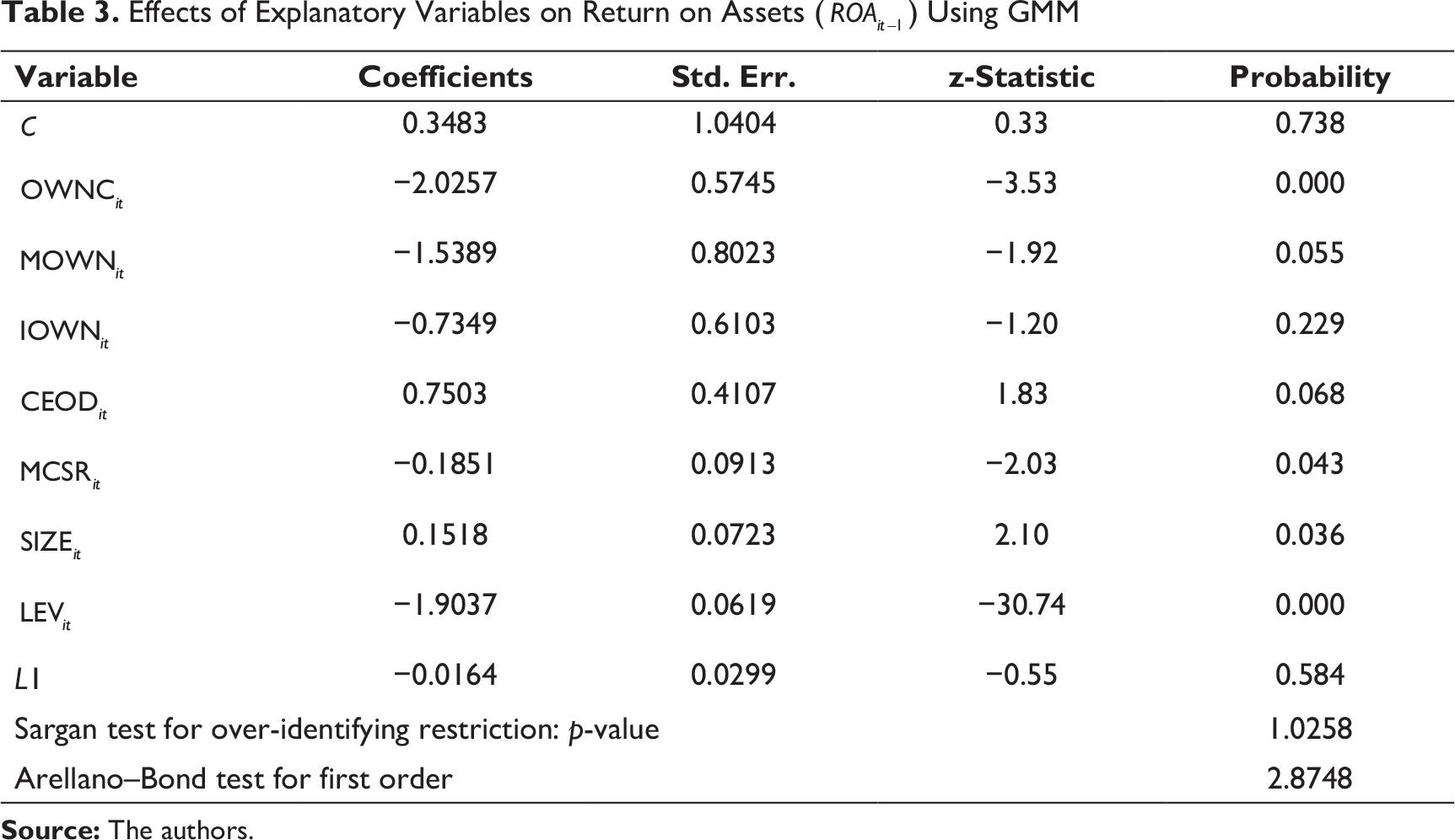
As stated earlier, this study employs dynamic modeling for estimation process of the data set as system GMM gives accurate and precise results. Table 3 exhibits the regression results of the impact of corporate governance mechanisms and CSR practice on ROA. However, in system GMM, 1-year lagged value of ROA is used. The findings reveal that ownership concentration and managerial ownership are negatively and significantly linked to
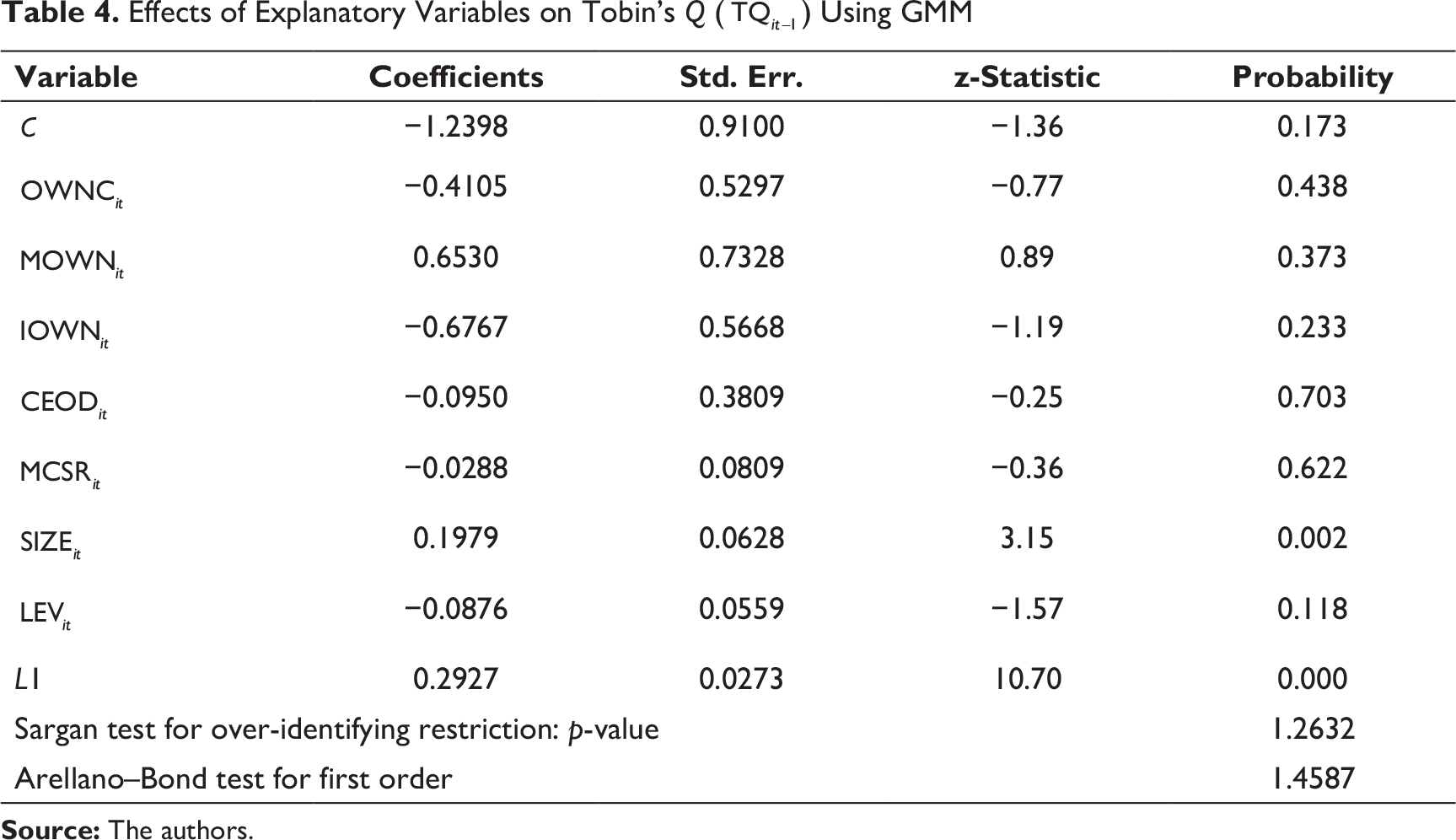
Table 4 gives the results relating the impact of internal attributes of corporate governance and CSR practice on Tobin’s Q. Findings indicate block holder ownership, institutional ownership, CEO duality and money spent on CSR are negatively related to Tobin's Q. Moreover, there is a positive relationship between managerial ownership and Tobin’s Q. However, none of the variables show significant results with
Effects of Explanatory Variables on Return on Assets (
) Using GMM
Effects of Explanatory Variables on Tobin’s Q (
) Using GMM
Moderating Effect of
on Governance Mechanisms, CSR and Firm Performance

In sum, ownership concentration is negatively related to
Discussion
The aims of this study are to assess the impacts of governance mechanisms and CSR practice on firm performance, and to examine the moderating effect of board independence on the given relationship. The regression results indicate that ownership concentration is negatively affecting
Moreover, managerial ownership is negatively related to prior ROA, embracing the entrenchment hypothesis assumptions that managers who tend to have stakes in the firm are involved in obtaining personal benefits. The agency issues between shareholders and management may encourage the managers to exert less effort to administrate the firm. Moreover, these issues may lead the managers to use available resources for their personal well-being. However, agency problem may be reduced if managers hold a large fraction of the firm’s equity. Accordingly, the negative results are in accordance with Ahmed and Mubaraq (2015) and Aluchna and Kaminski (2017).
Concerning the CSR practice, that is, money spent on CSR and its effect on firm performance indicate the negative relationship with lagged return on assets. The probable explanation for this relationship is that firms face trade-off between social responsibility and firm performance, placing them in a disadvantageous cost position incurring agency costs, where managers attain private benefits from building the reputation as good social citizen at the expense of shareholders (Barnea & Rubin, 2010). Therefore, CSR has a value-decreasing impact in the face of high-level managerial entrenchment, where managers overinvest in CSR activities for their personal benefits to camouflage their corporate misconduct (Jo & Harjoto, 2011; Kotchen & Moon, 2012). It indicates that managers of Malaysian firms overinvest in the CSR activities to hide their financial misconduct, thus creating agency costs for firms and negatively affecting firm performance. However, these findings are parallel to the findings of Sadeghi et al. (2016).
Furthermore, board independence negatively moderates the significant relationship between corporate governance mechanisms, corporate social responsibility practice and firm performance. This outcome confirms the predictions of agency theory, where higher outsider representation is the prospective cause of conflict of interest between shareholders and management. However, this result suggests that excessive involvement of the independent directors in the daily affairs of organizations may restrict the managers to perform their functions liberally, and hence negatively moderating the relationship. However, this finding is analogous to the finding of Wu and Wu (2014).
Findings related to control variables suggest a positive relationship between firm size and both performance measures due to scale economies where organizations get resources at lower cost but at greater diversification. However, the finding is parallel to the results of Hassan and Halbouni (2013), Ahmed and Mubaraq (2015), and Ofoeda (2017). Alternatively, the negative relationship between leverage and firm performance suggests that agency issues are the potential cause of firms to use higher levels of debt, limiting managers to perform firm’s operations effectively, thus negatively affecting the performance. Conversely, the negative relationship is in congruence with Muttakin and Subramaniam (2015), and Mishra and Kapil (2017).
Conclusion
Conclusively, this study attempts to investigate the joint impacts of corporate governance mechanisms and CSR practice on firm performance and to examine the moderating role of board independence of the given relationship. The findings reveal significant results for studying the combined impact of governance mechanisms and CSR practice on firm performance in the unique way. Moreover, the negative moderating role of board independence exhibits novel approach towards this study. Correspondingly, the article has both theoretical and practical implications. For example, the study obtains support from agency theory and the agency cost approach for explaining the majority of the relationships and moderating role of board independence on the relationship between governance mechanisms, CSR practice and firm performance. Conversely, the study raises the matter of compliance of code of corporate governance in Malaysia in front of Bursa Malaysia and Securities Commission Malaysia. And, this research has gained the attention of regulators to redefine the proportion of independent directors on board so that firms avoid unnecessary interference of independent directors in the daily processes of organizations. Moreover, the study is also practically important for stakeholders, investors, depositors, managers and employees of firms in Malaysia in terms of corporate governance mechanisms, CSR practice and firm performance.
Footnotes
Acknowledgement
The authors are grateful to the anonymous referees of the journal for their extremely useful suggestions to improve the quality of this article. Usual disclaimers apply.
Declaration of Conflicting Interests
The authors declared no potential conflicts of interest with respect to the research, authorship and/or publication of this article.
Funding
The authors received no financial support for the research, authorship and/or publication of this article.
