



Abstract
The application of good corporate governance (GCG) aims to improve company performance. In implementing GCG, a mechanism is needed, namely a procedure and a clear relationship between the decision-maker and the party overseeing the decision. The mechanism of GCG can be measured by the numbers of board of directors, independent board of commissioners, audit committees, and also managerial ownership. This research is conducted at manufacturing companies listed on the Indonesia Stock Exchange, with a total sample of 52 companies determined by purposive sampling technique. Data are analyzed by using multiple regression analysis with statistical package for the social sciences (SPSS) tools. The findings show that the board of directors and independent commissioners have an influence on company performance, while audit committees and managerial ownership do not affect the company’s performance. The company’s performance is improved by the existence of an independent board of commissioners that provides guidance and direction as well as supervision to the company management. Meanwhile, the audit committee has no influence, because the audit committee is only responsible for assisting the board of commissioners in monitoring the financial reporting process by the management to improve the credibility of financial statements, and managerial ownership does not affect the company’s performance because the number of management shares is quite low, because of which the management cannot influence the decisions taken at the general meeting of shareholders to improve the company’s financial performance. Thus, if the GCG mechanism goes well, then the company’s performance will increase.
Keywords
Introduction
Performance is an illustration of the achievement of the implementation of an activity in realizing company goals (Hartono & Nugrahanti, 2014). Financial performance can be seen from the profitability ratios of companies that measure the ability to obtain profits by using assets or company capital, where the higher the profitability ratio, the better, because the profit obtained is greater (Sjahrial & Purba, 2013). Profit is very effective as a tool for measuring company performance and as a decision-making tool, because with profit, a company is believed to be able to manage the funds invested by investors well, so other investors are also interested in investing in the company (Napitupulu & Kurniati, 2011). If a company has the trust of investors, then investors and other stakeholders do not hesitate to make investments that will cause the company’s value to increase (Garay & González, 2008; Haat et al., 2008). Profitability ratios that can be used as a measure of company performance include return on assets (ROA) (Ahmed & Hamdan, 2015; Hassan & Halbouni, 2013; Lee et al., 2016; Rose, 2016; Vo & Nguyen, 2014). This ratio is important for the management to evaluate the effectiveness and efficiency of the company management in managing all company assets (Puspitasari & Ernawati, 2010). The greater the ROA, the more efficient the use of company assets; in other words, the same amount of assets can generate greater profits (Sudana, 2011, p. 20). In order for companies to maintain and improve efficiency, both in terms of operations and investment, both in times of a stable economy and during a crisis, it is necessary to apply good corporate governance (GCG) (Ahmed & Hamdan, 2015; Vo & Nguyen, 2014).
Good corporate governance is the duty of every company to improve the performance of management in controlling the practice of fraud in the corporation, as well as determining the direction and control of company performance (Manik, 2011). Corporate governance describes a set of institutions that determine how a company regulates shareholder rights, rules that determine how members of the board of directors are elected through their performance (Mueller, 2018). It is also believed that the implementation of good corporate governance is another form of upholding business ethics and work ethics that have long been indicators of a company’s commitment, so that it can improve the company’s image (Purwani et al., 2017). Corporate governance is also implemented because there are concerns about controlling shareholders taking over wealth from minority shares (Globerman et al., 2011). This means that implementing good corporate governance will protect the interests of shareholders and related parties in managing the company.
In 2008, there was an economic crisis in which there were financial scandals in large companies in the world such as Lehman Brothers and Goldman Sachs, and in 2012, there were scandals that hit financial institutions such as JP Morgan, Barclays, UBS, and others. This condition is indicated by companies’ poor performance, which has an impact on business collapse. Principles of good corporate governance are needed to deal with the economic crisis and also to rise from an economic crisis (Grove et al., 2011; Liu et al., 2012; Peni & Vähämaa, 2012). Thus, companies that implement good corporate governance will be able to maintain stable performance, so that they can survive in business competition in the present and the future, especially in the economic crisis (Darwis, 2009; Erkens et al., 2012; Sulistyowati, 2017). GCG is a system that regulates and controls companies to create added value for all stakeholders (Sutedi, 2017, p. 2).
In Indonesia, the application of GCG has been developed since the economic crisis that struck in 1997–1998, the aim is to improve companies’ performance with the principles of transparency, accountability, responsibility, independence, and fairness. Even though the implementation of governance in Indonesia has been implemented for two decades, there are still cases of companies indicated with good governance crisis such as the case of Lapindo Brantas LTD, the effect of Lapindo’s misconduct cost the community damage in material. This problem also occurred in Davomas Abadi LTD, by not obeying the regulations making the IDX (Indonesia Stock Exhange) carry out forced delisting. Co, the impact of procedural errors caused the community to experience substantial material losses. Problems also occur at Davomas Abadi. Co, by not obeying the rules so that the Indonesia Stock Exchange (IDX) carried out forced delisting. Fraudulent company organizers occur because they do not carry out supervision properly so that the practice of corruption, collusion and nepotism (Sedarmayanti, 2012, p. 50). Other problems that often arise in Indonesia are often found in the business world, such as bribery and corruption, embezzlement of funds, investment fraud, abuse of authority, environmental pollution, injustice of employee treatment, fraud, and so forth, to the detriment of stakeholders and the public. These many cases prove that corporate governance in Indonesia is still ranked low in Southeast Asia (Afrianto, 2017), and there are still many issuers that have poor corporate governance (Binsasi, 2018). The results of a survey conducted by the Asian Corporate Governance Association (ACGA) and CLSA Limited in 12 companies in the Asia Pacific found Indonesia ranked at the bottom (Flo, 2018); this proves that Indonesia’s rating has deteriorated. Specifically, Indonesia’s rating is considered weak on the score of government and public governance, regulators, reform, enforcement, and investors.
The issue of good corporate governance is a global issue that is widely discussed, because the existence of good corporate governance will protect every stakeholder in the company, create added value for all stakeholders, and prevent manipulation within the company, so as to improve organizational performance (Agoes & Ardana, 2014). To carry out good corporate governance, it is necessary to optimize the mechanism of good corporate governance, because it will increase supervision of the company towards a better direction (Bhojraj & Sengupta, 2003). Companies that implement strong corporate governance will outperform companies that have a weak corporate governance (Bhatt & Bhatt, 2017). Good corporate governance mechanisms in this study were inspired by previous studies including the board of commissioners, the size of the board of directors, the existence of an audit committee, an independent board of commissioners, and managerial ownership (Agoes & Ardana, 2014; Al-Bassam et al., 2018; Kyereboah-Coleman, 2008; Darwis, 2009; Martsila & Meiranto, 2013; Sutedi, 2017, p. 1; Vo & Nguyen, 2014).
Good corporate governance is becoming a global issue, as evidenced by the many studies on good corporate governance carried out in various countries, such as research conducted in the Middle East (Ahmed & Hamdan, 2015; Al-Bassam et al., 2018), USA and Canada (Berthelot et al., 2010; Gill & Obradovich, 2012; Grove et al., 2011; Hussain et al., 2018; Malik & Makhdoom, 2016), South Asia (Ibrahim et al., 2010; Kumar & Singh, 2012; Sheikh et al., 2013), East Asia (Globerman et al., 2011; Hu et al., 2010; Lee et al., 2016), Southeast Asia (Bhatt & Bhatt, 2017; Goh et al., 2014; Ibrahim & Samad, 2011; Vo & Nguyen, 2014), and Africa (Mohammed, 2012; Ongore & K’Obonyo, 2011). The results obtained support that good corporate governance is very necessary in a company, because good corporate governance can take care of all stakeholders and improve company performance. However, the results of research conducted show not all elements of corporate governance mechanisms can affect company performance.
The results of research conducted in various countries on the effect of corporate governance on company performance have inspired researchers in Indonesia. Researchers in Indonesia have done a lot of research on corporate governance in various business sectors, such as Darwis (2009), Amyulianthy (2012), Manik (2011), Bukhori (2012), Adestian (2015), Irma et al. (2015), Aprianingsih (2016), Mulyasari et al. (2017), Septiana et al. (2016), Sulistyowati (2017), Purwani et al. (2017), Putri and Muid (2017), and Sarafina and Saifi (2017). Research conducted in Indonesia and in various countries show the same results; there are those who find that the mechanism of GCG affects the company’s performance, and there are also those who find that the mechanism of GCG does not affect the company’s performance. The differences in the results of previous studies have inspired this study and proven again where the optimization of corporate governance mechanisms proxied by the board of directors, independent commissioners, audit committees, and managerial stock ownership can improve company performance, which is predicted by return on assets (ROA). This research was conducted with a sample and analysis unit taking data from Indonesian manufacturing companies listed on the Indonesia Stock Exchange. The observation took place between 2012 and 2017.
Review of Literature
The Company’s Performance
The company’s performance is a product of administrative activities, namely cooperation activities to achieve corporate goals that are a reflection of success in running a business (Amirullah, 2015, p. 208). The company’s performance can be measured from the financial statements produced in one accounting period, because the financial statements are one of the media used to measure a company’s long-term performance from the actualization of managerial performance aspects (Manik, 2011). Performance measurement shows a close relationship between planned goals and the results achieved by the company (Hery, 2017, p. 217), so that success can be determined through whether a strategy has been set and can be used as a tool for continuous improvement (Amirullah, 2015, p. 216). Measurement of company performance can use profitability ratios. Profitability ratios are measurements of the ability to earn profits using company assets or capital. It can be ascertained that the higher the profitability ratio, the better, because the profit obtained is greater (Sjahrial & Purba, 2013). Profitability ratios can use ROA, return on equity (ROE), net profit margin (NPM), and earning per share (EPS) (Napitupulu & Kurniati, 2011).
In this study, the measurement of company performance uses ROA, as was done in the studies of Hassan and Halbouni (2013), Lee et al. (2016), Vo and Nguyen (2014), Ahmed and Hamdan (2015), and Rose (2016). ROA is used as a performance measurement tool because it shows the company’s ability to use all assets owned to generate profits after tax. This ratio is important for the management to evaluate the effectiveness and efficiency of company management in managing all company assets (Sarafina & Saifi, 2017). A greater ROA means more efficient use of company assets; in other words, the same amount of assets can generate greater profits (Sudana, 2011, p. 20).
Good Corporate Governance
GCG is a set of rules governing the relationship between shareholders, managers (managers) of the company, creditors, government, employees, and other internal and external stakeholders relating to their rights and obligations, or in other words, a system that regulates and controls the company (Forum for Corporate Governance in Indonesia [FCGI], 2006). Implementing GCG will also protect the interests of shareholders and related parties in managing the company. A company also believes that implementing GCG is another form of upholding business ethics and work ethics as a corporate commitment and improving the company’s image (Purwani et al. 2017).
According to the FCGI (2006), the goal of implementing GCG in every organization is to (a) improve company performance through the creation of a better decision-making process so that the achievement of operational efficiency of the company is achieved and to improve services to stakeholders; (b) make it easier to obtain cheaper funds so as to increase corporate value; (c) restore investor confidence to invest in Indonesia so that it helps companies develop funds to expand their business; and (d) ensure shareholders are satisfied with the company’s performance because it will increase shareholders’ value and dividends. Meanwhile, according to Agoes and Ardana (2014), the objectives of GCG are to: (a) improve organizational performance; (b) create added value for all stakeholders; (c) prevent and reduce significant manipulation of errors in organizational management; and (d) increase efforts so that stakeholders are not disadvantaged.
Stakeholder theory says that companies are not entities that only operate for their own interests but must provide benefits for stakeholders (shareholders, creditors, consumers, suppliers, government, society, and other parties). Thus, the existence of a company is strongly influenced by the support given by stakeholders to the company (Ghozali & Chariri, 2014, p. 439). Stakeholder theory also reveals that stakeholders are not absent from the role of influencing a company‘s going concern, both for internal and external parties, and each stakeholder has their own interests (Lindawati, 2015).
In addition to stakeholder theory, the concept of corporate governance mechanism also uses agency theory, a theory that states that there are differences in interests between owners (shareholders), board of directors, and company employees, which can then lead to conflict between individual interests and corporate interests (Hartati et al., 2014). Agency theory can imply or give rise to information asymmetry. Conflict between groups or agency conflict is a conflict that arises between the owner and manager of the company where there is a tendency for managers to prioritize individual goals rather than company goals (Jensen & Mecling, 1976). Conflicts of interest will arise and information asymmetry will often occur if there are more directors in the company, and if the manager has a stake in the company.
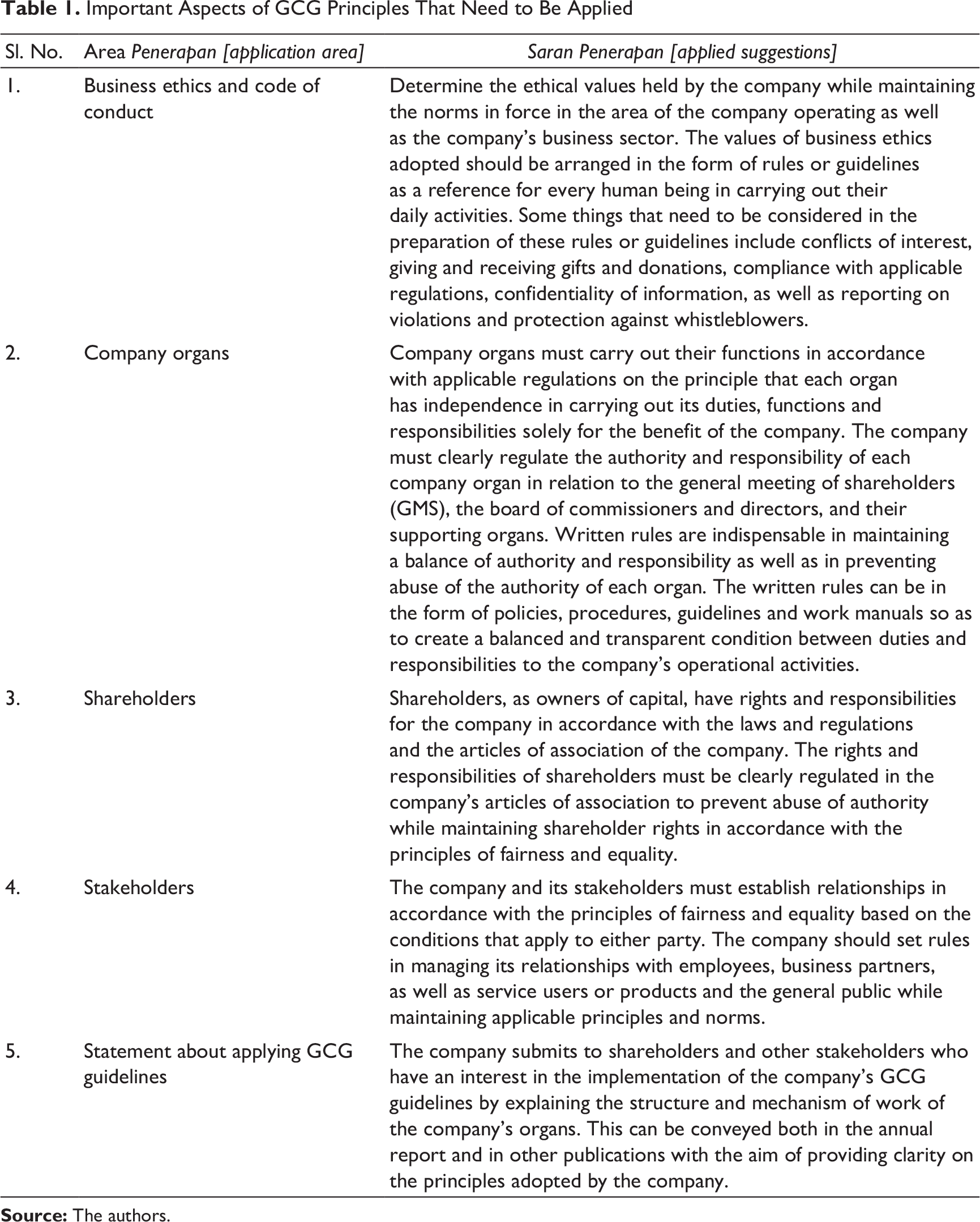
The concept of GCG explains the mechanism of relationships between stakeholders in an organization. According to the FCGI (2006), there are basic principles of GCG: transparency—to maintain objectivity in conducting business, companies must provide material and relevant information in a way that is easily accessible and understood by stakeholders; accountability—the company must be accountable for performance in a transparent and fair manner; responsibility—the company must comply with the legislation and implementing responsibility towards society and the environment, so that business continuity can be maintained in the long term and to be recognized as a good corporate citizen; independence, to smooth the implementation of the principle of good corporate governance, companies must be managed independently, so that different organs of the company do not dominate each other and cannot be intervened by other parties; and fairness—in carrying out its activities, the company must always pay attention to the interests of shareholders and other stakeholders based on the principle of fairness and equality. If GCG principles are implemented properly, it will improve company performance, especially transparency, enabling the company to outperform competitors (Augustine, 2012). Referring to the Indonesian GCG guidelines, several important aspects of GCG principles that need to be applied so that companies can have good governance are shown in Table 1.
Broadly speaking, managers within the company consist of internal parties and external parties. Internal parties include the board of commissioners, directors, and employees, while the external parties include investors, the government, the community, and other interested parties or stakeholders (Manik, 2011). Related to efforts to improve organizational performance, the choice of which handlers will be optimized, whether those on the internal side of the organization or those on the external side of the organization, depends on the problems faced by the organization (Amirullah, 2015, p. 209). The corporate governance mechanism is a clear procedure and relationship between the party making the decision and the party overseeing the decision. Therefore, different internal and external mechanisms have been considered through corporate governance to prevent agency conflicts and to avoid neglect of other parties’ interests in the company by management. Most company research focuses on governance dimensions that are relatively easily measured (for example, ownership structure, board of directors, and executive compensation) and the role played by governance in reducing agency costs (Lehn, 2018).
Important Aspects of GCG Principles That Need to Be Applied
Board of Directors
Based on the law on limited liability companies, it is explained that the board of directors is the organ of the company that is authorized and has full responsibility for the management of the company for the interests of the company, in accordance with the aims and objectives of the company and representing the company, both inside and outside the court in accordance with the provisions of the articles of association. The board of directors plays an important role in managing the company, but must comply with the resolutions of the GMS, the articles of association and the provisions of the applicable legislation. Each member of the board of directors can carry out their duties and make decisions in accordance with the division of tasks and authority. However, the implementation of duties by each member of the board of directors remains a shared responsibility (Adestian, 2015). In this study, the parameter used for the board of directors is the number of all members of the board of directors in a company.
The Board of Independent Commissioners
The board of commissioners is the representative of shareholders in the company. The board of commissioners is the organ of the company that is tasked with carrying out general and/or special supervision in accordance with the articles of association and giving advice to directors (RI Law, 2007). The board of commissioners can consist of a board of commissioners and an independent board of commissioners. The term independent is often interpreted as independent, free, impartial, not under pressure from certain parties, neutral, objective, having integrity, and not in a position of conflict of interest (Agoes & Ardana, 2014). A member of an independent board of commissioners is a commissioner who is not affiliated with other members of the board of commissioners, directors, and controlling shareholders, and who is free from business relationships or others that can influence the ability to act independently (Adestian, 2015). The independent board of commissioners must be able to carry out its duties freely or without being influenced by pressure from parties who have interests or relationships with one another. The greater the number of members on the board of commissioners, the easier it is to control the chief executive officer (CEO) and the more effective will be the monitoring that is carried out (Adiertanto & Chariri, 2013, p. 171). Hence, the parameter used is the comparison between the number of independent boards of commissioners and the total number of boards.
Audit Committee
The limited liability company law explains that the board of commissioners can form certain committees whose members are one or more people who are deemed necessary, because they can assist the task of supervision (RI Law, 2007). One of the additional committees that has now risen to help the board of commissioners function is the audit committee. The emergence of the audit committee was caused by the increasing tendency of various fraud scandals and negligence by directors and commissioners of large companies, both in the USA and in Indonesia, which indicates inadequate oversight functions (Agoes & Ardana, 2014). The audit committee is an additional committee formed by the board of commissioners whose job is to help the board of commissioners supervise the company. In this study, audit committee variables are measured based on the number of all members of the audit committee in a company (Adestian, 2015).
Managerial Share Ownership
Managerial share ownership is shares owned by the management privately or shares owned by a subsidiary of the company and its affiliates. The indicator to measure managerial ownership is the percentage comparison of the number of shares owned by the management with all the company’s stock capital in circulation (Agustia, 2013). Managerial share ownership in a company can be seen as a way to harmonize the potential differences of interests between shareholders outside management so that agency problems can be assumed to be lost if a manager is also an owner (Jensen & Meckling, 1976). Ownership of a manager will also determine policy and decision-making in the companies managed (Vo & Nguyen, 2014). Managerial share ownership has a high sensitivity to changes in productivity in the company (Palia & Lichtenberg, 1999). Companies that have managerial ownership shares are more likely to be family-owned companies that maintain company ownership not fully controlled by the public. Manager-owned shares function so that they can control the company’s activities and that they also get higher incentives (Chen & Yu, 2012). The parameter used in managerial share ownership in this study is the ratio of share ownership by the management to the number of shares outstanding in the market.
Research Objective
This study aims to examine the effect of good corporate governance mechanisms on company performance. The mechanism of good corporate governance uses the proxy of the board of directors, independent commissioners, audit committees, and managerial share ownership. Optimizing corporate governance mechanisms means optimizing the board of directors, independent commissioners, audit committees, and managerial share ownership in accordance with their respective functions, so that it can affect the company’s performance.
Theoretical Framework
The Effect of the Board of Directors on Company Performance
The board of directors in a company will determine the policies to be taken by the company in the short term or long term (RI Law, 2007). The board of directors controls the day-to-day operations of the company within the limits specified in the law, the articles of association, and the GMS, and under the supervision of the board of commissioners (Sulistyowati, 2017). The number of boards of directors logically will greatly affect decision-making. The more the boards of directors, the faster the decision-making process because of the many inputs or opinions received (Bukhori, 2012).
The results of research conducted by Kajola (2008), Bukhori (2012), Adestian (2015), and Purwani et al. (2017) show that the board of directors has no effect on the company’s financial performance. Bukhori (2012) states that this is because large numbers of boards benefit companies from the perspective of resource management. However, a greater number of boards of directors will also increase the problems in terms of communication and coordination. The increasing number of boards of directors also makes supervision more difficult, giving rise to agency problems that arise from the separation between management and control. A solution to dealing with conflict requires an independent board of directors, and the market also values the company more if it has a composition of a larger independent board of directors (Kumar & Singh, 2012).
However, these results are different from what was stated by Sulistyowati (2017), that the board of directors influences the company’s performance. Similar results are seen in the studies of Amyulianthy (2012) and Septiana et al. (2016). Sulistyowati (2017) states that this condition occurs because a greater number of members of the board of directors can lead to more conflicts, but that number can provide alternative solutions to an increasingly diverse problem from members of the board of directors. This is supported by research by Al-Bassam et al. (2018) which states that companies with a larger board size will reveal much better corporate governance. Corporate governance can provide new insights and enhance corporate competitiveness (Kyereboah-Coleman, 2007). Optimizing the function of the board of directors will help carry out the principles of GCG, so that company performance can be achieved in accordance with company expectations.
The Effect of the Independent Board of Commissioners on Company Performance
An independent commissioner is a member of the board of commissioners who does not have financial, management, share ownership or family relations with other members of the board of commissioners, directors, or controlling shareholders, or other relationships that can affect his/her ability to act independently (Sulistyowati, 2017). The independent commissioner functions to oversee the company management in order to create a good corporate governance that can improve company performance. The board of commissioners mediates in the event of a dispute within the company. Independent commissioners are appointed not in the capacity to represent any party but are solely appointed based on the background of their knowledge, experience, and professional expertise to fully carry out their duties in the interests of the company (Agoes & Ardana, 2014, p. 110).
The results of the research conducted by Kyereboah-Coleman (2008) and Darwis (2009) show that the independent board has no influence on company performance; this is because the existence of independent commissioners in the company observed is only a formality to comply with regulations. Hence, the existence of this independent commissioner is not to carry out a good monitoring function and not to use the independence to oversee the policies of the directors. The studies conducted by Mulyasari et al. (2017), Sulistyowati (2017), Septiana et al. (2016), and Adestian (2015) also show that independent commissioners do not affect a company’s financial performance.
However, different from the results of the research presented by Sarafina and Saifi (2017), Manik (2011), Amyulianthy (2012), and Purwani et al. (2017) show that the independent board of commissioners influences the company’s financial performance. Sarafina and Saifi (2017) stated that a greater proportion of independent commissioners from outside the company with diverse expertise and experience would enable it to increase the ability of the board of commissioners to conduct supervision. Supervision carried out by an independent board of commissioners will carry out the principles of GCG, such as independent company management, without any intervention from other parties, so as to improve the performance of the company, and can ensure paying attention to the interests of shareholders.
The Effect of the Audit Committee on Company Performance
One way to improve the corporate governance standards is by establishing a specific corporate governance committee to monitor company‘s compliance to the regulations, especially those related to good corporate governance practices (Al-Bassam et al., 2018). To improve its performance, a company must keep the audit committee relatively independent (Kyereboah-Coleman, 2007). The audit committee formed by the board of commissioners aims to assist the supervisory duties of the board of commissioners. The role of the audit committee that runs well can affect performance in the company (Mulyasari et al., 2017). The results of the research conducted by Adestian (2015) and Sulistyowati (2017) show that the audit committee has no effect on a company’s financial performance. Adestian (2015) states that this condition occurs because the audit committee has the task of assisting the board of commissioners in monitoring the financial reporting process by the management to improve the credibility of the financial statements. The results of the research conducted by Purwani et al. (2017) are slightly different; they show that the audit committee has a positive but not significant effect on a company’s financial performance.
This is different from what was found by Kyereboah-Coleman (2008) and Irma et al. (2015); the results of their studies indicate that audit committees influence the performance of a company. This means that the more the audit committees that oversee a company, the better the company’s performance. This result is also the same as that of studies conducted by Manik (2011), Aprianingsih (2016), Sarafina and Saifi (2017), and Mulyasari et al. (2017). Sarafina and Saifi (2017) state that an increasingly large audit committee enables better reporting quality and higher monitoring of management because more effective audit committee supervision will optimize the profitability of the company.
The Effect of Managerial Share Ownership on Company Performance
The greater the number of shares owned by company managers, the more effective and disciplined the management will be, so as to improve company performance (Kapopoulos & Lazaretou, 2007), and the greater the share ownership by the management, the less likely would the management be to optimize the use of resources (Martsila & Meiranto, 2013; Vo & Nguyen, 2014). This happens because managers who have an involvement in the company through managerial ownership will also have a sense of ownership of the company so that all decisions taken by managers will be done with a more cautious manner, considering all the consequences that will occur due to the decisions taken will also impact on the managers. The low level of share ownership does not encourage company managers to improve company performance; therefore, company managers must be compensated for shares compared to cash compensation (Vo & Nguyen, 2014). Managerial share ownership tends to have a relationship with a family company, where family ownership greatly influences the company’s performance, because family ownership always maintains stable performance for future generations (Ibrahim & Samad, 2011). Therefore, a management that owns shares in the company tends to develop strategies to improve company performance, especially long-term company performance. This is in line with the research conducted by Puspitasari and Ernawati (2010), which found a positive relationship between managerial ownership and financial performance of the company. Increasing managerial share ownership in a company will increase company efficiency (Tomar & Bino, 2012). Increasing the efficiency of the company will reduce the company’s operational costs, thus impacting the company’s financial performance.
Research Method
Data Source
The type of data in this study is pooled data that combines cross-section and time series data. The data used are secondary data from the financial statements of manufacturing companies listed on the Indonesia Stock Exchange from 2012 to 2017. The companies’ financial statement data are obtained from the official website of the Indonesia Stock Exchange (IDX). From the company’s financial statements will be taken the data needed to support each variable in the study (see Table 2), namely performance data that are proxied by profitability using the indicator return on assets, board of directors with an indicator of the number of directors, independent board of commissioners with an indicator comparing the number of independent boards of commissioners with the total boards of commissioners in the company, audit committee using the total audit committee indicators in the company, and the percentage of managerial share ownership.
Sample Frame
The method used to determine this research sample was purposive sampling, which is a technique of determining samples from populations based on certain requirements or criteria. The criteria used for the sample manufacturing companies are: (a) Those that are listed on the IDX and publish financial statements in full from 2012 to 2017; (b) Those having complete data regarding the board of directors, independent board of commissioners, audit committee, and managerial ownership; and (c) Those having complete data on ROA. Based on these criteria, the sample of this study comprised 52 companies from 152 manufacturing companies listed on the Indonesia Stock Exchange, with observations from 2012 to 2017. Table 3 shows the sample and observational data in this study.
Indicators of Research Data

Research Samples and Observation Data

Empirical Model
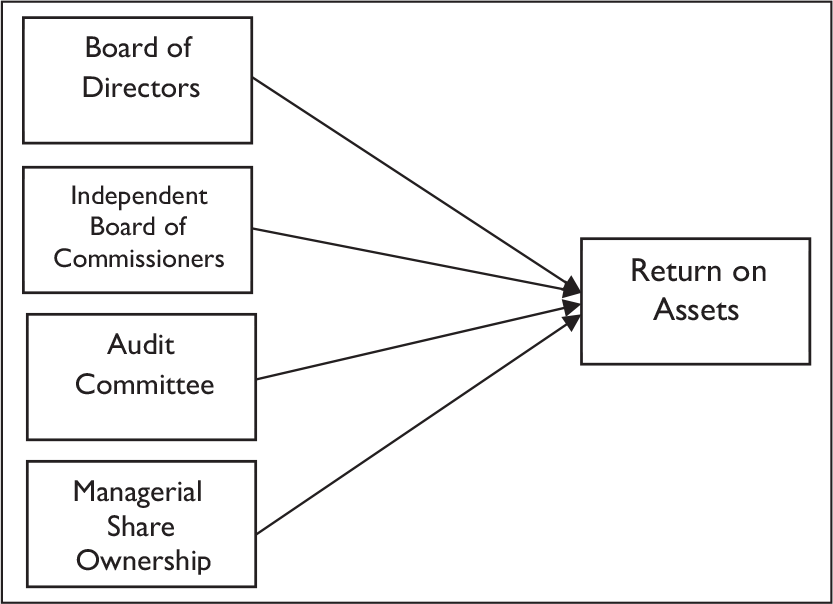
This study examines the influence of the board of directors, independent board of commissioners, audit committees, and managerial share ownership on company performance. The research data analysis technique used is multiple regression, with the help of a test tool using statistical package for the social sciences (SPSS). To see the effect between variables, the study used a significant level of 5 per cent. Our research model is shown in Figure 1.
Results of Statistical Test
Result and Discussion
Result
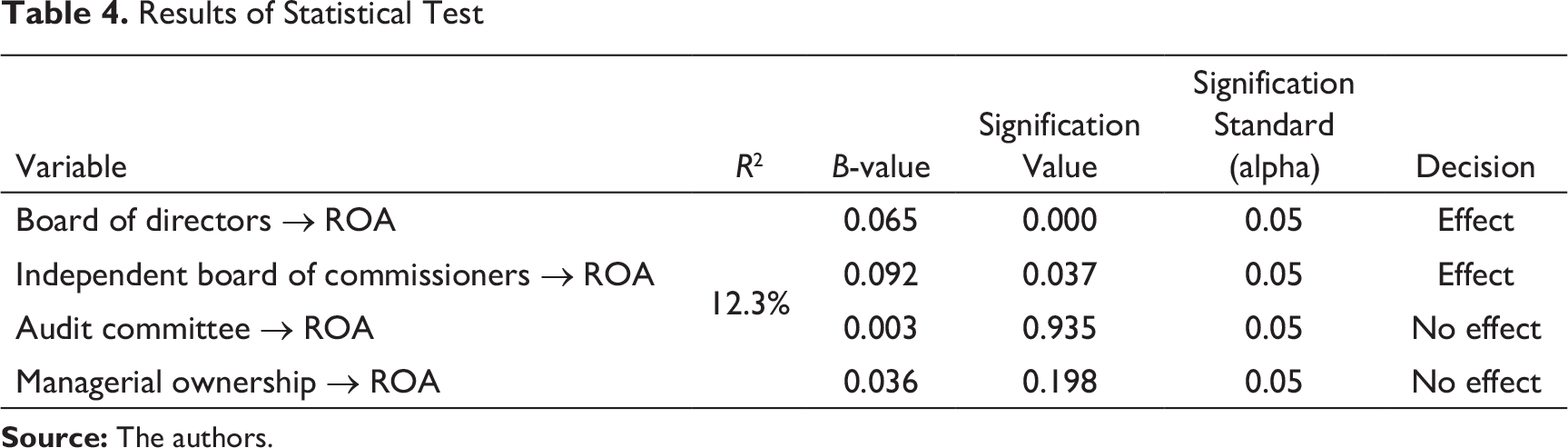
In accordance with the objectives of the study which looked at the influence of the board of directors, independent board of commissioners, audit committee, and managerial share ownership on company performance, the SPSS analysis tool was used. The results of the research test are shown in Table 4.
The results of this study found that the effect of the GCG mechanism on company performance looks small; this is shown from the R2 research value of 12.3 per cent. This means that the contribution of the GCG mechanism that is proxied by the board of directors, independent board of commissioners, audit committee, and managerial share ownership in manufacturing companies affects the performance of manufacturing companies in Indonesia by only 12.3 per cent, while 87.7 per cent is influenced by other variables not present in this study.
Although the GCG mechanism has a small contribution value in influencing a company’s financial performance, the concept and purpose of the GCG mechanism greatly influence the company’s performance (Agoes & Ardana, 2014; Arora & Bodhanwala, 2018; FCGI, 2006). The small influence of the GCG mechanism on the company’s financial performance is predicted because it has not functioned optimally and is not yet supported by a well-integrated management accounting information system. Management accounting information systems can help realize GCG in organizations (Susanto, 2015). It is to be noted that a management accounting information system is a specification that can be used as an integrated framework within a company by utilizing resources to provide relevant information to managers and employees in an organization, both financial and non-financial information, for decision-making in achieving its objectives specifically in organizations (Napitupulu, 2018). Thus, a quality management accounting information system will be able to support a company’s performance at a good level.
Discussion
The Effect of the Board of Directors on Company Performance
The results of this study indicate that the board of directors influences the performance of manufacturing companies. With the separation of roles from the board of commissioners, the board of directors has great power in managing all available resources in the company. The board of directors has the duty to determine the policy direction and strategy of resources owned by the company, both in the short term and in the long term (Bukhori, 2012). The results of this study are the same as those of Amyulianthy (2012), Septiana et al. (2016), Sulistyowati (2017), and Al-Bassam et al. (2018) regarding the influence of the board of directors on company performance—a greater number of boards of directors can provide alternative solutions to a problem. The board of directors is very important in managing the company, because each member of the board of directors can carry out their duties and make decisions in accordance with the division of tasks and authority. The significant effect of the board of directors in the compaby due to the amount of the board of directors exceeds that of the minimum allowed by the regulations. In addition, the influence of the board of directors of the company’s performance because the board of directors in Indonesian manufacturing companies is dominated by directors who have family relations with the owner or founder of the company. Directors in the board who have kinship ties tend to make the company’s operations more efficient, because they do not want the company founded by their predecessors to collapse. This condition is in line with research conducted by Srivastava and Bhatia (2020) on companies in India, that family companies influence company performance.
Our results are not in line with studies conducted by Bukhori (2012), Guoa and Kumara (2012), Adestian (2015), and Purwani et al. (2017), which state that the board of directors has no effect on the company’s financial performance. Bukhori (2012) states this because large numbers of boards benefit companies from the perspective of resource management. However, a greater number of boards of directors will also increase the problems in terms of communication and coordination. Increasing the number of boards of directors can make supervision more difficult, due to various inputs or opinions in solving problems within the company, causing agency problems that arise from the separation between management and supervision. The board of directors can have more influence on performance and add value to a company if in the company is found an independent board of directors (Kyereboah-Coleman, 2008). A greater number of independent directors will increase market confidence in the company (Kumar & Singh, 2012). However, firms with more independent board members raised more equity capital during the crisis, which led to a wealth transfer from existing shareholders to debtholders (Erkens et al., 2012). The results of this study responded empirically that optimizing the GCG mechanism can improve and maintain the performance of the company, so as to increase the confidence of the parties concerned in the company, especially investors. Good corporate governance is needed by the company, both in stable economic conditions and in difficult economic conditions or crisis periods, because the implementation of GCG can minimize the risks that will occur from the impact of policies taken.
The Effect of the Independent Board of Commissioners on Company Performance
This study found the influence of independent commissioners on the financial performance of manufacturing companies. The existence of an independent commissioner is intended to encourage the creation of a more objective climate and work environment and to place fairness and equality among various interests including the interests of minority shareholders and other stakeholders (Sulistyowati, 2017). The results of Purwani et al. (2017) show that there is an influence of an independent board of commissioners on company performance, which can be seen from the function of the board of commissioners that ensures the implementation of the company’s strategy and oversees the company’s management in managing the company, and the implementation of accountability. With the board of commissioners providing guidance, direction and supervision to the company management, the company’s performance will be even better. The independent board of commissioners will be able to support the principles of GCG, while the board of commissioners oversees the company’s operations which are run by company agents or company managers. The functioning of the independent board of commissioners will safeguard the interests of those interested in the organization.
This result is also supported by the studies by Sarafina and Saifi (2017) and Manik (2011) which show that an independent board of commissioners influences a company’s performance. In manufacturing companies in Indonesia, the composition of independent commissioners is, on average, 33 per cent, so this composition can affect company performance. Although the results of this study show positive results regading an independent board of commissioners affecting company performance, there are also other studies that show different results, that the independent board of commissioners has no influence on company performance; this is because the existence of independent commissioners in the company that is observed is only possible in the form of formalities to meet regulations (Darwis, 2009). If this is the case, the independent commissioner cannot carry out a good monitoring function and does not use his independence to oversee the directors’ policies. This result was also reflected in that of the studies by Putri and Muid (2017), Mulyasari et al. (2017), Sulistyowati (2017), Septiana et al. (2016), and Adestian (2015), that independent commissioners have no effect on a company’s financial performance. For further, in order to control the effect of the independent commissioner on the company‘s financial performance, then the company should optimizing and implementing the function of these commissioner properly. Optimizing the function of the board of commissioners is supported by developing a reward system or providing incentives, where the incentives given have an impact on the behaviour and attitude of the board of commissioners, so that the board member gives more time and energy to the company (Sari & Tjoe, 2017).
The Effect of the Audit Committee on Company Performance
The results of this research found that the audit committee had no effect on company performance. The audit committee is one of the corporate governance mechanisms that are expected to be able to reduce manipulation and fraud practices by upholding the principles of corporate governance which in the process hinder fraudulent practices and manipulation within the company (Manik, 2011). In reality, even though audit committees in manufacturing companies meet the requirements in accordance with the rules, the companies’ performance is still not in line with expectations, as it is shown that there are still many manufacturing companies that suffer losses. The audit committee has no influence on a company’s financial performance because it has the task of only assisting the board of commissioners in monitoring the financial reporting process by the management to improve the credibility of financial statements (Adestian, 2015; Sulistyowati, 2017). This means that the audit committee does its work as a supervisor and does not function independently in accordance with the functions of the actual audit committee. The other finding of this research was un-proper function of the audit committee in Indonesia, which is be the main reason for the fraud‘s practices. And it will come with the corruption, collusions and nepotism‘s practices (Sedarmayanti, 2012, p. 50). Many persons in the business world commit bribery and corruption, embezzlement of funds, investment fraud, abuse of authority, environmental pollution, injustice in treating employees, fraud, and so on, to the detriment of various stakeholders and the public (Afrianto, 2017). With this, many cases prove that the audit committee still does not play a role in accordance with its function.
Although there was no significant effect in our study, Irma et al. (2015) found results that showed that the audit committee had an effect on company performance. This means that the more the audit committee that oversees the company, the better the performance of the company. This result is in line with the studies of Aprianingsih (2016), Sarafina and Saifi (2017), Manik (2011), and Mulyasari et al. (2017), that an increasingly large audit committee allows for better quality reporting and higher monitoring of management, so as to optimize the profitability of the company. Thus, if the audit committee is given the freedom to carry out its functions and if the number of audit committees is optimized in accordance with the rules, the audit committee is able to significantly influence the company’s financial performance.
The Effect of Managerial Share Ownership on Company Performance
Based on agency principles, share ownership by management will help overcome agency problems because the more the shares owned by the management, the more motivated they will be to work more actively and focus on increasing company value (Bangun & Tarigan, 2012). However, this study found that managerial stock ownership did not affect the company’s financial performance. This result is in line with that of studies by Guoa and Kumara (2012). There is no influence of managerial stock ownership found on the financial performance of a company because the number of management shareholdings is quite low, because of which the management cannot influence the decisions to be taken at the GMS to improve the company’s financial performance. Managerial shareholding in manufacturing companies is not more than 1 per cent. These results have not been able to realize the objectives of management ownership in aligning interests between managers and owners (Hartono & Nugrahanti, 2014). So, the managerial ownership will affect the company‘s financial performance only if this kind of ownership could offset the other kind of ownership, so it will have a significant impact on the decision making process in the organization. When the GCG mechanism functions in accordance with its objectives, the company management can pay attention to the interests of shareholders and other stakeholders based on the principle of fairness and equality.
The other finding of this research was the managerial ownership did not affect the company‘s performance. This result predicted as the consequences of kinship orientation that almost happened in most Indonesian‘s company. Managerial ownership figured as the part of incentive for the family member contribution on the company‘s management. Our results are in line with the statement of Ibrahim and Samad (2011), that managerial share ownership tends to have a relationship with a family company, where family ownership greatly influences company performance, because family ownership always maintains a stable performance for the future of inheritance. Managerial share ownership that has a family relationship can hamper the agency principle, because a manager who has a family relationship does not develop a strategy that benefits the personal management of the company alone. The management that owns shares in the company tends to develop strategies to improve company performance, especially long-term company performance. Increasing managerial share ownership in a company will increase company efficiency (Tomar & Bino, 2012). Increasing the company’s efficiency will reduce the company’s operational costs, thus impacting the company’s financial performance. Managerial share ownership in a company is one way to reduce conflicts of interest and reduce agency costs.
Conclusion
Conceptually, the corporate governance mechanism can be key in improving company performance. The corporate governance mechanism outlines a clear procedure and relationship between the party making the decision and the party overseeing the decision. This study found that the board of directors and independent commissioners had an effect on company performance, while the audit committee and managerial stock ownership had no effect on company performance. Although a greater number of boards of directors can improve company performance, the side-effect is that it can lead to greater conflicts of interest as well, due to various inputs or opinions in solving problems within the company. The company’s performance is even better with the existence of an independent board of commissioners that provides guidance and direction as well as supervision to the company management. Meanwhile, the audit committee has no effect, because the audit committee is only tasked with assisting the board of commissioners in monitoring the financial reporting process by the management to increase the credibility of the financial statements. Furthermore, the managerial ownership was not significantly affected the decisions that will take in general meeting of shareholders for the company‘s performance. Thus, if the corporate governance mechanism can be optimized, the company’s performance can improve.
Implication
This research has the implication of optimizing the mechanism of corporate governance that can improve a company’s performance. The mechanism of good corporate governance is measured using the variables of a board of directors, independent commissioners, an audit committee, and managerial share ownership. The optimal amount of Board of Directors in a company will raise the company‘s performance. It because of the directors will have their own interest to increase company‘s assets and prestige, but in other hand will give rise to a conflict of interest. As stated in the agency theory of Jensen and Meckling (1976), in carrying out their duties, managers as agents have the obligation to maximize the welfare of the company owners (principals) both in the short and long terms, but on the other hand, managers also have an interest in maximizing their own welfare. Hence, to reduce intrigue, conflict of interest, unfair competition, and agency costs in a company, a board of directors with family ties is needed. If some of the directors in the company are directors who have a family relationship, then it will be better for the company’s performance, because these directors do not want the company founded by their ancestors or their families to collapse or go bankrupt, and so they try to maintain the company’s growth.
The condition in Indonesia compatible with the research of Srivastava & Bhatia (2020), that the company which is running with the kinship orientation will affect the organization‘s performance. This research also has implications for stakeholder theory, because the objectives of corporate governance are to (a) improve organizational performance; (b) create added value for all stakeholders; (c) prevent and reduce manipulation and significant errors in organizational management; and (d) increase efforts so that stakeholders are not disadvantaged (Agoes & Ardana, 2014). Stakeholders who are interested in the company’s performance are investors, because the company’s good performance will have an impact on the return on investment. The value of ROA will indicate the efficiency of the organization‘s management, so this value will affect the amount of the investor‘s payback.
In addition to the optimization of the board of directors, optimizing an independent board of commissioners can also improve company performance. Hence, the implication of the research for optimizing the board of commissioners is to give freedom to the board of commissioners carrying out its function as supervisor in the company without any intervention or pressure from any party. Due to the many problems arising in companies, the board of commissioners add a supervisory board in the company as an extension of the commissioners, namely the audit committee. The audit committee could not affected company‘s performance just because of this committee not optimally functioned according to its functions. Audit committee only functioned to support the board of commissioners to monitor the financial reporting processes in term of to increase the credibility of their financial statement.
Another implication of this research is that managers who have more shares in the company will be able to determine the direction of company policy, especially in terms of investment, but because the composition of managerial stock in the company is very small, it does not have many voting rights in the policy, so it does not affect the company’s performance. Although managerial shareholding does not affect the company’s performance, it will reduce conflicts of interest and agency costs.
Footnotes
Acknowledgement
I would like to thank the reviewers of this article who have contributed to the improvement of this article. I also would like to thank my affiliates Politeknik Negeri Medan for providing research funding support and providing other facility support.
Declaration of Conflicting Interests
The authors declared no potential conflicts of interest with respect to the research, authorship and/or publication of this article.
Funding
The authors received no financial support for the research, authorship and/or publication of this article.
