



Abstract
The inward foreign direct investment (FDI) has been emphasized in the literature, and although the benefits related to innovation are known, there is not much information about their effects on emerging economies. This study investigates how local domestic factors such as research and development (R&D), exports and foreign technology acquisition moderate with inward FDI to improve the innovation performance. The empirical findings from a generalized method of moments (GMM) estimator suggest, at short term, that the FDI has a positive effect in the Brazilian manufacturing industry. As a complementary effect, there is an interaction between FDI inflows and exports, increasing the innovation performance. However, improvements in R&D-related FDI is not observed. For this reason, the results suggest FDI-related exports could indicate a mere product adaptation to the foreign market. There is a predominance in import substitution of machines, equipment and software and no evidence of internal R&D investments or R&D-related FDI. Our results suggest managerial and policy implications, once it was observed the high-technology intensity industry sectors show better innovation performance than medium- and low-technology industries. Policymakers should implement better policies to encourage more R&D-related FDI to decrease import substitution and improve the local innovation performance to strengthen the local industry R&D investments.
Keywords
Introduction
Since the 1990s, economic growth has been rapid and impressive in emerging countries, such as Brazil, Russia, India, China and South Africa (BRICS), contributing to transform the world economy (Fu et al., 2011). In search of growth, productivity and innovation performance, emerging economies facilitate the access of multinational enterprises (MNEs), providing large amounts of FDI in their economies (Blomström & Kokko, 1998; Bruhn & Calegario, 2014; Bruhn et al., 2015; Jin et al., 2019). Inward FDI acquired attention in the extant literature, due to the benefits derived from technology spillover, which became a primary source to promote economic growth enhancing the technology transfers, know-how, exports expansion and product and process innovation (Djulius, 2017; Jawaid et al., 2016; Jin et al., 2019; Mohanty & Sethi, 2019; Wang & Kafouros, 2009).
The literature strongly suggests that, in the past, inward FDI flows has often been a significant contributory factor to the structure and growth of a country’s technological capacity (Dunning & Lundan, 2008). Some noteworthy studies—Liu and Wang (2003), Wang and Kafouros (2009) and Castellacci and Natera (2016), among others—discuss the importance of FDI, considering it not as a mere source of capital but also as a conduit for technology transfer, management and human skills augmentation in host countries. In the specific case of Latin America and the Caribbean (LAC), foreign presence breaks the existing equilibrium, eliminates the monopolistic power of local firms and improves productivity (Castellacci & Natera, 2016).
The post-war era has been a period of significant growth for both world trade and FDI. That is an important factor of innovation for all countries, specially in emerging economies (Bruhn et al., 2015; Fleury & Fleury, 2011; Narula & Wakelin, 1998; Wang & Kafouros, 2009). Forward to the 1950s and 1960s, Brazil was essentially a receiver of FDI (Fleury & Fleury, 2011) when specific governmental programme reforms were created to attract foreign capital as strategy for industrial development through import-substitution industrialization. In the 1970s and 1980s, the inflows of FDI decreased (mainly due to the oil shock crisis) and grew back rapidly after 1990 in countries such as Mexico, Argentina, Brazil and Chile (Benavente et al., 1997; Bruhn & Calegario, 2014). Bruhn and Calegario (2014) and Casanova et al. (2019) argue that during the 1980s and 1990s (a period often referred to as ‘the era of market reform’), most Latin economies experienced changes in comparison to the previous phase of long-run growth. Thus, industrial development resurged under a new philosophy during the 1980s, based on national sovereignty and security doctrines, with a 5-year period of national development plans, national science and technology development programmes (Fleury & Fleury, 2011).
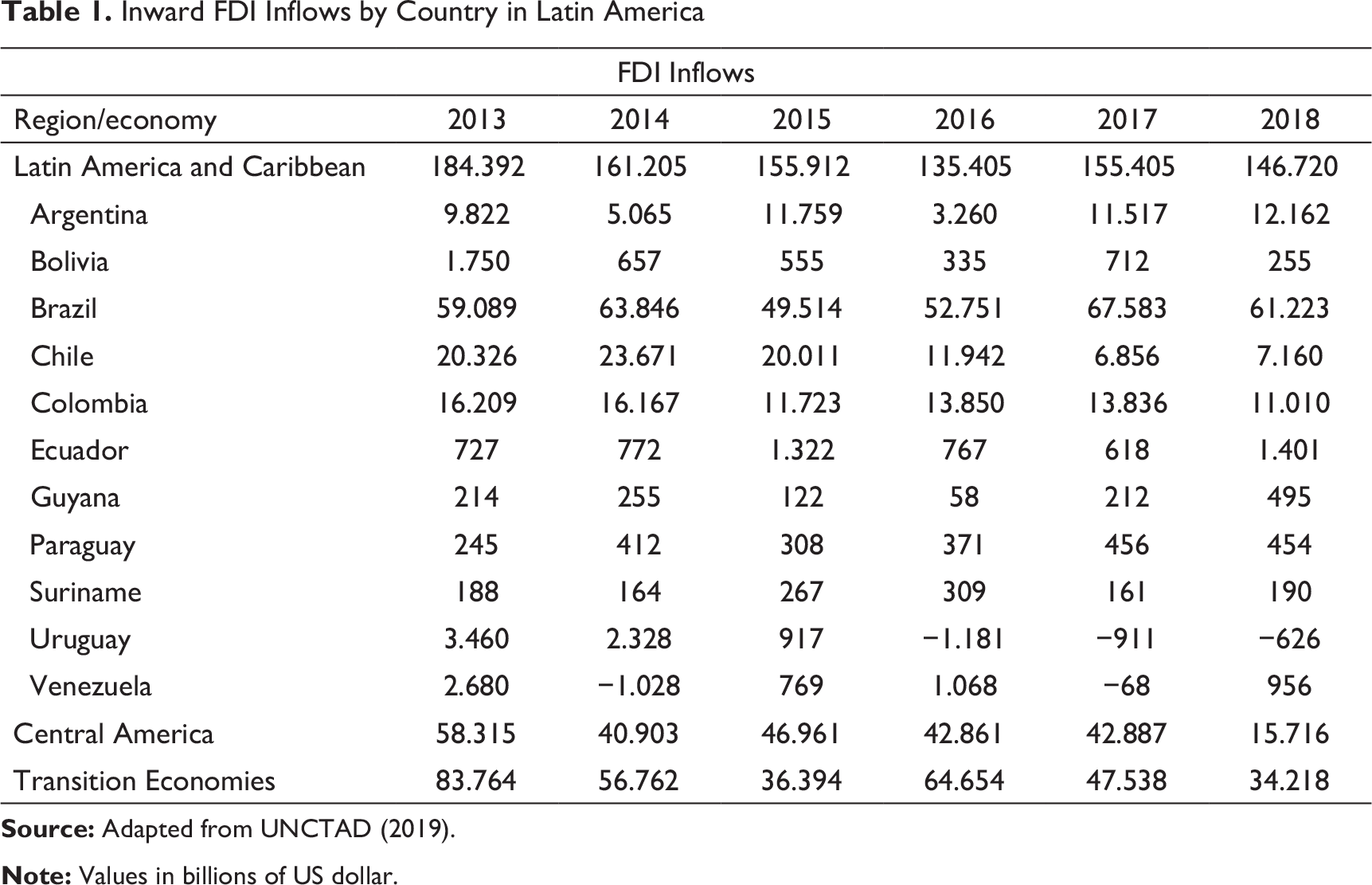
The LAC increased the openness of the economy following the Washington Consensus programme of pro-market reform through trade liberalization, increasing inward FDI (Casanova et al., 2019; Castellacci & Natera, 2016). FDI to LAC rose by 8 per cent to reach US$155 billion in 2017, driven by the region’s economic recovery (UNCTAD, 2018), the first rise in a 6-year period, but the inflows remained well below the 2011 peak during the commodities boom in the 2000s. From Table 1, it is possible to observe that Brazil received the largest amount of FDI in Latin America, over US$67.5 billion in 2017 and US$61.2 billion in 2018, a higher amount than Central American Economies and Transition Economies.
Brazil is considered the largest economy in Latin America, attracting more than 40 per cent of the total flows to the Latin region. Nine of the 10 largest acquisitions by foreign companies in the region were made in Brazil; seven concerned Chinese buyers, which acquisitions involved electricity, oil, infrastructure (gas transmission) and agribusiness companies (UNCTAD, 2019). However, it is possible to observe a decline in FDI when compared to 2017. Following a decline in commodity prices and corruption scandals, market turbulence in Argentina, recession in Brazil and a continued political deterioration in Venezuela, economic growth in the region slowed down between 2016 and 2018 (Casanova et al., 2019). Nonetheless, the authors argued the region grew by 0.6 per cent in 2018 and it is expected to grow by 1.6 per cent in 2019. On the other hand, prospects for foreign investment significantly depends on progress in the new Brazilian administration’s reform programme (UNCTAD, 2019). So far, the confidence of domestic investors reflected in stock markets and has not been matched by foreign direct investors, who appear to be waiting for stronger signals and higher inflows in 2019, on the back of positive economic forecasts, supportive investment policies and the value of announced greenfield projects increasing by more than 50 per cent in 2018 (UNCTAD, 2019).
Inward FDI Inflows by Country in Latin America
This article is organized into six sections including ‘Introduction’. The second section discusses the ‘Theoretical Framework’, with the respective grounding literature, followed by the ‘Objective’ and ‘Rationale of the Study’. The third section presents the ‘Methodology’. The fourth section goes on to demonstrate the ‘Discussion and Results’. The fifth section highlights the ‘Conclusions and Managerial Implications’, and finally in the sixth section we present ‘Limitations and Implications for Future Studies’.
Theoretical Framework
Wang and Kafouros (2009) argue that there are three main channels which improve the innovation performance in an economy: (a) internal R&D; (b) exports; and (c) foreign technology acquisitions. The first channel, (a), consists in own internal R&D expenditures, which benefits firms in one country to create new products and processes (Coe & Helpman, 1995; Crespi & Zuniga, 2012; Kafouros, 2008). The second, (b), exports, which can foster growing market size in developing countries (Keller, 2010; Mohanty & Sethi, 2019; Wang et al., 2010). The third, (c), foreign technology acquisitions through imports of machinery and technology equipment, is an important channel for foreign technology spillover (Frank et al., 2016; Fu et al., 2011; Narula & Wakelin, 1998).
Based on these assumptions, we believe that the outlined channels do not improve an industry sector’s innovation performance in an isolated manner, making it necessary to moderate with the country openness, defined by FDI inflows (Castellacci & Natera, 2016). We adopt this idea once the level of foreign presence is low and the possibility of improving innovation performance through inward FDI is expected to be lower (Wang & Kafouros, 2009).
Research and Development
An important determinant on innovation performance lies in industrial research, measured by the level of investment in R&D (Wang & Kafouros, 2009). The presence of R&D by foreign firms is becoming more important in host countries with technological activities, including some developing countries (Dunning & Lundan, 2008). The benefits of foreign R&D can be direct and indirect (Coe & Helpman, 1995). The direct benefits are related to learning about new technologies and materials, production development or organizational methods. On the other hand, indirect benefits come from imports of goods and services, which have been created by trading partners.
Crespi and Zuniga (2012) argued firms’ stock of knowledge allows them to perform two crucial activities. First, it enables them to develop and produce new products and processes to better compete and survive in the market. Second, a high level of R&D allows firms that rely on internal R&D to recognize and select valuable linkages and to capture the know-how of the partners. Both mentioned forms are directly related to in-house production (Crespi & Zuninga, 2012). In this way, R&D boosts innovation and increases productivity, either by providing new products and processes or by upgrading the existing ones (Coe & Helpman, 1995; Wei & Liu, 2006). In addition, in firms with their own R&D, it complements the adoption of existing technology because it is an important component of absorptive capacity (Goedhuys & Veugelers, 2012).
Crespi and Zuniga (2012) found evidence of several Latin economies in regard to the ability of firms in developing economies to transform R&D into innovation. It is much more mixed than in the case of firms in industrialized countries. Braga and Willmore (1991) have shown empirically that R&D and foreign technology transfers complement each other, with technology imports having a positive effect on technological performance in Brazilian industries. However, to take advantage of the external knowledge, it is necessary to improve the absorptive capacity of the local industry. Guimón et al. (2018) conducted a study on a Chilean manufacturing industry, suggesting national policies do attract R&D-related FDI. The authors argued it is necessary to identify technology fields or industries where there is already a threshold level of absorptive capacity that can facilitate the transfer of knowledge.
Exports
The activities of an organization do not end at the boundary of the company and international trade and FDI activity of firms is a natural starting point for thinking about the international diffusion of technology and economic growth (Görg & Greenaway, 2004; Keller, 2010). Mohanty and Sethi (2019) argued that FDI makes a positive impact on the host country’s export competitiveness, once the international linkages provide better access to foreign markets. These activities allow companies to explore and make contact with foreign technologies and enhance organizational learning, information about competing products and customer preferences by analysing the innovations of their foreign competitors (Blomström & Kokko, 1998; Görg & Greenaway, 2004; Salomon & Shaver, 2005).
Wei and Liu (2006) argued that buyers are looking for lower-cost, better-quality products from leading suppliers. In this case, firms can also benefit from exposure to more intense competition, forcing companies to improve their innovation performance (Wang et al., 2010). Crespi and Zuniga (2012) identified that competition and learning effects of exporting are expected to enhance innovation efforts by firms, notably when local firms have a certain level of technological skills. This is confirmed, for example, by China and Brazil negotiating export and local content requirements on FDI in some industries, such as the autovehicles industry, to create links between foreign and local firms (Fu et al., 2011).
Brown and Guzmán (2014) found, for Mexican industries, that R&D-related FDI are used to adapt local products to foreign markets. Bravo-Ortega et al. (2014) found that in Chilean industries that invest in R&D, it is considerably more likely that exports and R&D have a joint effect on improving productivity. Braga and Willmore (1991) found the same result for Brazilian industries, in which firms that invest more in innovation are exporters. Jawaid et al. (2016) found for the Pakistan manufacturing industry an evidence that FDI and exports are complementary. However, Mohanty and Sethi (2019) found a recent evidence from India that indicated a necessity to identify industry sector–wise policies with FDI-related exports, once the inflow of FDI in India is mostly for efficiency-seeking, not for growing market size. Finally, Narula and Wakelin (1998) argued that exports could have a negative effect for developing economies once the nature of export consists in low value-added products.
Foreign Technology Acquisition
Since R&D is mainly carried out in developing countries, imports are seen as the channel for technological spillovers between developed and developing countries (Wang & Kafouros, 2009). Given the technological backwardness, technology imports have long been the main source of technological change and the most important innovation strategy followed by firms in Latin regions (Crespi & Zuninga, 2012). According to the United Nations Conference on Trade and Development (UNCTAD, 2014), the transfer of technology is particularly important, since it provides the construction of the technological capabilities of countries and companies, as these technological capabilities refer to the ability of firms to identify, choose, access, learn, understand and use technologies and also create new ones.
Fu et al. (2011) argue the technology transferred through imports of machinery and equipment is embedded in this machinery. In this case, imports of scientific knowledge and technologies can be deconstructed by reverse engineering, in order to learn about their operation (Liu & Buck, 2007). Technological learning will emerge through reverse engineering, necessary to understand and imitate the technologies incorporated in the acquired devices (Görg & Greenaway, 2004; Wei & Liu, 2006). Another argument lies in the demonstration effect, where the exposure of superior technology in multinational corporations may lead local firms to upgrade their own production methods through competition (Liu & Buck, 2007).
Recently, Mardones and Zapata (2019) identified that for Chilean industries, purchasing machinery, equipment and software improves local innovation. Muinelo-Gallo and Martínez (2018) found a positive effect for investments in hardware and software in Uruguay, affecting the probability of obtaining product and process innovations. Djulius (2017) identified for Indonesian firms that FDI application is important not only to complement the lack of capital to grow the economy but also to enable technology transfer in the form of knowledge spillover. Calegario et al. (2014) identified for Brazilian manufacturing industries that import-oriented industries have a positive relationship with FDI in the short run but a negative relationship in the long run. However, Taveira et al. (2019), investigating the acquisition of knowledge in Brazil, observed a negative effect in the probability of companies contributing a truly new innovation to the market.
Objective
Considering the foreign capital inflows and the local source of knowledge as an important factor to improve the innovation and development in local economies, the objective of this study consists in analysing the main local knowledge sources that moderate with inward FDI and improve the local industry innovation performance.
Rationale of the Studies
In this study, we make three contributions. First, it is an attempt to fill the gap in the literature related to the inward FDI in emerging economies (Bruhn & Calegario, 2014; Jawaid et al., 2016; Jin et al., 2019) with empirical evidences identifying positive and negative effects and the theory not identifying a clear relationship between foreign presence in these economies. Second, we take advantage of a six-period industry survey. Few studies have addressed the innovation performance analysis using this type of data in one large emerging economy. For instance, the data permit analysing specific sectorial characteristics, such as industry R&D intensity, export activities, capital intensity, sector size and technology intensity. Third, the research contributes to policies focused on the development of national industry and economic industry, with the literature suggesting it is necessary to attract more R&D-related FDI (Guimón et al., 2018) and FDI related to exports (Mohanty & Sethi, 2019).
Methodology: Data Sources, Empirical Model and Variables
Data Sources
The framework was tested using the database from the annual census of industries conducted by the Brazilian Institute of Geography and Statistics (IBGE) and reported in the Technological Innovation Research—PINTEC. The PINTEC survey is based on innovators and non-innovators. The PINTEC survey corresponds to the periods 1998–2000, 2001–2003, 2004–2005, 2006–2008, 2009–2011 and 2012–2014, totalling six periods. It is important to note tha the survey informs both qualitative and quantitative information. Our data is quantitative regarding information such as sales and R&D expenditures. The data refer to the final year of the reference period of each survey, that is, 2000, for the period 1998–2000.
Calegario et al. (2019) assert that the conceptual and methodological reference of the PINTEC is based on the Oslo Manual (OECD, 2005), on the European Community Statistics Workshop and the Community Innovation Survey (CIS). The PINTEC data are provided in aggregated industry sectors (data are not available at the firm level). For this reason, we did not apply a temporal lag. The PINTEC data are consistent with past research regarding manufacturing industry sectors (Calegario et al., 2019; Frank et al. 2016; Taveira et al., 2019). It is worth noting that the exports data (expressed in millions of dollars) were collected from the Ministry of Development, Industry and Foreign Trade (MDIC) and inward FDI data (expressed in millions of dollars) were collected from the Central Bank of Brazil (BACEN).
The sample includes 19 Brazilian manufacturing industry sectors, defined by the National Code of Economic Activities (CNAE 2.0), which follows the ISIC 4.1 classification. The data sample is composed by five high-technology industrial categories: (a) chemical industry; (b) machinery; (c) electronics and optical equipment; (d) electrical equipment; and (e) autovehicles and transport; and 14 industrial categories from medium- and low-technology industries: (a) food products and beverages; (b) tobacco; (c) textiles; (d) clothing and textile accessories; (e) leather and leather products; (f) wood; (g) paper and cellulose; (h) print and publishing; (i) oil and gas; (j) rubber and plastic; (k) non-metallic minerals; (l) metallurgy; (m) metal products; and (n) furniture. Our final sample is composed of a balanced panel covering the six periods and 19 industry sectors, which results in 114 observations.
Empirical Model
Equation (1) shows the models for testing formulated hypotheses based on the link between innovation performance (dependent variable) and independent variables, by both direct and the moderated effects, between inward FDI and R&D, inward FDI and exports and inward FDI and technology acquisition.

where γ represents the dependent variable and α the constant. Independent variables are defined by inward foreign direct investments (FDI), internal research and development (R&D), (Exports) and foreign technology acquisition (Technology acquisition) in an industry sector i in year t. The moderated effect is defined by (FDI × R&D), (FDI × Exports) and (FDI × Technology acquisition). The control variables are represented by the number of scientists working with R&D indicated by (Labour), capital (Capital intensity) and industry sector size by (Size). Time (Year) and industry dummy (Industry) variables were adopted to verify any idiosyncrasies across time and industries. Finally, ε denotes the residuals.
Variables
‘Dependent variable’ measures the innovation performance. The innovation performance is operationalized by the ratio of new product sales over total sales in a given industry sector (Wang & Kafouros, 2009). The third edition of the Oslo Manual (OECD, 2005, p. 46) states that ‘an innovation is the implementation of a new or significantly improved product (good or service), or process, a new marketing method, or a new organizational method in business practices, workplace organization or external relations’. In this case, new product sales correspond to any product innovation in the market (Liu & Buck, 2007; Wang & Kafouros, 2009). In addition, sales are a performance indicator that reflects the level of direct earnings from customers (Javorcik, 2006).
Independent Variables
This study analysed the direct effect and the relationship between FDI and R&D, FDI and exports and FDI and technology acquisition.
‘Inward foreign direct investment’ (FDI) measures the openness of the economy. The variable was estimated by using the total share of foreign capital by total assets in a given industry sector (Li & Wang, 2003; Wang & Kafouros, 2009). Inward flows of FDI represent a potentially important channel through which domestic companies can learn and adopt foreign advanced technologies and better organizational practices (Castellacci & Natera, 2016).
‘Internal research and development’ (R&D) measures the innovation proxy input. R&D is measured by the ratio of the R&D expenditure as a percentage of total sales for each industry sector (Javorcik, 2006; Jin et al., 2019). R&D expenditures are fundamental for industries to develop new products and processes (Crespi & Zuniga, 2012; Kafouros, 2008).
‘Exports’ measures the foreign sale levels in a given industry sector. Exports were defined by the share of foreign sales in a given industry sector by total industry sales (Brown & Guzmán, 2014; Wang & Kafouros, 2009).
‘Technology acquisition’ measures the foreign technology imports. It is measured by the imported resources through multiple items (e.g., equipment, machines and software) over its total industry sector assets (Wang & Kafouros, 2009).
Control Variables
We adopted several control variables. For the first, we adopted the employees’ qualification using the ‘labour’ variable, estimated by the number of scientists working with R&D over the total number of employees in a given industry sector (Wang & Kafouros, 2009). We deducted the share of scientific employees from the total employees to avoid double counting (Kafouros, 2008). It is important to consider labour, once technology transfer is not only in the form of capital embodied but also in the form of brain-ware and managerial skills (Djulius, 2017). For the second, we adopted ‘capital intensity’ as the ratio of total assets to the number of employees in the industry sector (Wang & Kafouros, 2009). Third, the ‘size’ of the industry sector was measured by the natural logarithm of the total number of assets in a given industry sector (Kafouros, 2008). Finally, we added one industry dummy variable separating industry sectors by technology intensity, where (1) indicates the industries that perform in high-technology and (0) indicates the industries that perform in medium- and low-technology sectors.
Discussion and Results
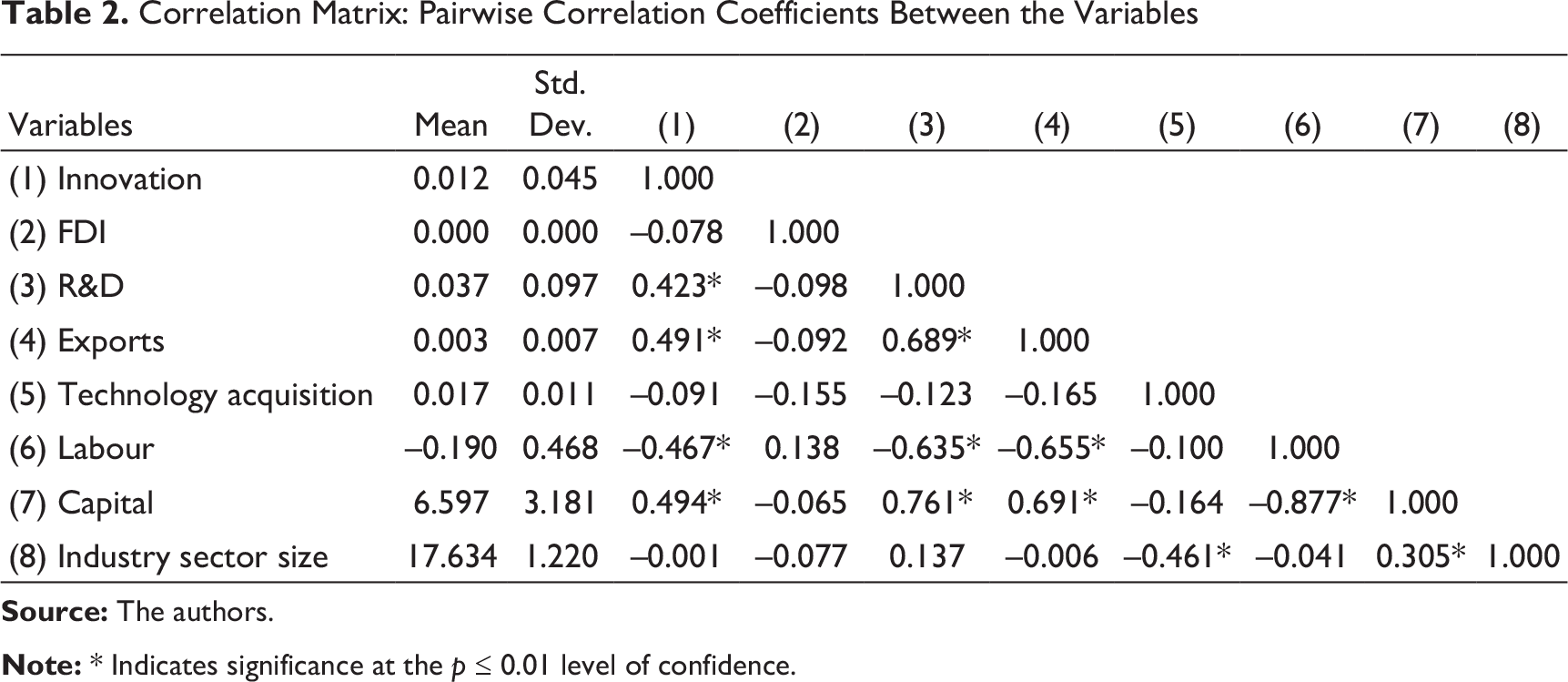
Correlation Matrix: Pairwise Correlation Coefficients Between the Variables
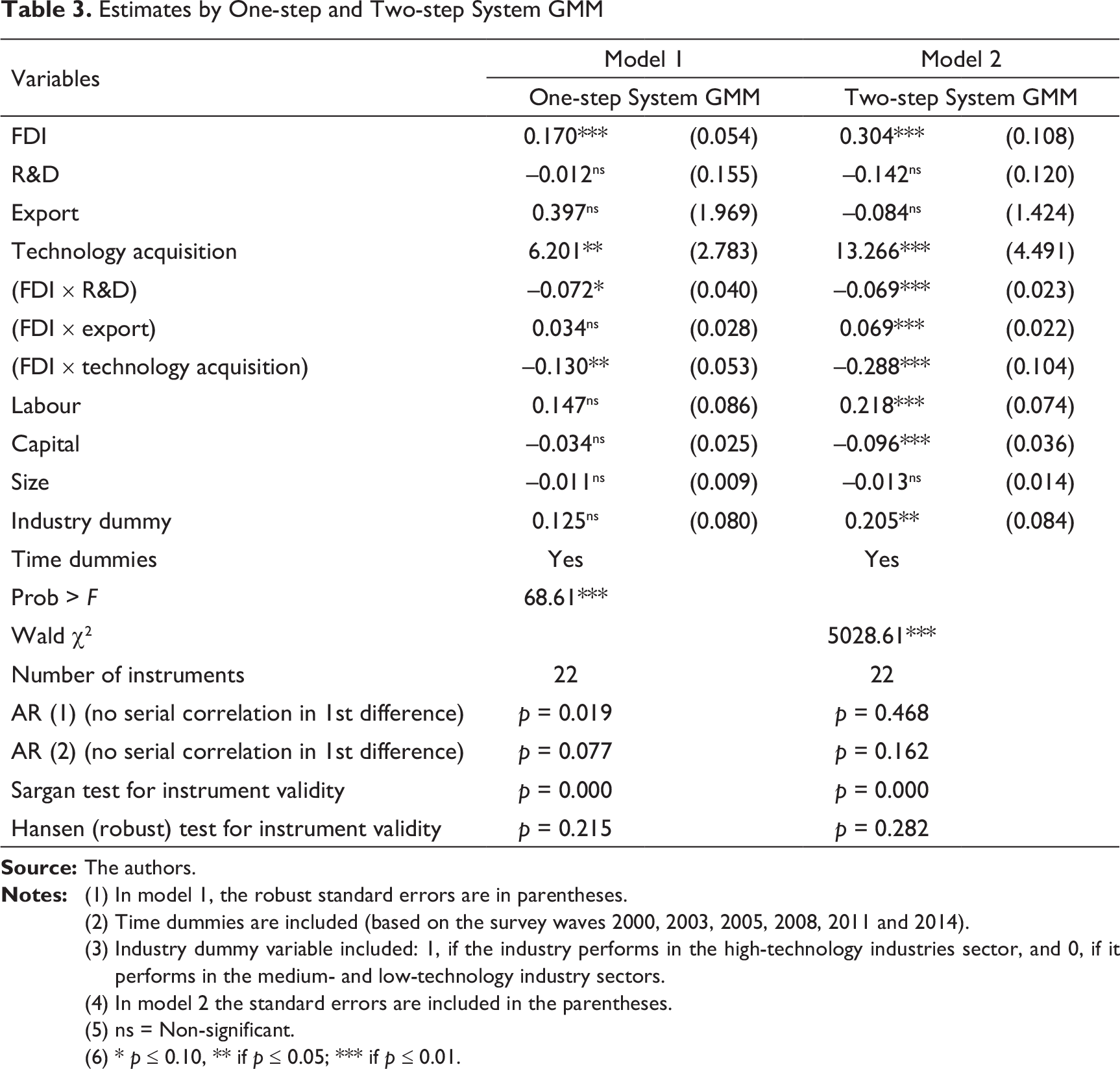
Estimates by One-step and Two-step System GMM
(2) Time dummies are included (based on the survey waves 2000, 2003, 2005, 2008, 2011 and 2014).
(3) Industry dummy variable included: 1, if the industry performs in the high-technology industries sector, and 0, if it performs in the medium- and low-technology industry sectors.
(4) In model 2 the standard errors are included in the parentheses.
(5) ns = Non-significant.
(6) * p ≤ 0.10, ** if p ≤ 0.05; *** if p ≤ 0.01.
Considering the composition of the dependent and independent variables and the endogeneity issues, we estimate model 1 using the one-step system generalized method of moments (GMM) estimation (Arellano & Bond, 1991). The use of internal R&D expenditure can bring endogeneity to the model due to measurement errors of the interest variable (Taveira et al., 2019). In addition, we adopt the two-step system GMM to estimate model 2. The two-step system GMM allows us to control for unobserved heterogeneity and a potential simultaneity between ‘R&D’, ‘exports’, ‘capital intensity’ and ‘labour’.
Table 3 shows the results for models 1 and 2. The two-step makes the coefficients more efficient and robust than the present coefficient in model 1. Considering this, the potentially endogenous variables have the correction recourse considering the external instruments to the model. It is important to mention a short note on the satisfactory diagnostics tests for model 2. The Wald χ2 test indicates the joint significance and a good explanatory power of the variables. The first- and second-order serial correlation and the heteroskedasticity-robust Hansen test are shown as adequate. However, the Sargan test shows itself as very sensitive to the increase of the number of instruments (Roodman, 2009). Nonetheless, since our model is based on system GMM, this does not invalidate the instruments considering the Hansen test.
The results indicate for model 2 that ‘FDI’ has a statistically and positive coefficient
However, this result indicates the high dependence of foreign technology. Frank et al. (2016) argue that technology acquisition is still the main investment category in terms of innovation activities in Brazil. Taveira et al. (2019) assert that companies do not invest heavily in internal technological development such as R&D. This strategy is particularly pertinent in Brazilian companies, since, in most cases, they have a wrong perception about the usefulness of the technology acquisition approach for innovation (Frank et al., 2016), showing interest in upgrading outdated technologies instead of focusing on developing new technologies. In particular, besides investing in R&D and own technology is expensive for a large number of industries; the importing substitution is preferable.
We found evidence of the interaction effect between ‘FDI’ and ‘R&D’ in model 2 with significant coefficient, but with a negative sign
Following the analysis, it is possible to observe in model 2 the positive relationship between ‘FDI’ and ‘exports’
Concerning the control variables in model 2, we identified a positive and significant effect on ‘labour’
Aiming to capture a better result across industries, we adopted the industry dummy variable. The result in Model 2 shows a significant and positive coefficient
Conclusion and Managerial Implications
The aim of this study was to analyse the main local sources of knowledge that moderate with inward FDI and improve the local industry innovation performance. The empirical results regarding the interaction between several local factors and the FDI inflow suggest a positive impact of FDI on local innovation. In addition, the interaction effect between FDI and exports has a positive impact, but R&D-related FDI does not improve the performance, since this activity occurs in headquarters in developed countries.
Furthermore, inward FDI does not show a positive result moderating with technology acquisition, suggesting the import substitution behavior. This could lead to buying only external technology and not developing their own, a reason why internal R&D investments do not have an impact on Brazilian manufacturing industries. One critical result is related to the high-technology industry sector, which shows higher innovation performance than medium- and low-technology sectors. Our findings infer some managerial and policy implications. In this case, the policymakers should give attention and protection to the potential of the medium- and low-technology sectors. It is necessary to attract more R&D-related FDI, specially in industries from high-technology sectors, to increase import substitution.
Limitations and Implications for Future Studies
The purpose of this research was not to generate a statement but to understand the impacts and possibilities of FDI inflows. Notwithstanding that the data did not represent the firm level, we captured an average effect using an industry survey. Future studies could explore the adoption of firm-level data to improve the results, with other important variables and other types of interactions between variables which were not observed here.
Footnotes
Acknowledgement
The authors are grateful to the anonymous referees of the journal for their extremely useful suggestions to improve the quality of the article. Usual disclaimers apply.
Declaration of Conflicting Interests
The authors declared no potential conflicts of interest about the research, authorship and/or publication of this article.
Funding
The authors disclosed receipt of the following financial support for the research, authorship and/or publication of this article: The research was financed in part by the Coordenação de Aperfeiçoamento de Pessoal de Nível Superior—Brasil (CAPES)—Financial Code 001.
