



Abstract
The current research envisages the ownership structure and earnings management nexus in the context of the effective monitoring hypothesis and myopic institutions hypothesis. The ownership aspects, including, shareholdings by the management, institutions, foreign institutions, pension funds, investment companies, and mutual funds are analyzed. The study follows Kothari et al. (2005) for the estimation of discretionary accruals and applied Arellano and Bond dynamic panel estimation to test the models based on a sample of 206 non-financial firms over the period of 2015–2019. The results of the study supported the agency theory, effective monitoring hypothesis, and myopic institutions hypothesis. Consistent with the previous empirical studies, the results reveal that managerial and institutional ownership curtails earnings management practices and discourages myopic management. Furthermore, the analysis of institutional investors based on their investment objectives reveals that the ownership of pension funds and investment companies restrains earnings management practices. On the other hand, discretionary accruals increase monotonically due to the existence of ownership by mutual funds. Furthermore, the study also provides a beer insight to regulatory authorities in order to design policies in such a way that ensures the protection of minority shareholders.
Introduction
Ownership structure influences the corporate strategic policies especially related to earnings management practices (Bao & Lewellyn, 2017). A recent study (Ghaleb et al., 2020) encapsulating the role of ownership concentration in formulating corporate earnings management practices highlighted the need to explore the multiple aspects of ownership structure, such as institutional and managerial ownership, in emerging economies, to establish the direction and magnitude of such constructs. In emerging economies, management holds large share of equity in the firms (Bao & Lewellyn, 2017), and the institutional corporate equity is rapidly growing (Waheed & Malik, 2019a). So, there is a need to explore the role of managerial and institutional ownership in the governance policies of the firms especially related to the earnings management practices.
The ownership structures of the firms in emerging economies have their own distinct features (Li & Zhang, 2010) and Pakistan being an emerging economy is relatively different from other emerging economies in the context of ownership structure (Kamran & Shah, 2014). This distinct characteristic owes to the concentration of corporate equity in the hands of the founding families, in the case of Pakistan (Waheed & Malik, 2019a). Such a phenomenon is commonly found extending to the expropriation of the wealth of the minority shareholders (Khan & Habib, 2018), and is an embedded feature of emerging economies, which may further complicate the principal-agent problem (Saeed & Sameer, 2017).
This opportunistic approach of the management in such firms through ownership structure is well described by the Agency Theory (Al-Fayoumi et al., 2010; Jensen & Meckling, 1976; Kazemian & Sanusi, 2015). It explains that a higher fraction of managerial shareholding in the corporations makes the management more responsible (Alves, 2012; Brandes et al., 2006), and also the higher level of local or foreign institutional ownership in the corporate equity structure results in better financial reporting standards (Burns et al., 2010; Velury & Jenkins, 2006). This restricts the corporate managers to adopt earnings-management-related practices, either in the presence of managerial or institutional shareholdings in such firms. Hence the opportunistic behaviours can be controlled either by the managerial presence in such a firm’s equity structure (alignment of interest hypothesis) or through the improvement of the firm’s monitoring mechanism by the local or foreign institutional investors in such firms (effective monitoring hypothesis). Moreover, the existence of a weak corporate governance mechanism exacerbates the agency conflict thereby empowering the management to provide compromised quality of financial reporting in emerging economies (Hussain & Shah, 2017; Rafique et al., 2017; Waheed & Malik, 2019a; 2019c).
Moreover, the earning management practices owing to the weak control of the owners over the management (Dong et al., 2020), corporate managers’ opportunistic behaviour, and exploitation of discretionary powers for personal gains (Anwara & Buvanendra, 2019), the resulting perceptions of the owners about misleading reporting (Bzeouich et al., 2019; Hui, 2018), leading to the financial scams of the developed countries (Yang et al., 2009); have got considerable attention in the empirical research covering the developed countries (Nasir et al., 2018; Suryandari et al., 2019). Yet the emerging and developing economies have way more to go ahead for revisiting the nexus for their own unique and distinct environment. Similarly, the phenomenon of institutional equity ownership in corporations and corporate manipulative practices related to earnings have also been widely explored in developed and emerging economies but with contradictory results (Bao & Lewellyn, 2017; Kałdoński et al., 2019) 1 . The presence of local and foreign institutional ownership in the corporations has resulted in an effective monitoring mechanism in curtailing earnings manipulative practices (Farooq & El Jai, 2012), due to their better market knowledge and financial expertise (Gallagher et al., 2007), and because of the effective monitoring by the individual equity holders being costly (Almazan et al., 2005; Hussain & Shah, 2017; Kim et al., 2016). Hence the institutional investors may play a critical role to ensure the interests of all types of shareholders (Hadani et al., 2011), through eliminating the weak control of equity holders on the management resulting in suboptimal managerial decisions, especially, related to earnings management practices (Yang, 2010).
On the contrary, the phenomenon of effective monitoring of institutional investors is widely negated in the financial literature, stating that financial investors invest in the corporations as long as they perform well and are financially stable; and that they are not concerned with the monitoring of the management (Abd-Mutalib et al., 2017; Bamahros & Hussin, 2015; Chen et al., 2015), confirming the myopic institutions’ hypothesis. But institutions such as pension funds and investment companies have been observed to hold long-term investment objectives in the firms through effective monitoring (Abd-Mutalib et al., 2017; Schneider & Ryan, 2011). Yet mutual funds have been found to be investing in corporations on the basis of economic conditions and not having any long-term investment objectives (Ajina et al., 2015; Yuan et al., 2008), and not taking interest in internal affairs of the investee firms (Hutchinson et al., 2015). Consequently, the literature is still looking forward to concluding the contrasting nature of the relationship, owing to the fact that the institutions are heterogeneous in nature and vary in terms of their structure and investment objectives in the investee firms (Abd-Mutalib et al., 2017).
Moreover, the transaction pattern of pension funds is counter-cyclic, as investors of the pension funds invest in the funds with long-term objectives, so pension funds are not in need of liquidity throughout the year (Abd-Mutalib et al., 2017). Thus, pension funds invest in corporate equity for a longer period of time (Del Guercio & Hawkins, 1999). This long period of corporate investment enables the pension funds to ensure effective monitoring (Faccio & Lasfer, 2000). On the contrary, mutual funds have very high fiduciary responsibilities, since they have cyclic transaction patterns, so they always require high liquidity (Abd-Mutalib et al., 2017; Yuan et al., 2008). In such circumstances, mutual funds neither bear extra monitoring costs nor interfere with the management’s affairs. Thus, there are different approaches to diverse institutional investors in monitoring the management of the corporations.
The above discussion very clearly highlights the gap that needs to be further tested and explored for better generalization of the linkages among earnings management, the contradictory state of effective monitoring, and the myopic institutions’ hypothesis under institutional heterogeneity. Thus, the current research addresses this context by exploring the impact of managerial and institutional ownership on corporate earnings management practices by taking a sample of non-financial sector firms from an emerging economy with distinct ownership structure features. The reason for selecting the non-financial sector is again the extensive presence of the distinct ownership by founding families in such firms.
Specifically, with reference to an emerging economy like Pakistan, the scarcity of literature ascertaining the relationship between institutional ownership and earnings quality via static models (Latif et al., 2017; Rehman et al., 2017), gives rise to the need for a dynamic study addressing the earlier biased and inconsistent results owing to the endogeneity issues in such studies. Moreover, due to the availability of limited empirical evidence considering the heterogeneous nature of the financial institutions (Abd-Mutalib et al., 2017), and the disparities among their long-term and short-term investment objectives (Jun & Genfu, 2012; Rebai, 2011; Shin & Seo, 2011), their different transaction patterns (cyclic or counter-cyclic) throughout the year, and their liquidity differences (Abd-Mutalib et al., 2017; Copeland et al., 2005; Ryan & Schneider, 2002) 2 ; clearly provide a lead for a study addressing the context considering the heterogeneity of the institutions and the distinct characteristics of those institutions in emerging economies like Pakistan.
So, for a deeper understanding of this phenomenon, the study is an attempt to examine the relationship of pension funds, investment companies, and mutual funds ownership with earnings management practices in view of effective monitoring and the myopic institutions’ hypothesis. In the context of the emerging economies, the findings of the study will have far-reaching implications for the economies with similar characteristics, where corporate control is in the hands of founding families (Waheed & Malik, 2019a). The research has practical implications for corporate managers, individual investors, and regulatory authorities. The present research edifies the management about the role of institutional investors as homogeneous and heterogeneous groups in shaping the earnings management practices in firms. The study helps them to understand the long-term behaviour of pension funds and the short-term behaviour of mutual funds in corporations.
The research is also useful for individual investors for making long or short-term investment decisions in corporations. The study advises the individual shareholders, that their dependence on financial institutions for the protection of their interests is not appropriate. Some institutions, such as pension funds and investment companies have long investment objectives while mutual funds have short-term investment objectives. The study is also useful for regulatory authorities so that they make policies that ensure the protection of all the stakeholders of the firm. The remainder of the article consists of the second section which provides a critical review of the literature and articulation of the research hypotheses; the third section describes the empirical methods; the fourth section presents results and their discussions and the fifth section presents the conclusion.
Literature Review and Hypotheses Development
Managerial Ownership and Earnings Management
The review of the literature suggests that there exists a wide range of diverse theoretical and empirical opinions explaining the role of managerial ownership in manipulative practices related to earnings (Efendi et al., 2007; Nasir et al., 2018; Summers & Sweeney, 1998; Suryandari et al., 2019). Agency theory discusses that managerial shareholdings reduce the agency problems since the presence of managerial proprietorship realizes that the control of the firm is in the hands of their representatives (Mustapha & Ahmad, 2011). Many scholars identified that managerial ownership aligns the interests of the equity holders and management whose effect reduces the managerial opportunistic behaviour, and consequently increases the value of the firm (Alves, 2012; Lafond & Roychowdhury, 2008; Piosik & Genge, 2019; Short & Keasey, 1999). Thus, according to the alignment of interest hypothesis, managerial ownership is negatively related to earnings management practices (Alzoubi, 2016; Teshima & Shuto, 2008).
However, there also exists contradictory theoretical and empirical evidence regarding the role of managerial ownership in earnings management. For instance, the management entrenchment hypothesis proposed by Shleifer and Vishny (1989) does not prove that managerial ownership is a solution to the earnings management problems in firms. The management entrenchment hypothesis describes that a higher level of managerial ownership in firms may reduce the equity holders’ pressure on the management (Farinha, 2003), which results in entrenchment between the management team and the managers aggressively involve in earnings management practices for their short-term benefits (Shuto & Takada, 2010). Yang et al. (2008) found that managerial ownership involved manipulative practices related to the earnings in order to create a positive signal to the market participants which in turn artificially increases the market value of the firm. Moreover, Al-Fayoumi et al. (2010) and Cheng and Warfield (2005) also supported the entrenchment hypothesis in their research. Thus, there is no consensus in explaining the role of managerial ownership in earnings management practices in firms. Thus, there is a need to retest this relationship in the context of emerging economies. Thus, the review of the literature further suggests that the majority of the developing countries have a weak investors protection mechanism, especially for individual investors (Rehman et al., 2021; Waheed & Malik, 2019a) and managerial ownership aligns the interests of the firm and the equity holders (agency theory). Thus, in the light of the previous discussions, managerial ownership can be considered a valuable source to control managerial opportunism, especially, in those countries which have weak legal and unstable political environment. So, based on the above arguments under the context of agency theory applicability in Pakistan the study develops the following hypothesis:
Institutional Ownership and Earnings Management
A plethora of theoretical and empirical research explored the role of financial institutions in curtailing earnings manipulative practices. One of the established hypotheses of agency theory discusses the effective role of financial institutional owners in monitoring the management activities (efficient monitoring hypothesis). The financial expertise, skills, and market-based knowledge of financial institutions are very useful for corporate managers (Almazan et al., 2005). Thus, in the light of the effective monitoring hypothesis, the presence of institutional ownership in the firms’ ownership structure curtailed the opportunistic behaviour of the corporate managers and reduced managerial intentions to report manipulated earnings (Abdul Jalil & Abdul Rahman, 2010; Hadani et al., 2011; Hao & Yao, 2010; Kazemian & Sanusi, 2015; Sajjad et al., 2019).
Financial institutions are not the only sources of financial capital for corporations but they also strengthen the governance mechanism by ensuring the corporate board independence (Uribe-Bohorquez et al., 2018; Waheed & Malik, 2019a). Corporate board independence decreases the influence of executive directors and senior management in the firms and ensures that the interests of all the groups of shareholders (especially minority shareholders) are protected (Schnatterly & Johnson, 2014). Thus, agency and resource dependence theories suggest a constructive role of institutional shareholding in ensuring the quality of the reporting. Empirically, there exists a large body of research that documented institutional investors as a dynamic external corporate governance proxy to control the opportunistic behaviour of the managers in earnings management (Alves, 2012; Benkraiem, 2008; Chung et al., 2002; Kamran & Shah, 2014; Koh, 2003; Sakaki et al., 2017).
Chung et al. (2002) found that it is hard for the management to cheat equity holders by reporting higher profits in firms’ annual reports in the presence of a large share of equity in the hands of financial institutions. Koh (2003) provided a concaved-shaped association between discretionary accruals and institutional shareholding. The firms which hold a higher level of institutional ownership were located on the decreasing side of the concave graph, while those which hold a higher level of institutional shareholding were located on the increasing side of the curve (Koh, 2003). Kamran and Shah (2014) established negative institutional shareholdings and earnings management relationship, and they claimed that financial institutions ensure the lucidity in the corporate financial information. Moreover, institutional investors are erudite investors (Monks & Minow, 1996), and they are also adept at spotting earnings management practices by corporate managers (Balsam et al., 2002).
However, there are a number of researchers who either concluded a positive or insignificant impact of financial institutions on earnings management practices of the firms (Yang et al., 2009). Theoretically, agency theory and myopic institutions theory provides contradictory views on the role of institutional investors in monitoring the management. Agency theory propagates that the effective monitoring of the management by the institutional investors restricts the managers to refrain from earnings management practices, whereas, myopic institutions theory describes that, institutional investors are not concerned with the affairs of the management (Alves, 2012; Hansen & Hill, 1991). Moreover, financial managers are also found to misstate the financial information of the firms to meet the expectations of the financial institutions (Cornett et al., 2007; Tehranian et al., 2006). So, in order to reply to these conflicting theoretical and empirical findings, there is a need to explore this relationship, especially, in the context of emerging economies as well. Therefore, the study developed the following hypothesis based on the above-mentioned empirical debate under the agency theory context.
Foreign Ownership and Earnings Management
Theoretically, the global investor hypothesis describes that foreign institutional ownership has better monitoring abilities vis-à-vis local investors. The foreign institutional shareholders restrict the management in doing earnings management practices (Kim et al., 2016). Empirically, it is also found that foreign institutional shareholding is an important component in curtailing the manipulation practices in the context of the developed and emerging economies (Almashaqbeh et al., 2019; Farooq & El Jai, 2012; Khanna & Palepu, 2000; Kim & Yoon, 2009; Lev et al., 2010; Liang et al., 2012). Kim and Yoon (2009) studied the impact of foreign companies and local institutional shareholdings on earnings-management-related practices in the Korean context. Their study ascertained the positive institutional ownership and performance relationship. Further, they also found the negative impact of foreign institutional shareholdings over the fraudulent management of earnings. Farooq and El Jai (2012) found a negative impact of local and foreign institutional shareholders on earnings-management-related practices in Morocco. Similarly, the foreign investors are also found to have a long-run investment objective in the corporation (Bena et al., 2017), and empirically majority of the scholars reported that the foreign shareholders have a negative impact on the earnings management practices (Kim & Yoon, 2009; Lev et al., 2010). However, Almashaqbeh et al. (2019) reported that local institutional shareholding (foreign companies’ ownership) is negatively (positively) associated with manipulations of earnings. Thus, the above discussion led to the development of the following empirical hypothesis based on the global investor hypothesis.
Institutional Heterogeneity and Earnings Management
The review of theoretical and empirical research in the previous section revealed inconclusive results regarding the positive or negative role of institutional shareholders in earnings manipulations. However, some scholars classified the institutional stakeholders on the basis of their investment objective in the investee companies (Abd-Mutalib et al., 2017; Copeland et al., 2005; De-la-Hoz & Pombo, 2016; Hoskisson et al., 2002; Hutchinson et al., 2015; Rebai, 2011). The investment objectives of the institutional investors in the corporations have provided the grounds to establish two renowned hypotheses, that is, effective monitoring hypothesis and the myopic institutions’ hypothesis. The effective monitoring hypothesis describes that the market-based knowledge and financial expertise of the financial institutions make them superior investors as compared to individual investors, so the financial institutions refrain the corporate managers from opportunistic actions and, hence, provide an effective external monitoring mechanism to the firms which resist the earnings manipulations practices (Almazan et al., 2005). Moreover, the huge amount of investment of the institutional investors in the corporations enables them to bear extra monitoring costs for a longer period of time, so their long-term investment objectives in the firms are more desirable for them and for the investee companies as well (Sajjad et al., 2019).
On the other hand, the myopic institutions’ hypothesis describes that institutional shareholders are more interested in short-term earnings, thereby, keeping in view the short-term investment objectives (Bhide, 1993; Porter, 1992). Due to their short-term investment objectives, the institutional shareholders are least concerned to interfere with the governance affairs of the firms (Hutchinson et al., 2015), so corporate managers are aggressively involved in earnings management practices (Koh, 2003). However, institutional shareholders are non-homogeneous in nature (Hoskisson et al., 2002), so the in-depth study of financial institutions based on their heterogeneity, may fill this gap in the role of financial institutions in earnings management practices.
Empirical evidence provides that the heterogeneous nature of institutional investors has different long-term or short-term investment objectives (Abd-Mutalib et al., 2017; Waheed & Malik, 2019c). The investment objectives of financial institutions are based on their needs for liquidity (Abd-Mutalib et al., 2017; Waheed & Malik, 2019c). Pension funds and investment companies offer their investors long-term investment schemes, so they prefer to invest this capital in the corporations for a longer period of time (Della Croce, 2011; Giannetti & Laeven, 2008), and their long-term investment objectives enable them to effectively monitor the management and restrain them from earnings management activities (Giannetti & Laeven, 2008; Waheed & Malik, 2019c). In a recent study, Sakaki et al. (2017) confirmed the minority role of pension funds and investment companies in decreasing earnings management practices. Whereas, Dai et al. (2013) reported that short-investment objectives of the mutual funds encourage earnings management practices in China. So based on the above discussion, there is a need to examine the relationship of various types of financial institutional shareholdings with earning manipulations, especially in the context of developing economies, where the overall governance mechanism is weak (Rafique et al., 2017) and financial inefficiency prevails in the markets (Abbas et al., 2018). The above theoretical debate directed the study towards the development of the following hypotheses based on the effective monitoring hypothesis.
Moreover, the debate also led to the development of the following hypothesis based on the myopic institutions’ hypothesis
Research Methodology
Theoretical Framework of the Study
The study analysed the impact of managerial ownership in the light of two contradictory opinions, that is, alignment of interest and management entrenchment. The alignment of interest opinion claims that managerial share-holding restrains the corporate managers to involve in fraudulent activities and thus hinders them from earnings management activities (Piosik & Genge, 2019). Management entrenchment opinion links managerial ownership with more frequent earnings practices in the firms (Farinha, 2003). Thus, based on these two contradictory opinions, the study tested the managerial ownership and earnings quality relationship.
Agency theory links institutional ownership with fewer earnings quality. Moreover, the effective monitoring hypothesis also suggests that financial institutions, with their expertise and skills, are better able to monitor the management as compared to individual investors (Kazemian & Sanusi, 2015). The research further linked the effective monitoring of financial institutions to their long-term or short-term investment objectives in the investee firms (Johnson & Greening, 1999; Waheed & Malik, 2019b). On these grounds, the current research modelled that pension funds’ shareholdings and investment companies’ ownership have long-term investment objectives, and thus their long period in the firm enables them to effectively monitor the management and restrict them from earnings management practices (Johnson & Greening, 1999; Waheed & Malik, 2019b). Moreover, the following model further proposes that foreign institutional ownership effectively monitors the management in the light of the global investor hypothesis and restricts the corporate managers from earnings management practices.
However, financial institutions, such as mutual funds have short-term investment objectives (Johnson & Greening, 1999), hence these do not put extra monitoring costs on the firms’ and their investment decisions in the firms are linked with access to information and market conditions (myopic institutions hypothesis). Thus, the research does not expect a positive impact of mutual funds in curtailing the earnings management practices in the firms. Moreover, in the light of the effective monitoring hypothesis, the study also expects a positive role of foreign institutional investors in curtailing earnings manipulative practices.
The study developed the following theoretical framework (Figure 1) in the light of agency theory, effective monitoring, and myopic institutions hypothesis.

The current study addresses the intriguing question in the above framework, that is, whether managerial ownership, institutional investors, and foreign companies’ ownership curtail the earning manipulative practices in the presence of endogeneity, heteroscedasticity, and simultaneity problems. In earlier studies considering the problem of endogeneity, Kamran and Shah (2014) established the relationship between institutional ownership, corporate governance, and earnings management via 2SLS. However, Hussain and Shah (2017) and Nguyen et al., (2015) prefer the use of Arellano–Bond estimation (AB) in the dynamic panel framework of Arellano and Bond (1991). Unlike 2SLS and 3SLS, it resolves the issue of endogeneity without relying on external exogenous instruments (Wintoki et al., 2012). Therefore, the current study addresses the intriguing question of whether the presence of managerial ownership, institutional investors, and foreign companies’ ownership curtail the earning manipulative practices in view of agency theory and global investor hypothesis through Arellano–Bond dynamic panel estimation in order to produce unbiased and consistent parameters, thereby overcoming the endogeneity, heteroscedasticity, and simultaneity problems.
The Details of the Data Sample
The sample set of the current research is selected from an emerging economy with distinct features as discussed above to develop insights for better generalization for such economies. For this purpose, a population of 580 listed firms on the Pakistan Stock Exchange (PSX) was selected. Of these firms; 146 financial sector firms were excluded since they had different financial and regulatory frameworks. Afterward, 228 firms were excluded either due to incomplete data or firms having less than 3 years of data during the sample period. Finally, the study considered 206 non-financial firms over the period of 2015–2019. The details of the sampled 206 firms from 11 distinct sectors are as follows: 103 firms from textile sector; 21 firms from sugar sector; 11 firms belong to food sector; 10 firms included from the chemicals and pharmaceuticals industry; 20 firms taken from other manufacturing industry; three firms from mineral products sector; 11 firms from cement sector; 13 firms from auto industry; six of them from fuel & energy industry; five firms from information, communication and transport services industry; three firms from Coke and refined petroleum industry. The data set related to the selected variables was computed from the firms’ audited annual reports obtained from the Security and Exchange Commission of Pakistan (SECP). The data relating to the corporate governance variables are computed through directors’ reports and the financial information is obtained through financial statements and managerial and institutional ownership. The data is computed from the pattern of shareholdings reports. Thus, the final sample consists of 206 unbalanced firms with 1030 maximum firm-years observations from 2015–2019. Finally, the variables of the study are winsorized at 1% and 99% levels in order to control the possibility of outliers.
Calculation of the Dependent, Independent, and Control Variables
Earnings Management (EM)
The Kothari et al., model (2005) is used to measure the discretionary accruals (accrual earnings management) as a proxy for earnings (Al-Fayoumi et al., 2010). The Kothari Model (2005) is estimated through the following equation:

where, TAccruals it = Total Accruals, Assets it - 1 = Total Assets in year (t - 1), PPE it = Gross value of Equipment, Plant and Property, ∇REV it = Change in Revenue, ∇REC it = Change in net Receivables, ROA it = Return on Assets in year (t - 1),ϵit = Residual terms (to represent the discretionary accruals).
The Econometric Models
The current study adopted the regression model from Sakaki et al. (2017). The current study modified the model and classified the financial institutions on the bases of their investment objectives in investee firms and analysed their heterogeneous effect on earnings management practices of the managers. We have examined the institutional shareholdings and earnings manipulative practices relationship in the panel data framework. Hsiao (1986) argued that panel regression estimation has several benefits. First, the panel estimation allows us to account for unobserved heterogeneity. Second, large numbers of observations provide more degree of freedom. Third, panel data addresses the issue of collinearity among explanatory variables to a large extent. Hence, the current study analysed the baseline Equations (2) and (3) through static panel models.
We also estimated the baseline Equations (2) and (3) in AB dynamic panel framework setting of Arellano and Bond (1991) for the robustness of the results. Moreover, dynamic panel models are also considered superior when the nature of the relationship between two variables is endogenous (Akbar et al., 2016; Waheed & Malik, 2019a). Thus, the endogenous nature of ownership structure proxies with the earnings management practices in the light of the literature provides a solid ground to apply the Arellano–Bond dynamic panel estimations on the selected sample (Waheed & Malik, 2019a). Moreover, dynamic panel models are considered more effective in handling the problems of unobserved heterogeneity, simultaneous and dynamic endogeneities in the panel found to provide consistent and unbiased coefficients especially when the selected panel is unbalanced and with the characteristics of endogeneity (Bhagat & Bolton, 2008; Nguyen et al., 2015). Thus, the researchers tested the first three hypotheses of the study with the help of econometric Equation (2), whereas, hypotheses number four and five are tested with the help of econometric Equation (3).


Results
Descriptive Statistics
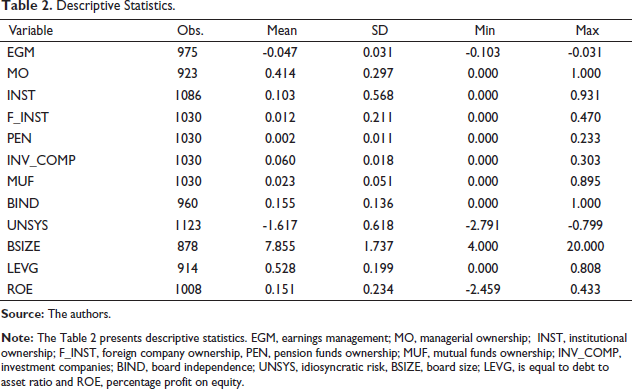
Table 1 presents the descriptive statistics of variables under study. The descriptive statistics table includes total number of observations of the selected variables along with its mean, minimum, maximum, and standard deviation values. As the data set is unbalanced in nature so, each variable under study has different number of observations. Table 1 shows that the mean value of earnings management is −0.047 with standard deviation of 0.031. The mean value of discretionary accruals is less than Kamran and Shah (2014). However, the mean value of managerial ownership is 41.4% which is greater than Kamran and Shah (2014) due to the difference in sample size and period. The maximum value of managerial ownership also implied that the sample set also includes firms with no managerial ownership and there also exists such firms in the data who have the whole equity ownership in the hands of their management. The sample firms on average have 10.3% of their ownership in the hands of the institutional investors that varies between 0% and 93.1%. The mean of institutional shareholding is lower than Latif et al. (2017) and Rehman et al. (2017). Table 1 also shows that mean value of investment companies’ ownership is greater than the mutual funds and pension funds ownership. Moreover, the mean value of mutual funds is 2.3% with minimum value of 0 and maximum value 89.5%. Table 2 also depicts that the mean value of foreign institutional ownership is 1.2% with standard deviation of 2.11%.
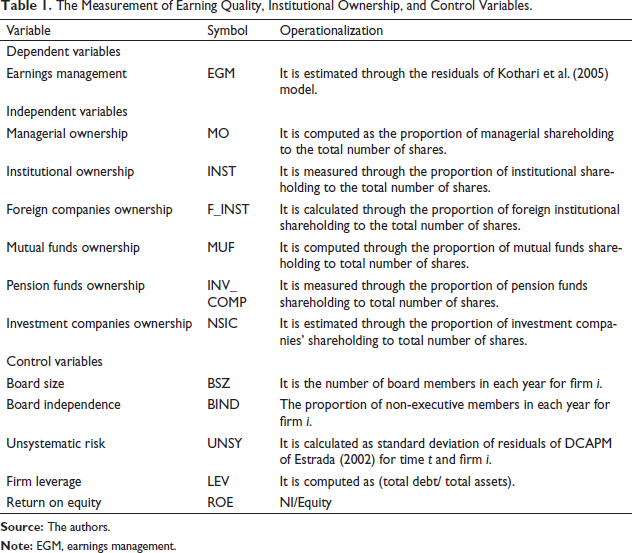
The Measurement of Earning Quality, Institutional Ownership, and Control Variables.
Descriptive Statistics.
Correlation Matrix
Table 3 provides the correlation matrix of exogenous and endogenous variables. In Table 3 institutional ownership and earnings management have a negative and statistically significant correlation. Similarly, the pension funds and investment companies’ ownership are negative, while mutual funds’ shareholding is positively correlated with manipulative practices. The negative correlation coefficient of investment companies’ shareholding with earning quality is higher among all the explanatory proxies of institutional ownership, which is statistically significant at 1% level of significance. Moreover, there is not a serious issue of multicollinearity as all the values of the coefficients in the matrix is less than 0.80 (Gujarati & Porter, 2009). Here, the highest correlation that exists between foreign ownership and idiosyncratic risk is 0.71. The second utmost correlation exists between mutual funds and institutional ownership.
Correlation Matrix.
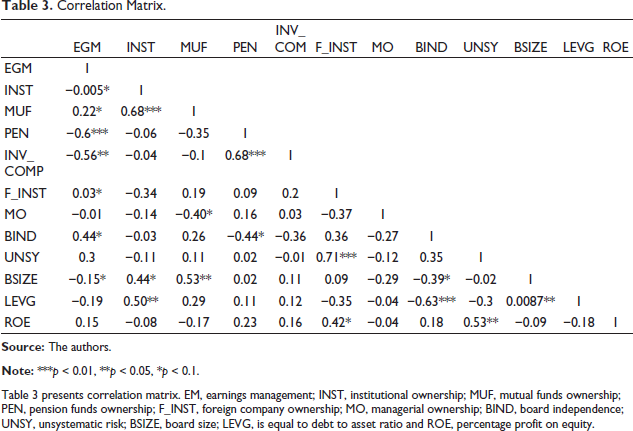
Table 3 presents correlation matrix. EM, earnings management; INST, institutional ownership; MUF, mutual funds ownership; PEN, pension funds ownership; F_INST, foreign company ownership; MO, managerial ownership; BIND, board independence; UNSY, unsystematic risk; BSIZE, board size; LEVG, is equal to debt to asset ratio and ROE, percentage profit on equity.
Regression Analysis
In case of static model, the Hausman (1978) specification test is applied to choose the most suitable estimation model between fixed and random effects. The results of Hausman test support the random effect model. However, we also estimated the econometric model in a dynamic panel framework setting. The post estimation tests of Arellano-Bond estimation dynamic panel estimation such as the Sargan test and AR (2) are statistically insignificant, indicating that all the instruments are valid and data has no issue of serial correlation issue of order 2. The coefficient of lagged earnings manipulative practices is negatively associated with the current discretionary accruals. It indicates that current year earnings management is affected by previous period discretionary accruals. The results in Table 4 reveal that the coefficients of institutional shareholding are negative and significant at a p-value less than 1% in the static panel model and it is also negatively significant in the dynamic panel model with earnings quality. Thus, the econometric results of both models confirm the negative connection between institutional ownership and earnings management practices.
The Institutional Ownership and Earning Management Perspective.
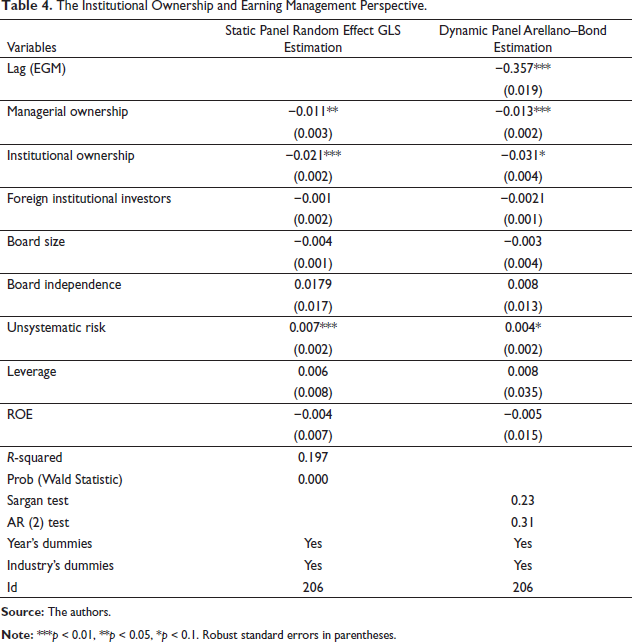
Theoretically, this result confirms the agency role of institutional investors in effective monitoring of the management and restraining them from earnings management practices. Empirically, this result is consistent with the finding of Hadani et al. (2011), Kazemian and Sanusi (2015), Sajjad et al. (2019). The hypothesis H2 states that managerial ownership has a significant negative impact on earnings management practices. The results in both static and dynamic models are negatively and significantly associated with earnings management practices in both fixed and dynamic models. Thus, the study confirms the role of managerial ownership in curtailing the earnings manipulative practices in corporations. This result also validates the alignment of interest hypothesis in the Pakistani context, and this result is empirically consistent with the findings of Alves (2012), Lafond and Roychowdhury (2008), Piosik and Genge (2019), Short and Keasey (1999). Finally, the coefficients of foreign institutional ownership are insignificant with earnings management practices in Pakistani firms. Ali Shah et al. (2009) also reported an insignificant association between foreign institutional ownership and earnings management practices in Malaysian firms. The reason for insignificance is that majority of the corporations in Pakistan have concentrated ownership either in the hands of local financial institutions or founding families (Afza & Mirza, 2011; Latif et al., 2017; Waheed & Malik, 2019a), so it is difficult for the foreign investors to influence the corporate earnings management practices.
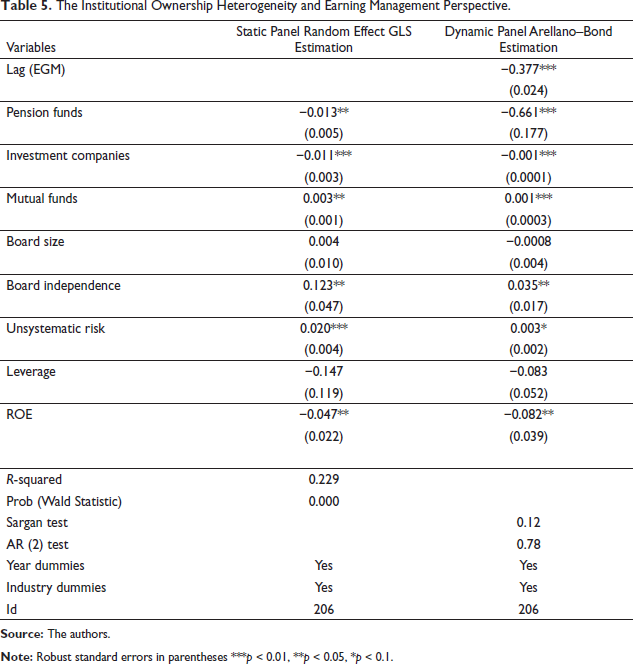
Table 5 presents the regression results of the heterogeneity nature of institutional shareholders on manipulative practices through static and dynamic panel estimation techniques. Consistent with the effective monitoring hypothesis, the pension funds, and investment companies’ shareholdings are negatively associated with earnings management practices. The coefficient of pension funds is negative and significant (β = −0.013, p < 0.05) with earnings management practices in the static model. Similarly, the coefficient of pension funds is also significantly negatively (β = −0.661, p < 0.01) associated with manipulative practices in dynamic panel framework. Likewise, the coefficient of investment companies is negatively significant (β = −0.011, p < 0.01) in static panel model and it is also negatively significant (β = −0.0009, p < 0.01) in dynamic panel model. Thus, the study confirms that pension funds and investment companies have long-term stake in the firms and due to this longer stake these types of financial institutions effectively monitor the management and restrict them from earnings management practices in the firms. On the contrary, the coefficient of the mutual fund is positively significant (β = −0.003, p < 0.05) with earnings management practices in both static and dynamic panel estimations, respectively. Thus, the study confirms that mutual funds have a myopic role regarding the earnings manipulative practices of the management and this result is in line with the myopic institutions’ hypothesis (Chen et al., 2015).
The Institutional Ownership Heterogeneity and Earning Management Perspective.
Conclusion
This study concluded that managerial ownership restricts the corporate managers from earnings management practices in the firms, thus validating the alignment of interest opinion and rejecting the entrenchment opinion in an emerging economy like Pakistan. Moreover, it concluded that institutional investors as a homogeneous group effectively monitor the management and restrict them from earnings management practices, while foreign institutional investors do not have any impact on earnings management practices thus validating that the comparative advantage of foreign institutional investors is not valid in Pakistan due to greater influence of domestic financial institutions on firms.
The heterogeneous nature of the financial institutions was also found significant by validating through financial institutions, such as pension funds and investment companies’ long-term investment objectives, effective monitoring of the management, and restricting the earnings management practices in the firms. Whereas, mutual funds were found to be having short-term investment objectives, and are not concerned with corporate affairs thus aggressively involved in the earnings management practices in the studied firms.
The results and findings were found to be very important for corporate managers, governing body managers, policy-makers, financial institutions, and academicians. It will help them to develop, an ideal equity structure that ensures the protection of all the stakeholders of the firm. The study will enable the CEOs and corporate board members to formulate effective corporate policies for control of the earnings management practices in the firms. Hence, the findings of the study go a long way in impinging upon the firm managers and investors the way financial institutes affect the earnings management practices in corporations. The study enables the institutional investors to make long-term or short-term investment decisions in the corporations by considering the earnings management practices of the corporate managers.
The research imparts a very important lesson for stakeholders that, in a country like Pakistan, where the majority of the corporations have concentrated ownership, only institutional investors can restrict the management from the expropriation of the wealth of the minority shareholders. Regulatory authorities should make such policies that encourage institutional financiers to invest in the equity structure of the firms and discourage the higher level of managerial ownership in firms. So, the regulatory authorities should encourage the financial institutions to invest in the corporations, because they bring consistency in the governance and performance mechanism and this will lead to the stability of the stock market and economic growth of the country. However, the study also informs the individual shareholders, that their sole reliance on the institutional investors for the protection of their interests in the firm is not appropriate. Some institutions, such as pension funds and investment companies have long investment objectives and mutual funds have short-term investment objectives, so individual investors may make long- or short-term investment decisions by considering this aspect of the financial institutions.
The results of the current research are also very significant in the context of extreme external economic shocks such as the COVID-19 outbreak in Wuhan City, China, that paralysed the world’s economies. The pandemic of COVID-19 has a profound impact on the corporations of emerging economies because, unlike in the western world, the firm in the developing countries does not have enough technological and financial resources. The current research further concludes that long-term equity holders such as pension funds and investment companies, not only keep their investment in the firms but also counsel the management with their financial expertise, to overcome the external economic shocks. Thus, the stable ownership structure is very crucial for the continuity of the managerial policies, related to the corporate earnings quality, even in volatile economic conditions.
The research study is also useful in the theoretical context. The study provides a theoretical understanding of the ownership structure, corporate governance, and earnings management practices by using effective monitoring and myopic institutions hypothesis. The present research is also useful for individual investors to apprehend the earnings management practices of the corporate managers so that they could make short and long-term investment decisions in the corporations.
The current thesis is limited to only those firms which are listed on the Pakistan stock exchange (PSX), although there are a large number of businesses operating in Pakistan which are not registered on PSX. Secondly, the study has only included firms from the non-financial sector, future research could be carried out by taking a sample from the financial sector. The available data related to ownership structure (pattern of shareholding) is published annually in Pakistan and it provides limited information. The study also urges regulatory authorities to enforce the corporation to publish quarterly data related to their ownership structure; it would help to understand the phenomena of institutional investment horizon in greater detail.
Footnotes
Declaration of Conflicting Interests
The authors declared no potential conflicts of interest with respect to the research, authorship and/or publication of this article.
Funding
The authors received no financial support for the research, authorship and/or publication of this article.
