



Abstract
In recent years, there is an increasing interest in the literature in investigating whether and how corporate ownership structure may influence corporate social responsibility (CSR), but despite some attempts, this relationship still lacks in-depth empirical exploration. Building on extant insights, we analyze the relationship between environmental, social and governance (ESG) activity and the ownership structure of the Indian banking system. Our sample includes 37 publicly traded Indian banks observed over the period 2015–2020. Through random effect regression models accounting for the existence of selection bias, we find that the banks’ decision to engage in ESG activities is associated with the investors’ geographical region of origin rather than the types of investors. Our study brings knowledge to the extant literature, shedding light on the role of the ownership structure in driving ESG oriented decisions and actions.
Keywords
Introduction
In recent years, driven by the institutional and societal calls for greater attention to sustainability themes, international institutions and policy-makers have been increasingly committed to raise firms’ sustainability awareness, and investors have started to assess firms’ positions towards sustainability.
In September 2015, 193 countries belonging to the United Nations signed the 2030 Agenda for Sustainable Development, focused on 17 objectives to be achieved by 2030, namely the sustainable development goals (SDGs). These goals seem to be very interesting for investors as they can communicate to the market where firms are focusing their sustainability efforts.
Therefore, the growing attention to environmental, social and governance (ESG) issues has contributed to the spread of corporate sustainability metrics, which have become popular among operators. Institutional investors, in particular, have increasingly based their investment decisions on the sustainable development of their investee firms (Dimson et al., 2015).
Prior research found that firms’ shareholders can exercise a positive influence over corporate sustainable attitude, by stimulating proactive behaviour towards sustainable practices (Alda, 2019). Notwithstanding, there has been lack of empirical studies examining how the ownership structure affects ESG activity, especially with reference to emerging economies. In fact, ownership structure has been mainly investigated in the industrial setting in the North American and European contexts (Alda, 2019; Pucheta-Martínez & López-Zamora, 2018), while it is under investigated in the banking industry and in the context of the emerging economies.
De facto, countries are not homogeneous in terms of sensitivity to ESG themes, cultural orientation to sustainability, attention to environmental issues and climate change, thus leading to different ESG actions and practices.
Aiming at filling this gap, the article investigates the influence of the ownership structure on corporate ESG activity, by analyzing the Indian banking system.
India is an emerging country among the largest in the world in terms of GDP. 1 In this country, the corporate sector is primarily characterized by concentrated ownership. This because an important part of the shareholding, which could reach up to 75%, is held by the promoter group. After promoters, a significant part of the equity of Indian firms is occupied by institutional shareholders (Arora & Srivastava, 2021; Banik & Chatterjee, 2021).
In particular, this article aims to answer the following research questions.
RQ1. Does banks’ ownership structure affect the overall ESG activity? RQ2. Does banks’ ownership structure affect each specific dimension of the sustainable activity, namely the Environmental (E), Social (S) and Governance (G) dimensions?
The present study provides several contributions to the extant literature. First, the article contributes to the ongoing debate on the relationship between ownership structure and corporate social responsibility, by providing empirical evidence that ownership structure affects ESG activity in the banking industry of an emerging economy. Second, it also illustrates that the geographical region of origin of investors, rather than types of investors, has the potential to influence the banks’ ESG activity. Finally, this study adds knowledge to the existing corporate governance literature, as it provides empirical evidence that banks’ ESG activity is favoured in presence of higher board independence and a dedicated CSR committee. All this in the context of an emerging country.
Our study also has significant practical implications. Specifically, it encourages institutions and policymakers to increasingly invest in fostering sustainability culture across firms, also introducing guidelines and regulations on environmental, social and governance issues that can benefit the sustainability outcomes in emerging economies.
In addition, from a managerial perspective and in response to the growing investors’ attention with reference to ESG scores, the findings of this study stimulate firms to have a proactive behaviour towards sustainable practices, adopting good governance practices to favour the implementation of corporate sustainability-oriented activities and the CSR disclosure.
The remainder of the article is organized as follows. Below we present a literature review and describe the methodology adopted. Then we present the empirical results and propose some conclusions.
Literature Review
In recent years, corporate social responsibility (CSR) has become a hotly debated topic among policy makers, practitioners, stakeholders, and academics. Recently, some of the literature has focused on the long-term evolution of this important concept (e.g. Carroll, 2021).
At corporate level, firms are responding by adapting their governance structures and practices. Some firms have introduced a dedicated CSR committee (Ricart et al., 2005) or increased the board independence, as a greater percentage of independent directors tend to stimulate firms to meet stakeholders’ demands and ESG criteria (Ortas et al., 2017).
Firms’ sustainable behaviour and results are becoming increasingly important also for firms’ shareholders.
Prior literature has largely explored the relevance of firms’ ownership structure. From an Agency theory perspective (Jensen & Meckling, 1976), the agent-principal relationship between shareholders and managers is characterized by conflicts of interest that need to be mitigated and aligned.
According to Iannotta et al. (2007), two dimensions can define the ownership structure: the degree of ownership concentration and the nature of the owners. In fact, shareholders may differ in terms of objectives and decision-making horizons (e.g. Hoskisson et al. 2002).
Over the last years, investors have devoted an increasing interest in the firms’ orientation towards sustainability, especially institutional investors, whose investment decisions have been progressively based on the sustainable development of their investee firms (Dimson et al., 2015).
Several authors analyze the corporate ownership structure in terms of ownership concentration and ownership type and its effects on CSR, finding mixed results.
Scholars come to interesting findings with reference to the ownership concentration. Dam and Scholtens (2013) investigate how ownership concentration in European multinational firms is associated with CSR, and show that more concentrated ownership is associated with poorer CSR policies. In addition, Kim et al. (2018) analyze the relationship between corporate social responsibility (measured in terms of ESG variables) and firm value in the case of different ownership structures, using a sample of Korean listed firms. Among other things, they find that the positive relationship between CSR and firm value is weaker in firms with high large shareholder ownership than in firms with low large shareholder ownership. This suggests the conflicting role of large shareholder ownership in the CSR–firm value relationship. Furthermore, the authors find no evidence of the impact of foreign ownership on the association between CSR and firm value.
Many scholars also devote their research efforts to the ownership type. Dam and Scholtens (2012) examine how different types of owners relate to the dimensions of CSR (environment, ethics, and stakeholders). Looking at multinational firms in 16 European countries and 35 industries in 2005, they find that ownership by employees, individuals, and firms is associated with relatively poor firm CSR performance. In contrast, the holdings by banks and institutional investors as well as those by the state result to be neutral. Some authors focus on family ownership. Block and Wagner (2014), using a dataset of large US firms, report that the effect of family ownership can differ across various CSR dimensions. The authors argue that family ownership is negatively associated with community-related CSR performance, while the largest positive effect of family ownership on CSR performance exists regarding product-related aspects of CSR. On the other hand, Rees and Rodionova (2015), analyzing an international sample of firms, investigate the impact of family equity holdings on ESG rankings. They find that family ownership is negatively associated with ESG performance, consistent with family shareholders discouraging ESG investment. Ducassy and Montandrau (2015), using a sample of French listed firms, investigate how ownership concentration, ownership type, and governance practices relate to corporate social performance (CSP). They find that neither family nor institutional shareholders influence CSP. Other authors concentrate on the relationship between institutional ownership and CSR, resulting in mixed findings. For example, Graves and Waddock (1994) report that institutions buy stocks in firms when social performance improves. Johnson and Greening (1999) find that pension fund equity is positively related with CSP, but mutual and investment funds show no direct relationship with CSP. Similarly, Neubaum and Zahra (2006) show that long-term institutional ownership is positively associated with CSP. On the same wave, Dyck et al. (2019) document that institutional ownership is positively associated with environmental and social performance. Furthermore, Chen et al. (2020), examining the effect of institutional shareholders on corporate social responsibility, find that a higher level of institutional ownership leads to better CSR ratings (in terms of ESG activity). On the other hand, Lopatta et al. (2017) report non-unique findings. Analyzing a multinational panel data sample, they examine the relationship between blockholder and bank ownership and firm CSR performance. The authors find that the degree of blockholder ownership is negatively related to CSR performance, while the degree of bank ownership is positively related to CSR performance. They add that these relationships (positive and negative) are more pronounced in firms with high ownership dispersion.
Despite the ongoing debate, there is still room for further investigation on this topic, as some points remained underexplored. In fact, most empirical studies on ownership structure generally employ industrial settings. With reference to the financial institutions, instead, the empirical literature dealing with ESG is still scarce and, in recent years, it has mainly focused on the relationship between ESG activity and bank performance (see, among others, Azmi et al., 2021; Bătae et al., 2021; Buallay, 2020; Miralles-Quirós et al., 2019; Shakil et al., 2019).
In addition, according to some authors, differences in terms of geographical settings and culture have the potential to explain different ESG outcomes at the national level. In particular, the legal system adopted by the countries (e.g. common law and civil law) has been object of investigation. Empirical evidence shows that civil law countries, like most European ones, result in higher environmental and social performance than common law countries, namely the US (Collison et al., 2012; Kock & Min, 2016). This is due to the different stakeholders’ orientation (i.e. civil law countries are stakeholder-oriented, while common law countries are shareholder oriented) and to the different stage of introduction and implementation of regulations, directives, and guidelines regarding environmental, social, and governance themes (Ioannou & Serafeim, 2017).
As extant empirical research has been mainly conducted in European and North American settings, due to the higher disclosure of information about ESG initiatives and availability of ESG scores (Camilleri, 2015; Tamimi & Sebastianelli, 2017), less is known about how ownership structure affects firms’ ESG activities in the emerging economies.
In this under examined context, it is worth analyzing not only the type of investors belonging to the ownership structure, but also the geographical region of origin of the investors, in order to have a finer-grained understanding of their influence on sustainability outcomes.
Methodology
Sample and Data Collection
Our sample includes all the domestic Indian banks listed on the National Stock Exchange of India Ltd (NSE) for at least one fiscal year starting 1 January 2015 and ending 31 December 2020. To build our dataset, we use Refinitiv Thomson Reuters database, which provides both ownership data and ESG and financial data. After eliminating firms with missing information, our final sample is an unbalanced panel since not all firms are listed for all the years considered, and it is composed of 203 firm-year observations from 37 unique banks.
Variables
Dependent variables
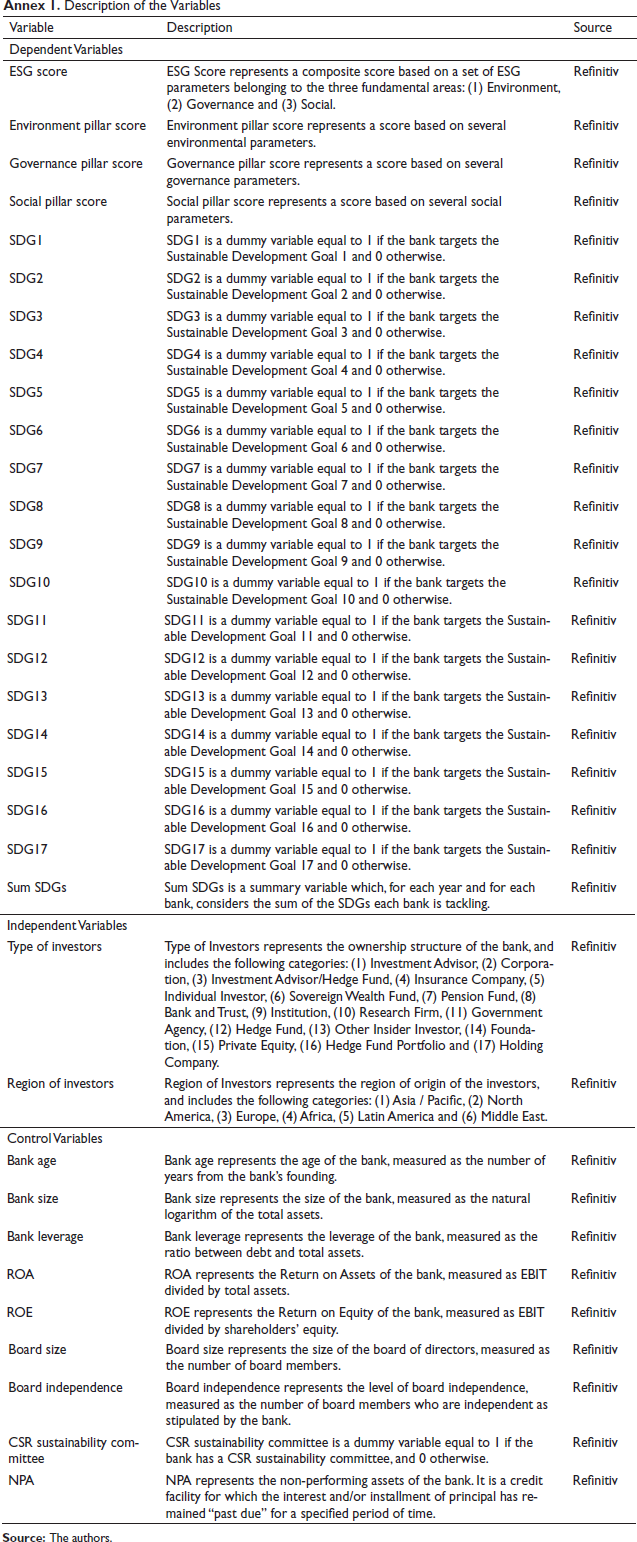
We measure ESG activities using the environmental social governance score (ESG Score), which is a composite score based on a set of ESG parameters belonging to the three fundamental areas: (1) Environment, (2) Social and (3) Governance.
With the aim of having a more fine-graining understanding of the relative importance of the specific ESG area, we also focus on each area by including in our analysis the Environment Pillar Score (based on several environmental parameters), the Social Pillar Score (based on several social parameters) and the Governance Pillar Score (based on several governance parameters).
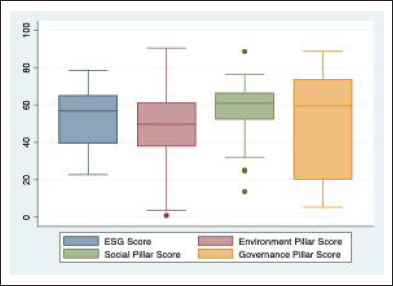
Figure 1 shows the distribution of the four different scores, by highlighting a higher level of variability for the environment and governances scores compared to the overall ESG score. Moreover, it should be noted that the governance score also shows the highest level of variability in the central part of the distribution.
Furthermore, in order to analyze which of the United Nations Sustainable Development Goals (SDGs) have been targeted by the banks in our sample, we created some dummy variables equal to 1 if the bank targets the specific SDG, and 0 otherwise, as follows: SDG 1 (No Poverty), SDG 2 (Zero Hunger), SDG 3 (Good Health and Well-Being), SDG 4 (Quality Education), SDG 5 (Gender Equality), SDG 6 (Clean Water and Sanitation), SDG 7 (Affordable and Clean Energy), SDG 8 (Decent Work and Economic Growth), SDG 9 (Industry Innovation and Infrastructure), SDG 10 (Reduced Inequality), SDG 11 (Sustainable Cities and Communities), SDG 12 (Responsible Consumption and Production), SDG 13 (Climate Action), SDG 14 (Life Below Water), SDG 15 (Life on Land), SDG 16 (Peace and Justice Strong Institutions), SDG 17 (Partnerships to achieve the Goal).
With the aim of achieving model convergence without stressing the reduction of degrees of freedom, we created a summary variable (Sum SDGs) which, for each year and for each bank, considers the sum of the SDGs each bank is tackling.
Independent variables
In order to analyze the ownership structure of the banks in our sample, we created the variable Type of Investors, which includes the following categories: (1) Investment Advisor, (2) Corporation, (3) Investment Advisor/Hedge Fund, (4) Insurance Company, (5) Individual Investor, (6) Sovereign Wealth Fund, (7) Pension Fund, (8) Bank and Trust, (9) Institution, (10) Research Firm, (11) Government Agency, (12) Hedge Fund, (13) Other Insider Investor, (14) Foundation, (15) Private Equity, (16) Hedge Fund Portfolio and (17) Holding Company.
Furthermore, to distinguish the geographical region of origin of the investors, we created the variable Region of Investors, including the following categories: (1) Asia/Pacific, (2) North America, (3) Europe, (4) Africa, (5) Latin America and (6) Middle East.
Control variables
In our models we consider some control variables to account for factors that, in our view, may influence the banks’ sustainable activities. In particular, consistent with prior research (e.g. Azmi et al., 2021; Di Tommaso & Thornton, 2020; García Martín & Herrero, 2020; Neitzert & Petras, 2022; Orazalin & Mahmood, 2021), we control for the following factors: the age of the bank (Bank Age), measured as the number of years since the bank was founded; the size of the bank (Bank Size), measured as the natural logarithm of the total assets; two profitability ratios, that is, the Return on Assets—ROA, measured as EBIT divided by total assets, and Return on Equity—ROE, measured as EBIT divided by shareholders’ equity; the Leverage (Bank Leverage), measured as the Debt to Assets of the bank; the Non-Performing Assets (NPA), that is, a credit facility for which the interest and/or installment of principal has remained ‘past due’ for a specified period of time. Finally, we also include some corporate governance controls: the size of the board of directors (Board Size), measured as the number of board members; the level of board independence (Board Independence), measured as the number of independent directors as established by the bank; and the CSR Sustainability Committee, which is a dummy variable equal to 1 if the bank has a CSR Sustainability Committee, and 0 otherwise.
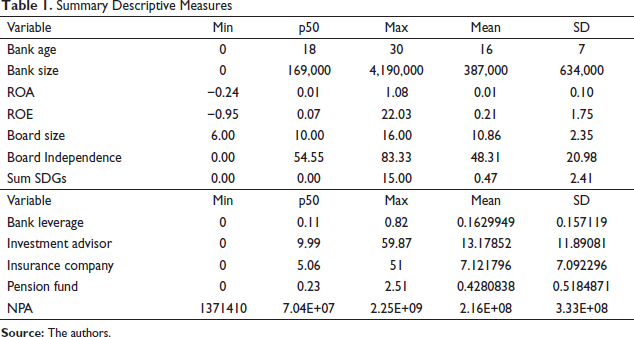
Summary Descriptive Measures
Modelling Relationships
Bearing in mind the aim of the article and considering the longitudinal structure of the constructed dataset, we decided to model the studied process in two different stages. The first-stage process referred to the presence for each bank (and for each year) of the ESG scores while the second-stage process focused on the specific amount (values) of these scores. These two stages were distinguished for the overall ESG scores and for each of the three scores (environment, social and governance).
From a statistical perspective, modelling this multiple process means to verify—before carrying out the estimations—the existence of a self-selection bias aimed at assessing whether and to what extent the set of banks for which ESG scores are available represents or not a random sample of the population (i.e. the missingness is or not random) and therefore whether the process of deciding to be involved in ESG activities and the related scores can be considered independent or interrelated with each other. To address these estimation problems, we referred to Heckman’s selection model (Heckman, 1976; 1979) which not only respond to the aim of our article, but it is a consistent estimator to deal with the truncated distribution of the sample (Plümper et al., 2006) in the second-stage, where ESG scores are observed only for those banks that have decided to be involved in ESG activities. In terms of dependent variables, the process can be described as follows.
In the first stage, the dependent variable indicates whether ESG scores are available for a specific bank i in period t. Therefore, the dependent variable takes a value equal to 1 if the ESG score is available and 0 otherwise.
In the second stage, the dependent variable is represented—for each of the four models specified—by the overall or specific scores (Environment, Social, Governance) observed for each bank i in period t.
Without loss of generality, the specified models can be described as follows. The Heckman selection model is a two-equation model (Heckman, 1979; Verbeek, 2000) for which the equations (1) and (2) provide the vectorial algebraic reduced notation. The outcome of interest 
where 
where
The estimation strategy first involved a pooled Heckman model in which the existence of the self-selection bias—defined by Heckman (1979) as the bias that would result from using non-randomly selected samples to estimate behavioural relationships as an ordinary specification error or ‘omitted variables’ bias—was tested. The first equation (selection equation) of the Heckman-type specification model captured the likelihood of the bank decisions to be involved in the ESG activities. The second equation (outcome equation) involved the study of the intensity (amount) of ESG scores for those banks which decided to carry out ESG activities. The Likelihood Ratio (LR) test was used to check whether the two modelled processes and therefore the two specified Equations (1) and (2)—on one hand the presence for each bank (and for each year) of the ESG scores are present and, on the other hand, for those banks where the ESG scores are present, their specific amounts (values)—can be considered independent of each other. Not rejecting the null hypothesis means that the two processes (and therefore the two equations are not related to each other) can be considered independent and therefore the self-selection bias does not exist. On the other hand, rejecting the null hypothesis led to the existence of a self-selection bias and therefore as suggested by Wooldridge (2010) to consider the sample of banks for which the ESG scores were observed as a non-random sample of the first-stage decisions (to be or not involved in ESG activities). Estimations were carried out by using STATA 17.0 software. It is important to note that the convergence of the models was achieved by carrying out a two-step Heckit estimator (Wooldridge, 2010) in which the inverse Mills-ratio was estimated by the probit model and then introduced as additional covariates in the regression (outcome equation), the latter model always considering the panel structure of the data through RE. Although the lower efficiency of the two-step estimator compared to the simultaneous maximum likelihood estimation, we would like to emphasize its use in financial and management areas (Huynh, 2022; Ma, 2022; Yang & Ma, 2022).
Analysis and Results
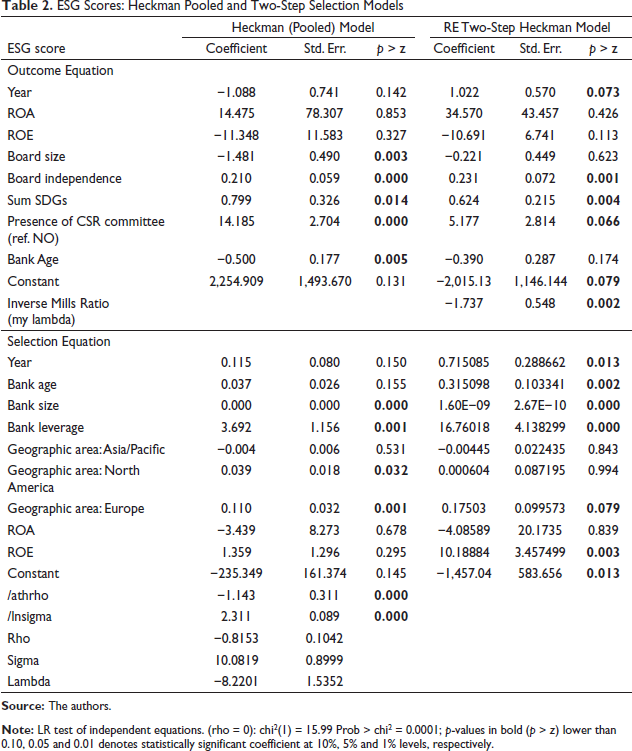
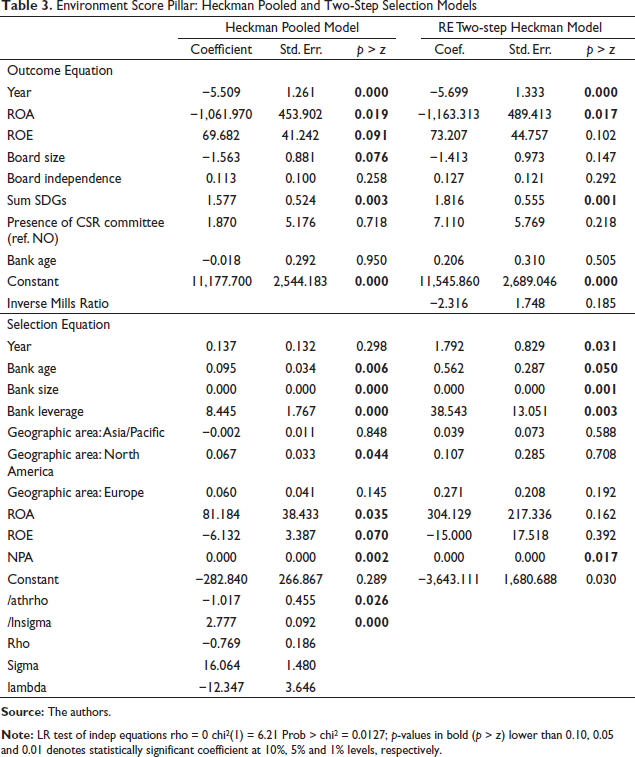
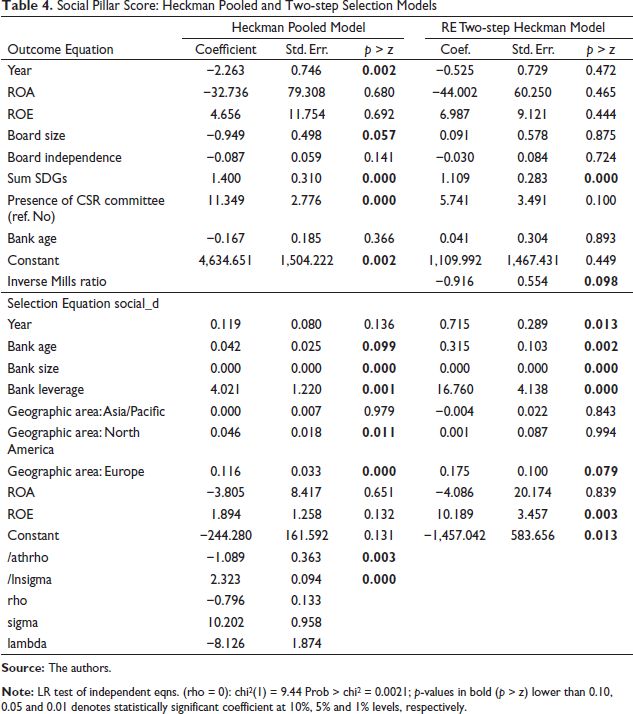
Tables 2–5 present the influence of the geographical region of origin of investors on ESG scores. They show the estimated models by distinguishing the results in the Heckman pooled model (the starting model where the panel component was not explicitly considered) and the longitudinal two-step Heckman model with RE. Each table shows in notes the results of the LR test, verifying the independence between selection and outcome equations. p-values lower than 0.10 increasingly highlight the existence of a selection bias and therefore the need of estimating the models according to the Heckman specification.
ESG Scores: Heckman Pooled and Two-Step Selection Models
Environment Score Pillar: Heckman Pooled and Two-Step Selection Models
Social Pillar Score: Heckman Pooled and Two-step Selection Models
Governance Pillar Score: Heckman Pooled and Two-Step Selection Models
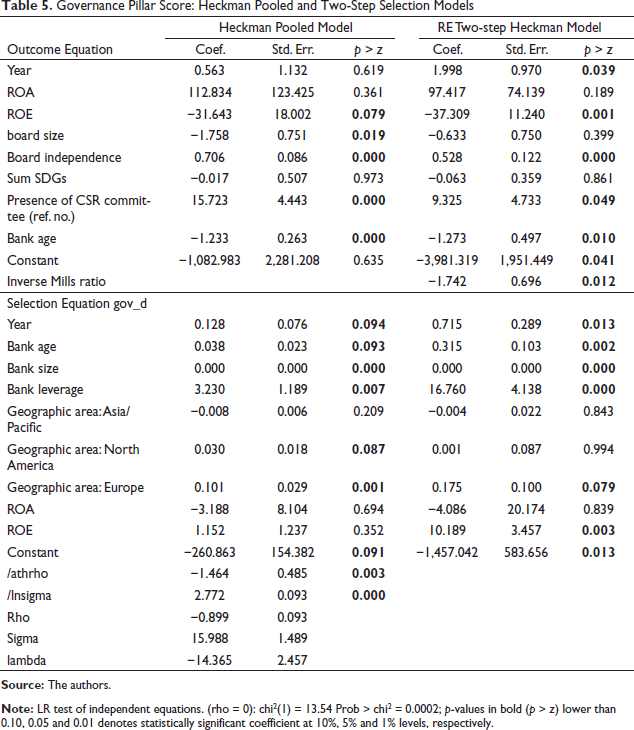
The existence of a selection bias was found for all the four processes presented below (overall ESG scores and the Environment, Social, Governance pillar scores) thus confirming that the observed outcome did not represent a random sample of observations. It is worth noting that the Environment Pillar Score model also considers—among the control variables—the variable NPA as described above and in the Appendix. This evidence provided us with the analysis of the relationship between the NPA of the bank and the environmental dimension, although a complete comparison between the different dimensions is not possible.
Focusing on the ESG overall process, the decision to be involved in ESG activities is positively and strongly influenced by bank age, with older banks having a higher likelihood to start ESG activities, the bank size, and the bank leverage. By focusing on the geographical area, the higher the presence of investors from Europe, the higher the likelihood of setting up ESG activities. This could be due to a higher sensitivity of European investors to ESG scores, also considering the growing attention of policymakers towards sustainability issues (Camilleri, 2015; Tamimi & Sebastianelli, 2017).
As regards the overall score, we found a positive effect of the board’s level of independence and the presence of a CSR committee on ESG scores. Moreover, the higher the targeted number of SDGs, the higher the overall scores. The positive and significant coefficient for time (year) shows the presence of an increasing temporal trend in the overall score, keeping the other variables of the model constant.
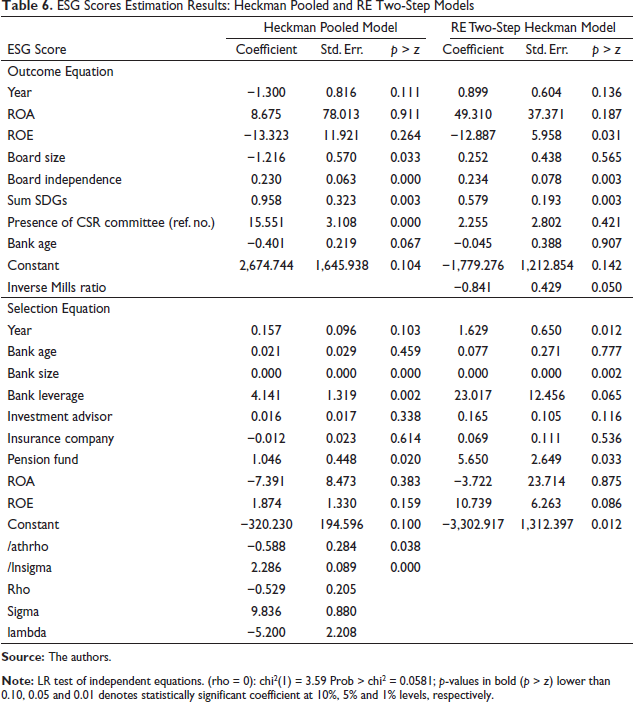
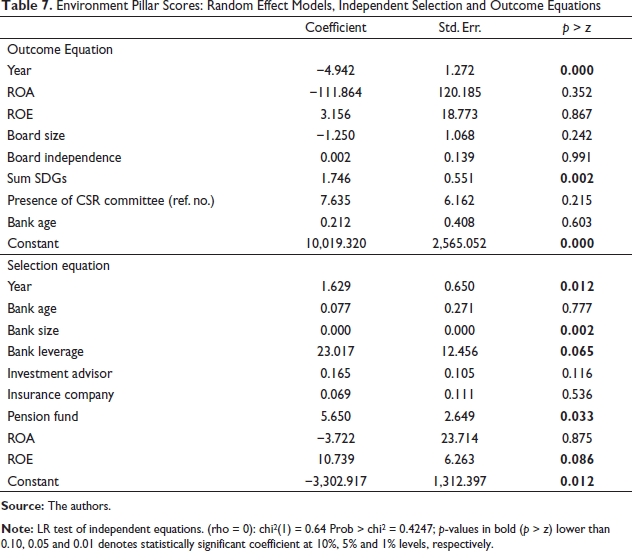
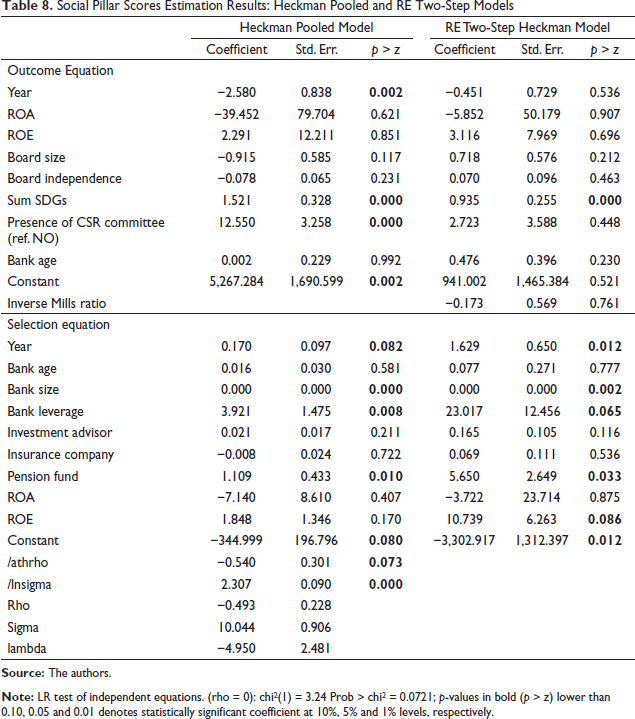
In Tables 6–9, the estimates of the models—according to the general specification presented above (in the paragraph ‘Modelling relationships’)—were also obtained by considering, in the set of explicative variables, the types of investors and not the geographical area of origin of the investors. This is to consider the heterogeneity of owners who may be motivated by different financial and non-financial motivations and show different sensibility to sustainable themes. For these models we did not always find a significant selection bias (the results of the LR tests are reported in the footnotes of the tables) and therefore we carried out separate estimates for the selection and outcome processes. Specifically, the selection bias was significant albeit with a slight strength for the ESG overall process (Table 6) and for the Social pillar (Table 8), while the two processes can be considered independent of each other with reference to environment (Table 7) and Governance pillars (Table 9).
ESG Scores Estimation Results: Heckman Pooled and RE Two-Step Models
Environment Pillar Scores: Random Effect Models, Independent Selection and Outcome Equations
Social Pillar Scores Estimation Results: Heckman Pooled and RE Two-Step Models
Governance Pillar Scores: Random Effect Models, Independent Selection and Outcome Equations
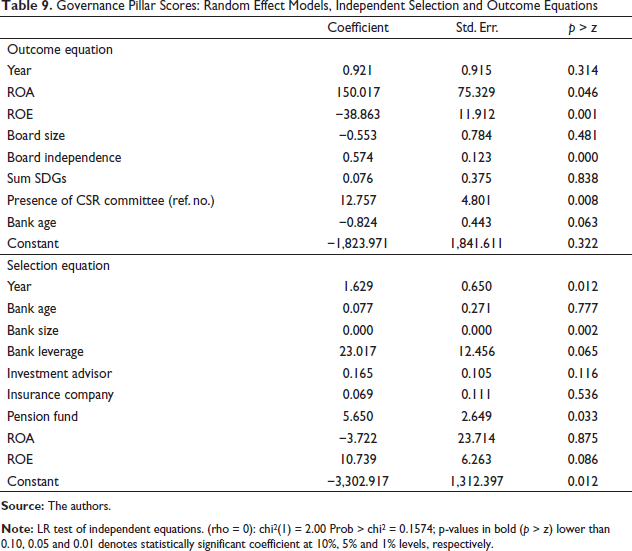
For both the Environment and the Social pillars, we found that banks are more likely to set up ESG activities in presence of pension funds, which are considered influential investors in corporate sustainability (Alda, 2019). This is also in line with not so recent research, which highlights an active role of institutional investors in driving corporate social performance (Johnson & Greening, 1999; Neubaum & Zahra, 2006).
Conclusions
In the context of the research area dealing with environmental, social and governance (ESG) dynamics, in this article we investigate the relationship between the ESG activity and the ownership structure of the Indian banking system. In detail, through random effect regression models accounting for the existence of selection bias we analyze a sample of 37 publicly traded Indian banks, over the period 2015–2020.
This research contributes to the understanding of the ownership-level triggers of ESG-oriented strategic decisions and actions. To the best of our knowledge, it is the first study to address this topic with reference to an emerging economy.
The results show that the banks’ decision to set up ESG activities is associated with the investors’ geographical region of origin rather than the types of investors. In particular, banks are more likely to engage in ESG activities in the presence of European investors. This finding seems to suggest that European investors have a higher awareness of sustainability issues and are more sensitive to the sustainability cause, probably due to the increasing attention paid by European institutions and regulations to CSR. Therefore, the European investors have the potential to influence the bank’s orientation towards ESG initiatives. Additionally, for what concerns the type of investors, our findings highlight that banks are more likely to engage in ESG activities especially in the presence of pension funds investors, consistent with prior research (Alda, 2019). Finally, from a corporate governance perspective, ESG activity appears to be linked to the number of independent board members and the presence of a dedicated CSR committee, suggesting firms to adopt good governance practices to meet the sustainable agenda.
This research is not without some limitations. We focus on Indian banks, without considering other financial institutions and the corporate sector. Furthermore, it might be interesting to extend the analysis to other emerging economies. Finally, we do not consider the business model and strategies of individual banks. We believe these may be some food for thought for future research.
Description of the Variables
Footnotes
Acknowledgement
The authors are grateful to the journal’s three anonymous reviewers for their extremely useful suggestions that have allowed us to improve the quality of the article.
Declaration of Conflicting Interests
The authors declared no potential conflicts of interest with respect to the research, authorship and/or publication of this article.
Funding
The authors received no financial support for the research, authorship and/or publication of this article.