



Abstract
The conjuncture of both the economic and the pandemic crisis has brought to fore the urgency for the Greek economy to reconsider sustainable economic growth strategies. In the light of recent efforts to boost Greek exports, the agri-food sector is called upon to play an important role. This article is about the need for the Greek economy to revisit its export growth strategies with regard to the agri-food sector, by assessing the factors affecting the performance of the EU Mediterranean agri-food exporter countries, such as France, Italy and Spain, including Greece. The applied gravity model methodology and both OLS and PPML estimations were conducted by use of UNCTADStat data between 1995 and 2019. The findings suggest that improving the availability of Greek agri-food products for exports constitutes a prerequisite for the competitiveness of this sector in international markets, which can be achieved by strengthening synergies between agribusinesses and by facilitating product standardization procedures.
Introduction
The emphasis on an export-led economic growth has been clearly emphasized in the recent official documents of the recent Greek governments. The conjuncture of the economic crisis, apart from the negative impact on the Greek economy and society, was at the same time an opportunity to introspect the production model of Greece, to explore new alternative strategies for increasing GDP and, consequently, exports. The decisive contribution of the tourism industry to the Greek economy is certainly not in question, given that the size of the domestic market complicates national strategies to strengthen the Greece’s weak industrial base. However, the diversification of the development strategies of the Greek economy is reflected in the relevant policy recommendations as well as in the recently approved Greek recovery and resilience plan (RRP) by the European Commission, certainly in addition to the tourism industry.
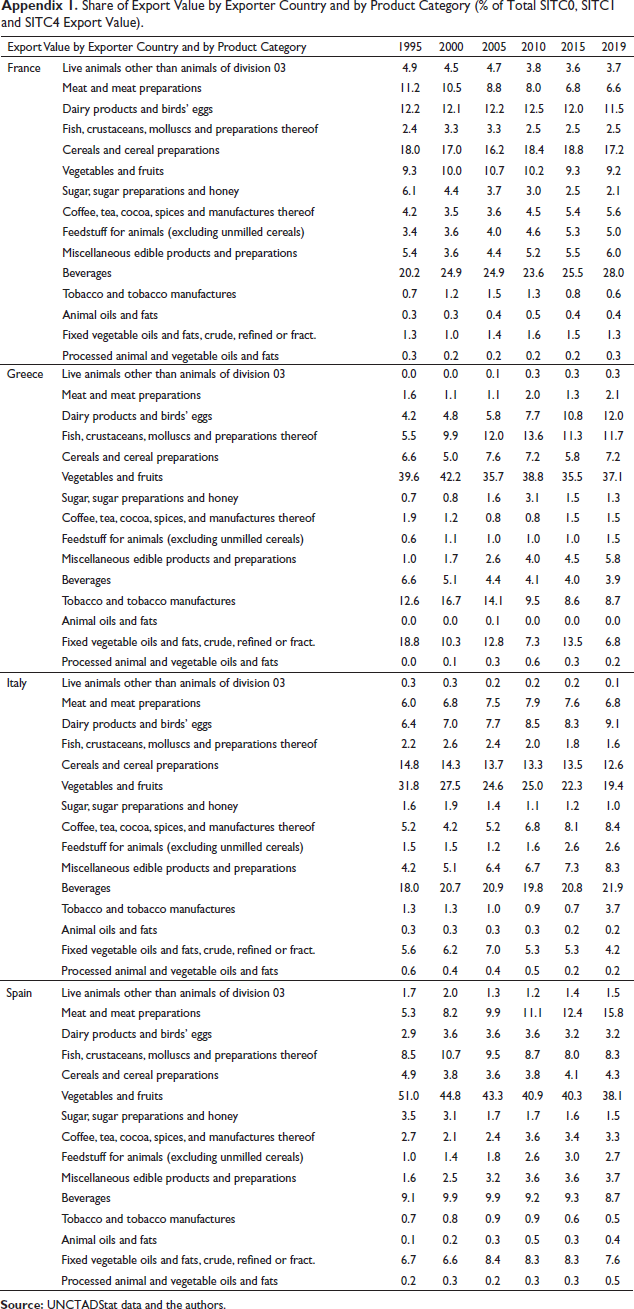
The quality of agri-food products is considered a key factor in agricultural export resilience during times of economic crisis (De Filippis, 2012). In the Greek case, high fragmentation together with a large share of small family businesses mainly characterizes the agri-food sector (PwC, 2018). During the recent decades, there has been a differentiation process with regard to the agri-food export structure in Greece. This does not mean that traditionally exported Greek products, such as olive oil and fruits and vegetables, are necessarily losing their momentum (Appendix 1). Sectors such as the dairy industry are gradually showing significant export activity, which is due, at least in part, to the direction of exports to markets with a significant Greek diaspora. In addition, domestic fish farming follows the general trends, showing significant growth, given the high demand for seafood. The contribution of seafood exports (fish, crustaceans, molluscs and preparations thereof) to total agri-food exports has at least doubled since 1995. A common feature between the agri-food export structure of France and Italy is the enhancement of the already significant contribution of beverage exports, in particular wine, which is not the case in Greece.
The present article aims to assess the weak points of the Greek production and export sector in the field of agri-food products, through a comparative analysis between the country’s export activity in relation to Italy, France and Spain, namely both Mediterranean countries and EU members with similar export baskets. The latter three countries show significant export activity in terms of exports of agricultural and food products, characterized by relatively similar climatic characteristics. The methodological approach of the present study is based on the employment of the gravity model for international trade of the above four countries, including Greece, in order to assess the differentiated effect of various factors included in the analysis. The added value of such an approach derives from the title question: What lessons can be learned from the French and Italian agri-food sector for the benefit of the emerging agri-food industry in Greece? The purpose of this study is certainly to go one step beyond proving the inherent disadvantages of the Greek domestic production in relation to its EU partners under study, such as the limited natural resources.
The remainder of the article is organized as follows. The second section provides some of the major characteristics of the EU Mediterranean agri-food sector, while the third section provides the methodological framework and the sources from which statistical data were employed. The fourth section describes the augmented gravity equation and, consequently, the factors that determine the intensity of agricultural and food product exports for Greece, France, Italy and Spain. The fifth section is dedicated to the presentation and interpretation of the empirical results obtained from the OLS and PPML regressions, the sixth section provides policy recommendations for the development of the Greek agri-food sector and finally the seventh section concludes the article.
The EU Mediterranean Agri-Food Sector
The European Union remains firmly a net exporter of agri-food products (European Commission, 2021a). The range of exported agri-food products is considered quite diverse, while the European Commission documents emphasize the competitiveness of EU producers not only in basic agricultural food and feed products, but also in food preparations (European Commission, 2016). According to 2020 data, China, Switzerland, the Middle East countries and MENA region countries constitute the major growth destinations for EU agri-food exports. The EU agri-food trade balance remains consistently positive since 2010, even after the United Kingdom leaves the European Union in 2020 (European Commission, 2021b).
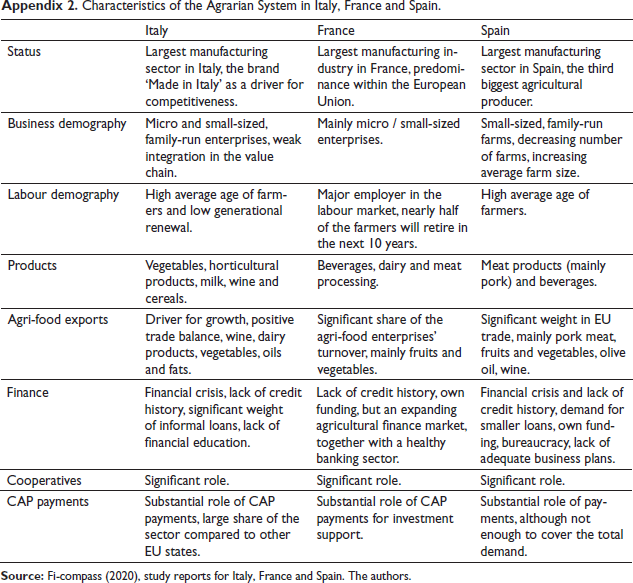
In this comparative study, the methodological selection of Italy, France, and Spain is directly related to their similar characteristics in terms of agricultural production and, subsequently, their agri-food sector. Together with Germany, the above countries are the four most important agricultural producers in the EU (Fi-compass, 2020a, 2020b, 2020c). In all three cases, the agri-food sector is the dominant one in the manufacturing sector of the national economies, mainly characterized by small-sized (<50 employees), family-run enterprises, along with the strong presence of the cooperatives in the sector (Appendix 2). The brand ‘Made in Italy’ seals on the competitiveness of Italian products abroad, both in the agri-food sector and also in the clothing and footwear sectors. Exports of agri-food products play a crucial role in EU export trade, although with differences in the composition of the major produced and exported products.
The general demographic developments in the European Union are reflected in the relatively high average age of the labour workforce engaged in the agri-food sector. In addition, the ‘change of baton’ between the old and new generations involved in agricultural production is a major stake for all the countries of the European South. The financial crisis has severely hit the Italian and Spanish economy—and, of course, the Greek economy—as opposed to France, where a sound banking system facilitates the expansion of financing in agricultural production. Common weaknesses are the lack of credit history, which is reflected in the high rates of self-financing or even borrowing from relatives or friends. The studies also address the lack of financial education (Italy), as well as the discouraging role of the bureaucracy and the lack of appropriate business plans (Spain). Funding under the Common Agricultural Policy (CAP) has become key to boosting investment in the agri-food sector, although it was considered rather insufficient to meet aggregate demand in Spain.
Methodology and Data
The gravity equation has become an important methodological tool for analyzing trade flows (Anderson & Van Wincoop, 2003; Bergstrand, 1985; Feenstra et al., 2001; Helpman & Krugman, 1985; Santos Silva & Tenreyro, 2006), derived from the Newton’s law of universal gravitation. The simplified form of the gravity model correlates the intensity of trade flows with the trading partners’ economic sizes and their bilateral distance, the employment of which is theoretically justified on the basis of the Heckscher–Ohlin assumption (Deardorff, 1998). Several empirical studies further focus on international trade in agri-food products. Emlinger et al. (2008) employ the gravity model in order to evaluate the role of tariffs in the overall trade barriers on Mediterranean exports of fruit and vegetables towards the EU, while Hajderllari et al. (2012) investigate factors affecting FDI outflows from Danish agri-food firms. As already shown in several studies, the effect of the variables usually included in the gravity equations varies depending on the export sector under study. Sohn (2001) employs the gravity model methodology to carry out cross-sectoral analyses, while Berthelon and Freund (2004) try to assess the differentiated effect of geographical distance on bilateral trade for each of the general product categories (SITC 1-digit level). Heerman and Sheldon (2018) apply a ‘systematic heterogeneity’ gravity model which predicts that countries with similar land and climate conditions will specialize in the same range of agricultural products. Jongwanich (2009) evaluates the impact of food safety standards on processed food exports from developing countries.
As mentioned above, the analysis includes four regressions by using the ordinary least squares (OLS) and poisson pseudo maximum likelihood (PPML) estimators, the latter being recommended in studies where the sample consists of a significant number of zero-value observations (Santos Silva & Tenreyro, 2006; Truong et al., 2019). As expected, several observations relate to zero export flows over this long period of time. In the present analysis, the existence of zero values is particularly common in countries that are not major trading powers globally, and this is evidenced by the fact that zero value observations account for 64% of all observations in Greece, in contrast to France (24%), Italy (31%) and Spain (34%). According to the existing literature, in cases of zero trade flows the observed value of the dependent variable is set equal to the unity and its log is censored at zero (as, for example, in Figueiredo et al., 2015).
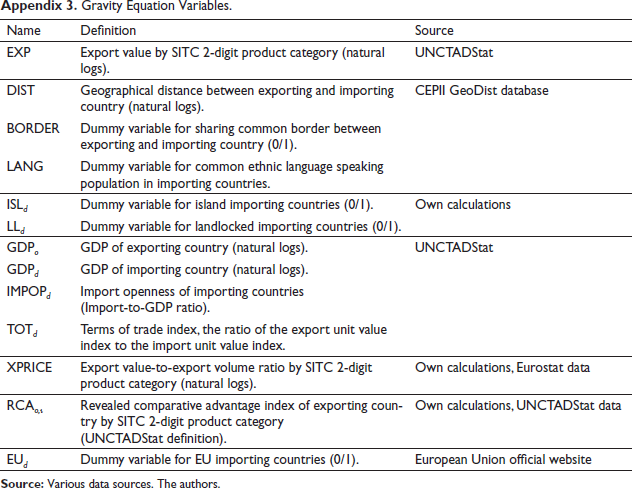
The categorization of exported products is based on the SITC classification, including exclusively agricultural and food products contained in the general categories SITC0 (food and live animals), SITC1 (beverages and tobacco) and SITC4 (animal and vegetable oils, fats and waxes). The dependent variable (EXP variable) represents the 2-digit agri-food product export value by exporting country (France, Greece, Italy and Spain) and by export destination country (Appendix 3). Every 2-digit agri-food product group refers to each of the 15 subcategories of agricultural and food products included in SITC0, SITC1 and SITC4 categories (Table 1), based on the available data from the UNCTADStat database. It should be stressed that, for simplification purposes, the choice of the 2-digit product categories includes those within the SITC0, SITC1 and SITC4 broader product groups, thus leaving out Division 22 (oil seeds and oleaginous fruits) and Division 121 products (unmanufactured tobacco and refuse), as is the case in relevant studies (Jongwanich & Magtibay-Ramos, 2009).
List of 2-Digit SITC Product Categories.
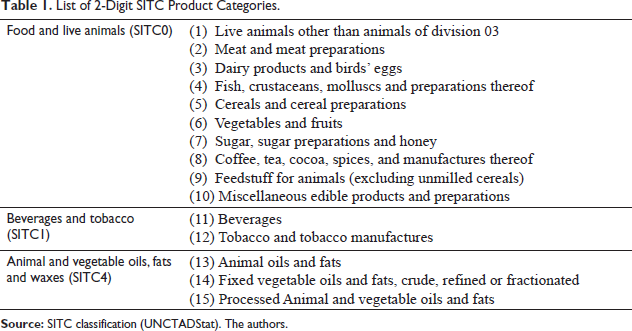
Export flows, as well as the economic size of both exporting and importing countries, are expressed in nominal (current) prices, which is considered for gravity modelling, since deflating trade values could produce misleading empirical results (Shepherd, 2016). Some of the expalanatory variables introduced relate to the export profile of the four countries, such as the revealed comparative advantage (RCA) and the unit export value. Since the current analysis makes use of trade flow data at the 2-digit level of the SITC classification, it was necessary to calculate the aforementioned two variables based on UNCTADStat data. The complete set of variables as well as the relevant data sources are described in Appendix 3.
Model Specification
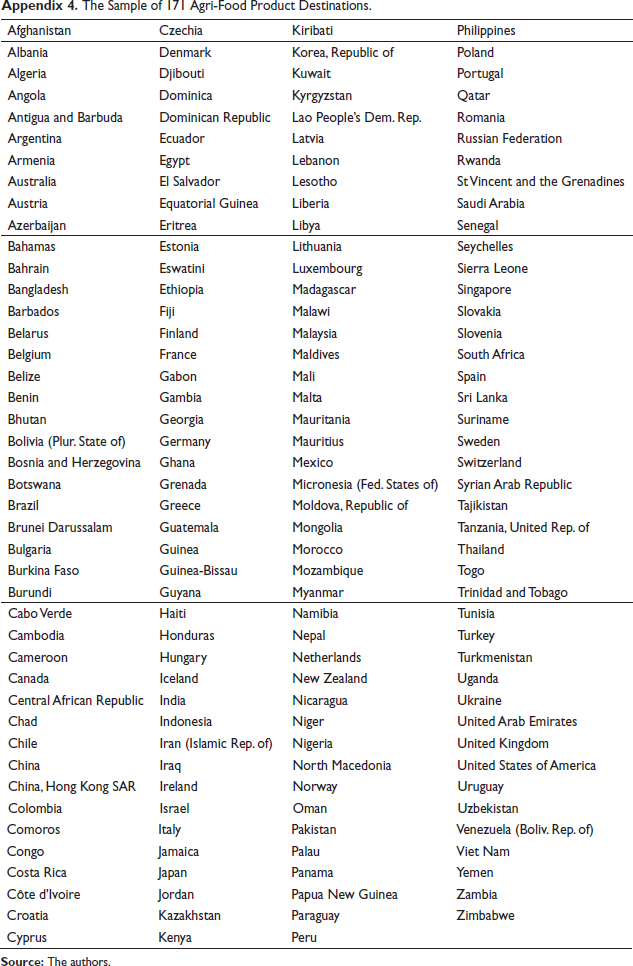
In the present analysis, the dependent variable (EXP) refers to the value of exports of agricultural and food products of France, Greece, Italy and Spain to 171 partner countries or regions (Appendix 4) during the period 1995–2019. Each of the four OLS and PPML regressions corresponds to each of the aforementioned exporting countries. It should be noted that the rather long period of time under study delimits, at the same time, the range of explanatory variables for which data are available for the entire period. The employment of the augmented gravity model methodology aims to highlight the differentiating effect of a range of factors on exports originating from Greece, France, Italy and Spain. In this context, the following linear form of the model includes a set of economic, trade related, geographical and sociopolitical variables, as follows:

As already mentioned, the augmented gravity equation includes some variables that are commonly incorporated into gravity analyses for trade. With regard to agricultural exports, several researchers have introduced variables reflecting the exchange rates (Hatab et al., 2010), bank loans to the agricultural sector (Bakari et al., 2020), preferential trade agreements’ effect (Sapa & Droždz, 2019), or even variables that represent the density of road network (Jongwanich & Magtibay-Ramos, 2009), which is directly related to transport costs. At a preliminary stage, the analysis sought to include in the gravity equation variables related to the per capita income of importing and exporting countries, FDI flows and stock, consumer price index in destination countries, as well as a dummy variable for WTO accession, which were eventually excluded either because they were statistically insignificant or associated with collinearity issues. Especially in the case of Greek exports, the coefficient sign for WTO membership proves to be positive but statistically insignificant. This could be probably explained by the fact that a not negligible part of the four samples’ observations (around 15%) concern agri-food exports to countries that are not yet WTO members. This finding could eventually be different if the analysis referred to a more recent period.
The discouraging effect of geographical distance (DIST) is widely documented by empirical results in the relevant literature (e.g., Magerman et al., 2015; Truong et al., 2019), capturing the role of transport costs in bilateral trade. The importance of this specific factor can reasonably be considered even more crucial in this analysis, compared to those concerning the total traded products of a country, given that agri-food products are characterized by greater vulnerability, as well as other limitations related to the differentiated institutional framework for food security between countries. In any case, the coefficient of the DIST variable is expected to receive a negative sign, while data on bilateral distance is derived from the CEPII GeoDist database (Appendix 3—Mayer & Zignago, 2011). On the contrary, the existence of a common border (BORDER) between exporting and importing countries, ceteris paribus, is expected to have an encouraging effect on bilateral trade between these countries (Zhang & Wang, 2015). However, some relevant studies have shown that the effect of common border sharing depends on both the type of products traded and the exporting country (Nguyen, 2020), so the sign may differ in each of the three countries. Especially in the case of agricultural exports, Hatab et al. (2010) confirm a positive sign.
The geographical characteristics of the importing countries, especially of those importing mainly agricultural and food products, also has a direct effect on the intensity of trade. The effect of insularity as well as the lack of access to the sea of the importing countries (ISL and LL dummies) are often integrated in the gravity equations (e.g., Chang & Lee, 2011; Chen & Li, 2014). Lack of access to the sea—that is, the absence of a port—has traditionally a negative effect on bilateral trade, as isolated importing or exporting countries depend on their harmonious diplomatic relations with neighbouring countries to strengthen their trade relations (Carrere & Georgiou, 2011). In addition, as long as international trade is highly dependent on maritime trade routes, the absence of a coastal front will retain its negative impact. The sign of the coefficient corresponding to the LL dummy is expected to be negative. The effect of insularity is generally ambiguous, although usually negative (Kucera & Sarna, 2006). All other factors remaining constant, countries’ exports are preferably directed to countries that are geographically interconnected, which further enhances the expansion of trade.
The variables that represent the gross domestic product (GDP variables) of the exporting and importing countries play the classic role of repulsion and attraction ‘masses’ in bilateral trade. The sign of the corresponding elasticities is traditionally positive, but this is not without exceptions, as evidenced in previous studies regarding Greek exports (Karkanis & Fotopoulou, 2021). The expansion of exports, especially with regard to the southern countries of the European Union, which have suffered significant losses from the economic crisis over the past decade, has been a strategic choice amid simultaneous shrinking of the GDP. Therefore, an eventual negative sign concerning the coefficient of the GDP variable would not be a surprise, at least in the case of Greece.
In particular with regard to the countries’ trade openness, the IMPOP variable is employed here in order to capture the positive effect of the countries’ integration to international trade, through the general trend of agri-food import expansion. The respective coefficient is expected to take a positive sign. From the point of view of the exporting countries, it is obvious that the export prices of the agri-food products directly affect export intensity with regard to the specific sectors. In the present analysis, the XPRICE variable has been calculated as the ratio of export value to export volume by product category (SITC 2-digit), by employing the available data from the UNCTADStat database.
In an attempt to capture the relative specialization of exporting countries according to the type of products traded, the RCA variable is additionally introduced in the equation. The revealed comparative advantage corresponds to the ratio of the contribution of exports related to a specific product category to the total of the country’s exports, to the contribution of world exports related to the specific product category to the total of world exports. With regard to the specific level of SITC classification (2-digit), the RCA estimates are made by own calculations, based on the available UNCTADStat data. Ceteris paribus, the greater the relative specialization of the exporting country in exports of a particular product category—and therefore the greater the comparative advantage—compared to the world pattern, the more intense the exports of these products will be. As a result, the coefficients corresponding to the elasticity for export prices and the revealed comparative advantage are both expected to receive a positive sign.
Improving the terms of trade, ceteris paribus, either by an increase in export prices relative to import prices or by a decrease in the reverse ratio, results in an improvement in the living standards of the exporting countries, as imported products tend to become cheaper for domestic consumers (OECD, 2021). Conversely, countries with declining terms of trade are required to export a larger number of product units in order to acquire the same number of imported products. It thus becomes clear that the sign of the coefficient related to the TOT variable depends on the trade profile of the agri-food product importing countries.
At the institutional level, the EU variable is introduced in order to reflect the possibility of export direction of the three countries preferably to other EU members. However, it should be mentioned that the importance of trade with other EU countries may lose its validity, as the exporting countries are major trading powers (France and Italy), or even countries that maintain significant trade relations with non-European Eastern Mediterranean countries, as well as third countries with significant diaspora (Greece). In that case, the sign of the corresponding coefficients is rather controversial. The existence of diaspora in countries that import products from the countries of origin of migrants usually works positively in terms of bilateral trade between these countries. In the Greek case, the positive role of the Greek Diaspora in Greek olive oil exports has already been stressed in the relevant literature (Vlontzos & Duquenne, 2008). Therefore the sign of the coefficients of the corresponding LANG variable is expected to be positive (as e.g., Hatab et al., 2010).
Results
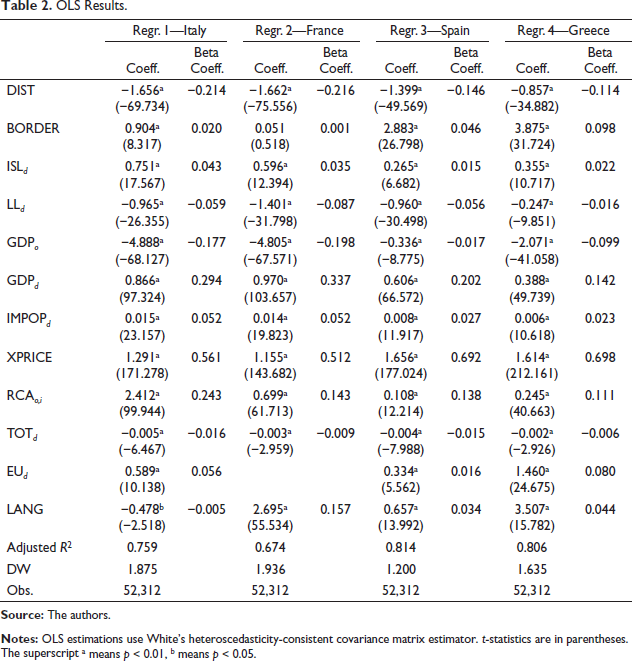
The interpretative value of the four regressions can be assessed as satisfactory or very satisfactory (Table 2), ranging from 0.67 (France) to 0.81 (Spain) in OLS and from 0.42 (Spain) to 0.58 (Greece) in PPML estimations (Table 3). The variable representing the importing countries’ EU membership (EU variable) was excluded from Regression 2 (France) for colinearity reasons. It should be borne in mind that France is a world exporter especially in the agri-food industry, which facilitates the access of French products to third countries. The above finding also justifies the statistically insignificant effect of the common border (BORDER variable) on French exports of agricultural and food products, however the coefficient takes a positive sign, as in the case of the corresponding coefficients for Spain, Italy and Greece. There are no major differences in the coefficient signs between the two estimates. The final OLS estimations were corrected by the use of White’s heteroskedasticity-consistent covariance matrix estimator in order to obtain robust standard errors, although there were no significant differences with the original estimates.
OLS Results.
PPML Results.
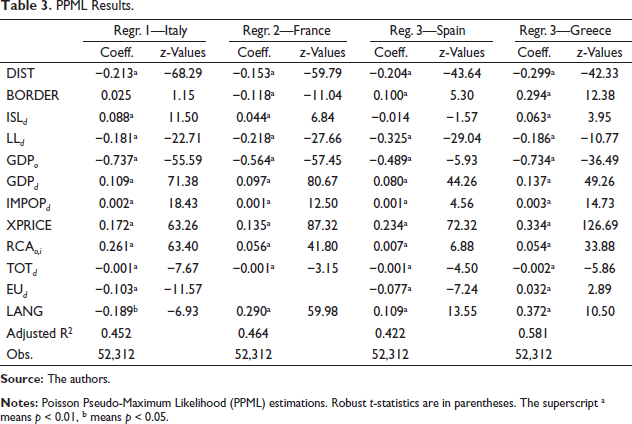
The dependency of Greek agri-food exports on the existence of the Greek diaspora may justify the relatively limited negative impact of the geographical distance (DIST variable). Remaining at the level of the geographic factors, the findings suggest that the insularity (ISL dummy) of the importing countries seems not an obstacle for Greek, French and Italian exports. The signs of the corresponding coefficients are consistently positive and statistically significant, although the relative weight of this specific factor, as shown by the beta coefficient, is quite limited. On the contrary, with regard to the Spanish agri-food exports, the coefficient signs turn out to be mixed. Perhaps this ambiguous result is due to the existence of a significant Greek or Italian diaspora in island countries (for Greece, in Australia or Cyprus), in contrast to the Spanish diaspora which is located mainly in Latin America. The lack of access to the sea (LL dummy) of the importing countries proves to negatively affect the export intensity of the agri-food product group, as expected and confirmed in all four regressions. The negative effect appears to be weaker in the Greek case, which is to be expected given that a very large share of Greek exports are destinated to countries with direct access to the sea. In this context, we consider that the strengthening of the synergies between the agri-food and tourism sectors in Greece can help mitigate the high dependence of Greek exports on importer countries with significant Greek diaspora. The introduction, for example, of the Greek breakfast in the hotel industry could more effectively communicate to visitors the value of Greek agri-food products.
In the economic field, the expectation for a negative correlation between GDP and exports of agricultural and food products is confirmed not only for Greece, but also for all three EU partners. The GDP contraction over the past decade and in the midst of an economic crisis, either severe (Greece) or relatively limited (France, Italy and Spain), coincides with the countries’ strategic goal for boosting export performance. The global expansion of exports seems to be enhanced, at least in part, by exports of agri-food products. These findings are consistent with those of relevant studies (Karkanis & Fotopoulou, 2021), which may differ as the time period under study moves away from the economic crisis. Conversely, the economic size of importing countries, represented by the corresponding GDP variable, always exerts an attractive effect on agri-food products from these four Mediterranean countries. However, the current state of both the pandemic crisis and the war in Ukraine raises fears of an impending food crisis in the months to come, which will surely test the resilience of the global value chains, as well as the export performance of agribusinesses.
As regards the factors directly related to the businesses’ trade activities, it is evident and confirmed here that the export unit price (XPRICE) matters for export intensity of the specific product categories, in both the OLS and PPML estimations (Tables 2 and 3), indicating the crucial role of the specific factor for all four countries under study. Ceteris paribus, the higher the export unit price, the higher the export performance in the specific sector, and this relation seems stronger in the Greek case. It is quite expected that countries with comparatively limited production than the predominantly exporting agri-food countries, such as Greece’s three EU partners, become more dependent on achieving higher export unit prices, in order to sell their products in the international markets.
The greater the revealed comparative advantage of the exports of certain products (RCA variable), the greater the export intensity of the specific products. The coefficient is estimated significantly larger in the case of Italian agri-food exports than the corresponding French, Spanish and Greek exports, which is confirmed by both OLS and PPML estimations. This could be seen as the result of the Italian businesses’ initiatives to seize the well-established comparative advantage to promote Italian food exports, compared to the other three EU partners. This comes as no surprise, especially if we bear in mind that the Italian agri-food sector holds a significant share in the Italian manufacturing industry (Brasili, 2003). In any case, the empirical results could only confirm the Ricardo’s theory of comparative advantage, gained in specific sectors of traded products by national economies, due to differences in their factor endowments or their technological progress levels. At the business level, the need to promote a common trademark for Greek food products should be taken seriously both by the Greek state and the businesses involved, with a view to improving their international competitive position.
As expected, the smaller economies’ dependency on exports within the common European market, such as Greece, is clearly higher than that of the three larger national economies. If considering the empirical results from PPML estimates more reliable than those from the OLS estimates on the EU variable coefficient, it seems that focusing on exports towards the common market exerts a discouraging effect on French, Italian and Spanish global agri-food exports. Agribusinesses already operating in large markets seek to place their products in even larger markets. Besides, the European companies’ openness, as well as their pursuit of gaining market share in third countries, must be an imperative strategy for the successful implementation of budgetary policies particularly in the southern European countries affected by the economic crisis.
Importing countries’ degree of integration in international trade certainly counts for agri-food export intensity from the specific four countries. The positive sign of the elasticities for the partners’ global import openness (IMPOP variable) is confirmed in both OLS and PPML estimations. Even though the effect of the specific variable seems quite limited in the present study, countries that import Euro-Mediterranean agri-food products are generally economies well integrated into the global economic system, characterized by non-negligible import activities in order to meet the consumer needs and living standards of their citizens. Any tendency to return to a model of less open national economies, due to the successive past and forthcoming crises in the European Union—economic recession, pandemic crisis, war in Ukraine, an eventual impending food crisis—would undermine the benefits of agribusinesses from international trade.
The negative sign of the TOT variable coefficient is confirmed in all four cases, being statistically significant at 1% level. Increasing intensity of agri-food imports is observed mainly in countries with declining terms of trade, that is, developing countries that increase export levels in order to import at the same levels as before. It could be argued that declining terms of trade scores could also be observed in countries with increasingly positive trade balances over the last two decades, such as Germany. Countries characterized by significant population growth and gradually rising income levels are definitely a destination for Euro-Mediterranean agri-food products. Rising living standards in developing countries alter the consumption patterns of the indigenous population, at the same time when evolving urbanization trends are taking place. It should be noted, however, that the relative weight of this specific determinant is clearly lower than the rest of those included in the gravity equation in all four case studies.
Both OLS and PPML estimations converge on the negative impact of the existence of a common ethnic language in the countries of destination of Italian agri-food products (LANG variable). While certainly retaining some reservations, it seems that the internationalization of Italian agri-food products ultimately contributes to weakening the otherwise beneficial effect of the Italian diaspora on imports of agricultural and food products from the country of origin. Instead, this is not the case of French, Spanish and Greek products. Especially in the Greek case, the attractive effect of the diaspora succeeds in overcoming the discouraging impact of the geographical distance on exports of the specific product group to distant but large markets. The cultural ties (LANG dummy) of the Greek immigrants with their place of origin affect their consumption and nutritional needs over time, even though the destinations are often overseas in highly developed countries (United States, Australia, Canada, among others).
Policy Implications
The empirical results highlighted the importance of the export unit price levels especially for Greek agri-food exports, as is also shown in Figure 1. National economies whose agri-food export sector has achieved greater penetration into large distant markets, such as the French, Italian and, to a lesser extent, the Spanish agri-food export sector, seem to be less affected by exporting products characterized by lower unit prices. The inherent problem of limited agri-food products to be exported in large quantities is a key feature of the Greek economy, at least compared to the other three economies. Greek agri-businesses are generally characterized by small size, both in terms of turnover and number of employees. Limited production makes it more difficult for export companies to seek for external markets where sufficient profit margins can be achieved for their survival. It therefore becomes apparent that easing the financial burden for the typically smaller exporting Greek agribusinesses should be a key strategy to be adopted by all the agents involved. Overcoming the business size problem implies the implementation of policies that will encourage the creation of cooperatives between agri-businesses, which is already more common in Greece’s EU partners. Based on data for 2010, the share of agricultural products marketed through cooperatives is lower in Greece compared, for example, to France and Italy (Bijman et al., 2012).
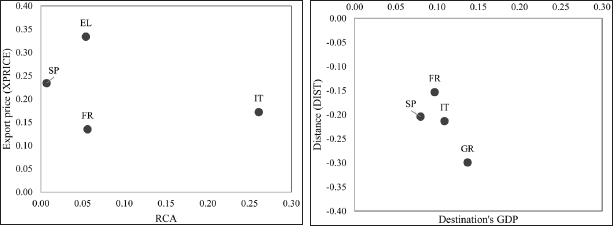
The relationship between agri-food export performance and the strong presence of diasporas is clearly beneficial, but it is still necessary for agribusinesses to launch appropriate strategies, along with the financial assistance of the state, in order to create a strong brand for Greek products, as is already the case for French, Italian and Spanish agri-food businesses. At the institutional level, initiatives such as the negotiation of a double taxation treaty between Australia and Greece would significantly help to foster economic ties between the Greek agri-food sector and the Australian market, which is characterized by the significant presence of the Greek diaspora (Enterprise Greece, 2021). Similar strategies could help expand the market share in the countries of immigrants’ destinations, especially if we take into account the beneficial role of the foreign tourists’ familiarization with Greek culture and diet. Undoubtedly, however, the annexation of Crimea by the Russian Federation in 2014, as well as the ongoing war in Ukraine are expected to weaken the ties between the Greek diaspora in Eastern Europe and the country of origin, thus leading to the opposite direction. The results also highlighted the importance of the market size in destination countries, in order for agri-businesses to overcome trade barriers such as transport costs or, in other words, the discouraging imprint of the geographical distance on exports (Figure 2). It is quite expected that the destination countries’ market size to be more beneficial for Greek export companies, compared to French, Spanish and Italian ones, provided, they manage to overcome the direct and indirect transport costs.
The European Commission support for small and medium-sized enterprises in the agri-food sector should be taken for granted, provided that the agribusinesses will invest in sustainability and quality of their products. The aim of enhancing EU agri-businesses’ internationalization requires accelerating the digital transformation of relevant processes, by providing online support tools (certificates, product compliance information, etc.) for mostly small and medium-sized enterprises (European Commission, 2021c). Greek businesses should take advantage of the facilitation of bureaucratic procedures regarding trade facilitation, although this is certainly not the only point of intervention. The empirical results showed that penetration in larger markets presupposes a significant reduction in direct and indirect transport costs, which in turn implies encouraging synergies between agri-businesses for the joint marketing and distribution of agri-food products. At the policy level, achieving partnerships in the framework of agricultural cooperatives can make a positive contribution in this direction, as is already the case for the other three EU partners. Another step to increase the size of available Greek agri-food products in the global supply chain could certainly be the expansion of standardization processes for agri-food commodities in Greece.
Conclusion
The added value of the present article lies in capturing the different agri-food export performance patterns among three EU Mediterranean countries, namely France, Italy and Spain, with the emerging agri-food export sector in Greece. The results showed that countries with limited domestic production, such as Greece, become more dependent on as high as possible export unit values, as well as on exports within the common market. The Italian agri-food sector possesses a significant share in the Italian manufacturing industry, seizing the well-established comparative advantage to promote exports. The internationalization of French, Spanish and Italian agri-food products contributes to weakening the discouraging effect of geographical distance, as well as the beneficial effect of diasporas.
At the methodological level, it is worth noting that any differences in the empirical results between OLS and PPML estimates were once again not significant, as also in other relevant studies on bilateral trade with a non-negligible number of zero-value observations. The presentation of the OLS estimates together with the PPML is also considered useful for comparing the empirical results between the two technical methods. One of the limitations of the present study is the fact that it was considered preferable to retain observations concerning all product subgroups from the SITC0, SITC1, and SITC4 general categories, even if they do not include the entire range of agri-food products. Moreover, apart from the eventual limitations with regard to the gravity model methodology, we consider that its employment contributes positively to the unification of the vocabulary between the different sciences.
Apart from the deadly consequences of the pandemic crisis in most countries worldwide, this conjuncture has become an opportunity for the ongoing expansion of the digitalization of bureaucratic processes for both citizens and businesses in Greece. The pandemic crisis also highlighted the need for the Greek economy to diversify development strategies, given the measures to limit human mobility since the coronavirus outbreak and its negative impact on tourism. The need to ensure global food supply is becoming more apparent during pandemic crises, such as the current one, while the latest EU documents warn of the risk of cutting off the developing countries from the global value chains (European Commission, 2021c). The ongoing disruptions in the global food and agricultural product supply due to the war in Ukraine may generally favour agricultural producers of goods directed to the least developed countries, but the same seems uncertain for high-value-added agri-food businesses. Enhancing policies to improve the global supply chain efficiency can only benefit the sustainable development of agri-food businesses at both international and European levels, a condition that is now becoming even more urgent given the war in Ukraine and fears of an impending food crisis.
We argue that improving the availability of Greek agri-food products for exports constitutes a prerequisite for the competitiveness of this sector in international markets. To this end, we could sum up two complementary strategies. On the one hand, given the limited natural resources available, emphasis should be given on enhancing synergies between agri-food businesses in Greece, with the aim of maximizing benefits from the economies of scale. The enforcement of cooperative schemes can contribute positively to this end, as is already the case for the three EU partners under study, especially if taking into account the recent re-establishment of a central coordinating body for cooperatives in Greece (2021). The joint distribution of agri-food products would significantly contribute to agribusinesses achieving long-term contracts and higher prices. On the other hand, it is considered crucial to strengthen the vocational training of professionals in the agri-food sector in Greece, to provide regular information about product standardization and export procedures, combined with more efficient digital systems for trade facilitation. The need for the Greek agribusinesses to implement the above strategies becomes even more obvious, in a country where agricultural production is characterized by significant fragmentation of land ownership, unlike the other three EU partners.
Share of Export Value by Exporter Country and by Product Category (% of Total SITC0, SITC1 and SITC4 Export Value).
Characteristics of the Agrarian System in Italy, France and Spain.
Gravity Equation Variables.
The Sample of 171 Agri-Food Product Destinations.
Footnotes
Acknowledgment
The authors are grateful to the anonymous referees of the journal for their extremely useful suggestions to improve the quality of the article. Usual disclaimers apply.
Declaration of Conflict of Interests
The authors declared no potential conflicts of interest with respect to the research, authorship and/or publication of this article.
Funding
The authors received no financial support for the research, authorship and/or publication of this article.
