



Abstract
This study analyses the emergent activities of public leaders (PLs) during the COVID-19 pandemic. Are the activities of PLs associated with their performance, and do leadership theories explain the activities of such leaders? The findings of 18 articles published in 2020 were summarized and 10 themes were constructed from the words and phrases found in the findings. High-performing PLs and collaborators analyse the context, make decisions and implement interventions urgently. They mobilize people to adhere to preventive health practices, communicate empathetically, show masculine and feminine behaviours, interpersonal sensitivity and they are resilient and tech-savvy. They address emerging discrimination, attempt to reduce economic hardships, collaborate with multiple sectors and display valued behaviours. Multiple theories model their behaviours, which can be subsumed under adaptive leadership. Adaptive and flexible leaders show context sensitivity, focus on the present, learn constantly, foster cross-sector collaborations, deliver on a shared purpose and implement activities congruent with situational requirements to halt the spread of and death from coronavirus. Adaptive responses spread to other leaders, COVID warriors and public.
Introduction
Public leaders (PLs) are elected or appointed politicians at all government levels and public officials or administrators who work in public service. They exist in every corner of society. They also include officials from non-governmental organizations (NGOs) who shape public debate and implement health, education, employment and environmental programmes to improve people’s welfare. They mobilize people, networks and organizations, foster requisite relationships, and ensure the flow of experience, knowledge, skills and of needed human, material, technological and financial resources to respond to social challenges and remedy public problems (Crosby & Bryson, 2018). Their activities demonstrate their performance. Unlike leaders’ performance in industries, in terms of improved employees’ performance, work engagement and decreased absenteeism, PLs’ performance during the COVID-19 pandemic can be assessed in terms of the rate of spread of coronavirus and the number of deaths in a country.
On 30 December 2019, the first coronavirus case was detected in Wuhan, China. Just 3 months later, on 11 March 2020, the World Health Organization (WHO) declared a global pandemic with alarming levels of spread, severity and inaction. As of 12 November 2020, it spread to 217 countries and territories around the world and two international conveyances, affected 52,701,532 people and had claimed 1,293,542 lives (
The mainstream leadership theories (Yukl & Gardner, 2020), oft-reported to explain public leadership (Crosby & Bryson, 2018), can be put under the following four categories: trait, behavioural, process and situational theories. In trait theories, effective leaders display cognitive flexibility, innovative decision-making, values and personality attributes. In behavioural theories, effective leaders are democratic, task- and people-oriented and transformational compared to authoritarian, laissez-faire and transactional, respectively. Authentic, ethical, servant and level-5 leadership emerged to suit different contextual requirements (VanWart, 2003). In process theories, relations of the leader with followers or collaborators (Rost, 1995) determine leader’s performance. In situational theories, leaders adapt their behaviours, abilities and values to cope with situational demands. Adaptive leadership is inferred to be effective in crises (Yukl & Mahsud, 2010).
PLs, to be effective, need to create and maintain cross-sector collaborations of organizations and groups, processes and practices, and responsibilities and accountabilities for public good (Crosby & Bryson, 2010). Scholars (Vogel et al., 2020) have conceptualized PLs in the following four roles to be effective: (1) being responsive to the needs of citizens, (2) acting according to government rules and regulations, (3) aligning actions with the interest of politicians and (4) collaborating with stakeholders. Does a specific theory or combination of theories explain the performance of ministers, politicians, public officials and COVID-19 warriors? In light of the two questions, the objective of this review is to (a) critically assess the roles and activities of PLs that associate with their performance and (b) derive a theoretical conceptualization to explain their roles and activities during the early days of the pandemic.
Method
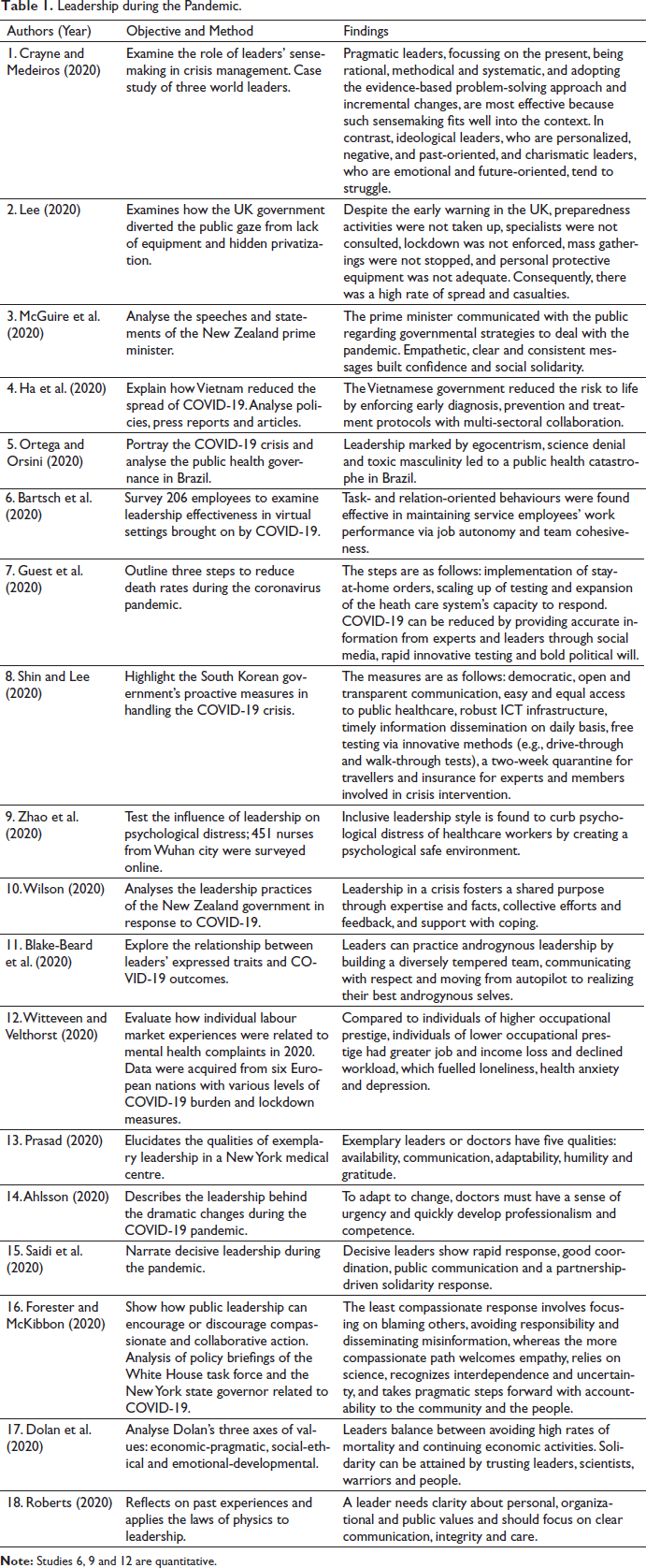
Conveniently, publishers allowed free access to articles related to COVID-19 in Google Scholar. An automated and inclusive database of Google Scholar provides more coverage of academic documents including book chapters and conference papers in social sciences and management than the selected database of Web of Science and Scopus (Martín-Martín et al., 2018). An internet search on Google Scholar was carried out using the following two keywords: ‘COVID-19’ and ‘leadership’. This yielded 262 documents as of 24 October 2020 in the English language. First, the two authors read all the abstracts; when no abstract was available, they read the full document. The first author identified 18 articles and the second author 21 articles that were relevant to the goal of lowering the spread of and deaths from coronavirus. Eighteen articles were common to both authors and the third author rejected the other three articles. Cohen’s kappa was 0.85 (p < .001), suggesting a substantial agreement between the first author and the second author. Then, the full contents of 18 articles were read; 15 were observational, qualitative studies and only three were quantitative studies (Table 1). In total, 45 words and phrases were extracted from the reported findings of 18 studies and were classified into 10 themes by the first author (Table 2). For triangulation of themes, the words and phrases and the themes of the first author were given to two independent coders (doctoral students in management) and they were asked to sort the words and phrases into 10 themes. Cohen’s kappa, used for cross-classification of words and phrases into themes, between the first author and the first coder was 0.69 (p < .001) and between the first author and the second coder was 0.79 (p < .001), suggesting substantial agreement. Themes of 18 articles with newspaper, government, WHO and online reports, were critically examined to gauge PLs’ performance. The themes, depicting roles and activities, were scrutinized using theoretical lens to develop a conceptualization of public leadership.
Leadership during the Pandemic.
Words and Phrases in Findings and Themes.

Findings
The findings show that top PLs and collaborators from places as diverse as New Zealand, South Korea, Vietnam and Germany had emerged as role models in tackling the pandemic (Crayne & Medeiros, 2020; Ha et al., 2020; McGuire et al., 2020; Shin & Lee, 2020; Wilson, 2020). In accordance with first-part of the objective, the performance of top PLs was associated with context-relevant decision-making, encouraging adherence to preventive health practices, empathetic and technology-supported communication, both masculine and feminine activities, pushing for robust testing, tracing and isolation of positive cases, mobilisation of citizens for shared responsibility, attempting to reduce discrimination and economic hardships, cross-sector collaborations, creating local taskforces for action and value-driven actions that displayed trust, accountability, integrity, fairness and resilience (Table 2). Important to PLs’ performance were sense-making, flexibility, swift decision and collaborative action as per situational requirements. In contrast, PLs who inspired mistrust, egocentrism or denial of science created ripple effects of fear, emptiness and restlessness among the masses. Such cases were evident in Brazil, the United States and the U.K. (Beer, 2020; Lee, 2020; Ortega & Orsini, 2020).
The 45 words and phrases observed in the above findings were classified into 10 themes (Table 2), and themes are critically discussed in the next section.
Discussion
Decision-Making and Urgent Action
With the first reported cases of COVID-19 from China, the human-to-human transmission was denied and the virus was not contained, so it spread to different countries. Traditional medicines failed to ward it off. Efforts then to find a way out evolved into preventive health practices, including wearing facemasks, washing hands, staying at home, maintaining physical distance, isolating positive cases and restricting mass gatherings. Infections, hospitalizations and casualties rose, when and where people violated the new COVID protocols. The spread of the virus could have been halted had the top PLs in China consulted virologists, public health specialists, administrators and local PLs, made and executed collective decisions to contain the virus before the Chinese New Year gathering on 25 January 2020 and advised other countries to do the same.
PLs at the highest levels undermined efforts to contain COVID. Former US president Donald Trump mentioned that the virus was a ‘little like a regular flu’, (Beer, 2020) and Brazil’s President Bolsonaro similarly dismissed it as ‘a little flu’ (Phillips, 2020) or a bit of a cold. The people there followed what the top PLs said, and these countries experienced the greatest casualties. Despite early warnings about the virus in the UK, public health specialists were not consulted, COVID protocols were not enforced, medical protective equipment was inadequate and, consequently, there was a high spread and casualties (Lee, 2020).
New Zealand’s prime minister, Jacinda Ardern, immediately after the detection of coronavirus cases, consulted other PLs, experts, administrators and others for sensemaking and transformed their conflicting opinions into innovative decisions. She mobilized people to adhere to preventive health practices, imposed border restrictions, self-isolated those entering the country and banned mass gatherings; all of this halted the spread of the coronavirus (Wilson, 2020). India’s first case of coronavirus was reported on 30 January from Kerala, but preventive health practices, shutdown and restrictions on entry to and exit from the country were only enforced after 22 March (United Nations, 2020), so the coronavirus spread was not regulated.
Top PLs with high performance showed cognitive and behavioural flexibility, consulted local leaders, experts and others to understand the on-the-ground reality, articulated conflicting views, made adaptive decisions, sought stakeholders’ participation and executed timely decisions.
Preventive Health Practices
Brazil’s president, Jair Bolsonaro, claimed to be handpicked by God to rule the country, and he believed in a magical cure. He used his veto power to remove legislation that obliged people to wear facemasks in shops and churches, and he attended anti-lockdown rallies. Though the Health Minister of Brazil pleaded for adherence to COVID protocols, the public who supported the president did not adhere to such norms. The president’s concern was the economy, not life. He argued that Brazilians were hardy and thus less susceptible to the virus, called on people to continue their jobs and businesses and blamed the media for exaggerating the little flu (Crayne & Medeiros, 2020). The ideological divide between the top PLs, denial of science, glorification of the past, violation of COVID protocols and inaction plagued the country as it fell into a health catastrophe (Ortega & Orsini, 2020). In northern Italy, people aged 70 and over had high rates of comorbidities and high levels of socialization. They did not obey preventive health norms, and most of them succumbed to the virus (Rudan, 2020).
Former US president Donald Trump did not wear masks or practise physical distancing during public events, which went against the administration’s mandate (Kahane, 2021). The UK’s prime minister, Boris Johnson, ‘shook hands with everybody’ (Grey & MacAskill, 2020) on a hospital visit. Observing such non-verbal cues, people acted as their top PLs did, and COVID-19 spread quickly.
Vietnam’s prime minister, Nguyễn Xuân Phúc’s key message was the government’s willingness to sacrifice economic benefits in the short term for the sake of everyone’s health. This helped motivate all to obey preventive norms (Ha et al., 2020). In Malaysia, the virus arrived on 24 January, and the government initiated a movement control order on 18 March to break the chain of infection. Nonessential businesses were closed, public gatherings and religious congregations were banned, and only selected economic activities were opened up in June; this lowered the spread of COVID (Kaur, 2020). In South Korea, the government, experts and the public collaborated in the implementation of innovative and rapid mass testing, two weeks of quarantine for travellers with the provisions of basic needs and financial aid, free distribution of facemasks, daily briefings, SMS alerts, and free and fast internet for communication with family members, friends and relatives, and for the education of school children (Shin & Lee, 2020). Denmark’s prime minister, Mette Frederickson, shut down Denmark’s borders and put the country in early lockdown. The national policies, innovative testing, communication network, adherence to preventive health norms and border restrictions slowed the spread of the coronavirus.
PLs shifted their thoughts and actions in accordance with situational requirements, local specialists invented diagnostic procedures, and localities participated in and adopted COVID protocols. All of these slowed the spread of the coronavirus.
Communication
Often, the verbal and visual messages of the top PLs or their representatives contained more pessimistic than optimistic information, such as the number of persons infected, death tolls, and risks of non-adherence to COVID protocols, instead of the number of tests carried out, number of persons recovered, and the benefits of adherence to COVID protocols. Although negatively framed information tends to evoke anxiety, it also increases the individual efforts and vigilance of the pandemic response (Sobral et al., 2020). However, more positive and less negatively framed information tends to dispel anxiety and inspire optimism and self-regulation among those obeying COVID protocols.
With the first confirmed case of the coronavirus on 28 February in New Zealand, the prime minister, Jacinda Ardern, sought citizens’ participation to keep New Zealanders safe, calling for an increase in clinical tests, asking young people to obey preventive health norms, take care of older people and their needs, buy local items, and quarantining those who entered the country after 22 March. On 13 April, in a Facebook live broadcast, Ardern asked for kindness and compassion to 514 fellow citizens who were affected by the coronavirus. On 27 April, she announced that they have won the battle against community transmission (McGuire et al., 2020).
The top PL’s empathetic communication, rational appeals, identification with coronavirus sufferers, calls for citizens’ participation and sacrifice, and solidarity decreased the spread of the coronavirus.
Masculine and Feminine Behaviours
Countries where the top PLs were women had lower spread and casualties than their nearest neighbours on socio-demographics whose top PLs were men. Germany, led by a woman, had 8,657 cases and 144 deaths per million, while France, led by a man, had 28,557 cases and 561 deaths per million; Norway, led by a woman, had 4,876 cases and 52 deaths per million, while Ireland, led by a man, recorded 13,362 cases and 396 deaths per million population; Taiwan, led by a woman, reported 25 cases and 0.03 deaths per million, while South Korea, led by a man, registered 545 cases and 9 deaths per million; Bangladesh, headed by a woman, recorded 2,585 cases and 37 deaths per million, and Philippines, headed by a man, recorded 3,658 cases and 70 deaths per million as of 12 November 2020 (
In the United States, states with female governors had fewer deaths than states with male governors. Compared to male governors, female governors were more inclusive and empathetic, expressed greater confidence in their briefings to the public, were more sensitive to grassroots needs, and were more resilient in their efforts to stop coronavirus deaths (Sergent & Stajkovic, 2020). While empathy, inclusiveness and interpersonal sensitivity are considered feminine attributes, confidence and resilience are considered masculine attributes and task-oriented behaviours. All these attributes were found in female governors.
During the pandemic, German Chancellor, Angela Merkel, implemented evidence-based responses. She called upon people to focus on the present and be proactive, and she praised them for obeying restrictions. On 28 August, she warned that the pandemic was likely to get worse in coming months. With an increase in the number of cases since early July and the possibility of a second wave, major public events were banned, testing was intensified, fines were imposed for not wearing facemasks in shops and public transport, and people returning from high-risk areas were given free tests for the virus in airports, train stations and highway stops, and they also went through quarantine for 14 days. Hospitals and day care centres were protected, but online education continued (Made for minds, 2020). In national television messages, Merkel expressed deep concern for people’s lives, justified the ongoing lockdown and appealed to all to help combat the virus (Blake-Beard et al., 2020; Crayne & Medeiros, 2020). She demonstrated highly feminine behaviours of empathetic communication, sensitivity to citizens and inclusiveness, as well as highly masculine attributes of enforcement of strict discipline and bold decisions and actions.
Top PLs, when they are women, are proactive, evidence-based, quick decision makers and action executors. They brief people empathically, seek citizens’ participation, give primacy to life over economy and create an ambiance of psychological safety. Their masculine and feminine behaviours foment public trust such that people follow these top PLs, which slows the spread of the coronavirus.
Interpersonal Sensitivity
At the initiative of top-level PLs, in early days of coronavirus in 2020, temporary COVID-19 hospitals were built, quarantine centres were opened up, shutdowns were implemented, COVID-19 warriors were deployed, and technical advice and resources were sought from administrative units for rapid action. Police personnel enforced preventive measures, drivers transported essential commodities and shoppers supplied basic amenities with a risk to their lives. Doctors and paramedical staff served coronavirus-affected patients, and some of them died.
High-performing PLs were courteous, respectful, considerate and responsive to citizens. In South Korea, ‘food of cheer’ was sent to the countryside at the initiative of local PLs (Shin & Lee, 2020). Norway’s prime minister, Erna Solberg, assured children at a press conference in September that a vaccine would be invented and that kids would be vaccinated against the coronavirus just as they had been against other diseases.
As positive leaders (Kelloway et al., 2013), top-level PLs mobilized people towards solidarity and gratitude to COVID-19 warriors by clapping, ringing bells, beating drums and lighting candles for their relentless service to humanity (BBC, 2020). This happened in Spain, Italy and India at the behest of top PLs. In a gesture of special gratitude, Indian armed forces flew past COVID-19 warriors, throwing rose petals, and their bands performed a tribute to them (The Statesman, 2020). People thanked, applauded and praised COVID-19 warriors.
Understanding the urgent requirements of COVID-19 patients, Ford, General Motors, Toyota and Tesla repositioned their production lines from manufacturing automobiles to ventilators. Asian countries, including China, India, Japan, South Korea and Taiwan, raced to increase the production of facemasks to meet domestic and export demands.
Older people were at greater risk due to their decreased immunity and bodily reserves. In New Zealand, the top PL mobilized young adults to take care of the needs of older people. Children, in the absence of play and parental care, experienced insecurity. Top PLs or their collaborators advised parents to keep children engaged in online classes, assignments and communication with those close to them.
Tech-Savvy
The pandemic made the world feel the need to be digitized. Saloons, hotels, airlines, cinema halls, markets and malls did not provide services during lockdowns, but financial institutions, media, education, health care, logistics and public offices operated in a virtual work environment. Within this context, PLs structured tasks, built teams, provided guidance and monitored employees’ work using information and communication technology (ICT) (Bartsch et al., 2020). Employees also communicated with customers using mobile phones. South Korean government representatives communicated daily with people using ICT and people communicated with near and dear ones using free, high-speed internet services to cope with physical isolation and emotional upheavals (Shin & Lee, 2020).
In developing countries, testing was scaled up. For instance, innovative technology from scientists and drive-through and walk-through tests from local doctors in South Korea shortened the time from test to results (Shin & Lee, 2020), which provided improved guidance for healthcare decisions. In the higher education sector, online courses and webinars became more frequent. Everything from student interviews to admissions and regular classes to exams, as well as job interviews, was conducted online, and working from home using laptops was the new normal.
In India, the ‘Aarogya Setu’ app was launched by the central government. Citizens were instructed to register using mobile phones to monitor their health status, keep watch over the COVID-19 cases in their vicinity and stay alert to positive cases. The app was free, easy to download and user-friendly, and it reached 50 million downloads in a span of a mere 13 days (The Hindu, 2020). PLs inspired people to use it and people quickly adopted it due to its source authenticity, ease of use and immediate utility.
Indeed, global leaders were identified as tech-savvy (Goldsmith et al., 2003). During the pandemic, people followed the initiative of the top PLs, including the adoption of ICT to restore mental health, diffuse daily difficulties and continue their lives.
Discrimination
Stereotypes (how we think) and prejudices (how we feel) manifest in ‘othering’ and often escalate into discriminatory practices during a crisis. Trump and members of the Republican Party used the term ‘Chinese virus’ instead of ‘coronavirus’. This fuelled the perception that the presence of Chinese people was a threat to the health of people in the United States. As people began to associate the coronavirus’s origins with China, an increasing number of news reports appeared on rising antagonism towards people perceived to be of Asian descent (Wen et al., 2020). In the United States, Asian Americans were avoided physically and subjected to racist jokes, verbal assaults and physical threats (Lee & Waters, 2021). In Pakistan, the Hazara ethnic minority was accused of being the source of the coronavirus; in South Korea, Shincheonji, new Christian church attendees, were stigmatized as the source of transmission (Jung & Jun, 2020). Moreover, lesbian, gay, bisexual, transgender and queer people were accused of spreading the coronavirus and were threatened online (Thoreson, 2020). People from north-eastern states in India, who have more mongoloid features like the Chinese people, were subjected to racial attacks in metro cities, were asked to vacate their homes by landlords, suspended from jobs and denied entry to eateries (Colney, 2020). Such groups were removed from their social support systems, which led to isolation, financial hardships and poor physical and mental health, including sleep disruptions.
Muslims were perceived to be carriers of the coronavirus in India. They were asked to stop selling on streets, and videos showing Muslims spitting on vegetables and fruits and spreading surfaces with saliva were circulated on social media. In mid-March, more than 4,500 Muslim conservatives, many of whom were from outside of India, assembled at the Tablighi Jamaat Markaz in Delhi. Many positive COVID-19 cases had been traced back to them, and islamophobia flared up. Central and local PLs in New Delhi undertook measures to improve the situation. A team involving local administrators, doctors and bus drivers safely evacuated every jamaat following COVID protocol—thermal scanning, barricading and sanitizing—and they were sent to hospitals or quarantine centres (Trivedi, 2020). As coronavirus cases rose, a nationwide hunt was launched to locate jamaat participants, tracing their phones and searching door to door (Apoorvanand, 2020; The Economic Times, 2020a).
PLs communicated through TV and social media to encourage non-discrimination against Muslims. Local PLs met people from mutually antagonistic groups, cleared up any misinformation through dialogue, and helped them feel empathy for one another. More than 400 multidisciplinary Indian scientists formed a group to fight myths and misinformation about the coronavirus (Lancet, 2020).
Economic Hardship
The lockdown laid down norms for self-quarantine, restrictions on mobility and widespread closure of businesses except essential commodities and medical supplies. Compared to employees in jobs requiring higher skills and with higher pay, employees with lower skills and in lower paying jobs experienced reduced workloads, low income and job loss, which furthered inequality and led to increased loneliness, anxiety and depression among this population (Witteveen & Velthorst, 2020).
Domestic cleaners, daily wage earners, rickshaw-pullers, taxi drivers, migrant labourers and gig workers experienced reduced workloads. Working from home or adhering to COVID protocols in the workplace was not a viable option for manufacturing labourers. The hospitality and travel industries were hard hit, with a loss of income and jobs for gig workers. Despite panic buying, with the fall of bulk demand from hotels and restaurants and of exports and imports, the price of perishable vegetables, grapes and sugar was slashed by 20% (Bhosale, 2020), affecting the income of small producers and petty businessmen. With inadequate productivity, stock prices declined. With the closure of schools, children were unable to get free meals in the schools in India, leading to inadequate calorie consumption, deterioration of their health and growing dropout rates in low-income families.
Following the lockdown in India, work activities were temporarily suspended in agricultural and industrial sectors. India saw a mass exodus of migrant labourers from their workplaces to their native places with their families, and many of them travelled many kilometres on foot. The central government urgently released funds and directed the state government to use the money for shelters, food and employment in their native places (Ghosh & Ghosh, 2020). Poor people in India, without employment and income, experienced hunger, domestic violence and child abuse, could not maintain social distancing in small houses and had no access to running water for frequent hand washing. They could not buy sanitizer and could not eat vegetables and fruits to improve their immunity. With the funding of the central government, local PLs and collaborators took the initiative and provided cooked food and money to the poor.
In New Zealand, government employees suffered a pay cut of 20% for 6 months (McGuire et al., 2020) to meet the expenditures used to help needy people. The UK government provided vulnerable people, such as the elderly and children of low-income families, with food parcels and free meals to collect and take home (GOV.UK, 2020).
During the pandemic, the microeconomy crashed and the mental health of people worsened. The top PLs and collaborators took the initiative to reduce the economic hardships of vulnerable people by providing assistance. People are more likely to accept assistance for problems in daily living, such as money and food, than for problems in mental health (Norris et al., 2002). Delivering monetary and material assistance in conjunction with psychological help can increase the relevance of both.
Multi-Sectoral Collaboration and Solidarity Response
In Italy, the government-initiated measures of social distancing, lockdown, active surveillance and coordination with local taskforces to implement emergency plans (Torri et al., 2020). The largest national lockdown taken by the Indian government was implemented in cities and villages with the involvement of local PLs and police personnel, who were praised by the WHO for being ‘tough and timely’ (Lancet, 2020, p. 1315). Local PLs worked to verify on-the-ground realities, addressed lapses, provided feedback to intra-governmental units, and coordinated technical, financial and human resources, overhauling service personnel and executing plans.
Singapore established a multi-ministry taskforce to coordinate its response before any COVID-19 cases had been confirmed in the country (Lee et al., 2020). Vietnam tackled the pandemic with coordination among top-level and local PLs. The Ministries of Science and Technology and of Information provided information on COVID-19 through the mass media and traced cases; the Ministry of Health carried out the detection, confirmation and isolation of cases, and arranged for care of positive cases in hospitals; the Ministry of Foreign Affairs restricted borders and checked the health of those entering Vietnam; the Ministry of Transportation suspended transport and banned flights; the Ministry of Défense locally isolated those returning from abroad; the Ministry of Education closed schools and introduced online learning; local authorities traced high-risk groups, set-up surveillance and isolation points, cancelled public events and mass gatherings, and encouraged people to stay at home; industries produced facemasks, gowns and ventilators; and the Ministry of Finance supported people and businesses affected by the pandemic (Ha et al., 2020).
A partnership-driven solidarity response was observed during the pandemic. South Korea shared data with the WHO after its first case of COVID-19; Saudi Arabia donated financially; Cuba sent doctors abroad to support other countries (Saidi et al., 2020); and the prime minister of India ordered the export of hydroxychloroquine to the US and other countries for possible treatment of COVID-19 (The Economic Times, 2020b). The WHO offered global support through its Solidarity Fund in response to the pandemic (WHO, 2020a) and conducted a Solidarity Trail over 30 countries to gauge the effectiveness of coronavirus vaccines (WHO, 2020b). Cross-sector collaborations and solidarity responses among top PLs were strategic responses in the fight against the pandemic.
Values
Values are desirable ideals or intrinsic qualities that drive our extrinsic activities. During the pandemic, high-performing PLs cultivated the personal values of integrity, fairness, transparency, resilience, empathy, altruism, humility, gratitude and adaptability, the organizational values of commitment, teamwork, customer focus, accountability and community welfare, and the public service values of respect, care and equity in access to healthcare services, and compassionate, collaborative action (Dolan et al., 2020; Forester & McKibbon, 2020; Roberts, 2020).
Despite the scarcity of personal protective equipment, heavy caseloads and emotional exhaustion among doctors in a New York hospital, values that fostered collaboration among senior and junior doctors in treating coronavirus cases were psychological availability in the hospital, humility, adaptability, gratitude and empathetic communication (Prasad, 2020). Women value ‘life’ and ‘care’ more than men, and they constituted 70% of the frontline global healthcare workforce caring for coronavirus-affected people (
Can Leadership Theories Explain Above Observations?
In accordance with second part of the objective, PLs were portrayed as ideological, pragmatic, charismatic (Crayne & Medeiros, 2020), task- and relations-oriented (Bartsch et al., 2020), proactive (Shin & Lee, 2020), decisive (Saidi et al., 2020), inclusive (Zhao et al., 2020), androgynous (Blake-Beard et al., 2020), exemplary (Prasad, 2020), and bold and dark (Ortega & Orsini, 2020) in studies reported in Table 1. Each portrayal is founded on roles and behaviours of a specific PL and diverse theoretical nomenclatures have emerged from roles and behaviours of PLs in different countries. Such diverse portrayal of PLs does not unfold a unified theory.
As the pandemic unfolded, it threatened public health and socioeconomic life of people and posed an adaptive challenge to PLs to arrest the adverse consequences. High-performing PLs were alert to situational cues and changed responses promptly in terms of decisions and actions, communication strategies, balancing gender roles, interpersonal activities, technology adaption, economic welfare, multi-sectoral partnership and virtuous behaviours for the good of people. Their roles and behaviours shifted paradoxically from individual to collective decisions, traditional to an innovative approach, self-centredness to other-centredness, hardship to welfare, uni-sector action to multi-sector collaborative action and disvalued to valued behaviours. Micro-level PLs, frontline Covid warriors, and people modified their decisions, beliefs, values and priorities as the top-level PLs did. This was observed in New Zealand, South Korea, Vietnam and Germany and leadership had a contagion effect.
In accordance with trait theory, the constellation of cognitive flexibility, personality traits, motivation and values (Zaccaro et al., 2013) furthered adaptive responses. Cognitive flexibility enables to understand and identify changes and shift thought and action accordingly. Emotional intelligence makes oneself self-aware and social intelligence makes one aware of public feelings. Self-monitoring enables us to make self-presentations and tailor behaviours as per situational requirements. Motivation increases readiness to perceive the change and act promptly. The display of such attributes was missing among top-level PLs in China, the United States, UK and Brazil but converted to a collective decision and urgent action in New Zealand.
The openness to ideas, moral values and empathy found in authentic leadership were expressed through empathetic and rational communication in New Zealand and Germany. Caring, serving others, offering provisions to overcome economic hardships and making self-sacrifices for others’ welfare, characteristic of servant leadership are shown through interpersonally sensitive acts in South Korea and provisions of cooked food and monetary support to the poor in India. The tech-savviness of PLs promoted the use of ICT among people in South Korea and Aarogya Setu in India. Interpersonal relations, concern for others and inspirational motivation, incorporated into transformational, charismatic, positive, people-oriented and inclusive leadership are reflected in mobilization of people to adhere to preventive health norms, facilitation of teamwork and encouraging service providers to ramp up their activities. The values of humility, adaptation, gratitude and care were observed in a US hospital; those reinforced PLs to learn from the public, administrators and COVID warriors and deliver a shared purpose to minimize the spread of coronavirus. Ethical leadership, embodied through equity, collaboration and virtuous acts, was observed in service delivery. The attribute of equity manifested in non-discrimination and implementation of micro-plans. PLs brought diverse sectors together in semi-permanent ways (Crosby & Bryson, 2018), created multi-perspective collaboration, maintained relationships with stakeholders, made innovative collective decision and drew needed resources to execute the decision for reducing the spread of coronavirus in New Zealand and Vietnam. They were accountable to coronavirus sufferers and the public and also to ministries of health, politicians, intragovernmental and NGOs, business, civil society, media and professional associations (Vogel et al., 2020). Thus, the confluence of theories, incorporating multiple attributes, behaviours and processes relevant to situational contingencies, associates with PLs’ performance.
High-performing PLs nurtured adaptive responses by developing collective understandings. In the process, conflicting views recreated new ideas using the collective intelligence of all stakeholders to ease people’s hardships and distress. In contrast, low-performing top PLs did not break their longstanding behaviours. Their verbal and nonverbal cues did not provide solutions to the crisis; instead, people followed these PLs, which exacerbated adversities. This was evident in the United States, Brazil and the UK.
High-performing PLs functioned flexibly to reduce people’s distress, changed their roles, cultivated new behaviours, built new relations and even displayed contradictory ways of functioning. For example, while the top PL in Germany was empathetic and people-oriented, she was a strict disciplinarian, showing the role of a task-oriented or autocratic leader in her imposition of preventive health norms.
Adaptive and flexible PLs and collaborators were able to arrest the spread of the coronavirus and resultant deaths by displaying the following traits and actions: (a) readiness and openness for constant learning from their context, including the public, politicians, administrators, coronavirus warriors and plan executors; (b) sensitivity to ongoing conditions of the public and the changing context; (c) creating and maintaining relationships with multiple sectors for involving stakeholders, drawing needed resources, making collective decisions, resolving conflicts and mobilizing teamwork; and (d) engaging in flexible, fast and valued activities congruent with situational demands. Any deviation from these lowered PLs’ performance and intensified the chaos.
Theoretical and Practical Implications
Adaptive and flexible PLs are found engaging in changing roles and actions rapidly, appropriately and paradoxically as the ground realities change during the pandemic. Their adaptive responses emerge from the confluence of personal attributes, behaviours and situational emergencies. They also change collaborators’ roles and behaviours to ensure contextual relevance.
To aid future PLs, a checklist based on the 10 themes reported above, with explanations of the required actions, could be developed. Localities and leaders can rate the performance of a PL against each theme on a scale (0 = not at all, 1 = partially, 2 = substantially, 3 = fully) to understand the extent to which a PL has been able to resolve adversities.
The 18 studies including 15 observational studies and the popular press documents provided rich evidence regarding PLs’ behaviours and their consequences. Cases were drawn from multiple countries and 10 themes were derived to portray high- and low-performing PLs. It might have been better if the cases had been drawn from only two countries with high-performing PLs and two other countries with low-performing PLs. However, this may have disallowed the emergence of the 10 themes observed here and the theorization of PLs’ roles and behaviours. All themes may not be applicable to all countries, but adaptive leadership can protect people against emerging adversities. The evidence is found in 2020, during the early days of the unfolding pandemic, as some PLs’ behaviours fell in line with the adaptive leadership model. However, while some PLs may be adaptive, others may be non-adaptive and still others may be in-between. The model may be revalidated in later waves of COVID-19 or in future pandemics.
Conclusion
Despite staying at home, avoiding daily work, acquiring new skills through online education, and the revival of the natural environment in 2020, there was a risk of infection and uncertainty regarding when this pandemic would be over. With the availability of the vaccine, the pandemic may stay for years (Kissler et al., 2020) with coronavirus mutations and variants. The WHO (2015) has already listed various diseases that have the potential to turn into epidemics. The signs of climate change and the unchecked foray of humans entering animal territory through deforestation and habitat destruction are paving the way for ‘virus spillovers’ (Rogers, 2020), and the chances are strong that another zoonotic-borne pandemic will come. Moreover, the public health crisis in a pandemic is a complex issue. It is not the responsibility of the health sector alone, and it calls for innovative and timely decision-making, people’s participation, use of technology, addressing discrimination, economic hardship, multi-sector collaboration and valued behaviours. Building upon what was learned about leadership during the pandemic in 2020, ‘adaptive, flexible leadership’ among PLs and collaborators in a rapidly changing context can arrest unrest among the masses in the future.
Footnotes
Acknowledgement
The authors are grateful to the anonymous referees of the journal for their extremely useful suggestions to improve the quality of the article. Usual disclaimers apply.
Declaration of Conflicting Interests
The authors declared no potential conflicts of interest with respect to the research, authorship and/or publication of this article.
Funding
The authors received no financial support for the research, authorship and/or publication of this article.
