



Abstract
Using panel data from 2000 to 2019 for low-income and middle-income African countries, this study examined what determines income diversification and its impact on bank risk and performance. Based on the system’s generalized method of moments and least square dummy variable results, high volatility risk, profitability, cost efficiency and high GDP encourage banks to diversify their income. While having lower leverage, a high net interest margin, and during inflationary times, banks are less encouraged to pursue income diversification. Moreover, income-diverse approaches improve profitability in regular and crisis periods for low-income and middle-income countries. However, income diversification does not lower volatility risks during crisis times. The study shows that increasing the cost efficiencies, higher liquidity and leverage ratios positively affects profitability and reduces volatility risk during the non-crisis period. The net interest margin positively influences risk during and after a crisis. The results show that GDP positively connects to a bank’s profitability. The link between profitability and inflation varies based on the analysis’s emphasis (i.e., before, during or after the crisis) and income level (i.e., low income or middle income). This study’s results have significant implications for bankers, regulators and the banking literature on the determinant, merits and risks of income diversification.
Keywords
Introduction
The intercontinental finance sector has experienced diminishing profit margins, competitive pressures, deregulation and the rise of technology change in recent years, particularly during global financial crises (Batten & Vo, 2016; Meslier et al., 2014; Zhou, 2014). Banking competitiveness and rival loan pricing have intensified; then, bankers in all economies, including Africa (Adesina, 2021), have been pressured to transfer into non-interest means of revenue to maintain financial efficiency and minimize their reliance on interest income (Hunjra et al., 2020).
The diversification of non-interest incomes includes security underwritings, insurance, broker agents, investment banking, money transfer services, ATM fees and other activities that generate non-interest income (Adesina, 2021; Isshaq, 2019; Meslier et al., 2014). Such diversification helps to enhance performance by limiting bank risk and flattening banking system functions. Diversified income, contrarily, may not aid banking institutions and may give rise to other streams of threat, such as systemic risk, market volatility, insolvency risk and agency cost issues (AlKhouri & Arouri, 2019; Jouida & Hellara, 2018). Thus, whether a bank may benefit through revenue diversification in a developing market scenario is unclear and inconsistent. This established the groundwork for a continuing argument and controversy within theories and studies about whether diversification improves profitability or exposes companies to more risk. This is because its benefits depend on the bank’s underlying portfolios, and it is more unstable than interest-based activities (Deyoung & Roland, 2001).
From the theoretical background, portfolio theory hypothesizes that preserving a variety of manoeuvres improves business performance through economies of scale. In contrast, strategic focus asserts that concentrating on imperative activities is more advantageous since diversifying entails agency expenses, excessive monitoring costs and regulating difficulties (Boadi, 2018; Duho et al., 2020). Given this setting, there is also an ongoing debate in the literature. Proponents of income diversification assert that financial institutions can stand to gain from diversification (Meslier et al., 2014; Sissy et al., 2017), yield higher risk-adjusted profits and increase profitability for middle- and low-income country banks (Lee et al., 2014).
In contrast, critics contend that diversification may start reducing profitability (Adesina, 2021; Jouida & Hellara, 2018). Excessive diversification results in additional systemic risk and high vulnerability (Deyoung & Roland, 2001; Li & Zhang, 2013; Stiroh & Rumble, 2006). Aside from the literature’s ambiguous conclusions, the empirical data on income diversification that have been reported thus far have mostly been centred on developed states. Limited studies have been conducted in African countries. (e.g., Mathuva (2016) for Kenya; Hamdi et al. (2017) for Tunisian; Sissy et al. (2017) for 29 African countries; Boadi (2018) for Africa; Duho et al. (2020) for Ghanaian; Adesina (2021) for 34 African countries; Adem (2022a) for Africa). Unfortunately, the findings of those studies are inconsistent and equivocal and fail to explain how the income diversification effect varies across specific economic conditions (i.e., low-income and middle-income countries) and under different time conditions (before, during and after the global financial crisis).
In addition to contributing additional elements of empirical findings on the impacts of diversification on banking risk and performance, this study aims to fill a gap in the literature by investigating the other side of the debate by addressing the issue of what motivates the banking system’s diversifying choices. Therefore, this research aims to fill the gap between inadequate empirical evidence and contradictory outcomes on the influence of diversification on a bank’s risk and performance. Annual country-level banking datasets for African nations from 2000 to 2019 were estimated with a dynamic panel model’s generalized moments methods system. Along with the findings, revenue diversification boosts banking performance in terms of both return on assets (ROA) and return on equity (ROE) measures. However, increased diversity does not ensure profit steadiness during the crisis period. This finding contributes to the continuing debate regarding diversification. It also has significant implications for management, business practitioners, regulators and academicians concerned about the effect of diversification on a bank’s performance.
This article is arranged as follows: The next section presents the relevant theoretical and empirical literature, which is followed by the section that describes the data and empirical framework. The discussion of the results is presented in the subsequent section. Finally, the last section concludes and affords some policy implications.
Literature Review
Theoretical Issues
The financial impact of diversification might be measured by the equivalent gains and costs associated with diversity (Jouida & Hellara, 2018). Two major hypotheses underpin the link between income diversification and profitability (strategic focus and conglomeration or portfolio). According to proponents of the strategic focus hypothesis, firms may enhance revenue by focusing on the most important products and fundamental proficiency (Boadi, 2018). Increasing the extent of a commercial banking system poses encounters, profit instability and acting outside of core competence, resulting in information asymmetry (Brighi & Venturelli, 2014; Deyoung & Roland, 2001; Duho et al., 2020). Advocates of the conglomerate hypothesis and portfolio theory, contrarily, argue that a company needs diversification to manage agency difficulties. Furthermore, operating a wide variety of businesses has potential advantages through efficiency gains and lowering earnings fluctuation (Brighi & Venturelli, 2014). Banking institutions obtain risk-reducing advantages if non-interest income streams are still not highly associated with interest income (Hunjra et al., 2020).
Empirical Literature
Determinants of Income Diversification
The current literature focuses mostly on how diversification affects institutions’ risks and profitability (Meng et al., 2018), even though a consensus has yet to be reached. Additionally, identifying the primary factors influencing the choice to diversify income streams has still not gained attention inside the banking literature (Ammar & Boughrara, 2019). First, significant profit growth and extreme volatility risks incentivize institutions to broaden the range of existing operations and establish new business units. This is because managers assume diversifying allows for the stabilization of overall profitability and see alternative business lines as a secure base that assists in lowering risks by reducing the impact of an unexpected financial upheaval (Lee et al., 2014). As a result, banks pursue new businesses that produce non-interest revenue to improve profitability and minimize risk (Ammar & Boughrara, 2019). Liquidity proxied by the loan-to-deposit ratio could influence decisions towards diversifying. Most of the literature argues that retaining a small level of liquidity position makes it harder for firms to satisfy their financial requirements. In other words, a high percentage indicates a high level of leverage on making loans, and institutions could not be capable of meeting unanticipated funding needs. As a result, banks may support illiquid assets using deposit liabilities with the help of diversifying (Meng et al., 2018). In contrast, a greater loan-to-deposit proportion suggests that banks continue pursuing core lending operations, leading to a minor switch into non-interest income-generating establishments (Meslier et al., 2014; Stiroh & Rumble, 2006). Therefore, it is predicted that a higher liquidity level would significantly affect income diversification.
Cost efficiency is another influential factor of diversity because the cost-to-income ratio indicates management’s competence to control costs. Hence, lower operational expenses typically coincide with good management competence, which may safeguard banks from unforeseen profitability upheavals (Nguyen et al., 2012). Therefore, it could increase their motivation to take advantage of diversification’s economies of scale effectively. It is anticipated to possess a favourable impact on diversification. The deposits to total assets ratio is used to determine the funding sources since deposits seem to be a cheap and reliable financial means relating to financial sources. When deposits constitute a substantial part of financing decisions, it can increase the bank’s income stream; hence, banks may build innovative operations to retain existing customers and attract new customers (Ammar & Boughrara, 2019). As a result, a favourable effect of the leverage ratio on diversification is projected.
According to the cross-subsidization assumption, a bank’s net interest margin, as measured by interest earned divided by total revenue, is also connected to income diversification. As per the cross-subsidization concept, banks may cut interest rates to lend to consumers on a long-term basis; over time, the relationship between the bank and the borrower enables banks to provide non-interest income generating operations (Isshaq, 2019). Additionally, the increased revenue through conventional operations encourages banks to diversify to increase overall profit levels. In contrast, effective lending operations and income streams that yield interest revenue may discourage banking institutions from considering establishing new retail operations, leading them to prefer to concentrate on their most important core operations (Ammar & Boughrara, 2019).
GDP is still an important motivational factor because banks migrate to non-interest income generating activities amid downturns to offset the losses induced by volatile or imprudent measures undertaken during an economic expansion (Nguyen et al., 2012). Last, the higher rate of inflation calculated by the yearly consumer price index suggests a terrible macroeconomic situation that discourages financial innovation and impedes the utilization of alternative income sources (Meng et al., 2017). Inflation is predicted to have an adverse impact on income diversification.
Income Diversifications and Bank Risk and Performance
Several studies have strived to examine the influence of diversification on bank profitability and have argued in some advanced economies even though there is no agreement among the results. There are now five aspects of the evidence-based diversification literature. The first piece supports the positive aspects of banking income diversification and the promise of risk mitigation. For instance, Moudud-Ul-Huq (2019) investigated the effects of diversification on risk and expected returns in ASEAN-5 banks. He concluded that increasing income diversification enhances performance and may decrease risk. A similar finding was made by Moudud-Ul-Huq et al. (2020). Using a dataset of Chinese listed national banks from 2003 to 2012, Liang et al. (2020) showed that income stream variety favourably influences performance. Such conclusions were congruent with those of Gupta and Mahakud (2020) for India and Omet (2019) for Jordan.
Unlike the preceding strand of literature, the second body of literature has found a negative correlation between diversification and profitability. For instance, Duho et al. (2020) investigated the influence of diversification on the profitability of 32 banks in Ghana between 2000 and 2015 and found that income diversity diminishes profitability. Similarly, Maudos (2017) analysed the effect of revenue structure on the risk and returns of European banks from 2002 to 2012. According to the results, non-interest revenue hurts profitability. Similarly, Jouida and Hellara (2018) confirmed a reverse association between the interaction of diversification, leverage and performance. Using a sample of 69 in the Gulf Cooperation Council (GCC) between 2003 and 2015, AlKhouri and Arouri (2019) empirically showed that non-interest income diversification has a negative impact on GCC banks’ performance.
The third perspective of diversification research has stated that while income diversification rises, so do its volatility and risk. Hunjra et al. (2020) used a dataset of banks from emerging regions in Asia from 2010 to 2018; they concluded that non-interest revenue leads to bank risk-taking. Using panel data from 1997 to 2012, Zhou (2014) also suggested that as the percentage of non-interest income grows, its volatility and systematic risk also increase. In a similar spirit, Batten and Vo (2016) examined risk shifting in Vietnamese commercial banks, and they found that turning to non-interest earning streams increases risk. Li and Zhang (2013) provided evidence that non-interest income has more instability and cyclicality than net interest income for the Chinese banking industry. Similarly, DeYoung and Roland (2001) and Stiroh and Rumble (2006) suggested that a transition to non-interest-generating operations increases earnings volatility and depresses productivity.
Concerning the possible consequences of revenue diversification, the fourth strand of the literature has revealed mixed effects and inconclusive results. According to Nisar et al. (2018), non-interest revenue has a favourable impact, while fees and commission incomes negatively affect the profitability of South Asian commercial banks. Ammar and Boughrara (2019) assessed the impact of income diversification on the profitability of banks across 14 MENA countries from 1990 to 2011. Their results suggested that buying and selling businesses enhance profit, yet non-interest operations reduce diversification benefits due to greater bankruptcy risk.
Other research in the fifth strand has demonstrated the usefulness of diversification for certain economies and nations only. Thus, Lee et al. (2014) concluded that non-interest practices lead to increased risk for banking institutions in high-income countries, whereas it improves profitability or lower the risk for banks in middle- and low-income countries. Doumpos et al. (2016) also found that income diversification might be slightly more advantageous for banks in less developed nations.
Regarding the perspective of Africa, limited articles have been presented concerning African countries. Using data from 212 deposit-taking savings and credit cooperatives in Kenya between 2008 and 2013, Mathuva (2016) found that non-interest earnings are correlated with larger profits and risk profiles in profits. Correspondingly, Hamdi et al. (2017) explored the impact of diversification on Tunisian banks from 2005 to 2012. They concluded that diversification improves bank profitability while being inversely linked with risk. A similar finding was found by Sissy et al. (2017). Boadi (2018), in contrast, examined the connection between diversification and profitability for 584 African banks from 2001 to 2013. Therefore, diversifying African banks appear to become less productive. In such a related manner, the evidence by Adesina (2021) examined 400 commercial banks running in 34 African nations between 2005 and 2015. According to the author, more diversification diminishes bank profitability.
In conclusion, the contradictory empirical evidence revealed that the effects of diversification on risk and return are equivocal. In addition, the determinants of income diversification receive less attention in the literature. With these considerations in mind, the purpose of this research is to discuss this issue in the context of the African banking sector.
Data and Methodology
Data Sources
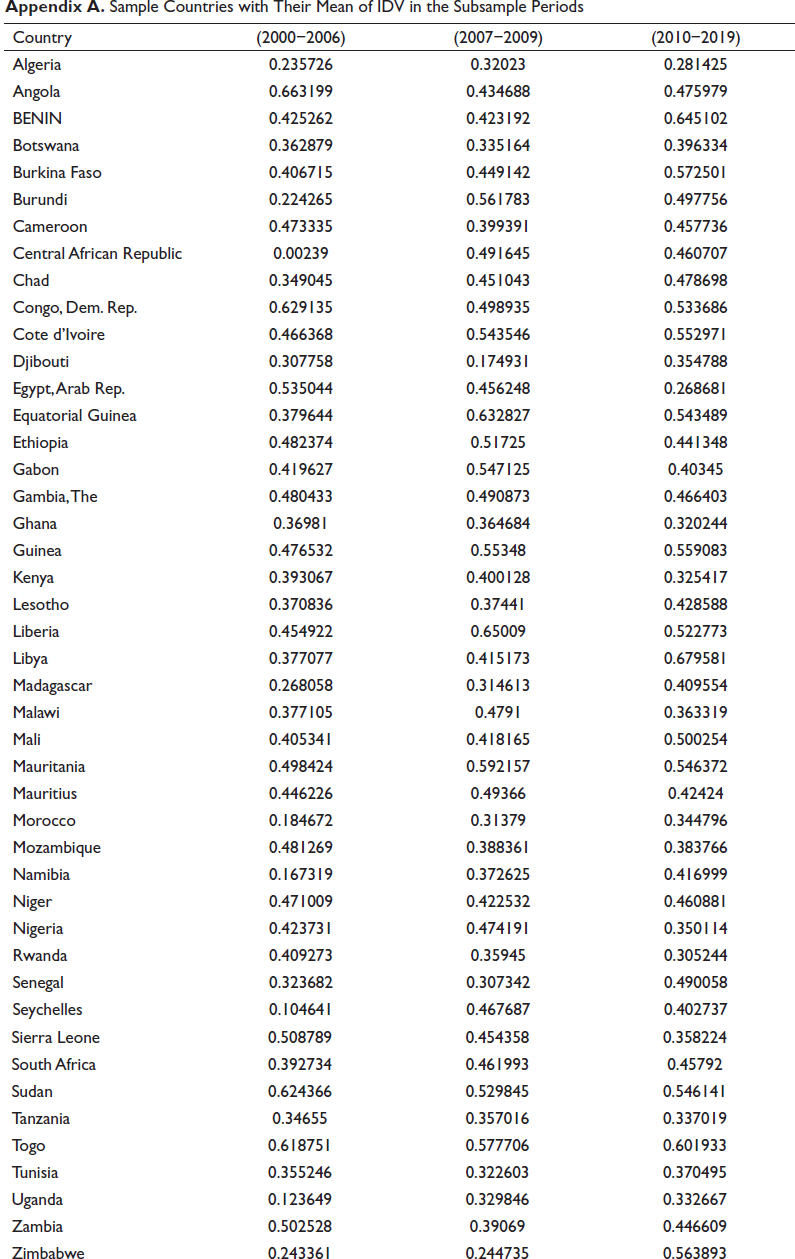
The study’s main objective is to investigate the impact of income diversification on bank risk and performance by employing longitudinal data from African economies. Secondary data are collected at the country or aggregate levels, with the premise that nations handle the whole range of banking operations on a consolidated basis. Furthermore, data for the variables of the study were gathered from the Financial Development and Structural database as well as the World Bank Indicators Database. Countries with insufficient or discontinuous data to construct the parameters are excluded from the selection. Following filtering, the final sample comprises just 45 African countries from 2000 to 2019. The countries represented in the sample are listed in Appendix A.
Variable Description
Bank Performance Measures
Bank performance is employed as a dependent variable. Following prior research (Gupta & Mahakud, 2020; Liang et al., 2020), the study measured bank performance utilizing various metrics, such as ROA and ROE. ROA is computed as the percentage of net income after tax to total assets that measures whether effectively a bank uses its assets to generate revenue. ROE is a return on stockholder capital measurement proxied as the ratio of net income after tax to total shareholder equity (Gupta & Mahakud, 2020).
Diversification Measures
To determine the impact of bank diversification on risk and performance, a fraction of net non-interest income to net operating income was used as a proxy for income diversification, as in prior studies (Deyoung & Roland, 2001; Hunjra et al., 2020; Moudud-Ul-Huq, 2019). Service charge revenue, foreign exchange transactions, income from investments and other non-interest earnings are all examples of non-interest income. Therefore, the difference between non-interest revenue and non-interest costs provides net non-interest income. A larger figure indicates that the bank’s income may seem more diverse. It is therefore projected that its coefficient will have a positive sign with the performance ratio. However, the effect on risk is indeterminate.
Bank Risk Measures
Various banking risk-taking indices are used for a comprehensive examination, robust outcomes and assessment of performance instability. The standard deviation of yearly return on assets σ (ROA) is used to calculate the first risk indicator, which indicates total bank profitability risks. The second proxy is the standard deviation of the annualized return of equity ratio σ (ROE), which depicts the volatility of stockholders’ profit. A reasonably high number indicates the risk associated with bank profitability.
Control Variables
Based on previous research, numerous control parameters were introduced to account for attributes that potentially impact a bank’s risk and performance.
Liquidity (LIQ)
The ratio of loans to total deposits is used as a proxy to analyse the impact of liquidity on bank performance. A bank with just a large proportion of loans within deposit holdings would not have enough liquidity to meet unanticipated financing needs. Therefore, they may be vulnerable to the threat of nonperforming loans. The lower the ratios are, the more liquid the bank’s holdings are, and the bank may not even gain profits as much as it could be. The impact of this ratio is uncertain.
Cost Efficiency
The cost-to-income ratio is used as a covariate and calculated by dividing a bank’s operational expenses by the combination of net interest income and other operating income. A lower ratio indicates greater efficiency as a result of higher-quality strategy implementation (Liang et al., 2020). A negative relationship between the cost-to-income ratio and profitability and a positive association with risk are expected.
Leverage (LEV)
The deposits to total assets ratio have been used to analyse the effects of leverage on performance. Deposits are a low-cost mode of finance that promotes a bank’s profits when such funds are resold at a higher premium. Conversely, banks may become disadvantageous if they do not convert those deposits into income-generating activities. Consequently, the deposit ratio is predicted to have a favourable impact on banking performance and risk.
NIM
Interest earned to gross earning assets (net interest margin) is also added to determine the profitability of conventional returns. The efficacy of loans and investments that produce interest income is what determines the sign.
GDP
The real gross domestic product was devised to measure the influence of macroeconomic fluctuations. Improved economic conditions could significantly promote profitability. As a result, a positive influence on profitability and a negative impact on the risk proxy were expected.
Inflation
Inflation was included, and a yearly rate of inflation measures it. It could have a favourable influence on profitability if bankers properly alter lending rates promptly. Whenever banks are reluctant to change their interest rates, their expenses surpass their potential income, raising the risk. As a result, the negative effect of inflation on performance and the positive effect on risk are predicted.
CRISIS Dummy
The CRISIS dummies account for the consequences of the global financial crisis. For both 2008 and 2009, this variable has a value of one and otherwise has a value of zero.
Empirical Framework
Estimating Equation (1) using an ordinary least square, random effect or fixed-effect model may still not yield reliable results since it does not account for heterogeneity among institutions or time; it does not account for endogeneity issues. It might even result in inconsistent parameter estimation, such as the correlation of error terms and heteroscedasticity. Moreover, some predictors are dynamic, and their present performance and risk are affected by their previous comportment. Therefore, the dynamic generalized method of moments estimator (GMM) proposed by Arellano and Bover (1995) was employed in this study. A GMM estimator uses the lagged values of a dependent variable as a covariate to tackle unobserved heterogeneity, omitting parameter biases and measurement error and determining the dependent variable’s persistence (Adem, 2022b). Additionally, GMM is used when predictors are not exogenous and heteroskedasticity, and a serial correlation exists inside individuals (Roodman, 2009).
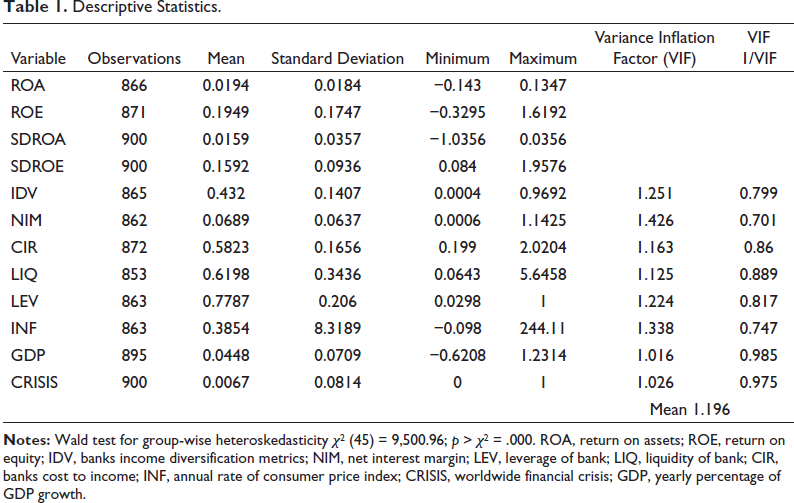
Variance inflation factor analysis was also carried out to detect potential multicollinearity issues (see Table 1) and confirmed no multicollinearity. Then, the Breusch–Pagan test for the heteroscedasticity problem is again performed. The econometric test p values presented in Table 1 confirm that there is heteroskedasticity. The existence of heteroscedasticity suggests that the GMM technique is preferential for the need for instrumental variables. Accordingly, the empirical model for a dynamic panel regression is specified as follows:
Descriptive Statistics.

where Yi,t represents a dependent variable that represents the profitability (ROA/ROE) or profitability volatility (SDROA/SDROE) of the bank in state i at period t, α is the constant-term, Yi, t − 1 is the one-period lag value of the dependent variable, IDV i , t is income diversification of banks at country i at time t, Xi, t is an independent variables vector consisting of bank-specific factors and certain macroeconomic indicators for banks in country i at time t, Crisis dummies is a dichotomous variable inserted to account for the global financial crisis, αi symbolizes the unobserved bank-specific effect, and Ui, t is the error term.
In GMM, there are two estimators: difference GMM and system GMM. Difference GMM is ineffective whenever the coefficients of the lagged dependent variable are high (Nisar et al., 2018). System GMM resolves endogeneity induced either by missing values or reverses causality flowing out from the dependent variable as well as other explanatory covariates. It accounts for any serial correlation issues that arise in the existence of lagged outcome variables (Ammar & Boughrara, 2019; Nisar et al., 2018). Finally, the two-step system GMM estimation technique is applied to estimate Equation (1), and it can be defined as follows:



where ROA/ROE states the bank performance of country i at period t, whereas SDROA/SDROE relates to risk metrics, the measures of ROA/ROE i , t − 1 and SDROA/SDROE i , t − 1 are 1-year lag measurements of bank performance and risk, IDV i , t denotes banks income diversification metrics of country i at period t, IDV i , t − 1 refers to one-year lag measurements of bank diversification, LIQ i , t symbolizes the liquidity of bank in country i at time t, CIR is banks cost to income in country i at time t, LEV i , t stands for leverage of bank in country i at time t, the bank’s net interest margin of country i at time t is denoted NIM i , t , GDP i , t is the yearly percentage of GDP growth, INF i , t is the annual rate of consumer price index, CRISIS is the worldwide financial crisis that affects country i at time t, αi is the unobserved bank-specific effect, Ui,t is the random term, and αi and Ui,t are scattered independently and uniformly scattered.
Model (2) shows the specifications for the determinants of income diversification, Model specification (3) shows the impact of income diversification on the performance of banks, and Model (4) represents the impact of income diversification on the profit risk (volatility risk) of banks. In system GMM estimation, the Arellano–Bond autocorrelation (AR) test is used to determine whether second-order serial AR exists. If the null hypothesis is accepted, the moment conventions remain valid. The Hansen and Sargan test of overidentifying restrictions is the second qualification test. Its initial hypothesis asserts that all of the instruments are exogenous or valid as a group, and non-significant p values indicate that the instruments are reliable.
Empirical Results
Descriptive Statistics
Table 1 presents descriptive statistics to summarize the results of the investigation. The average ROA is approximately 0.019, whereas the average ROE is approximately 0.194. The negative sign for the minimum values for the profitability indicators implies that certain institutions did not start profitable. This could be because companies are new to the industry and unable to compete or because they are not expanding current forms of income. SDROA and SDROE have average risk measures of 0.0159 and 0.159, respectively. IDV has a greater mean value (0.432) than NIM (0.069). The average cost-efficiency ratio is approximately 0.58, and its highest value indicates that some banks commenced with greater operational expenses. Liquidity’s mean result is 0.61, less than LEV (0.77), showing that banks have more deposits than loans, which have been the low-cost funding source. The average value of inflation is 0.38, which is larger than the average value of GDP, which is 0.044. The mean value of the crisis is 0.0067.
Regression Results
Determinants of Income Diversification
Before conducting the regression, the study categorizes the estimation specification into three categories: full samples, low-income countries and middle-income countries. Then, an estimation was conducted for the three specifications. Table 2 presents empirical estimates based on the findings of the dynamic two-step system-GMM estimates. The insignificant p values of Hansen test indicate that the instruments were valid and that the model was free from overidentification. AR(2) has insignificant scores, indicating no second-order serial correlation. The one-period lag values of income diversification is statistically significant. This inference gives credence to the model’s dynamic nature, indicating that the level of income diversification in the previous year directly influences the level of income diversification in the succeeding period.
Estimation Results for the Determinants of Income Diversification.
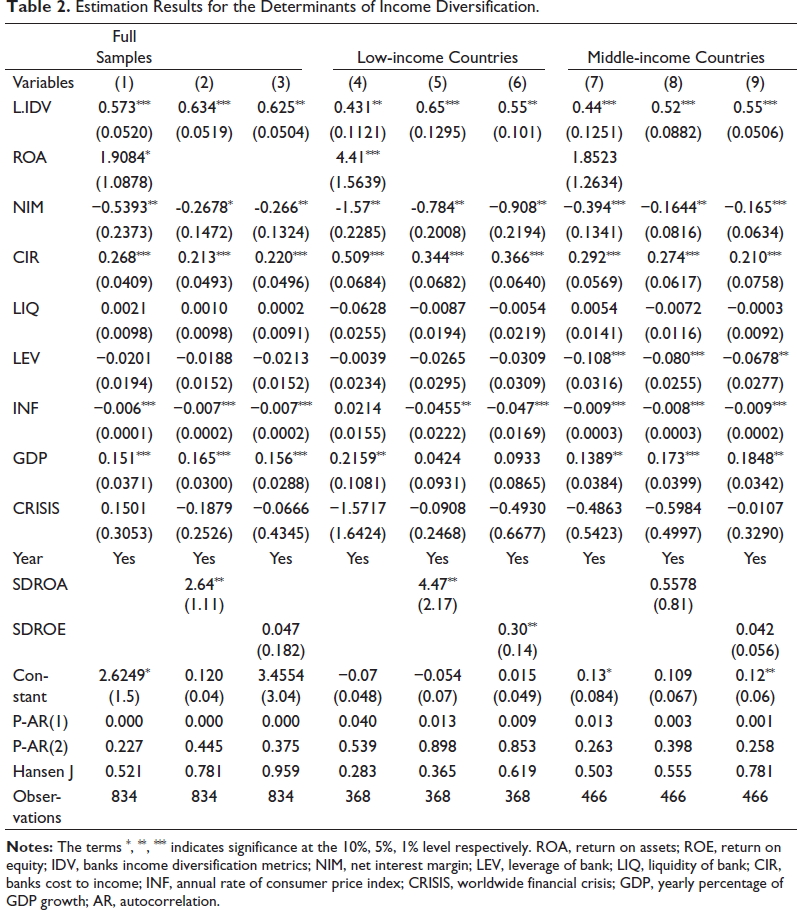
Table 2, columns 2, 5 and 7 show that the volatility risk indicated by the SDROA & SDROE in the estimates is substantial and favourable. According to the findings, banks highly exposed to increased earnings instability are more inclined to diversify their business. The empirical results demonstrate that a component that encourages diversity involves institutions’ profitability measured by return on assets. To increase overall profitability margins, banks that are profitable engage in growing banking and technology improvements (Hamdi et al., 2017). The net interest margin proportion has a significant negative relationship with income diversification, indicating that perhaps a decrease in the operating income of core business processes encourages institutions to undertake new business alternatives. As a result, businesses strive to reimburse declines in profit across existing conventional lines of business as well as to strengthen corporate standing by establishing new products and processes in different market segments (Ammar & Boughrara, 2019).
Furthermore, the predictor of cost efficiency reveals that banks with efficiently managed operational expenses and adequate managerial experience become more inclined to participate in non-interest income-generating businesses. This result is supported by (Hamdi et al., 2017). The estimated leverage parameter has a significant negative coefficient, implying that bankers having lesser deposits seek to expand into non-interest earning operations that need fewer resources (DeYoung & Roland, 2001) and potentially provide more cash inflows (Ammar & Boughrara, 2019). This could be due to lower-leverage institutions needing some adequate funding to consider alternative businesses.
The inflation variable demonstrates a negative connotation with income diversification. This indicates that banks working in economies with inflationary pressures tend to discourage pursuing new income sources (Meng et al., 2017). These results deviate from those obtained by (Hamdi et al., 2017). The gross domestic product indicator does have a substantial and positive effect on income diversification. Such a result illustrates that positive economic progress may create opportunities for banks to expand their current income streams. As a result, the banking industry is increasing the extent of its operations, seeking new possibilities for innovation and increasing the diversification of its earnings.
Impacts of Income Diversification on Bank Risk and Performance
Table 3 shows that the one-period lag values of income diversification, profitability (e.g., ROA_lag and ROE_lag) and risk (SDROA & SDROE lag) are statistically significant. This inference that the level of risk and performance in the previous year directly influences the level of income diversification, risk and performance in the succeeding period.
Effect of Diversification on Risk and Performance for Overall Period (2000–2019).
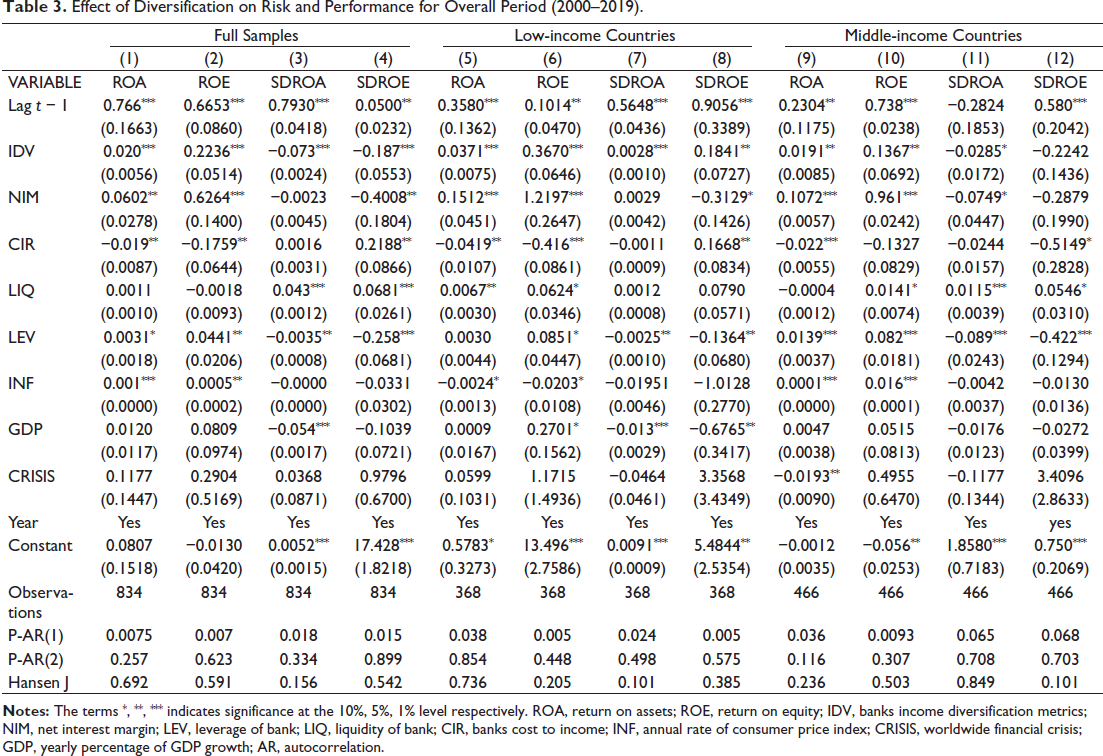
Table 3 shows that across all performance metrics equations, the coefficient of income diversification is positive and significant across all subsamples. This tends to suggest that incremental income diversification is crucial and makes a substantial contribution to the success of banks. This result corresponds with the portfolio diversification principle, confirming that diversification enhances the bank’s financial performance. Such findings also lend credence to the notion of economies of scale underlying the synergy effect, which holds that banks gain from additional information provided by conventional businesses while performing non-interest activities. Nonetheless, in columns 7 and 8 of Table 3, diversification has a positive and substantial risk coefficient for low-income countries, implying that overdiversification causes instability in the financial performance of commercial banks. This could be attributed to the fact that involvement in non-interest income-generating operations exposes banks to inefficiency, rising costs and operating outside of expertise, in turn exacerbating volatility. Hence, bankers and supervisors in low-income countries need to focus on the relevant places of diversification and use synergies to reduce agency costs. The findings corroborate the literature (e.g., Gupta & Mahakud, 2020; Hamdi et al., 2017; Omet, 2019).
For both overall and subsample specifications, cost efficiency has been demonstrated to be negatively correlated with the profitability of banks while positively linked with risks, showing that more efficient banks seem to be more profitable and far less risky. The findings indicate that appropriate cost management and enhanced cost optimization techniques are essential for banks to enhance their returns in developing economies. The outcome is supported by the evidence obtained by Mathuva (2016), Sissy et al. (2017) and AlKhouri and Arouri (2019).
When the control factors are considered, liquidity has a positive and substantial link with bank volatility risk but is an insignificant for-profit metric in full samples. However, liquidity positively influences risk and returns in low- and middle-income nations, demonstrating that an increased level of loan exposures boosts bank risk and return. Financial institutions may be tempted to issue a sizable loan balance due to holding an overbearingly large percentage of liquidity, which would maximize their profits by producing interest revenue. Conversely, if banks are unable to administer and concentrate on their credit facility, they could well be exposed to the risk of nonperforming assets, which would seriously weaken their capacity to maintain a steady profit. Moreover, Abdelaziz et al. (2020) argued that among the elements that adversely affect income revenues obtained from lending operations is a low level of liquidity, thus lowering banking performance, bank credibility and customer satisfaction.
Table 3 shows that leverage measured by the deposit to total asset ratio has a significant positive influence on performance across all specifications but a negative and substantial effect on volatility risk. The positive impact implies that African banks have more client savings and drive improvement from high leverage levels, thus allowing them to access a low-cost venture finance source that improves profitability (Adesina, 2021). It also significantly reduces the volatility risk of profit, indicating that as banks reduce interest spread widening, banks experience lower interest expenditures while generating high-interest revenue. As a result, financial institutions in low- and middle-income nations better secure prospective customer deposits and effectively mobilize potential customer funds to attain higher profitability. This result is supported by Ammar and Boughrara (2019) and Duho et al. (2020). Table 3 shows that the net interest margin parameter has a positive and significant influence on performance while negatively impacting risk for the full sample and subsamples. This illustrates that African bankers can still sustain and benefit from existing conventional revenue streams.
Concerning economic factors, inflation has a strong positive effect on performance within whole samples and middle-income economies, demonstrating that increasing annual inflation may increase the probabilities of operating margins. This could be attributed to institutions raising their interest rates amid periods of high inflation contributing to overall profitability. In contrast, inflation is significantly negative for performance in low-income countries, suggesting that greater annual inflation might increase the risk of loan default by tumbling debtors’ capacity to repay. As a result, bank profits are decreasing, but profit instability and uncertainty continue to increase. This outcome is commensurate with the findings of Hamdi et al. (2017), Ammar and Boughrara (2019) and Hunjra et al. (2020). As proxied by the dummy variable, the financial crisis has an insignificant effect on performance and risk for total samples and low-income countries. However, it adversely impacts the performance of middle-income countries, indicating that the recent economic crisis enhanced risks by raising the instability of bank profits. Similar evidence was highlighted by Brighi and Venturelli (2014) and Nisar et al. (2018).
Table 3 suggests that the coefficient of the GDP growth factor has a nonsignificant positive impact on performance for the whole sample and middle-income countries but a considerable detrimental effect on volatility risk for the full sample (Table 2, column 3). For a low-income nation, GDP growth does have a positive and negative impact on performance and risk, respectively. This shows that, over time, economic development is linked to increasing bank profitability and reducing risk because of the increase in the economy’s expansion, increased loan demand and enhanced financial institution soundness. Hence, policymakers should formulate policies that enhance the prosperity of the economy and the soundness of the financial system.
Diversification and Bank Risk-Return in Pre, During and Post Financial Crisis Periods
The dataset was divided into three groups for scrutiny: a subsample for the years prior to the financial crisis (2000–2006), a subsample for the years during the financial crisis (2007–2009) and a subsample for the years after the financial crisis (2010–2019). Table 4 displays the average levels of the significant parameters for each subsample period.
Mean Estimation Values of Variables in Subsamples.
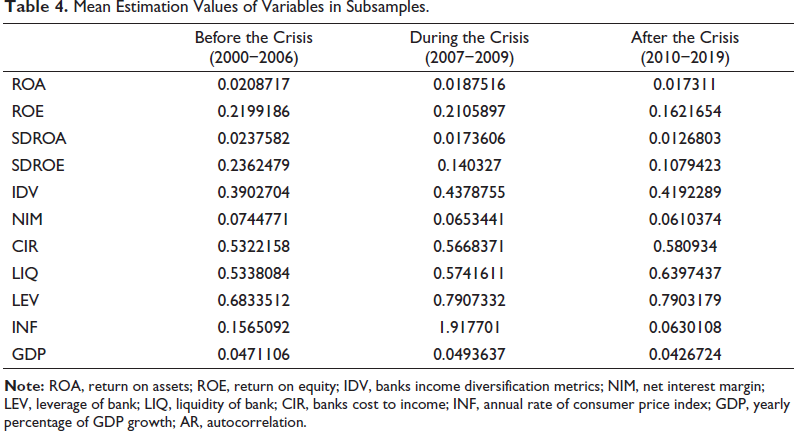
Although profitability during and after the financial crisis is lower compared to the precrisis era, the overall average value of a bank’s volatility risk as assessed by SDROA and SDROE during the financial crisis period remains substantially high relative to the postcrisis time. These results demonstrate how the global financial meltdown negatively impacted African banks, making them risky and less profitable relative to their overall status during the prefinancial crisis. Even though bank liquidity improved to 57% during the financial crisis relative to 53% precrisis periods, the average net interest margins were substantially lower by 10% during the crisis era. Contrary to the NIM’s decrement, African banks’ non-interest income expanded to 43.78% from 39% prior to the crisis and 41% afterwards. This suggests that the African banking sector was engaged in non-interest income sources of operations throughout the crisis; they prospered from non-interest sources of revenue.
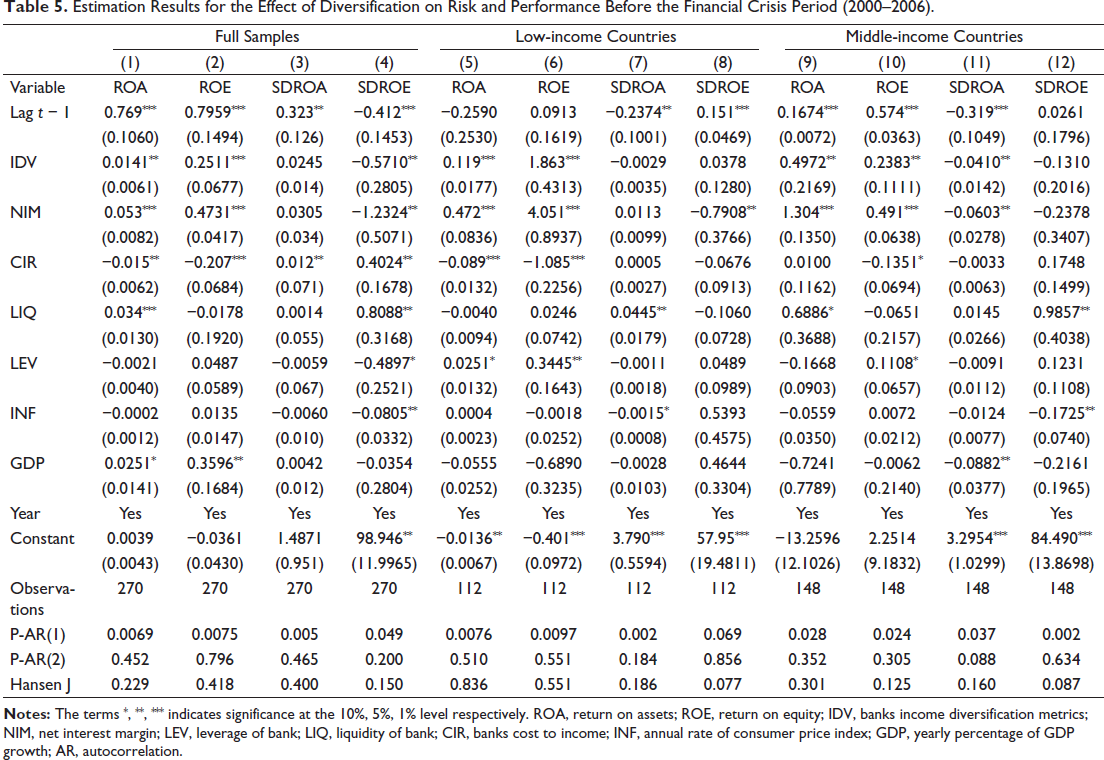
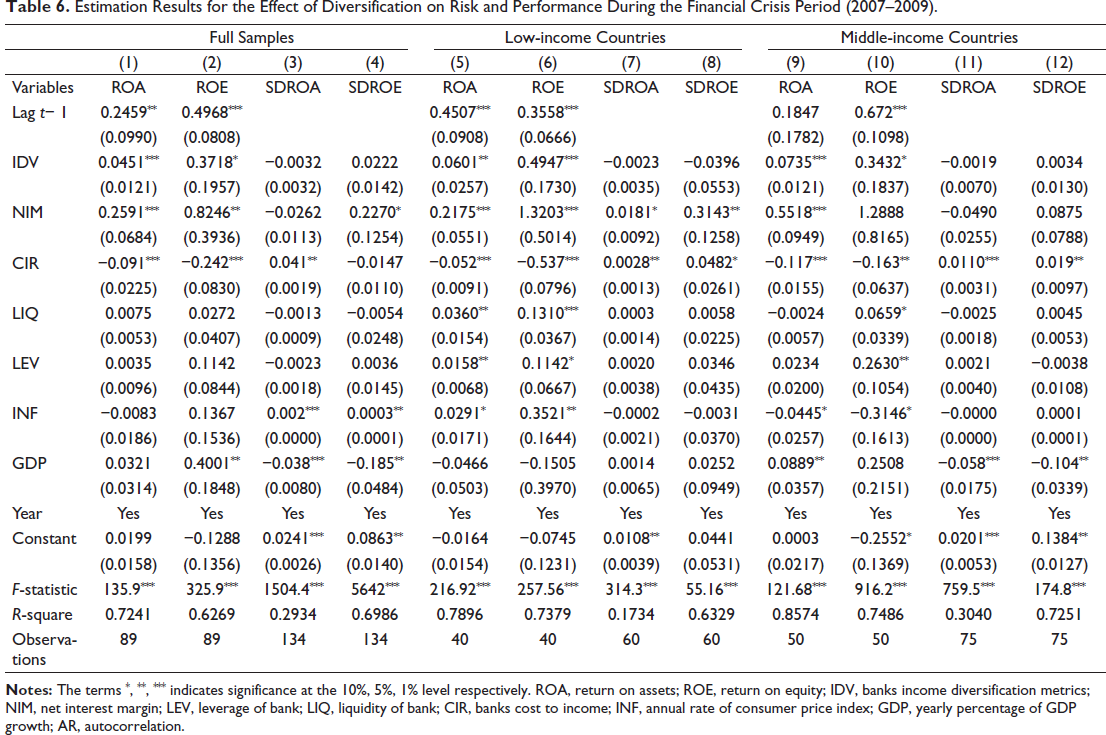
The GMM two-step approach was utilized in the study to assess the precrisis (2000–2006) and postcrisis sample groups (2010–2019). Meanwhile, to eliminate the issue of small sample bias, the study employed the least squares dummy variable model for the sample population of the crisis period (2007–2009). Tables 5–7 present the parameter estimates for each of the three subgroups and show that most of the results for the factors in pre- and postcrisis remain comparable to the main findings in Table 3.
Estimation Results for the Effect of Diversification on Risk and Performance Before the Financial Crisis Period (2000–2006).
Estimation Results for the Effect of Diversification on Risk and Performance During the Financial Crisis Period (2007–2009).
Estimation Results for the Effect of Diversification on Risk and Performance after the Financial Crisis Period (2010–2019).
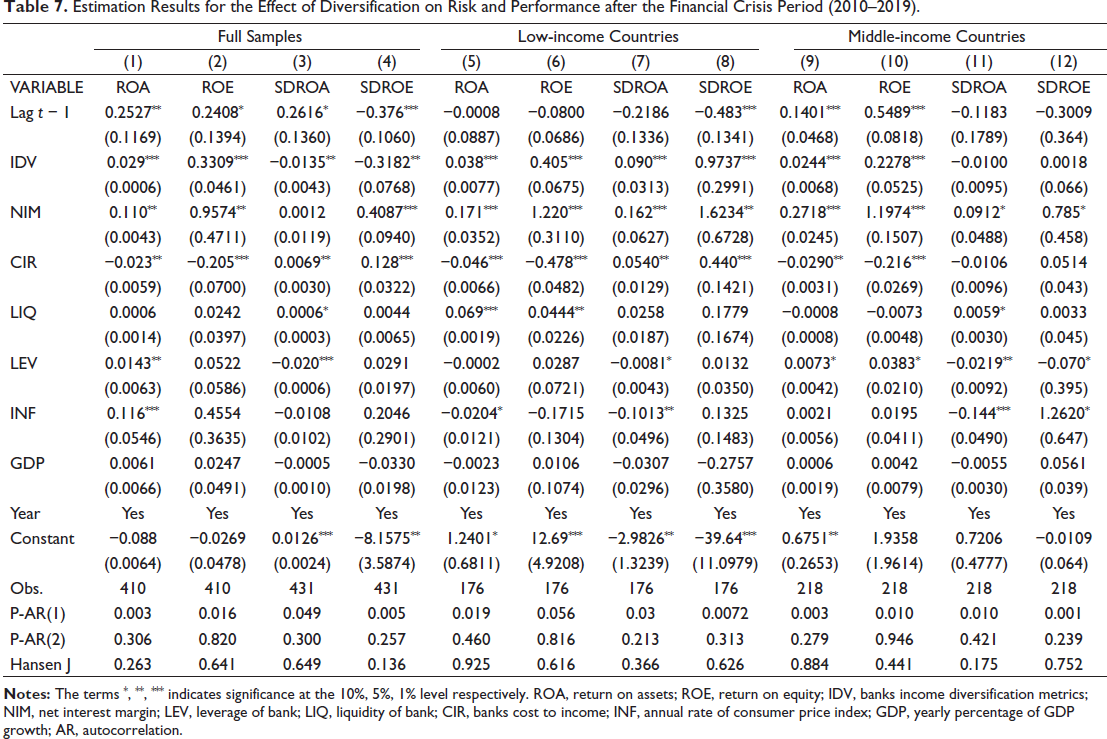
However, Table 5 reveals that revenue diversification in banking had a minimal detrimental influence on bank volatility throughout the crisis period of 2007–2009 (SDROA and SDROE) but positively affected profitability indicators. This shows that diversity enables banks to increase profits but has no impact on risk reduction during a crisis. Liquidity and leverage also positively impact profitability but do not significantly impact risk indicators during the crisis period. The findings in Tables 6 and 7 reveal that NIM positively influences risk indicators during and after the financial crisis. This could be because high inflation coupled with low economic growth could lower citizens’ expenditure capabilities, resulting in customers’ inability to repay their principal loan and interest. This, in turn, affects the banks in generating the required interest income that makes their profit volatile. Therefore, banks in low-income and middle-income countries need to diversify into non-interest income-producing businesses. This is because diversification promotes bankers in strengthening their capabilities and resisting competitive pressure (Ammar & Boughrara, 2019).
During and after the crisis, inflation was positively linked with risks and adversely connected with performance in the total sample and middle-income nations, suggesting that an inflationary environment increases the risk volatility and reduction of profit at the time of crisis. In low-income countries, however, the significant and positive link between inflation and profitability indicators during the financial crisis contradicts earlier detrimental outcomes. The outcome indicates bankers’ capacity to transfer higher inflationary costs to potential customers, increasing overall earnings, particularly in a competitive banking system. The findings showed that GDP growth had a substantial favourable connection with banks’ profitability prior to and throughout the financial crisis. This implies that the financial crisis would have no restraint upon the commercial activity of African banks and banks remained capable of increasing their interest charges during the time. Nonetheless, after the financial crisis, this association became insignificant. Table 6 shows that the scores of the crisis period dummy variables (2007, 2008 and 2009) were substantially positive with bank risk and yet negatively significant with profitability.
Conclusion and Policy Implications
The study examined what determines income diversification and the impact of income diversification on bank risk and performance using panel data from 2000 to 2019 for low-income and middle-income African countries. Based on the two-step system GMM estimation results, banks with high volatility risk, profitability and cost efficiency and work in good economic progress are inclined to diversify their sources of income. Banks having lower leverage and high net interest margins and banks working in economies with inflationary pressures tend to be discouraged from pursuing new sources of income. Moreover, income diversification does have a beneficial influence on bank performance measures. Specifically, diversifying approaches improve profitability through regular and crisis periods and it provides earnings stability by lowering volatility risks during noncrisis times for middle-income countries and low-income economies. Liquidity and the leverage ratio positively affect profitability for all subsample periods and substantially impact bank risk in the noncrisis period.
Furthermore, the findings imply that increasing the cost efficiencies results in enhanced financial performance and risk mitigation across all periods. The net interest margin benefits profitability in normal and crisis periods, while it positively influences risk both during and after a crisis. Thus, bankers who promote high repayment borrowing costs as payoffs should modify their lending rate by considering the client’s ability to repay the loan. They also need to strengthen their interest revenue by switching to non-interest sources of income. Regarding macroeconomic considerations, GDP positively connects to a bank’s profitability before and during a crisis. Policymakers should design policies that promote economic prosperity. The findings show that the link between profitability and inflation varies based on the analysis’s emphasis (i.e., before, during or after the crisis) and income level (i.e., low income or middle income).
The study highlights a set of recommendations in light of the empirical findings. First, policy initiatives that aim to increase revenue diversity across low- and middle-income nations are still more important in promoting profitability. Second, financial institutions should use synergies to gain from diversification and reduce earnings instability during the crisis period. To refrain from making unsafe investment choices and to lower volatility risk, regulators and managers in low-income nations should be thoughtful and be able to cope with nonconventional operations while expanding into new markets. Banking institutions should be cost-effective through economies of scope to effectively consume resources and keep agency costs from outweighing the advantages of diversity. Banking in low-income and middle-income nations must properly manage existing lending activities and conduct a thorough assessment of liquidity management. Furthermore, bankers in low- and middle-income nations need to acquire new client depositors in remote regions, modify borrowing costs and minimize interest gap worsening to achieve increased profitability from their leverage. While inflation adversely influences bank profitability, authorities in low- and middle-income economies should stress appropriate inflationary mitigation strategies that reduce superfluous currency mobility within the market, allowing banks to gain from their loaning.
By illustrating that diversification enriches banking institutions in developing nations, the study contributes significantly to the banking literature on the merits and risks of diversification. Due to a lack of data, the research was unable to separate non-interest income into its many parts. As a result, future studies might look at the impact of revenue diversification in emerging economies by separating out non-interest income. Future research might examine revenue diversification’s impact by comparing developing, emerging and developed economies.
Sample Countries with Their Mean of IDV in the Subsample Periods
Footnotes
Acknowledgement
The author is grateful to the anonymous referees of the journal for their extremely useful suggestions to improve the quality of the article. Usual disclaimers apply.
Declaration of Conflicting Interests
The author received no financial support for the research, authorship, and/or publication of this article.
Funding
The author has not received financial support for the research, authorship and/or publication of this article.
