



Abstract
The present study shades light on the short-term wealth effects of the share repurchase decision of Indian IPO firms on their stock prices. For the years 2000–2019, the sample considers the IPO companies who announce buybacks within 5 years after their listing. By evaluating short-term fluctuations in stock prices around the buyback announcement date, wealth effects have been quantified using the event study approach. According to our empirical investigation, investors responded favourably to the news and produced positive 1.13% nonsignificant abnormal returns on the event day. Further investigation finds that these companies likewise endure erratic stock performance in the days that follow the announcement, with the exception of the day when they actually purchase back their shares, which produced positive and significant abnormal returns to investors of 0.92%. Also, over the event window, the results are positive at 10.69% and significant. Our results show that investors favourably view share repurchase by IPO firms and can regard it as a sound investment strategy. This study also adds to the scanty literature about newly listed firms’ payout preferences.
Introduction
Share-repurchase is an important form of payout policy not only in advanced nations but in emerging nations as well. US companies used to follow it even when it was not legalized. Then, in 1982, US government made share buyback as a legal practice. Later on, other European countries started adopting this norm in late 1980s. Developing nations also followed the same suit in 1990s. As a form of corporate payout, share repurchase has been gaining momentum in place of dividend since it offers flexibility and tax advantage to the company (Jagannathan et al., 2000). Additionally, previous studies have offered empirical evidence that established US corporations’ payout behaviour has changed, with share repurchases now outpacing dividends as a percentage of overall payout (Brav et al., 2005; Grullon & Michaely, 2002).
Numerous empirically tested reasons are given behind these announcements and valuation benefits of share repurchase. The excess cash with firm, capital structure adjustment, flexibility associated with repurchase, signalling undervaluation to the market are among the various reasons. Importantly, the most compelling and widely accepted reason among them is the signalling of undervaluation hypothesis, which is quite popularly studied as well. It states that if the management thinks their company’s market price is undervalued and experiencing decline in returns, then they announce repurchase to signal undervaluation of their share price. Hence, it is perceived that buyback shall boost the prices of the stock if they are announced at a price higher than the market. This shows that management has confidence on their firms and future profitability. This also shows the inefficiency of market, as it is not able to depict the correct price of the company (Grullon & Michaely, 2005; Ikenberry et al., 1995; Vermaelen, 1981). Thus, such buyback decision can also be seen as an investment by the company in itself that management try to signal through buyback announcement. However, the effectiveness of these programmes will depend on how the firms’ anomalous returns perform following the announcement. There are numerous empirical evidences from other countries like United States and Canada that show abnormal returns around repurchase event (Comment & Jarrell, 1991; Ikenberry et al., 1995; Vermaelen, 1981). All these programmes are usually backed by the firms that have excess cash flow with them (Monzur & Riaz, 2022; Rapp et al., 2014; Soo & Suh, 2011). These firms are mainly large and established firms because they have more operating cash flows (Soo & Suh, 2011). It is likely unexpected from small or newly listed firms because they are considered growth-oriented firms and tend to have cash shortage (Jain et al., 2009). Hence, new, or small firms must retain the excess cash if they require it for future investments and generate profits rather distributing them. Despite this, anecdotal evidence has shown that new listed firms are also initiating share repurchase within few years of their listing. Fama and French (2001) documented that at least 22% of newly listed firms announce payout within 3 years of their listing.
Some academicians have tried to find the buyback behaviour of newly listed firms and how the investors perceive to such announcements. Newly listed firms tend to underperform in the long run as various studies have empirically pointed out (Chen et al., 2013; RITTER, 1991; Schultz, 2003). So, announcement of share repurchase, which is considered as motive to correct undervaluation, must succeed in signalling undervaluation to the market. But the available evidences of correcting undervaluation by share repurchase are mixed and limited in number for newly listed or IPO firms. Jain et al. elucidated that signalling is the motivation behind repurchases, while dividends are backed by life cycle and catering theory for US-based IPO firms (Jain et al., 2009). German-based IPO firms’ repurchase choice is partially influenced by signalling theory but more by free cash flow theory since many IPO owners exit from equity stake at the IPO and generate insignificant positive valuation effects (Bessler et al., 2016). Whereas Chen et al. found that IPO firms mislead investors by announcing shares repurchase and this reflects in their long run performance because it does not generate significant positive abnormal returns (Chen et al., 2013). From the present results, we understand that existing studies provide no concrete results about IPO firms for correcting their undervaluation using share repurchase. Thus, it becomes imperative to see how emerging market reacts to these announcements.
The studies based in developing nations about share repurchase, like Malaysian firms, do experience rise in price post repurchase (Isa et al., 2011) and many times firms buyback their shares to support the price as examined for Greek (Drousia et al., 2019). On the other hand, evidence-based results demonstrated that Indian and Taiwanese firms performed poorly after the announcement of the buyback. (Chatterjee & Mukherjee, 2015; Hsu et al., 2016). This also shows that developing nations have given mixed results about the presence of abnormal returns and only talks about the established firms (Henrique Castro & Yoshinaga, 2019). Further, it has been observed that newly listed firms tends to under perform in the long run and they return cash to their shareholders through buyback due to undervaluation in their initial years. (Chen et al., 2013; RITTER, 1991; Schultz, 2003). There is no study that talks about newly listed firms in any of the developing nations. Thus, we argue that if the firms tend to underperform post IPO issue, then repurchase announcements must cause positive abnormal returns to the investors.
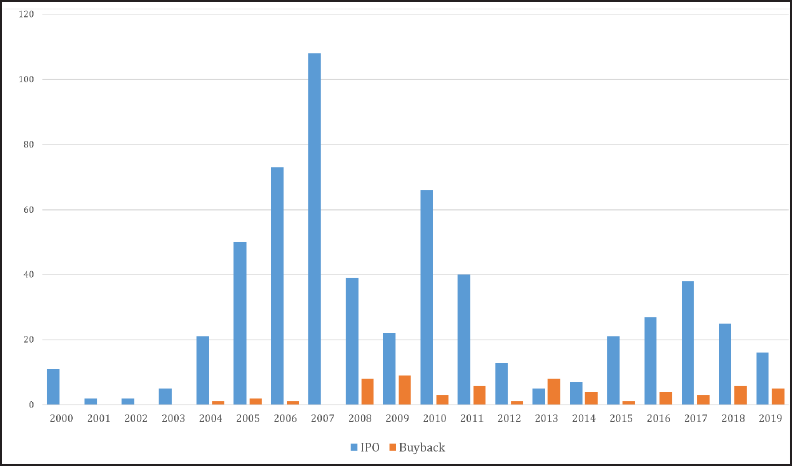
India is one of the world’s largest and fastest-growing economies, with a unique ownership structure. Concentrated ownership, including family-owned and promoter-driven enterprises, dominates Indian corporations. Better decisions result from concentrated ownership, yet there is a lack of openness. Hence, we expect that the announcement should have an impact on prices of firm as they signal the new information to the market. Also, over the period, 10% of IPO firms have announced for buyback in initial years. Figures 1 illustrates the IPOs and buyback by IPOs from 2000 to 2019. It shows the rise in buyback from 2008 with highest IPOs in 2007 before the recession period. The available literature in India that has examined the share repurchase announcement effect, has been carried out for a limited time span for large companies and these studies are scattered throughout the period. Whereas no dedicated study has been performed for the newly listed firms and to investigate the immediate market reaction of their decision. Therefore, the goal of the study is to determine the wealth effects of repurchase decisions made by Indian IPO firms.
Number of IPOs and IPO’s Buyback Announcement in Each Year.
In the present study, IPO firms that have announced buyback within 5 years of their listing have been considered in the pre-COVID period from 2000 to 2019 that is during the normal market conditions. Wealth effects have been examined using short-term fluctuations in stock prices following buyback announcement using event study approach. According to our findings, the repurchase announcement has a favourable impact on investors, who produce positive anomalous returns of 1.13% on the day of the event and 1.65% significant abnormal returns on next day of the event. The cumulative anomalous returns across the event window are both positive and noteworthy. This shows investors react positively to buyback decision of IPO firms, and hence, it can be considered a good investment strategy. These results may also prove useful to corporate managers of IPO firms as they may consider before initiating payout.
Our article is organized as follows: ‘Review of Literature’ discusses pertinent literature on share buybacks by IPO companies and their effects on price performance before moving on to literature specific to India. The data sample and research technique are highlighted in ‘Methodology’. Results and analysis are highlighted in ‘Empirical Results’ with a summary in ‘Conclusion’.
Review of Literature
Significant literature focuses on the impact and motives behind the buyback. In this section, the relevant literature is analysed, which discusses share buyback behaviour of IPO firms that deals with price effect associated with buyback, followed by the evidence collected from India.
Share Buyback and IPO
The existing literature shows the various motives behind the repurchase of shares. Among them, signalling is the major motive empirically studied so far. In this theory, share repurchases are considered as a signal of undervaluation, thus the market should respond quickly, and stock prices should go up. Based on the above notion, Comment and Jarrell (1991) tested repurchase announcement in United States and found significant positive short-run effects, which are consistent with (Peyer & Vermaelen, 2005) and also for privately negotiated repurchases (Lee & Suh, 2011). All the results shows that share repurchase is primarily used by management if they think their share is undervalued. Newly listed or IPO firms have evidently shown that they tend to underperform in the long run (Chen et al., 2013; RITTER, 1991; Schultz, 2003). Thus, repurchase announcement from the newly listed firms must be able to communicate undervaluation by generating abnormal returns.
The minimal literature focuses on IPO firms doing the buyback activity. Chen et al. (2013) exhibited poorer long-run operating performance as well poorer stock return performance of the IPO firms that have announced buyback within 3 years, and suggested instances of insider trading with their results being consistent with misleading hypothesis where IPO firms announce repurchase to give false signals and mislead investors. While Jain et al. (2009) conducted their study about the payout-initiating behaviour of IPO firms, they found that firms prefer repurchase method for initiating payout rather than dividends for signalling purposes. Both the above studies have shown contrasting results for IPO firms. Another reason for the buyback is the free cash flow that is generated during IPO listing (Bessler et al., 2016) and has shown positive abnormal returns and no underperformance in long run. Hence, cash availability is a crucial factor to decide whether to repurchase shares or not. This also leads to a rise in agency cost of free cash flow (Bessler et al., 2014) due to which firms buy back their shares after IPO. They have also investigated the decline in operating cash flow but large surplus cash holdings. Available literature has focused on why IPO firms announce share repurchase in United States and Germany only. Moreover, no dedicated study is present for any of the developing nation.
Share Buyback and India
In developed economies such as United States or UK, buyback officially commenced during the 1990s, after the other European economies followed suit. India introduced buyback in 1998 by making amendments in section 77A, 77AA and 77B to the Companies Act of 1956. SEBI has allowed buying back shares through open market repurchase (OMR) and fixed price tender offer method. Initially, it was not much prevalent method opted by companies, but in the previous years, buyback activities have risen owing to tax benefits. Till date, the total number of open market offers is higher than the total number of tender offers on SEBI. However, after the changes to the Companies Act of 2013, more strict guidelines for open market offers were enforced and that was due to the potential misuse of open market offers as discussed in the (SEBI Discussion Paper, 2013). As a result, tender offers are becoming a more popular choice in India than OMRs after 2013 as per SEBI data.
In Indian context, literature on share repurchase is growing. Some studies tried to identify the motive behind the buyback (Arora, 2019; Bhama, 2021; Kumar Jena et al., 2020) while others tried to capture their valuation effect on the firm (Chatterjee & Mukherjee, 2015; Mukherjee & Chatterjee, 2019; Pandey et al., 2020). In a survey based study conducted by Anwar et al. (2018), it was identified that undervaluation is the prime motive behind stock repurchase. This finding was also empirically supported by (Arora, 2019; Bhama, 2021). They stated that correcting short-term undervaluation is the prime motive for buyback. Additionally, it was reported that low valuation of the stocks, which is particularly held by small companies, has preference for repurchase more than large companies (Bhama, 2021). The reason is that small companies tend to have more instances of information asymmetry. They claimed that the market does not react favourably to the announcement, as positive returns were observed for a very short duration. Additionally, they stated that tender offer is the preferred mode than open market offers (Bhama, 2021). Similarly, Kumar Jena et al. (2020) in their study stated that if the companies are given a choice to correct short-term undervaluation, they prefer tender offer instead of OMR.
Verma and Munjal illustrated in their study based on tender offer announcement that market reactions are positive on the next day of the announcement but remain insignificant for rest of the days (Varma & Munjal, 2016). This positive reaction creates value to the shareholders. It also indicated that the management is successful in carrying undervaluation signal to the market by tender offer announcement. In the empirical study, it was found that the market reacts more positively to share repurchase announcements, as it generates 1.50% positive returns on the announcement day (Gupta, 2016). The study by Dayanandan et al. (2020) also elucidates that 2.07% abnormal return on announcement day is a good signal.
Contrastingly, Chatterjee and Mukherjee (2015) claimed that OMR announcements do not generate wealth for investor and imply that announcements do not carry much information to the market. Mukherjee and Chatterjee (2019) in their study for open market announcement empirically identified that average abnormal return (AAR) goes up significantly on announcement day but declines in subsequent days. They have also stated that the firms are not able to time the market. Additionally, when they segregated the companies on the basis of market capitalization, they found that the firms prefer small and mid-cap companies on the day of announcement for the premium but switch towards large cap post repurchase announcement. Because investors think that large firms have better fundamentals and corporate governance than small firms, and small/unknown companies go for share buyback to correct undervaluation.
Pandey et al. (2020) empirically reveal that positive announcements are present in pre-event window instead of after announcement. There are negligible trading opportunities after buyback announcement. However, these results indicate that investors can earn abnormal returns if they can predict announcement in advance. They also emphasized that pre-announcement returns show the possibility of insider trading and it signals that the market is in a semi-strong form due to lack of information symmetry. Hence, more disclosure norms are needed in the Indian capital market.
All these studies have tried to explore, in a way or other, the signalling impact of buyback announcements on share repurchase. From the findings, we can conclude that if the stocks are undervalued, then they must generate abnormal returns, which also shows that the markets are inefficient, and investors cannot predict the announcements before. However, the IPO firms are considered to be underperforming in longer duration (Chen et al., 2013; RITTER, 1991; Schultz, 2003). Same findings have been found for Indian IPO firms as well (Wadhwa et al., 2014). Thus, if the IPO firms announce share buyback within few years of their listing, when they are underperforming, then such announcements must garner attention from the investors and generate abnormal returns.
As it can be noted, from the above literature, the results are mixed regarding share repurchase announcement. And so far, no such study has happened that tried to gauge upon the effect of IPO firms announcing repurchase in developing nation context. Hence, this study extends the share repurchase of IPO firms to India as well. This study fills this research gap by incorporating the buyback data of Indian IPO firms from 2000 to 2019.
Objective and Hypothesis
The goal of our study is to evaluate the price reaction around share repurchase announcement of IPO firms in Indian stock market. This study tests research question with following hypotheses.
H1: There are AAR for IPO firms on the event day. H2: There are CAAR for IPO firms during the event window of repurchase announcement event.
Methodology
Data
For the study, we have taken the announcement data of both OMRs and tender offers from the period of 2000 to 2019 from the SEBI website. As the data before 2000 is quite minimal, it may not have enough influence on the results. Second, the period of pandemic from 2019 to 2020 and afterwards has not been included, as it may have a huge impact on repurchase behaviour of the firms that may influence the announcement effect. For the repurchase information, we have manually checked all the companies’ post repurchase announcements, letter of offers and public announcements reports from the official SEBI website to get public announcement date. Total 369 announcements have happened during the period, announced by 251 companies. Following (Bessler et al., 2016; Jain et al., 2009), we consider only those firms as IPO firms that have announced buyback within 5 years after coming up with their IPO allotment and have been listed on BSE or NSE at the time of announcement. The reason for selecting 5 years is that IPO firms tends to underperform in long run and the considered period for it is 3–5 years after their initial allotment (Chen et al., 2013; RITTER, 1991; Schultz, 2003). The third year is crucial year, after which fifth year performance is considered. Furthermore, if we select only 3 years of the IPO announcing repurchasing firms, it will reduce the sample to an exceedingly small size.
There is at least 10% of all the firms that have announced buyback within few years of their public allotment. These were total 65 firms that have announced first buyback within 5 years of their listing. To qualify for the sample, the company must have trading information available for 140 days before and 20 days after of the announcement date. Out of all firms, we could not retrieve price information for three companies and announcement date of two companies. We omitted the companies who announced buyback within 3 months since their estimation period would not have sufficient days to calculate the expected returns. Hence, our final sample has been reduced to 59 companies. We have selected BSE SENSEX as the benchmark for calculating returns, since BSE is the oldest exchange and largely represents Indian stock market. Stocks and benchmark-related information have been collected from Prowess IQ and BSE website.
Event Study Methodology
Using the event research methodology, anomalous returns are calculated to determine whether the news had any effect on the stock price. Brown and Warner (1985) and Mcwilliams and Siegel (1997) have identified the following steps:
Identifying and defining the event of interest and estimation period with event period respectively. Computing expected returns using estimation model & determining abnormal returns. Testing the significance of cumulative abnormal returns over the event window.
In this study, first share repurchase announcement by the board of IPO firms is taken as the event of interest. The length of the event window must be carefully considered because a long window will diminish the test’s power due to which false results are reported about the significance of the event (Brown & Warner, 1985). And it should be kept short enough to capture accurately the significance of the event and no other confounding event effects should affect the result (Mcwilliams & Siegel, 1997). Thus, keeping in view all the above points and based on previous studies, we have chosen the event window of 41 days, 20 days before and 20 days after the event. To perform more in-depth analysis of how the information seeps in the market, event window of different periods is also used.
Abnormal returns are the discrepancy of the actual and predicted return. Here, the predicted returns are calculated using market model as previously done by (Anwar et al., 2017; MacKinlay, 1997; Pandey et al., 2020). The model establishes the linear relationship between asset return and market return assuming joint normality of asset returns (MacKinlay, 1997). Expected returns are estimated through estimation window wherein we have taken 120 days before the event period, that is -140 to -21 days to ensure the expected returns are unaffected with the event returns. Expected returns are calculated as per given Equation (1):

where

Subsequently, AAR is calculated by summing up all the abnormal returns of all firms on each day of the event and calculating the mean of it. Given by Equation (3), where

Next, CAAR values were determined to ascertain the combined effect of the event over the given period. CAARs (cumulative AARs) is the sum of daily AARs for the period, which starts at

Significance Test
The event studies are susceptible to event-induced variance, clustering of event dates or correlation among abnormal returns, and non-normality of the daily stock returns (Fama, 1976; Kolari & Pynnonen, 2011). Thus, non-parametric test seems more appropriate because they are free from stringent assumptions unlike parametric tests. Because of which, it dominates the event study for single day tests, though their efficacy gets reduced as the number of days for CARs increases (Campbell et al., 2010; Kolari & Pynnonen, 2011). Due to this shortcoming, use of non-parametric test alone is not appropriate. In turn, Brown and Warner (1985) also stated that normality does have no obvious impact as the sample size increases, the abnormal returns converges to normality. Alongside, increase in the statistical power of parametric test as given by (Boehmer et al., 1991; Patell, 1976), parametric tests have gained popularity across event study. Since both these tests have their own advantages and disadvantages, it is appropriate to use both tests. This also makes it a common practice to apply both non-parametric and parametric tests to insure the robust statistical inference of the significance of abnormal returns (Boehmer et al., 1991; Campbell et al., 2010; Jain et al., 2019).
The null hypothesis for the study is that abnormal return and cumulative abnormal return are both equal to zero. Two non-parametric and three parametric tests are used to test this claim.
Cross-sectional t-test (Csec-t)
It is a simple parametric test to check if AAR and CAAR are significant given by Equations (5) and (6), respectively:

where

where
t-test lacks robustness in variance induced by event as asserted by (Boehmer et al., 1991) and exhibited that standardized t-test do not reject null hypothesis when it is true and holds greater power.
Patell Test (Patell Z)
It is a widely used test in event studies. Jain et al. (2019) and Patell (1976) ask for standardizing the abnormal returns by the forecast-error corrected standard deviation, which is calculated by adjusting prediction errors that occur at or around the event date. For AAR, test statistics is calculated using following Equation (7):

where
Test statistic for cumulative AAR uses the following Equation (8):

where
Standardized Cross-sectional Test (BMP Z)
Boehmer et al. (1991) introduced the test, which is the improved version of Patell test, because it assumes that variance changes due to event and variance change does not harm the test if there is no actual variance change, and it draws the information from estimation window as well event window. The test is estimated using the following Equation (9):

where,

G sign-test (Cowan Z)
As suggested by Cowan (1992), generalized sign test or G sign-test is appropriate for checking abnormality of returns in conditions when event window is long. And it also does not need assumptions as required for parametric test like the symmetry of cross-sectional abnormal returns.
The null hypothesis assumes the number of stocks with positive CAR equal to the fraction expected to have that positive CAR. The fraction with

where Sit = {1 if ARit > 0 or 0 otherwise} and L1 is the length of estimation period.
The test follows the normal approximate binomial distribution with parameter

where
Rank-test (Corrado Z)
As given by Corrado (1989), rank test is well specified and better than parametric test. This also does not require symmetry in cross-sectional excess returns. Rank test is less affected by the event-induced variance than another parametric test. The first step is to convert the abnormal returns of both estimation and event period into ranks. Rank statistic for day zero is given by Equation (13):

where
Test statistic for CAAR is calculated using Equation (14):

where
Empirical Results
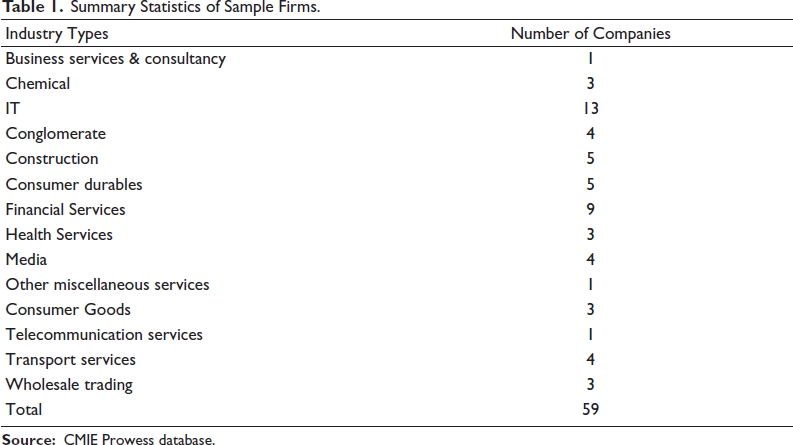
Table 1 indicates the summary statistics of 59 IPO firms over the entire sample period of IPOs firms that have initiated buyback with the span of 5 years from the date of initial public offering. The companies in the sample are from various industries and highest number are of companies from the IT sector.
Summary Statistics of Sample Firms.
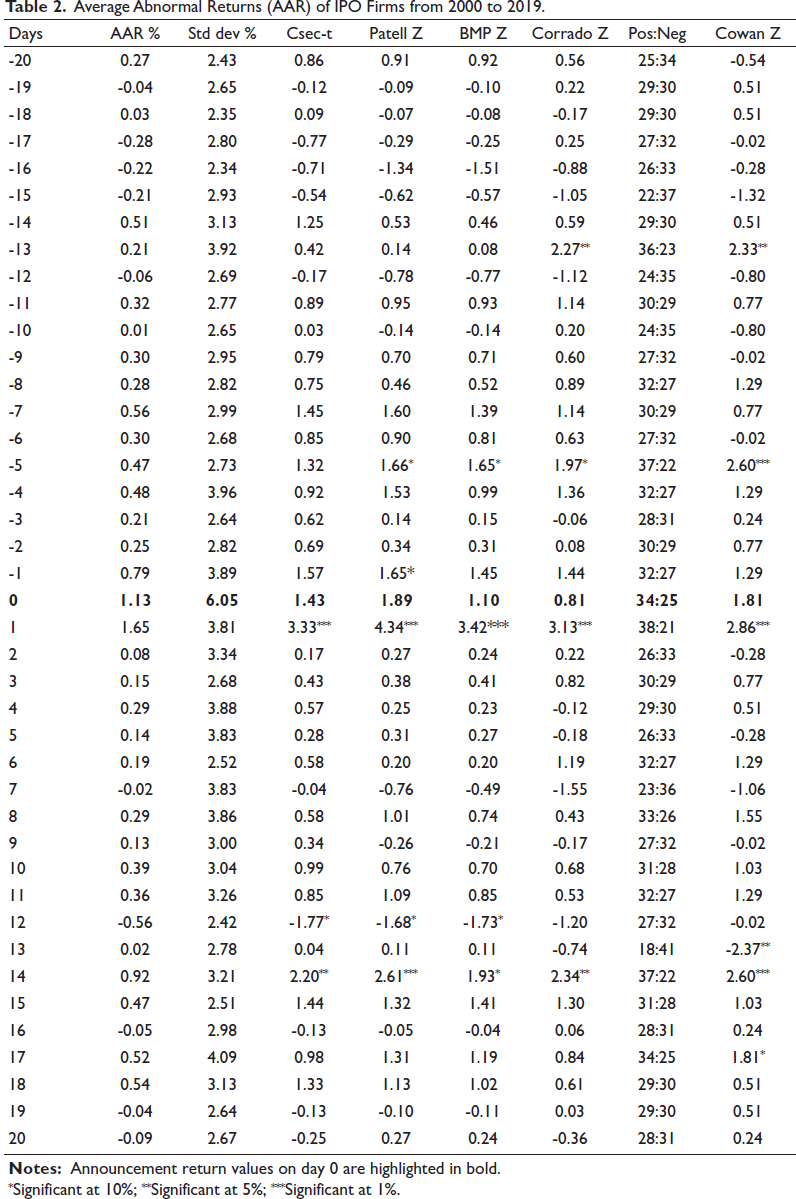
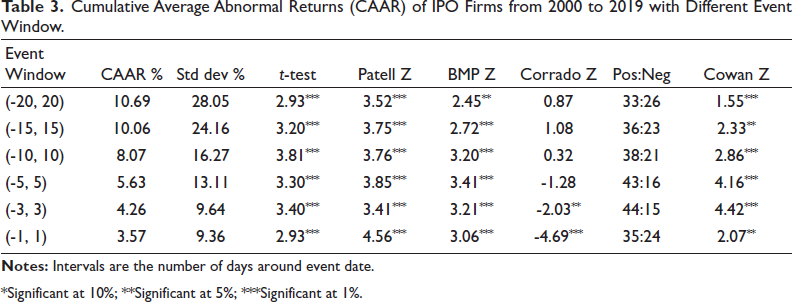
Tables 2 and 3 depict the values in percentage for (AAR) and (CAAR), respectively, experienced by the entire sample during the study period. Table 2 contains AAR values described by their standard deviation, t-statistic, and other parametric test that is Patell test and standardized abnormal returns test and non-parametric that is generalized sign test and rank test results around 41 days event window. Figures 1 and 2 depict the AAR and CAAR graphically.
Average Abnormal Returns (AAR) of IPO Firms from 2000 to 2019.
*Significant at 10%; **Significant at 5%; ***Significant at 1%.
Cumulative Average Abnormal Returns (CAAR) of IPO Firms from 2000 to 2019 with Different Event Window.
*Significant at 10%; **Significant at 5%; ***Significant at 1%.
AAR of Indian IPO Firms, 2000–2019.
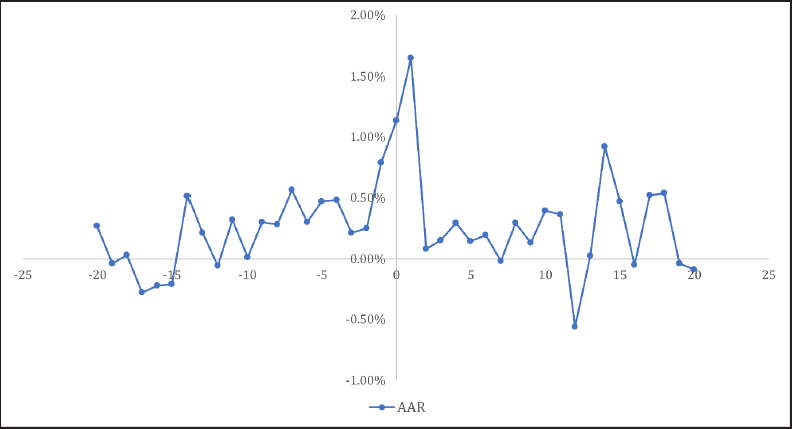
The results indicate that both companies and investors have benefitted with share repurchase announcements in terms of abnormal returns for investors. From the AAR values in Table 2, we corroborate that announcement has generated abnormal returns for shareholders. On the public announcement day of buyback itself, investors have gained positive 1.13% abnormal returns, but it is not significant enough. However, positive cumulative 3.57% returns are present on the day before and after the announcement, which depicts the positive reaction towards share repurchase announcement and it is statistically significant. Therefore, it is clear from Table 2 that the 1% level of significance does not rule out the hypothesis (H1) that on the day of announcement, IPO firms shareholders receive abnormal returns. But both the parametric and non-parametric tests reveal on day 1 that the abnormal returns are significant at 1%. The possible explanation can be that the IPO firms tend to be new and small firms due to which they are more prone to suffer from information asymmetry. Thus, market responded strongly after the repurchases announcement when it comes from the newly listed firms. The CAAR yielded 10.69% with a respective p value of less than .01 during the entire event window, which is statistically significant at 1% and resilient for multiple test outcomes. Thus, hypothesis (H2) stands accepted, as there are significant cumulative AARs for IPO firms during the event window.
In Table 2, the trend of AAR does reveal pattern of positive returns in pre or post announcement period. On announcement day, the returns are positive with 1.13% but not significant enough. Also, the standard deviation during the event window varies significantly across the period, and on the announcement day, it is as high as 6.05% that does indicate high volatility. Such market response can be because IPO firms are new firms, and if any such information is made public by them, then the market reacts strongly to it. In the pre-event period, announcement returns on day -5 before the event day are significant at 10%; for such effect, insiders buying could be the possible reason. In post announcement period, the abnormal returns were not statistically significant enough except on day 1 and day 14. This is the peculiar finding of results that on day 14 in post-announcement period, the abnormal returns are statistically significant at 1%, and the probable reason can be the opening of buyback offer that is when some companies may have actually started acquiring their shares. From sample companies, few have started acquiring their share after two weeks of their public announcement date and this can be the reason behind such effect.
It is plausible to believe that share repurchase announcements result in significant short-term wealth creation for shareholders the day after the announcement based on the statistics in Table 2. Furthermore, Figure 2 graphically depicts the AAR values for each day of the event window over a 20-year period (2000–2019). It displays the AAR trend and substantiates our conclusions. Abnormal returns post the event day are more than pre-event day. Before the day 14 in post announcement period, sudden sharp decline has been seen before the jump in abnormal return. The reason behind it could be actual buying back activity of firms, which further boosted the price of share.
Further, Figure 3 shows the rising pattern of CAAR over the event window. It means that if the investor holds stock for the entire period, then they gain significantly. Also, if shareholders are able to time the market and anticipate announcement of such event, then they can buy the stock before and sell after the event to earn abnormal returns.
CAAR for (-20,20) Interval of Indian IPO Firms, 2000–2019.
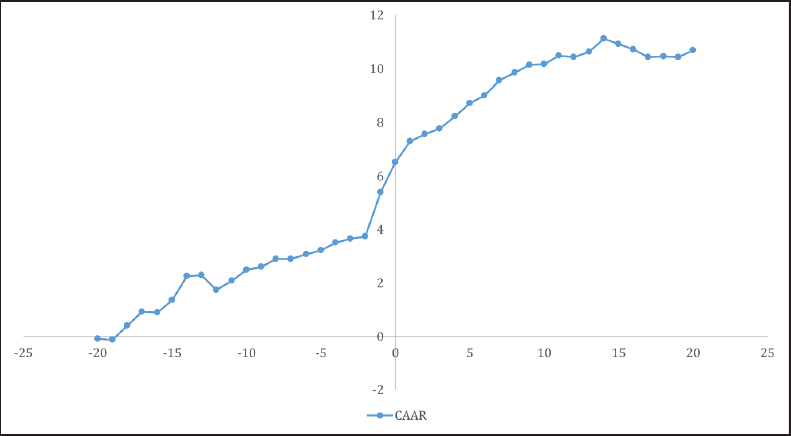
To better comprehend the impact of buyback on stock returns, small event windows are created. Table 3 presents the CAAR values with respective test results around the announcement day. To minutely evaluate the announcement impact and to study how the information seeps in market, we created short event windows around the announcement of (-1,1), (-3, 3), (-5,5), (-10, 10), (-15, 15) and (-20, 20). The smallest window (-1, 1) showed CAAR of 3.57%, which is found to be statistically significant at 1%, 5% and 10%, respectively. According to the parametric statistics, that is, Csec-t, Patell test and BMP test, CAAR values within all windows are observed to be significant at 1%, 5% and 10%. In case of non-parametric test, generalized-sign test has observed to be significant like the parametric test. But the rank test has found to be significant in the shortest period of (-1,1) and (-3,3) days. As reported (Cowan, 1992; Kolari & Pynnonen, 2011), rank test is powerful for single days event windows, whereas for longer duration, sign test holds more power. Thus, in above results, we conclude all the event windows’ CAAR values are significant and generate wealth for shareholders. Sudden rise in abnormal return begins from day before the event and rises significantly on the day after the event showing the market did not discount the information before and it keeps growing until the sudden sharp decline before the opening of offer and then rises again.
Conclusion
Share repurchase is an important payout policy of the firm that many times companies use to signal undervaluation in the market and correct its mispricing. Also, if it is not undervalued, then it may not generate abnormal return. This phenomenon is widely studied across for established firms. However, no focus was given to newly listed firms. These IPO firms are considered to remain undervalued for a long duration, as there is more information asymmetry for them. Thus, if they announce share repurchase on pretext of undervaluation, then they must be able to generate abnormal returns. Extant of literature on payout policy of IPO firms is limited to dividend payout. And this subject is still understudied in the context of IPO enterprises with no focused research on the wealth effects of buybacks on shareholders. This study has attempted to fill this gap in literature by examining the wealth effects of buyback by IPO firms to shareholders in short duration in Indian stock market. The entire data of IPO firms, which announced buyback within 5 years, is used in the present study. For the same, event study methodology with multiple significance tool is employed to obtain the robust findings. First, the abnormal returns around buyback announcements and cumulative returns are investigated to examine collectively the announcement effect during the multiple event windows.
Our empirical results indicate that announcement effects are significantly positive in 41 days event window with 10.69% of cumulative returns. These findings are consistent with existing studies (Bessler et al., 2014), which indicated that IPO firm’s announcement in Germany is perceived as an important information by investors. The findings suggest that the signalling effect of announcement by IPO firms does hold true because abnormal returns are generated after share repurchase announcement even though it is for a very short duration. As the firms’ experiences rise in stock price a day after the announcement, this signals the presence of information asymmetry from IPO firms. These findings differ from the existing studies in Indian context of share repurchase wherein (Chatterjee & Mukherjee, 2015) found negative abnormal returns in pre and post announcement period. Our findings somewhat coincide with (Mukherjee & Chatterjee, 2019) wherein abnormal returns suddenly decline after the announcement but then gradually improve. However, in the current study, significant returns are also identified 2 weeks after the announcement. And the reason for this can be some companies may have actually started their buying back process after announcing share repurchase during those days. This is an important finding of our study.
The following are some of the ways in which the article adds to the literature: There have been minimal studies about share repurchase impact by IPO firms in creating wealth for the shareholders. The previous literature does only talk about motives behind the policy in developed countries. This article fills the gap by considering Indian IPO firms for developing economies sample. This study also considers longer duration of study, which none of the similar studies have done so far. This study created a small window to minutely capture the announcement impact unlike the previous ones.
The limitation of our study is that it captures only short-term effect of announcement for a period 41 days beginning from 20 days before and 20 days after the event. Thus, for future studies, timespan can be increased and long-term effects can be explored along with probable reasons behind the choice of payout method of IPO firms. Since the study is solely applicable to India only, it can be expanded to cover other developing countries in order to generalize the findings. Also, another important limitation can be that segregation of tender offer and OMR is not incorporated, as the prior studies have shown evidence that tender offer gives stronger undervaluation signal than open market offers (Kumar Jena et al., 2020) in short term. This can be investigated in future. Beside this, other hypothesis associated with share repurchase can also be tested along with undervaluation to better understand why IPO companies go for buyback and find out the more suitable reason behind buyback choice.
The findings will be useful for the IPO firms if they are initiating repurchase within few years of their listing, keeping in view, the results and analysis presented here. Investors as well will get the better understanding of the behaviour of price around such announcements. So, they can decide and design their investment decision accordingly and can better exploit the publicly available information. Corporate managers may also consider these results before initiating their payout choice. This study is a major contribution to IPO buyback literature with the only study in emerging economy from Indian perspective. This creates a baseline in the direction of investigating buyback in IPO firms and provides the fundamentals to explore it in other dimensions.
Footnotes
Acknowledgement
The authors are grateful to the journal’s anonymous referees for their beneficial suggestions to improve the quality of the article. Usual disclaimers apply.
Declaration of Conflicting Interests
The authors declared that this study has no conflict of interest.
Funding
The authors have not received any financial support to conduct this research.
