



Abstract
This study explores the relationship between LinkedIn ESG-related activities of CEOs and the stock market performance of their respective companies. The study analyses data of CEOs of listed SMEs on Euronext Growth Milan and their LinkedIn activity, along with their company’s performance. In particular, this study focuses on the diffusion of ESG topic-related contents during the COVID-19 pandemic on LinkedIn using a sample of approximately 37 thousand activities and more than 2 million words examined. Clustering the sample of SMEs in n.2 groups by stock performance with k-means method, we applied textual analysis to identify LinkedIn contents containing ESG topic-related contents. The study found a significant and positive correlation between CEOs’ ESG-related LinkedIn and their company’s stock market performance. Results show that CEOs of best performing SMEs share a higher volume of ESG contents and they suggest a role of LinkedIn in ESG information dissemination on financial markets.
Introduction
LinkedIn is a social networking platform that allows professionals to connect with each other, create and share content, and build their personal brand. In recent years, LinkedIn has become a popular platform for CEOs to engage with their stakeholders, including employees, investors, customers and the media.
This study aims to investigate the relationship between the LinkedIn activities of CEOs and the stock market performance of their respective companies. The study focuses on CEOs of Euronext Growth Milan listed companies, as they are the fast-growing firms well-known and publicly traded companies in the market. Recent studies show that the dissemination of news and financial information through social networks can influence investor perception and the impact of news on investor perception also depends on the topic of the news (Khan et al., 2022). It has been demonstrated that information in the form of earnings surprises, and noise in the form of transitory stock returns, are transmitted across social networks (Al Guindy & Riordan, 2019).
Therefore, the diffusion of contents through social network may have significant implications on the market, especially when contents are produced of shared by firm leaders, such CEOs are.
Examining the diffusion of contents related to ESG topic on LinkedIn, this study shows that higher level of ESG communication made by CEOs on LinkedIn is associated with a higher stock market return during the COVID-19 period. According with previous literature, investors trust on internet stock messages to obtain financial news (Antweiler & Frank, 2004); they use internet search engines such as Google (Da et al., 2011), and are influenced by CEOs reputation (Jian & Lee, 2011). In addition, CEOs’ communication on social is crucial to deliver financial information media (Koehn & Goranova, 2018). Furthermore, firm performance is influenced by CEOs’ public communications (Acharya et al., 2019). The presence of leaders on social network offers a more prominent way of outreach important information, approach, communicate and collaborate with stakeholders (Heavey et al., 2020), and there are several practical implications for CEOs who enhance their online social profiles disseminating information about firms (Huang & Yeo, 2018).
Our research on CEOs’ LinkedIn ESG-related activities and their impact on company stock market performance makes a significant contribution to the existing literature in several ways. First, while prior studies have focused on other social network platforms such as Twitter or Facebook, or traditional ESG disclosure channels such as corporate reports and websites, our study specifically examines LinkedIn, which is a rapidly growing platform for professional networking and information sharing. This novel approach allows us to capture ESG-related activities of CEOs and explore their potential influence on stock market performance. Second, our research goes beyond mere observation of correlations by employing econometric techniques to establish a positive relationship between CEOs’ LinkedIn ESG activities and stock market performance. We provided a qualitative analysis of contents that increases the credibility of our findings and extends the current understanding of the link between CEOs’ social media online engagement and financial outcomes. Finally, by emphasizing the role of CEOs in driving ESG-related activities on LinkedIn, our study sheds light on the importance of individual leadership and personal branding in shaping corporate sustainability efforts. This perspective expands the current discourse on ESG and provides valuable insights for both practitioners and scholars interested in understanding the dynamics of online engagement and its impact on firm performance. In sum, our research contributes to the existing literature by introducing a novel platform, employing robust analytical techniques, and highlighting the significance of CEO involvement in the context of LinkedIn ESG activities.
To demonstrate that CEOs’ ESG-communication on LinkedIn is relevant in financial markets, in this research we used a dataset of approximately 37 thousand activities, and we analysed more than 2 million words, studying interactions made by CEOs of listed firms on their LinkedIn profiles, during the COVID-19 pandemic (December 2020–December 2021). Using textual analysis, we then identified contents related to ESG topic. Empirical results, according with previous
literature, suggest CEOs’ of best performing SMEs on the stock market share more ESG-related social media contents. The contribution of this study is demonstrating that CEOs of best performing stocks on the market make more activities on LinkedIn related to ESG topics, and this aspect should lead practitioner to improve their communication in this direction. A second contribution of this study is represented by the analysis of LinkedIn data, a social network rarely analysed in literature.
Data and Methodology
Data Collection
This study is based on LinkedIn activities made by CEOs of SMEs listed on Euronext Growth Milan. Data include number of followers, number of activities, post text and number of reactions.
The choice of Italian SMEs as a sample for our research during the COVID-19 pandemic is particularly fitting for several reasons. First, Italy was one of the first countries to implement a strict nationwide lockdown in response to the pandemic. This unprecedented measure led to a significant increase in remote work and digital communication across various sectors, including business. The enforced lockdown provided a unique context where CEOs and companies had to rely heavily on digital platforms for communication and engagement. This makes the analysis of CEOs’ LinkedIn ESG activities during this period particularly relevant and insightful. Second, the Italian economy is predominantly composed of small and medium-sized enterprises (SMEs). These SMEs play a vital role in the country’s economic landscape, representing a substantial portion of businesses across different sectors. By focusing on Italian SMEs, we capture a significant portion of the business ecosystem and gain insights into the specific challenges, strategies and outcomes of these key players during the COVID-19 pandemic. This sample provides a more representative understanding of the overall business landscape, as SMEs often have distinct characteristics, resource constraints and operational dynamics compared to larger corporations. By considering the Italian SMEs sample during the COVID-19 pandemic, we take advantage of the unique context created by the early lockdown measures and the dominance of SMEs in the Italian economy. This allows us to explore the impact of CEOs’ LinkedIn ESG activities in a setting where digital communication became essential and where SMEs played a pivotal role. The findings derived from this context can contribute valuable insights and serve as a relevant reference point for other regions and industries facing similar circumstances.
Firms are clustered with k-means method based on stocks performance: clustering methodology in financial markets is well acknowledged in literature (Marti et al., 2021). K-means clustering is a widely used method that aims to partition a dataset into distinct groups or clusters based on their similarities. In the context of our research, we employed the k-means clustering method to categorize firms into two clusters based on their stock performance. The first step in this process is to select the appropriate variables for clustering. In our case, we considered the stock performance as the primary variables. The k-means algorithm then iteratively assigns each observation (in this case, each firm) to one of the clusters by minimizing the within-cluster sum of squares. It starts by randomly selecting a predefined number of cluster centres, which act as the initial centroids. Next, it calculates the Euclidean distance between each observation and the centroids and assigns the observations to the cluster with the nearest centroid. This assignment is updated iteratively until the centroids stabilize, and the clusters become well-defined. By applying the k-means algorithm to our dataset of firms, we were able to create two clusters: one representing firms with positive stock performance and another representing firms with negative stock performance. The advantage of using the k-means clustering method lies in its simplicity and interpretability. It provides a straightforward approach to segmenting data and allows us to identify meaningful patterns within the dataset. By categorizing firms into distinct clusters, we can gain insights into the relationship between CEOs’ LinkedIn ESG activities and stock market performance, ultimately contributing to our research objectives.
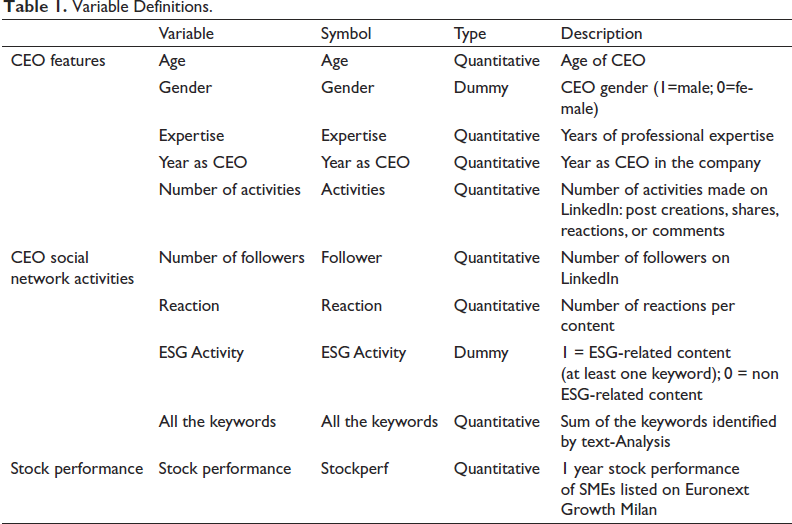
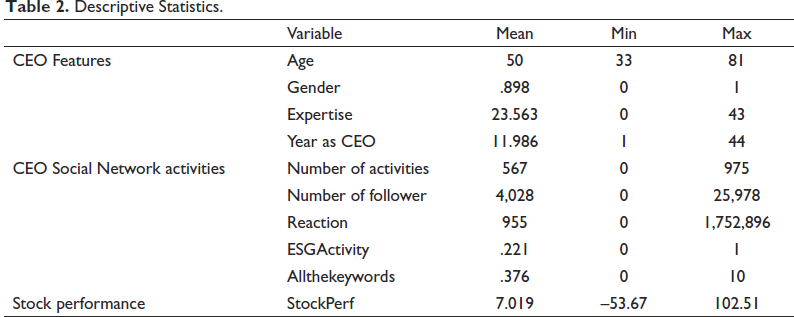
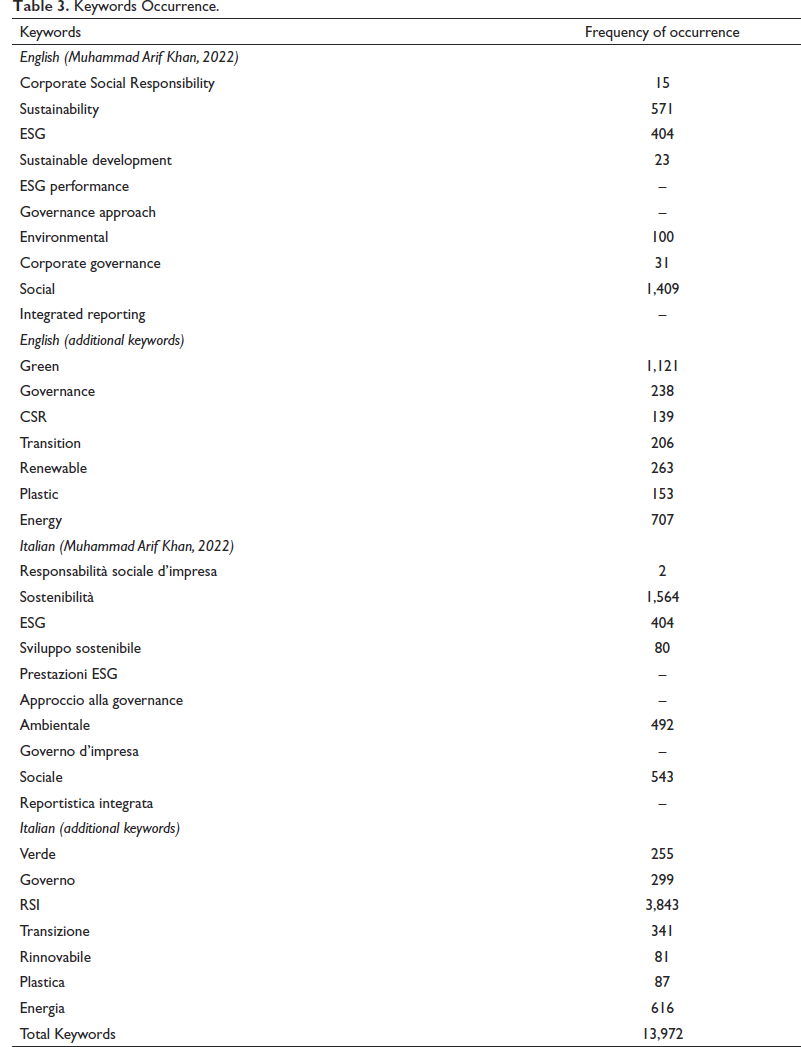
We then used statistical analysis to verify if exists a significant correlation between the LinkedIn activities of CEOs and their company’s stock market performance. Data used in this study contains publicly available LinkedIn posts about CEOs of firms listed on the Euronext Growth Milan market for the period from December 2020 to December 2021, therefore, during the Covid-19 pandemic. The dataset contains all the activities made by CEOs on LinkedIn (likes, posts, shares and comments). A total of 141 firms with more than 37,000 activities detected and more than 2,200,000 words are finally analysed. Posts collected and their texts represent all the (publicly available) discussions about ESG topics for each CEO in the sample. ‘ESG’ stands for Environmental, Social and Governance. It is a framework used to evaluate a company’s performance and impact in these three key areas. The term ‘ESG’ has gained significant prominence in recent years as investors, stakeholders and society at large have recognized the importance of sustainable and responsible business practices. The ‘E’ in ESG refers to environmental factors, such as a company’s carbon emissions, energy efficiency, waste management and commitment to mitigating environmental risks. The ‘S’ represents social factors, including issues related to employee welfare, diversity and inclusion, human rights, community engagement and customer satisfaction. The ‘G’ stands for governance, which encompasses factors such as board composition, executive compensation, shareholder rights, transparency and adherence to ethical business practices. ESG has become a crucial consideration for investors looking to assess a company’s long-term sustainability and its ability to manage risks and seize opportunities. By evaluating a company’s performance across these three dimensions, investors can gain insights into the company’s overall impact on the environment, society and its governance structure. In our study, we examine the LinkedIn ESG-related activities of CEOs, which refers to the specific actions and engagements related to ESG issues that CEOs undertake on the professional networking platform LinkedIn. This includes activities such as sharing articles, posting updates, participating in ESG-related discussions, promoting sustainability initiatives and showcasing the company’s ESG efforts. As LinkedIn do not provide any Application Programming Interface (API), the database represents one of few on which scientific study are currently based on. Using textual analysis, we labelled contents as ‘ESG content’ if they contain at least one the following keywords: Corporate Social Responsibility, Sustainability, ESG, Sustainable development, ESG performance, Governance approach, Environmental, Corporate governance, Social, Integrated reporting (Muhammad Arif Khan, 2022). To have a more comprehensive analysis, we have analysed text using the following additional keywords: Green, Governance, CSR, transition, renewable, plastic, energy. Each keyword has been searched also in Italian language due to nationality of CEOs in the sample. The full list of the words used, also in Italian language, is shown in Table 3. Table 1 shows a summary of all LinkedIn interactions variables, as well as statistics about posts related to ESG topics. The variables are presented at CEOs LinkedIn profiles level.
Variable Definitions.
Descriptive Statistics.
Keywords Occurrence.
Econometrical Approach
In order to pursue the goal of this research, we adopt to treat the data both cluster analysis and linear regression. The firm sample is clustered in no. 2 group based on stock performance using k-means method on STATA (Makles, 2012), which performs the cluster analysis based on Euclidian distances. The k-means clustering method led to the creation of Group 1 (n.72 firms—51.06% of the sample) composed by firms with a negative stock performance and of Group 2 (n.69 firms—48.94% of the sample) composed by firms with a positive stock performance.
We then run a text analysis following the suggestion provided by Stone et al. (1966). Contents have been defined as ‘ESG content’ or ‘non-ESG content’ depending on the presence of at least one ESG keywords shown in Table 3. A value of 1 means that a post contains at least one ESG-keyword while a value of 0 means that the post does not contain any keyword and then is classified as a non-ESG content. We also provide the absolute number of keywords in each content and the absolute value of the total keyword analysed for each Group.
Results
More than 54% of activities on LinkedIn are made by CEOs of firms in Group 2 while only 45.61% of activities are made by CEOs of firms in Group 1. CEOs of firms in Group 2 have a higher number of followers on LinkedIn in comparison with their peers of firms in Group 1. CEOs of firms in Group 2 have a higher number of activities on ESG-related topic (n. 4,545 activities—55.50%) on LinkedIn in comparison with their peers of firms in Group 1 (n. 3,644 activities—44.50%). For CEOs of firms in Group 2, ESG-related activities represent 23.52% (n. 4,545/19,463) of the total activities made on LinkedIn, while for CEOs in Group 1 ESG-related activities represent only 20.63% (n. 3,644/17,663).
On average, 22% of activities made by CEOs if referring to ESG topics. CEOs of Group 2 have a higher number of activities related to ESG topics in comparison with their peers in Group 1 (23.35% vs 20.63%).
In addition, the overall presence of the keywords analysed is higher in the LinkedIn activities made by CEOs of firms in Group 2 (39.30% vs 35.62%).
Table 4 shows that there exists a significant positive correlation between ESG activities and stock performance. In addition, also the presence of all the keywords is significantly associated with a positive performance.
Pairwise Correlation on ESG.

Table 5 shows that there exists a positive relationship between the presence of the ESG keywords and CEOs’ age and gender, while the relationship is negligible with the years of expertise and the yeas as CEO in the firms.
Linear Regression.
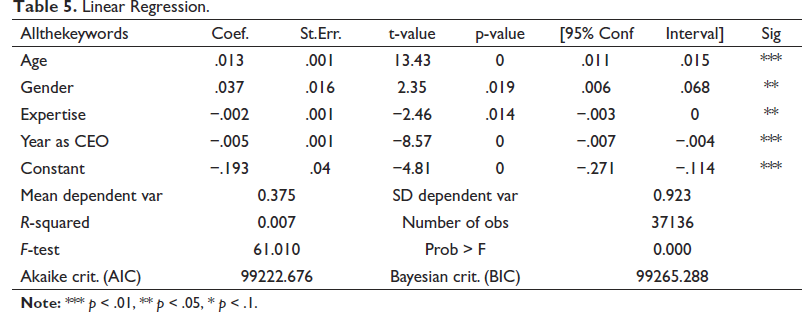
Table 6 shows that there exists a significant positive correlation between the number of CEOs’ followers and stock performance while the reaction level on each content interacted by CEOs is not relevant.
Pairwise Correlations on LinkedIn Variables.
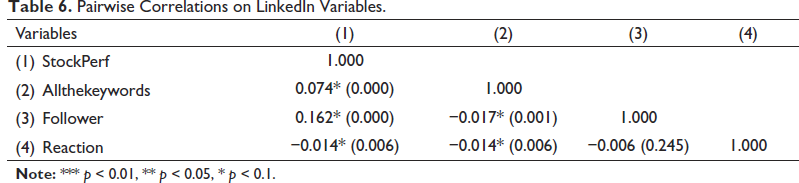
Those results, in line with previous literature, suggest that CEOs’ communication on social media is associated with higher value for their companies in term of stock market performance. In particular, this study focuses on LinkedIn, a social network not yet deeply analysed in literature due to the absence of API, and it represents a contribution to social media communication as its empirical results show that CEOs of Group 2 (best performing stocks) use LinkedIn more than their peers of Group 1 (worst performing stocks) to communicate ESG topics to their stakeholders to build trust, credibility and value.
The observation that CEOs of best performing SMEs share a higher volume of ESG contents on LinkedIn suggests the existence of underlying mechanisms that contribute to this correlation. Several factors could potentially explain this phenomenon. First, it is possible that CEOs of best performing SMEs possess a stronger commitment to sustainability and responsible business practices. These CEOs may recognize the long-term value of incorporating ESG considerations into their company’s strategy and operations. Consequently, they actively engage in sharing ESG-related content on LinkedIn as a means of communicating their commitment to stakeholders, including investors, customers and employees. By highlighting their ESG efforts, these CEOs can enhance their company’s reputation and attract socially conscious investors, leading to improved stock market performance. Second, the higher volume of ESG content shared by CEOs of best performing SMEs could indicate a proactive approach to stakeholder engagement. These CEOs may recognize LinkedIn as a platform that allows them to directly connect with a wide range of stakeholders, including potential investors, industry peers and thought leaders. By sharing ESG-related content, they demonstrate transparency and openness, fostering trust and credibility among stakeholders. This enhanced stakeholder engagement can result in increased investor confidence and support, positively influencing the company’s stock market performance. Furthermore, the act of sharing ESG content on LinkedIn may also facilitate knowledge sharing and networking opportunities. CEOs of best performing SMEs may actively participate in ESG-related discussions, exchange ideas and learn from others in the field. This exposure to diverse perspectives and insights can enable CEOs to refine their own ESG strategies, leading to improved business practices and, consequently, better stock market performance. It is worth noting that these potential mechanisms are speculative and require further investigation. Future research could delve deeper into the motivations and strategies behind CEOs’ LinkedIn ESG content sharing, conduct qualitative interviews or surveys with CEOs to gain insights into their decision-making processes, and explore the impact of different types of ESG content on stock market performance. By exploring these mechanisms, we can gain a richer understanding of why CEOs of best performing SMEs engage in higher volumes of ESG content sharing and further elucidate the relationship between LinkedIn ESG activities and stock market performance.
This study has implications for CEOs who wants to manage their LinkedIn communication channel and has implications for investors who can use CEOs’ LinkedIn activities as a proxy for SMEs stock performance. In fact, investors can gain insights into the CEO’s leadership style, industry knowledge and strategic vision by analysing their LinkedIn profiles. This information can also help investors in making more informed investment decisions.
Conclusion
The study suggests that there exists a significant positive correlation between firms stock market performance, (I) the CEOs’ ESG activities on LinkedIn and (II) the number of their follower. On the contrary, it seems to be not so relevant the number of reactions obtained on each activity interacted by CEOs. Results are in line with previous literature: CEOs of best performing firms are more active on social network, and this led us to demonstrate that a higher stock market performance is related to higher level of social media usage, in particular LinkedIn. In addition, this study shows that some personal CEOs’ features, such as age and gender, can play a role on the relationship between ESG topic and firms’ performance, while the professional expertise years and number of years in the firms as CEO seem to be not so relevant in affecting the same relationship.
Furthermore, this study has implications for investors, who can use LinkedIn activity as a proxy for CEO performance and company performance. Overall, the study highlights the importance of social media in the modern business world and underscores the potential benefits of CEOs engaging with their stakeholders on particular topics through social media platforms, like LinkedIn. Further developments of this research can expand the dataset, including different markets or firms’ size, to observe whether and how the cultural environment or companies’ dimension affect CEOs’ LinkedIn ESG communications. Also, in this study we focused Chief Executive Officer of listed SMEs and their LinkedIn profiles, measuring their activities related to ESG contents. Anyway, we did not consider different topics: on this regard, further research can focus on different relevant topics shared during the pandemic period, such as the analysis of contents related to COVID-19 pandemic itself, to understand the relationship between CEOs’ social media communication trend-topics and firms value during the recent crisis. This information would allow to measure if ‘speaking’ about some specific topic is correlated with a higher or lower financial performance. In addition, it would be interesting to explore the types of interactions made by CEOs on LinkedIn.
Footnotes
Declaration of Conflicting Interests
The authors declared no potential conflicts of interest with respect to the research, authorship and/or publication of this article.
Funding
The authors received no financial support for the research, authorship and/or publication of this article.
