




Abstract
The Mauritius Artificial Intelligence Strategy 2018, established by the government, aims at making Artificial Intelligence (AI) a cornerstone of the next development model by recognizing the potential of technology to improve growth, productivity and quality of life. In this regard, AI has already started to shape the legal sector, for instance, by assisting law practitioners to identify and minimize bias in client intake, offer initial consultation solutions, expand the scope of information for law practitioners and predict the outcome of future legal cases, among others. Nevertheless, while the legal profession worldwide is facing pressure to innovate and transform, the emergence of AI is causing significant disruption to long-established practices in the legal world, especially since this particular sector has traditionally under-utilized technology. Consequently, this study seeks to assess the influence of AI on employees from the legal profession mainly in terms of their performance, their reaction, and adaptability to change and to identify the challenges faced by these employees in Mauritius in adopting AI for their operational activities.
Keywords
Introduction
Technological advancements, in particular artificial intelligence (AI), are forcing various sectors to innovate and transform encompassing disciplines such as accounting, law and medicine, among others. The huge importance being attributed by the governments of several countries to the promotion of AI evidences the fact that there will soon be a greater dependency on data analytic tools that may either aid professionals in their work or simply replace them (Moses, 2017). For example, the Mauritius Artificial Intelligence Strategy 2018, established by the government, aims at making AI a cornerstone of the next development model by recognizing the potential of technology to improve growth, productivity and quality of life. In this regard, while the unique personalized services of the legal world tend to give the perception of a small usage of AI and its related impacts in this industry, on the other side, AI is being used to formulate computer models to enable practitioners to input legal issues and thereafter receive the corresponding legal output or advice (Hu & Lu, 2019).
Initially, AI was mainly applied in the legal profession in some non-core areas which direct at enhancing efficiency or reducing expenses through online services and management systems. Nowadays, AI algorithms can interpret human intelligence by collecting, regulating, sorting information and even imitating the process of legal reasoning. Recently, AI has been used to draft and review contracts through the application Lawgeex, to identify the relevant documents from an opponent in a lawsuit via the application developed by CS Disco, to conduct legal research through Westlaw Edge or Quick Check, and even to predict the outcomes of legal cases by resorting to Lex Machina. Some judges are also adopting AI solutions like COMPAS (Correctional Offender Management Profiling for Alternative Sanctions) to seek advice on bail and sentencing decisions. It has also been observed that there is a positive relationship between AI and legal work. For instance, Ross, which is the first AI lawyer developed in 2016, is currently providing its services to an American law firm for the purposes of communicating with lawyers, giving a prior experience of working with future employees, or even dealing with bankruptcy issues.
With such a heightened proportion of the usage of AI in the legal sector, this prompts the question of whether robots and AI will replace fellow human beings who are law experts, or alternatively, if these are being utilized as aiding tools, what will be their impact on employees from the legal profession? While the majority of literature has focused on the benefits and impacts of using AI (Brooks et al., 2020; Hu & Lu, 2019; Moses, 2017), little research has been conducted on investigating the effect of adopting AI on employees, which is where this current study aims to fill the research gap. Consequently, the objectives of this research seek to assess the influence of AI on employees from the legal profession, mainly in terms of their performance, their reaction and adaptability to change, and to identify the challenges faced by these employees in adopting AI for their operational activities. While it will not be feasible to assess the influence of AI on all employees across the globe, this research focuses on jurists from a developing country, Mauritius. This study has selected Mauritius for conducting the survey since it is intended to provide some policy recommendations to the official authorities given that it is an ambition of the government of Mauritius to portray the country as an AI hub. It is, therefore, imperative to investigate the fears and resistance of employees since they are the drivers of change and innovation and, thus, to thereafter recommend the requisite course of action plans. In order to achieve these research objectives, an interview was conducted among employees of the 13 law firms that are duly licensed in Mauritius. One employee from each law firm was approached to conduct an in-depth, semi-structured interview that included managing partners, senior associates, jurists, barristers, attorneys, paralegals and administrative secretaries.
While the first part of the paper has introduced the background of the research and set out the research objectives and methods employed, the second section will discuss some existing literature relating to the influence of AI in the legal profession, and the third section will elaborate on the research design and formulation of interview questions. The fourth section will present the findings of the survey conducted. The fifth part will focus on discussions and recommendations, while the final part will conclude the research.
Literature Review
AI Adoption in the Legal Sector
Several scholars like McCarthy (2007) and Alarie et al. (2018) categorized AI as some form of computer science that generates algorithms capable of detecting and utilizing intelligent human behaviour. However, the interpretation of the term ‘intelligent’ remains debatable even in today’s digitalized era. As such, AI is quite complex to define, although common consensus agrees on its various uses and applications across multiple sectors. Brooks et al. (2020) believe that AI in the legal sector is emerging through machine learning and automation, and this helps law practitioners to identify new methods of value creation for their clients. The authors believe that these facilities enable companies to learn from past experiences and then adapt to their current external environment so as to remain competitive. Moreover, Alarie et al. (2018) mentioned that through the use of AI machine learning tools, lawyers are able to spend less than 5% of their time on the review of documents since these are being catered for by machines, thereby decreasing the dependency on labour-intensive methods. Lawyers can then focus on other core areas of the legal profession where reasoned judgements need to be exercised, an aspect that machines may not necessarily perform with perfection. Therefore, by reducing the time spent on automated tasks, law practitioners can broaden their areas of specialization.
In terms of existing literature on the researched topic, Brooks et al. (2020) conducted an exploratory study among law practitioners based in the UK to investigate the impact and challenges of AI on legal services. Their findings demonstrate that, on the one hand, UK law firms are increasingly being pressurized to adopt new technological methods in order to remain competitive. On the other hand, however, these firms are facing resistance from their employees to adapt to AI-based technologies since this represents a considerable shift from long-established practices. Employees’ resistance is further fuelled by the fear of data security and handling by machines. The authors, nevertheless, concluded their research on a positive note, highlighting that the fears and skill gaps among employees to adopt AI in the legal services sector are difficult but not impossible to overcome. They mentioned that the business model of law firms needs to be changed first so that employees can be supported to resort to new methods of working.
In the same context, Goodman (2019) analysed the impact of AI on law practitioners’ and clients’ relationships in the USA. Four areas of concern were established by this research, which summarized the challenges encountered in lawyers–clients relationship when using AI, and these are the bias involved in the decision-making process, credibility assessments, communication methods, and perceptions of justice and fairness. The author concluded that law practitioners need to be aware of what the profession loses by increasing reliance on AI and suggested that transparency is a key component to gain the trust and confidence of clients when using AI. This transparency requires lawyers to disclose the AI method utilized to reach a legal decision. Additionally, the research also highlighted the importance of having human actors supervise machine learning tools, which is vital to produce fairer outcomes.
Relating to the challenges of AI, Moses (2017) conducted a study among legal professionals to understand the limitations of the use of AI in the decision-making process so as to harness the benefits and reduce the detriments of new AI technologies. A series of notable recommendations were suggested by the author to enable the proper development of AI tools such as lawyers need to have inexpensive access to AI technologies that perform standardized tasks such as drafting and reviewing agreements, conducting due diligence, or even running and settling litigation. The author also suggested that lawyers need to be taught new skills such that, in the future, they will be able to assist in designing new technology-enabled legal solutions. This recommendation has also been suggested by Hu and Lu (2019), who explained the importance of law education for the development of AI in the legal profession. Fundamentally, the case of having robot lawyers was established by these researchers in order to enable the less well-off members of society and small and medium enterprises to avail of legal services at a low cost instead of having to resort to expensive legal solutions provided by law firms or legal experts. Hence, to adapt to this new era of AI, law practitioners need to obtain an understanding of algorithms at the university level and then follow continuous development programmes on AI once these students enter the legal profession. Consequently, interdisciplinary training is required to encompass both legal and computer science dimensions, and for this purpose, Hu and Lu (2019) recommended that legal educators have to primarily renew and update their knowledge reserve so as to train students in both law and technology.
AI Impact on Ethics and Regulations in the Legal Sector
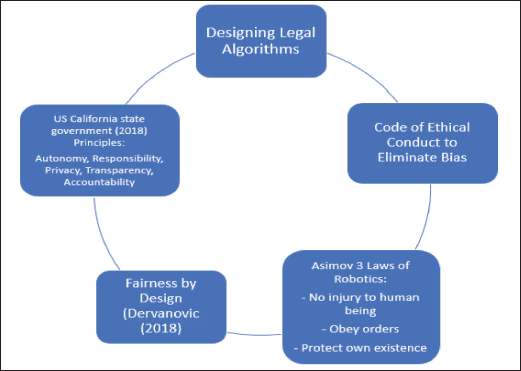
Undeniably, to come up with AI-based legal systems, Dervanovic (2018) rightly mentioned that the law has to be translated to an algorithm, and in this process, several challenges may arise with respect to the linguistic aspects of such translation. One recurring question that is still left unattended is whether we can create AI lawyers while simultaneously codifying their ethical conduct.
In fact, AI refers to the application of machine-based solutions that are able to act autonomously while having the ability to imitate human reasoning. However, if a system is designed with the view of discriminating against people from any demographic, be it in terms of gender, race, religion or otherwise, then the situation will simply become out of control, leading to chaotic and perhaps irremediable circumstances. As such, it becomes necessary to introduce ethical rules to regulate the functioning of such technologies. In this respect, Dervanovic (2018) suggested that Asimov’s Three Laws of Robotics are helpful to create transparent and objective AI legal-based technologies. These refer to the principles that a robot must not injure a human being, it must obey orders and it must protect its own existence. However, the author also recommends that the legal profession needs to be redefined in its entirety to render legal advice and justice more accessible to all.
Moreover, Dervanovic (2018) advocates for the adoption of Fairness by Design for machine creators to establish algorithms that will not discriminate or negatively impact any member of the society. This practice is specifically relevant for members of the legal sector since a lawyer is trained to employ ethics and morals in their normal course of professional activities. For this purpose, a 2018 Commission instituted by the US California state government identified five dimensions to consider mainly autonomy, responsibility, privacy, transparency and accountability (Little Hoover Commission on AI, 2018). This Commission then provided four suggestions to enhance the reliability of AI legal-based technologies: (a) add diversity to data sets, (b) diversify knowledge and design teams, (c) train lawyers to understand and apply AI tools and their respective limitations, and (d) increase the collaboration between lawyers and software engineers to shape machine learning to maximize outcomes in justice.
One area of law which is gaining heightened importance is international arbitration, and AI involvement in this sector involves the appointment of arbitrators, legal research and drafting, hearing arrangements, and drafting of standard sections of awards, among others. In this light, Scherer (2019) published research that focused on the core arbitral process, which is decision-making itself. The author suggests that most AI models are based on information extracted from previous data input, and they are thus likely to follow conservative approaches since they are not adapted to deal with policy changes over time. It follows that if AI models are structured only on algorithmic objectivity and infallibility, they will perpetuate existing biases. Consequently, the researcher emphasized the need for reasoned decisions when training AI machines, since this may have considerable implications for judicial decision-making.
On similar lines, Nunez (2017) sought to assess whether AI lawyers can make ethical decisions by focusing specifically on the functioning and programming of Ross, the first US AI lawyer. While US lawyers are bound by the American Bar Association’s Model Rules of Professional Conduct, the author investigated how Ross applied these principles, and the findings reveal that this AI lawyer was indeed able to determine and assess the language of the applicable rules and the non-observance of legal rules by collecting exact passages from cases that answered the questions asked. However, it still remains difficult for a machine to develop a professional role that is unique based on an individual’s morals. The question of defining morals is a subjective one and, in this case, the individual lawyer may train an AI legal-based machine to use professional and moral judgement that is consistent with what this human lawyer perceives to be ethical. As such, there is still a degree of objective human quality that Ross is not yet equipped with, and according to Nunez (2017), there is no risk of attorneys being replaced by AI yet.
While the above-mentioned researchers have focused on the emergence and importance of AI and its impact on ethics and regulations in the legal profession and have set out recommendations to foster an environment conducive to the adoption of AI, no research has been conducted yet on the impact of AI on employees in the legal profession, especially in the context of developing countries where the application of AI is still at an infancy stage. Consequently, this current study aims at filling in this research gap by investigating how law practitioners in Mauritius are impacted by the use of AI tools. Accordingly, the theoretical model established in this section is used to investigate the subject matter of the research in the context of the Mauritian legal sector. An illustration of this model is provided in Figure 1:
Theoretical Framework for the Design of Legal Algorithms.
Research Design
Currently, there are 13 law firms that are duly licensed and based in Mauritius, and they are involved in almost all areas of the legal profession, including inter alia litigation, arbitration, commercial transactions, financial services and real estate legal assistance, amongst others. It was contemplated to conduct an in-depth, semi-structured interview with one personnel from each law firm that included managing partners, senior associates, jurists, barristers, attorneys and paralegals. The contact details of each law firm were found on their respective websites, and an email was sent to the main contact requesting an interview at a specified date and time with an employee. The email request was accompanied by an explanation of the purposes of the study, a confidentiality statement and an informed consent paragraph.
In drafting the interview questions, it is important to mention that the questions were formulated based on the existing literature mentioned in the second section of this paper and taken from the studies conducted by McCarthy (2007), Alarie et al. (2018), Goodman (2019), Hu and Lu (2019), and Brooks et al. (2020). Eleven questions were designed with the view of addressing the five scopes of this existing research: the first dimension concerns investigating the understanding of AI legal technologies, the second one questions the use of AI tools in assisting law practitioners with legal work, the third one asks the employee’s views on the adoption of AI technologies, the fourth one is on the barriers that impede the adoption of AI tools, and the fifth one looks for recommendations to make the legal profession more versatile with the use of AI technologies.
Research Findings
Profile of Respondents
The interviews were conducted between November 2022 and mid-February 2023, and although a physical meeting was requested, 10 of the 13 respondents responded by requesting an online meeting at the scheduled time. This did not appear to be problematic to the researchers, and hence, the online interviews with the 10 participants were proceeded with. The profiles of the employees that responded to the survey are set out in Table 1.
Profile of Respondents.
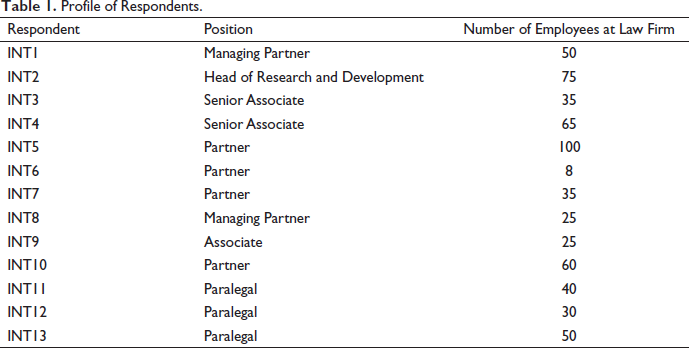
Table 1 illustrates the position of each employee of the targeted law firms, and due to the personalized nature of legal services, these organizations employ a small number of individuals ranging from 25 to 100 employees. The interviews started with questions that established the context of the researched topic and, more precisely, on the use of AI in providing legal services.
Analysis of Interview Results
The diversity of various categories of employees at the targeted law firms, coupled with their substantive years of experience, ensured that the study captured the views on AI adoption and its impact on employment at different levels of the legal sector. The interviews followed an interview guide developed from the theoretical framework established in Literature Review section, which encompasses five main dimensions: understanding, uses, adoption, challenges and perception of AI. The researchers had handwritten each interview in order to facilitate the analysis, and the transcripts were carefully scrutinized to summarize the findings with the aim of understanding the impact of the adoption of AI on the legal sector in Mauritius.
The interviews started with a basic question that sought to establish the context of the research and the role of technology in today’s businesses. This was followed by specific questions that concerned some technical jargon and the existing use of technology in Mauritian law firms. Additionally, the perception of employees was investigated in terms of whether AI is seen as either a threat or a helping tool in their day-to-day services. This helped the researchers figure out if law practitioners in Mauritius are willing to adopt AI in the delivery of their services. Thereafter, some other questions surrounded the barriers to the adoption of AI in terms of both internal and external challenges, and the last few questions focused on how AI impacts clients’ relationships, the perceived risks of resorting to new technologies and the type of support needed to encourage the adoption of AI by the legal sector in Mauritius.
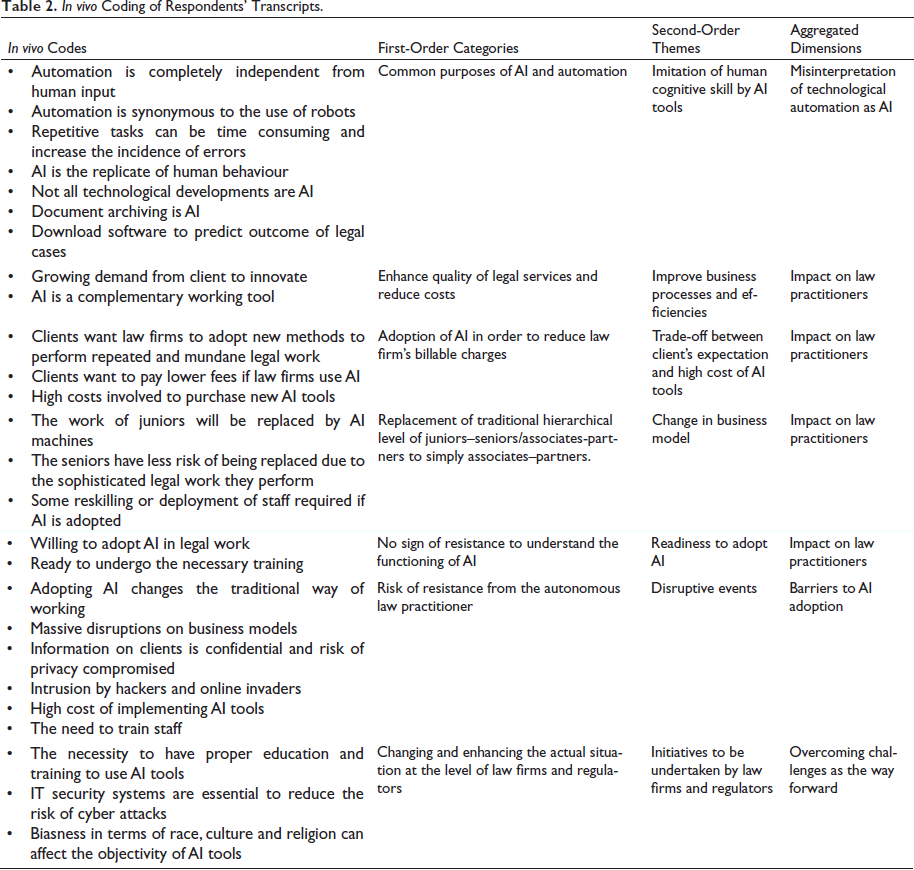
Following the interview, the transcripts were scrutinized to categorize and identify themes using the inductive method. That is, the interview data were compared among the responses obtained for the purpose of identifying and gathering conceptual similarities, patterns and themes. Consequently, the initial data sets were grouped by the understanding and adoption of AI in Mauritius in the legal sector; the second data sets were classified by the impact of AI on law practitioners; and the final data sets were categorized by the barriers to AI adoption and recommendations from employees of the legal sector to implement AI in an efficient manner. As such, the interview findings provide a comprehensive landscape of the emergence of AI in the legal industry of Mauritius and its impact on employees in the legal sector. The identification of in vivo codes, categorization of themes and aggregated dimensions are illustrated in Table 2.
In vivo Coding of Respondents’ Transcripts.
Differentiating AI and Automation
Although AI and automation are two terms that are often used interchangeably due to their common purposes, several scholars, such as Ribeiro et al. (2021), van der Aalst et al. (2018) and Anguirre and Rodriguez (2017), have highlighted the main nuances between these two terms. Fundamentally, automation is completely independent from human input since it involves the setting up of robots to follow a pre-defined set of rules, whereas AI is the use of empowered robots through human intervention to make decisions. In fact, both AI and automation help businesses work towards the main goal of achieving smart and efficient functioning, but the essence of automation is to exempt humans from performing highly repetitive tasks that are time consuming and where the risk of errors is heightened (Azad et al., 2018). To this effect, a study conducted by Iqbal and Idrees (2022) sought to assess the reasons behind the adoption of automation in Pakistan using the UTAUT2 (Unified Theory of Acceptance and Use of Technology) theory. The findings revealed that enhanced performance, facilitating conditions, price value and social influence are the main drivers of automation adoption.
On the other side, AI is designed in a manner that imitates human behaviour at an intellectual level by performing tasks that it has learned and been trained for. AI differs from automation in the sense that once it is programmed, the user interface learns from and acts on its past experiences instead of simply relying on algorithms. However, although it is called ‘intelligent’, the intelligence is still narrow due to the machine’s restricted ability to apply knowledge within a specific area and is not empowered to go beyond that (Baishya & Samalia, 2019). In this light, one study conducted by Roy et al. (2020) sought to analyse the factors that motivate customers in the Indian tourism and hospitality industries to use AI devices. The results found that customers go through three stages of decision-making in demonstrating their willingness to use AI, and the influencing factors are social encouragement, hedonic motivation, performance expectancy and emotion.
The findings of these existing studies prompted the researchers to investigate the interviewees’ understanding of automation and AI. Upon being asked about the usage of AI by law practitioners, three interviewees provide clarification on what represents AI in the legal sector. One of them (INT2) avers that automation, such as document sorting and archiving, is a fundamental technological adoption by almost all law practitioners since it is simple and quick to organize but he does not term this technology as AI. Interestingly, INT6 further mentions that AI corresponds to either machine learning, language processing tools coupled with the involvement of bulky information to perform some human-empowered skills such as interpretation. Similarly, INT9 highlighted that people have the tendency to term all technological innovations as AI since this is a way of marketing, although not all technologies are AI. In summary, these respondents classified AI as things that an individual human being would perform by applying some sort of cognitive skill to the task. Consequently, the findings of this interview reveal that legal practitioners are more inclined to adopt automation due to performance expectancy, which appears to be the most relevant influencing factor for resorting to automation, which corroborates partly the results obtained by Iqbal and Idrees (2022).
The Use of AI by Law Firms in Mauritius
Ten of the 13 interviewees responded in the affirmative upon being asked if they have used AI in providing legal services, and a follow-up question was then asked on the type of AI legal technology-based tool. This further investigation indicated that not all 10 participants have truly grasped the true definition of AI. In particular, some interviewees have confused a simple web search on Mauritian case law judgements as having resorted to an AI tool, while the other participants wrongly admitted that document archiving software is an AI tool.
On the other side, it was noted that only four interviewees have made use of AI legal technology to help them in their legal work. More precisely, two participants (INT3 and INT12) made use of free downloaded software from the Internet to predict the outcomes of their law suits by inputting the documents and evidential claims that they possess. Following these forecasted results, they averred that they were able to enhance and amend the quality of their arguments to secure better chances of winning the law cases. The other two interviewees (INT5 and INT13) highlighted that their respective law firms have recently acquired some specialized software that help in reviewing contracts following the input of a certain amount of basic information.
In the true sense, only 4 of the 13 law practitioners, representing only 31% of the sample population, have resorted to AI legal technology-based tools to assist them in their work, which indicates that the use of AI in the legal sector in Mauritius is considerably low. It has also been noted that law practitioners have a minimal understanding of the term AI since they tend to confuse technological automation with AI, which, in reality, requires the mimicry and usage of human skills encoded in an algorithmic form.
Impact on Law Practitioners
Improvement of Business Processes and Efficiency
A specific question was developed to consider the views and perceptions of employees if their law firms start making extensive and substantive use of AI technology that performs human-skills-related tasks. All the participants confirmed that there is a growing demand from clients to innovate and adopt new technology tools to enhance the quality of legal services and reduce costs. Surprisingly, rather than perceiving AI as human competitors to replace the labour force, two interviewees (INT10 and INT11) highlighted that law practitioners need to implement AI solutions to improve business processes and efficiencies.
Expectation of Clients versus Cost of Adoption of AI
Along the same lines, another interviewee (INT13) emphasized that clients are under pressure not to adopt AI forcefully but rather to look out for different means to perform repeated and mundane legal work at lower costs and more quickly. This is particularly true in the context of law firms that charge billable hours. Thus, clients expect law practitioners to use technology and, in return, to pay lower fees, thereby making it difficult for law firms to justify the billable hours approach. Accordingly, this portrays the growing demand to resort to automation and, in a more advanced manner, to train machines to perform human-enabled tasks. However, one managing partner also mentioned the difficulty in charging clients lower fees when using AI tools since these clients are not acquainted with the high cost involved in adopting new technologies, and he noted that clients are less willing to pay for business-as-usual automated services.
Change in Business Model
The interviews also highlighted that the traditional business model of law firms having one partner responsible for groups of associates and paralegals will become obsolete due to the emergence of AI tools in the legal sector. This is because juniors will no longer be expected to create profitability since this aspect will be catered for by machines, and this may impact adversely on the labour market. Some follow-up questions then explained that those at the top hierarchy level of law firms usually perform some sophisticated type of legal work that cannot be replaced by AI, whereas those in the middle may make use of AI tools to help them improve their efficiency. On the other side, employees at the bottom of the hierarchical level usually carry out standardized work that can easily be taken over by AI solutions. This will then require some reskilling or deployment of staff so as to avoid massive termination of employment contracts. Consequently, the interviewees believe that AI is more disruptive for small law firms that do a lot of bulk volume work but less disruptive for those who perform sophistical legal work where machines cannot replace humans. The use of AI legal technology also implies that the pyramidal hierarchy of law firms will be replaced by a more linear one with only partners and associates. The associates’ scope of work will be significantly reduced since their job is being performed by machines, but they will need to look for alternative revenue streams to compensate for the expected decreases in hourly fees.
Readiness to Adopt AI
It is also apposite to note that all 13 interviewees have responded in the affirmative upon being asked if they are ready to adopt AI in their legal work, and they showed no sign of resistance. In fact, several of them are even looking forward to undergo the requisite training to understand and make use of AI tools.
Barriers to AI Adoption
The interviewees were asked about the challenges encountered in law firms to adopt AI tools, and one senior partner mentioned that lawyers are quite autonomous in their work, so they would not be inclined to implement changes that they are pushed upon which may affect their ways of working. In parallel, AI technologies imply massive disruptions to business models, and some law practitioners are often conservative and risk averse regarding their traditional methods of working. The interviewees are, therefore, of the opinion that employees of the legal profession are mostly sceptical about adopting new AI tools.
Additionally, the participants highlighted that the successful usage of AI technologies requires the input of large amounts of data, whose privacy may be compromised if there is a bug or loophole in the protection mechanism of the AI tool. There will always be the fear that clients’ confidential information gets leaked, and thus, lawyers are faced with this additional stress that arises from the usage of AI unless the law firm has implemented the appropriate safeguards. However, even if this is the case, these technological tools are not free from intrusion by hackers and online invaders, as well as other forms of cyberattacks.
Another barrier to AI adoption put forward by the interviewees is the high cost of acquisition and implementation of the AI technology. For instance, one partner stated that employees will need to be given extensive training on the use of AI tools, and in addition to cost and time constraints, we must expect teething issues that have no place in today’s competitive legal sector; otherwise, we will be kicked out of the market. This statement gives the impression that rather than seeing AI as an investment and a collaboration tool, law firms perceive the adoption of AI tools as a threat to the viability of their businesses.
AI and the Way Forward
Primarily, the interviewees mostly mentioned education and training as the facilitators for adopting and also overcoming the challenges posed by AI technology and legal tools. Essentially, being equipped with the necessary knowledge and skills empowers employees to address their resistance to change and fear of adaptation. It was noted that the participants will enjoy a higher level of trust and understanding if they properly understand the framework and functioning of AI systems and perceive AI to be their complementary working tool rather than their replacement.
Another pertinent issue highlighted by the interviewees previously relates to the increased risk of cyberattacks. In fact, AI legal technology relies on the IT security systems of the respective law firms, and the use of AI implies a higher usage of electronic data. Quite often, organizations with large amounts of online information are the subject of ransomware attacks, and this issue requires law firms to continuously establish and update their protection mechanisms to reduce the risk of cyber-attacks and also to minimize the risk of data breaches. Clients submit their confidential information to law firms based on a relationship of trust, and failure to protect this information’s privacy may lead to severe reputational damage, hence discouraging the adoption of AI.
Another recommendation put forward by the interviewees is to enhance employees’ faith in the efficiency of AI tools. This is because machine learning has been trained to think and act in a specific manner through the design of algorithms, and the developers or founders of such machines can leave a huge imprint on the functioning of the AI legal technology. Some form of bias by the developers in terms of race, culture, religion or other dimension can impact adversely on the objectivity of the AI tools, and hence, these must be avoided at all costs so as to ensure a fair delivery of services to all clients. In this respect, the interviewees suggested that a code of conduct be designed for the AI programme developers.
Discussion and Recommendations
The legal sector is already undergoing a paradigm shift from the traditional hierarchical and labour-intensive method to adopt new technologies based on algorithmic developments that can imitate cognitive skills. While this change challenges the core dimension of business method, it also exerts pressure on law firms to identify new methods of creating value and enhancing the quality of legal services rendered. In this process, one must not undermine the double-edge dimension of AI technologies in the sense that they represent both a catalyst and a transformation tool for law firms and their employees. Indeed, the interview results showed that employees are hesitant to endorse AI tools in their work since they are aware that some job positions will become obsolete and that these employees will then need to be redeployed and reskilled. There is also the risk of cyberattacks and information leakage due to the increased usage and storage of electronic data which may, in turn, impact the credibility of law practitioners since clients provide their confidential information on the basis of trust. The autonomy and objectivity of AI technologies are also questioned since no one apart from the developers is aware of the algorithms used to detect and apply human skills.
Nevertheless, despite the challenges, the interviewees are quite positive regarding the emergence of AI in legal services; otherwise, they acknowledge that failure to adopt new technologies will render their firms less competitive on the market. Given this perspective, there is a role for public policy to encourage and ease the adoption of AI in the legal industry. Basically, there is a necessity for shaping law students for the basic understanding of how AI machines work and then grooming them for adopting AI technologies by combining both the legal and technological knowledge. Thus, universities and professional bar vocational exams must now imperatively consider the insertion of AI related modules in their curriculum. The continuous professional development courses need to also emphasize the understanding and usage of AI tools with the view of enhancing the quality of services and helping law practitioners remain competitive. This is already being practised by the American Bar Association, which has a recommendation concerning technical expertise for continuing education certification.
Concerning data security, some additional safeguards considerate of AI algorithms need to be implemented by law firms to protect confidential information from invaders. However, the process of establishing these security systems is costly and time consuming, and hence, it is suggested that the government and official authorities provide incentives such as tax deductions for the relevant software development and acquisition. This initiative will undeniably help law practitioners respond to the current challenges that hinder the adoption of AI systems.
As mentioned by the theoretical framework in Section AI Impact on Ethics and Regulations in the Legal Sector, AI technologies are developed by fellow human beings, who, even if not done purposefully, may influence the way machines think. Accordingly, the findings of this existing research reveal that it becomes necessary to test the ‘fairness’ status of these AI tools before they are made available on the market, which therefore explains the need to have a proper code of conduct for AI machine creators. This result is in line with Dervanovic’s (2018) suggestion of the adoption Fairness by Design by creators of AI algorithms. The US California State Government principles are also vital to establish fair, impartial and equitable legal algorithms. In a nutshell, to come up with reliable AI tools, it is imperative to teach AI what is acceptable and unacceptable.
Additionally, given the proliferation of AI in the near future, there is a need to regulate the design of AI tools, and thereafter, monitor their application. Accordingly, it will be convenient for Mauritius to adopt specific legislation on the development and approval of AI technologies and to test their ‘fairness’ status, and this law will also provide for the setting up of a specific national council. This council will in turn be responsible for issuing codes of conduct applicable to engineers/developers and users of AI, issuing guidelines relevant to the development of AI software, approving AI tools and then monitoring their application.
Conclusion
Research investigating the impact of AI on employees in the legal sector in the context of developing countries is missing, and this study has filled in the gap in the literature by conducting a survey on law firms based in Mauritius. The views of some law practitioners were sought on the concept of AI, their reaction to the adoption of AI, the challenges encountered that impede the implementation of AI and recommendations to foster an environment conducive to the adoption of AI. It was noted that the use of AI in Mauritian law firms is still quite low, but since the country is heavily engaged in cross-border transactions, there is a high need to innovate by responding to international clients’ demands, which now incline towards the adoption of cognitive human skills technologies. This will thereafter change the traditional method of doing business by law firms, with some jobs becoming obsolete while other professionals will have more time to direct towards other dimensions of the legal work. Moreover, the challenges faced by law firms cannot be underestimated in terms of resistance from employees, lack of trust and confidence in the objectivity of AI machines and data privacy. In this respect, it becomes important for the government to assist in terms of policy decisions that may influence educational syllabuses, tax credits on research and development, and the establishment of formal laws and a national body to regulate the development and application of AI tools.
Furthermore, it is expected that AI will continue to have a significant impact on the legal profession but lawyers need to guide the process by understanding the limitation of these tools and also ideally be involved in their design. The most crucial step in harnessing the benefits of AI is to convince employees that AI is a complementary working tool and not a replacement one. As Fan (2017) mentioned, it is baseless to speak about robot judges, and it is only through education and training that law practitioners will gain the wisdom that AI tools assist and serve judges in handling cases rather than replacing judicial decision and eliminating handling judges.
Footnotes
Acknowledgement
The authors are grateful to the journal’s anonymous referees for their beneficial suggestions to improve the quality of the paper.
Declaration of Conflicting Interests
The authors declared no potential conflicts of interest with respect to the research, authorship and/or publication of this article.
Funding
The authors received no financial support for the research, authorship and/or publication of this article.
