



Abstract
This article aimed to examine the impact of subjective norm (SN), attitude and perceived behavioural control (PBC) on Nigerian youths’ agro-entrepreneurial intention (EI) as well as moderating role of gender. The unit of analysis is 400 youths in Nigeria, ranging from ages of 18 to 40 years. In this study, structural equation modelling was used. The result shows that attitude, SN and PBC have significant relationship with Nigerian youths’ agro-EI. Also, there is no significant difference between men and women on PBC and attitude towards agro-entrepreneurship, but there is a significant difference on SN. Standard estimates revealed that women have a stronger SN than men. Finally, it was discovered that Nigerian youths have interest in agro-entrepreneurship. This study is unique since it focused specifically on agro-entrepreneurial intent and the moderating role of gender in an agrarian and gender sensitive zone, which many studies ignored. Gender role was emphasized in this study. Thus, it has shown that society and community have more influence on women than men when engaging in agro-entrepreneurship.
Introduction
Nigerian agricultural sector was among the major producers of cocoa, palm oil, groundnuts and other cash crops in the world during pre-colonial and colonial era (Forrest, 1981). Also, Indian agricultural sector engaged more than half of India population, and agriculture increased Indian gross domestic products (GDP) (Gulati et al., 2020). Additionally, in the United State of America, Barbieri (2013) found that agriculture assists in economic, environmental and socio-cultural development. The viability of agricultural sector is celebrated worldwide. However, the discovery of oil in 1956 shifted the Nigerian government’s focus from agriculture to oil mining, resulting in the progressive decline of the agricultural sector in Nigeria. It is recorded that overdependence on oil has contributed to the low GDP (Uzonwanne, 2015). Furthermore, Kemi (2016) stated that any government that runs a mono-economy will be stagnated economically and socially. Thus, the National Bureau of Statistics (NBS) (2020) revealed that Nigerian unemployment and underemployment rates are on the rise. Numerous studies have demonstrated the urgent need for re-diversification into agriculture to boost Nigerian GDP and shrink unemployment (Ikuemonisan et al., 2022; Uzonwanne, 2015). Additionally, Welter and Smallbone (2011) opined that governments in developing countries should establish enterprises that will encourage economic development. Also, Gulati et al. (2020) highlighted some policies that improve Indian agricultural sector, which the Nigerian government can adapt. Therefore, the Nigerian government should increase its citizens’ agro-entrepreneurial orientation to achieve both economic and social goals (Adelakun et al., 2019). Thus, the recent Agricultural Promotion Policy that prioritizes the development and support of agro-entrepreneurship in Nigeria is commendable.
Moreover, to avoid the dangers of youth unemployment, young people must be involved in agricultural programs and agro-entrepreneurship (United Nations Development Programme (UNDP), 2014). Also, because of the vast amount of land in northwest Nigeria (Adam, 2018), agro-entrepreneurship is expected to be the major source of employment for youths as well as a sustainable source of food security in Nigeria. On that note, some scholars found that some regions have comparative advantage on agriculture over other regions (Maté-Sánchez-Val & Occhino, 2020; Matkovski et al., 2021). However, majority of young people do not want to engage in agro-entrepreneurship because they believe it is a non-viable option (Morris et al., 2017). They prefer not to work in agricultural sector, instead they focus on office jobs that appear to offer more appealing pay and benefits (Abdullah & Sulaiman, 2013). Poverty among farmers in rural areas has also contributed to the growing youth apathy towards agro-entrepreneurship (Johnson et al., 2015). That notwithstanding, being an entrepreneur is dependent on individual life path (Donaldson et al., 2022). Also, career planning, entrepreneurial capacity and family background are some of the factors that can shape one’s entrepreneurial intentions (EIs) (Banerjee et al., 2020), which may also influence agro-EI.
Moreover, literature has shown that women ventures may not be the same to men (Dawson et al., 2011; Hovorka & Dietrich, 2011). Even some cultures forbid women economic empowerment (Malaquias et al., 2022). Others found gender difference on factors that influence EI (Malach-Pines & Kaspi-Baruch, 2008). Also, it has been recorded that northern Nigeria, the region under study, relegates women (Ali & Salisu, 2019). Additionally, in most Islamic countries, like Pakistan, noticeable female gender biased is observed (Rabia et al., 2019). Notwithstanding the viability of gender role theory, debatably, gender-based research is still lacking, specifically in agro-entrepreneurship literature. These led in determining the moderating role of gender on agro-entrepreneurship.
Nonetheless, there is a paucity of research, specifically on agro-entrepreneurship in developing countries, particularly in Nigeria (Ezeh & Juniadu, 2019), whereas there is more on general entrepreneurship (e.g., Ezeh et al., 2020). However, attitude, subjective norm (SN), perceived behavioural control (PBC), self-efficacy, knowledge, need to progress, need for achievement, internal control, risk taking, creativity, the need for independence, personal, social, agro-entrepreneurial awareness and finance have been enlisted in literature as determinants of agro-entrepreneurial as well as EI (Banerjee et al., 2020; Che Nawi et al., 2022; Devkota et al., 2022; Ezeh & Juniadu, 2019; Ezeh et al., 2020; Ridha et al., 2017; Sa’adiah et al., 2019). Arguably, studies on agro-entrepreneurship are scanty, thus this study adds to the existing literature. For instance, Che Nawi et al. (2022) conducted their research in Malaysia and Ridha et al. (2017) in Indonesia. However, most of these scholars focused on university undergraduates, and their findings cannot be generalized among youth of diverse demography. Furthermore, the closely related work (Ezeh & Juniadu, 2019) has a weak methodology and a small sample size; additionally, they did not consider moderating effects of gender. This study adds to Ezeh and Juniadu’s (2019) work by providing evidence for strong methodology, as well as the moderating effects of gender. This study attempts to build on the work of Ezeh and Juniadu (2019) by replicating the constructs but differing by enlarging the scope, updating the methodology, increased sample size as well as the moderating role of gender in a gender sensitive zone of Nigeria.
Notably, most studies focused on entrepreneurship in developed and developing countries using university students as unit of analysis, with little on agro-entrepreneurship (Che Nawi et al., 2022). Thus, literature has shown that factors that influence entrepreneurial or agro-EI in developed and developing countries are not the same (Bruton et al., 2008); rural and urban (Haggblade et al., 2015). Also, it has been observed that different scholars have used different factors to explain EI (Bhaskar & Garimella, 2017). Consequently, individual national culture has effect on factors that influence career choice (Akosah-Twumasi et al., 2018). Also, it is demonstrated that EI on a specific venture (for instance, agro-entrepreneurship) is dependent on contexts or environment, which differs across countries, this limits generalizability of research findings (Fishbein & Ajzen, 2011). Moreover, based on the literature reviewed, Fitz-Koch et al. (2018) appeal that scholars should delve more into economic sector/industry as well as context for theory generalization, thus it becomes imperative to test the theory of planned behaviour (TPB) on agro-entrepreneurship in a developing economy in Nigerian context. Moreover, scholars of entrepreneurship have suggested on validating or developing entrepreneurship theory that is sector- and context based (Stam, 2016).
Perhaps, what motivates one to engage in fashion-entrepreneurship may not be the same with agro-entrepreneurship; however, scholars seldom research a sector or an industry as a central focus in entrepreneurship studies (Shane, 2007). But recently, researchers from both entrepreneurship and agricultural economics conducted research on factors that determine agro-EI (Banerjee et al., 2020; Dias et al., 2019). A strategic diversification of core agricultural activities into agri-businesses is required for economic as well as social growth (Banerjee et al., 2020; Devkota et al., 2022). Moreover, Barbieri (2013) asserted that agro-entrepreneurship has a helpful impact on rural economies. Thus, developing countries have different business environments, and these environments relate differently to the elements of TPB or other resources/factors that can be mobilized for business start-ups (Welter & Smallbone, 2011). Also, it has been documented that entrepreneurial activities in developing countries increase with decreasing income (Ibourk & Amaghouss, 2016). This scenario may lead to force or necessity entrepreneurship, which is always applicable to African entrepreneurs.
Studies have shown that various models have been used in predicting EIs, for instance Shapero and Sokol (1982). Scholars have shown that none has had the same impact as the TPB (Ajzen, 1991; Palamida et al., 2017). As a result, TPB is a powerful model for comprehending entrepreneurial intent (do Paço et al., 2011; Kautonen et al., 2015). TPB is robust for international as well as comparative studies (Autio et al., 2001). Furthermore, Fishbein and Ajzen (2011) argue that TPB antecedents are adequate to elucidate behavioural intentions. They further stated that TPB offers a coherent theoretical framework for broad applicability. This study stems from previous studies’ disagreements on determinants of EI, specifically agro-EI. Moreover, the theory can only be validated by testing and retesting it in different countries, context as well as specific industry or industries (Waltz, 1997).
Thus, the purpose of this study is to evaluate the influence of SNs, attitudes and perceived behaviour control on agro-EI among Nigerian youth, as well as the moderating role of gender on the study factors. This study makes two important contributions. First, it expands on the little research that exists on agro-EI in secular sub-Saharan African countries. Second, the introduction of moderating role of gender in a gender-sensitive region is another contribution. Thus, the Nigerian government and other institutions will be able to improve youth’s participation in agro-entrepreneurship. After the forging, the second section is literature review. The methodology, third section comes next, followed by the analysis and result, which is the fourth section. The discussion, fifth section comes next, followed by the summary and conclusion.
Literature Review
Nigeria, a developing country, is confronted with massive challenges such as high levels of unemployment and underemployment, particularly among young people (National Bureau of Statistics (NBS), 2020; Uzonwanne, 2015). The labour market is saturated, unable to absorb the ever-increasing labour force, thus the government’s decision to prioritize the development and support of agro-entrepreneurship is commendable. Nigeria government has been implementing varieties of agricultural policies and programmes since 1900 in order to revive agricultural sector as well as encourage youth’s involvement for economic growth and development (Iwuchukwu & Igbokwe, 2012). Arguably, these programs have not transformed or had a noteworthy impact on Nigerian agricultural sector due to poor implementation process (Iwuchukwu & Igbokwe, 2012). Although, Adelakun et al. (2019) discovered that graduates have a positive attitude towards learning agro-allied skills, but they are not putting their knowledge into practice. As a result, they recommended that stakeholders and government should provide financial assistance, supervision, monitoring and psychological motivation to encourage more graduates to pursue agribusiness as a profession.
Nonetheless, there is a paucity of research on the factors that predict agro-entrepreneurial intent, particularly in northwest Nigeria (Ezeh & Juniadu, 2019), while more on general entrepreneurship intention exists (Ezeh et al., 2020). Scanty scholars have delved into agro-EI. For instance, Banerjee et al. (2020) conducted research on 345 postgraduate students in India and they found that career-planning, competences and family-background predict agri-entrepreneurship intention. The above study did not use TPB theory, but subsequent scholars applied TPB and found contradictory results. For example, Rosli et al. (2021) applied the TPB to identify factors that the rubber smallholders deemed important before engaging in agro-entrepreneurship programme. They discovered that attitude, SN and PBC are important to Kelantan rubber smallholders to engage in agro-entrepreneurship program. Also, Che Nawi et al. (2022) discovered that attitude, PBC and acceptance significantly predict agro-entrepreneurship intention among Malaysian university students. Furthermore, Abdullah and Sulaiman (2013) found acceptance, attitudes and knowledge as factors that influence Malaysian youth to become agro-entrepreneur. Additionally, Sa’adiah et al. (2019) discovered that only attitudes and SNs influence agro-EI in Malaysia. Ridha et al. (2017) discovered that SN is the only factor influencing agro-EI in Indonesia. Ezeh and Juniadu (2019) discovered that among Nigerian youths, SN and PBC predict career in agriculture. Interestingly, unlike studies on EI, all these studies on agro-EI identified SN as an important factor in agro-EI. Moreover, majority of these studies were conducted outside of Nigeria, and they specifically targeted undergraduate students rather than youths. Thus, context, personality and sectorial elements predict factors that influence one’s entrepreneurial choice (Akosah-Twumasi et al., 2018; Fishbein & Ajzen, 2011; Fitz-Koch et al., 2018). Thus, that calls for test of TPB in Nigerian context using agro-entrepreneurship.
Hypotheses Development
Entrepreneurship is seen as a major instrument for balancing of income inequality and human development (Rani & Kumar, 2021). Explaining the determinants of EIs is a major domain in entrepreneurship studies (Baluku et al., 2021), which has resulted in several theoretical explanations. The most prominent of which are TPB and Shapero’s Entrepreneurial Event models (Krueger et al., 2013). According to the models, social and personal factors encourage entrepreneurship. Thus, entrepreneurship is a behaviour that is being propelled by perceptions of its attractiveness (Shapero & Sokol, 1982). On the other hand, TPB claimed that entrepreneurship is being propelled by attitudes, PBC and social norms (Ajzen, 1991) (Figure 1).
Conceptual Framework for the Study.
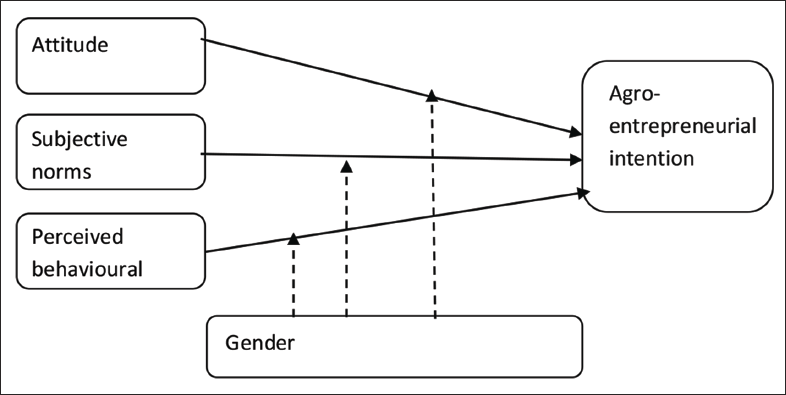
The majority of research in Nigeria on EI is based on TPB (Ezeh et al., 2020). This theory offers a real-world theoretical model that is appropriate for intentional behaviour, such as entrepreneurship. TPB states that behavioural intention is a result of attitude, SN and PBC. Attitude towards behaviour denotes an individual favourable or unfavourable assessment of behaviour (Ajzen, 1991). SN refers to an individual’s perception that those who are important to them will okay their decision to start a business. Finally, PBC shows if action is out of individual violation or how difficult is it to perform a specific behaviour (Ajzen, 1991).
Attitude
Ajzen (1991) defines attitude as an individual’s belief in themselves towards engaging in entrepreneurship. Moreover, this belief can be positive or negative. It is argued that one’s view of the benefit of agriculture is a measure of one’s attitude to agro-entrepreneurship. Scholars have found that attitude, along with PBC and SNs, influences EIs. Phuong et al. (2021) discovered that people with positive attitude have favourable view of entrepreneurship, whereas people with negative perception have unfavourable view. The association between attitude and EI has been supported in the literature (Abdullah & Sulaiman, 2013; Che Nawi et al., 2022; Doanh & Bernat, 2019; Okun & Sloane, 2002; Sa’adiah et al., 2019; Tiraieyari & Krauss, 2018). In Indonesia and Nigeria, however, Ridha et al. (2017) and Ezeh and Juniadu (2019) discovered that attitude has no influence on agro-EI. Thus,
H1: Attitude relates to youths’ intention to engage in agro-entrepreneurship.
Subjective Norm
SNs are the assumptions that people you respect will accept or disapprove of a behaviour (Ajzen, 1991). Thus, Ridha et al. (2017) discovered that SN is the only factor influencing agro-EI in Indonesia, while Sa’adiah et al. (2019) in Malaysia. Furthermore, Ezeh and Juniadu (2019) discovered that among Nigerian youths, SN predicts a career in agriculture. Other researchers such as Tiraieyari and Krauss (2018) as well as Okun and Sloane (2002) also discovered that SN influences agro-EI. Surprisingly, most studies on agro-entrepreneurship found SN as a predictor of agro-entrepreneurship, which is not the same on the studies of EI (do Paço et al., 2011; Ezeh et al., 2020). Thus,
H2: Subjective norm relates to youths’ intention to engage in agro-entrepreneurship.
Perceived Behavioural Control
PBC is defined as an individual’s insight of how easy it will be to deal with a specific scenario (Ajzen, 1991). Thus, individuals with advanced PBC may find it easier to cope with difficulty, leading to higher EIs. Also, competency and ability lead to productivity and quality of a product (Khan et al., 2022; Kumar & Shukla, 2022; Mitra & Sur, 2023; Napitupulu, 2023). Che Nawi et al. (2022) found that PBC influences agro-EI in Malaysia, while, Sa’adiah et al. (2019) discovered a moderate effect of perceived behavioural control on interest in agro-entrepreneurship in Malaysia. Ezeh and Juniadu (2019) discovered in Nigeria that PBC predicts a career in agriculture among Nigerian youths. However, Ridha et al. (2017) discovered that PBC has no effect on agribusiness intention in Indonesia. The contradictory findings led to hypothesis H3.
H3: Perceived behavioural control relates to youths’ intention to engage in agro-entrepreneurship.
Moderating Effects of Gender
This study also wants to see if there is a gender difference on attitude, SN and PBC on agro-entrepreneurship intention. Scholars have discovered that men have a stronger relationship between commitment to entrepreneurship than women (Che Nawi et al., 2022; Vamvaka et al., 2020). Specifically, in Greek, Vamvaka et al. (2020) discovered that men have higher positive attitudes, PBC and higher preference for entrepreneurship than women; however, significant gender effects were obtained only for perceived controllability. Also, Maes et al. (2014) discovered that gender differences are explained by PBC and personal attitude in Flanders, Belgium. Moreover, in Ghana it was discovered that men possess more innovation competence than women (Iddris et al., 2022). Furthermore, Heilman (1983) emphasizes that people aspire to work in professions that are socially acceptable for their gender. Debatably, agriculture has been categorized as female business in Nigeria (Adam, 2018). Moreover, it has been recorded that attitude of women towards entrepreneurship is influenced by social pressure (Arshad et al., 2021). Also, in many organisations, there is a problem of gender segregation (Khan & Roy, 2023).
H4: Females show positive attitude, subjective norm and perceived behavioural control towards agro-entrepreneurship than males.
Materials and Methods
A questionnaire was used for generating data for this study. The study area is Nigeria, Zamfara state. The study’s population was made up of youths from the study area. It has been validated that sample size of greater than 200 is considered enough for a study (Hair Jr et al., 2010). A Google application called ‘power analysis calculator regression’ (Kelley & Maxwell, 2003), and Green (1991) rules of thumb were used to confirm the sample size. Moreover, agro-entrepreneurial scholars used sample size that is at the range of 200–400 (Che Nawi et al., 2022). All of these methods support the 400 sample size. Thus, 400 copies of questionnaire were distributed, which is double of sample size (Ezeh & Juniadu, 2019) used in their study.
This study relied on questionnaires designed to elicit responses about factors that influence entrepreneurial intent and moderating role of gender. The current study used the same instrument that Liñán and Chen (2009) developed to assess entrepreneurial intent. The scale has been validated and used in studies on entrepreneurship intention in Nigeria (Ezeh et al., 2020; Kautonen et al., 2015), agricultural career (Ezeh & Juniadu, 2019) and school enrolment (Ezeh et al., 2021).
The unit of analysis is youths in Nigeria, those that are between ages of 18 and 40 years. The 400 sample is divided into 14 local governments in Zamfara state to have an in-depth finding. Twenty-eight copies of the questionnaire were conveniently distributed in 14 local governments, except Gusau where 36 copies of questionnaire were distributed, being the capital of the state. Furthermore, 10 research assistants were trained and employed, who assisted in distribution and collection of the questionnaire. The questionnaire was dropped and immediately collected from the respondents.
A total of 400 pieces of questionnaires were distributed and 330 were returned. The retrieval rate was high, because of the drop, wait and pick method used. However, due to the high number of missing values and other statistical flaws, 27 questionnaires were removed from the data. The Statistical Package for Social Sciences (SPSS) version 20 was used for coding and data entry. The SPSS variable view was tailored to the analysis goals. Each case was assigned an ID number to help determine outlier cases in the data. The information for this study was derived from a questionnaire designed to assess EI. Thus, common method variance occurs when the data collection methods for both the predictor and criterion measures are similar (Kline, 2005). To reduce response bias, the questionnaire was structure as thus, independent variables as well as dependent variables come first, and demographic variables last (Malhotra & Birks, 2006, p. 336). The items in the questionnaire were untitled so that it had no effect on the respondents’ responses, it also reduces response bias. Furthermore, the majority of the questions were negatively worded but were recorded during the analysis. However, most biases in management and social science research are unserious to compare with other disciplines (Malhotra et al., 2006).
Result
Construct Reliability and Validity
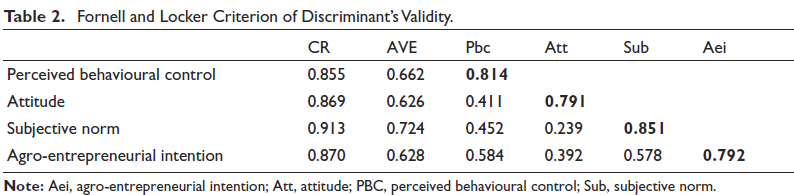
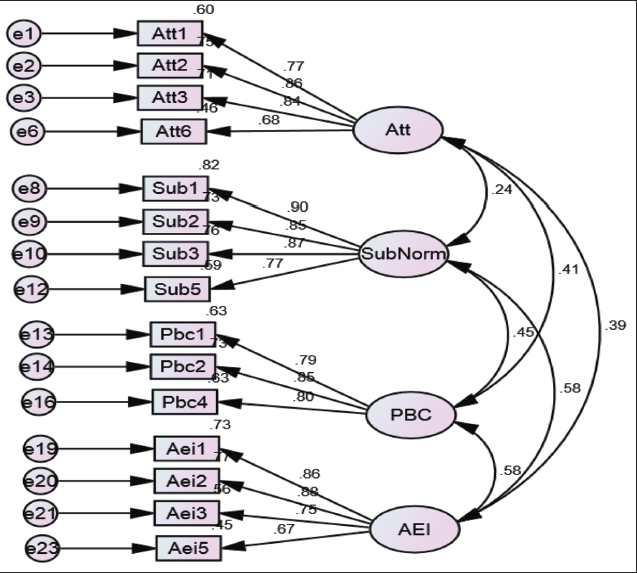
Table 1 records the Cronbach’s alpha as well as reliability and convergent validity test of the constructs. The highest Cronbach’s alpha is 0.909 for SNs, while the lowest is 0.852 for PBC. According to Hair Jr et al. (2010), Cronbach’s alpha and composite reliability (CR) values of 0.70 and above are valid and reliable, thus this study met the set criteria. Thus, the average variance extracted (AVE) values are 0.5 and higher, as shown in . Thus, this study equally met the convergent validity criteria. Table 2 depicts the Fornell–Larcker criterion for determining discriminant validity (Hair et al., 2014). The current study met the Fornell–Larcker criterion, which is the square root of AVE, as shown in Table 2. Moreover, the cross-loadings are also satisfied (see Table 1 and Figure 2). It is concluded that the entire criteria have been met, thus convergent and discriminant validity have been established.
Internal Consistency Reliability and Convergent Validity.
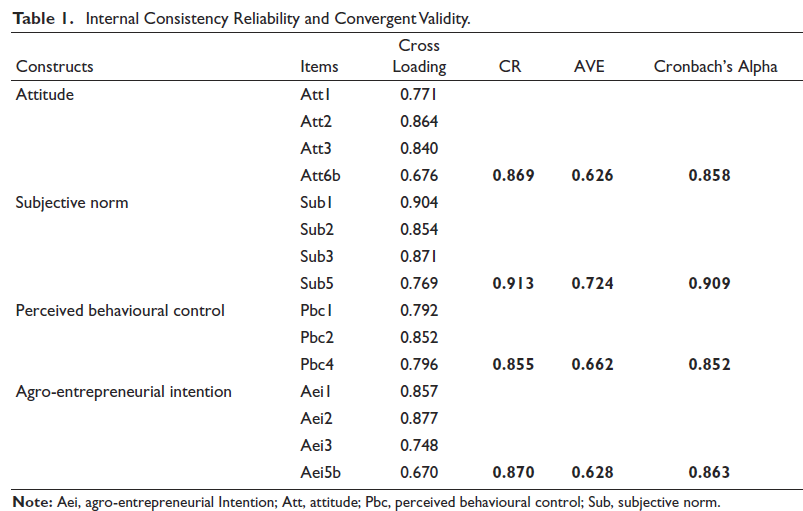
Fornell and Locker Criterion of Discriminant’s Validity.
Demographic Variables
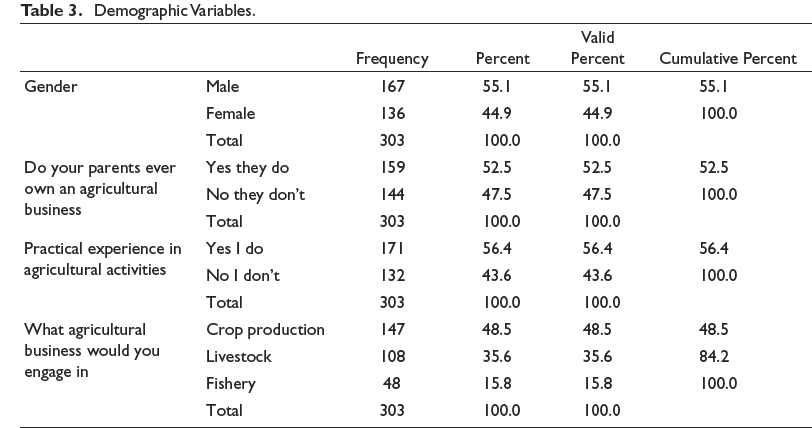
The respondents’ demographic characteristics were examined using descriptive statistics. Debatably, youth in Nigeria are those between 18 and 40 years of age. According to the descriptive statistics in Table 3, 55.1% is male and 44.9% is female. Descriptive statistics on respondents’ agricultural activities were computed in the same way. When asked if their parents had ever owned an agricultural business, 52.5% indicated that they had. According to the descriptive report, 56.5% have practical agricultural experience. According to the data, 48.5% of young people want to engage in crop production entrepreneurship, 35.6% on livestock and 15.8% on fishery.
Demographic Variables.
Structural Equation Modelling
Structural equation modelling (SEM) (AMOS) was used. This is a multivariate technique that allows for the investigation of numerous and complex relationships (Hair et al., 2014). Some indicators were removed through assessing the modification indices. Thus, model fit was evaluated using χ2/df = 1.675 (p < .001), incremental fit index (IFI) = 0.98, Tucker–Lewis index (TLI) = 0.97, comparative fit index (CFI) = 0.98 and root mean square error of approximation (RMSEA) = 0.05. The model estimated shows a good fit with the data they fall within the acceptable cut-off limits (Hu & Bentler, 1999) (see also Figure 2).
Path Analysis
The model fit for path analysis was also used to assess the path’s viability and fitness. The GFI is 0.925, the IFI is 0.975, the TLI is 0.968, the CFI is 0.975 and the RMSEA is 0.030. The calculated model has a good fit (Hu & Bentler, 1999) (see also Figure 3).
Path Analysis.
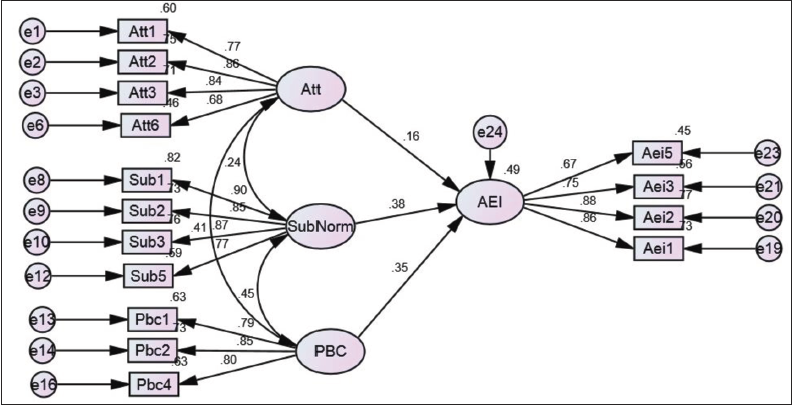
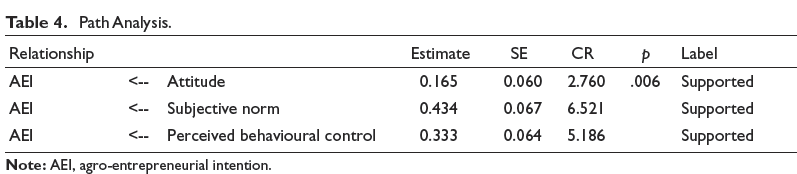
Table 4 presents the path analysis of the impact of attitude, SN and perceived behavioural control on the agro-EI. The path coefficients showed that the coefficients value for attitude (β = 0.165, t = 2.760, p = .006), perceived behavioural control (β = 0.333, t = 5.186, p = .000) and SN (β = .434, t = 6.521, p = .008) indicate a significant and positive effect on agro-EI. It shows that SN has the highest impact followed by PBC and attitude.
Path Analysis.
Moderating Effects of Gender
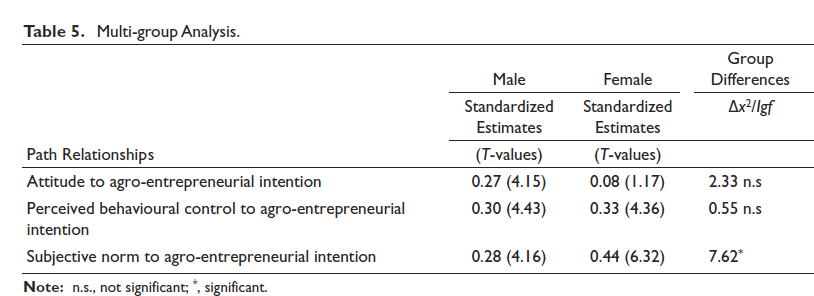
Amos constraint two-group analysis method was used to evaluate the moderating effect of gender (Collier, 2020). Table 5 presents the moderating effects of gender across the TPB elements. Thus, it was discovered that attitude and PBC have no significant difference between men and women, but SN shows significant difference (see Table 5). Furthermore, looking at standard estimates (Collier, 2020), it was discovered that the influence of SN is stronger in women than in men. In other words, social pressure will influence women more than men in pursuing agro-entrepreneurship.
Multi-group Analysis.
Agro-EI Among Nigerian Youths
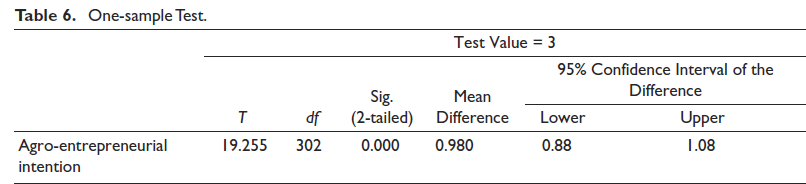
Scholars found that majority of graduates do not want to participate in agro-entrepreneurship (Abdullah & Sulaiman, 2013; Morris et al., 2017). Thus, agro-EI of Nigerian youths was tested using T-test (see Tables 6 and 7).
One-sample Test.
One-sample Statistics.

Table 6 above shows that theT-test statistics is 19.255 and the significance level is 0.000. This means that the Nigerian youths have agro-EI. Moreover, with the mean of 3.98 and standard deviation of .886, it shows that Nigerian youths have agro-EI (see also Table 7). The mean of 3.98 is higher than the mid-point of 3 on the 5-point scale (‘5–strongly agree’ that you have intention of becoming agro-entrepreneur and ‘1–strongly disagree’).
Discussion
The effect of TPB components on agro-EIs as well as the moderating role of gender is investigated. Many scholars have used TPB framework, and almost all of them have discovered a link between TPB components and EI. This study discovered that attitude, SN and PBC relate to agro-EI, this result is consistent with the previous research (Doanh & Bernat, 2019). Thus, TPB appears to be the most important behavioural theory in many contexts and nations, including Nigeria, when it comes to agro-EI.
It was discovered that SN influences agro-entrepreneurship intention. Thus, this study backs up the findings of Abdullah and Sulaiman (2013) and others, who discovered that parental influence, teacher influence, peer influence and association with people in the profession all have a greater influence on their job decision. According to Okun and Sloane (2002) and Tiraieyari and Krauss (2018), SN influences the proclivity to engage in entrepreneurship. Furthermore, this study supports Ridha et al. (2017), who found that SN is a factor influencing entrepreneur’s purpose in the agricultural industry in Indonesia. Other studies, such as Sa’adiah et al. (2019) in Malaysia, highlight social factors as predictors of agriculture as a career choice, which is consistent with this study as well as Ezeh and Juniadu (2019) in Nigeria, who discovered that SN predicts agro-EI. Thus, Nigerian government and other stakeholders should recruit more opinion leaders as disciples who will encourage more youths to engage in agro-entrepreneurship.
This study supports Che Nawi et al. (2022) and Tiraieyari and Krauss (2018), who discovered that PBC predicts students’ agro-EI and willingness to volunteer in the University of Putra Malaysia program among Malaysian university students. Furthermore, this study supports Ezeh and Juniadu (2019), who discovered that PBC predicts Nigerian youths’ career in agriculture. This study, however, contradicts Ridha et al. (2017), who discovered that PBC has no influence on agro-EIs in Indonesia. In addition, Sa’adiah et al. (2019) discovered a moderate level of PBC in the inclination towards agro-food entrepreneurship in Malaysia. Thus, this study shows that Nigerian youths have the capacity to engage in agro-entrepreneurship.
According to the findings, attitude has an impact on the intentions of Nigerian youths to pursue agro-entrepreneurship. This study supports a number of previous studies that found attitude to be a predictor of young people’s entrepreneurial intent (Abdullah & Sulaiman, 2013; Che Nawi et al., 2022; Okun & Sloane, 2002; Tiraieyari & Krauss, 2018). This study contradicts the findings of Ridha et al. (2017) as well as Ezeh and Juniadu (2019), who discovered that attitude has no bearing on agro-EIs among Indonesian and Nigerian youths, respectively. Thus, this contradiction with Ezeh and Juniadu’s (2019) study on attitude leaves a lot of questions to address. Does it mean that Nigerian government’s Buhari’s agricultural policy has started working? Is it a methodological issue? Thus, a longitudinal research design is encouraged. Thus, more research is encouraged.
Moderating role of gender is the major contribution of this current study. Thus, it was found that there is no significant difference between men and women on attitude and PBC, but there is a significant difference on SN. As a result, standard estimates revealed that females have a stronger SN than males. In order words, women will be influenced more by social pressure in pursuing agro-EI than men, which is in line with Arshad et al. (2021). This study is line with the culture of the study environment, which says that more women will engage in agro-entrepreneurship if society supports them. Thus, where women are relegated, more social pressure is needed to spur women to engage in agro-entrepreneurship.
Finally, this study found that Nigerian youths have intention to engage in agro-entrepreneurship. This study is in line with Adelakun et al. (2019), who found that Nigerian youths after learning agro-allied skills want to start their own agribusiness. However, our study contradicts other scholars, (Abdullah & Sulaiman, 2013; Morris et al., 2017), who found that graduates do not have interest in agro-entrepreneurship. This difference might be because our study targeted youths, while Abdullah and Sulaiman (2013) and Morris et al. (2017) targeted specifically the undergraduates. Arguable, one can say that formal education impedes on youths’ agro-EI.
Conclusion
This study discovered that Nigerian youths have agro-EI. Also attitude, SN and PBC influence agro-EI. Furthermore, it was found that there is no significant difference between men and women on attitude and PBC, but there is a significant difference on SN. As a result, standard estimates revealed that females have a stronger SN than males. This study emphasizes the importance of TPB in improving agro-EI. Thus, educational institutions and other institutions should begin to strengthen agro-entrepreneurial education by redesigning the schools’ programme from primary school age. This will assist young Nigerians to imbibe agro-entrepreneurship early in life. Also, this will help to improve youths’ PBC and attitudes towards agro-entrepreneurship. Successful agro-entrepreneurs should be invited on a regular basis to give practical talks to Nigerian youths. Agro-entrepreneurship should be one of the primary missions of government agencies. Furthermore, religious leaders should emphasize on dignity of labour in their various places of worship. In summary, the government, universities and other stakeholders should encourage and monitor Nigerian youths as they start their own agribusiness. It is critical for institutions, public and private, to educate the youths about the importance of agro-entrepreneurship. Thus, universities and other interested institutions should work to maintain the confidence of Nigerian youths. Therefore, the educational institutions should de-emphasize certification, but encourage practical outputs. Furthermore, women should be encouraged to engage in agro-entrepreneurship through social campaigns, as they are more drawn to societal influence than men. This study’s findings is practical and useful for the government in better targeting its actions and strategies to attract more Nigerian youths to engage in agro-entrepreneurship. Moreover, in Ghana, it was observed that lack of institutional and social support hampered the growth of farmer-entrepreneurship (Adobor, 2020).
Also, this study has some theoretical implications. Despite the fact that entrepreneurship research has been extensively studied across contexts and constructs, there has been little research on agro-EI in Nigeria. Thus, Whetten (1989) asserts a consistent emphasis on the role of context in theory development. Moreover, scholars have argued that a theory can only term strong after being tested in different environment and it solves societal problems (Corley & Gioia, 2011). This study is contextually driven, focusing on the northwest of Nigeria, particularly Zamfara state, which claims to be an agrarian and a gender-sensitive zone. Additional theoretical contribution is the inclusion of gender as a moderating influence on the elements of PBC on agro-EI, which is an area that needs more investigation.
This research is limited to Zamfara state in northwest Nigeria. It is also not the researcher’s intention to test all possible exogenous factors that are influencing agro-EI. Moreover, most studies on EI discovered the weakness of SN, but virtually all the studies on agro-EI found that SN has significant influence on agro-EI. It is advised that future studies should evaluate and come up with reasons for the differences. It would be beneficial to investigate additional significant variables. Surprisingly, the result of this studies (Ezeh & Juniadu, 2019) that are conducted in the same state, Zamfara, but different time and respondents, have different outcomes, this calls for longitudinal survey. Other researchers may also use other constructs such as agro-entrepreneurial experience, parental involvement in agro-entrepreneurship, education, age and so on as moderating variables or as an indirect relationship with agro-entrepreneurial intent.
Footnotes
Acknowledgements
The author is grateful to the journal anonymous referees for their beneficial suggestions to improve the quality of the article.
Declaration of Conflicting Interests
The author declared no potential conflicts of interest with respect to the research, authorship and/or publication of this article.
Funding
The author received no financial support for the research, authorship and/or publication of this article.
