



Abstract
Over the last 30 years, China has experienced outstanding economic growth along with significant transformation in its financial system and institutional environment. It has also emerged as the primary destination for substantial foreign direct investment (FDI). Therefore, numerous studies have focused on the roles of FDI, financial development and institutional quality in stimulating the Chinese economy. However, existing literature primarily addresses the direct linear impact on economic growth, neglecting potential non-linear relationships and the roles of institutions and financial development in moderating the FDI–growth nexus. This study employs unit root and Johansen’s cointegration tests to examine the roles of FDI, institutional quality and financial development in explaining economic growth in China from 1985 to 2020. Our results show that FDI, institutions, financial development and growth are cointegrated, with non-linear effects of institutional quality and financial development on growth. Furthermore, the impact of FDI on growth decreases when financial development is high (0.627%–0.517%), but increases with improved institutional quality (0.921%–1.158%). Hence, continuous improvements in institutional quality and the financial system do not uniformly affect economic growth, but significantly influence the contribution of FDI to economic growth in China.
Introduction
Economic growth is the macroeconomic goal pursued by most economies, and policymakers have made a variety of efforts to achieve this goal. Investment is considered an important driver of economic growth, improving productivity and promoting employment. Foreign direct investment (FDI) is an important form of investment, and when it takes the form of capital flows introduced by multinational corporations, it becomes more promising, particularly in this era of economic globalization. Economic globalization primarily involves the rapid growth of international trade and investment. In the global economy, FDI flows—through multinational enterprises—are constantly increasing (Nair-Reichert & Weinhold, 2001). As observed in the literature review (e.g., Loungani & Razin, 2001; Raza et al., 2021), FDI boosts the economic growth of host countries through technological spillover effects, creating employment opportunities, advancing managerial skills and increasing corporate tax revenue. In light of this, Borensztein et al. (1998) and many other studies (e.g., Chaudhury et al., 2020; Rao et al., 2023; Sahoo & Sethi, 2023; Sinha & Sengupta, 2022; Sulaiman et al., 2024) claim that economic growth in most developing countries can be attributed to FDI inflows.
Although economic growth appears to be closely tied to FDI inflows, a strand of the empirical literature rejects this assertion, arguing that the goal of FDI is to exploit resources in host countries rather than provide aid (Griffin & Enos, 1970). This is because the primary goal of investment is not charity but profit maximization. In another study, Singer (1975) adds that foreign capital inflows may distort prices and result in the misallocation of resources in the host countries. This outcome is also known as the Prebisch–Singer hypothesis. Similarly, Herzer (2012) identifies a negative impact of an influx of FDI on economic growth in 44 developing countries. This is because the influx of FDI may enhance external economic vulnerability and crowd out domestic investment, eventually retarding the host country’s economic growth (Aiken & Harrison, 1999; Lipsey, 2004).
In a sectoral-level analysis of South Asian economies, Chaudhury et al. (2020) also fail to find significant evidence to support the conventional wisdom of FDI inflows contributing to economic growth in the primary, secondary or tertiary sectors. Indeed, recent findings of Singh et al. (2023) in India, as well as by Jahanger (2021) and Zhao and Du (2007) in China, also show that economic growth and development are not the result of inward FDI. In a similar vein, in their meta-analysis of studies on China, Gunby et al. (2017) conclude that FDI-led growth might be a myth or, at least, less impactful than previously believed. In light of the diverse results in the empirical literature, it is essential to apply recent data to delve more deeply into the impact of FDI on propelling economic growth in China as a large and rapidly expanding emerging economy in Asia.
Since China reformed its economy to pursue liberalization, it has actively worked to create favourable conditions to attract FDI and accelerate its economic growth. The country has, in fact, emerged as a global leader in attracting FDI, especially after joining the World Trade Organization in December 2001 (Hannon & Jeong, 2021). The rapid growth of FDI in China is mainly attributed to its expansive market and abundant resources. Statistics show that FDI inflows skyrocketed from $3.487 billion in 1990 to approximately $149.342 billion in 2020. In addition, in the midst of a global decline in FDI, in 2020, the country managed to achieve a 4% increase in FDI, securing the top spot globally.
This economic transformation is evident in impressive GDP growth, which surged from $394.56 billion in 1990 to approximately $14,687.74 billion in 2020, marking an increase of almost 40 times. Beyond this growth, transformation has resulted in significant changes to China’s financial system and institutional framework. More specifically, China has undergone substantial reforms in its legal system, governance structures and political and regulatory frameworks and has seen advances in its financial development (Kobayashi et al., 1999). As such, China is an appropriate focus for the present study.
A number of studies have investigated the factors (including FDI) that determine China’s growth. However, most studies (e.g., Jahanger, 2021; Zhao & Du, 2007) focus on the direct linear impact on economic growth. Therefore, the present study contributes to the literature by delving deeper into the impact of FDI on growth at different degrees of institutional quality and financial system development. This initiative is particularly relevant given the major transformations of China’s financial systems and institutional frameworks. We also examine the non-linear effects of institutional quality and financial development on economic growth, an issue that has received relatively less attention, particularly in the Chinese context. Obviously, unlike previous studies, this study takes the initiative to closely examine the interplay of FDI, institutional quality and financial development in stimulating growth, and we do so by accounting for linear, non-linear and moderating factors. As such, the findings of the present study are more comprehensive and informative for policymaking.
The remainder of this study is organized as follows: In Section 2, we present a review of the literature on economic growth in relation to FDI, financial development and institutional quality. The study’s methodology and data are discussed in Section 3, and in Section 4, we present our findings. Finally, we offer our conclusions and policy recommendations in Section 5.
2. Literature Review
A large body of literature has focused on the roles of FDI, financial development and institutional quality on economic growth in both developed and developing economies. However, the effects of these factors on growth remain inconsistent (Iamsiraroj, 2016). The neoclassical growth theory suggests that in the short run, labour and capital are the key drivers of economic growth, while in the long run, technological progress becomes crucial (Solow, 1956). Coincidently, FDI not only adds to capital but also fosters technological spillovers, then promotes long-term economic growth (de Mello, 1997). Girma et al. (2001) and Kokko (1994) added that FDI facilitates knowledge transfer through training, demonstration, market competition and other channels, thus, enhancing the technological level and productivity of the host economy. Moreover, a large strand of literature supports the positive impact of FDI on economic growth (e.g., Hayat, 2018; Kumari et al., 2023; Nistor, 2014; Sarker & Khan, 2020; Sulaiman et al., 2024).
Although FDI generally promotes economic growth, a strand of empirical literature provides contrasting views. Some past studies argue that FDI can crowd out domestic investment and lead to issues like external vulnerability and over-dependence on foreign capital (Aitken & Harrison, 1999; Lipsey, 2004). Recently, Singh et al. (2023) also found that FDI has a negative impact on economic growth in India. Asongu and Odhiambo (2020) and Blanco et al. (2013) documented that FDI, especially in polluting industries, can harm the environment and undermine sustainable growth. As a result, the empirical evidence on the impact of FDI on growth remains controversial.
Apart from direct impact, Balasubramanyam et al. (1996) note that the effect of FDI on growth can also be shaped by host country policies, while Fortanier (2007) adds that the effect depends on trade and financial policies. Anwar and Nguyen (2010) added that factors like education and technological level determine the FDI–growth relationship in various regions of Vietnam. Furthermore, Nair-Reichert and Weinhold (2001) found that FDI is more effective in open economies and those with strong institutional frameworks (Brahim & Rachdi, 2014; Karim et al., 2012; Zhang & Kim, 2022).
Institutional quality is another important driver of economic growth. The institutional economics school of thought holds that institutions are critical for economic efficiency. A high-quality institutional environment is a prerequisite for poor countries to escape poverty (Glaeser et al., 2004). North (2000) claims that a good institutional framework creates incentive mechanisms, directly affecting economic and political activities and laying the institutional foundation for growth. High-quality institutional systems, such as respect for the rule of law, reduced corruption, efficient government services and politically stable and sound regulatory frameworks, offer an attractive development environment for domestic and foreign companies, encouraging them to engage in healthy competition and thereby improve their operating efficiency (Tran, 2019). Conversely, poor institutions will increase transaction costs and operating risks and lead foreign companies to reduce their investment and long-term commitment to host countries (Baker et al., 2019).
Most empirical studies support the positive impact of institutional quality on economic growth (Ngo & Nguyen, 2020; Raza et al., 2021; Singh, 2022; Tang & Abosedra, 2019; Xu et al., 2019). Raifu et al. (2021) show the sub-components of institutional-like government stability and democratic accountability also significantly enhance growth in West Africa, whereas corruption hinders it. In contrast, Olaoye and Aderajo (2020) discover that the relationship between institutional quality and economic growth in ECOWAS countries could be non-linear. The study shows that improvements in institutions only yield expected economic results once a certain threshold of institutional quality is surpassed. Besides influencing economic growth, Bhujabal et al. (2024) and other studies (e.g., Mengistu and Adhikary, 2011; Rani and Batool, 2016; Raza et al., 2021) reveal that institutional quality plays a crucial role in attracting FDI, which, in turn, leads to economic growth. Good institutions are considered the basic condition for attracting FDI inflows because they can better protect the rights and interests of investors and give investors a greater sense of security (Acemoglu et al., 2005; Mody & Srinivasan, 1998).
Next, it is also important to consider the relationship between financial development and economic growth. Xu and Tan (2020) emphasize that financial development can promote economic development by optimizing capital allocation. A developed financial market makes it convenient for enterprises to obtain funding for their operation, production and advancing technology. Therefore, many past studies found that financial development tends to have a positive impact on economic growth either in developed or developing economies (e.g., Abbas et al., 2022; Abu-Bader & Abu-Qarn, 2008; Chong, 2020; Hassan et al., 2011). However, Ibrahim and Alagidede (2018) argue that although financial development supports economic growth, excessive financial development can be detrimental. Ram (1999) describes the relationship between financial development and economic growth as ‘uncertain and fuzzy’ as the impact of financial development varies across countries and stages of economic development (Hassan et al., 2011).
In addition, some studies find a negative relationship between financial development and economic growth (e.g., Cournede & Denk, 2015; De Gregorio & Guidotti, 1995). As such, the finance–growth relationship is not very robust, and the relationship might be non-linear. Many studies highlight an inverted U-shaped relationship between financial development and economic growth. Rioja and Valev (2004) find that the positive impact of financial development on economic growth only manifests once a specific threshold of development is reached. Nevertheless, Fufa and Kim (2018), Samargandi et al. (2015) and Law and Singh (2014) all find that beyond a certain threshold, further development of the financial sector can harm economic growth. They argue that excessive financial development may lead to inefficiencies and economic instability, thus, it harms growth.
Apart from direct impact, Khan (2007) claims that a fully developed financial system can improve the efficient allocation of resources, enhancing the host country’s ability to absorb FDI inflows and facilitating the dissemination of advanced technologies introduced by FDI. Choong and Lim (2009) add that a well-developed financial system makes a positive contribution to technology diffusion through FDI. The interaction between FDI and financial development offers a significant impact towards economic growth (Anwar & Nguyen, 2010; Sothan, 2017). Sirag et al. (2018) also assert that financial development alone is more conducive to economic growth than FDI, but when coupled with financial development, FDI leads to even better economic performance.
Finally, our literature review can be summarized with three key takeaways. First, the effect of FDI on host countries’ economic growth remains inconsistent. However, its impact can depend on various factors such as local policies, institutional quality, financial development and other specific characteristics of the host economy. Second, good governance and institutions not only provide a conducive environment for domestic economic activities but also play a critical role in attracting and efficiently monitoring FDI. Third, financial development is generally viewed as beneficial for economic growth by enhancing capital allocation, FDI and technological innovation, but its effect can be non-linear.
Although previous studies have widely examined the impacts of FDI, institutional quality and financial development on growth, there is a lack of research exploring these three factors together, especially in the context of the Chinese economy. Moreover, past studies have mainly focused on the direct linear impact of FDI on growth, while overlooking the non-linear and moderating roles of financial development and institutional quality in bridging the FDI–growth relationship in China. Motivated by these research gaps, it is crucial to closely examine the linear, non-linear and moderating impacts of institutional quality and financial development on the FDI–growth relationship in China.
Materials and Methods
3.1. Empirical Model
This study used Solow’s growth theory as the basic theoretical framework to construct our growth model. With reference to the growth theory and the existing empirical literature, the impacts of FDI, financial development and institutional quality on growth are commonly analyzed using the following growth model:

where
Since the research interest in the present study is not limited to linear and direct relationships, we augment the growth model by incorporating non-linear and interaction terms. We analyze the non-linear and moderating effects of institutional quality and financial development on the FDI–growth nexus by taking into account the quadratic and interaction variables, namely




Based on the augmented growth models above, the statistical significance of


Based on Equations (6) and (7) above, the effect of FDI on economic growth is contingent upon the extent of financial development and institutional quality. We verify the statistical significance of these marginal effects by applying the revised standard errors formula suggested in Aiken and West (1991). More specifically, the standard errors for the marginal effects of FDI with respect to financial development and institutional quality (


where
3.2. Data Sources and Descriptive Statistics
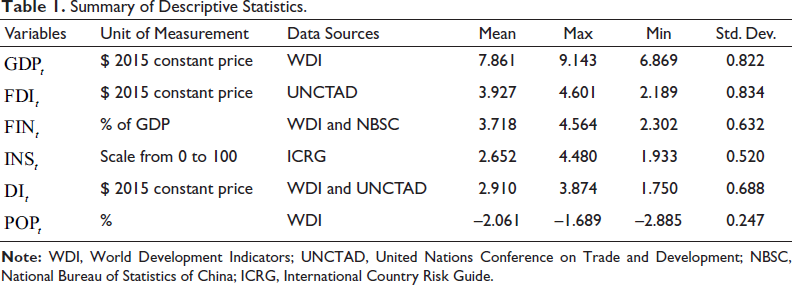
This study employs yearly time series data for China from 1985 to 2020 due to data availability. The data are collected from various reputable sources, namely the World Bank’s World Development Indicators (WDI), the United Nations Conference on Trade and Development (UNCTAD) statistical series, and the data sets of the National Bureau of Statistics of China and the International Country Risk Guide. All variables are converted into natural logarithms to standardize the unit of measurement, control heteroskedasticity and improve stationarity.
In addition to FDI inflows, financial development and institutional quality are included as important variables in the present study. Our review of the literature shows that a number of variables are used to measure financial development and institutional quality. For example, common measures of financial development include the (a) share of broad money supply M2 to GDP, (b) share of domestic credit to private sector to GDP, (c) share of deposit to the financial institution to GDP, and (d) share of stock market capitalization to GDP.
Similarly, according to the literature (e.g., Tang, 2018) and the World Governance Indicators (WGI), there are also six major aspects in rating institutional quality, namely, (a) political stability, (b) control of corruption, (c) government effectiveness, (d) rule of law, (e) voice and accountability and (f) regulatory quality. Given that there is no perfect measure, the widely applied approach—the entropy-weighted method—is used to integrate the existing indicators and construct an index for financial development and institutional quality. The summary descriptive statistics are reported in Table 1.
Summary of Descriptive Statistics.
3.3. Johansen–Juselius Cointegration Test
In this sub-section, we present the procedure for the multivariate test for cointegration introduced by Johansen and Juselius (1990). There are several advantages to using this cointegration test. First, unlike the single-equation framework cointegration tests, the Johansen–Juselius multivariate test is a widely adopted approach, particularly for a model that includes more than two variables. This is because it allows one to examine more than one cointegrating vector. Second, this approach releases the assumption of exogeneity by treating all variables as endogenous within the vector autoregression (VAR) framework. Third, the Monte Carlo simulation results in Gonzalo (1994) show that this multivariate cointegration approach is well-performed even if the disturbance terms are not spherically distributed or there is imperfect model specification. Motivated by these flexibilities and the robustness of the outcomes, we employ the Johansen–Juselius cointegration test.
We examine the existence of cointegration or a long-run equilibrium relationship between economic growth and the variables of interest in our model by estimating the following vector error-correction model:

where 

where ln is the natural logarithm, T denotes the number of observations, and
4. Results and Discussions
The empirical results and discussions are now presented. Given that the estimated results of the time series analysis are sensitive to the stationarity of the variables, we begin the analysis by examining the order of integration. We borrow the augmented Dickey–Fuller (ADF) unit root test and the Kwiatkowski–Phillips–Schmidt–Shin (KPSS) test for stationarity. The Monte Carlo simulation experiments of Keblowski and Welfe (2004) and Charemza and Syczewska (1998) consistently show that employing the ADF and KPSS tests together yields more reliable results, regardless of whether the sample size is small or the series is subjected to a structural break. The results of the ADF and KPSS tests are presented in Table 2.
The Results of Augmented Dickey–Fuller (ADF) and Kwiatkowski–Phillips–Schmidt–Shin (KPSS) Tests.
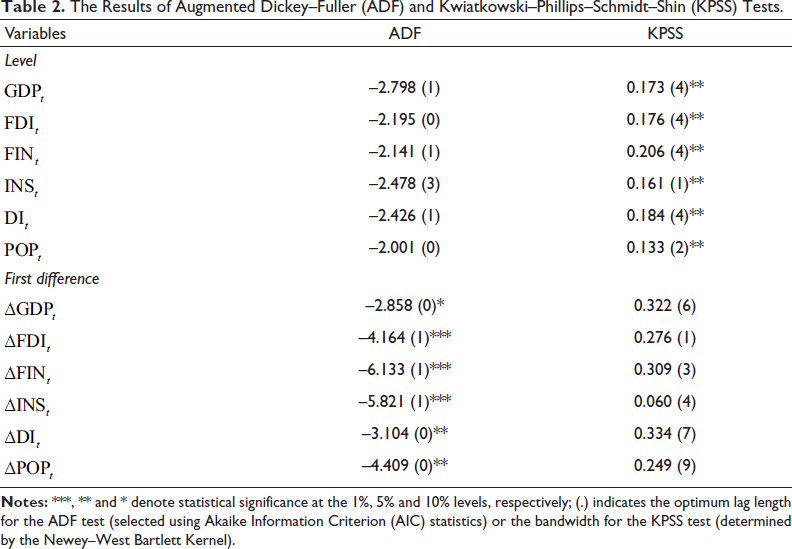
Based on the results in Table 2, both tests consistently suggest that all variables are non-stationary at the level form; however, they become stationary after transforming into the first difference form. Therefore, we can conclude that the variables in the present study are integrated of order one, I(1). Since our findings suggest that the variables are I(1), it fulfils the criteria for determining the existence of a cointegrating relationship. Hence, we extend our analysis to investigate the presence of cointegration using the Johansen–Juselius multivariate cointegration method.
While the Johansen–Juselius approach for cointegration is widely utilized and powerful in detecting cointegration, its sensitivity to the choice of lag length and the specification of deterministic terms in the testing model is notable. We ensure robustness by employing three information criteria, encompassing the system-wide Akaike Information Criterion (AIC), system-wide Schwarz Bayesian Criterion (SBC) and system-wide Hannan–Quinn Information Criterion (HQ) to determine an appropriate lag length. Additionally, we adhere to Johansen’s (1992) approach by applying Pantula’s principle to select the best combination of deterministic terms in the testing model.
Enders (2014) adds that if the lag length in the testing model is too short, it may not be able to effectively capture the dynamic elements, and the errors do not clearly follow the white-noise process. On the other hand, too many lags in the testing model may also jeopardize the statistical power of a test because it consumes a degree of freedom. Following the recommendation of Enders (2014), we begin by setting the maximum lag as 3 years. The general-to-specific approach is then applied to select an optimum lag with minimum values of the information criterion. Table 3 shows the outcome of system-wide information criteria based on the VAR system at the level.
The System-wide Information Criterion of Vector Autoregression (VAR) System.
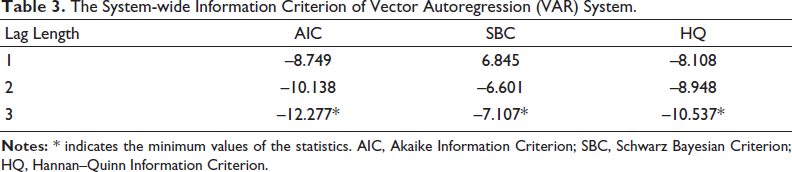
Remarkably, our results show that the system-wide AIC statistic and the other two criteria consistently suggest the optimum lag of 3 years. Next, we perform the Johansen–Juselius cointegration test with the suggested lags for Models 2, 3 and 4, then select one out of these three models using Pantula’s principle. The Johansen–Juselius multivariate cointegration results, together with the adjusted LR statistics for a small sample, are summarized in Table 4. Ironically, we find that the recommended model varied across LR tests (i.e., trace and maximum eigenvalue), but they consistently reject the null hypothesis of only one cointegrating vector at the 5% level or better. Specifically, when we apply Pantula’s principle on the results of
Johansen–Juselius Cointegration Analysis.
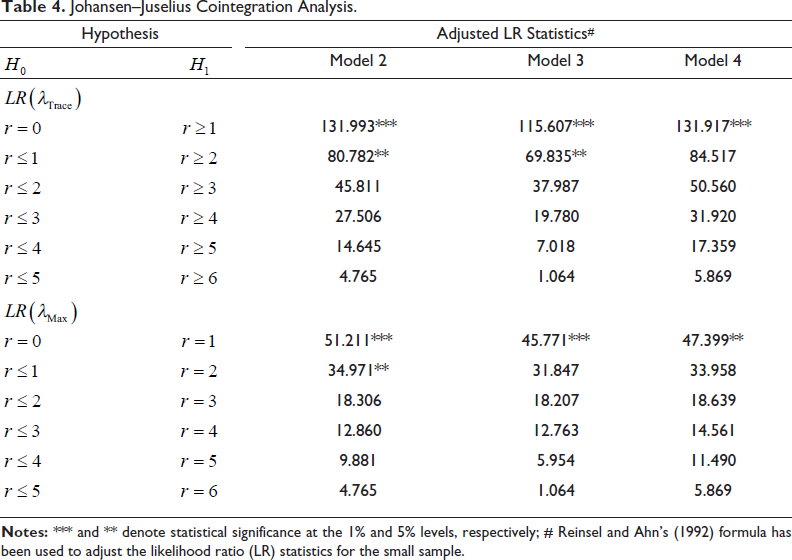
Given that the variables are cointegrated with one cointegrating vector, we estimate a long-run relationship between economic growth, FDI, financial development, institutional quality and the covariate using the ordinary least squares estimator. Table 5 sets out the estimated long-run coefficients and diagnostic test results.
Estimation of Long-run Relationships.
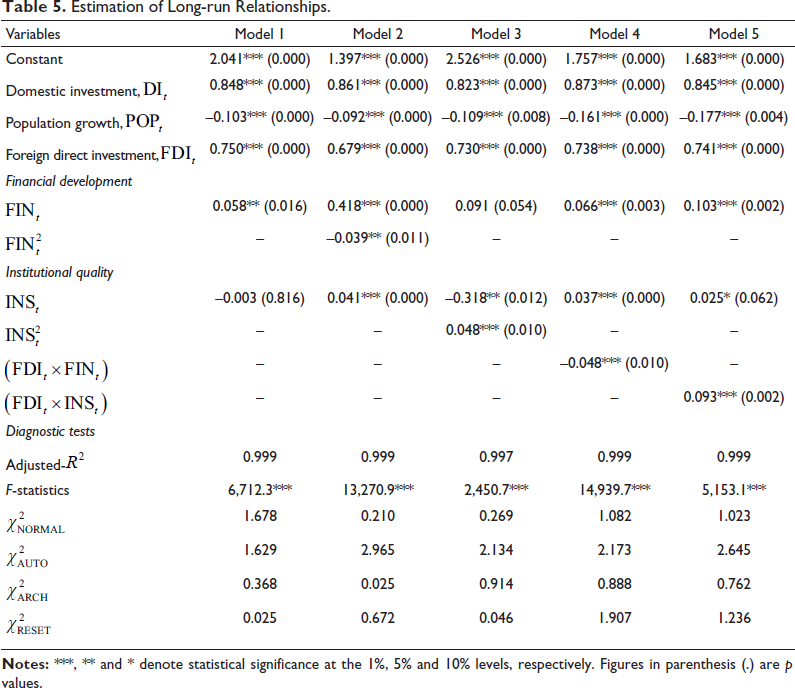
We find that, overall, the adjusted-
Turning to the estimated long-run coefficients in Table 5, we observe that the control variables (i.e., domestic investment and population growth) are both statistically significant at the 1% level in all five models. In contrast to the findings in Chaudhury et al. (2020), our results indicate that domestic investment
Next, we shift our discussion to the impact of FDI, financial development and institutional quality on long-term economic growth. Our results show that FDI has a consistently positive impact on economic growth in China. Although the effect of FDI is slightly lower than that of domestic investment, our findings in Models 1, 2 and 3 show that a 1% increase in FDI inflows into China results in an increase in economic growth of approximately 0.71%.
The positive relationship between FDI and economic growth aligns with our expectations and is also corroborated by existing studies (e.g., Kumari et al., 2023; Luo et al., 2021; Raza, 2021; Sulaiman et al., 2024). The influx of FDI will improve labour skills, provide working opportunities, and facilitate technological transfer, eventually promoting the host country’s economic growth. Therefore, it appears that the FDI-led growth model is reasonable for China. Similarly, the results of our baseline regression (Model 1) show that financial development is positively related to economic growth in China. A 1% increase in financial development, on average, results in an approximately 0.058% increase in economic growth in China. This result corroborates the findings of Abbas et al. (2022) and Chong (2020), who suggested that countries with better-developed financial system are likely to stimulate economic growth, irrespective of whether they are lower-middle or upper-middle-income countries.
Although we expect that institutional quality influences economic growth, the results in baseline regression appear to be statistically not significant at the 5% level. This result is contrary to that of Sinha and Sengupta (2022), Raifu et al. (2021), Raza et al. (2021) and Tang and Abosedra (2019), who find that institutional quality improvements are decisive for economic growth. However, when we transform the growth model into a non-linear version by accommodating quadratic financial development
The inverted U-shape of the relationship in our results highlights that economic growth first increases with financial development and declines thereafter. Steady development in the financial sector will thus not always benefit China’s economic growth. This outcome is consistent with Osei and Kim (2020), Samargandi et al. (2015) and Law and Singh (2014), who agree that over-finance hurts economic growth. In the early stages of financial development, expansion of the financial sector promotes economic growth through financial advice and credits that support physical capital investments.
However, in the later stages, over-supply of finance will expose the Chinese economy to unnecessary external shocks that may eventually cause economic vulnerability and be to the detriment of economic growth. In addition, over-reliance on the development of financial markets can lead to misallocation of resources and risk financial instability, hindering long-term economic growth. The 2008 global financial crisis is an excellent example of the consequences of over-dependence on the development of financial markets.
As the Model 2 results show, the threshold for financial development in China is approximately 212.72% of GDP
Studies on the institutions–growth nexus (e.g., Butkiewicz & Yanikkaya, 2006; Nawaz et al., 2014) tend to treat the relationship between institutional quality and economic growth as linear. However, our estimated results in Model 3 suggest a non-linear U-shaped relationship, wherein economic growth in China initially declines with institutional quality and subsequently increases. This outcome differs from Zhou et al. (2021) and Chong (2020), but it is broadly consistent with Gasimov et al. (2023) and Nguyen et al. (2022), who identify a U-shaped relationship between institutions and growth. Indeed, our finding of a U-shaped relationship between institutional quality and economic growth is justifiable.
Glawe and Wagner (2020) emphasize that the process of institutional improvement can be challenging and difficult in the initial stages. They highlight that the positive effects of institutional enhancement might translate into economic gains only after the institutional environment is sufficiently developed. It may take time for the initial improvements in property-rights protection, legal-system transparency and reduced corruption to translate into trust among investors and businesses. Consequently, the full positive impact on economic growth may only materialize once these institutional enhancements are firmly established and have permeated the economic landscape (see also Acemoglu et al., 2006; Rodrik, 2008). Therefore, it is reasonable to find that the relationship between institutional quality and economic growth is U-shaped in nature.
Next, we extend the analysis further to Models 4 and 5 to emphasize the effects of financial development and institutional quality on the FDI–growth nexus in China. We find that interaction terms of
The Results of Marginal Effects of Foreign Direct Investment (FDI) on Economic Growth.
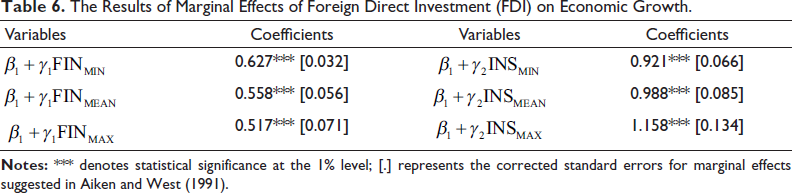
Overall, we observe consistently positive and statistically significant estimated marginal effects of FDI at the 1% level. These effects hold true across various levels of financial development and institutional quality. We find that the marginal effects of FDI increase with an improvement in institutional quality from 0.921% to 1.158%, meaning that an improvement in institutional quality both promotes economic growth directly and boosts the impact of FDI on economic growth. These results are in agreement with Gupta et al. (2023), Raza et al. (2021), Tun et al. (2012) and Ali et al. (2010), who find that a high-quality institutional environment tends to promote FDI inflows, leading to economic growth. Although the marginal effects of FDI on economic growth are positive, their magnitude reduces gradually from 0.627 to 0.558 and 0.517% with an increase in the level of financial development. This observation is closely associated with our earlier findings and past studies that over-reliance on financial sector development may harm economic growth and development (e.g., Osei & Kim, 2020).
5. Conclusion and Managerial Implications
Over the past 30 years of economic liberalization, the Chinese economy has undergone a major transformation of its financial system and institutional framework. China has become one of the fastest-growing Asian economies, attracting a high volume of FDI inflows. Motivated by these transformations and the country’s outstanding economic achievements, we critically investigate the responsiveness of China’s economic growth to FDI, financial development and institutional quality from 1985 to 2020.
The Johansen–Juselius multivariate cointegration analysis is used to examine the relationship between economic growth and its determinants in China. Several key findings are highlighted here. We find that all the variables under investigation belong to an I(1) process. More importantly, they are cointegrated. Therefore, a meaningful long-run equilibrium relationship between economic growth and its determinants can be estimated.
Our findings suggest that FDI is positively related to long-term economic growth. However, the effects of institutional quality and financial development on economic growth are non-linear. Furthermore, we find that the impact of FDI on economic growth is contingent upon the levels of financial development and institutional quality. As such, we conclude that financial development and institutional quality not only impact growth directly, but they also moderate the impact of FDI on growth in China. Nevertheless, the moderating effects of institutional quality and financial development on the FDI–growth nexus vary significantly. For example, when institutional quality increases from its minimum level (1.933) to its maximum level (4.480), the marginal effect of FDI on economic growth rises from 0.921% to 1.158%. However, the marginal effects of FDI on growth decrease from 0.627% to 0.517% when financial development increases from its minimum level (2.302) to its maximum level (4.564).
Based on our findings, we propose that Chinese policymakers should focus on several key strategies. First, maintaining an open policy that encourages economic engagement and collaboration is of utmost importance. Second, adopting an inclusive approach to FDI is necessary. This involves cultivating a conducive environment for foreign investors by offering favourable terms and incentives. Finally, it is also important to undertake a coordinated and strategic plan to enhance China’s reputation as a compelling investment destination. This can be achieved by actively participating in global platforms such as the World Economic Forum, where China’s potential can be showcased to a global audience. These initiatives are not only crucial in preserving the positive economic gains that China has achieved, but they also play a significant role in propelling further economic growth through increased inward FDI.
Besides, the Chinese policymakers should also expand the financial sector to promote growth. However, this policy conclusion should be accepted with caution as financial development does not always benefit growth, particularly after the estimated threshold. Even though financial development is recognized as a powerful engine of growth, it is critical to prioritize approaches that produce the most effective and long-term sustainable results. Following Law and Singh (2014), instead of increasing the size of the financial sector, policymakers should pay attention to its mediating function, for example, mobilizing savings to the productive sector through investment and minimizing financial risks.
With respect to the effect of institutional quality on growth, as attested by our study, there is an urgent need to focus on improving the quality of institutions in order to surpass its threshold. This involves working to maintain political stability, boost the effectiveness of the government, increase the quality of the regulatory framework, and combat corruption. To further improve the institutional quality rating, policymakers should also focus on deepening cooperation with the international community. This includes actively participating in international dialogue and enhancing China’s worldwide reputation. These would extend the international community’s understanding of China’s political system and institutional framework. Collectively, these efforts would contribute to the strengthening and improvement of institutions, fostering an environment conducive to sustainable economic growth.
This study, however, is not without its limitations. First, the present study only utilizes an aggregate level data set. As a result, the findings may only provide a macro or general perspective of FDI and the moderating roles of institutions and financial development in the FDI–growth nexus. Second, this study focuses mainly on the case of China. Consequently, our findings may not be easily generalisable to other developing countries due to variations in geography, policy and socio-economic factors. Given these limitations, future research may consider conducting studies at a more granular or micro level, such as at the provincial or sectoral level, to yield more precise findings.
Footnotes
Acknowledgement
We would like to thank the two anonymous reviewers and editor for their constructive comments and suggestions to the earlier version of our research. We are solely responsible for any errors that remain in this research article.
Authors’ Contribution
Chor Foon Tang: Conceptualisation, investigation, methodology, supervision and writing– review and editing. Jiechen Wang: Formal analysis, investigation and writing- original draft preparation.
Declaration of Conflicting Interests
The authors declared no potential conflicts of interest with respect to the research, authorship and/or publication of this article.
Ethical Declaration
The authors abide by all the ethics involved in this academic work and have not submitted it to any other journal.
Funding
The authors received no financial support for the research, authorship and/or publication of this article.
