



Abstract
The application of artificial intelligence is growing rapidly in the hospitality industry. Therefore, understanding guests’ emotions and the services provided by service robots is critical to assessing guests’ revisit intentions in robotic hotels. Data from 390 respondents were collected using a structured questionnaire. Partial least squares structural equation modelling using the semopy library in Python programming was used to test the measurement model and the structural model. The results show that customer emotions and customer service have an insignificant impact, while customer experience has a significant positive impact on revisit intention. In addition, the mediation effect of customer experience was also measured. The results provide deep insights into the influence of service robots on revisit intention. In addition, the recommendations are discussed in the implications of the study. In summary, this study improves the understanding of customer expectations of service robots in hotels, which, in turn, affects visit intention. This study applies cognitive appraisal theory and uses first- and second-order constructs to investigate the influence of customer emotions, customer service and customer experience on guests’ revisit intention in hotels with service robots.
Introduction
Technology has started introducing a wide range of innovations in the hospitality sector, revamping all the processes (Samala, 2020; Tussyadiah, 2020). To meet the aspirations of discerning customers, hotels have started introducing technologies in the industry (Soares et al., 2020) that can provide rapid and efficacious service to customers. Due to the technological revolution, the application of robots in hotels (Fahada W Ab Rahman et al., 2022; Qiu et al., 2019), catering (Cha, 2020) and tourism (Chaturvedi et al., 2023; Seyitoğlu & Ivanov, 2023) started emerging drastically. The use of robots has become widespread following the outbreak of COVID-19 (Henkel et al., 2020; Shin, 2022). However, the expeditious development of artificial intelligence and the guests’ desire to use robots during COVID-19 increased the adoption of service robots in hotels (Kim et al., 2021). To attract guests and improve customer experience, robots are designed with anthropomorphic elements (Xiong et al., 2021), and higher satisfaction and pleasure were generated by the female service robots than by male service robots (Seo, 2022). Furthermore, different types of service robots influence guests’ intention to stay in hotels, and the findings show that robot-assisted services enhance customer loyalty and satisfaction (Alma Çallı et al., 2022). Despite many studies done on robotic hotels in different contexts, the significance of this study lies in addressing the emotions and experiences of affluent customers who seek unique and highly personalized services. By understanding robots in terms of interaction quality, personalized services, consistency in service without error, reliability, safety and so on, customer service, emotions, experience and revisit intention can be elevated. As innovative technology such as service robots is highly required by luxury hotels to stand out in this competitive world and stay unique from their competitors, understanding the influence of service robots on customer service and how these services build customer emotions and experience becomes very crucial. Thus, exploring the influence of service robots on customer services and emotions can help enhance customer experience, which, in turn, will lead to revisit intention that shoots up the sales revenue of luxury hotels.
Though many empirical studies were conducted to analyze robot usage in service encounters (Ayyildiz et al., 2022; Filieri et al., 2022; Holthöwer & van Doorn, 2023; Rauf et al., 2022), guest acceptance of hotel service robots (Kao & Huang, 2023; Pande & Gupta, 2022; Xie & Kim, 2022) and customer attraction towards humanoid or non-humanoid service robots in restaurants (Huang & Liu, 2022), there exist scarcity of studies in understanding how customer service impacts guest emotions and how these emotions lead to customer experience.
Despite the positive effects of robots experienced in hotels (de Kervenoael et al., 2020), there are also research works that claim humans are irreplaceable due to empathetic intelligence (Čaić et al., 2018; Huang & Rust, 2018). For instance, replacing human caregivers with robots may dehumanize care, raise emotional concerns and cause social isolation, especially for elderly people (Čaić et al., 2018). Studies have also found that hotels have stopped using service robots even after successfully implementing them (Ivanov et al., 2020; Lu et al., 2020). Previous research demonstrated that Generation X customers show less interest towards robot-assisted service as they believe that service robots have many disadvantages (Ayyildiz et al., 2022). It was also found that service robots’ performance was good in terms of emotional and functional value, while social interaction skills need to be improved (Huang, Cheng et al., 2021). Henceforth, it is understood from the previous studies that customers have not completely accepted the use of service robots in hotels and there remain issues in using robots to deliver hotel services. Though many studies claim that service robot is not widely accepted by customers, there is a lack of studies that examine what factors cause this hesitation and resistance towards the usage of service robots. While many empirical studies have been examined to understand customer emotions towards robots in the context, such as hotels and service encounters (Borghi & Mariani, 2022; Chen & Girish, 2023; Hlee et al., 2022; Lajante et al., 2023; Schepers et al., 2022), there exist very limited studies that have investigated the impact of customer emotions on revisit intention in luxury hotels. Also, to our knowledge, this research remains one of the first studies that has analyzed customer experience as a mediating variable between customer service, customer emotions and revisit intention in robotic hotels and no studies have attempted to measure the dimensionality of customer experience that includes service equality, interactions, aesthetic atmosphere and location (Figure 1) in the context of service robots in hotels that adds novelty to the study. While a recent study has analyzed the consumer resistance towards hotel front-desk services by robots (Wang et al., 2023), the current research examines the customer resistance to using service robots in terms of customer service, emotions and experience in overall hotel services.
Proposed Research Framework.
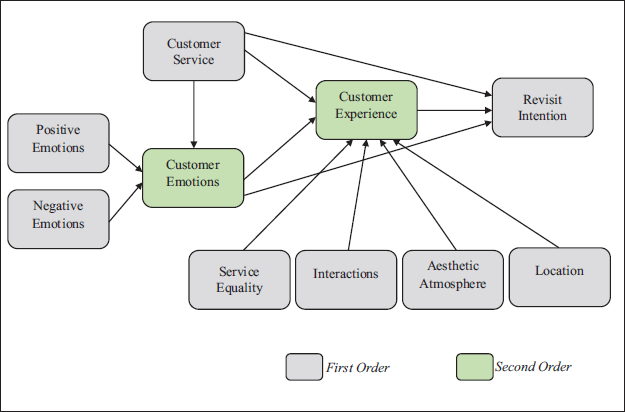
Proposed Research Framework.
Thus, the research focuses on the robot’s inabilities as technology cannot play its role equal to a common human and sheds light on the area where customers feel that humans cannot be replaced by machines as they can better understand the emotions of guests, which is highly required in a service industry. It is also strongly believed that though human-like robots instigate quality customer interaction (Brengman et al., 2021), extreme human resemblance to robots would affect guests’ attitudes towards service expectations and robots (Belanche et al., 2019; Huang, Cheng et al., 2021). For the hotel to be considered itself as hospitable, it needs to demonstrate caring for the guest’s happiness and quality of experience. Thus, the combination of both hospitality and service impacts guest experience where service cannot be recognized without hospitality that connects customers emotionally. Nevertheless, though robots can offer efficient services, they can never interact graciously and sociably with the guests due to their lack of emotion, and studies have also revealed that customers have negative emotional responses towards service robots (Akdim et al., 2021; Mende et al., 2019). Since guests’ emotions, service and experience dimensions lack examination and are still unclear, this current research investigates the impact of human-like robots on customers in hotels, which can augment the guest revisit intention. Therefore, the study aims to investigate what influences customer service, emotions and customer experience in robotic hotels, thereby leading to wider acceptance of robots, which may finally lead to repeat visits of customers.
Thus, the following research questions were framed to examine the problem statement. RQ1: What influences the customer service provided by robots in service robot hotels? RQ2: What are the underlying factors that affect customer emotions in robotic hotels? RQ3: What factors influence customer experience in service robot hotels? and RQ4: How do the identified dimensions affect guest revisit intention in service robot hotels? Therefore, the study acknowledges the robot application in hotels and its impact on customer service, customer experience, customer emotions and revisit intention.
The article further has theory and hypothesis development in Section 2, followed by data collection and analysis in Section 3, results and discussions in Section 4, implications of the study in Section 5, and finally conclusion and future research directions in Section 6.
Many theories have been applied to know the attributes that affect the willingness towards service robot acceptance and human–robot interaction, especially from the perspective of consumers (Fuentes-Moraleda et al., 2020). Cognitive appraisal theory is a theory of emotions, which explains that an individual’s evaluative judgement of a particular situation, event or object ultimately determines the emotional responses. This theory was first proposed by Schachter (1964) and further other researchers developed it. Studies have highlighted that this method is a promising roadway for examining emotions in the context of consumer behaviour (Bagozzi et al., 1999; Johnson & Stewart, 2005). This concept has appeared as a valuable framework for analyzing responses towards information systems in general (Beaudry & Pinsonneault, 2005; Fadel & Brown, 2010) and service robots (Stock & Nguyen, 2019). Despite the fact that synthesizing fully developed human-like emotions necessitates extensive modelling of numerous cognitive functions, this theory has been used as a foundation for the methodical construction of artificial emotion systems. Several studies have adopted this theory to analyze service robots’ acceptance (Paluch et al., 2021; Pande & Gupta, 2022; Schepers et al., 2022). Henceforth, this current study applies cognitive appraisal theory to examine the guest emotions towards service robots that influence the revisit intention in hotels.
Revisit intention is referred to as the intention of a customer to use a product/service continuously and indicates consumer satisfaction or dissatisfaction (Sirohi et al., 1998) and the chances of a customer to again visit the same product/service provider in the future time period (McDougall & Levesque, 2000). Therefore, revisit intention is a crucial element for measuring the effectiveness of relationship marketing as it is helpful in estimating the likelihood of maintaining relationships (Zeithaml, 1988). Very recently, a study was conducted to measure the impact of robot anthropomorphism towards revisit intentions, and findings reveal that hotel guests have high-performance expectations for human-like robots, which, in turn, creates high revisit intentions (Cui & Zhong, 2023). Also, it has been proved that perceived value, empathy, perceived ease of use and perceived usefulness directly affect the intention of elderly customers towards the usage of service robots (Huang, 2022). Other studies related to revisit intention include research that examines the factors which influence Generation Z customers’ intention to revisit robotic restaurants (Gupta & Pande, 2023), analyzing the effect of self-service technology, service quality and corporate image on guest satisfaction and their intention to revisit among luxury hotels in Malaysia (Li, 2020). Table 1 demonstrates the significant outcomes of the selected literature.
Significant Outcomes.
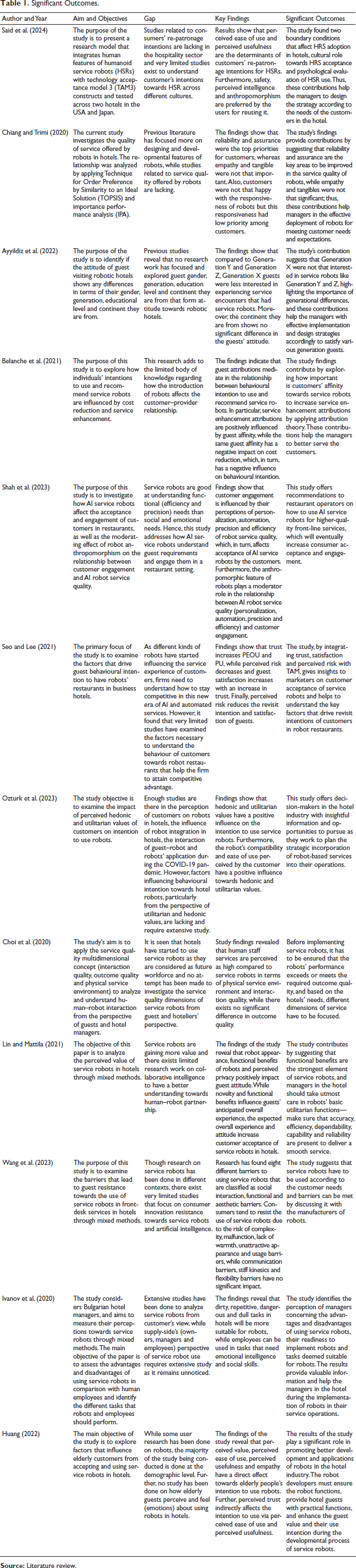
Significant Outcomes.
Services include all that an organization makes to satisfy their customers. Services are different kinds of activities performed between the customers and organization to enhance sales and use of products. Xu et al. (2019) and Herjanto et al. (2021) have studied the relationship impact of service failure on customer emotions in airline services, and the findings in the former revealed that service failures influence the positive and negative emotions of the customers whereas the results of latter claims that service failure has a direct impact on negative emotions of passengers.
Barari et al. (2020) have empirically tested the impact of service failure on the experience (affective and cognitive) of customers from the context of online shopping and the results show that service failure negatively influences the customer experience. Singh and Söderlund (2020) analyzed the impact of the same variables in online grocery shopping and found that customer service significantly affects the overall experience of the customer. Furthermore, Ross et al. (2020) identified various factors (contextual and personal) that impact customer experience whenever service failure happens in rail transport. Moreover, service failure influences emotions and these emotions affect the behavioural outcome of the consumers (Harrison-Walker, 2019)
H1: Customer service has a negative influence on customer emotions. H2: Customer service has a negative influence on customer experience. H3: Customer service has a negative influence on revisit intention.
Customer emotion is a measure of how customers feel about a particular product or service. Isaac and Budryte-Ausiejiene (2015) defined emotion as ‘affective states characterized by occurrences or events of intense feelings associated with specific evoked response behaviors’. Emotions represent the mental state of a customer, which is followed by the subsequent actions that the customer undergoes during the experience of a product or service (Bagozzi et al., 1999). Customers exhibit both positive emotions and negative emotions (Walsh et al., 2011) when they interact with people, and customer emotions are generally instigated through many ideas that vary widely. For example, in retail service, customer emotions are evoked by interacting with other customers, employees and the store ambience (including music, scent and lights) (Pantano et al., 2021).
Researchers have examined the relationship between customer emotions and customer experience and findings indicate that emotions drive the experience of the customer both positively and negatively (Manthiou et al., 2020; Torres et al., 2019). Furthermore, a few studies have also claimed that customer emotions and behavioural intention of guests in hotels are positively associated (Ahn & Kwon, 2020; Ryu et al., 2021).
Polas et al. (2022) identified that service quality, physical environment and perception of price have positive effects on customers’ revisit intention in halal restaurants. Leri and Theodoridis (2019) examined the relationship between emotions and post-visit behaviour intentions in the context of a winery visit and the results represent a positive impact between both emotions and behavioural intention. Though studies have examined the impact of customer emotions on willingness to use (Della Corte et al., 2023), approach behaviour (Chen & Girish, 2023), customer attitude (Hlee et al., 2023), consumer opinion and comments (Borghi & Mariani, 2022) in robot-assisted hotels, there exists lack of research that has tested customer emotions on revisit intention that adds value to the study. Moreover, as these robots cannot replace humans due to empathetic intelligence (Čaić et al., 2018; Huang & Rust, 2018), the following hypothesis is framed in a way different.
H4: Customer emotions have a negative influence on customer experience. H5: Customer emotions have a negative influence on revisit intention.
User (customer) experience is meant as how people utilize a product and the extent to which the product serves the purposes from the context of experience (Alben, 1996). Becker and Jaakkola (2020) defined customer experience as ‘non-deliberate, spontaneous responses and reactions to particular stimuli’. Business leaders strongly focus on customer experience, and in modern business practices, customer experience management is the backbone (Hodgkinson et al., 2021). Understanding customer experience has become the biggest challenge to any firm as it needs internal capabilities to deliver such experiences (Lieberman, 2020), which focus on ‘treating consumers as humans, not just a target’. With the purpose of offering superior value-added propositions to customer experience, the hospitality industry is now altering itself with new technological advancements that help firms in the best management processes (Buhalis et al., 2019). Previous research by Paisri et al. (2022) proved that customer experience has to be focused to generate revisit intention. Many studies have investigated the relationship between customer experiences and revisit intention and identified that customer experience has a positive impact on revisit intention (Shahid & Paul, 2022; Ugwuanyi et al., 2021).
H6: Customer experience has a positive influence on the revisit intention.
While many studies have tested the mediating effect of customer experience in different contexts, such as banks (Kumar et al., 2021; Mokha & Kumar, 2021, 2024), departmental stores (Srivastava & Kaul, 2014) and mobile phones (Sheng & Teo, 2012), there exist no studies that have analyzed the mediation effect of customer experience in robotic hotels. Amoako et al. (2023) demonstrated that customer experience mediates between online innovations and repurchase intention in hotels. Furthermore, a previous study has tested the mediating effect of customer experience between customer emotions and behavioural intention relationship in passenger shipping service (Gerou, 2022), whereas the current study examines the same in the context of robot-assisted hotels. While the mediation effect of customer experience between customer emotion and behavioural intention is tested in the shipping service context, there is no study that has tested the mediation effect of customer experience between customer service and revisit intention that highlights the study’s value. Thus, the following hypotheses are framed:
H7a: Customer experience significantly mediates between customer service and revisit intention. H7b: Customer experience significantly mediates between customer emotions and revisit intention.
Based on the above theoretical development and hypothesis, the following research framework is proposed as shown in Figure 1. The research framework consists of both first- and second-order constructs to analyze the revisit intention of customers in robotic hotels.
Materials and Methods
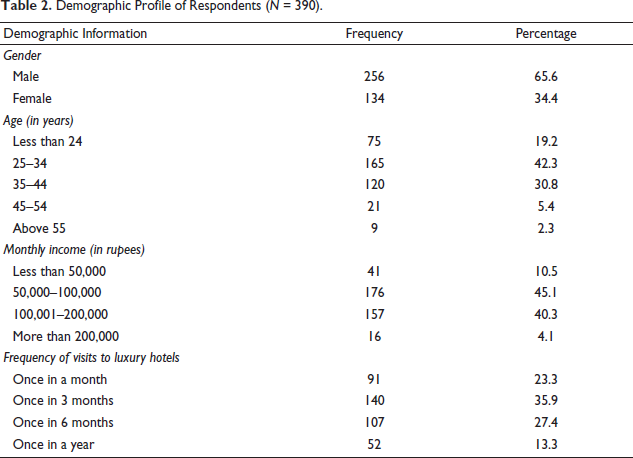
The prime objective of the study is to investigate the revisit intention of customers in robot-assisted service restaurants, and the responses are obtained from customers who have prior experience with service robots in hotels. Purposive sampling was implemented to collect data through online questionnaires (from March 2023 to June 2023) and the study has revealed that online surveys can be carried out at a low cost and have a high response rate (Griffis et al., 2003). Table 1 represents the distribution of the respondents taken for the study. A total of 390 responses were received in the data collection phase, among them, male and female respondents were 65.6% and 34.4%, respectively. It is observed from Table 2 that the maximum respondents fall in the age group of 25–34 years and income level ₹50k–₹1L. Furthermore, it is interpreted that maximum respondents visit luxury hotels every 3 months once.
Demographic Profile of Respondents (N = 390).
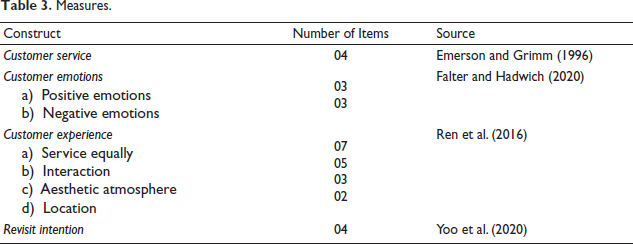
The questionnaire contains all the constructs that are required to achieve the objective of the study, which consists of 31 questions to measure 4 constructs and another 6 questions to collect demographic data for the study. This research applied five-point Likert scale (1—strongly agree, 2—agree, 3—neutral, 4—disagree, 5—strongly disagree) to measure the constructs as it is relatively easy to use (Preston & Colman, 2000), less confusing and has increased rate of response (Bouranta et al., 2009). Table 3 indicates the sources of the items adopted for the study, and the questionnaire which is used to collect data can be found in Appendix A.
Measures.
Structural equation modelling (SEM) is used to test the model as it enables researchers to evaluate high complex models with many constructs and indicator variables even with a smaller sample size (Sarstedt et al., 2021). Partial least squares structural equation modelling (PLS-SEM) is considerably good when compared to covariance-based SEM as PLS-SEM is good and strong in analyzing data and is more applicable to test the model that gives the direct, indirect and total effects of the constructs (Hair & Alamer, 2022). Furthermore, PLS-SEM also offers much flexibility in estimating relationships in the model (Sarstedt et al., 2020). Both measurement and structural models were performed using PLS-SEM using semopy library in Python programming. Before SEM analysis was performed, the measurement model was tested for reliability and validity. To verify the instrument’s reliability, Cronbach’s alpha metric was used and discriminant validity was performed by the Fornell and Larcker (F&L) criterion and heterotrait–monotrait (HTMT) ratio. Other parameters like composite reliability (CR), average variance extracted (AVE) and average loadings (AL) were also taken into consideration to test the instrument’s reliability and validity.
From Table 4, it can be observed that constructs have a good internal consistency, and all the variables were found to have their Cronbach’s alpha and CR value greater than the desired value of 0.70 (Ali et al., 2018; Traymbak et al., 2022). The AVE was estimated and found that all the factors have values greater than 0.50, thereby satisfying the conditions of Fornell and Larcker (1981).
Validation of Measurement Model—Reliability and Validity.
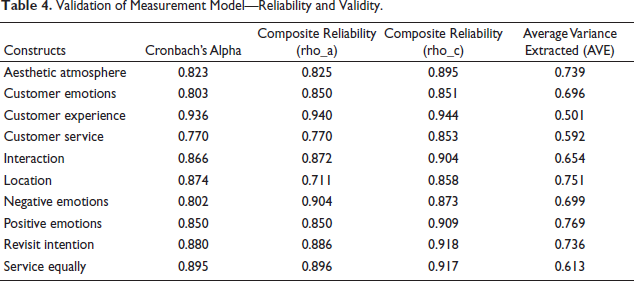
Validation of Measurement Model—Reliability and Validity.
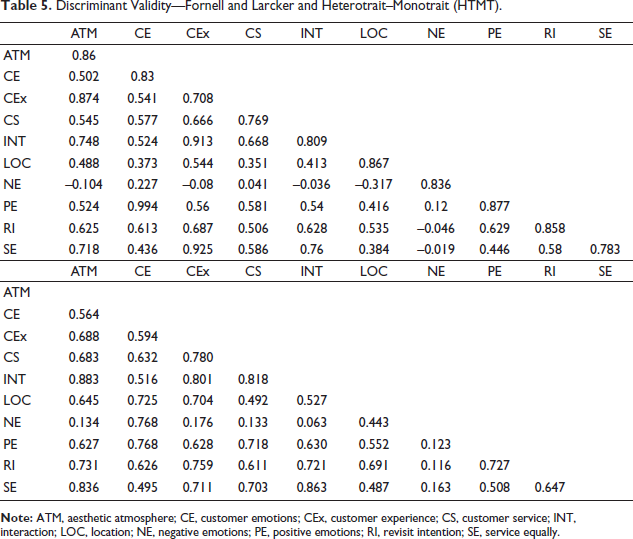
Discriminant validity by F&L criteria is calculated by comparing AVEs square root and other respective correlation values of the variables (Fornell & Larcker, 1981), and found that all the AVEs square root values were greater than the correlation values of the variables. Table 5 represents both cross-correlation of constructs through square roots of AVE and HTMT values. It is also observed that all the HTMT values were below the threshold value of 0.85 and 0.90 as recommended by Henseler et al. (2014) and thus proved that the discriminant validity was satisfied for all the constructs in the research model. Henceforth, the measurement model accomplished the conditions of reliability and convergent validity.
Discriminant Validity—Fornell and Larcker and Heterotrait–Monotrait (HTMT).
Data were taken for further analysis through SEM after validating the measurement model wherein the results and empirical estimates are represented in Table 6. It is observed that hypothesis H1, H4, H6, H7a and H7b were accepted and H2, H3 and H5 were rejected. Table 5 shows t-values, which indicate a better measure of the strengths of the relationship between variables, and it is observed that both customer service (H3; β = 0.005, t = 1.086, p > .05) and customer emotions (H5; β = 0.002, t = 1.149, p > .05) have an insignificant impact on revisit intention, whereas customer experience has a significant positive relationship towards revisit intention (H6; β = 0.529, t = 4.576, p < .05). Similarly, customer service (H1; β = 0.236, t = 19.513, p < .05) and customer emotions (H4; β = 0.357, t = 3.703, p < .05) have significant positive association towards customer experience. Finally, customer service (H2; β = 0.002, t = 1.008, p > .05) was found to have an insignificant impact on customer emotions.
Hypotheses Results.
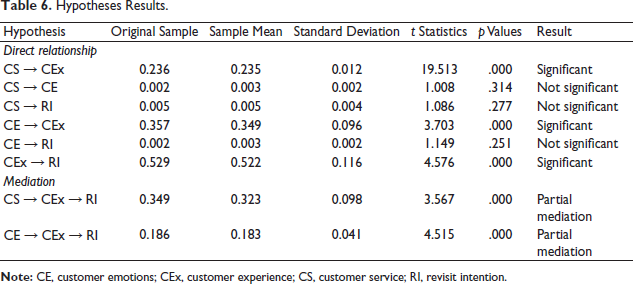
Table 6 shows the mediating role of customer experience. To study the mediation effect, customer experience was sectioned into two scenarios. First, the customer experience mediation effect is analyzed between customer service and revisit intention (β = 0.349, t = 3.567, p < .05) followed by the same between customer emotions and revisit intention (β = 0.186, t = 4.515, p < .05). It is observed that in both cases, customer experience partially mediates and hypotheses H7a and H7b were also accepted. Henceforth, it was found from Table 5 that customer service and customer emotions have insignificant influence towards revisit intention but through customer experience, which acts as a mediator, both customer service and emotions were found to have a significant positive impact on revisit intention.
This study has made a theoretical contribution to exploring the impact of service robots on revisit intention using cognitive appraisal theory. Our study highlighted the negative impact of humanoid robots on customer emotions and customer service, which is similar to a study that has already pointed out the negative impact of using robots (Fusté-Forné, 2021). In contrast to research that has focused on the benefits of service robots (Shin, 2022) and the positive impact of robots on usage intentions (Kim et al., 2022), this current study highlights the negative impact of robot adoption on customer emotions and customer service, which ultimately influences guests’ revisit intentions. A recent study found that Generation X guests are less interested in service robots in service encounters because they believe that artificial humans offer many disadvantages (Ayyildiz et al., 2022). In addition, it is recognized that services provided by robots affect guests’ behaviour compared to services provided by employees (Chan & Tung, 2019). Thus, the findings extend the research to analyze the influence of service robots on guests’ intention to revisit hotels.
This study examined the impact of artificial robots on customer emotions and customer service in terms of revisit intention and found an insignificant impact. Specifically, we examined the mediating effect of customer experience in two different scenarios. First, we tested the mediating effect between customer emotions and revisit intention, and second, between customer service and revisit intention. In both cases, the results showed a significant impact, thus proving the mediating effect. Therefore, this study extends the theoretical considerations of revisit intention in hotels with service robots by examining the effects of customer emotions, customer service and customer experience, providing a better understanding of guests’ expectations of artificial robots.
Driven by guests’ desire for robotic service during the COVID-19 pandemic (Kim et al., 2021) and the positive evaluation of service robots in mid- and high-end hotels (Chang et al., 2022), managers need to understand the extent to which the use of service robots in hotels with robots is generally accepted by guests. Previous research has shown that while robots promote innovative, interesting and diverse interactions that benefit hotels (de Kervenoael et al., 2020), extremely human-like robots negatively affect guests’ willingness to accept service robots (Huang, Chen et al., 2021; Roy et al., 2020). In our study, we found that service robots affect customers’ emotions, which, in turn, could influence revisit intention. Even though artificial robots provide expeditious and efficient service, employee service is still the heart of hotel operations. Accordingly, we suggest that the combination of robotic and employee service would represent a brighter future for the hospitality industry. This recommendation is consistent with a previous study that the fusion of staff and robots not only reduces costs, frees staff from unnecessary services, and involves them in handling more complicated service content (Wang et al., 2022), but also provides customers with highly satisfactory service. In addition, managers need to understand users’ acceptance of robotic services and plan service delivery according to guests’ needs.
Conclusion
Service robots have always been viewed as one that enhances guest experience. Ergonomically speaking, robots are used in many fields other than hotels, such as manufacturing industries, health care, airline and education, due to their ease of use and convenience. Furthermore, customer preference for service-assisted robots in hotels greatly increased during COVID-19 (Shin, 2022) as customers feel safe and secure during the delivery of services without human touch. In the early days, many researchers’ main focus was on the technical functions or operational challenges of robot-assisted services (Pinillos et al., 2016). As many service robots are emerging with social features like interaction and expressing emotions towards guests, researchers have started showing keen interest in understanding the guest experience in robotic hotels (Hall et al., 2017). Though many studies have proven the acceptance of robot services, it is still unclear if these artificial machines can completely replace humans.
This study contributes largely to the existing knowledge in the field of artificial robots to understand the recent dynamics in the hotel industry as these humanoid robots have started appearing in the lodging industry (Pinillos et al., 2016). The present research provides insights into factors like customer service, customer emotions and customer experience towards revisit intention in the hotel industry. The main objective of this study is to enhance the visiting intention of guests in robotic hotels and give suggestions to further improve guests’ experience that leads to increased revisit intention. This study further helps in knowing the acceptance of technology (service robots) by the guests in service robot hotels. The mediating effect of customer experience helps to gain an understanding towards the importance of it in improving the visiting intention of guests in hotels, and it is found to be in accordance with the previous research by Amoako et al. (2023), Veloso and Gomez-Suarez (2023), Lv et al. (2024) and Kwon et al. (2024).
The direct and positive influence of customer experience on the revisit intention has relevant and managerial implications. Customer experience plays a vital role in the adoption of service robots in hotels that convert new visitors to loyal ones. Hence, to improve guest revisit intention, it is highly necessary that managers nurture the experience of the customers through humanoid robots and understand the customer psychology towards the acceptance of robots to deliver the services. The result of this study shows that customer experience has a significant positive impact towards customer revisit intention in robotic hotels, and it is found to be in accordance with the previous research by Gibson et al. (2022) and Shoukat and Ramkissoon (2022).
Customer service provided by robots also plays an important role in increasing the visit intention of guests. Though a study in the past proved that adopting service robots provides a smooth customer experience than any other self-service technologies, it appears reasonable to accept that customer experience with humanoid robots depends on how good the robots provide service assistance (both functional and social) to meet the requirements of customers (Wirtz et al., 2018). Human-like robots will never be idealistic service providers as the services delivered by humans cannot be substituted by robots. The findings of the study show that customer service provided by artificial robots has an insignificant impact on revisit intention, whereas it has a positive impact on customer experience. The results were in accordance with the previous study that identified an emotionless and apathetic robot cannot be considered an ideal caregiver (Stahl & Coeckelbergh, 2016), which may have an impact on revisit intention. Another research has also claimed that service robots need to be enhanced with social interaction skills (Huang, Chen et al., 2021) to provide better service to hotel visitors. Henceforth, hotel managers should focus on the service requirements of customers, such as accuracy in delivery service, friendly interaction, personalized service and engaging guests, and understand their expectations towards service robots in the delivery of service that may positively reflect on good experiences and revisit intention of the guest.
Customer emotion has a great influence towards guests’ experience that might generate both positive and negative emotions. To further generate positive emotions in customers, robots are designed with anthropomorphism features that portray human-like characters. However, research suggests that humanoid robots are not only judged by their behaviour but also by how realistic they are (Miao et al., 2021). Though, it appears that robots with anthropomorphic features elicit positive responses from the customers, it is identified that absolute human-like robots were mostly evaluated negatively by the guests (Sundar et al., 2014). Henceforth, this study’s main objective is to analyze customer service and customer emotions’ influence on customer experience, which consequently leads to revisit intention.
Results of the current research work show that customer emotion generated by service robots has an insignificant impact on revisit intention, wherein customer experience mediation effect between customer emotion and revisit intention is significant. The Uncanny Valley Theory states that though anthropomorphism can enhance people’s acceptance towards robots, extreme human-like robots can result in discomfort to guests, as the complete imitation of humans can never be perfect. Furthermore, the extent of the robot’s human likeness depends on the user’s level of comfort with the service robots and anthropomorphic robots may invoke negative feelings of discomfort and uneasiness (Mende et al., 2019; Mori et al., 2012). Previous studies claim that replacing humans with robots would dehumanize care, resulting in emotional concerns and isolation, especially for elderly people (Čaić et al., 2018), and emotional expressions of robots cannot be perceived as genuine (Wirtz et al., 2018) that may affect the visit intention of the guest. These results were in accordance with the findings of the current study, which showed that customer emotion has an insignificant impact on revisit intention, and the mediation effect of customer experience shows the importance of it, which helps to enhance the guest intention to revisit. However, customer emotion has a significant positive impact on customer experience. Hence, understanding customer emotion towards artificial robots is very important for the managers in the robotic hotels to provide a good experience to the visitors, and such positive experiences will reflect in revisit intention of the customers. Thus, managers should be very careful in handling customer emotions and decide the appropriate level to use robots for service delivery.
This study empirically investigates the revisit intention of guests in robotic hotels by examining the impact of customer emotions, customer service and customer experience. It is found that customer experience has a significant positive influence on revisit intention, whereas customer service and customer emotions have an insignificant impact on revisit intention. Thereafter, the mediation effect of customer experience was tested in two scenarios and found that it is partially mediated. First, the mediation effect was measured between customer services and revisit intention; and second, between customer emotions and revisit intention. It was observed that in both cases, the mediation effect had a significant impact. Like previous literature, this study also proves that service robots though provide quick and efficient services, they cannot be substituted by humans. Though robots offer quick services, the extent to which it has to be used to serve customers in the hotel is very important. Hence, the study suggests that a combination of both robots and employees would enhance customer experience, and managers must be very careful in deciding when to use robots and when to deploy employees to deliver services to their customers. Thus, the results of the research can benefit hotels to a greater extent by understanding and managing customer expectations towards service robots. Furthermore, it gives deep insights concerning the emotional responses of guests invoked by the artificial robots that influence revisit intention. We believe that this research model is generalizable across different service sectors like healthcare, education, airlines and so on.
Limitations and Future Research Directions
Many limitations of this study have to be acknowledged that when taken positively provides a strong base for future research in the adoption of service robots not only in the hotel industry but also in other service sectors.
First, this study is limited only to the hotel industry, which has restricted the understanding and application of service robots in various other service sectors. Industries that are service-oriented, such as banking and education, possess unique challenges and have different emotional dynamics, wherein robots have to perform their activities accordingly to enhance the customer experience. Future research is encouraged to investigate the service robots in other service sectors, such as education, banking, robotic baristas, entertainment and so on, that require robots to understand customer emotions.
Second, this research has its limitations in the variables used to analyze revisit intention. Though authors have generally analyzed the customer emotions and experience to understand the revisit intention in robotic hotels, future studies can have a deeper investigation into factors, such as inconsistent service quality, social discomfort, perceived risk and cultural nuances, to analyze the revisit intention of the customers. Understanding these factors can offer valuable insights for customizing service robots to target specific customers.
Third, the current research is limited to cross-sectional study, and hence longitudinal studies can be recommended for further research that would help examine the long-term effects of service robots in luxury hotels. This would enhance the understanding of the service robot’s influence on customer revisit intention over a period of time.
Fourth, the study uses quantitative data to analyze the revisit intention, whereas the same research can be conducted qualitatively through comments, interviews or semi-structured interviews. Analyzing the data qualitatively, such as interviews, provides a deeper understanding of individual experiences and emotions that would not be possible in empirical studies. This would offer rich information that reveals the real customers’ emotions and attitudes, which cannot be quantified.
Last, future research can also probe into developing best practices to implement service robots in luxury hotels considered from successful case studies and investigate innovative techniques to further enhance the revisit intention of customers.
Footnotes
Appendix A
Technical knowledge is appropriate Reliability of information is fair Integrity of robots is good Competence (ability or skill) of robots is great
I have a feeling of happiness because of robots I experience pleasant feelings due to robots I feel joy because of services of robots
I feel stressed due to robots I have negative feelings because of robot usage I am embarrassed as robots are used
Cleanliness of service rendered by robots Fragrance controlled by robots Showering of room cleanliness by robots Quietness in the hotel premises maintained by robots Temperature of the room controlled by robots Providing facilities to have comfortable shower in the room by the robots Maintenance of the hotel by the robots
Robots communicate promptly Robot interaction is excellent Robot responsiveness appreciable Information provided is valuable Robot’s welcome gesture is good
External visual provided by robots is appealing Internal visual provided by robots is pleasing Colour combination controlled by robots in the hotel room is attractive
Hotel is situated nearby your place Hotel is situated in a convenient location to all
I intend to revisit this hotel in the near future I plan to revisit this hotel continuously I am likely to revisit this hotel next time It is very likely that I will revisit this hotel very often
Acknowledgement
The authors would like to express their heartfelt gratitude to all respondents who participated and contributed to the primary data collection process.
Authors’ Contribution
A. Suganthi: Conceptualization, Methodology, Visualization, Data curation, Formal analysis, Investigation, Writing—original draft. K. Mohamed Jasim: Conceptualization, Methodology, Writing—review & editing, Supervision, Validation.
Code Availability
Not applicable.
Data Availability
Not applicable.
Declaration of Conflicting Interests
The authors declared no potential conflicts of interest with respect to the research, authorship and/or publication of this article.
Ethical Declaration
The authors abide by all the ethics involved in this academic work and have not submitted it to any other journal.
Funding
The authors received no financial support for the research, authorship and/or publication of this article.
Informed Consent
Not applicable.
Research Involving Human Participants and/or Animals
Not applicable.
