




Abstract
Traditionally, a policy-making exercise is regarded to be a mechanical process comprising well-defined steps and it is presumed that if those are taken care of, a sound policy is put in place. These key steps normally include—(a) problem identification, (b) selection of the policy options from the given basket of choices, (c) implementation by the available public agency, (d) monitoring and feedback and (e) review and rectification. Of late, policy makers have started focusing on the stakeholders, the deadlines and the media management too. However, in this ‘linear rational’ view of policy making, ‘the element’ which though involved from beginning to the end yet normally given a miss is the ‘human factor’. Interestingly, this ‘human factor’ or ‘the agency’ does not happen to be a mere ‘complex grouping of cells’ or ‘an automated robot’. According to psychologists, this ‘mammalian agency’ might carry an endless emotional, intellectual and psychological baggage which according to my research insight is capable of impacting the entire policy process often in unintended and unforeseen ways. This, in Indian context, has significant dimensions since it is a pluralistic society and every individual carries a plethora of social identities, namely, caste, sub-caste, class, ethnicity, creed, language, religion, gender, rural–urban and constitutional status, etc. These multiple identities often supersede or come in clash with the national identity and in turn might come in the way of ‘public interest’. This article, therefore, takes a look at how in real world, this psychological baggage or attitudes of human agency might interfere with the policy process at implementation level, distorting the entire policy outcome. The methodology adopted is that of an ethnographic case based analysis located in an Indian public organization. Taking a cue from existing literature and prominent policy frameworks and adopting select qualitative research tools, an inferential analysis is done to inform the research question—‘How bureaucratic attitudes can mess up with policy implementation to defeat the very purpose of an otherwise well-intended policy?’
Keywords
Introduction
Humans are ‘not creatures of logic’, but ‘creatures of emotion’, creatures bristling with prejudices and motivated by pride and vanity. Dale Carnegie
Generally, a policy-making exercise is regarded to be a scientific process comprising well-defined linear steps which if taken care of, a sound policy is supposed to be put in place. These key stages or steps normally include—(a) problem identification, (b) selection of the possible policy options from the given basket of choices, (c) committing resources, (d) implementation by the available public agency, (e) monitoring and feedback and (f) review, reassessment and rectification. However, when seen in practice, this exercise very often turns into a mechanical process underpinned by an assumption that that if a well-designed policy and a good implementation mechanism is put in place, the policy objectives will automatically be achieved (Thomas and Grindle, 1990). The idea is often backed by a theory of gap between existing and desired state of an affair and the variable(s) that could be manipulated to reach that desired state. A wishful thinking, more often than not, it is, although lately policy makers have started taking into account the target beneficiaries, budget utilization, deadlines and the media management also, primarily borne out of the intent of managing a vote bank. However, what gets completely missed in this entire process of the policy making process, is the ‘proxy human agency’ 1 handling the entire affair right from the identification of the problem to the implementation and review.
In contexts like India, this human agency happens to be a highly structured bureaucracy as it is they who identify the problem, choose and design the appropriate policy intervention. No doubt they keep in their view the major stakeholders but ‘who will be consulted, who will be left out, who will be simply ignored and whose advise will be paid heed to and to what extent and when’ is all decided by them. And beneath this entire process lies the biggest assumption that the ‘agency’ will behave in a rational manner being well recruited, educated, sensitized, trained and being under oath to work in public interest along with an unflagging allegiance to the constitutional will and obligation to the prescribed Conduct Rules. But in real world, this rational approach and the model may not hold since it tends to be overly linear and simple (Young et al., 2009). It overlooks that the ‘human actors’ or ‘agency’ are neither robots nor a mere ‘complex grouping of cells’ but a bundle of emotions, thoughts and perception with lots of irrationality and unexplainable engrained in their personalities and behaviour (Berman and West, 2008; Vigoda-Gadot and Meisler, 2010) According to psychologists the ‘mammalian agency’ might carry an endless emotional, intellectual and psychological baggage. This in turn could impact each stage of policy process often in unintended and unforeseen ways. And, in Indian context, the behavioural dimension of bureaucracy becomes more important since it is a pluralistic society wherein every individual carries a plethora of social identities, namely, caste, sub-caste, class, creed, language, religion, gender, rural–urban and constitutional status.
The literature review indicates that despite being very important, this remains an under analyzed dimension of public policy. Much of the evidence that exists in this respect is anecdotal (Hill, 1992). The possible reasons could be either difficulty in using modern research methods while bureaucratic behaviour mostly remains shrouded in confidentiality or overdependence of public policy field on economics and econometrics with not much of the scope for behavioural sciences. This article, therefore, challenges the linear rational model of the policy process in the tradition of Thomas and Grindle (1990) who did it about a quarter century back. However, this article deviates from Thomas and Grindle to the extent that it looks at the policy implementation and its outcome from the perspective of ‘how human behaviour shapes it’, and in it lays its value and contribution.
Literature Review
Background and My Conceptual Framework
Meier’s works showed that bureaucratic attitudes can affect programme (policy) implementation (Meier, 1993; Meier and Nigro, 1976) and administration at the ground level (Kropf et al., 2012). The crucial role of implementation agencies and their employees in shaping the actual policy outcome was acknowledged vehemently by Lipsky in his Street Level Bureaucracy (Lipsky, 1980). He pointed out that well-designed policy is not a guarantee for successful implementation and impact since bureaucracy willingly or unwillingly may tweak it or temper with it. The possible bureaucratic constraints explained by scholars and different theoretical frameworks highlight the most common factors behind bureaucratic tempering of policy as—‘time, resource and information constraints’ (Lipsky, 1986), lack of control and monitoring (Pressman and Wildavsky, 1973), lack of knowledge and power (Long, 1992), managerial failure and lack of political will (Juma and Clarke, 1995; Sutton, 1999), complexities of implementation and management and resistance to change (Crosby, 1996; Thomas and Grindle, 1990), policy and implementation divide, especially, in the linear view (Thomas and Grindle, 1990), the urge and endeavour to simplify complex things, often with help of narratives and discourses (Sutton, 1999), political pressure (Sabatier and Mazmanian, 1980), agency power (Long, 1992) and unmanageable number and variety of implementing agents (Verhoest et al., 2012).
The rational linear model was first questioned by Thomas and Grindle (1990) who pointed out that ‘the role of implementation in the [policy] process is substantially different from the linear model’. Parsons and Parsons (1995) posited that the rational model of policy making and public management were ‘not effective in practice, nor convincing in theory’ (Parsons and Parsons, 1995, p. 468). Sutton (1999) concluded that ‘there is much evidence to suggest that this model is far from reality’. And I posit that things in policy arena have refused to change even after lapse of a quarter century. The linear rational view of policy remains a popular choice with policy makers and despite so much of debate, around ‘rational choice theory’, questioning the simplistic assumption that that people do not always behave rational, things in public policy arena have not changed much, especially in Indian context. According to Hill and Hupe, policy is a ‘moving object’, (Hill and Hupe, 2009) and, therefore, an inert linear view with a simplistic presumption that people behave rational will not hold in real life.
Further, the scholars have debated over whether the attitudes of bureaucracy are shared by the societies they serve or whether bureaucrats hold belief that they have ‘a representative role, particularly if they are a racial or ethnic minority’ (Selden et al., 1998; Wilkins and Williams, 2009) or women (Keiser et al., 2002; Kelly and Newman, 2001). Theory of representative bureaucracy posits that the bureaucrats represent the interest and the desire of the people they share demographic profile with (Mosher, 1982, p. 14). The agency theory explains the reason of discordance and dilution of policy intent at implementation level in terms of clash of interest of ‘principal’ and ‘agents’. And to control the behaviour of the agents, the principal uses incentives who try to maximize their incentives while making rational choices. However, Simon contesting the notion of ‘rational choice’, theorized that these agencies are ‘not monolithic black boxes; are made up of sub-units all with their own structures and cultures’ (Simon, 1997a, 1997b) and in decision making, rationality of individuals is limited by the cognitive limitations of their minds, and the finite amount of time they have. The most people are emotional (irrational) in the major part of their actions (Simon, 1997a, 1997b). Therefore, it could be posited that between the policy intent and the policy performance outcome, the mindsets and attitudes of agency remain a significant independent variable impacting the implementation.
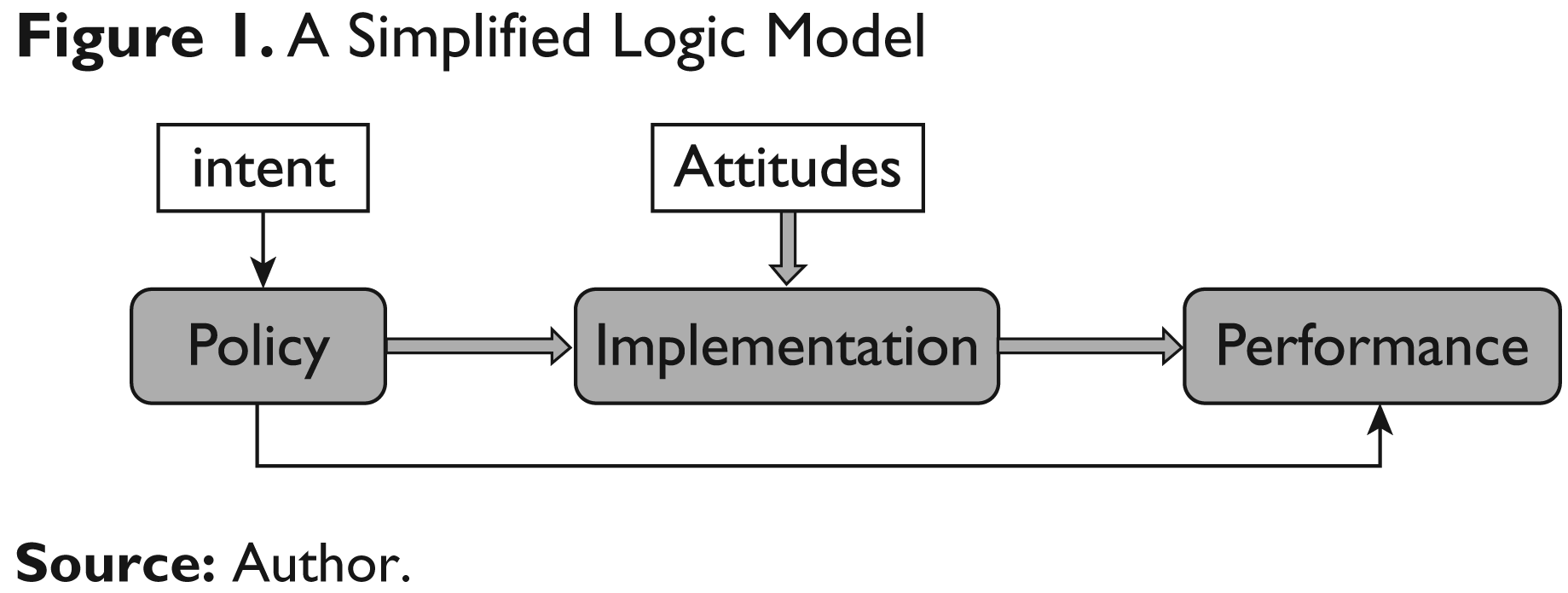
It will, therefore, be interesting to see as to how in real life the policy is interfered and impacted at implementation level by the mindsets and attitudes of the ‘agency’, that is, the bureaucrats. Does the agency or actors make ‘rational choices’ while implement and making decisions? Does the linear view of policy still holds in real life? It is these question that I attempt to seek answer to, with the help of a real life case based analysis, set in an Indian public organization, as not much of research exists in the area of implementation (Hupe, 2014; Mooji, 2003).
Methodology
Clemons and Foster suggested that to understand the public policy praxes in all its complexity, the case based approach is a desirable method (Clemons and Mcbeth, 2009; Foster et al., 2010). The methodology adopted here is that of a case based approach to policy analysis. The case and the involved policy implementation process was closely observed and analyzed by me in a public organization in Delhi NCR, India in May 2013 while conducting organizational ethnography for my PhD dissertation. Why ethnography? Well, ethnography as a method helps in understanding ‘the lived realities of workplace learning’ (Riemer, 2009, p. 2). To capture ‘process dimension of policy may require ethnographic approaches to obtain an analysis of the process through which policies are implemented’ (Dubois, 2009). It also provides useful qualitative data that offer ‘a nuanced and realistic ground-level view of policies, too often analysed abstractly from the top’ (Dubois, 2009). The Researchers like Unwin, Fuller, Hodkinson and Hodkinson, Felstead, Jewson and Eraut have used ethnographic approaches to carry out policy investigations (Walker, 2011) and their methods include ‘the use of small scale case studies’ or ‘an intensive investigation of a single situation’, as a type of ethnographic research (Hayes, 2006). Using research tools like ‘ethnographic observation, interviews and group—discussions’ and ‘social heuristics’, an inferential analysis has been done to understand the phenomenon and to arrive at the plausible answers. While doing so, I adopt the paradigm of Sabatier who says that ‘given the staggering complexity of policy process, the research analyst must find some way of simplifying the situation in order to have an occasion to understand it’ (Sabatier, 2007a, p. 4).
The case study based on my ethnographic observations in June 2014 in an Indian public organization follows.
The Case Study
‘A young female peon in a public organization makes a complaint that her boss, a male Group A officer had sexually harassed her while attempting to molest her in the workplace about a week back. According to her, first he directed her to bring him a glass of water in his lonely room and while she was handing in the glass of water, ‘he held her tightly by wrist against him and unzipped his pants’. She somehow manages to run out of the room. For a week, she remains in absolute shock and does not turn up for work but thereafter, she decides to take it up with authorities. She seeks an audience with the head of the organization (CEO) but is denied entry. She goes to the Head of the Personnel and Administration but gets a good dose of reprimand and is advised ‘not to create unnecessary ruckus and not to precipitate the issue further’ as finally nothing had happened. She is also grilled as to why she was coming and complaining after the lapse of a week’. She, then, with the help of a union leader goes to the local police station. The police station head dissuades her from registering formal report as in the first place nothing had actually happened and that the case was difficult to be sustained and rather, would bring her and her family a lot of adverse publicity. Meanwhile the CEO agrees to give her an audience but warns her not to indulge into behaviour that may bring some bad name to the organization. The next day she receives orders transferring her out to some other unit at a different station, putting her and her family into a lurch. All this happens notwithstanding a zero tolerance policy on the ‘Sexual harassment of women in workplace’ which is backed by law and penal provisions.
The Policy on ‘Sexual Harassment of Women in Workplace’
The relevant provisions of the policy are:
Provision 1
No government servant shall indulge in any act of sexual harassment of any woman at her workplace. Every government servant who is in charge of a work place shall take appropriate steps to prevent sexual harassment to any woman at such workplace.
Explanation—For the purpose of this rule, ‘sexual harassment’ includes such unwelcome sexually determined behaviour, whether directly or otherwise, as:
physical contact and advances; demand or request for sexual favours; sexually coloured remarks; showing any pornography; or any other unwelcome physical, verbal or non-verbal conduct of a sexual nature.
(
Provision 2
All employers must ensure that they provide a safe working environment for their employees.
Provision 3
Employers also have a duty to help the employee file a police complaint if she wants to press the criminal charges against the harasser.
(
Analysis and Discussion
The linear rational view of public policy continues to be a widely accepted and used framework of the policy-making process being relatively simpler and more practical. However, is it still the best approach? According to Kuruvilla, it is untenable on empirical, theoretical and ecological grounds (Kuruvilla and Dorstewitz, 2010). In the earlier case, the linear rational approach assuming that the bureaucrats at ground level responsible for implementation will behave rational, that is, as per the policy intent, proves too simplistic. It is not at all able to anticipate and address the complex irrational behavioural element of ‘the agency’ involved in implementation. The CEO neither acts upon the complaint nor gives an audience to the complainant till she files it with the police and even on hearing her; they tell her ‘not to do a thing that may bring a bad name to the organization’ and by implications, to the CEO. Here, it will not be unrealistic to think that CEO could have influenced the police officer too against her. The highest point of irrationality occurs when he gets more worried about his own reputation than of the aggrieved lady. How a complaint and the investigation into the matter might tarnish his name and image? Finally, the decision of transferring her smacks of sadistic mentality and crazy attitude of ‘kill the messenger who brings the bad news’ or ‘throw the baby with the bath tub’. As an employer, the CEO also has a duty to help the employee file a police complaint if she wants to press criminal charges against the harasser but it is the reverse of it happening in complete defiance of the policy. As an employer, he should have ordered an impartial investigation into the matter and assist the lady in filing the complaint with police if she chose so and see that the guilty was brought to the book.
Similar irrationality could be seen in the behaviour of the police station head. The law of the land says that if a lady approaches with such a complaint, the police agency will immediately file the complaint. In this case they do not; rather, they encourage her to close the case. The rationality (from the policy makers’ perspective) demands that instead of discouraging her, the police station head should have encouraged and supported her in filing the case and thus dispassionately supported the provisions of the policy in letter and spirit.
The head of the Personnel and Administration seems to be no exception to it. He is not able to see in it a case warranting their interference since ‘nothing had happened’. It is like if murder did not happen then attempt to murder is not an offence. From a rational perspective, the Administration is responsible for the overall discipline and the conduct of the officials. Under the policy, ‘any other unwelcome physical, verbal or non-verbal conduct of a sexual nature’ constitutes an act of sexual harassment. Instead of harbouring such crude and callous attitudes and putting lady in defensive as to why the lady did not complaint timely, he should have taken prima facie cognizance of the matter and put up a case for administrative investigation to the CEO. Instead, he chose to behave irrationally and in complete discordance with the policy intent. His intent was to basically put the lady on defensive which might weaken her position and might eventually force her to backtrack. What was he to gain except toeing the footsteps of the boss? Was it in public interest?
In sum, at every step of implementation, this comes up as a clear case of attitudinal distortions and negative mindsets, manifested in the bureaucrats behaviour, meddling with policy and defeating the complete purpose of it.
They do not consider molestation a crime big enough to warrant complaint and investigation. The complainant is a lady who could be treated lightly. They have taken sides with the male boss of the lady for whatever reasons, may be under some pressure or influence or may be because, he is a male. They just do not want to add to their work tray. They have a very indifferent or apathetic attitude to the issues like this.
All of it is illustrative of a very irrational approach to the issue and reflects very unreasonable and very hostile attitudes to the client.
As stated earlier, in policy literature there is ample evidence to suggest that the linear model of policy is far from reality (Sutton, 1999). Clay and Schaffer argue that ‘the whole life of policy is a chaos of purposes and accidents. It is not at all a matter of the rational implementation of the so-called decisions through selected strategies’ (Clay and Schaffer, 1984). The interactive model of Thomas and Grindle (1990, 1990) would view this policy outcome as a process in which concerned parties can put pressure for change at many points to the extent of altering or reversing the policy reform initiatives. One could very well infer that in this case the bureaucrats at the ground level have infinite ‘discretion’ not in just how to interpret the rules but also whether to apply or not to apply these rules and implement the policy in its letter and spirit.
An analysis of all possible constraints based on ethnographic observations and an explanation based on ‘social heuristics’ is given in Table 1.
The Possible Bureaucratic Constraints: An Analysis
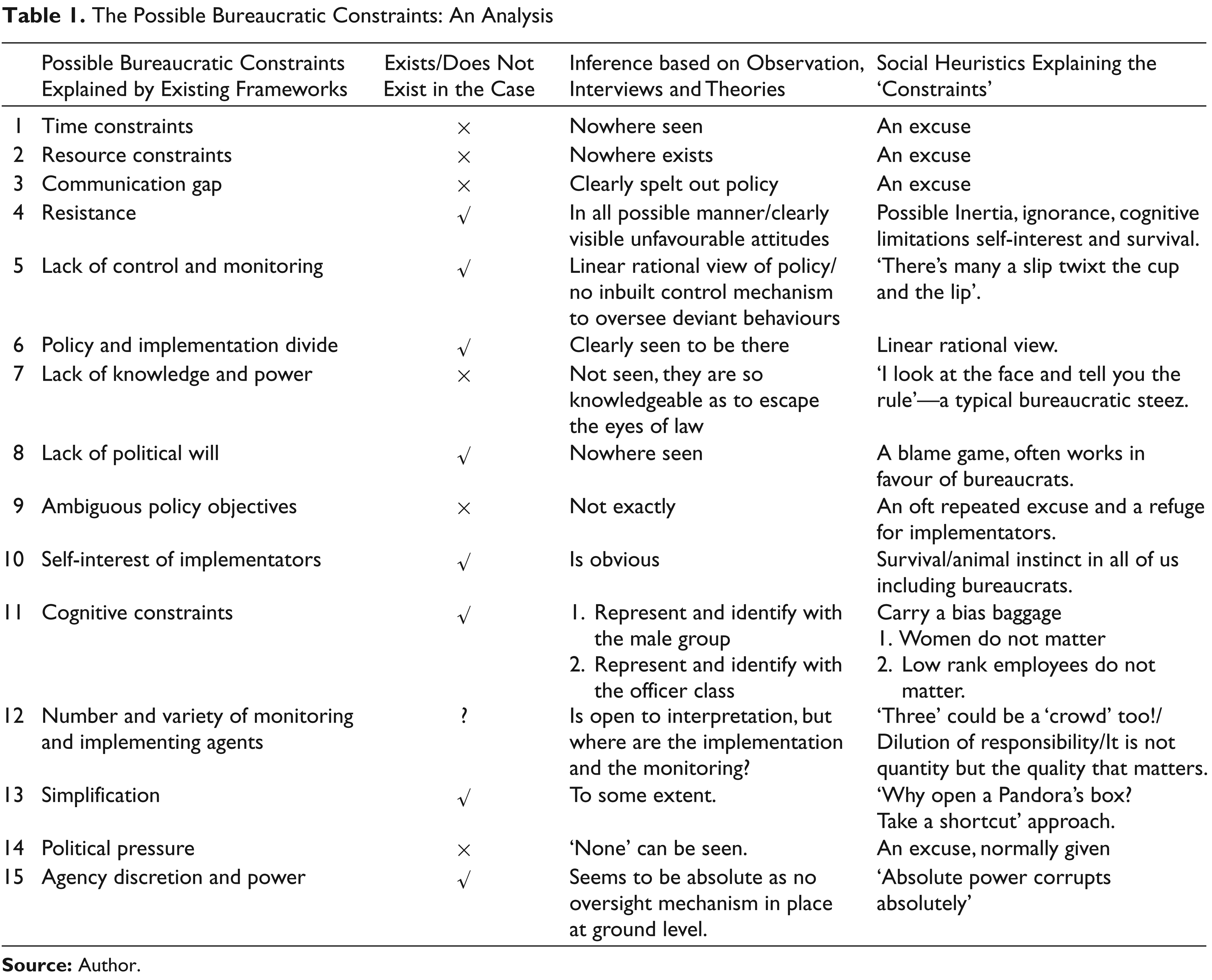
From the earlier analysis, it is clear enough that it is an exemplary case of redistributive policy gone haywire at the ground level due to bureaucratic mindsets and attitudes meddling with and messing up a well-intended policy. The net outcome is that the very purpose of the policy is defeated leaving client at the receiving end. As scholars contend that ‘implementation research is “research to see if what was intended to be done—was done—as intended” (Graham, 2008), this bit of research shows clearly that “No, What was intended (by the Policy) to be done, was not done”’.
In societies like India, the power distance between the authority and the client further may make this meddling not very uncommon as they have enormous discretion. This is notwithstanding the fact that the scholars have tried to establish that in this era of new public management ‘for the time being the street-level “policymaking” discretion observed by Lipsky is, for the most part, is over’ (Taylor and Kelly, 2006). Taylor and Kelly’s observations were due to visible ‘closer control’ and ‘better accountability’ while some scholars attributed it to increasing role of technology. However, in the Asian societies, particularly in Indian context, the bureaucracy at implementation level still has its own set of teething issues to be addressed; attitudes being, one such issue.
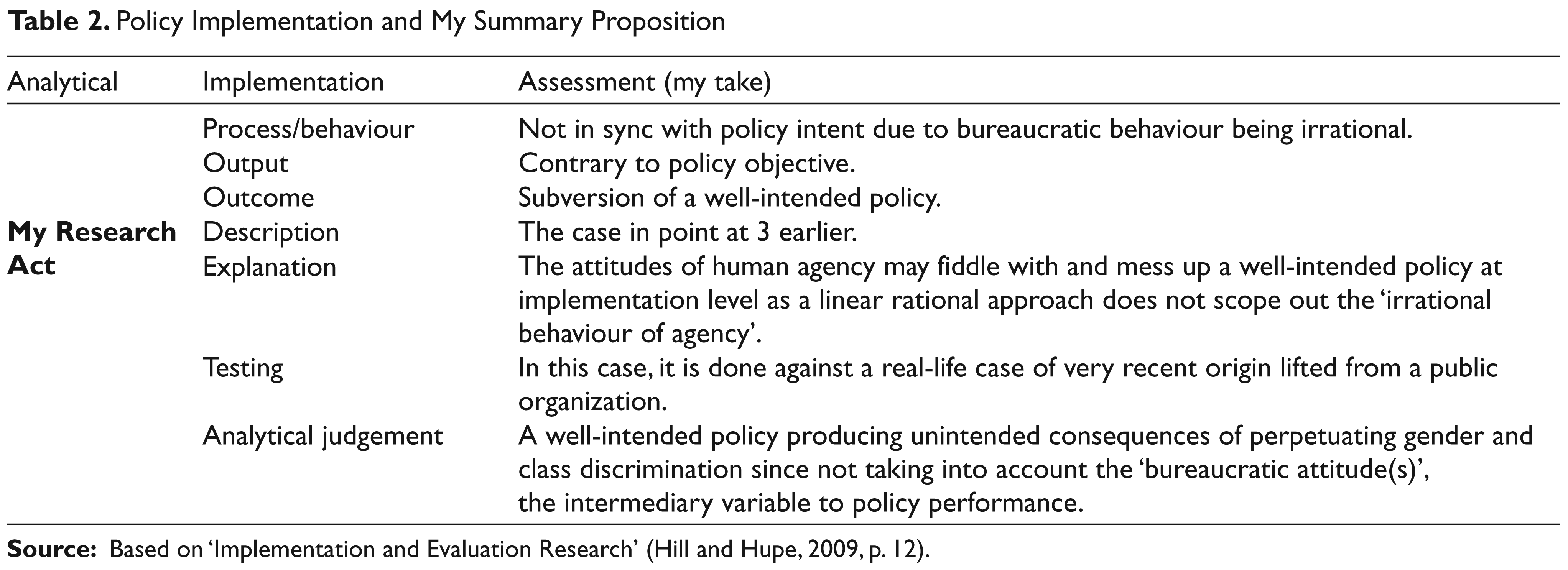
A summary of the policy implementation and my research act demonstrating my summary proposition is in Table 2.
Policy Implementation and My Summary Proposition
Implications and Conclusion
Policy is surely a ‘moving object’ (Hill and Hupe, 2009). A static linear view with a simplistic presumption that people behave rational does not hold in real life. Therefore, this article has implications for those seeking to introduce policy reforms and innovations especially in countries like India. Although, not without its limitations, being rooted in only one case, the article demonstrates the need for a new approach and an analytic framework for those interested in policy innovation. It challenges the core assumptions of the traditionally used linear rational approach of policy making and advocates the need to scoping for the irrational behaviour of human agency. It thus, contributes to the scanty body of policy implementation literature located in Indian context. It also synthesizes the previous theoretical contributions with ethnographic data taken from a case study of the ground level implementation of policy in an Indian public organization. However, since it is based on a single case study, it will be advisable to collect and analyse more such cases to have a better understanding of the earlier phenomenon. And this is my research proposition for future too towards which I am already working in my proposed thesis which was recently recognized by Emerald and Indian Academy of Management as the winner of ‘2013 Emerald/IAM South Asia Management Research Award’. In near future, I intend to come up with exhaustive findings. This article is only a precursor to that. However, I do not intend to overstate the applicability of my findings or its generalizability at this stage since I have observed a small data set of bureaucrats of one organization, and therefore, there is need for further research in the area.
Footnotes
Acknowledgements
The author expresses sincerely thanks to Professor Vishal Narain, the Chairman of her Thesis Advisory Committee (TAC) at MDI. This article could not have been possible without his encouragement, suggestions and very in-depth and painstaking reviews. The author is also thankful to Professor Rajan K. Gupta, Hony. Member, TAC and Professor M.P. Jaiswal, Member, TAC at MDI; and all the research participants including the CEO and his team of the organization where she did her ethnographic observations.
Disclaimer
The views expressed in this article are purely that of the author and not of Government of India or any of its agencies. Nothing in this article is intended to criticize any of the Government Policies or its agencies. The article is solely intended to be an academic exercise to explore and understand the nitti-gritty and complexities of the domain of public policy with a view to enrich and contribute to the body of literature on the subject.