




Abstract
Diversity dilutes lopsidedness that is inherent in a homogenous environment, and hence allows achievement of equilibrium. However, if heterogeneous groups comprising a diverse environment are incompatible with each other and unable to harness strengths and overcome weaknesses, it may lead to greater disequilibrium. The present research focuses on the diversity created in the organizations as a result of caste-based reservation system (affirmative action). The aim was to analyze the perception of the employees, belonging to both the general and the reserved category groups towards the diversity climate of their organizations. Three hundred participants, incorporating 123 general category men (GCM), 90 general category women (GCW), 66 reserved category males (RCM) and 21 reserved category women (RCW) participated in the study. They were all working in public/government sector organizations and were having firsthand experience of quota system at their workplace. A mixed methodology was adopted: Perceived diversity climate questionnaire (Surendra Kumar Sia, 2008); semi-structured open-ended question based on their views towards the overall quota system; and interview comprising of semi-structured situational questions was also taken with the 30 per cent of the sample. The analysis revealed that the perception of both reserved and general category employees towards the diversity climate of the organizations is poor. Based on the comparison between the four groups under study, the worst perception towards the diversity climate is being held by GCW and the best perception is held by RCW. The present research work also provides implications for improving the situation in terms of managing diversity created by the quota system.
Keywords
Caste system is a social practice, historically prevalent in India, of categorizing individuals into various castes and sub-castes. In the present system, a caste is inherited by an individual and not chosen. Due to power relations and differences in social status, a hierarchy of castes exists with many at the bottom suffering from lack of opportunity and support in social, political and economic spheres. In order to alleviate this situation, caste-based quota system is employed by the Government of India as an affirmative action. In the constitutionally enforced system, a fixed percentage of all student positions in the government-aided educational institutions and all employee positions in public sector organizations are reserved for selected social groups, considered at the bottom of the social hierarchy. The percentage of reservation is usually based on proportions in population to ensure equal opportunity and adequate representation. At present, nearly 50 per cent of all employee positions are reserved for certain categories, including Scheduled Castes (SCs), Scheduled Tribes (STs) and Other Backward Classes (OBCs).
The system has led to notable diversity in the workplace. The diversity is not only in terms of social groups, to which individuals in a workplace may belong, but also in terms of their educational and professional backgrounds and cultural and traditional practices. Diversity, in general, is beneficial for any organization, but only if managed well. Understanding the psychological impact of diversity is a key to development of suited diversity management tools.
The present study deals with workplace diversity created in public sector organizations with the introduction of caste-based quota system. Perceptions of reserved and general category employees towards the diversity climate are assessed quantitatively and qualitatively. Similarities and differences in perceptions are noted and reasons for the same are discussed.
Workplace Diversity and Its Perception
Workplace diversity is usually upheld for its immense role in the enhancement of an organization’s performance. Studies have revealed that the creative tensions and the variety of inputs associated with diversity may encourage innovation, creativity and higher quality of solutions to complicated problems (Ling, 1990; McLeod and Lobel, 1992; Nakui et al., 2011; Watson et al., 1993). However, fruits of diversity are met only with proper diversity management. Bond and Pyle (1998) observed that policies in favour of diversity are ineffective until and unless they are backed up by necessary changes in organizational culture. Avery and McKay (2006) observed that poor diversity training may lead to unmet expectations for an organization.
The concept of diversity management is usually misunderstood as a method of enforcing equality and reducing injustice. In actual sense, it refers to inclusion of different voices and perspectives, irrespective of differences. For effective diversity management, it is important to observe the dynamics and consequences of diversity at the group level, where individuals engage in face-to-face interactions more regularly than at the organizational level. Gauging perception of diversity climate at the group level is therefore of importance.
Perception of diversity climate plays an important role in determining organizational behaviour. In research, it has broadly been observed that an individual’s perceptions, assumptions and knowledge are strongly determined by her or his demographic background. When members of a group differ in attributes like gender and functional background, they may also differ in their interests, values and mental scripts, that is, expected sequences of actions or events (Ancona, 1990). This may result in different perceptions of the same issue or object among a group of people, selected and brought together through different channels.
In the present scenario, the policy of caste-based quota system has enforced a diverse work environment in public sector organizations. Individuals with diverse socio-economic backgrounds, cultural ethos, traditional practices, educational qualifications and work experience now constitute the workforce at every level of manpower. However, according to laymen perception, a divide within the workforce exists due to prerogatives enjoyed by certain individuals and the inadequate importance given to skill and merit.
Caste-based quota system as an affirmative action is highly debated for its impact on the present status of those at the bottom of the social hierarchy. The policy and its implementation at the administrative level are also discussed and deliberated well. However, its impact on the organizations and their work culture is nebulous. It is therefore pertinent to understand its impact on organizations’ work atmosphere and their employees’ attitude. These can be gauged in employee’s perception of each other, the organization and the quota system at large.
Berry (1997) gave concepts on acculturation and adaptation that can be put in the Indian organizational context and employed in the present study. He deals with strategies employed by a non-dominant group to adjust in a new culture and society. In comparison, the present study deals with strategies employed by both dominant and non-dominant groups to adjust in workplace diversity within an organization. Variables such as attitudes and behaviours towards diversity, seeking and providing social support from and to each other and the intensity of prejudice and discrimination prevalent in the culture, determine the strategies employed. Usually observed strategies are assimilation, separation, integration and marginalization.
In the present study, assessed employees are categorized into four groups, women and men belonging to reserved and general categories. Results for each category are also discussed in light of these four strategies.
Method
Perceived diversity climate is an index used to assess an employee’s perception of the organization’s diversity. In the present study, an Indian adaptation by Sia (2008) of diversity perception scale developed by Mor Barak et al. (1998), namely, perceived diversity climate questionnaire, has been employed for quantitative analysis. The questionnaire has three dimensions, namely, organizational fairness, organizational inclusiveness and personal diversity value. Organizational fairness relates to the extent to which an employee perceives the plans, policies and programmes of the organization to be fair towards him or her. Organizational inclusiveness relates to the employee’s perception of the organization’s attitude and interest in integration of employees like him or her with others. Personal diversity value relates to the extent to which an employee herself or himself values diversity in the organization.
Qualitative methods have been employed along with the questionnaire for validation of quantitative results and for observations beyond the questionnaire’s limitations. Semi-structured situational interviews have been conducted on 30 per cent of the sample. Further, critical incident technique has been employed in which the respondents are asked to narrate relevant original experiences. Data collected have been analyzed by employing descriptive and inferential statistical techniques, thematic analysis and content analysis.
Questionnaire
Perceived diversity climate questionnaire is used for indication of the employees’ perception towards diversity handling at their respective organizations. In the questionnaire, higher scores indicate a more positive perception of an organization’s diversity climate.
There are 11 items on the scale of which five correspond to organizational fairness, three correspond to organizational inclusiveness and the rest correspond to personal diversity value. The response pattern for the questionnaire is that of a 5-point Likert-type scale, that is, 1 for strongly agree and 5 for strongly disagree. Split-half reliability and Cronbach alpha for the questionnaire are 0.75 and 0.71, respectively.
Sample
The sample was comprised of employees chosen randomly from public sector organizations. The sample size was 300 participants that had been divided into four groups, namely, general category men (123 participants), general category women (90 participants), reserved category men (66 participants) and reserved category women (21 participants). Employees in the reserved category (both men and women) were those with a legal distinction of belonging to SCs, STs or OBCs. Employees in all managerial strata (low, middle and high) were parts of the sample. All the respondents had an educational qualification of at least graduation. All the respondents were within the age group of 25–55 years.
Hypotheses
The following hypotheses were formulated:
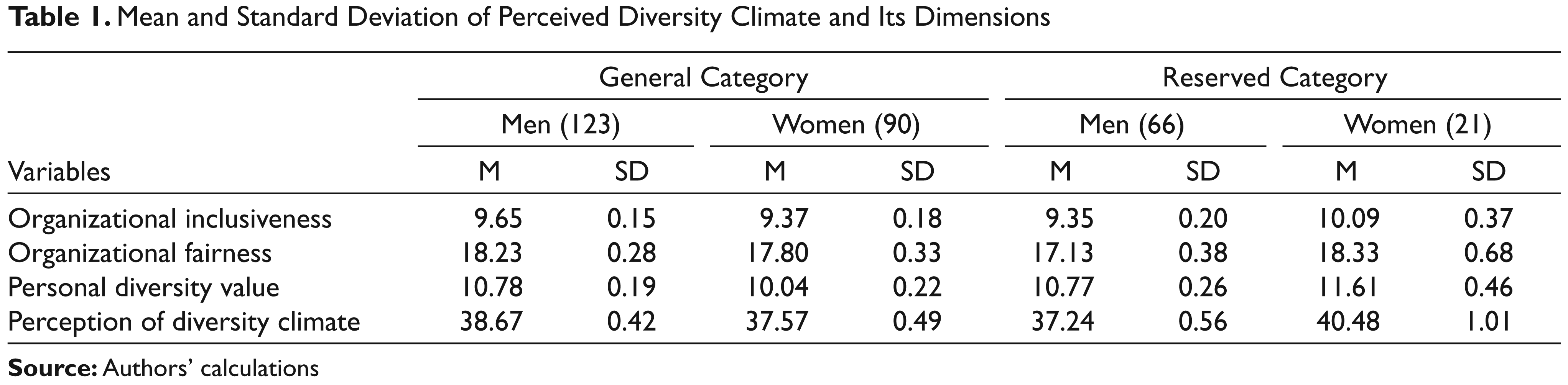
Mean and Standard Deviation of Perceived Diversity Climate and Its Dimensions
Data Collection and Analysis
Data collection began with filling of the questionnaires which were administered personally by the researcher. Confidentiality of individual responses was assured to all respondents. Once three quarters of the sample had filled the questionnaire, interviews were initiated. Interviewees were chosen randomly from the existing pool of respondents. During the interviews, they were also asked to narrate personal experiences, if any, of having faced any incident in their organization in relation to the quota-based reservation policy.
Comparisons between employees of the two categories, reserved and general as well as between employees of the two genders, women and men, were made on their perception towards the diversity climate. An interaction effect between the two factors (Gender × Category) was also analyzed using two way analysis of variance.
Results and Discussion
Table 1 presents the values of mean and standard deviation of scores for perceived diversity climate and its three dimensions separately for the four groups. Table 2 gives results of analysis of calculated variance (ANOVA) of perceived diversity climate and its three dimensions between gender and category.
Comparing the scores of each category, it is observed that women of reserved category have the highest mean scores for all dimensions separately as well as combined. It can thus be inferred that they have the most positive perception of the diversity climate. On the other end, men of reserved category and women of general category, having approximately the same scores, have the lowest mean scores.
Analysis of Calculated Variance (ANOVA) between Gender and Category Groups
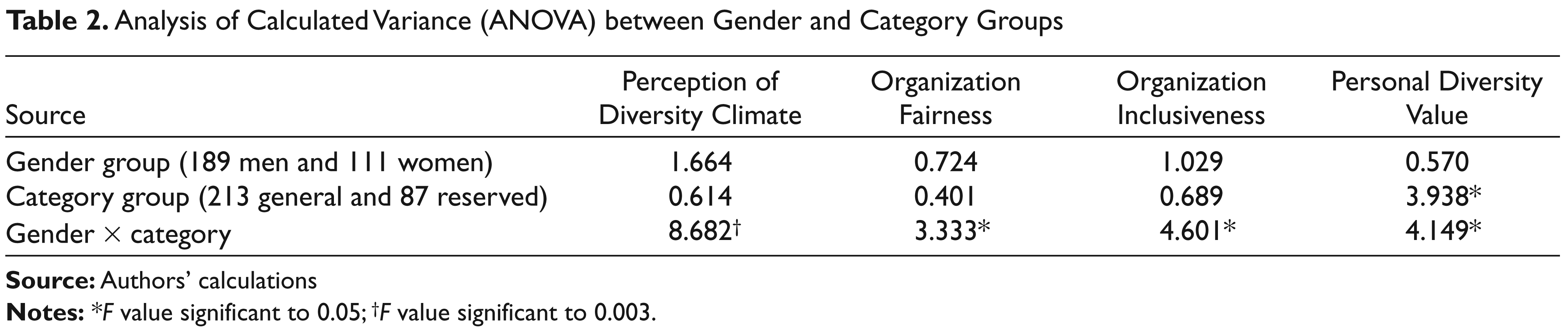
From analysis of calculated variance, it is observed that a significant difference in overall perception of diversity climate (F = 8.682 significant at 0.003) exists between the four groups under study. Further, significant difference between the four groups is also observed in the three dimensions (F = 3.333 significant at 0.05 for organizational fairness, F = 4.601 significant at 0.05 for organizational inclusiveness and F = 4.149 significant at 0.05 for personal diversity value). A significant difference (F = 3.938 significant at 0.05) in the dimension personal diversity value is also observed between the whole general and reserved category groups. The formulated hypotheses are thus accepted with respect to the data obtained.
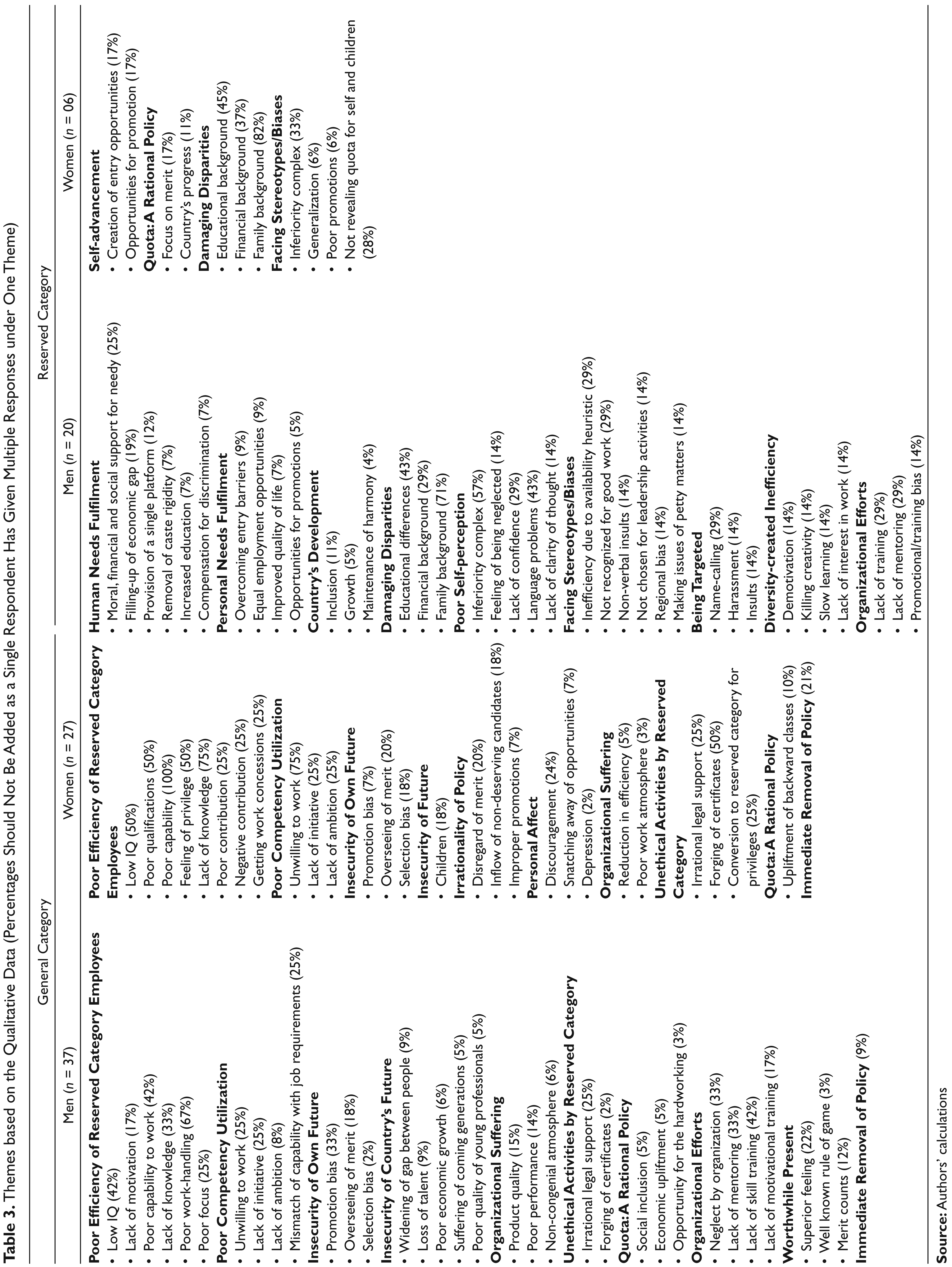
Table 3 is a list of observed themes and sub-themes for individual groups based on interview on related issues. Although a significant difference in the perception of the two categories is observed, both garner major grievances with the present diversity in their organizations. Another important observation is that of difference in gender-wise perception for the two categories. Women of general category have a perception more negative than that of men of the same category, whereas men of reserved category have a perception more negative than women of the same category. Thus, there is a marked gender difference in a reverse order. Following is a group-wise discussion on the obtained results.
Men of General Category
The ANOVA results show (see Table 2), men of general category have neither the least, nor the most negative overall perception of diversity climate. The themes which emerged from the interview show that they have a mixed perception (see Table 3). Many in this group perceive employees of reserved category as unworthy of the roles appointed to them. They believe that the latter have many flaws that make them incompatible for the workplace. This is revealed in the themes ‘Poor Efficiency of Reserved Category Employees’ (sub-themes: low IQ, lack of motivation, poor capability to work, lack of knowledge, poor work handling and poor focus) and ‘Poor Competency Utilization’ (sub-themes: unwilling to work, lack of initiative, lack of ambition and mismatch of capability with job requirements). They believe that the latter’s incompetence is leading to poor outputs for the organization and the country, at large. They feel insecure about their own future as well. This is revealed in the themes ‘Insecurity of Own Future’ (sub-themes: promotional bias, overseeing of merit and selection bias), ‘Insecurity of Country’s Future’ (sub-themes: widening of gap between people, loss of talent, poor economic growth, suffering for coming generations and poor quality of young professionals) and ‘Organizational Suffering’ (sub-themes: product quality, poor performance and non-congenial atmosphere).
There are a few who value workplace diversity and believe in the efficacy of the quota system in bringing a positive change in the society. This is revealed in the theme ‘Quota: A Rational Policy’ (sub-themes: social inclusion, economic upliftment and opportunity for hardworking ones). Such people point out a lack of inclusion initiatives at the organization’s end. Training of reserved category employees for skill-development and motivation is suggested to bridge a divide that is perceived in terms of language problems and motivation and ambition at work. The theme ‘Organizational Efforts’ (sub-themes: neglect by the organization, lack of mentoring, lack of skill training and lack of motivational training) reveals the same.
A significant observation is that many men (22 per cent) of general category have a feeling of grandeur as they usually have better qualifications than those of reserved category. Further, they are many a time recognized by the organization as more competent. This is revealed in the theme ‘Worthwhile Present’ (sub-themes: superior feeling, well-known rule of game, merit counts). However, many expressed discontentment with organizational policies due to which those of general category suffer at times. A major source of this discontentment is the special provision of a legal cell dedicated for complaints to reserved category employees against discrimination. They also shared experiences of suffering due to illegitimate complaints. This is revealed in the theme ‘Unethical Activities’ (sub-themes: irrational legal support and forging of certificates). A subject narrated,
I used to make efforts to motivate a reserved category employee working under me. He never performed effectively and often seemed disinterested. I kept on pushing him to work harder, which was sometimes taken negatively. Later, I got a notice of transfer to a remote village as a punishment delivered by the special legal cell for reserved category employees against a complaint they received from the very employee. The complaint was that I had insulted Dr. B. R. Ambedkar. However, in fact I had just been a part of a discussion over Indian history, in which the topic of reservation and castes had never come up. The employee had misused the opportunity and the legal cell as a tool against me.
Themes based on the Qualitative Data (Percentages Should Not Be Added as a Single Respondent Has Given Multiple Responses under One Theme)
Overall, most men of general category suggest measures of improving the policy and its implementation and not its complete removal. In the sample, only 9 per cent of men of general category suggested a complete removal of the present reservation policy, while the rest suggested improvements in it, favouring a diverse workplace.
Women of General Category
Results of ANOVA showed (see Table 2) women of general category exhibited a heightened sense of negative overall perception of diversity climate (a little less than RCM who were at the top in this regard). The interviews (see Table 3) also indicated a highly negative perception of the diversity climate. Discontentment towards the reservation policy, organizational efforts and workplace diversity are exhibited. Distinguishing women of general category from men of the same category is the fact that they do not show a sense of grandeur. This may so be as there is preferential treatment of men, regardless of category, despite of the women’s equal or higher qualifications—bringing gender discrimination to light. The discrimination has engendered a strong feeling of being secondary in the organization.
Most women of general category perceive employees of reserved category as incompetent for mainstream work. This is reflected in the themes ‘Poor Efficiency of Reserved Category Employees’ (sub-themes: low IQ, poor qualifications, poor capability to work, feeling of privilege, lack of knowledge, poor contribution, negative contribution, getting work concessions) and ‘Poor Competency Utilization’ (sub-themes: unwilling to work, lack of initiative, lack of ambition). Similar to that of men of general category, dismay over use of forged caste and qualification certificates and the irrationality of a special legal cell have been observed. This is reflected in the theme ‘Unethical Activities’ (sub-themes: forging of certificates, irrational legal support and conversion to reserved category for privileges). Hence, we may observe that there is uniformity in terms of negative perception of diversity climate in GCW.
Insecurity for their children is observed, notably in this group. This is reflected in the themes ‘Insecurity of Future’ (sub-theme: children), ‘Irrationality of Policy’ (sub-themes: disregard of merit and improper promotions) and ‘Personal Affect’ (sub-themes: discouragement, snatching away of opportunities and depression). Concern for the organization and its productivity is revealed in the theme ‘Organizational Suffering’ (sub-themes: reduction in efficiency and poor work environment).
Only a very small percentage of the subjects agree to the stance that if diversity is managed properly, the policy may benefit many. This is revealed in the theme ‘Quota: a Rational Policy’ (sub-theme: upliftment of backward classes), which one may see is due to social desirability effect.
A strong percentage (21 per cent) of women (compared to 9 per cent of men) of general category suggested a complete removal of the present reservation policy. One participant decried demanding, ‘remove the downgrading policy; no revamping’.
Men of Reserved Category
Although it is expected from a workplace with poor diversity management that the dissatisfaction of one group is balanced by the satisfaction of the other, it is not observed in the present scenario. According to the results of quantitative analysis (see Tables 1 and 2), men of reserved category have the largest negative overall perception of diversity climate. The interview data (see Table 3) also showed their highly negative perception of the diversity climate and its management, but a positive perception of the policy itself.
However, men of reserved category perceive the quota system as an important and valid step taken by the Government of India. They believe it is imperative for them and thereby the country’s upliftment. This is revealed in the themes ‘Human Needs Fulfilment’ (sub-themes: moral, financial and social support for the needy, filling-up of economic gap, provision of a single platform, removal of caste rigidity, increased education and compensation for discrimination), ‘Personal Needs Fulfilment’ (sub-themes: overcoming entry barriers, equal employment opportunities, improved quality of life and opportunities for promotions) and ‘Country’s Development’ (sub-themes: inclusion, growth and maintenance of harmony).
Though happy with the policy, this group is strongly discontented with its implementation at the workplace level. They experience a sense of dejection and of being out-of-place due to perceived differences (as compared to general category employees) in terms of educational qualifications, family background, socio-economic status and even clothing. This is reflected in such themes ‘Damaging Disparities’ (sub-themes: educational background, financial background and family background) and ‘Poor Self-perception’ (sub-themes: inferiority complex, feeling of being neglected, lack of confidence, language problems and lack of clarity of thought). The poor self-perception is strengthened by perception of a stigma attached to reserved categories. The perception is mostly due to misbehaviour by employees of general categories in the form of direct and indirect insults. This is revealed in the themes ‘Facing Stereotypes/Biases’ (sub-themes: inefficiency due to availability heuristic, not recognized for good work, non-verbal insults, not chosen for leadership activities, regional bias and making issues of petty matters), and ‘Being Targeted’ (sub-themes: name-calling, harassment and insults). An employee even remarked, ‘When employees of general category read news articles on the reservation policy, they criticize people belonging to the reserved categories. They should learn to mind their words.’
Another remarked, ‘I feel threatened of the policy. It reduces my confidence. I don’t participate and give my views as people generalize those belonging to the reserved categories as incapable...I am so uncomfortable.’ It is sad that such bad experiences in the workplace are affecting employees of reserved category psychologically and thus leading to inefficiencies in the workplace, shown by the theme ‘Diversity-Created Inefficiency’ (sub-themes: demotivation, killing creativity, slow learning and lack of interest in work).
Though it is not perceived that the organization, itself, is practising any discrimination, there is an undercurrent that organizations are not putting in enough efforts to manage the diversity and bridge the gap. This is revealed in the theme ‘Organizational Efforts’ (sub-themes: lack of training, lack of mentoring and promotional/training bias). There is, therefore, a need of training and motivation to boost morale of employees of reserved category and help them adjust into the work environment.
Women of Reserved Category
According to the results obtained (ANOVA) (see Table 2), women of reserved category have the least negative overall perception of diversity climate. Interestingly, this is in complete contrast to what is observed for men of the same category. However, according to results of qualitative analysis (see Table 3), it is noted that this perception is not altogether positive in the absolute sense, may it be better than the other three groups in the relative sense.
Similar to perceptions of men of reserved category, women of reserved category also perceive the quota system as an important and valid step taken by the Government of India. This is reflected in the themes ‘Self Advancement’ (sub-themes: creation of entry opportunities and opportunities for promotion) and ‘Quota: A Rational Policy’ (sub-themes: focus on merit and country’s progress). Further, they also have a sense of dejection and being out-of-place due to a perceived divide. This is revealed in the theme ‘Damaging Disparities’ (sub-themes: educational background, financial background and family background).
Women in this category have also experienced misbehaviour by employees of the general category, as revealed in the theme ‘Facing Stereotypes/Biases’ (sub-themes: inferiority complex, generalization and poor promotions). Being women, they experience neglect more than men of their category especially related to leadership roles. However, direct misbehaviour is experienced less; this may be due to other employees being afraid of possible charges of sexual harassment. This group comprising 27.8 per cent of the respondents who claim that they do not reveal their reserved category status and do not allow their children to do so as well. This may also be a reason for lower instances of misbehaviour experienced by them.
An important observation is that most women of reserved category are especially proud of having an opportunity to work and earn in the mainstream, despite facing poor opportunities in education and strong patriarchal forces in their community. They thus have a strong positive perception of the quota system, much higher than those of any other group.
The present findings can be explained partially by the model proposed by Berry (1997) which reflects the basis for acculturation which is closely associated with diversity perception and management.
Men of general category believe in separation, where they are concerned with holding on to their original practices while avoiding interaction with employees belonging to the reserved category. This is evident from the observation that most of them perceive employees of the reserved category as unworthy of being a part of their organization, and as causal factors for creating hindrances in the organization’s and the country’s progress. A subject said, ‘I usually do tasks myself rather than delegating them to my personal assistant who belongs to a reserved category. I am always sure that she will commit mistakes and be unable to match my standard.’
Women of general category are experiencing marginalization, where they are experiencing enforced loss of their original cultural practices and as a consequence avoid interaction with employees belonging to the reserved category. This is evident from the observations that most perceive themselves as being neglected by the organization due to gender discrimination and overseeing of merit. Increase in unethical activities is a major source of loss of original cultural practices. Thus, the women are in double bind. They feel marginalized due to their gender in a general sense and also feel deprived due to the space occupied by the reserved categories. We do not find this experienced by the RCW who are apparently quite happy to get a job due to the policy.
Men of reserved categories are experiencing forced assimilation, where they are losing their own practices and are being enforced to adopt the existing work culture. This is evident from the observations that most perceive grave disparities between them and employees of general category, experience misbehaviour and bias and seem to have lost their self-esteem and confidence. According to Berry (1997), when people choose to assimilate, the notion of the melting pot is appropriate; but when forced to do so, it becomes more like a pressure cooker. In the present case, as men of reserved category are being forced to assimilate, the resultant outcome is a pressure cooker scenario.
Women of reserved category are experiencing voluntary assimilation, where they are adopting the existing work culture happily, leading to a melting pot scenario. This is evident from the observations that although most experience bias and disparity in the workplace, they are content with the opportunity to work and earn. The observation that a significant portion of the group does not reveal their category status is also an indicator of assimilation.
Towards a Strategy of Integration
It is apparent from the discussion so far that none of the groups are completely content with the diversity climate of their organizations. A common strategy of integration is what can bring them all at par in terms of importance and respect in the organizations. Integration is where an interest exists in both maintaining one’s original culture and being in daily interaction with other groups. Some degree of cultural integrity is thus maintained while seeking to participate as an integral part of the larger social network.
Berry (1997) states that integration can be chosen and pursued by a non-dominant group (the reserved category employees in the present case) only when the dominant group is open and inclusive in its orientation towards diversity. Mutual accommodation is therefore the need of the hour. Employees of reserved category should adopt the basic practices of the existing workplace while maintaining their own systems and values. At the same time, employees of general category should be open to adopt new practices in order to meet needs of all the groups working together in the now diverse workplace.
The strategy of integration can be pursued only in societies/organizations that are explicitly multicultural and in which certain psychological preconditions are established (Berry and Kalin, 1995). These preconditions are: widespread acceptance of diversity’s value for a society/organization (i.e., the presence of a positive ‘multicultural ideology’); relatively low levels of prejudice (i.e., minimum ethnocentrism, racism and discrimination); positive mutual attitudes among groups (i.e., no specific intergroup hatred); and sense of attachment to or identification with the larger society/organization by all groups. In an integrated workplace, differences are recognized, differing viewpoints are heard and valued, others’ abilities are trusted and commitment towards working together is observed.
To achieve integration, an immediate action that can be taken up by organizations is inculcation of a culture of inclusion. For a culture of inclusion, organizations should provide employees of reserved category with proper training and mentorship programmes. This shall enable them to work at par with those of general category and also value the latter’s merit and qualifications and thus be motivated to make competent and valuable use of the opportunity provided vis-à-vis the reservation policy.
Conclusions
Overall findings indicate that the formulated hypotheses were accepted vis-à-vis the data obtained using both quantitative and qualitative analysis. We may conclude that though reservation policy has created an opportunity for the suppressed class there are many lacunas at the implementation and the practice level. There is a need to re-examine and recast the policy both at the levels of implementation as well as operation along with the understanding of psychosocial consequences. The social justice must be accompanied to its acceptance by all.