




Abstract
The Internet has become a popular channel during the last decade for shopping and is adding value to the retailing world. India’s e-commerce market is also growing in all product categories. Consumer spending at apparel websites is rising, and it is presenting a tough revenue war in this segment, which had traditionally been dominated by physical stores. Previous researchers have applied the consumer style inventory (CSI) by Sproles and Kendall (1986) for assessing the consumer decision-making styles. But there is a paucity of studies on analyzing the impact of CSI on online apparel purchase. Profiling consumer decision-making styles in an online context has importance to marketers, consumer affairs specialists and advertisers to determine the behavioural patterns and is also important for the market segmentation. The present research aims to examine the influence of consumer decision-making styles on the possibility to engage in online shopping of apparels. This study clarifies the relationship between each decision style category and online shopping consumption in Indian context with empirical evidence to enrich the literature.
Introduction
The efficiency of consumers in online shopping increases due to the accessibility of exhaustive product information, intelligent comparisons and reduction in customer search costs (Bakos, 1997; Johnson, Moe, Fader, Bellman & Lohse, 2004). According to a report of the Associated Chambers of Commerce and Industry of India (Assocham) on online shopping, India’s e-commerce market has reached US$ 8.5 billion in 2012, compared to US$ 2.5 billion in 2009. The market has shown a rise of 88 per cent with US$ 16 billion in 2013. The survey (conducted across 3,500 traders and organized retailers) also estimated the Indian online retail market to be US$ 56 billion by 2023. Results indicate that most of online purchases comprise of electronic gadgets (41 per cent), railway tickets (39 per cent) and apparels (36 per cent).
In 2005, online apparel sales became the second-most profitable e-commerce domain worldwide after jewellery and automobile (Auchard, 2005). Consumer spending on apparel websites is growing, and it is presenting a tough revenue war in this segment, which had been traditionally dominated by physical retail stores. A study by Google India and TNS Australia in 2013 revealed that in terms of product categories, apparels and accessories emerged as the second biggest searches (30 per cent) after consumer electronics (34 per cent) followed by books (15 per cent), beauty and personal care (10 per cent). According to MasterCard analysis (2014), apparel is the top category across all metros in India. Further demographics analysis reveals that consumers from Chennai spend most on clothes and jewellery, closely followed by Bengaluru (Tiwari, 2014). Major driver for this growth in the apparel segment is due to aggressive online discounts, search of better deals, rising fuel price and so on. Manufacturers and brand managers are earning enormously through online sales and its various benefit across other distribution channels. Moreover, Internet users avail this medium three times more to get updated on clothing fashion than others. Majority of them (90 per cent) buy clothing online (Assael, 2005). It is very important for the retailers to compare the behaviour of apparel consumers with other merchandise (Moore, 1995). Consumers usually differ in their motivations for shopping in terms of their propensity, comparative cost of their purchase decisions (Sproles & Kendall, 1986) and their loyalty (Chen et al., 2001; Kocas, 2002).
Great emphasis is placed on consumers’ decision on quality, which in turn depends on a consumer’s decision-making style (Kruger, Wirtz, Van Boven & Altermatt, 2004). Walsh, Mitchell and Hennig-Thurau (2001) argue that consumers’ certain decision-making traits combine to form a decision-making style. Customer decision-making is a complex phenomenon that includes number of factors that are important to the consumers and may affect their decisions (Lunenburg, 2010). With the advanced changes in the lifestyle and the increase of consumer’s power, different decision-making styles are become significant. In the past, consumer shopping behaviour and their decision-making styles in offline shopping environment have been studied significantly (Bakewell & Mitchell, 2003; Mitchell & Walsh, 2004; Tai, 2005), but these styles are not extensively researched in the online shopping scenario (Cowart & Goldsmith, 2007; Yang & Wu, 2006). The present study addresses this requirement by investigating online apparel consumption using the CSI, a basic shopping orientation related to consumer personality.
Most of the previous research analyzed online shopping in a wider sense; however, some of the researches have specifically studied online consumption in the apparel sector (Goldsmith & Flynn, 2004, 2005). Due to the increasing economic advantage of online apparel in the total e-commerce transactions, marketers, market researchers and academicians are focused in identifying the predictors that are related to web-based apparel consumption. This study aims to examine the consumer decision-making style that influences the apparel shopping. The present research defines consumption as a total online transaction, which results in the purchase of items. This study investigates the dominant customer decision-making styles in Indian context and it helps in understanding the relationship between each style of online shopping in an effort to enrich the literature.
Background
Early researches on Internet shopping describe their behaviour on the basis of its characteristics including demographics, motivation and attitude (Joines, Scherer & Scheufele 2003; Korgaonkar & Wolin, 1999; Sorce, Perotti & Widrick, 2005). Goldsmith and Goldsmith (2002) were among the first to study the online shopping behaviour of consumers in the apparel sector. The attitudes of these consumers were to be found positive. Studies reveal that the online apparel buyers were more knowledgeable and confident over their buying skills as compared to offline buying. Some indicators such as general consumer enthusiasm, Internet familiarity were the determinants for online apparel purchases in future (Goldsmith & Flynn, 2005). Research by Silverman (2000) also reported that apparels are the most popular categories to shop online among the highschool and college-going consumers. Young and educated consumers generally are inclined towards shopping online for clothing (Lee & Johnson, 2002; Xu & Paulins, 2005).
Sproles and Kendall (1986) defined consumer decision-making styles as a mental, cognitive orientation towards shopping related to their personality
According to CSI theory (Sproles & Kendall, 1986), a highly quality-conscious customer (perfectionist) shops carefully and systematically in search of highest quality products. For this, consumers are likely to conduct extensive comparison. In an online context, where enough product information is available, brands generally become less valuable for these shoppers (Degeratu, Rangaswamy & Wu, 2000). Brand-conscious consumers buy the most expensive and popular brands. The significance of the brand consciousness customer in online shopping is also well-established in a number of previous studies (Klassen, Gupta & Bunker, 2009). These consumers are less comparison-prone and considered to be low-price sensitivity (Ailawadi, Neslin & Gedenk, 2001).
Novelty and fashion conscious customers buy innovative products. In their study, Cowart and Goldsmith (2007) also reported a favourable influence of the novelty and fashion consciousness on online apparel shopping. Internet advantages like easy access and searching, and instantaneous information updates help customers to access rare and unusual items (Zhang, 2006). Recreational shoppers recognize shopping as a fun and pleasant activity. Hedonic value and entertainment benefits are important shopping motivations and influential factors (Babin, Darden & Griffen, 1994; Peters & Bodkin, 2007). On the other hand, price-conscious customers appreciate high value for money and are more sensitive towards sale offers (Sproles & Kendall, 1986). Impulsive and careless shoppers never plan their shopping. They tend to buy on the spur of the moment and do not even care about acquiring the best buys (To, Liao & Lin, 2007). Confused by information overload on too many brands and stores, some customers end up becoming indecisive (Sproles & Kendall, 1986). Habitual or brand-loyal consumers have favourite brands and stores or web sites for shopping. Information search and decision-making processes for these customers are based on their last shopping experiences (Bettman & Sujan, 1987).
One factor often discussed in the context of online shopping is social influence. Research by Zhou (2011) showed that customer social identity and group rule have important implications on user online participation. Çelik (2011) confirmed a positive relation between the subjective norm and perceived ease of use (PEOU) in shopping online. In a study on the moderating role of social influence theory, Lee, Shi, Cheung, Lim and Sia, (2011) found that a positive social influence can strengthen the relationship between attitude towards online shopping and the intention to shop. Research by Park and Cho (2012) on apparel shopping reported a favourable relationship between customer assurance to engage in online community and their information seeking behaviour. This commitment will be developed on the basis of the psychological attachment for the community. Against this backdrop, social influence is also considered as a possible determinant in the present research for online apparel consumption. Extant research had mainly focused user motivations such as perceived usefulness, trust towards online behaviour but seldom considered the effects of CSI over online user behaviour and their shopping intention for apparels in the Indian context. The present research tries to fill the gap and allows educators, retailers, marketers and producers to effectively respond to the priorities of different consumer groups.
CSI has also been tested in cross country studies. Durvasula, Lysonski and Andrew (1993) tested and accepted the dimensionality and reliability of CSI in New Zealand. Research by Hafstrom et al. in 1992 found that seven of the eight factors of CSI are applicable for Korean customers. Fashion consciousness was not confirmed in the study. A study by Fan and Xiao (1998) tested validity of CSI in China and found that only five decision-making styles are applied to young consumers. Mitchell and Walsh (2004) establish that all eight CSI factors applies to German shoppers and concluded that male shoppers were less perfectionists and fashion conscious than female shoppers. Bandara (2014) uses CSI to find a correlation between decision-making styles and domestic brand loyalty in Czech Republic. Bauer, Sauer and Becker (2006) studied British and German consumers to identify the relationship between high-involvement products and the consumer decision-making styles. Later in an empirical study, Canabal (2002) found five decision-making styles to be relevant to South India. A longitudinal analysis conducted by Lysonski and Durvasula (2013) on Indian consumer’s decision-making styles showed that four decision-making styles have changed statistically between 1994 and 2009. Consumers become more brand conscious, novelty seeking and impulsive over the studied time period. Jain and Sharma (2013) reviewed different studies conducted from 1986 to 2010 on CSI conducted in developed countries. It has been found that five CSI factors, namely, quality, price, brand consciousness, pleasure-seeking and confused by product overload, are indispensable to all consumers, irrespective of demographics like country, gender and age. These studies confirm the fact that CSI can be useful as a basic model.
CSI researches have also undergone many scale purification and validity tests. This instrument also reduces the conceptual and measurement differences in finding relevant decision-making styles in different cultures. CSI has also been used successfully to study purchase of apparels in different contexts (Wang et al., 2004). Study by Cowart and Goldsmith (2007) reported a significant positive influence of brand, quality and fashion consciousness, hedonistic shopping behaviour, impulsiveness and brand loyalty. But some researches show a negative influence of price sensitivity on the extent of online apparel shopping. Recent study by Kang and Johnson (2014) found that among the CSI consumer decision-making styles, novelty and fashion consciousness are the most important antecedents of opinion seeking using eWOM (electronic Word-of-Mouth), and brand consciousness was one of the most important attitudes for online shopping for apparels. Therefore, it can be concluded that CSI is important to understand consumer decision-making styles in determining online shopping behaviour. But there is dearth of research on applicability of CSI decision styles on Indian online apparel consumers. Hence, the objective of this study is to determine Indian customers’ propensities of buying apparel online influenced by the eight decision-making styles of the CSI.
Methodology
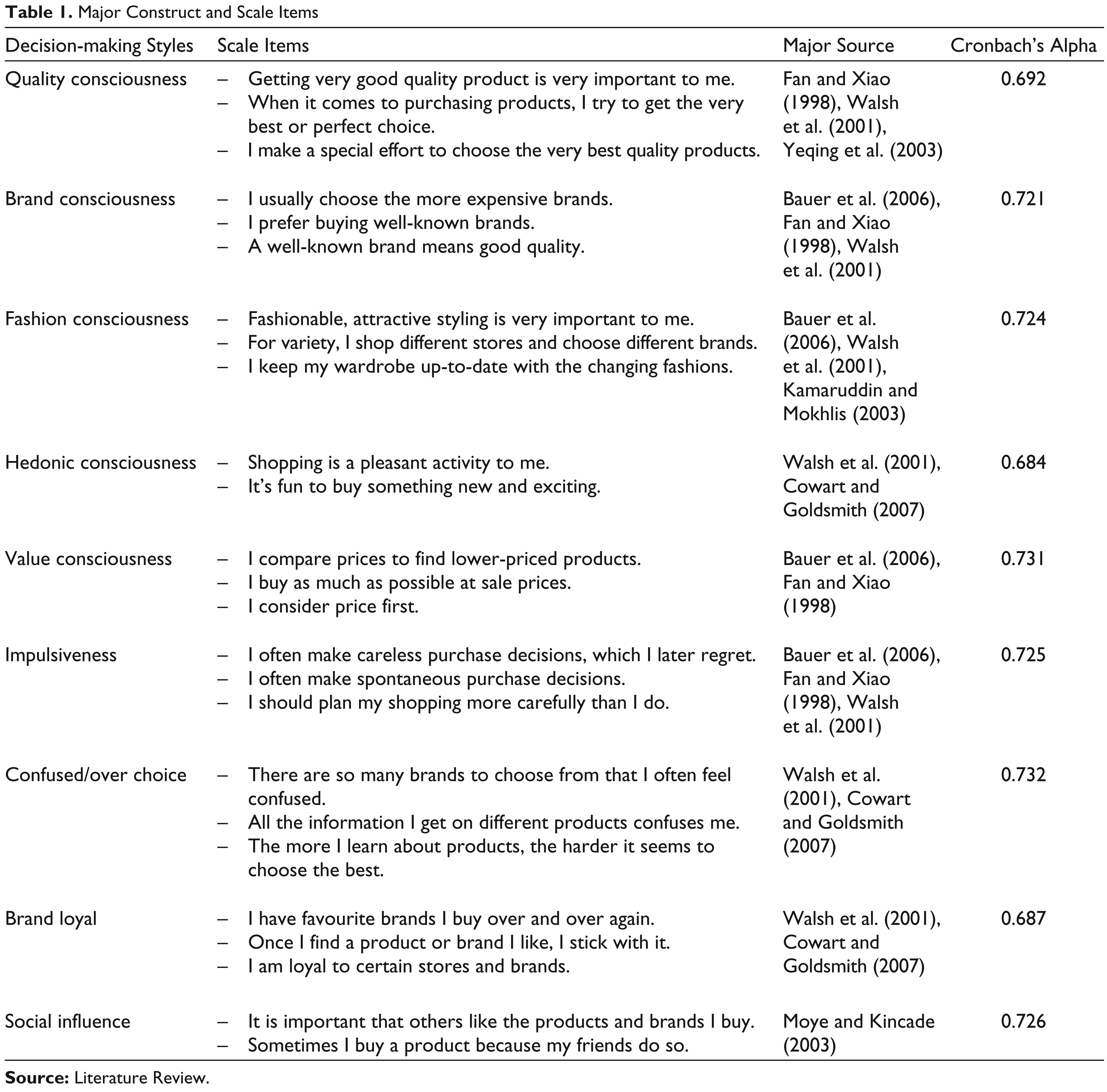
The study was conducted on online shoppers for apparels from both gender of different occupation, educational level and age. Participants were given the instructions and they were informed of the research objectives. Out of the 350 distributed questionnaires, 287 questionnaires were dully filled and submitted, reflecting the response rate of 82 per cent. The questionnaire contained questions related to Internet use, consumer purchase behaviours and relevance of different decision-making styles while shopping online (see Table 1).
The survey was conducted between May and July, 2014 with consumers targeted from three universities and three corporate offices in India, who had purchased apparel products online during the last six months. Content validity was tested using face validity method experts using criteria like clarity, conciseness and ambiguity. Scale items were measured using a 5-point Likert-type scale ranging from ‘1’ for Strongly Disagree to 5 for Strongly Agree. Descriptive and multivariate statistics have been used for data analysis. The reliability of the scales was examined using Cronbach’s alpha. Most scales exhibited high reliability with alpha value greater than the benchmark of 0.70 (Nunnally, 1967).
Major Construct and Scale Items
Result
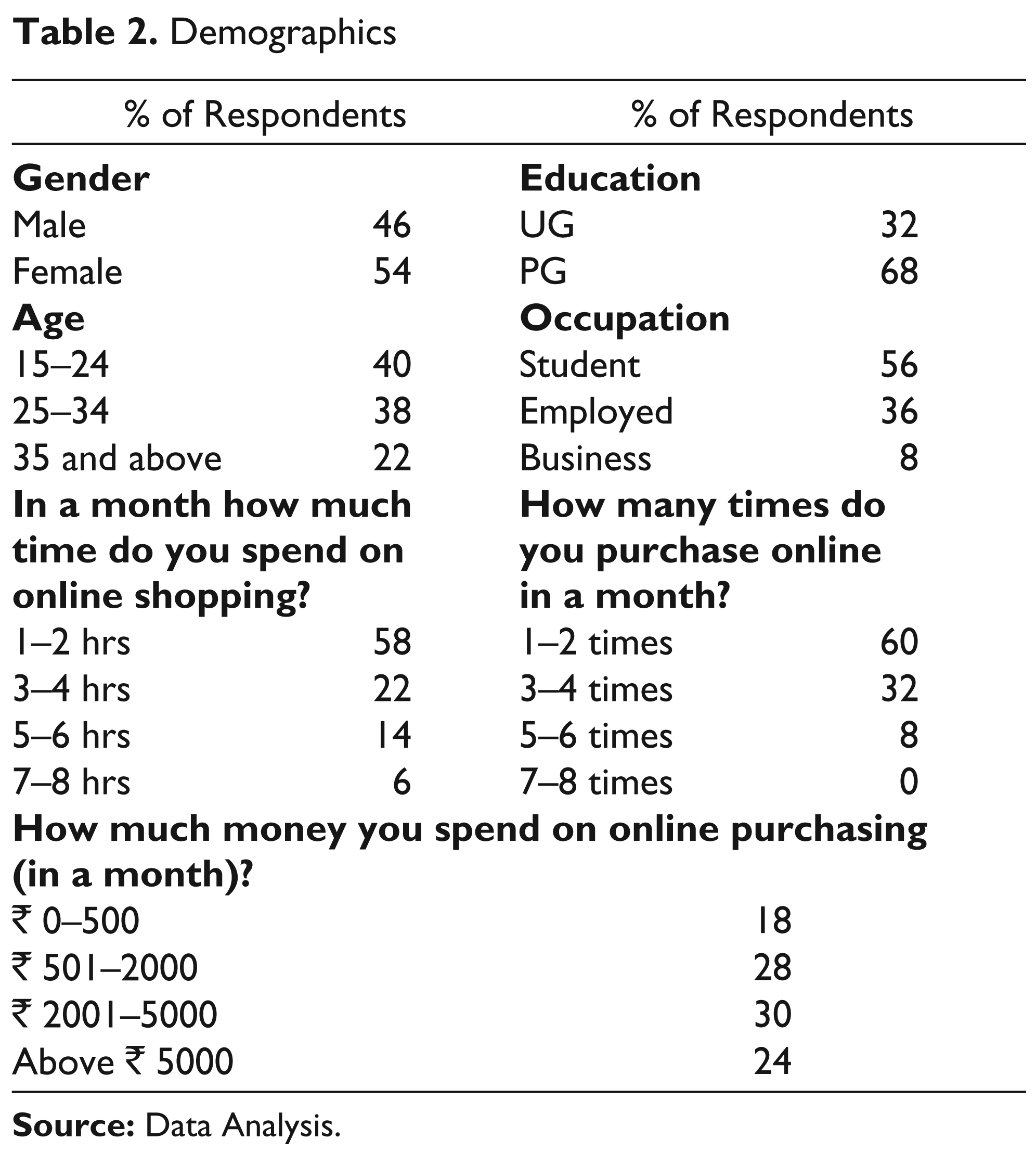
About 82 per cent participants (287 respondents) reported to perform apparel shopping using the Internet. In contrast to traditional assumption, the data analysis indicates that almost same number of male and females purchased apparel online. In a month, about 60 per cent of these buyers purchased apparels online. Majority, that is, 58 per cent spend 1–2 hours per month purchasing apparel online. A large section of online purchasers (80 per cent) are postgraduate student or employed professionals, belonging to 15–35 years of age bracket. Forty-six per cent of the respondents had spent up to ₹ 2000 for shopping through the Internet in the past 30 days, and 24 per cent consumers spent more than ₹ 5000 in a specific month (see Table 2).
Demographics
The scores on the eight CSI scales with social influence and two dependent variables, that is shopping frequency and online spending, were correlated for the given online buyers. As one might expect, Internet shopping frequency and the quantum of spending online are positively related for apparels (r = 0.262, P < 0.01). From the eight CSI dimensions, four styles have statistically significant correlations (P < 0.05) with the frequency of online apparel buying. These dimensions are high-quality consciousness (perfectionism), brand consciousness, value consciousness along with social influence. In addition, brand consciousness and fashion consciousness were found to be significantly correlated (P < 0.05) with the amount spent online for apparel shopping. The dimension of social influence is found to be statistically negatively correlated with online spending (P < 0.01). These findings identify that few of the consumer mental characteristics are related to the frequency of online spending. Moreover, the effect of social influence is also established to be significantly related to the number of online visits and purchases by Indian consumers (see Table 3).
Correlation Matrix and Descriptive Statistics for Measures
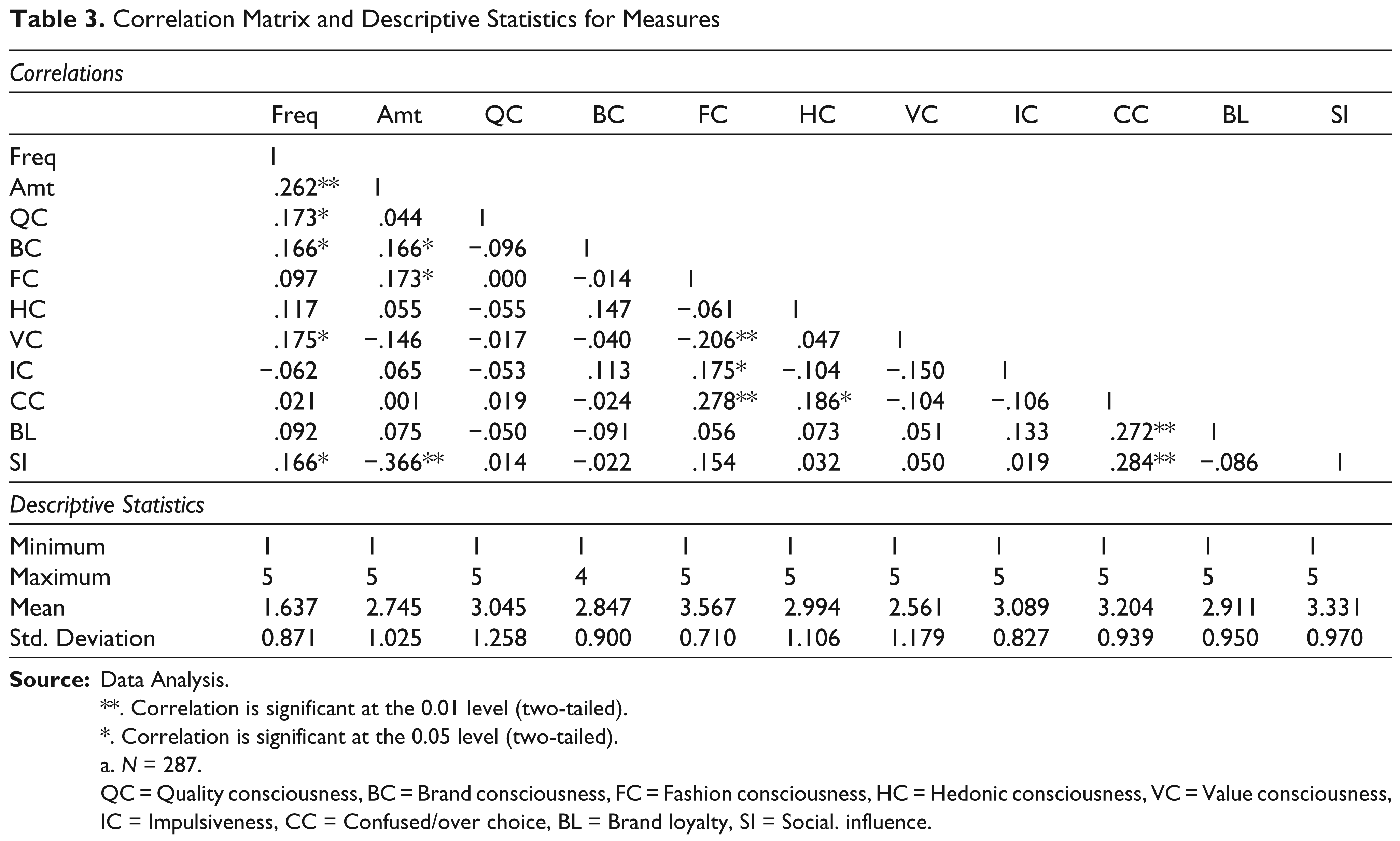
**. Correlation is significant at the 0.01 level (two-tailed).
*. Correlation is significant at the 0.05 level (two-tailed).
a. N = 287.
QC = Quality consciousness, BC = Brand consciousness, FC = Fashion consciousness, HC = Hedonic consciousness, VC = Value consciousness, IC = Impulsiveness, CC = Confused/over choice, BL = Brand loyalty, SI = Social. influence.
The relationships between the CSI dimensions and the dependent variables have been also studied with a multivariate technique called linear regression to analyze scores on frequency and total amount along with one additional factor ‘social influence’. These results (Table 4) show that the frequency of online shopping was significantly related only to four dimensions of the CSI: quality consciousness shopping (b = 0.203), brand consciousness (b = 0.208), fashion consciousness (b = 0.157), value consciousness (b = 0.167) along with social influence (b = 0.186). The amount spent on online apparel shopping was significantly related to two CSI dimensions, that is, brand consciousness (b = 0.157) and fashion consciousness (b = 0.212), accompanied by significant effect of social influence (b = 0.120). It shows that brand and fashion consciousness consumers are more likely to shop for apparels online. The more the consumer is conscious of their social life, more they visit online stores. Similarly, brand and fashion consciousness are positively associated with the amount of online spending. The influence of social circle and belongingness is also positive. The multicollinearity among the various independent variables was assessed through computations of VIF (variance inflation factor) statistics, and these values indicate the absence of multicollinearity among the independent variables (see Table 4).
Regression Result

a. Beta standardized coefficients
b. Collinearity statistic
DV = Dependent variable
Discussion and Conclusion
With the growth of Internet shopping, organizations need to understand consumer behaviour and the particular reasons behind the shift to online shopping from to bricks-and-mortar stores. The convenience and speed afforded by online shopping environment has pushed a number of apparel shoppers from brick-and-mortar to online destinations. With the increasing interest and fiscal benefit in online apparel shopping, it is essential to identify the predictors that motivate consumers for online buying and to understand their decision-making styles. A large number of past researchers have addressed online shopping behaviour in general; only few studies have focused specifically on the apparel domain. This study identifies the motivation for online apparel consumption using CSI. Some research have identified that frequency of online shopping of men differ significantly from women (Zhang, Prybutok & Strutton, 2007). But the result of this study found that men shop online just as often as women. Online buying by men is on an upward trend, so the firms selling male apparel may get an equal opportunity to capture good market share and profits. Thus, this segment could be an attractive and lucrative subgroup along with female consumers. Retailers may focus on web design and layout that entices male visitors.
The findings of this study show among the diversified respondents, shoppers who are highly brand and fashion conscious are more inclined to buy clothes online than shoppers with other consumer styles. Value-conscious shoppers spent more time in purchasing clothes online, which shows that they not only derive pleasure from shopping but also are attracted by the financial benefits associated with online shopping. The key finding of this study is related to the value-conscious consumers. Value-conscious shoppers tend to visit online sites for best offers and price benefits. These finding are in line with earlier researches (Goldsmith & Bridges, 2000). Moreover, value consciousnesses also seem to have a determining effect on the amount of spending in online purchase. It means that other identified dimensions like brand interest, fashion curiosity and social influence significantly predict the online spending. Social influence is also a positive predictor for online shopping frequency and spending. People like to follow their friends and family to shopping destinations. These findings imply that people who enjoy shopping will encourage online apparel consumption. Further, this study does not support the assumption that impulsive shoppers spent significantly in apparel shopping. These findings conclude that a good number of online apparel purchases are planned, and buyers are more value conscious than impulsive. Thus, manufacturers and retailers particularly increase sales to this subgroup by interactive online marketing tools such as banner ads, signups and other online sales promotions. This study may assist marketers to enhance the development of product positioning strategies addressing the differences in consumers’ decisions-making styles.
This study expands the present theoretical framework of online consumer behaviour and encourages other empirical researches in the field. But this research also suffers from limitations, which gives idea for different approaches for future studies. First, data were largely collected from college students, young professionals, who are more proficient in Internet usage than the general public. Second, this group is more fashion conscious than others, and they do shopping online more regardless of the venue. The study findings were obtained from a small dataset covering only actual online shoppers having single cross-sectional pattern. Hence, future research can be of longitudinal nature to show the effects of temporal change. This study does not identify various types of fashion items purchased online. Rather, it only examines the relationship between the CSI characteristics and the dependent variables of shopping frequency and spending.
Future Research
Future research should focus on using different measurement scales, or experiments, to find out the causal relationship. The objective of this research is to identify the predictors and processes that are related to online apparel consumption in the Indian context. The findings propose that CSI may be an effective tool in determining consumers’ online behaviour and decision. However, it is still not known whether online clothing purchases actually replace or complement in-store buys. A comparative study of consumer apparel purchases across online and in-store venues would answer this question. It will be interesting to investigate whether the increasing number of dual earners in a family or lack of time for offline shopping pushes people to online shopping as a means to simplify their lives. There is a need to uncover the motivating factors that drive online shopping behaviour in the fashion domain. As consumers continue to seek convenience, it is certain that online merchants will capture a substantial portion of the market and money spent on apparel.