



Abstract
In the fast-changing business world, change management skills play a critical role in moulding change in favour of the competitive advantage. They have to deal with others’ emotions along with their own emotions in the fast-changing dynamics. In such a situation, executives’ emotional intelligence takes the centre stage in not only enhancing their change management skills but also in changing the course of change in favour of the organization. The present article attempts to explore the relationships of executives’ emotional intelligence with their change management skills. The article also examines as to which dimension of emotional intelligence significantly contribute in predicting and enriching their change management skills. A total of 510 executives from Indian organizations have been surveyed by using well-established measures of emotional intelligence and change management skills. Correlation and regression analysis unveils that self-awareness and self-management are the significant predictors and contributors in change management skills.
Keywords
Concept Development
This identification of the importance of emotional intelligence (EI) has developed as relationships, communications and interactions have come to be seen as core components of organizations along with intelligence and technical skills. EI is crucial to four areas of business: selection and hiring, building high-performance teams, career development, and restructuring and workforce planning decisions. EI traces its origin from concept of social intelligence (Thorndike, 1920), whereas proposition of non-intellective abilities, as well as conceptualization of personal intelligence and study into social intelligence hints at the value of emotions to intellectual functioning (Gardner, 1983; Wechsler, 1940). Cooper and Sawaf (1997) extended their research on EI, whereas the term ‘emotional intelligence’ was firstly used in terms of four domains: expression, knowing and handling one’s own and others’ emotions and then described EI as ‘the subset of social intelligence that involves the capacity to monitor one’s own and others’ feelings and emotions, to distinguish among them and to use this information to guide one’s opinion and actions’ (Salovey & Mayer, 1990) but it was Goleman (1995) who globally popularized the concept of EI and as a result of which both practicing managers and academia have started believing in its importance in the world of organization. It is also to be revealed that the EI has been referred to as a skill and aptitude and a combination of both (Goleman, 1995; Mayer & Salovey, 1997; Roberts, Zeidner, & Matthews, 2001).
Over the years, a number of scholars have given definitions of EI. EI is being able to monitor our own and other’s feelings and emotions, to discriminate among them and to use this to guide our thinking and actions (Salovey & Mayer, 1990). EI is explained as the composite set of capabilities that enable a person to manage himself/herself and others (Goleman, 1998). Emotions are human beings’ warning symbol as to what is really going on around them. Our emotions are valuable resources in order to help us to make decisions, without emotions we do not recognize how we feel about our choices (Mayer et al., 2003).
Hence, it is said that the EI meets the traditional standards for an intelligence that can be broken down into a set of mental abilities. It is more accurate to say that a person, the frequency with which he/she demonstrate or uses the constitute capabilities or competencies, inherent in EI determine the ways in which he/she behave with themselves, their life and work, and others (Boyatzis, Goleman, & Rhee, 2000).
Emotional Intelligence and Organizational Change
The organization’s ability to manage with change provides a competitive advantage (Skinner, Saunders, & Thornhill, 2002). A number of researchers have identified the emotional aspects of dealing with change (Antonacopoulou & Gabriel, 2001; Ashkanasy, Ashton-James, & Jordan, 2004; Jordan, Ashkanasy, & Hartel, 2002; Paterson & Hartel, 2002; Ryan & Macky, 1998). In general, these writers have identified the emotional consequences of change; however, there is little research available that identifies the emotional skills required to successfully manage organizational change. So, the aim of this article is to test the relationship between EI dimensions and employees’ change management skills, to find out the extent to which EI dimension contributes to employees’ change management skills.
Some writers mention the provision of social support as a method for facilitating change (Mealiea, 1978); however, often this support proves to be a reaction to an existing problem rather than a proactive method of enabling change (Sheehan & Jordan, 2003). This article highlights the importance of considering emotions in the context of change management and to offer managers some insights into ways of addressing these emotional issues by linking EI abilities. Vince and Broussine (1996) reported that the most important significant construct which has not been thoroughly investigated is the function of emotions in organizational change. In view of the fact that the typical organizational changes focus on problem-based models underestimating the impact of emotions; Massholder et al. (2000) defined that because of the strength of reactions attached to organizational change, researchers of change have begun to consider emotional undercurrents of change. The emotional energy is essential to mobilize and sustain radical changes in combination with cognitive interpretations. ‘Well channelled emotional dynamics can lead to the realisation of radical or second-order change’ (Fiol & O’Connor, 2002; Huy, 1999). One of the reasons why there is a resurgence of the interest to emotions at work is first, the large number of organizations operating in the service sector and second, the popularization of the construct of EI (Briner, 1999). George and Jones (2001) scrutinized a theoretical model of the individual change process and propose that emotionally intelligent employees will be more likely to be adaptable in emotional reactions to discrepancies signalling the need for change since these people are more adaptive and responsive to their emotions and moods with better knowledge and understanding of the feelings they are experiencing. The most important significant construct which has not been thoroughly investigated is the function of emotions in organizational change in view of the fact that the typical organizational change paradigm focus on problem-based models underestimating the impact of emotions (Vince & Broussine, 1996). EI is very important for people’s change and it can be developed through training and it is also recommended that imagined interactions relate directly to self-directed learning assisting EI change (Fragouli, 2009). However, a small body of research that has examined the role of emotions during organizational change and has largely focused on emotional responses such as stress (Terry & Jimmieson, 2003).
Change Management and the Role of Emotional Intelligence in Change Management
Change is concerned with shifting from one phase to another or breaking down existing structures and building new one (Chonko, 2004). The change causes can be technology, communication, general instability, mergers, re-engineering organizational growth or by institutional and market instability; simply put, change is a source of feeling of pressure, uncertainty, frustration, isolation and anxiety (Ashford, 1988). Von Krosigk (2006) emphasized the importance of developing a positive attitude towards personal change in employees. Change is generally stressful for the people involved, when it entails a change from the known—the comfort zone—to the unknown. With changes, new roles, responsibilities, challenges and conflicting views comes. Consequently, the entire process needs to be adroitly managed. When people are not clear about the future, they are normally confused and thus resist the process.
Kurt Lewin and John P. Kotter are known as key management thinkers who have contributed significantly for management of change. Kurt Lewin (1951) has suggested a change model which comprises three steps, viz., unfreezing, changing or movement and refreezing. The process of unfreezing simply makes the individuals or organizations aware and prepares them for change. In fact, this is the stage wherein the need of change is recognized, and the process of casting aside the old values, behaviour and organizational structure takes place. In fine, this is the stage of infusing change proneness behaviour in the individuals and hence can be considered as the most significant one. In the changing phase new values, behaviours and structures replace the old one, and it is action-oriented stage based upon the efficacy of the first phase. The third phase, that is, refreezing makes the change permanent and encourages the practice of what has been learnt in the second phase. John Kotter (1995, 1996) of Harvard Business School built on Lewin’s three-step models to create a more detailed approach for implementing change. Kotter (2002) speaks about the following eight steps for successful large-scale change; however, if we compare the contribution of Lewin and Kotter, it comes out that the first proposed stage, that is, ‘unfreezing’ by Lewin and the first four steps as suggested by Kotter have great similarities. In fact Kotter’s first four steps essentially extrapolate on the ‘unfreezing’ stage which concentrate on infusing ‘readiness to change’ amongst those who may be affected from the change. Similarly, change model developed by KI Thought Bridge, talks about the change in another approach; however, this model too is very similar to other two models developed by Lewin (1951) and John Kotter (1995, 1996) wherein he suggests three stages of change management in which stage one is ‘ending’ and this initiation stage actually is the end of old culture, values and procedure which are currently followed. Stage two is ‘gap’ where all emotional responses are foreseen after implementing stage one, for example, confusion etc., as new changes are still not introduced. Stage three is called ‘new beginning’ and from here on experiments and implementations of the new activities, revised objectives are observed. Apart from sensing the employee’s mood wisely and correctly, excitement and positivity should be created in the environment to make believe about changes and its successful outcome.
The conceptual model on EI and commitment to change find out that by having a better understanding of EI at the workplace, there are higher possibilities of the employees adapting to any kind of change situation and consequently the ability to manage own and others emotions makes an individual open to thinking and reactive to the changes (Asnawi, Yunus, & Razak, 2014).
When followers of change believed that leaders understood their emotional reactions and responded appropriately they felt more comfortable and had a more positive orientation to the change. Furthermore, he observed that the people with higher degree of self-awareness and social awareness are more open to the need of change in their immediate surroundings and work place and are better equipped to accept and carry the change management forward. People with these abilities are generally seen as torch bearers for others in the entire process as at times there is a lot of confusion and uncertainty among fellow colleagues and people with strong self-awareness and social awareness skills are the ones who are easy to be convinced first for the change and later to influence people in a better and effective way to follow and accept change and its impact by understanding its consequences on others and thereby explaining it better to them and help removing their initial hesitation and fear of change (Smollan & Parry, 2009).
This further gets corroborated with findings of (Schmidt, 1997), wherein he stresses that EI competency of emotional perception and understanding may contributes to employee’s ability to change as with these skills they are able to read social situations and interpret information which is otherwise not openly expressed or stated by other employees and thereby resulting in conception of a winning vision as they accurately perceive the emotions of both themselves and followers. It is, therefore, safe to say that social skills along with other EI dimensions also play a major role in change management and, thus, people with a higher degree of social skills can play a very positive and constructive role in entire change process.
The days could not be very far when the organizations will start measuring emotional quotient along with the intelligence quotient (IQ) and at the same time weigh it far more than any other attribute like personality or smartness in recruitment procedure (Raithatha, 2015). Recruiters are rapidly involving various questioners and role play scenarios to assess the candidates on their self-management skills to find out how a particular person tends to react on certain situations and thereby assessing and evaluating them on their self-management scores along with other parameters. It is now a growing believe and as stated by George (2000), this skill plausibly contributes to constructive thinking patterns and the ability to solve problems with a minimal amount of stress. Change management is a process of developing a planned approach to accommodate changes in organizations (Andersen, 2005). Bryant & Wolfram (2006) found that just half of their non- management respondents referred to the need of managing their emotions during various forms of change as there is a great need to express emotions during change. The degree of change is directly linked to the people who manage others in the organization, irrespective of their titles, since these people are in a position to influence the procedure and the outcomes of change. What they do and say, have a direct bearing on whether others will change from their comfort zone towards a different future (Cook, Macaulay, & Coldicott, 2004). Huy (2002) examined the need of middle managers to heighten some group emotions while dampening on others, so that there is a balance between the stability required for ongoing processes and the dynamics needed for the new initiatives.
Looking at the other side of the coin to understand the phenomenon well, it is believed that things can be counterproductive if change is not managed by employees with strong EI, ‘leaders who have difficulty in determining their own feelings and empathizing with those of others are unlikely to be able to spearhead major changes in organizations’ (Abraham, 2000). Thus creates need for change mangers with strong EI as in words of Carney (2000).
Taking insight from the earlier studies (Abraham, 2000; Carney, 2000; Cook et al., 2004; Huy, 2002; Wasielewski, 1985; Wolframe, 2006), the following hypotheses are developed:
H1: Self-awareness (dimension of EI) is a significant predictor of employees’ change management skills. H2: Social awareness (dimension of EI) is a significant predictor of employees’ change management skills. H3: Self-management (dimension of EI) is a significant predictor of employees’ change management skills. H4: Social skills (dimension of EI) are a significant predictor of employees’ change management skills. H5: Emotional intelligence is a significant predictor of employees’ change management skills.
Emotionally intelligent leaders are also able to set challenging goals and take calculated risks during the change process. One of another possible reason for having this strong connection between EI and change management is explained as ‘this skill plausibly contributes to constructive thinking patterns and the ability to solve problems with a minimal amount of stress’ (George, 2000).
Wasielewski (1985) has explained further on effectiveness of having a change manager with strong EI skills by proving that in times of change these leaders can create an atmosphere of co-operation and trust by aligning themselves and organizational goals preferring long-term goals of organization rather than looking for personal needs and by doing this contributing to quality interpersonal relationships with employees emotions and attitude towards change. This may further induce employees to re-evaluate extant negative feelings.
Change management is a key process in achieving organizational excellence; however, EI is an attribute which is required essentially in order to bring and manage change in an organization. This has led to a new approach within most of the organizations to try and use employees with high emotional quotient as change agents to lead and manage change. The idea is that these people can analyse the situation very well, and with the control over their own impulses and behaviours, they will first understand the aspect of change and will convince the resistance. It is generally believed that these employees if found to be with change managers, can drive home desired results; in this case change effectively; thus, stressing once again on the correlation of EI with change and its successful management.
Although there have been numerous studies linking EI and organizational change (Antonacopoulou & Gabriel, 2001; Ashkanasy & Hartel, 2002; Ashkanasy, Ashton-James & Jordan, 2004; Huy, 1999; Jordan, Fiol, & O’Connor, 2002; Paterson & Hartel, 2002; Vince & Broussine, 1996). Change management skills and EI has not received much attention. The present study intends to find which EI dimensions (self-management, self-awareness, social awareness and social skills) are significantly predicting employees’ change management skills.
Based on the research literature that has been reviewed so far, the author framed the following objectives of the present study as:
To assess the relationship between EI dimensions and employees’ change management skills. To find out the extent to which EI dimension contributes to employees’ change management skills. To suggest a workable model for enhancing the employees’ change management skills.
Conceptual Model of Hypotheses
Based on the research presented in the literature review, a conceptual model is developed. The model (Figure 1) postulates the relationship between EI and change management skills. EI dimensions, that is, self-awareness, social awareness, self-management and social-skills are acting as independent variable and change management skills is acting as dependent variable. We have assumed the model in the given direction. Model I is discussing the general specification which is assumed on the basis of EI dimensions and employees’ change management skills.

Statistically the model can be represented as

where
X1i = Self-awareness, X2i = Social awareness
X3i = Self-management, X4i = Social skills
Towards the above model of the study, hypotheses are formulated as follows.
Research Methodology
The study is based on a literature review and conceptual framework, and hypothesis developed to examine the relationship between independent and dependent variables by applying structured questionnaire. The procedure adopted for this research follows a quantitative approach for data collection and analysis.
Participants/Respondents
A sample of 510 employees from selected organization are approached individually and requested to participate in this study. This sample belonged to white collar employees of selected organization. The target population of the study consisted those are in managerial positions in organization, this included three level of cadre: top, middle and operational level.
Procedure
The survey instrument was administered to the participants via as a mixture of e-mail, post and personal visit. Before sending out the questionnaire, participants were contacted to ascertain their willingness to take part in the study. After getting an affirmative response, each participant was sent a structured questionnaire with a request of not leaving any item unanswered. Those who did not respond despite reminders were dropped from the study and regarded as non-responders.
Measures
Change management skills inventory consists of 10 statements. The change management skills scale is developed and standardized by John W. Newstrom (2007) which measures the solid capability to manage change in the organization. It is a self-report inventory. Example of the item includes an example item ‘I prefer to be proactive rather than reactive regarding change’. A 10-point scale is used in scoring responses, ranges from ‘good description (10)’ to ‘poor description (1)’. The Cronbach’s α was found 0.76 for this scale, which is greater than the benchmark of 0.70 (Nunnaly, 1967).
The emotional IQ consist 32 statements regarding EI which measures the employees’ score on EI dimensions. EI scale has been taken from ‘Organisational Behaviour’ authored by Hellriegel and Slocum (2007). It is a self-report inventory and it uses 4-point rating scale that ranges from weights of 1 to 4. The structured questionnaire has altogether 32 items. These 32 items of emotional IQ belongs to four major dimensions of self-awareness, social awareness, self-management and social skills. The Cronbach’s α was found 0.92 for this scale, which is greater than the benchmark of 0.70 (Nunnaly, 1967).
Data Analysis
Until and unless the data collected in the study are treated with suitable statistical tools nothing meaningful can emerge and therefore, the investigator used two kinds of statistical instruments, namely, Pearson’s coefficient of correlation, simple regression and step-wise regression analysis. To meet the first objective of the study, the collected data are treated with statistical instrument of Pearson correlation. This statistical analysis helped the investigator to develop relationship between EI and employees’ change management skills. On the other hand, with the help of statistical instrument of step-wise regression for dependent and independent variables, investigator tried to assess the second objective of study, that is, which EI dimensions is significantly predicting employees’ change management skills. Finally, in order to measure the relative impact/contribution of all four dimensions of EI on the change management skills, one model has been developed, which is the third objective of the study. It is to be mentioned that for a meaningful discussion of the results obtained in this study, the investigator decided to club both results and discussions together.
Research Sample
The study had been conducted in manufacturing and service organization of north India. A total of 600 questionnaires were distributed by hand to white collar manufacturing and service organizations located in parts of Haryana, Delhi, Noida, Greater Noida and Ghaziabad. In all, the primary data actually used in the study pertains to eight manufacturing organization and nine service organizations. The list of stipulated companies is enclosed in the Annexure. The research scholar explained the voluntary nature of the survey to the employees, assured them of the anonymity of their responses and told them to feel to opt out at any time. They provided each respondent with a copy of the questionnaire by hand and an envelope, explained how the questionnaire is to be filled out and collected the completed questionnaire. A total of 24 refused to participate and another 66 questionnaires were discarded because the employees failed to complete them properly. The effective sample size is thus 510 with a response rate of 85 per cent. The summary of the respondents profile and company profile is elaborated in Table 1. This response rate is higher than the response rate of the acceptable limits to ensure the validity of the data.
Research Sample
Respondents were asked about their organization, job position, age, gender, job experience and qualification. As shown in Table 1, with regard to age categories, 297 (58.2 per cent) respondents are in the age group of up to 30 years and 158 (31 per cent) of the respondents are in the age group of 31–45 years and rest 55 (10.8 per cent) are from eldest aged group of above 45 years. Analysing the gender distribution, it was slightly higher for males. Out of 510 respondents, 406 (79.6 per cent) are males and 104 (20.4 per cent) were females. Thus, it can be said that gender distribution was quite similarly dispersed between the two groups. Concerning educational qualification, 218 (42.7 per cent) respondents are those who posses their qualification from basic subject (MA, BA) and 292 (57.3 per cent) respondents, who posses their qualification from technical/professional subjects (BTech, MBA, MCA etc.). With regard to organization, 240 (47.1 per cent) employees are from manufacturing organizations and rest 270 (52.9 per cent) employees are from service organization (Table 1). Out of 510 respondents, 37 (7.3 per cent) were holding top cadre position while 237 (46.5 per cent) are from middle cadre position and rest all 236 (46.3 per cent) are from operative cadre position. Examining the respondents’ job experience, 254 (49.8 per cent) employees have less than 5 years of experience, 118 (23.1 per cent) have between 5–10 years experience, 57 (11.2 per cent) have more than 10–15 years of experience and 81 (15.9 per cent) have more than 15 years experience on the job.
Profile of Respondents

Results and Discussions
The present study investigated the relationship between four EI dimensions (self-awareness, social awareness, self-management and social skills) and change management skills. In order to provide a through description of the data, descriptive statistics of the studied variables (EI dimensions) is computed. Table 2 represents mean, SD and correlation of the studied variables (N = 510).
The scores of EI dimensions (self-awareness, social awareness, self-management and social skills) were correlated. All EI dimensions are positively correlated with each other; however, highest correlation is found between self-awareness and self-management. From the mean results, it can also be revealed that the self-awareness and self- management have higher mean values in comparison to the other dimensions of EI (see Table 2).
Descriptive Statistics

The major objective of this research article is to access the relationship between EI and employees’ change management skills.
Pearson’s coefficient of correlation (r) is applied to assess the relationship between the dependent variable (employees’ change management skills) and independent variable (EI dimensions). Employees’ change management skills were positively correlated with EI dimensions, that is, self-awareness, social awareness, self-management and social skills. As one might expect, self-awareness resulted in highest correlation with employees’ change management skills (r = 0.399, p < 0.01). These findings identify that EI contributes significantly to change management skills of the employees. The more the employee is emotionally intelligent, more easily they will manage changes in the organization. Hence, such employees’ can manage changes positively in the organization (see Table 3).
Results of Correlation between EI Dimensions and Employees’ Change Management Skills

In addition, regression analysis is applied to find the predictive values of EI dimensions. The findings of correlation helped the study to develop relationship between EI and change management skills. Furthermore, with the help of regression, the investigator tried to assess the second objective of study as to identify which EI dimensions most explain employees’ change management skills. Finally, in order to measure the relative impact/contribution of all four dimensions of EI on to employees’ change management skills, one model has been developed, which is the third objective of the study. It is to be mentioned that for a meaningful discussion, results and discussions club together.
The results are presented in Figure 2.
Model II (Figure 2) is modified model which is supported by statistical results based on the standardized β value and t with level of significance value. The above model is validated using a series of regression equations. Relationships of each of these paths are tested by a separate regression where each causing variable is taken as independent variable and the resultant variable is taken as dependent variable in the equation. The regression equation proved significant relationships for most of the specified paths. So, statistically representation of the modified model is


where
X1i = Self-awareness, X3i = Self-management
Change management skills = 46.735 + 0.22 (self- awareness) + 0.0.21 (self-management).
The results show that change management skills was significantly related only to two dimensions of EI: self-awareness (β = 0.22) (p ≤ 0.01) and self-management (β = 0.21) (p ≤ 0.05). It implies that both self-awareness and self-management are significant predictors of change management skills. It shows that self-aware and self- managed employees’ are more emotionally intelligent for change management in organization (see Table 6).
On the basis of the above, it can be interpreted that self-awareness and self-management are statistically significant in the model and the other two independent variables (social awareness and social skills) are not found significant.
Step-wise regressions analysis has been applied to find out the extent to which EI dimension contributes to employees’ change management skills.
Step-wise regression analysis has been applied to find out the extent to which EI dimension contributes to employees’ change management skills. Results revealed that the self-awareness and self-management are found statistically significant among EI dimensions, however, the other two independent variables (social awareness and social skills) are not found significant. Model I includes only self-awareness as independent variables whereas Model II includes both self-awareness as well as self- management as independent variables. In Model II, R square change value is 0.016 which means that inclusion of self-management after self-awareness helps in explaining the additional 1.6 per cent variance in the change management skills of the employees. Before inclusion of self- management, self-awareness accounted for 15.8 per cent (adjusted R-square value) in change management skills. The p value for testing significance of corresponding F change is 0.002, significant at 5 per cent level of significance. In nutshell, it can be concluded that inclusion of self-management improves the model to predict change management skills (see Table 4).
Step-wise Regression of EI Dimensions on Employees’ Change Management Skills

b: Predictors: (Constant), Self-Awareness, Self-Management.
ANOVA results indicate that there is a significant variation between the variables and within the variables of EI. As F value comes out to be very significant at both the steps. This represents that variations amongst the variables of EI are very significant, so it symbolize that the self-awareness and self-management are having a significant impact (see Table 5).
Results of ANOVA between EI Dimensions and Employees’ Change Management Skills

b. Predictors: (Constant), Self-Awareness, Self-Management.
c. Dependent Variable: Employees’ Change Management Skills.
Regression coefficient results revealed that when self-awareness is taken as first factor, the value of β is 0.683 and the value of t is 9.813, which is significant at 0.01 levels. Hence the first hypothesis is rejected. It implies that self-awareness is a significant predictor of employees’ change management skills. But when other independent variables social awareness, self-management and social skills are included then self-management and self-awareness are found to be the significant predictors of employees’ change management skills. The t value is found 3.098 which is significant at 0.02 levels. Hence, third hypothesis is rejected (see Table 6).
Results of Regression Coefficients between EI Dimensions and Employees’ Change Management Skills

To sum up, it can be extracted that on self-awareness and self-management dimensions, the hypothesis is rejected whereas on social awareness and social skills dimensions, the hypotheses second and fourth are accepted. Self-awareness and self-management are found to be the significant predictors of EI.
It also provides further evidence that when there would be an increase in employees’ self-awareness and self- management then employee’s change management skills will increase and they will manage and welcome change successfully in organization. On the other side, social awareness and social skills are not found to be the significant predictors of employees’ change management skills. Hence, it can be interpreted that when social awareness and social skills increases, change management skills will not increases as sometimes people become emotional and they are not in position to manage changes effectively in the organizations.
Simple Regression Analysis of EI on Employees’ Change Management Skills
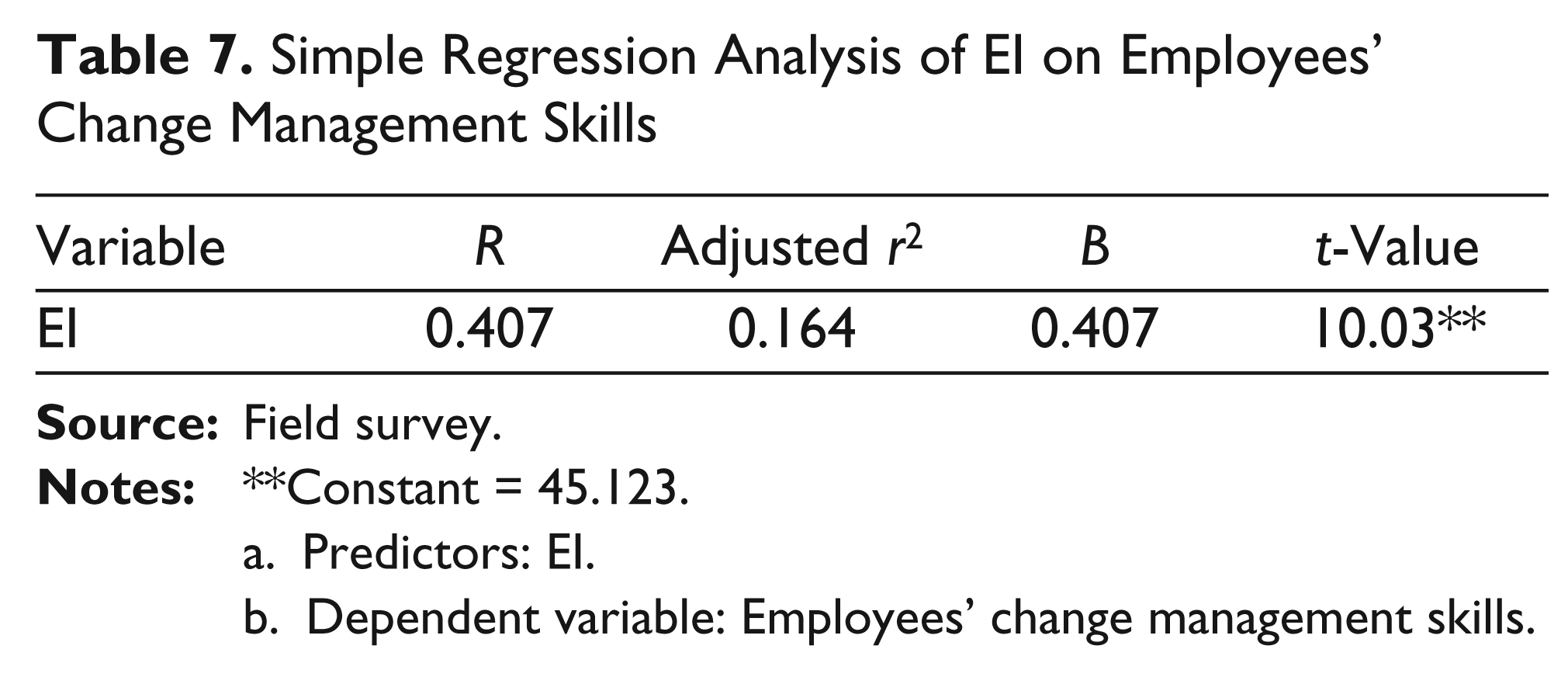
a. Predictors: EI.
b. Dependent variable: Employees’ change management skills.

where
Xi = EI
Change management skills = 45.123 + 0.407 EI.
When we take EI as a whole, the correlation (r) is 0.407, explained variance (adjusted r2) is 16.4 per cent of change management skills and β = 0.407 (p ≤ 0.01). Hence, the fifth hypothesis is rejected. It implies that EI is a significant predictor of employees’ change management skills. Therefore, it can be concluded that when there will be an increase in employees’ change management skills, 16.4 per cent changes would be there because of employees’ EI. So, in an organization if employees are having higher level of EI, they will be able to manage changes effectively in organization.
Conclusion
The present study tries to examine the relationship of EI and EI dimensions with change management skills and also try and find out the extent to which EI dimension contributes to employees’ change management skills. Five hypotheses were tested about the relationship between EI, its dimensions (self-awareness, social awareness, self-management, social skills and change management skills). It has also been observed that EI and its dimensions are positively related with employees’ change management skills, with self-awareness as the most important factor. Regression results also concluded that self-awareness and self-management are significant predictors; however, the other two independent variables (social awareness and social skills) are not found to be the significant predictors. Managers need to consider both, the self-awareness and self-management of the employees in enhancing the employees’ change management skills. Consistent with previous studies, the study confirms a significant relationship between change management and EI (Abraham, 2000; Carney, 2000; Cook et al., 2004; George, 2000; Schmidt, 1997; Wasielewski, 1985).
However, this study specially focuses on change management skills with EI. Very few researches are available on change management skills and EI. Furthermore, this study also tries to suggest a workable model for enhancing the employees’ change management skills and highlights a model in which self-awareness and self-management affect employees’ change management skills to a great extent. Model also provides further evidence that when there would be an increase in employees’ self-awareness and self- management then employee’s change management skills will increase and they will not resist for change and will manage changes effectively in the organization. Huy (1991) developed a model in which change receptivity, mobilization and learning are processes that incorporate cognition, emotion and action. EI helps an individual to deal usefully with each process. Paterson and Hartel (2002) proposed that people cope with anxiety that characterizes downsizing and employ productive coping mechanism.
The results portray that higher the EI, higher will be change management skills in manufacturing and service organization. A positive relationship has also been reported between EI and change management and organizational change. Higher change management skill indicates that the employees are emotionally capable to manage the changes in the organization. The findings are in line with earlier researchers (Asnawi et al., 2014; Fox & Amichai, 2001; Mossholder et al., 2000).
Practical Implications
The development of self-awareness and self-management is beneficial to employees’ change management skills. It is also recommended that organizations seek out top-level managers with high EI and seek ways to enhance the EIs of current managers because this element of managerial success can be developed. It is also recommended that firms should develop programmes that could enhance the EI of their managers. This could enable them to motivate themselves and their subordinate and to work in more creative, more fulfilled and more enthusiastic ways. It is recommended that the relationship between EI and change management skills can be studied in other industries and professions to allow a comparative treatment of the relationship. To enhance the measurement of EI, it is recommended that simulation, performance test or incident cased measures that specially address occupational and age groups and factors associated with such areas as hiring, career development and training be developed.
Footnotes
List of Manufacturing and Service Organization

Manufacturing Organizations |
|
| 1 | Jindal Industries Limited, Hisar |
| 2 | DCM Textiles, Hisar |
| 3 | LG Electronic India Limited, Greater Noida |
| 4 | Shri Ram Pistons and Rings Limited, Ghaziabad |
| 5 | Moser Baer India Ltd, Greater Noida |
| 6 | National Thermal Power Corporation Ltd (NTPC), Noida |
| 7 | DENSO India Limited, Greater Noida |
| 8 | J. K. Cement, Limited, Delhi |
Service Organizations |
|
| 1 | National Physical Laboratory, New Delhi |
| 2 | Designers Point India, P. Ltd |
| 3 | IDBI Bank, New Delhi |
| 4 | HDFC Bank, New Delhi |
| 5 | HSBC, Noida |
| 6 | Max New York Life Insurance Company Limited, New Delhi |
| 7 | Kotak Mahindra Life Insurance Company Limited, New Delhi |
| 8 | Birla Sun Life Insurance Company Limited, New Delhi |
| 9 | TATA AIG Life Insurance Co. LTD |