




Abstract
This decade witnesses renewed interest in research studies on workplace spirituality (WSP). The present research investigates the relationship between WSP and job satisfaction (JS) with the help of two approaches. First, with the help of necessary condition analysis (NCA), it is explored that whether WSP is a necessary condition for the occurrence of JS. Second, the mediation effect of organizational citizenship behaviour (OCB) in association amid WSP and JS is examined using Baron and Kenny’s (1986) technique of mediation analysis. A sample of 194 managers working in insurance companies is collected for the study. The study reports a positive correlation between all three variables of the study. Further, WSP does not come out as a necessary condition for JS. A partial mediation effect of OCB is reported. Practical implications and limitations are also discussed in the article.
Keywords
Introduction
Workplace spirituality (WSP) has started to get renewed attention from research scholars and practitioners both (Giacalone, Jurkiewicz, & Fry, 2005). Way back in 1980, Toffler (1980) stated ‘technology’ as a third wave of organizations. Nowadays, WSP has increasingly resorted as a revolutionary antidote for contemporary human resource-related issues. Theoretical and experimental studies on the definition, notion, construct and effectiveness of WSP have expanded considerably in recent times (Houghton, Neck, & Krishnakumar, 2016). WSP reduces organizational stress and improves decision-making (Tischler et al., 2002), highly satisfied workforce at workplace (Harung et al., 1996), effective and efficient performance at workplace (Duchon & Plowman, 2005, Malik et al., 2011; Malieki et al., 2012), higher level of job involvement and greater compliance with ethical constructs such as honesty and trust (Krishnakumar & Neck, 2002), and lower levels of psychological stress (Adams et al., 2003).
Spirituality at the workplace is not a fringe idea (Petchsawanga & Duchon, 2012), rather it is concerned with human’s deep psychological needs such as holistic development of the personality and expansion of human virtues such as compassion, trust and faith. At a broader level, WSP inspires an employee to start searching real essence and aim of human life (Gull & Doh, 2004). Moore and Casper (2006) categorized benefits of WSP in three broad levels—individual level, organizational level and societal level. At a societal level, WSP enhances people’s trust in goodness (Miller, 2001).
At an organizational level, profitability and productivity of the organizations increase with the implementation of WSP. Organizations soaked in WSP shows greater work efficiency and a higher rate of return (Jurkiewicz & Giacalone, 2004). Researchers including Neck and Milliman (1994); Pandey, Gupta, and Arora (2009); Malik et al. (2011), Garg (2017a) and Malieki et al. (2012) supported positive linkage between WSP and performance of the organization.
Further, at an individual level, employees’ physical and mental health is positively associated with WSP (Jurkiewicz & Giacalone, 2004; Krahnke et al., 2003). WSP is reported to have a positive effect on the confidence level of the employees (Krahnke et al., 2003). Organizational com-mitment of the employee increases with the experience of WSP (Garg, 2017b; Rego & Cunha, 2008), emotional quotient of employees (Hartsfield, 2003), employees’ motivation level (Bhunia & Das, 2012), commitment towards career (De Klerk, Boshoff, & Van Wyk 2006), ethical and cultural values (Issa & Pick, 2011) and self-efficacy (Garg, 2014). Robert et al. (2006) reported a positive connection between WSP and Job Satisfaction (JS). Various other studies also indicated linkage WSP and JS but none of the previous studies have explored the connection using necessary condition analysis (NCA).
The article is roughly categorized into four major segments. The first segment of the article provides diverse but enriching definitions and viewpoints of different research scholars around the globe. Indian dimensions/ constructs of WSP are discussed in the second part of the article. Third, the necessity of independent variable (WSP) for JS is explored using a new and innovative statistical tool—NCA. Mediating effect of organizational citizenship behaviour (OCB) is examined using method devised and used by Baron and Kenny (1986). The theoretical and practical significance of the findings along with proposi-tions for future researchers is elaborated in the last part of the article.
Literature Review
Workplace Spirituality—Definitions and Concept
The available literature on WSP is full of different defini-tions of WSP. Kinjerski and Skrypnek (2004) reported as many as 70 definitions of WSP but unfortunately, none of the definition got wide and unanimous acceptance and recognition from all academicians. Few definitions of WSP are tabulated as follows:
WSP has been differentiated from religion. It is not concerned with converting employees into a religious or sect-based belief system (Cavanagh, 1999). WSP is based on individual choices of values and work perception of the employees. It is about individuals who perceive themselves as spiritual creatures, whose inner selves demand nourishment at the workplace, who enjoy self-identification and purpose of life through work experience and ones who have developed a sense of connected-ness with others (Ashmos & Duchon, 2000; Milliman, Czaplewski, & Ferguson, 2003). Shrimad Bhagwad Gita defines WSP in terms of excellence in action at the workplace. It explains ‘yogah karmasu kaushalam’ which means ‘excellence in action is yoga’ (Shrimad Bhagwad Gita, verse 2.50). Researchers have provided diverse nomenclature to WSP: ‘Experience of inner self’ (Dillard, 1982), ‘super intelligence’ (Zohar & Marshall, 2000), ‘common purpose’ (Kinjerski & Skrypnek, 2004), ‘inclu-siveness and interconnectedness’ (Marcqus et al., 2005), ‘inner consciousness’ (Guillory, 2000), ‘feelings that energize action’ (Dehler & Welsh, 1994), ‘sacred force that implies life’ (Nash & Mclennan, 2001), ‘compassion’ (McCormick, 1994), etc.
Although there is no agreement of researchers on the universally accepted definition of WSP, dimensions of WSP are agreed in principle. Present article uses six fundamental Indian constructs of WSP: swadharma, sense of community, authenticity, lokasangraha, karma capital and kritagayata. The six dimensions are selected through an astute exploration of contemporary academic studies and major Indian scriptures such as Ramayana, Gita and Upanisads.
Constructs of Indian Spiritualism
The spiritual climate in Indian organization is measured using six dimensions: swadharma, authenticity, lokasan-graha and sense of community (as described by Pandey et al., 2016) and karma capital and kritagayata (as discussed by Garg, 2017c).
Swadharma: Shrimad Bhagwad Gita has made reference of the word swadharma quite frequently and regularly (Bhawuk, 2011; Sebastian, 2003). Swadharma is composed of two words—‘Swa’ (self) and ‘dharma’ (to uphold). Swadharma is referred to as swabhava which means one should work according to one’s own nature. Suda (1970) stated that the dharma is core to Indians. Modern day researchers defined swadharma as ‘meaningful and meditative work’ (Pandey et al., 2009). Meaningful work is engagement in work behaviour which is important, significant and valuable for the organization. Meditative work is one when an employee is totally engrossed and absorbed at work. Herein, employees become one with the work (Garg, 2017c).
Lokasangraha: It is made up of two sub-words: loka (world) and samgraha (coming together). It is defined as a pursuit of encouraging people to work collectively for the well-being of the common man (Sharma, 1999). Radhakrishnan (2009) termed lokasangraha as ‘working for world maintenance’. In a simple world, everyone has been assigned a definite role to contribute positively in maintenance of the world order. Apart from the welfare of human society, lokasangraha advocates adherence to one’s duty for the welfare of nature too (Pandey et al., 2009).
Authenticity: Authenticity refers to being oneself and to others (Garg, 2017c).It refers to synchronization of words and actions. Pandey et al. (2016) concluded that the authenticity is harmonization of one’s actions and behaviours with its fundamental values system. Authentic employee leads to organizational culture that promotes openness and collaborative workplace with no issue of office politics, favouritism, exploita-tion, stereotyping, oppression, nepotism and harass-ment.
Sense of community: According to Jurkiewicz and Giacalone (2004), mutual dependence and inter connectedness of employees may lead to develop-ment of sense of community among employees. It gets manifested in the form of teamwork, mutual respect and aspiration to move together towards realization of organizational goals. It develops through a common vision, common values and mutual collaborative goals. Sense of community strengthens with employee empowerment and with sharing of responsibility (Pfeffer & Veiga, 1999).
Karma capital: The approach appreciates selfless intentions and actions (Garg, 2017b). Shrimad Bhagwad Gita (Shloka 2, verse 47) suggested that one should put 100 per cent efforts without any expectations of results of the action. Ideal human actions are free from the bondage of feeling of sorrow & pleasure, loss & profit and loss & win (Shrimad Bhagwad Gita, Shloka 2, verse 38).
Kritagayata: It refers to the felling of gratitude to the divine. Spiritual values in India represents pinnacle and most advanced and extended version of gratefulness. Indian values honour every aspect of life whether it is living or non-living thing. Apart from honouring God in human form, the Indian tradition adores God in animal form (e.g., Cow, snake, etc.) and also in non-living forms (e.g., water, fire, earth, etc.). Gratefulness for every form of life is the basis of spiritualism in India (Shrimad Bhagwad Gita, verse 18.2).
Workplace Spirituality and Job Satisfaction
Porter and Lawler (1968) defined JS as ‘an unidimensional construct; that is, JS is people’s affective (emotional) response to their current job conditions’. JS is pivotal to HR managers because it is largely known for triggering attrition (Sturges & Guest, 2001). Jernigan et al. (2002) define JS as a positive attitude of employees for work, work environment, colleagues and also for larger organiza-tional context. Broader context of JS includes satis-faction with salary, job responsibility, peers and juniors and with company’s policies and procedures. However, a narrowly defined concept of JS includes only constructive and positive psychological assessment of job profile (Locke & Latham, 1990). In summation, it is a job atti-tude which is largely determined by employee’s experi-ence at workplace. This experience is shaped by phy-sical work environment, the relationship of colleagues among themselves, leadership style and also by degree of decentralization and power delegation (Kersley et al., 2006).
De Klerk et al. (2006) highlighted the fact that work, organization and working environment are increasingly acquiring centre stage in one’s life. People spend more time at workplace or in formal work-related activities than any other personal stuff. Thus, employees aspire to fulfil their spiritual needs at workplace itself (Garg, 2018). Institutionalization of WSP ensures meaningful and pur-poseful work along with social affiliation and thus it leads to spiritual fulfilment (Der Walt & De Klerk, 2014). Spiritually fulfilled employees have higher levels of satisfaction.
WSP is increasingly being lauded as a promoter of JS. WSP leads to desired outcomes such as worker motivation and JS (Krishnakumar & Neck, 2002). Pawar (2009) and Milliman et al. (2003) also reported a constructive linkage between two variables (WSP and JS). Other researchers who confirmed positive association includes Chawla and Guda (2010), Kolodinsky et al. (2008), Usman and Danush (2010) and many more. The present study does not only explore correlation between WSP and JS, but it also aspires to investigate necessity of WSP for JS with the help of a novel but an effective statistical tool —NCA.
Workplace Spirituality and Organizational Citizenship Behaviour
According to Bateman and Organ (1983), OCB is ‘individual behaviour that is discretionary, not directly or explicitly recognized by the formal reward system, and in the aggregate promotes the effective functioning of the organization’. It is a multi-dimensional construct which is commonly studied with the help of the following five dimensions (Garg & Sharma, 2015).
Courtesy: Proactive gestures that consider consulting with other workers in the organization before acting, giving advance notice and passing along information.
Altruism: Voluntary behaviour of the staff member through which an employee tries to aid colleagues in a particular task or work assignment.
Conscientiousness: Employee performance his or her assigned tasks according to their role expectations.
Civic virtue: Engrossment which the employee illustrates in the political life of the organization.
Sportsmanship: Abstaining from complaining about trivial matters.
WSP was reported to be a strong predictor of OCB (Fatahi, 2007). A statistically significant relationship between WSP and OCB was observed by Farhangi et al. (2006). In a famous experimental study, Geh (2010) theorized and examined a hypothetical model based on association of WSP and OCB. Like other researchers such as Harmer (2008) and Liu (2008), the author also concluded a positive association between two variables (WSP and OCB).
In summation, the above-quoted piece of theoretical and empirical researches clearly spelt out the potential of WSP in dealing with challenges and problems of contemporary organizations. However, unfortunately, the mechanisms through which WSP impacts JS have not been explored extensively. The present study tends to plug the stated research gap through investigating mediation effect of OCB. The proposition of the study is: OCB mediates the association of WSP and JS. Secondly, the study explores the necessity of WSP for JS using NCA. Accordingly, second proposition is: WSP is an indispensable condition for JS.
Research Framework
Data Collection and Sample
The study used exploratory-cum descriptive research design. A sample of 194 junior- and middle-level managers working in insurance companies was collected using convenience sampling. Respondents were approached through an online survey using a structured questionnaire comprising of measures of WSP, job performance, JS and OCB. The data was collected from a number of life and non-life insurance companies such as LIC, HDFC Ergo, GIC Re and United India Insurance Company Limited. Sampling captured nearly equal proportion of male (51%) and female (49%) respondents. As many as 25 respondents were below the age of 25 years, 88 employees were of age ranging from 26 to 35 years. Fifty employees were of the age group of 36 to 45 years and rest of the employees (31 employees) were above the age of 45 years. The average age of the participants was 38.6 years. Also, as high as 71 per cent of respondents were graduates while 19 per cent were diploma holders and 10 per cent was postgraduate. Figure 1 defines the direct relationship between workplace spirituality and job satisfaction. Figure 2 describes the mediation model wherein OCB is proposed to mediate the relationship between WSP and job satisfaction.


Measures
Workplace spirituality: It was observed using structured questionnaire of Pandey et al. (2009). The scale measured four dimensions of Indian WSP: swadharma (e.g., ‘Working here is a means for realizing my real self’, ‘Work itself is enjoyable for me’ and ‘I am deeply involved in my work here’), ‘authenticity’ (e.g., ‘People here own up to mistakes with others in the group’), lokasangraha (‘People here are concerned about the natural environment while working here’), ‘sense of community’. ‘Karma capital’ and kritagayata were taken from Garg (2017c). Karma capital (e.g., ‘My job helps me to realize feverishness of achievement of the desired results’ and ‘People here realize that good actions are reciprocated’) and kritagayata (e.g., ‘I am grateful for being part of this organization’ and ‘I am thankful for whatever I have in my life’). A five-point rating scale was used to access information from respondents. Reliability was explored with the help of Cronbach’s alpha, which shows good reliability (overall = 0.91, authenticity = 0.89, karma capital = 0.83, swadharma = 0.8, lokasangraha = 0.85, kritagayata = 0.78 and sense of community = 0.93).
Organizational citizenship behaviour: The variable was accessed using 15-items-structured questionnaire developed and validated by Podsakoff and MacKenzie (1997). It measured 5 constructs of OCB as: altruism (e.g., ‘I willingly help new comers to get oriented towards job’ and ‘I am always ready to lend a helping hand to those around me’), courtesy (e.g., ‘I am mindful of how my behaviour affects other people’s jobs’ and ‘I don’t abuse the rights of others’), sportsmanship (e.g., ‘I usually focus on what is wrong rather than positive side of situation’), civic virtue (e.g., ‘I keep myself updated with organizational announcements & memos’ and ‘I attend meetings that aren’t compulsory but help my department anyway’) and conscientiousness (‘I don’t take extra or long breaks while on duty’ and ‘My attendance at work is above the norm’). It is a seven-point rating scale. Again, Cronbach’s alpha (value = 0.77) confirmed reliability of the data.
Job satisfaction: The variable was measured on a five-point scale using five-items taken from Hackman and Oldham (1975). Value of Cronbach’s alpha is 0.78.
Method
NCA has been used to identify compulsory or essential conditions. The novel statistical technique is utilized to investigate whether WSP is an indispensable (necessary) requirement for JS.
A necessary cause is a constraint, a barrier, an obstacle, a bottleneck that must be managed to allow a desired outcome to exist. Each single necessary cause must be in place, as there is no additive causality that can compensate for the absence of the necessary cause. (Dul, 2016, pp. 11)
Fulfilment of necessary does not guarantee outcome but non-existence of necessary condition leads to guaran-teed failure. Outcome cannot exist without occurrence of necessary condition. Dul (2016), father of NCA, further elaborated that each and every necessary condition is indispensable. Further, the mediation effect of OCB is investigated using Baron and Kenny’s (1986) approach which confirms mediation effect if the following conditions are satisfied:
Independent/predictor variable (WSP) is signifi-cantly related to criteria/dependent variable (JS). Mediating variable (OCB) is reported to have a significant relationship with dependent variable. Predictor variable has a statistical significant rela-tionship with the mediator. Keeping mediating variable controlled, if the degree of association between predictor and criteria variable condensed significantly then partial mediation is concluded. And if the relationship between inde-pendent and independent variable ceases, then full mediation in confirmed.
Results
Table 1 provides descriptive information about six con-structs of WSP, overall WSP, five dimensions of OCB, overall OCB and JS with the help of mean, SD and correlation analysis. It is reported that all constructs of WSP (swadharma, lokasangraha, sense of community, authenticity, karma capital and kritagayata) and overall WSP have a statistical considerable affirmative correlation with five constructs of OCB and also with overall OCB. Also, encouraging positive association is also observed between WSP and JS (r = 0.75). Since both variables are reported to move in the same fashion then further analysis with the help of regression and NCA is feasible. Results are complementary with the results of other previous studies conducted in different cultural settings and with the help of different dimensions of WSP. Similar results are replicated with Indian constructs of WSP too. The current study does not end here, however the relationship between WSP and JS is investigated further using NCA. For the simplification of analysis, NCA is divided into two simple and basic steps considering WSP as independent variable and JS as a dependent variable.
Mean, Standard Deviation and Correlation Among Variables

2. * p < 0.05, ** p < 0.01.
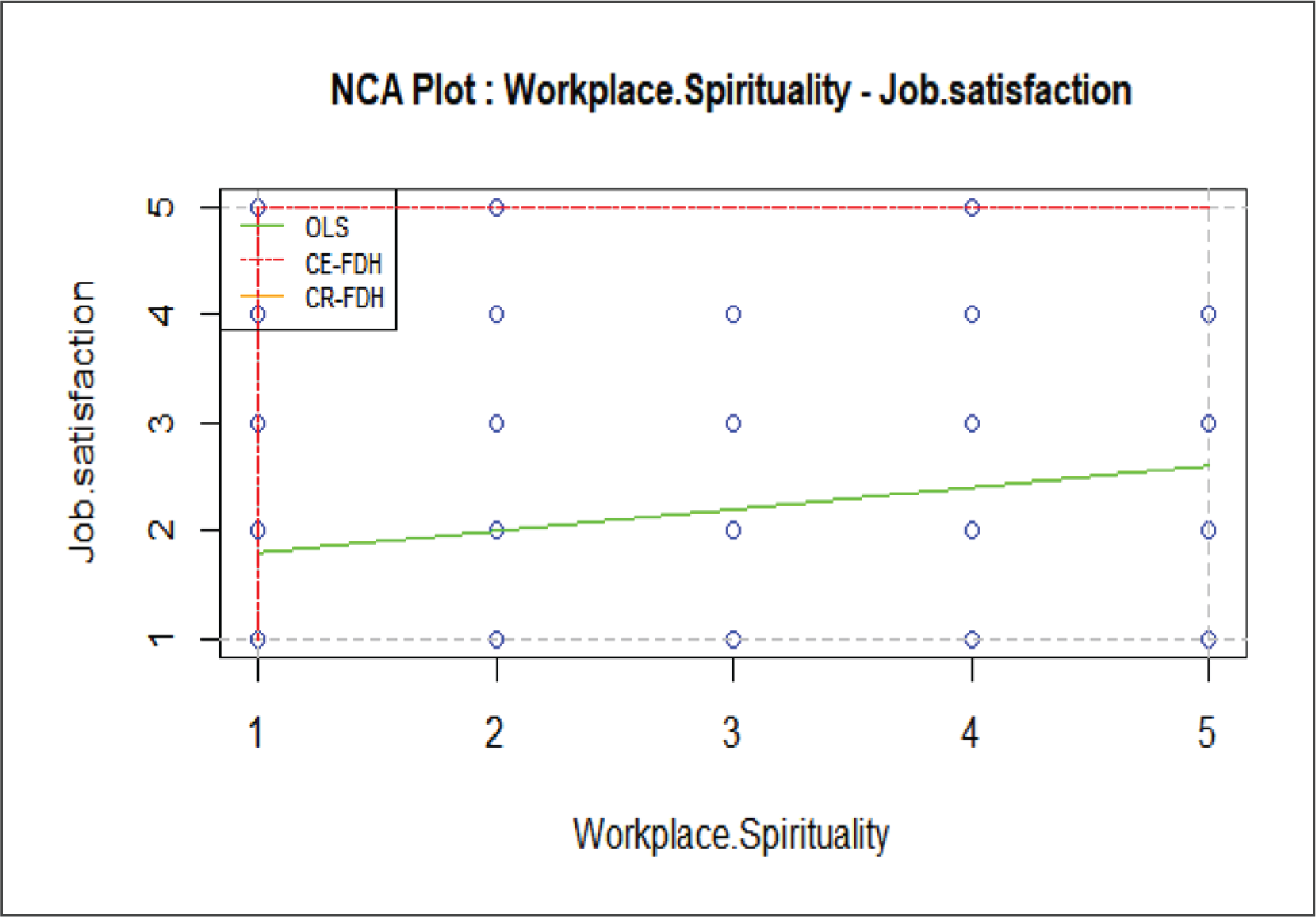
A scatter diagram is plotted considering independent variable on X-axis and dependent variable on Y-axis. Subsequently, NCA is designed to produce a ceiling line that differentiates the plot in two different zones. Zone 1 is called an empty zone and this zone does not have any observation. Zone 2 is full zone having nearly all observations of the study.
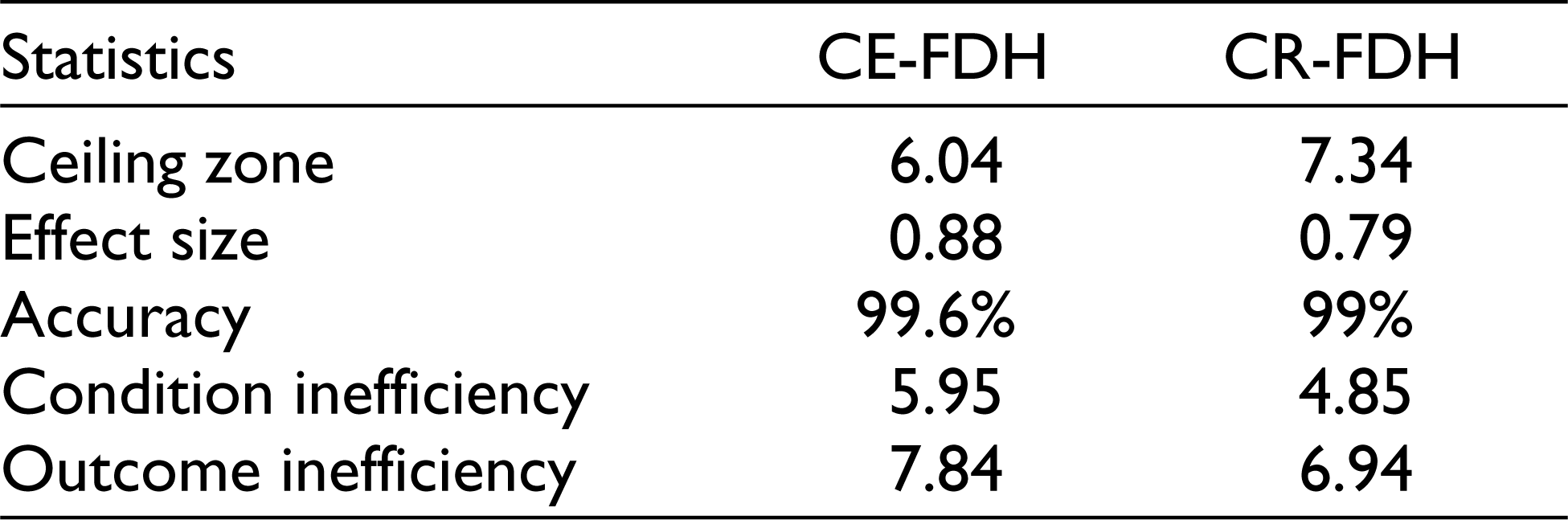
Now, quantitative and statistical parameters are calculated to determine accuracy of plotted ceiling line. Accuracy has been defined mathematically as number of observations in full zone divided by total observations. Accuracy equal to or above 95 per cent is desirable (Dul, 2016). Subsequently, effect size, which is an amplitude of necessity, is calculated. Value of effect size lies between 0 and 1 and could be analysed in the following way:
0 < d < 0.1 represents small effect size, 0.1 ≤ d < 0.3 represents medium effect, 0.3 ≤ d < 0.5 concludes large effect and 0.5 ≤ d < 1.0 confirms very large effect size
According to Dul (2016), empty upper-left corner region of the graph indicates the necessity of the independent variable. Two types of statistics are produced by NCA-ceiling envelopment with free disposal hull (CE-FDH) and ceiling regression with free disposal hull (CE-RDH). Since CE-FDH produces a better result (Dul, 2016), thus it has been preferred for analysis purpose. Threshold limit of 0.1 is essential to draw conclusive evidence of the existence of necessity of predictor variable (Dul, 2016).
Figure 3 is NCA plot and it could be easily observed from the graph that the observations are evenly spread across all the regions of the plot. Ceiling line could not demarcate the empty region from full zone. In other words, there is ‘no empty zone in upper-left region of the NCA plot’. It means that the first proposition is not true and WSP is not a necessary condition for JS. Now second proposition of probable mediation effect of OCB amid WSP and JS is examined using Baron and Kenny’s (1986) methodology of mediation analysis.
NCA Statistics
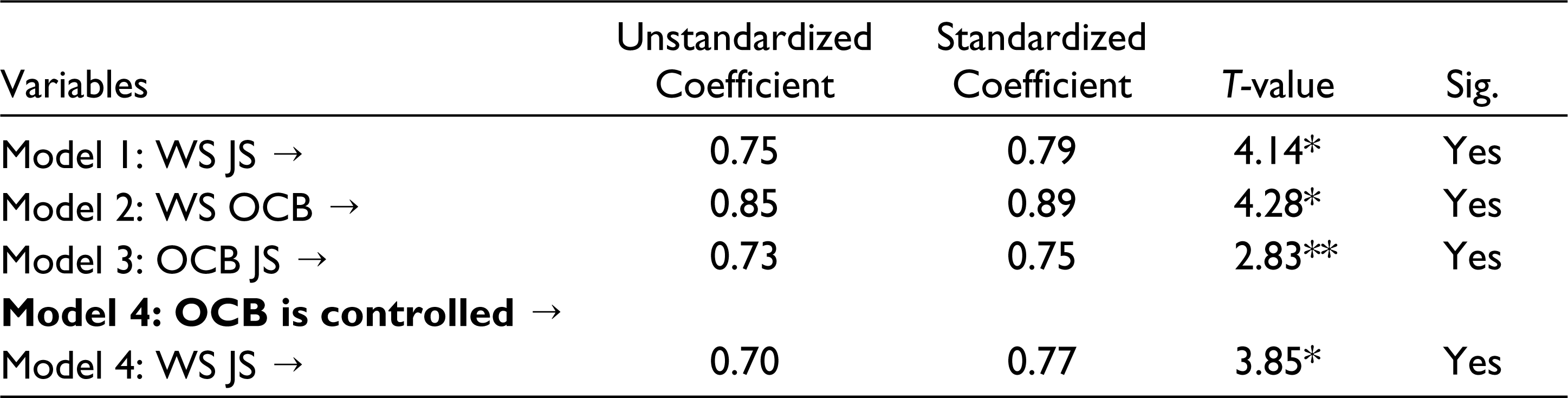
Baron and Kenny’s (1986) methodology of mediation analysis has four steps. Table 3 depicts the results of four sequential steps labelled as four different models. The first condition of mediation analysis is the presence of a significant relationship between an independent variable and dependent variable. Accordingly, overall WSP was regressed on JS (dependent variable) in Model 1, and it was significant and positive (β = 0.75, p < 0.05), which confirms the fulfilment of the first condition. Condition 2 requires a significant relationship between an independent variable (here it is WSP) and proposed mediator variable (OCB) and interestingly β value of 0.85 at p < 0.05 also confirms the same. Condition 3 demands a significant relationship between mediator variable and dependent variable. This condition is also met with β value of 0.73 at p < 0.01. Condition 4 analyses the relationship between IV and DV on controlling the effect of mediator variable. Here, hierarchical regression was used to control OCB and it was reported that the β value decreases from 0.73 to 0.70 on controlling OCB. Since a correlation coefficient of WSP and JS reduced on controlling OCB but still, it remained significant thus partial mediation is confirmed.
Mediation Effect of Organizational Citizenship Behaviour
Discussion and Conclusions
Previous scholars have concluded a positive association between WSP and JS but mediation studies in the domain of WSP are scare. The present article explores probable mediation effect of OCB. Mediating variable illustrates the mechanism through which the effect of independent variable transmits to dependent variable. According to results, WSP affects OCB and in turn, OCB affects JS. All six dimensions of WSP have been extracted from ancient Indian scriptures and also from previous academic and empirical research explorations in the Indian context. In nutshell, the present study in Indianization of spirituality studies. Another vital contribution of the study is application of NCA in the study of WSP. One of the propositions is proved correct and another proposition is proved wrong. The article concludes that WSP is not a necessary condition for JS. Further, it is also reported that OCB mediates partially the relationship between WSP and JS. In nutshell, the results suggest that those employees who experience spirituality at workplace will indulge in OCB and this inclination towards OCB will lead to a higher level of JS among them.
A number of practical implications could be inferred from the present study. As spirituality is highly correlated with JS, thus employers may try to incorporate spiritual intent and values at workplace. This spiritual intent must manifest itself in the form of more enlightened and enriching organizational vision, missions and practices. Fulfilment of spiritual needs of the employees may lead to more collaborative and responsible workforce. This constructive interaction and collaboration form basis of highly satisfied workforce. Organizations around the globe spend millions on increasing JS at workplaces and if some focus is given to the fundamental constructs of WSP, then there will be much more to be gained.
As usual, the present study has its own limitations too. First, owing to collection of information from the same source and also at the same time, there is a risk of a common method error. Future studies in the area may apply double source technique or longitudinal approach to mitigate the issue. Second, the sample of present is derived from insur-ance companies thus results could be generalized for insurance industry but generalization for other industries requires further inquiries and explorations. Future re-searchers may be required to adopt both qualitative and quantitative research approach. Exploration of the probable relationship of WSP and employee level outcomes inclu-ding employee engagement, organizational commitment, etc., could help in crystallizing the domain of WSP. The probable mediating effect of other intervening variables including emotions, trust, perceived organizational support, etc., could enrich knowledge and understanding of the field. Further, studies on moderation effect are scarce in the domain of WSP. One could definitely contribute by investigating the moderating effect of variables such as gender, experience and age.
Footnotes
Declaration of Conflicting Interests
The authors declared no potential conflicts of interest with respect to the research, authorship and/or publication of this article.
Funding
The authors received no financial support for the research, authorship and/or publication of this article.