




Abstract
This conceptual article examines the theory of reasoned action and theory of planned behaviour and some of its important extension models developed to find out consumers’ purchase behaviour for sustainable products. It has been observed in the first two models that consumers’ attitude, subjective norms, perceived behavioural control influences intention and purchase behaviour for sustainable product consumption. Further, in the extension models, it is observed that consumers’ confidence, environmental attitude, values, past experience, consumers’ willingness, social pressure, perceptions and feelings also influences consumers’ purchase intention and behaviour towards sustainable product consumption. Based on these studies, a conceptual model is proposed where moral obligation (values and ethics) and emotion are incorporated as separate constructs which may influence attitude and purchase intention, and consumers’ habit is taken under perceived behavioural control, which may also influence consumers’ purchase intention. Researchers further may test the proposed model using moderating role of demographic factors between purchase intention and purchase behaviour for sustainable durable products for Indian consumers.
Keywords
Executive Summary
Sustainable development refers to ‘impetus enabling fulfilment of the requirements of present generation without compromising the ability of future generations to meet their own needs’. This indicates to the environmental sustainability as a directive policy and very crucial work in today’s time. It was reported to the United Nations Conference on Environment and Development (UNCED) held in Rio de Janeiro in the year 1992 (Harmsen Consultancy BV, 2012). There are number of important issues such as air pollution, global warming, climate change, reduction in biodiversity and ecological balances, and acid rain etc., may endanger the preservation of environmental sustainability. Similarly, these issues are intimately linked with individual behaviour (Gardner & Stern, 2009). To preserve the environment, it is necessary to realize the importance and to change individual behaviour towards this direction (Steg & Vlek, 2009).
The McKinsey Global Institute (MGI) too suggested that if India continues to grow at the current pace, average household incomes will triple over the next two decades, making the country the world’s fifth-largest consumer economy by 2025, uplifting from the current 12th position. This situation is likely to continue due to growth factors like Govt. plan of doubling farmer’s income by 2022, rapid urbanization, continuous growth of middle-class population, changing lifestyles due to urban double-income family and growing aspiration of the Indian people, may further increase growth of demand for consumer durable products. Double income urban family gives a significant increase in disposable income and easy credit facility from banks have led to shorter product replacement cycles and aspirational life-styles have made consumer durable products e.g., air conditioners, LED TVs, washing machines, refrigerators, car, Smart phone, personal computer, laptops are perceived as utility items rather than luxury possessions.
The consumer durable products consume electricity or gasoline, emit green house gases, and have disposal hazards. So, these product manufacturers are challenged with three cardinal issues which include electricity or gasoline consumption efficiency, curbing greenhouse gas emissions and reducing disposal hazards. To gain confidence by marketers of these products, it is important to explore the consumption behaviour of Indian consumers and their future likelihood to use green durable products.
Introduction
Due to high air pollution level and forest protection measures, India ranks at 177 position out of 180 countries by the latest Global Environmental Performance Index (2018). The World Commission regarding environment and improvement recognized the Brundtland Commission and its relation with the environment protection and the world improvement. They recognized that the sustainable development refers to ‘impetus enabling fulfilment of the requirements of present generation without compromising the ability of future generations to meet their own needs’. This indicates to the environmental sustainability as a directive policy and very crucial work in today’s time.
Green products are described as environment friendly, safe for human consumption, energy efficient and do not harm the environment (Chan, 1996). These types of products also emphasize on the recycling, usage of alternative raw materials, reduction in materials usage for packaging including biodegradable materials usage which also do not harm the environment.
Many studies have been done in developed countries including India regarding green consumption behaviour for food products, organic food, packaged products and so on but less attention is paid to durable green products purchase behaviour in the Indian context (Saxena & Khandelwal, 2010). The consumer durables/light electronics market in India has grown by 11 per cent compound annual growth rate (CAGR) during FY2012–2017 to reach at US$21.70 billion. This industry is likely to grow at 13 per cent CAGR and will reach US$46.54 billion by 2020 (IBEF, 2018). Keeping in view the growth potential of consumer durables sector in India, this study makes an effort to explore the factors that lead to green consumption behaviour and its relationships for developing a conceptual framework on green consumption behaviour towards consumer durable products for Indian consumers.
Literature Review
The theory of reasoned action (TRA) and theory of planned behaviour (TPB) are the two pioneering model to measure the intention to behaviour. TRA dealt with the attitude and behaviour relations, which could not fully explain the behaviour that is under volitional control (Ajzen, 1991); hence, perceived behavioural control is included with the TPB to measure both intention and behaviour. The concepts of these two models and some of its extension models are applied in many studies including the study to examine purchase behaviour for environment-friendly products. In the TRA model, Fishbein and Ajzen (1975) divided beliefs into two separate conceptual sets: normative beliefs and behavioural beliefs. The behavioural belief influences the buyers’ attitude for taking purchase decision and the societal factors influences buyers’ subjective norm for performing actual behaviour. The TPB model included another variable: perceived behaviour control, which refers to the concept of possessing adequate resources and its essential scope to perform a particular behaviour. Ajzen (1991) suggested perceived behavioural control as ‘people’s perception of the ease or difficulty in performing the behaviour of interest’.
Methodology
The first step adopted for this review article is to restrict studies for inclusion. Given the focus on sustainable product consumption behaviour, studies applying the TRA and the TPB in other domain were excluded. In order to understand the basic research problems, an exploratory research method is used where research papers from the year 2005 to 2017 were exhaustively reviewed from various data sources such as EBSCO, JSTOR, EMERALD, SAGE Publications and Google Scholar. Through comprehensive theoretical review, we found that the TRA and TPB are extensively used to understand the behaviour of consumers towards the green products and hence we have used these models for our study.
We have selected most suitable five TRA and TPB extension models between 2005 and 2013 for our study: (a) model for predicting buying intentions of organic bread and flour products in Finland (Tarkiainen & Sundqvist, 2005) from the British Food Journal; (b) the TPB and the role of confidence and values for sustainable food consumption among young adults in Belgium (Vermeir & Verbeke, 2008) from Ecological Economics journal; (c) the conceptual model having impact on consumers’ intention in choosing sustainable products in India (Ramayah, Lee, & Lim, 2012) from the Journal of Environmental Management; (d) consumer purchase intention for organic personal care products of American consumers (Kim & Chung, 2011) from the Journal of Consumer Marketing; and (e) the conceptual model for environmentally sustainable textile and apparel products consumption by American, South Korean and Chinese university students (Kang, Liu, & Kim, 2013) from the International Journal of Consumer Studies. After studying these works, a conceptual model is proposed (Figure 1) where moral obligation (values and ethics) and emotion are incorporated as a separate constructs which may influence attitude and purchase intention, and consumers’ habit is taken under perceived behavioural control which may also influence consumers’ purchase intention. In the proposed model, we have also incorporated moderating role of demographic factors between purchase intention and purchase behaviour for sustainable durable products for Indian consumers.
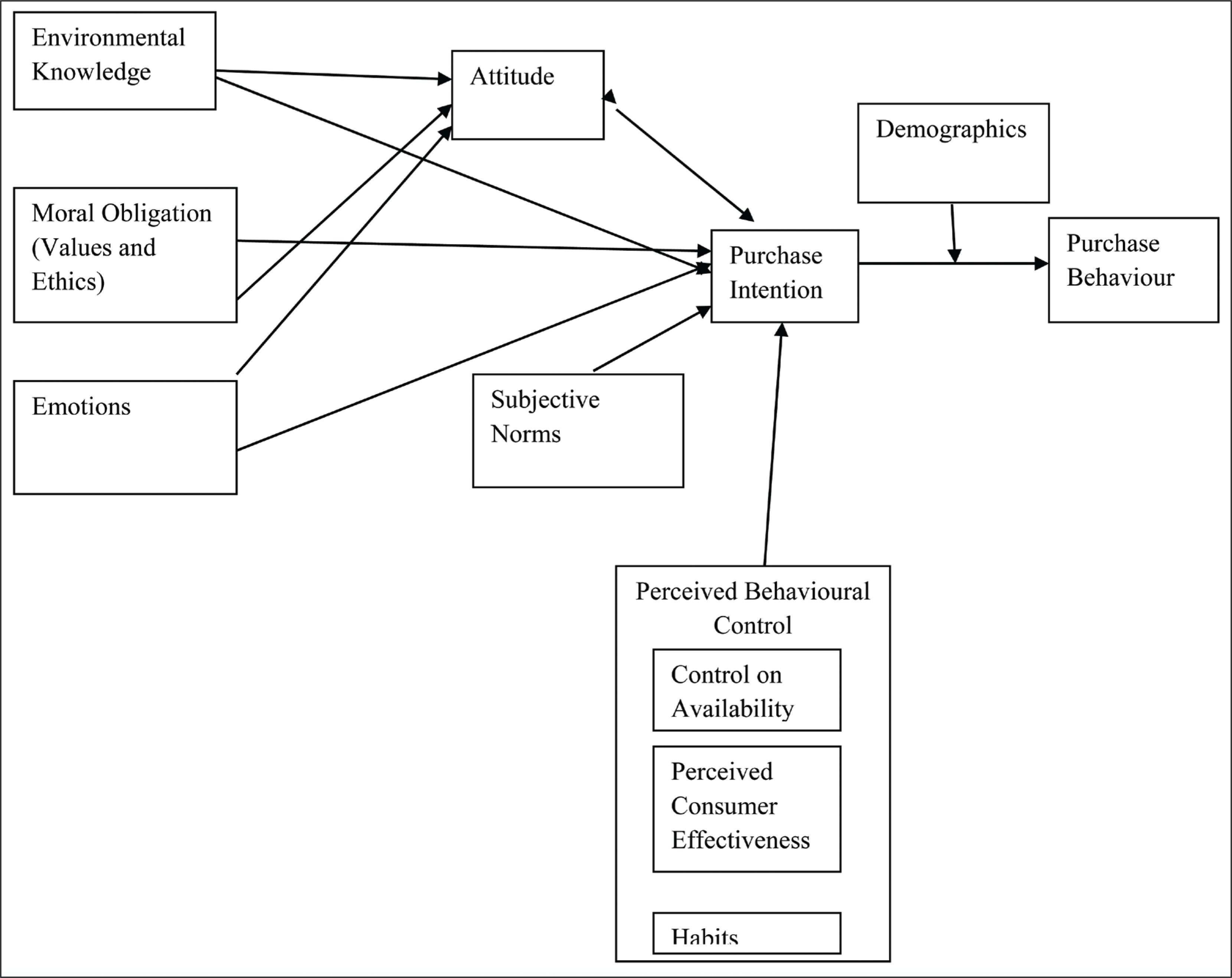
Conceptual Model
We now briefly discuss about these constructs proposed in the conceptual model, developed for green consumer durable products consumption behaviour and moderating effects of demographics in their purchase intention as well as behaviour.
Environmental Knowledge
People with more environmental knowledge are likely to show positive attitude towards environment. Bamberg and Möser (2007) underlined the role of awareness of knowledge about environmental problems as one of the important indirect determinants of green behaviour. Motivation for green consumerism can be influenced by knowledge of relevant issues and previous purchase experiences (Young et al., 2010). Environmental knowledge leads to developing attitudes and a pattern of behaviour that shows concern for the environment (Lee, 2011; Tan, 2011). Consumers with greater environmental knowledge likely to show more environmental concern compared to those who have less environmental knowledge.
Moral Obligation (Values and Ethics)
The sense of moral obligation is a strong determinant for environment-friendly behaviour. Values are personal objectives that work as guiding principles to form individual behaviour according to the amount of importance attached with it (Schwartz, 1994). Although, values and attitudes are very intimately related, at the same time, attitude depends on an individual’s values (Follows & Jobber, 2000). It is generally believed that environmental attitudes and behaviour is linked to an individual’s values (see Dunlap, Grieneeks, & Rokeach, 1983; Karp, 1996; Schultz & Zelezny, 1999; Stern, 2000).
According to Schifferstein and Ophuis (1998), ‘Organic food consumption is part of a way of life. It results from an ideology, connected to a particular value system, which affects personality measures, attitudes, and consumption behaviour.’ Vitell, Singhapakdi, and Thomas (2001) witnessed that people are more governed by values rather than consequences while making ethical decisions.
Emotion
Benton (1994) has termed ecological concern, which represents an individual’s degree of emotional attachment to ecological issues. The evidence from detailed literature indicates that experiences of guilt provide a favourable impact on individual’s future desire to buy green products. Feeling guilty about something is the direct result of one’s experience (Bagozzi, Gopinath, & Nyer, 1999; Lazarus, 1991; Roseman, Spindel, & Jose, 1990; Tracy & Robins, 2007). Soscia (2007) displays that people feels wrong in their conscience when objective result is experienced as a direct outcome of individual action.
Attitude
Attitudes are sets of beliefs about a certain object or an act that may translate into intention to carry out the act (Schwartz, 1992). Positive attitude has the ability to increase the chances of purchasing green products and determine their power of influence which is done for specific result (Follows & Jobber, 2000). Roberts has suggested that people’s attitude for the environment is very important determinants for environmental behaviour. His findings have suggested that people with environmental awareness have higher chances of displaying environment-friendly behaviour, and those who think their pro-environmental actions can lead to positive change have more chances to display ‘green’ behaviour.
Subjective Norms
Subjective norm refers to the existing social pressure to follow a certain behaviour (Ajzen, 1991). According to Ajzen and Fishbein (1977), subjective norm may be indicated as specific beliefs based on which people endorse or reject some behaviour while pursuing them. Subjective norm will drive action based on normative beliefs of an individual as to what their known people will think about their decisions, whether they should do certain thing or not and the conscience to comply with them. Research work carried out by scholars such as Siddique, Kaur, and Rajor, (2010) and Shaw (2008) shows that behaviours which improve the quality of environment, for example recycling, were directly linked to the social norms and the relationship tends to be positive.
Perceived Behavioural Control
Control on availability: Consumers’ buying decision is a complicated process and some time there are many situational factors, for example perceived behavioural control plays an important role in addition to the attitude (Jager, 2000). Ajzen (1991) suggested that consumers’ normal behaviour depends on the availability of relevant resources and presence of willingness to behave in a certain manner.
Perceived consumer effectiveness (PCE): It means ‘the measurement of one’s belief in the result of their own actions’ (Kinnear, Taylor, & Ahmed, 1974). It refers to one’s own judgement (Antil, 1978) and self-assessment (Berger & Corbin, 1992) regarding the environmental aspects that influence their behaviour in favour of the environment. It is noticed that PCE is about the individual’s belief that their actions will make a difference in solving environmental problems (Vermeir & Verbeke, 2006).
Habit: Many research works have identified previous behaviour as ‘habit’. For instance, Towler and Shepherd (1991) used additional measures of perceived behavioural control and habit with the TRA, and witnessed that ‘habit’ works as an independent factor for intention. On the other hand, Godin, Valois, and Lepage (1993) saw that habit was the most important factor while performing certain behaviour in addition to all the factors used in the TPB.
Purchase Intention
Intention to purchase a specific product has been found to be a good predictor of actual behaviour in purchasing the product. The intention construct is central to both the TRA and TPB models. Intentions are assumed to capture the motivational factors that influence a behaviour and indicate how much effort people would exert to perform the behaviour (Ajzen, 1991). Traditionally, intention is presumed to be one of the strong determinants of behaviour. Research scholars working on the purchase behaviour for organic food have noticed that there is a strong correlation between purchase intention and behaviour (Thøgersen, 2009).
Demographics
Demographic profile includes the population size, age, gender, education, income, profession, place of living and so on. Whether these factors moderate green durable products purchase intention and behaviour are criteria of study considered here.
Purchase Behaviour
Green purchasing behaviour means the preference for such products that are environment friendly and produced according to the environmental norms and process (Kilbourne & Pickett, 2008). People buying environment-friendly products are likely to think themselves who care for the environment (Thøgersen & Crompton, 2009). Indeed, a study indicated that many people are looking for less harmful life and society (namely less energy consumption, preference for renewable energy, recycling products and reduction in wasteful purchase) and displaying a strong preference for green products because they get personal satisfaction out of it (Flatters & Willmott, 2009). This type of satisfaction is not only attached with the good performance of green products but also with a sense of feeling that they are not causing any harm to the environment (Bodet, 2008; Chen, 2010).
Analysis
Organic Bread and Flour Products
This model is for predicting buying intentions of organic bread and flour products in Finland (Tarkiainen & Sundqvist, 2005). In this model, the authors have incorporated two control variables, first, the concept of ‘health consciousness’ and, second, the concept of ‘importance of price’. Most common reasons for purchasing organic food products is the buyers’ feeling that these products are safe and good for health (Chinnici, D’Amico, & Pecorino, 2002; Davies, Titterington, & Cochrane, 1995; Hutchins & Greenhalgh, 1997; Squires, Juric, & Bettina Cornwell, 2001; Zanoli & Naspetti, 2002). Since organic food products’ price is relatively higher than conventional products, which is the crucial factor for not purchasing these products by many consumers (see Magnusson et al., 2001; Tregear, Dent, & McGregor, 1994).
The findings of this study for the two newly added variables are: (a) Although health consciousness is one of the most common factors for purchasing organic food products, but the relation among consciousness about health and attitude for purchasing organic food was not significant. It indicates that consumers’ concern about health does not reflect their normal attitude for organic bread and flour products, which were tested. (b) Similarly, the importance of price of organic bread and flour products has no impact on buying intentions in Finland. Because, consumers do not feel that the price of these products category influences their purchase decisions. This could be the reason that the excess price for organic products compared to normal products does not exist in Finland (Tarkiainen & Sundqvist, 2005).
Sustainable Dairy Products
This model measured the impact of individual confidence and values under the TPB for sustainable dairy food consumption behaviour for youths in Belgium (Vermeir & Verbeke, 2008). In this study, the authors have focused on two additional probabilities, the individual factors for the intention development process for sustainable dairy food products, such as consumers’ confidence that the product performs as per its promise to the consumer and individual values. Many consumers are not very confident in self-determination about food quality (Verbeke et al., 2008), particularly in buying sustainable food products (Robinson & Smith, 2002). The authors suggest that people who feel more confident about the genuine quality and claim of the sustainable product should have separate determining factors guiding their behaviour in comparison to the people who lack self-confidence. Findings of the study suggest that different types of beliefs about the sustainable food attributes and values of the people provide different strengths to the TPB variables.
Sustainable Products
This conceptual model examines the impact on consumers’ intention in choosing sustainable products in India (Ajzen, 1991; Ramayah et al., 2012). This model, which is based on TPB, emphasized on the two main variables that may affect on consumers’ intention for deciding the sustainable products. First, environmental attitude, which completely depends on individual beliefs. Second, subjective norm, which has a linear relation with the social impact on the individual. In order to have a broader study of this work, an important external variable such as knowledge has been incorporated which is likely to impact on these two variables and indirectly impact on the intention and to behaviour.
The findings of this study indicate that the environmental knowledge has a huge positive relation with the attitude for eco-friendly products. The effectiveness of greater relationship between attitude and purchase intention is more in comparison to the significant relations among perceived behavioural control and buying intention.
Organic Personal Care Products
This study explores the consumers’ purchase intention for organic personal care products in America (Kim & Chung, 2011). The main purpose of this conceptual model is to find out American consumers’ buying behaviour for organic personal care products according to the theory of planned behaviour model suggested by Ajzen (1985). His work treats consumers’ values as a reference towards attitude and their previous exposure as the factor for buying intention. Whether perceived behavioural control moderates on the attitude and purchase intention of buyers and their relations were also tested. The theory of planned behaviour was used before to determine eco-friendly consumer behaviour and validity of the model was established (Bamberg, 2003; Chan & Lau, 2002; Kalafatis, Pollard, East, & Tsogas, 1999). The same concept was applied here to examine the precedent of purchase intention for organic products for skin and personal care. The result of the study suggests that environmental awareness and look conscious personality positively impact the attitude towards buying organic personal care products.
Environmentally Sustainable Textile and Apparel Products
This conceptual model determines the environmentally sustainable ‘textile and apparel’ products consumption by American, South Korean and Chinese university students (Kang et al., 2013). The model examines the TPB (Ajzen & Fishbein, 1980), which is widely used in many social behaviour contexts. As per this model, consumers’ willingness to have a particular behaviour may be described by their attitude towards behaviour, subjective norm perceptions about social pressure (i.e., subjective norms), perceptions and feelings about the problem of behaving in a certain way in a causal sequence. Attitude, subjective norm and perceived behaviour control were found valid predictors to determine eco-friendly and ethical consumer behaviour, for example consuming organic food (Vermeir & Verbeke, 2008), grocery shopping from fair trade (Shaw, Shiu, & Clarke, 2000), energy conservation (Gadenne, Sharma, Kerr, & Smith, 2011) and buying apparels from fair trade (Halepete, Littrell, & Park, 2009). Therefore, it is established in this study that attitude, subjective norm and perceived behaviour control influence behavioural intention for eco-friendly apparel buying.
Discussion
In Table 1, the first model under review used health ‘consciousness and importance of price’ constructs for predicting buying intentions of organic bread and flour products in Finland, which does not prove to be significant. Second, the TPB and the role of confidence and values for predicting sustainable dairy food products consumption behaviour among young adults in Belgium suggest that food attributes and values of the people provide different level of strengths to the TPB variables. Third, the conceptual model having impact on consumers’ intention in choosing sustainable products in India indicates that the environmental knowledge has a huge positive relation with the attitude for eco-friendly products and subjective norm has a linear relation with the social impact on the individual. The fourth model used for determining consumers’ purchase intention for organic personal care products in America using additional constructs values and past experience, and the result of the study suggests that the environmental awareness and look conscious personality positively impact on the attitude towards buying organic personal care products. The fifth model used for environmentally sustainable textile and apparel products consumption by American, South Korean and Chinese university students suggests that consumers’ willingness to behaviour, social pressure, perceptions and feelings influence in buying eco-friendly textile and apparel products. For a better understanding of the aforesaid objectives, we may develop adequate hypothesis to measure whether the constructs of the conceptual model (Figure 1) influence purchase behaviour of Indian consumers and test the model empirically with primary data.
Review of Extension Models of Literature Applying TRA & TPB for Sustainable Consumption Decision-making

Limitations and Future Research Avenues
Other than the above variables, which we have taken for our study, factors such as personality, culture and pride might influence green durable products purchase attitude, intention and behaviour. These factors have not been taken into consideration for our study. Under the demographics factor, we have not considered age of the people and psychographic factors, which could also influence green durable products purchase intention and purchase behaviour. Future researchers may consider these factors for their study.
Footnotes
Declaration of Conflicting Interests
The authors declared no potential conflicts of interest with respect to the research, authorship and/or publication of this article.
Funding
The authors received no financial support for the research, authorship and/or publication of this article.