




Abstract
The idea that business is a medium to deliver goods and services in lieu of profits is outmoded. The triple bottom line (profit, people and planet) approach is no longer a buzzword. It is a reality and a pressing need. There is no denying the fact that ‘corporate India’ too has embraced the philosophy of ‘doing well by doing good’. All appears hunky-dory when cash rich and highly profitable firms are hailed for being socially responsible organizations. However, at times, the situation may be ironical. An organization, seen as an epitome of altruism, is engaged in the manufacturing of a legal, albeit potentially harmful product. Any organization in the cigarette industry would fit this bill to perfection.
Business schools globally have revisited their course curriculum with increased focus on sustainability. Varun Chopra, on his day one of the MBA induction programme, has been confronted with a fundamental question: why do organizations exist? The answer to the complex question has to be examined through the lens of different stakeholders. Is there a simple answer as the interests of different stakeholders may be divergent? Scouting for an answer to this question in the cigarette industry draws attention to the need to juxtapose economic, social and environmental objectives.
Keywords
Introduction
The dean of the premier business school, in her inaugural address to MBA students during the induction programme, referred to the Paulo Freire’s work on education as a practice of freedom (1970, 1974).
Learning shall overcome economic inequalities, oppression of minorities, liberate the human mind in thought, word and deed, and provide human face. Most importantly, learning should emerge from a love for the world with a global mindset.
This statement drew Varun Chopra’s attention. Varun, a chemical engineer, had joined the school thinking that the programme will impart the requisite skills to make him job ready. He has an aspiration to join one of the top tier management consulting firms. Varun had already done his internship with one of the leading FMCG—tobacco companies in India. His understanding hitherto was that businesses exist to make profits only.
Varun listened to the dean’s address intently thereafter.
Education is all about freedom of thought and self-expression. It entails unlearning and relearning. Contrary to the perception, it is not corporate driven. Education provides an opportunity to reflect on social phenomenon and to find creative solutions to problems facing the world. Respect for diversity, social justice and concern for the environment are the key challenges today.
Varun’s dissonance reached the apex when the industry leader, an invited speaker, shed light on industry’s best practices wherein corporate houses being socially responsible is a sine qua non for long-term sustenance. The writing on the wall is clear: the first social responsibility of the business is to be profitable. However, it is not enough. Equally important are the other two dimensions of the triple bottom line approach: people and planet. Corporate boards are finding it difficult to prioritize the three.
Varun’s understanding that profit maximization objective and socially responsible corporate behaviour are oxymoronic was challenged. He was contemplating why do firms exist?
In the meanwhile, the class was handed over a case titled: ‘A Puff of Smoke, a Hole in the Pocket, a Fissure in the Lungs and Profit in Millions’.
Case method of learning is the pedagogy in business education, stated the dean. She referred to the Harvard Business School publishing note titled ‘Because Wisdom Can’t be Told’ since experiential learning is most effective in management, law and medical education (Gragg, 1940).
Learning is alchemy of interactions among a learner, faculty, and the subject (Parks, 2005) and case method facilitates it.
It was time for dinner. But Varun already had too much on his plate. Food for thought; how do firms achieve a balance between profit maximization, employee welfare, community engagement, customer health and agriculture land use in tobacco cultivation. The case presentation was due the next morning at 9 o’clock.
Case: A Puff of Smoke, a Hole in the Pocket, Fissure in the Lungs and Profit in Millions
It was 18 July 2017. A. V. Singh, a senior analyst, was contemplating the sharp decline in ITC Limited (hereinafter, ITC) stock during the day. On the previous evening, the Goods and Services Tax (GST) 1 Council had decided to levy additional cess on cigarettes. Cigarette manufacturing companies such as ITC, VST Industries Ltd and Godfrey Phillips India Ltd were bound to feel the heat of this decision.
The share prices of ITC had slid by 11.93 per cent, 2 while the stock prices of rival cigarette makers: Godfrey Phillips India Ltd and VST Industries Ltd also fell by 5.08 per cent and 8.56 per cent, respectively. It wiped out ₹468,282 million, ₹3,224 million and ₹4,741 million of shareholders’ wealth of ITC, Godfrey Philips India Ltd and VST Industries Ltd, respectively.
ITC is widely acclaimed for its socially responsible initiatives in sectors inter alia health and sanitation, drinking water, poverty eradication, education, livestock development, environment sustainability through soil and moisture conservation and watershed development and agriculture development. It had spent ₹2,759.6 million on corporate social responsibility (CSR) initiatives during 2016–2017. 3
The FMCG—cigarette segment accounts for 61 per cent of ITC’s total revenue and contributes 81 per cent of its profits before tax. Is there not a case that companies engaged in manufacturing and marketing sin goods have a moral obligation to spend more on CSR activities than regulatory norms?
A. V. Singh was contemplating that ITC had just met the regulatory requirement but not walked that ‘extra mile’ on CSR spend. Was this the reason that the market overreacted on the ITC stock on the announcement of increase in GST rate? Or was there something else that could explain this sharp southward plunge?
Cigarette and tobacco products are demerit goods. In India, cigarette and tobacco products had been placed in highest GST tax rate, that is, 28 per cent. 4 However, the 28 per cent GST tax incidence was lower than the pre-GST tax regime. It would have resulted in a tax revenue loss of ₹50 billion per annum to the government and consequent windfall profits to the cigarette manufacturing companies. The GST Council in its meeting, held on 17 July 2017, addressed this anomaly and levied 5 per cent ad valorem cess and a fixed cess of ₹1,591 per thousand sticks on both filter and non-filter cigarettes. 5
This announcement brought the indirect tax structure on tobacco products at par with the pre-GST tax era. The cess was levied on cigarettes with an intent to ‘reduce profiteering by companies and harm to public health’.
Globally, the average tax rate on cigarettes manufacture is 50 per cent and as high as 63 per cent in high-income countries (WHO, 2009, p. 57). Even after the imposition of cess, the indirect tax incidence on cigarettes will be 33 per cent in India, much below the global average. Most analysts felt that the Indian government would continue to impose negative tax on tobacco products in future as well.
ITC has generated profits of ₹102,779 million in 2016–2017, up from ₹92,617.9 million in 2015–2016. It has fared well on economic objective. But have they managed to achieve a balance between economic social and environmental objectives?
Competitive Landscape: About ITC
ITC is a conglomerate having presence in cigarettes, fast moving consumer goods, hotels, paper, apparel retail and agribusiness. A brief history and details about ITC are given in Annexure B.
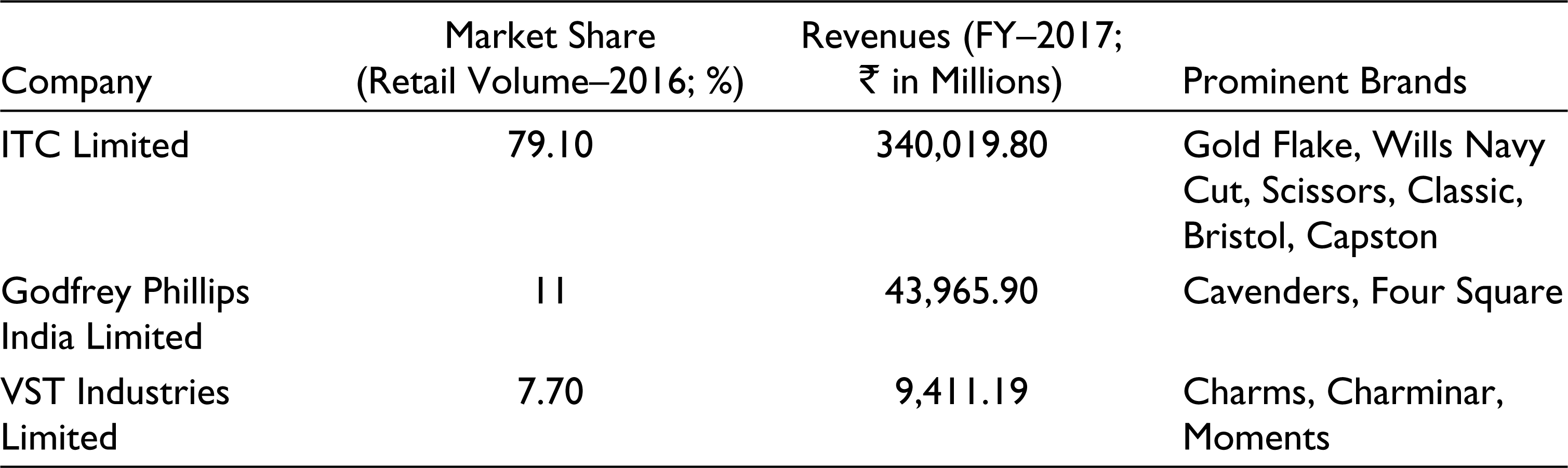
The cigarette segment is extremely important for ITC. In 2016–2017, the cigarette segment of ITC accounted for 61.32 per cent of revenues and 80.6 per cent of operating profits. It is market leader in the cigarette industry in India. ITC’s revenues are 14 multiple of Godfrey Philips India Ltd sales and 36 multiple of VST Industries Ltd sales, its nearest rivals.
ITC also faces competition from behemoths such as Hindustan Unilever Limited and Procter & Gamble Hygiene and Health Care Limited in the FMCG marketplace, from the Indian Hotels Company Limited and EIH Limited in the hotel industry, and from Tamil Nadu Newsprint and Papers Limited and JK Paper Limited in the paper industry. ITC also operates the agribusiness segment.
The main competitors in FMCG—cigarette segment, the flagship business segment of ITC, their market share and prominent brands are shown in Table 1.
Key Players in FMCG—Cigarette Segment
Puff of Smoke
Cigarette smoking is tip of the iceberg. The use of chewing tobacco, bidis and hookahs is widespread in India.
In 2016, sales volume of chewing tobacco in India was estimated to be 49,511.7 tonnes. It is expected to decline to 36,636.9 tonnes by 2021. The two leading players in this segment are DS Group (Tulsi and Baba brand) and Shri Meenakshi Food Products Pvt Ltd (Goa brand) with a retail volume market share of 32.9 per cent and 7.7 per cent, respectively.
E-cigarette, a type of Electronic Nicotine Delivery Systems (ENDS), has emerged as a substitute to conventional cigarettes during the last decade. E-cigarettes are available in the conventional format as well as in different shapes such as pens, USB pen drives and cylindrical and rectangular devices. Estimates of Euromonitor International 2013 reveal that 466 different brands of e–cigarettes were available globally with a market size of US$3 billion. It is expected to reach US$51 billion by 2030. Advocates of e-cigarettes claim it to be a means to reduce cigarette smoking. Critics have argued not only the health hazards of e-cigarettes to its users and non-users but also its efficacy to help quit smoking.
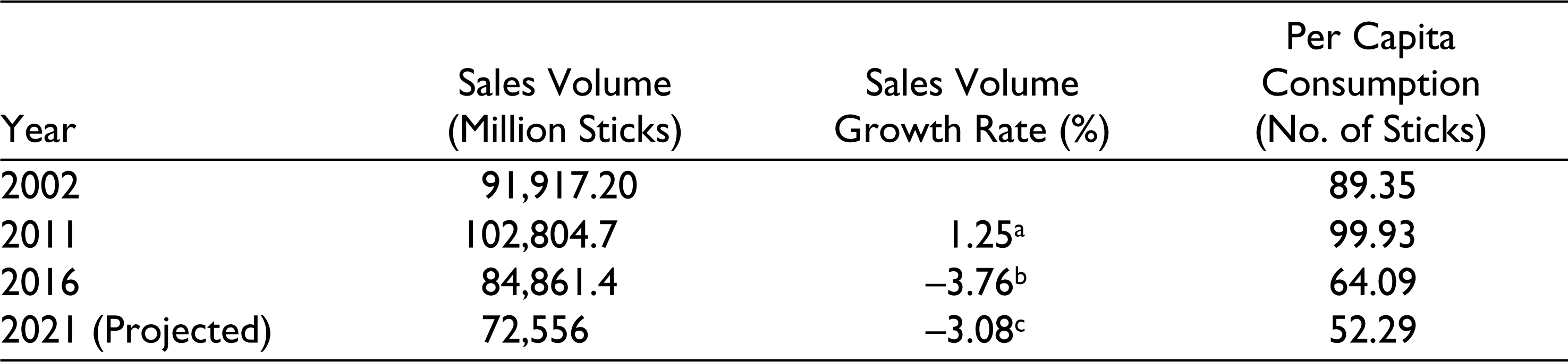
The per capita consumption, sales volume and growth rate of cigarettes in India in 2002, 2011, 2016 and projections for 2021 are shown in Table 2.
Cigarettes Consumption in India (2002–2021)
2. Growth rate and per capita consumption data has been estimated by the authors.
3. a2002–2011, b2011–2016 and c2016–2021.
The position is further worsened as the sale of illicit cigarettes is rampant in India. The size of illicit cigarette sales was 19.504 billion sticks (15.9% of legal sales) in 2011. It has grown to 24.9 billion sticks (22.7% of legal sales) in 2016. 6 It is partly due to increase in smuggling of international brands of cigarettes due to the high tax incidence.7 Another plausible reason is the unfounded belief amongst smokers that foreign cigarette brands are safe. 8
Hole in the Pocket
The puff comes at a price. In India, where 21.9 per cent of the population lives below the national poverty line, smokers shell out significant proportion of their income on the consumption of cigarettes and tobacco products.
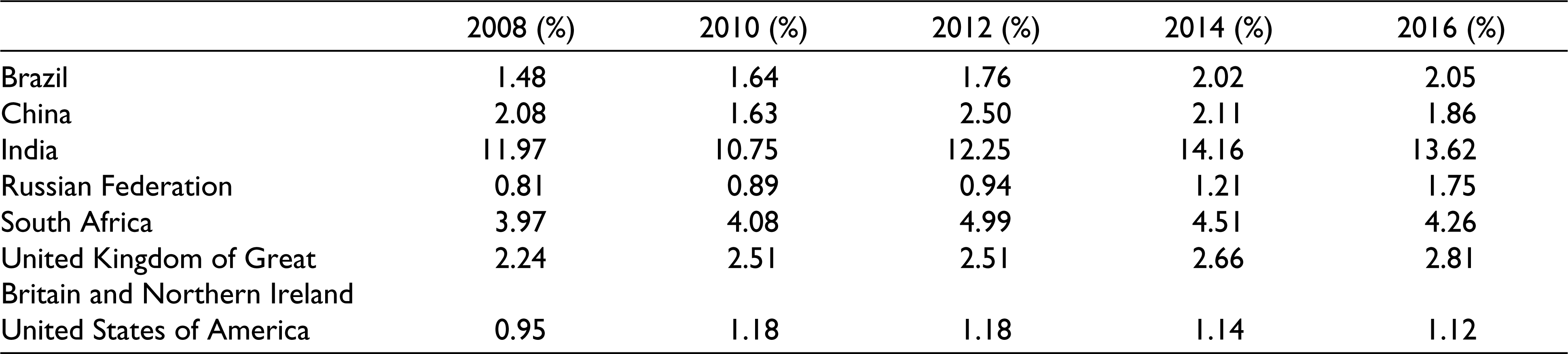
The percentage of per capita GDP required to purchase 2,000 cigarettes of most popular brand is significantly higher in India vis-à-vis other BRICS nations as well as the developed countries as is evident in Table 3.
Percentage of Per Capita GDP Required to Purchase 2000 Cigarettes of Most Popular Brand
Fissure in the Lungs
If 100 people smoke, only 50 survive. 9 The tobacco use snuffs life out of five million people every year globally. The relationship between large tobacco producing countries and their food security and health hazards have drawn the attention of the World Health Organization (WHO).
The developing world is home to 80 per cent of the world’s smokers. 10 These countries are plagued with the menace of increased tobacco use due to increasing population and ‘aggressive tobacco industry marketing efforts’ (WHO, 2008, p. 7). In India, more than one million people die due to tobacco consumption every year. 11
WHO (2008) finds that ‘… [T]obacco epidemic is one of the biggest public health threats the world has ever faced.… Tobacco use is a risk factor for six 12 of the eight leading causes of death ….’ (p. 6).
Tobacco farming, production and consumption cause millions of deaths every year. Researchers have examined the relationship between poverty, undernourishment and tobacco farming and consumption. Children from poor households are exposed to ‘green tobacco sickness’ while working in tobacco fields.
The different stages of environmental lifecycle of tobacco are growing and curing, tobacco-based product manufacturing and distribution, and consumption and post-consumption waste. The detrimental environmental impact of tobacco industry starts with land and water use, pesticide use, deforestation to cure the tobacco leaves, emission of greenhouse gases (GHG) during production and distribution, and toxic residue from tobacco smoke during consumption, and ends with cigarette butts disposal.
In 2012, India and China were among the top 25 tobacco leaf producing countries that have more than 10 per cent undernourishment. India was the second largest tobacco leaf producing country in the world, next only to China. India grew 0.875 million tonnes of tobacco leaves as against 3.202 million tonnes by China. India experienced 17 per cent undernourishment vis-à-vis 11 per cent under-nourishment in China (WHO, 2017, p. 30).
MPOWER 13 is a WHO initiative aimed at thwarting the tobacco epidemic in the world. This policy package is an outcome of WHO Framework Convention on Tobacco Control (FCTC). MPOWER necessitates active co-ordination amongst government, academia, medical associations and civil society actors with WHO support. In India, a comprehensive law has been enacted which inter alia includes tobacco free film and television policy to curb the menace of tobacco use. 14 It is mandated that every cigarette pack must carry a pictorial health warning covering 85 per cent on both sides of the package. The government has taken measures to ensure its effective implementation. 15
Professor Amartya Sen (2012) in 2nd CFI Foundation Lecture 2012 urged for strong government initiatives to discourage tobacco use.
… [S]moking influences the lives of others not just through forcing proximate people to what is called ‘passive smoking’, but also through the medical cost of the treatment of diseases that tend to result from smoking, such as cancer. When the cost of medical treatment is borne by the state directly, the connection is obvious, but even with private treatment the implicit subsidy provided by the state in supporting the medical infrastructure can be quite large. That may not be reason enough for prohibiting smoking, but the case for strong discouragement (through means such advocacy and taxation) is not something that even such defenders of liberty, as John Stuart Mill, would have found difficult to accept.…
Profit in Millions
The FMCG—cigarette industry is in the pink of financial health. It enjoys good operating margins, high asset productivity, strong liquidity, sound solvency position and robust earnings quality. As a result, the stock market places a high premium on their valuation in terms of their price-to-earnings and price-to-book ratios. The industry makes significant contribution by way of taxes, both direct and indirect.
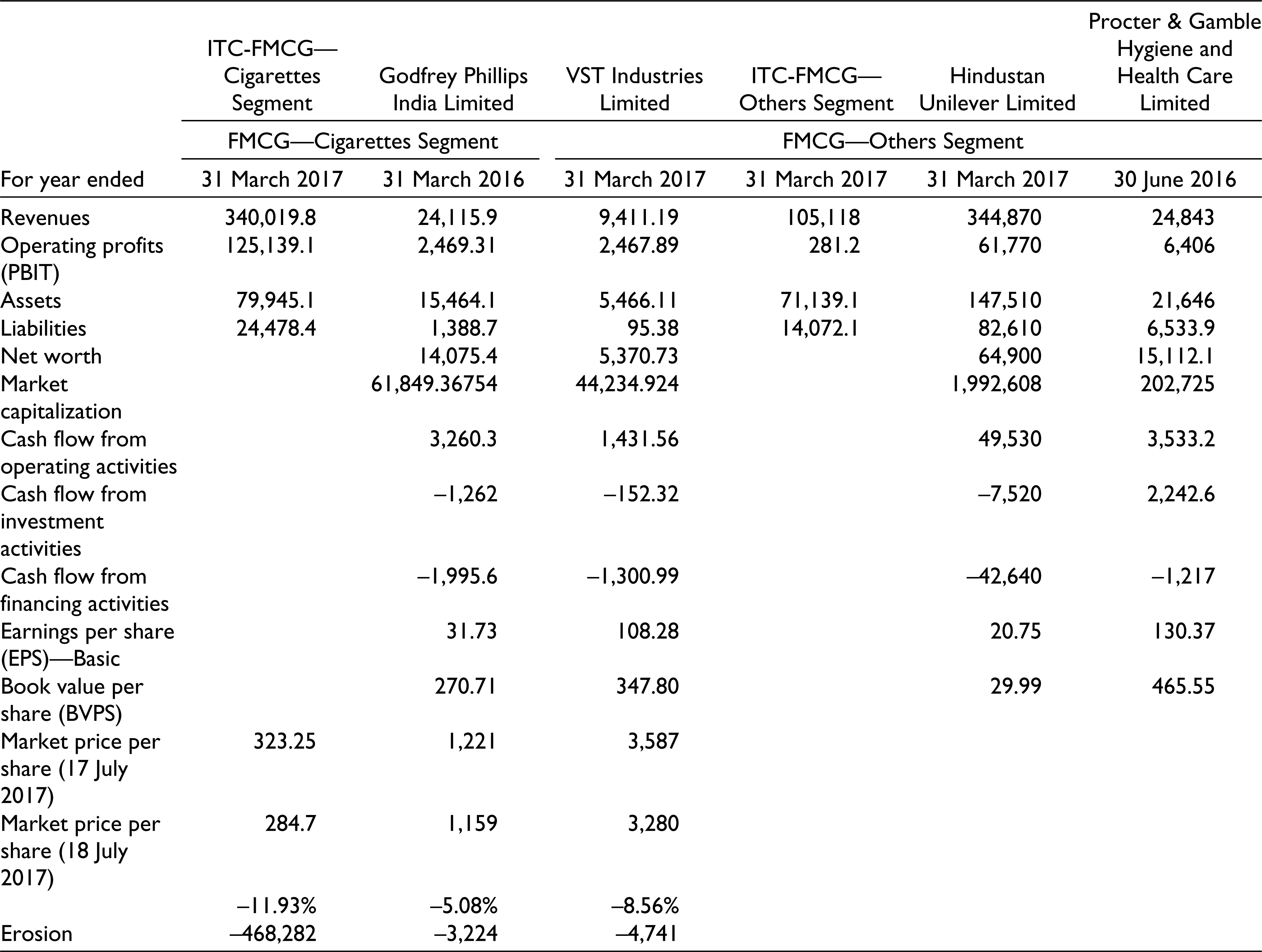
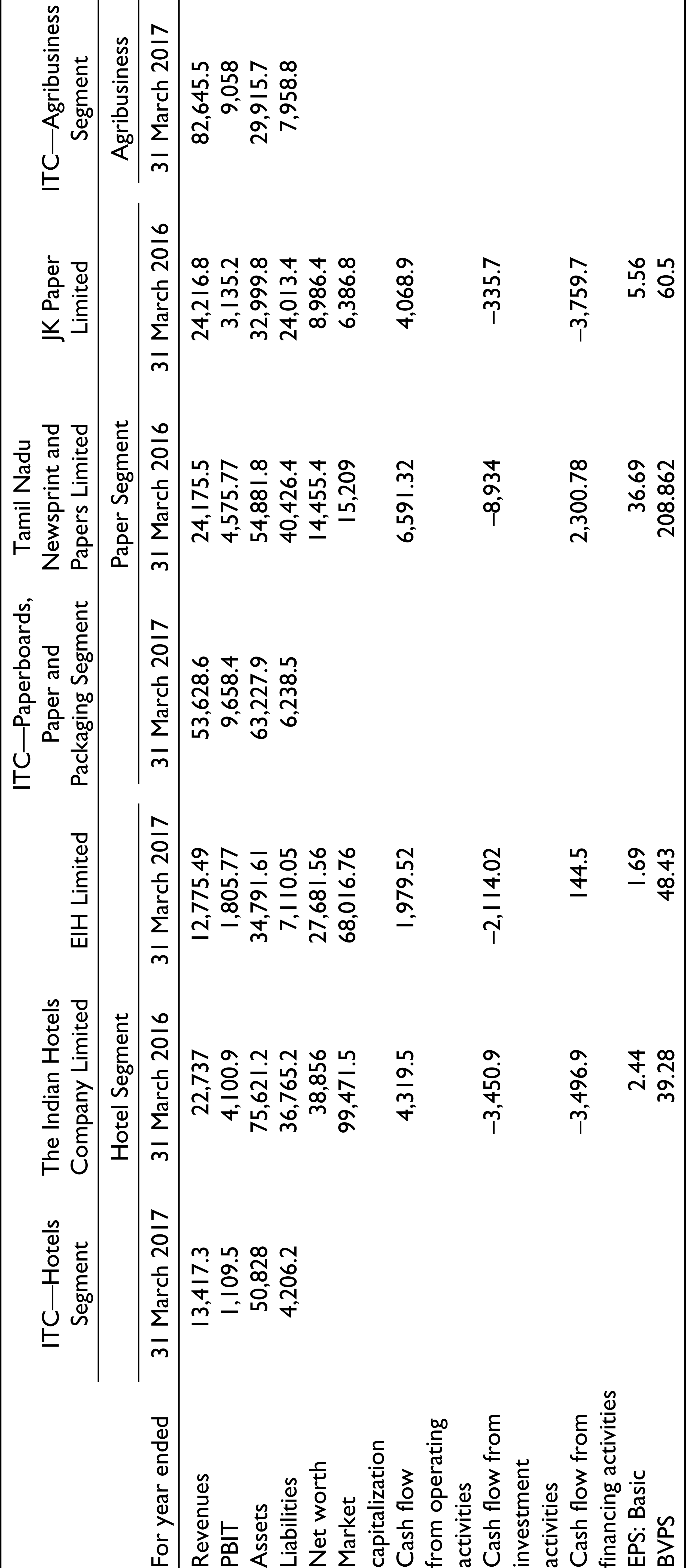
Key financial parameters of ITC and its competitors across various business lines based on the last available annual report on 18 July 2017, the date of levy of additional cess on cigarettes are given in Tables 4 and 5. The historical data of dividend payments and stock prices of ITC are as at Table 6.
Key Financials of FMCG Segment—ITC and Competitors
Key Financials of Other Business Segments: ITC and Competitors
ITC Historical Dividend per Share and Stock Price
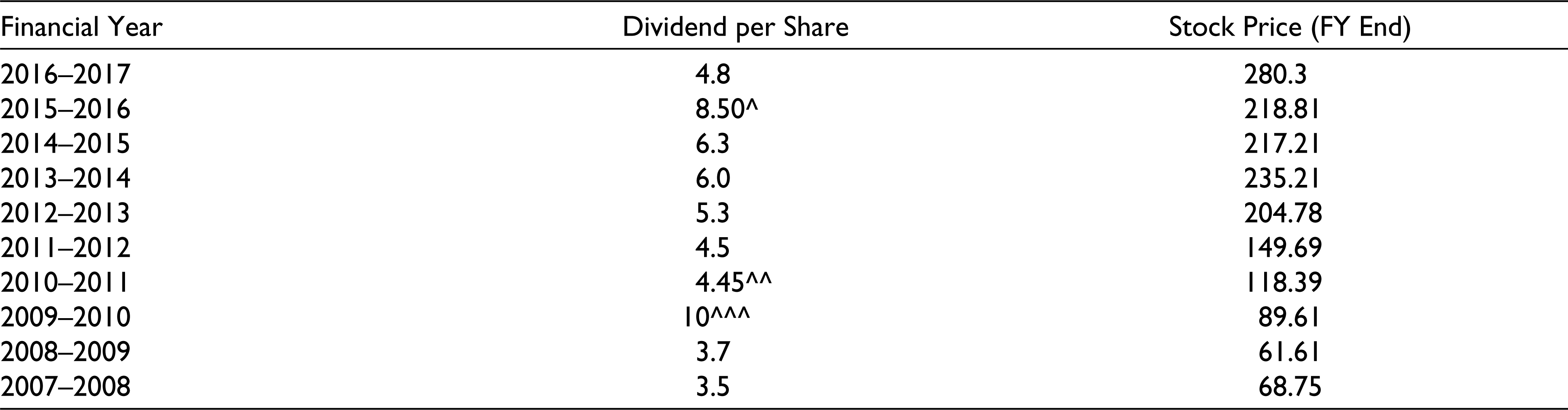
2. ^^ on Expanded share capital arising out of ‘bonus shares’ issued in the ratio of 1:1 and includes special dividend of ₹1.65 per share.
3. ^^^ includes special centenary dividend of ₹5.50 per share.
ITC’s strategy has enabled it to achieve spectacular economic results. It strives to juxtapose competitiveness and societal value creation in its corporate strategy.
The role of CSR and Sustainability Committee at ITC
… is inter alia, to review, monitor and provide strategic direction to the company’s CSR and sustainability practices towards fulfilling its triple bottom line objectives. The committee seeks to guide the company in integrating its social and environmental objectives with its business strategies and assists in crafting unique models to support creation of sustainable livelihoods.…
16
ITC claims to have been carbon positive for 12 years on the trot. It has also been water positive for 15 years and solid waste recycling positive for 10 years in a row.
Table 7 illustrates some of the CSR initiatives undertaken by ITC.
CSR Initiatives by ITC

In addition to this, ITC has taken numerous initiatives in the domain of women empowerment, education, skilling and vocational training, health and sanitation, environment, health and safety, and GHG and carbon sequestration.
Women empowerment initiatives have impacted 13,800 women and 496 self-help groups with 6,398 members. The Read India Plus programme of ITC has benefitted 0.54 million children spread in 19 districts across 11 states. The skilling and vocational training programme with a focus on imparting industry linked skills has ameliorated the condition of 43,700 youth across 29 districts and 17 states in India.
The company has embraced the Swachh Bharat Abhiyan of Government of India. It has built 23,979 low-cost household toilets in 22 districts located in 14 different states of the country.
ITC has reduced its dependence on energy from fossil fuels. It derives 48 per cent of its energy requirements from carbon-neutral fuels. ITC has decoupled emission growth with financial growth. 17
Mr Y. C. Deveshwar, Chairman ITC in the Sustainability Report 2017, highlighted their philosophy of ‘“Putting India First”—Keeping Country Before Corporation and the Institution Before the Individual’. The extract from his message in the report highlights the trade-offs in share-holders’ wealth maximization vis-à-vis stakeholder value maximization:
… The need to sustain global competitiveness in economic value creation, whilst simultaneously creating larger societal value, has led to innovation in business models that seek to synergise the building of economic, ecological and social capital as a unified strategy. A new paradigm of growth is today called for—an integrated Triple Bottom Line approach that builds competitiveness whilst at the same time ensuring that the environment is nourished and large-scale sustainable livelihoods are created.…
18
Is cigarette industry a zero-sum game? Is it not a distant dream for players in this industry to truly successful in the triple bottom line approach?
Dilemma
Even after burning the midnight oil, Varun’s team could not reach an unequivocal conclusion. They questioned each other as to what is business education all about? Why do firms exist? What is the objective function of management decision-making at ITC? Is it shareholders’ wealth maxi-mization vis-à-vis stakeholders’ value creation? Why ITC has to be socially responsible? What is the business model of corporate social responsibility? How ITC should achieve a balance between economic, social and environmental objectives? Is GST the only solution to address the tobacco epidemic or are the initiatives of MPOWER framework at the world level adequate?
Footnotes
Declaration of Conflicting Interests
The authors declared no potential conflicts of interest with respect to the research, authorship and/or publication of this article.
Funding
The authors received no financial support for the research, authorship and/or publication of this article.
Annexure A
Goods and Services Tax (GST) is a major indirect tax reform in modern Indian history. It leads to convergence of all central and state indirect taxes into a single levy and develops a single market for the entire country. The new tax regime has widely been termed as ‘One Nation, One Tax, One Market’.
The 101st amendment to the Constitution of India gave concurrent jurisdiction for levy and collection of GST by the centre and state government through Article 246A. The Central Government has exclusive jurisdiction for levy and collection of GST in the course of inter-state trade or commerce. It was notified on 8 September 2016 19 .
The historic move came into effect on 1 July 2017 when the president of India and prime minister of India pressed the GST button at the stroke of midnight. It was made possible after a decade-long industry, academic, political and legal discussions and deliberations.
GST has been referred to as ‘Good and Simple Tax’, which will benefit the poor. GST will eliminate the cascading effect 20 of indirect taxes as it allows input tax-credits 21 throughout the value-chain and across state boundaries. The resultant low cost will increase competitiveness of indigenously produced goods and services and in turn, also boost exports. Thus, it brings in certainty in the tax structure, better tax compliance, ease of doing business in India. This will cut the tax burden on goods and services. Ultimately, the industry will be forced to pass on the benefit to the consumer in a competitive market.
The indirect tax structure in India prior to introduction of GST included central taxes and state taxes. The state indirect taxes rates varied from state to state. The central indirect taxes and state indirect taxes are enumerated in Table A1.
Annexure B
About ITC
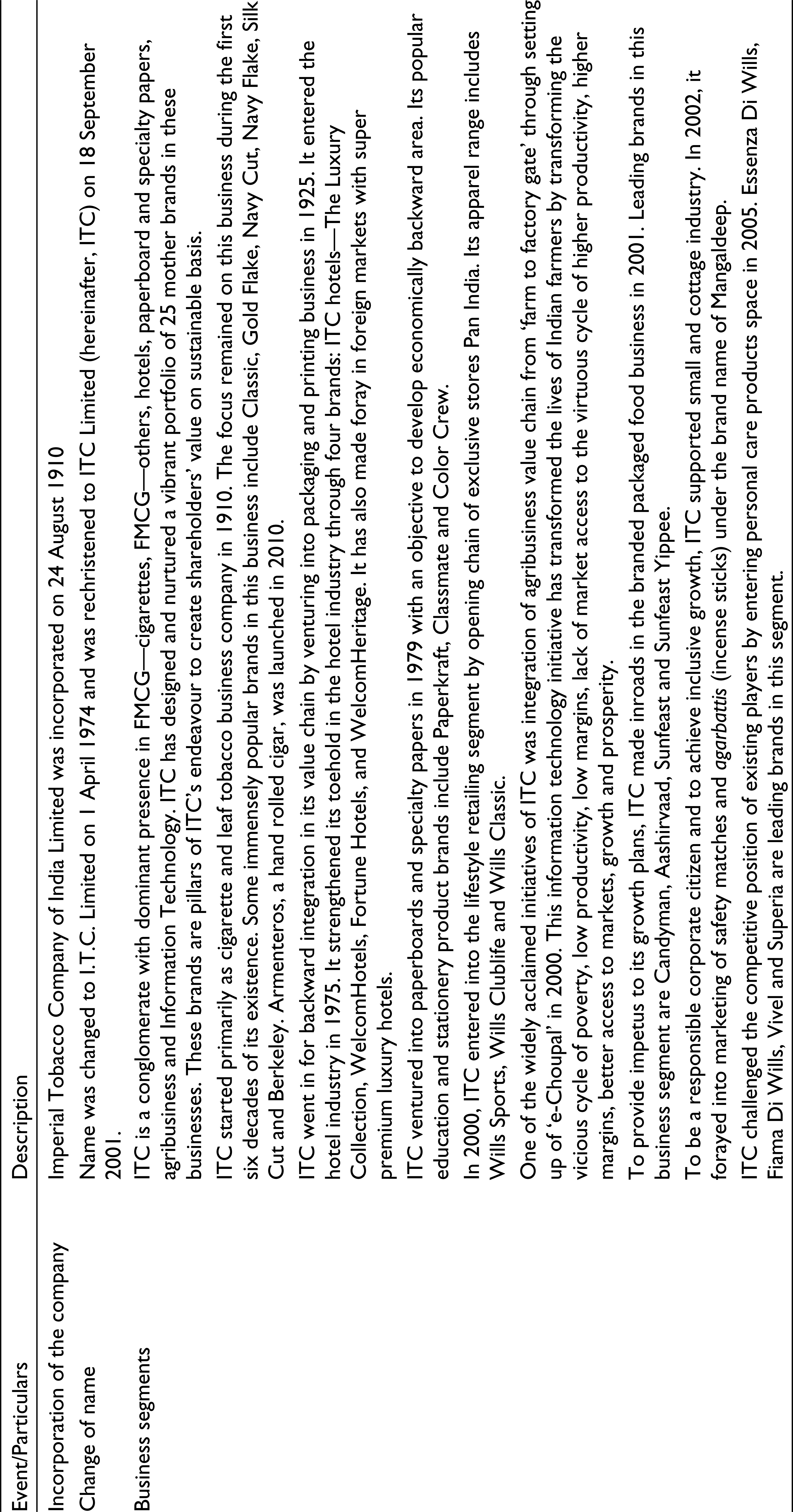
| Event/Particulars | Description |
| Incorporation of the company | Imperial Tobacco Company of India Limited was incorporated on 24 August 1910 |
| Change of name | Name was changed to I.T.C. Limited on 1 April 1974 and was rechristened to ITC Limited (hereinafter, ITC) on 18 September 2001. |
| Business segments | ITC is a conglomerate with dominant presence in FMCG—cigarettes, FMCG—others, hotels, paperboard and specialty papers, agribusiness and Information Technology. ITC has designed and nurtured a vibrant portfolio of 25 mother brands in these businesses. These brands are pillars of ITC’s endeavour to create shareholders’ value on sustainable basis. ITC started primarily as cigarette and leaf tobacco business company in 1910. The focus remained on this business during the first six decades of its existence. Some immensely popular brands in this business include Classic, Gold Flake, Navy Cut, Navy Flake, Silk Cut and Berkeley. Armenteros, a hand rolled cigar, was launched in 2010. ITC went in for backward integration in its value chain by venturing into packaging and printing business in 1925. It entered the hotel industry in 1975. It strengthened its toehold in the hotel industry through four brands: ITC hotels—The Luxury Collection, WelcomHotels, Fortune Hotels, and WelcomHeritage. It has also made foray in foreign markets with super premium luxury hotels. ITC ventured into paperboards and specialty papers in 1979 with an objective to develop economically backward area. Its popular education and stationery product brands include Paperkraft, Classmate and Color Crew. In 2000, ITC entered into the lifestyle retailing segment by opening chain of exclusive stores Pan India. Its apparel range includes Wills Sports, Wills Clublife and Wills Classic. One of the widely acclaimed initiatives of ITC was integration of agribusiness value chain from ‘farm to factory gate’ through setting up of ‘e-Choupal’ in 2000. This information technology initiative has transformed the lives of Indian farmers by transforming the vicious cycle of poverty, low productivity, low margins, lack of market access to the virtuous cycle of higher productivity, higher margins, better access to markets, growth and prosperity. To provide impetus to its growth plans, ITC made inroads in the branded packaged food business in 2001. Leading brands in this business segment are Candyman, Aashirvaad, Sunfeast and Sunfeast Yippee. To be a responsible corporate citizen and to achieve inclusive growth, ITC supported small and cottage industry. In 2002, it forayed into marketing of safety matches and agarbattis (incense sticks) under the brand name of Mangaldeep. ITC challenged the competitive position of existing players by entering personal care products space in 2005. Essenza Di Wills, Fiama Di Wills, Vivel and Superia are leading brands in this segment. |