




Abstract
The authors develop a scale to measure individual perspectives on Corporate Social Responsibility (CSR) constructs based on microfoundation theory. To develop the microfoundation based CSR scale, the research methodology involved two stages (qualitative research followed by quantitative research). In qualitative research, Focused Group Discussion (FGD) was conducted to extract items for survey questionnaire development. Subsequently, quantitative analysis was carried out. The data were subjected to exploratory and confirmatory factor analysis (CFA). The study sample comprised of 407 management students of Indian business schools who enrolled in CSR and sustainability courses. The developed scale comprised of four variables namely Customer Product Preference (CPP), Customer Firm Preference (CFP), Investor Preference (IP) and Employability Preference (EP). The results were arrived at by undertaking Exploratory Factor Analysis (EFA) and CFA. The scale developed and extended the theoretic conversation on CSR from the organizational level discussion to an individual level discussion based on microfoundation theory. This is one of the first studies to develop a scale on individual perspectives on CSR constructs based on micro-foundation theory.
Keywords
Introduction
Corporate Social Responsibility (CSR) has become necessity for present-day business organizations (Bhattacharyya, 2012; Werther Jr & Chandler, 2005). In India, CSR has become a regulatory mandate for large organizations (Subramaniam, Kansal, & Babu, 2017). In the last few decades, firms have engaged in increased CSR activities by increasing both the width and reach of CSR initiatives (Rangan, Chase, & Karim, 2015). Researchers however have reported from different contexts that even this enhanced level of CSR spending by firms have not necessarily translated into meaningful and impactful change in society (Bhattacharyya, 2010a; Porter & Kramer, 2006). It would thus be important to understand that why even after multitude of organizational CSR initiatives, such a state existed. The authors applied a microfoundations theory (MFT; Felin, Foss, & Ployhart, 2015) to understand the role of individuals in increasing the efficacy of organizational CSR initiatives. The works of Foss and Pederson (2016) and Molina-Azorine (2014) advocated that individuals mattered keeping in mind the strategy managers as the base of MFT. Hafenbrädl and Waeger (2017) extended the discussion on MFT for CSR executives.
Behavioural theories researchers such as Hafenbrädl and Waeger (2017) and Molina-Azorine (2014) referred to CSR as manifestations of individual perspectives. An individualized consideration on CSR rested upon the three pillars, namely individual knowledge on CSR, skill sets to practice CSR and attitude towards CSR (Hafenbrädl & Waeger, 2017). CSR initiatives were influenced by an individual’s ability to undertake decisions based on personal social outlook and value system (Hemingway & Maclagan, 2004). This would define individual’s competencies for undertaking effective CSR initiatives.
Firms have been emphasizing on business school students being socially sensitive (Christensen, Peirce, Hartman, Hoffman, & Carrier, 2007). Socially inclined students who would join organizations were expected to bring benefits such as developing products, investing in firms and being inclined to be employed in firms that have positive social and environmental externalities (and contribute to development of society) (Sobczak, Debucquet, & Havard, 2006). Hence, it would be prudent to discuss what behaviours management students are required to exhibit which are to be embedded in the notion of CSR. This research accommodated the viewpoints of students who had enrolled in CSR and sustainability courses. It assumed greater relevance as such management students in future would become mana-gers (Christensen et al., 2007; Sobczak, Debucquet, & Havard, 2006). Their understanding and conceptualization of CSR would throw light on what CSR activities their firms would do in future and the nature of social orientation their organizations’ employees would possess to drive CSR initiatives. There is no established scale to measure individual perspectives on CSR, based on MFT. Hafenbrädl and Waeger (2017) while discussing a meta-analysis on CSR perspectives argued that a scale capturing personal perspective on CSR should be developed, so the authors attempt to fill the gap.
Literature Review
The idea of CSR shaped the nature and limit of a firms’ commitment with stakeholders (Matten & Moon, 2004). Microfoundation based theory delved at individual level contributions to team and organizational decision-making (Molina-Azorine, 2014). The authors for the literature review considered three spheres of influence of an individual. Researchers had (Nan & Heo, 2007; Podnar & Golob, 2007; Sheikh & Beise-Zee, 2011) advocated the role of individual as customer of an organization. Individual playing the role of a customer subconsciously and informally guided organi-zation to become socially and environmentally sensitive (Podnar & Golob, 2007). The important role investors played in shaping organizations growth and development has been discussed (Brown-Liburd & Zamora, 2014). The inclination of investors to invest in a particular organization has defined organizations’ long-term sustainability (Sparkes & Cowton, 2004). Organizations’ valued investors’ inputs and undertook decisions which were investor friendly (Wang, Qiu, & Kong, 2011). Therefore, individuals influe-nced organizations to be socially sensitive (Dawkins & Lewis, 2003). An individual’s biggest commitment towards an organization was to become an employee (Rodrigo & Arenas, 2008). Therefore, a prospective candidate (as an individual) to be recruited in an organization might force organizations’ to undertake decisions (social and environ-mental) which were considered progressive by the indivi-dual (Nejati & Ghasemi, 2012). The willingness of an individual to join an organization transpired only if the firm in question was socially and environmentally sensitive (Dawkins & Lewis, 2003; Turker, 2009). Hence, individuals to assess CSR initiatives of organization played three roles, namely as a customer, as an investor and as a prospective employee (conceptualized in Figure 1).

Source: Authors own contribution.
Role as a Consumer
Society is constituted of actual or potential customers and thus their judgements about a firm being socially responsible helped determine their choice of products to be purchased and consumed (Leisinger, 2005; Mohr, Webb, & Harris, 2001). Vertical and horizontal differentiations were the two ways usually by which CSR differentiated firm products and services (McWilliams, Siegel, & Wright, 2006). Webb, Mohr and Harris (2008) observed that in modern-day society, increasingly consumers were engaging in socially responsible consumption. Present-day consumers are aware of the pressing social and environmental issues (Boehe & Cruz, 2010). Individual consumers who were socially and environmentally sensitive would choose firm products and services that were linked towards social and environmental causes (Fernández-Kranz & Santaló, 2010). Turban and Greening (1997) and Arpan (2005) explored enhanced corporate image because of indulgence in philanthropic causes. This resulted in positive buying behaviour from customers towards such firm’s products and services. Jones, Comfort, and Hillier (2007) and Brown and Dacin (1997) posited that corporate social and environmental action was an indirect way of marketing.
Webb, Mohr, and Harris (2008) studied the nature of consumer preference and propensity to buy products wherein the product or service carried information regar-ding the environmental impacts. This information consi-sted of environment impacts during production, usage, and marketing and distribution (Maignan, Hillebrand, & McAlister, 2002). Researchers had deliberated regarding customer preference towards a product or service because of the product service cause (Jones, Comfort, & Hillier, 2007). Customers preferred products that supported certain environmental and social causes (Webb, Mohr, & Harris, 2008). Further, research indicated that customers also preferred products that were made with fair work practices during manufacturing (Beckmann, 2007). Another stream of literature ascertained customer preference in buying behaviour on product/service inclusion (Webb, Mohr, & Harris, 2008). Such inclusion was determined by the scope of the product for usage by elderly differently abled and illiterate individuals (Faria, Silva, & Ferreira, 2012; Warschauer, 2004). Customers were interested to buy products of a firm that had demonstrated superior social/environmental performance (Mohr, Webb, & Harris, 2001). Often customer gauged firm’s superiority by the social/environmental performance awards received. Customers preferred to buy products of such firms that did not engage in businesses like tobacco which created negative social impact (Klein, Smith, & John, 2004).
Role as an Investor
The notion of individual investors inclined to investing in only such firms which undertook healthy social/environ-mental activities gathered momentum in the new millennium (D. J. Vogel, 2005). The idea of socially responsible investing and mutual funds has been a case in point (Shank, Manullang, & Hill, 2005; Verschoor & Murphy, 2002). Smith (2005) observed that even institutional investors like pension fund activists believed that firm performance on social and environmental aspects was linked to firms’ competitive success (Shank, Manullang, & Hill, 2005; Smith, 2005). Thus, this study attempted to capture that when given a possibility, would management students invest in such special mutual funds that had a motto of investing in only socially/environmentally friendly companies. Such firms’ equity stocks that indulged in socially/environmentally friendly companies would then be preferred by similar kind of potential investors (Cortez, Silva, & Areal, 2009; D. J. Vogel, 2005). Further, it was also of interest to explore whether the management students would restrain from investing in firms that engaged in industries and sectors such as alcoholic beverage, mining, armaments, chemical and such others (Chang, Nelson, & Doug, 2012; Ito, Managi, & Matsuda, 2013).
Potential investors were interested to invest in firms based on the social, environmental and financial reporting of firms (Cortez, Silva, & Areal, 2009). They gauged firms for investing, preferentially, when there were substantial reporting items on environmental and social factors on the firm’s website and annual report (Chang & Doug, 2010; Verschoor & Murphy, 2002). They also provided due weightage for evaluation when reports were published in the third party global reporting initiatives (Shank, Manullang, & Hill, 2005; Smith, 2005; Verschoor & Murphy, 2002). Potential investors also gauged firms based on social and environmental performance (Smith, 2005; Verschoor & Murphy, 2002). This evaluation was carried out by studying the national and international awards a firm received on social and environmental initiatives (Fombrun, 2005). Investors shunned firms that engaged in products such as mining, chemicals, armaments and addictive substances (Lewis & Mackenzie, 2000; Yakovleva, 2017). Investors avoided firms that witnessed social unrest or media and civil society led negative discussions (Doppelt, 2017; D. Vogel, 2007).
Role as a Prospective Employee
Bučiūnienė and Kazlauskaitė (2012) wrote that companies that exhibited desired good behaviour on social and environ-mental issues satisfied their employees in a better manner (Sharma, Sharma, & Devi, 2011). Individuals would thus like to be part of organization as an employee if the organi-zation was socially/environmentally sensitive (Joyner & Payne, 2002). Organizations’ social sensitivity included efforts of improving employees’ quality of life (Koonmee, Singhapakdi, Virakul, & Lee, 2010). CSR researchers (Brown, Dacin, Pratt, & Whetten, 2006; Turker, 2009) had advocated that organizations which were involved in serving employees and society attracted increased number of appli-cations during recruitment and were able to retain employees for longer tenure because of goodwill (Aguilera, Rupp, Williams, & Ganapathi, 2007). Such organizations also followed environmental-friendly product manufacturing pro-cesses (Boiral, 2009). Thus, organizational human resource management (HRM) functions played a vital role in main-taining CSR image of an organization (Dawkins & Lewis, 2003). There were studies which suggested that regressive HRM practices of firms negatively affects firms’ economic performance (Preuss, Haunschild, & Matten, 2009).
If information regarding CSR activities (social and environmental) were available on firm’s website and annual report, an individual would prefer to join the organization as an employee (Dawkins & Lewis, 2003; Rodrigo & Arenas, 2008). Prospective employees studied awards, recognition and goodwill a firm received for its social and environ-mental initiatives (Gaudêncio, Coelho, & Ribeiro, 2014). Turnipseed (2002) wrote that firms which engaged employees in CSR activities reinforced employee–employer relationship. Socially and environmentally sensitive employees participated in various community initiatives by the firm and other institutions (Rodrigo & Arenas, 2008). Prospective employees before joining an organization studied firm’s ethical and legal standing (Preuss, Haunschild, & Matten, 2009), clarity on code of conduct and processes (so as to avoid legal violation; Lee, Song, Lee, Lee, & Bernhard, 2013). Organizations facing long-term litigation in national or international courts were seen as negative (Preuss, Haunschild, & Matten, 2009). Further, organizations that were involved in mass lay off of employees were not considered favourable (Hansen, Dunford, Boss, Boss, & Angermeier, 2011). Thus, prospective employees actively sought for information about organizational functioning, its legal and ethical standing, and awards/accolades received for CSR initiatives (Rodrigo & Arenas, 2008; Royle, 2005). The current article explored the perception of respondents regarding desired CSR characteristics of an organization and willingness of an individual to join the organization as a potential employee.
Research Gap
Studies capturing an individual’s role response on the CSR characteristics of firms have not been undertaken previously as mentioned by Hafenbrädl and Waeger (2017). This sets the scope of the study. Literature indicated that the corporate and the collective representation of social bodies like community based organization decided what CSR actions were to be undertaken by a corporate (Waddock, Bodwell, & Graves, 2002). Recent research has been emphasizing the role of employees, customers and investors as individuals in deciding on CSR initiatives. The dimensions considered by corporates and social bodies about CSR differed from individual perspectives of CSR. Authors are anchoring the study based on MFT by consi-dering role plurality in CSR judgement. Gond, Akremi, Swaen, and Babu (2017) argued regarding the importance of plurality in microfoundations. It is important to understand what dimensions individuals apply to define and gauge a CSR lively organization through the individuals’ daily living roles.
Research Methodology for Scale Development
The section discusses the research methodology adopted in this study for developing the scale. The study involved two phases. In the first phase, over and above literature inputs, insights from a focused group discussion (FGD) (Krueger & Casey, 2014) were added. The FGD was conducted invol-ving 4 socially and environmentally sensitive students, 4 academicians who offered courses on CSR, environmental management and sustainability, and 4 industry experts who have been working on CSR, environmental management and sustainability for the last 10 years. The data was collected during October 2018. The average age of students was 24 years and the average age of academicians and industry experts was 33 years. The FGD lasted for about 58 minutes. It commenced with the introduction by facilitators ela-borating the concept, facilitation of the FGD and finally the concluding remarks by facilitators (Morgan, 1996). The first two authors were facilitators. The discussion was recorded and transcribed. A total of 55 items were generated based upon extant literature review and inputs from FGD (Krueger & Casey, 2014). Further, these items were revisited and validated for purification of items by new set of two academicians and two industry experts (Morgan, 1996). Three items were dropped because of duplication and lack of conceptual relevance. Thus, there were 52 items. After the round of qualitative purification in the second phase, the pilot study (with students) was done based on a structured survey questionnaire. The pilot survey was carried out for further refinement and appropriateness of the closed-ended structured questionnaire items. The filled in responses were tested by statistical analysis to check for the appropriateness and relevance of the items. Rewording of the questionnaire items were done based upon the feedback of respondents and by mean value test for relevancy (Churchill, 1979; Hinkin, 1995; Malhotra, 2008; Rossiter, 2002) so as to figure out the appropriate combination of items as well as for the shortlisting of items. In phase two, construct validity of questionnaire in pilot study was carried out using factor analysis. This was done in two steps. In Step 1, exploratory factor analysis was conducted with 102 student respondents. In Step 2, another independent sample size of 248 student respondents were collected to run confirmatory factor analysis (CFA). Thus a total of 350 independent students were surveyed. The number of schools targeted was four no other respondents were conducted. The population of the study was all Indian management students who have undergone CSR and sustainability courses. The sample frame was students enrolled in Indian business schools. The sample description of the same has been presented in Table 1.
Sample Description Stages 1 and 2
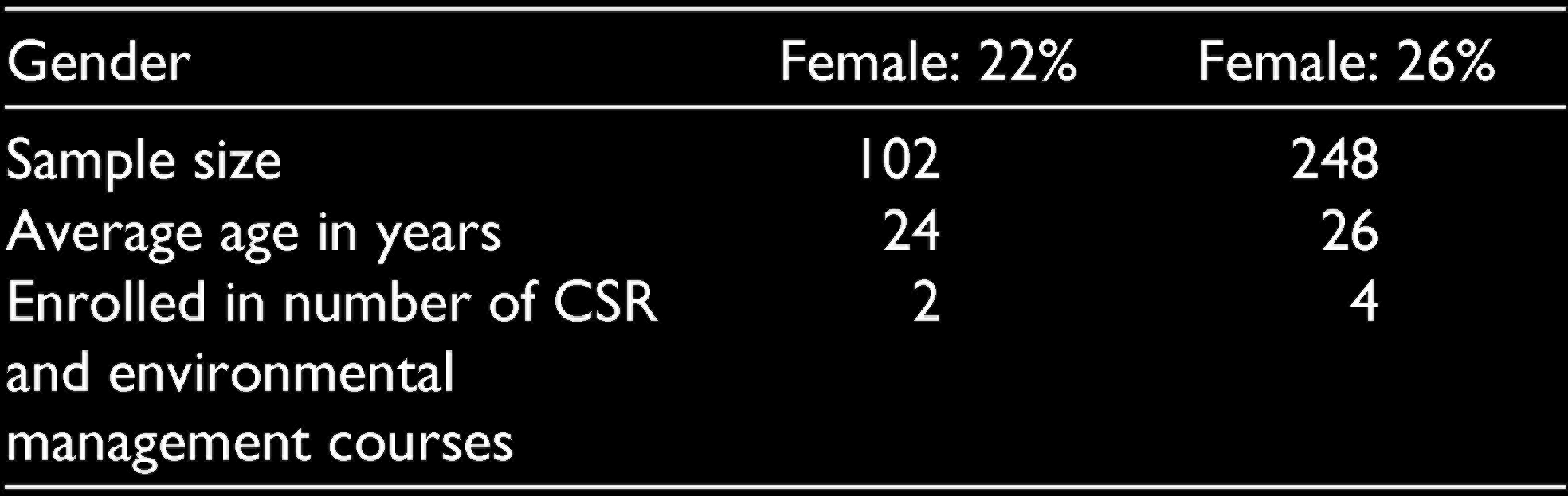
For step one, the data was collected from management students pursuing their master’s programme in management in India. A total of 201 questionnaires were distributed to student respondents who had enrolled in 2 CSR and environmental management courses. A total of 115-filled questionnaires were received. The 13 filled responses had non-response error, therefore, only 102 questionnaires were used for exploratory factor analysis. The sample comprised of 22 per cent female respondents. The average age of respondents was 24 years. For second step, 402 questionnaires were distributed. Out of which, 276 filled questionnaires were received. Finally, 248 filled responses were used for CFA. The sample comprised of 26 per cent female respondents. The average age of respondents was 26 years.
Results and Findings
The results of pilot study has been explained with the help of exploratory and CFA. EFA and CFA were performed to test the construct validity and refinement of the scale. Explora-tory factor analysis was conducted using SPSS principal component analysis method and varimax rotation (Malhotra, 2008). Varimax rotation maximizes the sum of the variances of the squared loadings thus has been preferred (Kaiser, 1958) and have been used in past studies specifically on CSR (Bhattacharyya, 2010b). Exploratory factor analysis was conducted for data reduction and to identify items for respective latent variables. A factor loading above 0.40 was considered for further analysis (as prescribed by Heene, Hilbert, Draxler, Ziegler, & Bühner, 2011; Lai, Hutchinson, Li, & Bai, 2007) and have been used in past research explicitly on CSR (Bhattacharyya, 2010b). Items cross loading on two factors or more factors were dropped from analysis and were not considered for CFA. The criteria of extraction were eigenvalue to be above 1. There are four variables, that is, consumer product preference (CPP), consumer firm preference (CFP), investment preference (IP) and employability preference (EM). In the subsequent paragraphs, each variable has been discussed.
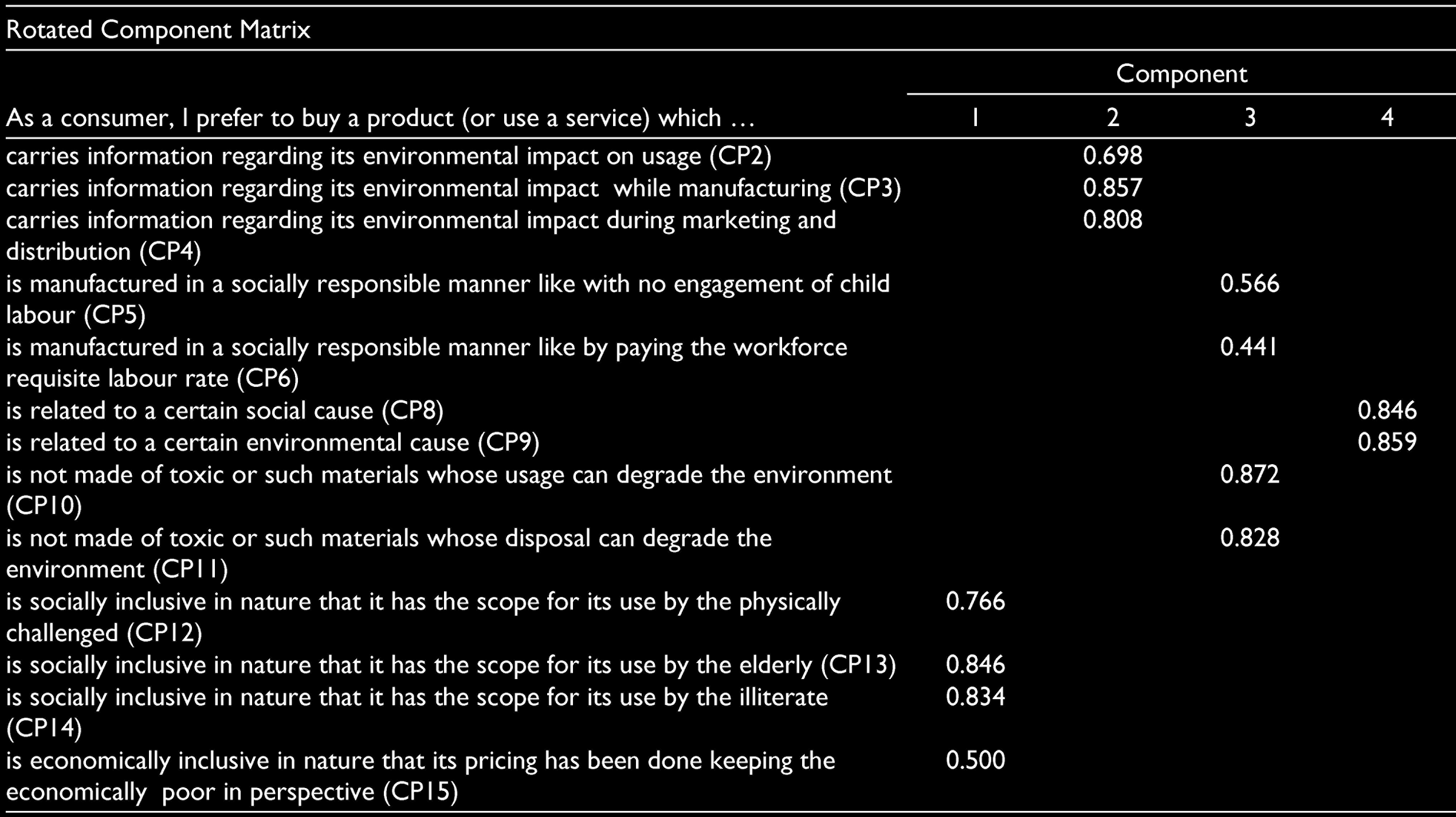
The variable ‘CPP’ to buy a product had a cumulative variance of 63 per cent. The rotation converged after five iterations. The Kaiser-Meyer-Olkin (KMO) test and Bartlett’s test of sphericity to test sample adequacy was found to be adequate and significant (KMO = 0.71, p = 0.01) (Williams, Onsman, & Brown, 2010). Four factors explaining reasons of consumer preference to buy a product were extracted. These are: social inclusivity in product (SIP), environmental information (EI), respon-sible product manufacturing process (RPMP), product cause association (PCA). The variable had 15 items questionnaire.
Social inclusivity of product (SIP): Explains the concept of product’s capacity to be used by physically challenged, illiterate or economically poor and elderly segment of the market. This factor had highest variance of 18.65 per cent and eigenvalue of 2.617. It had four items.
Environmental information (EI): Emphasises consumers’ preference for buying a product if organization displays information regarding environmental impact on usage during manufacturing and distribution of product. This factor had 3 items with 16.7 per cent variance and 2.3 eigenvalue.
Responsible product manufacturing process (RPMP): Depicts customer preference for a product which is manu-factured in a socially responsible manner, that is, with no engagement of child labour, by paying workers fair wage rate and no usage of toxic substances in manufacturing. Variance explained by this factor is 15.9 per cent with eigenvalue of 2.2.
Product cause association (PCA): Depicts social or environmental cause for which organization or product is associated. The two items of this factor explained 11.7 per cent of variance with eigenvalue of 1.6.
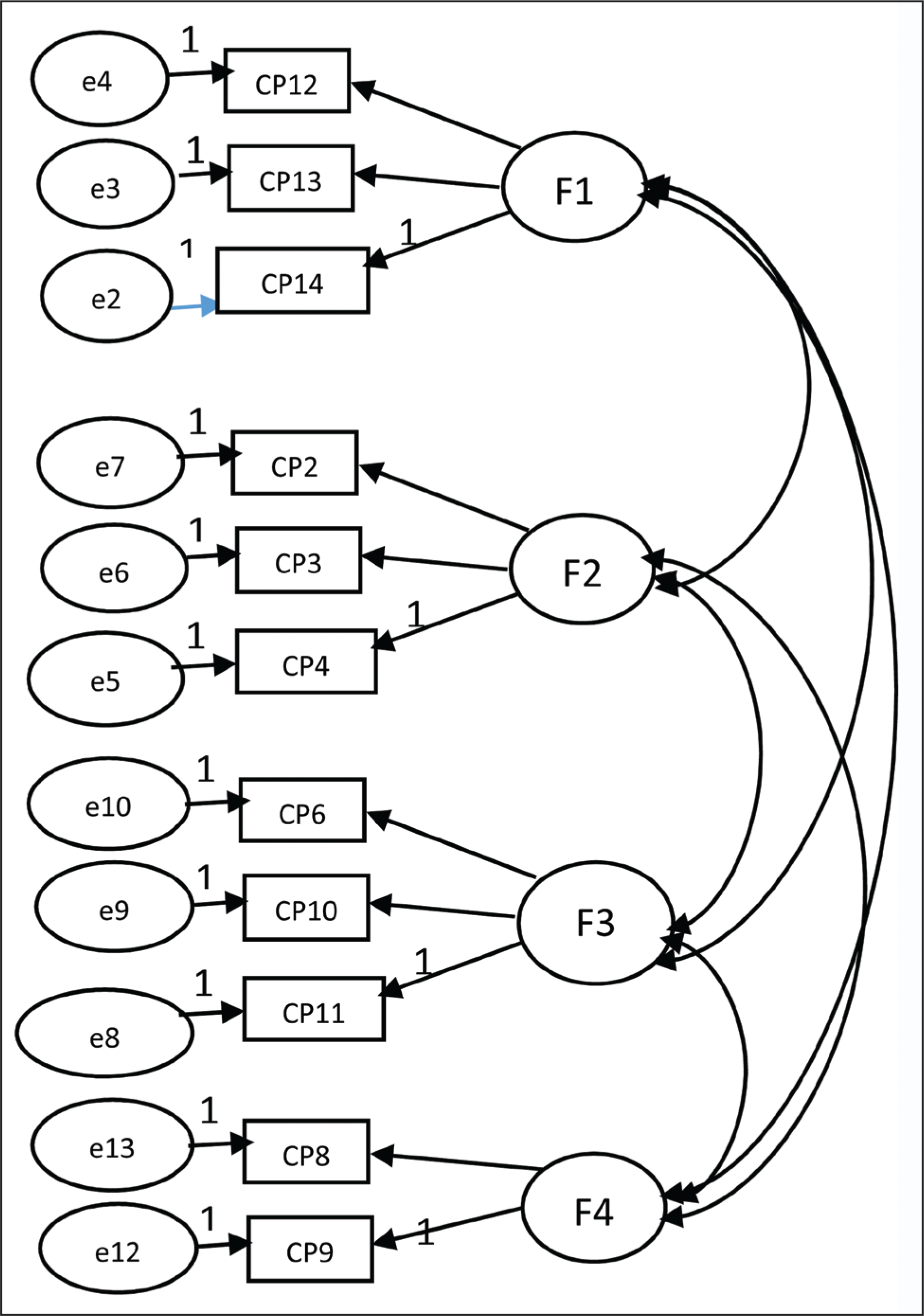
Post EFA, the extracted 13 items (2 items dropped) of CPP were then subjected to CFA to study the degree to which these items fit the proposed four factor structure (Arbuckle & Wothke, 1999; Byrne, 2001). Items ‘uses less pac-kaging’ and ‘making the workforce work in unhygienic ambience’ were dropped from further analysis because of cross factor loadings of these items on two factors. The items were conceptually not clear on aspects like product packaging. The packaging needs of different products might vary. Similarly, the requirement of hygienic ambience has become a basic right of workers, respondents might not have seen merit in the statement in a given context. Following were the model fit indices: Chi square value = 157.35 (df = 38 and significance level = 0.01), goodness of fit (GFI) = 0.939, adjusted goodness of fit (AGFI) = 0.893, normed fit index (NFI) = 0.913, root mean square residual (RMSR) = 0.059 and root mean square error of approximation (RMSEA) = 0.08. These fit indices indicate acceptable fit (Bollen, 1989) values of the model supporting four factors structure of the model. The final CFA model of the CPP construct had 11 items (Table 2 and Figure 2).
Factor Analysis of Variable 1: Customer Product Preference
Source: Authors own contribution.
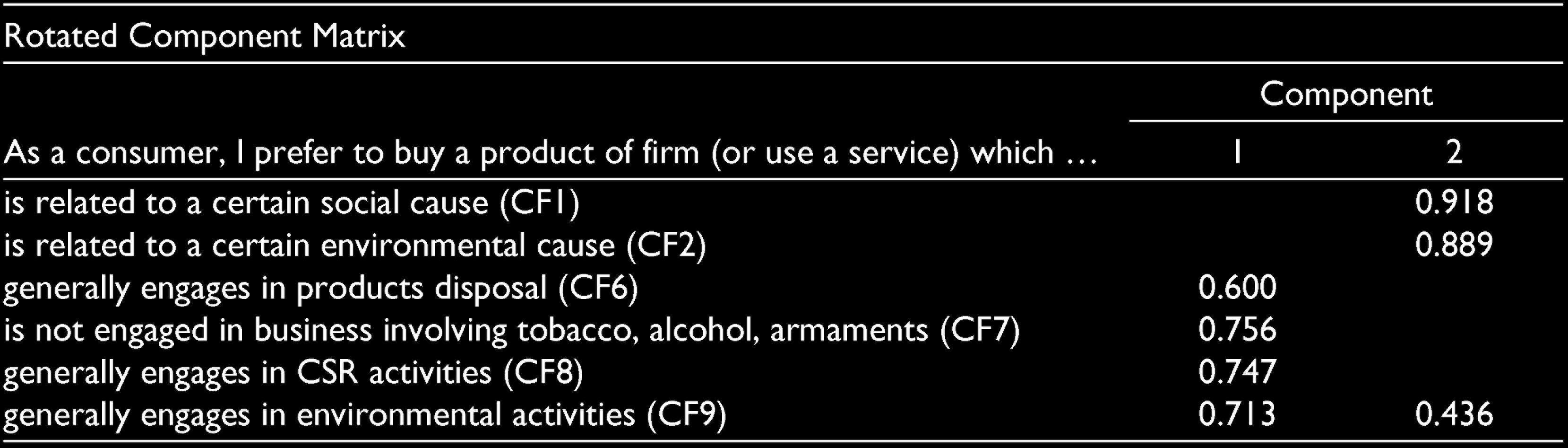
The variable ‘CFP’ to buy a product had a cumulative variance of 67.429 per cent. The rotation converged after three iterations. The KMO and Bartlets test of sphericity to test sample adequacy was found to be adequate and significant (KMO = 0.73, p = 0.01). Two factors explaining reasons of firm preference to buy a product were extracted. These are: firm socio-environmental awards (FseA) and firm socio-environmental engagement (FseE). The variable questionnaire had nine items.
Firm socio-environmental awards (FseA): Factor-1; indicate awards won by organization for their social- and environment-related performance. This factor had two items. It had explained 34.396 per cent of variance and had eigenvalue of 2.96.
Firm socio-environmental engagement (FseE): Factor–2; points out the interest that consumer specifies about organizations’ engagement with social and environmental causes. This factor had 4 items with 33.03 per cent variance and 1.08 eigenvalue. Items ‘reports its social and environ-mental performance in public domain like in annual report or its website’, ‘generally engages in social cause related marketing efforts’, and ‘generally engages in environmental cause related marketing efforts’ were dropped because of cross loading of values on different factors. The items were dropped because the respondents might not rely on annual report and website for firm performance. Similarly, con-sumers would like organizations to perform at the ground level than just perform marketing without action.
Post EFA, the remaining six items (three items dropped) were then subjected to CFA to study the degree to which these items fit the proposed two factor structure (Arbuckle & Wothke, 1999; Byrne, 2001). Following were the model fit indices: Chi square value = 29.566 (df = 7 and significance level = 0.01), GFI = 0.976, AGFI = 0.927, NFI = 0.969, RMSR = 0.024 and RMSEA = 0.089. These fit indices indicate acceptable fit (Bollen, 1989) values of the model supporting two factors structure of the model (Table 3 and Figure 3).
Factor Analysis of Variable 2: Customer Firm Preference

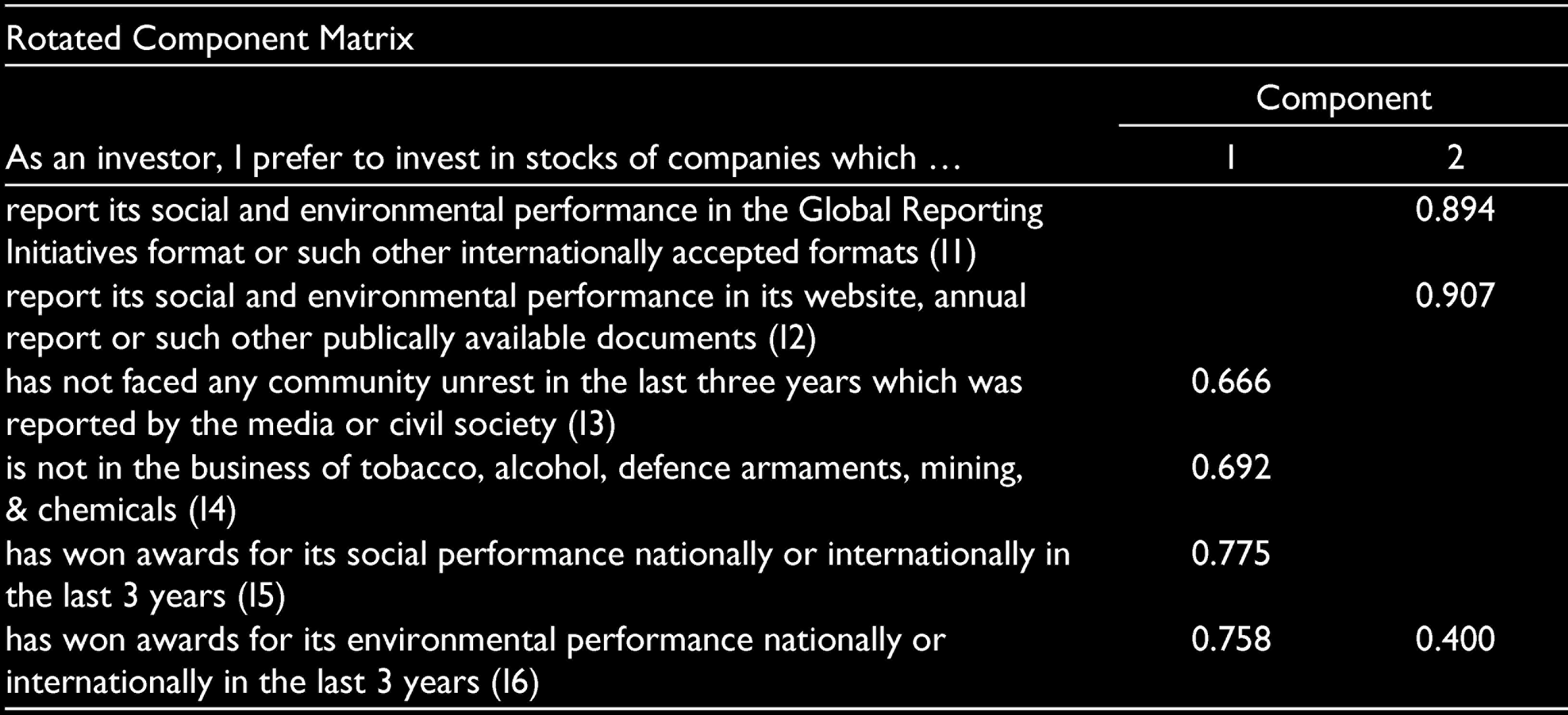
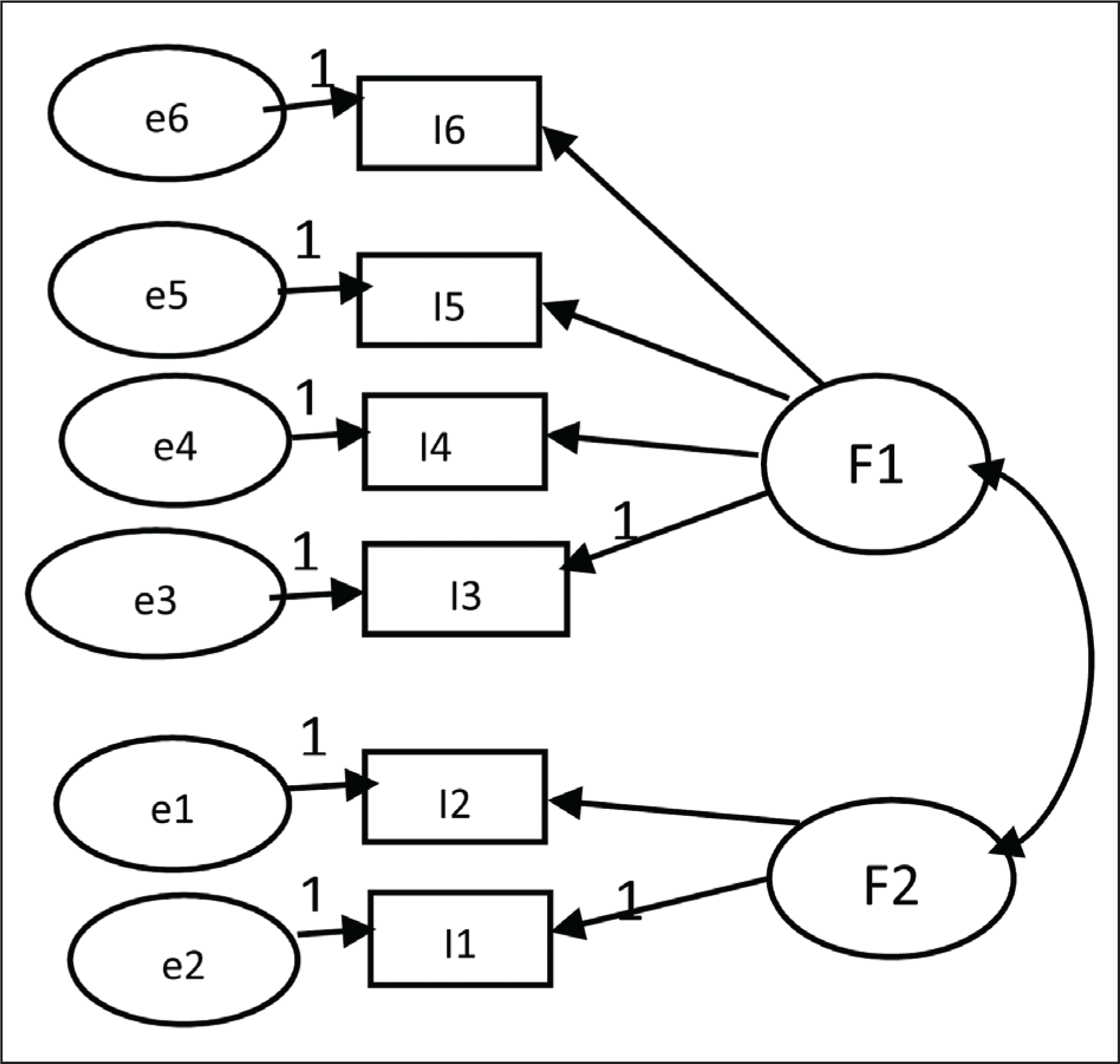
The variable ‘IP’ to buy a product had a cumulative variance of 67.8 per cent. The rotation converged after three iterations. The KMO and Bartlets test of sphericity to test sample adequacy was found to be adequate and significant (KMO = 0.85, p = 0.01). Two factors explaining reasons of investor preference to invest on a product were extracted. These are: reporting mechanism (RM) and firm social legal environmental performance (FSLEP). The variable had six items in the questionnaire.
Reporting mechanism (RM): This factor explains the organizations’ reports about initiatives taken at the global and national levels. It also covers the platform where these reports have been published. This factor had variance of 36.01 per cent and eigenvalue of 3.00. It had two items.
Firm’s social legal environmental performance (FSLEP): This factor talks about the investor preference for a product if organization has won awards for its social and environmental performance and is concerned about legal boundaries of the organization. This factor had 4 items with 31.8 per cent variance and 1.06 eigenvalue.
Post EFA, the six items (all retained) were then subjected to CFA to study the degree to which these items fit the proposed two factor structure (Arbuckle & Wothke, 1999; Byrne, 2001). Following were the model fit indices: Chi square value = 11.2 (df = 7 and significance level = 0.128, GFI = 0.991, AGFI = 0.973, NFI = 0.990, RMSR = 0.030 and RMSEA = 0.039. These fit indices indicate acceptable fit (Bollen, 1989) values of the model supporting two factors structure of the model (Table 4 and Figure 4).
Factor Analysis of Variable 3: Investor Preferences
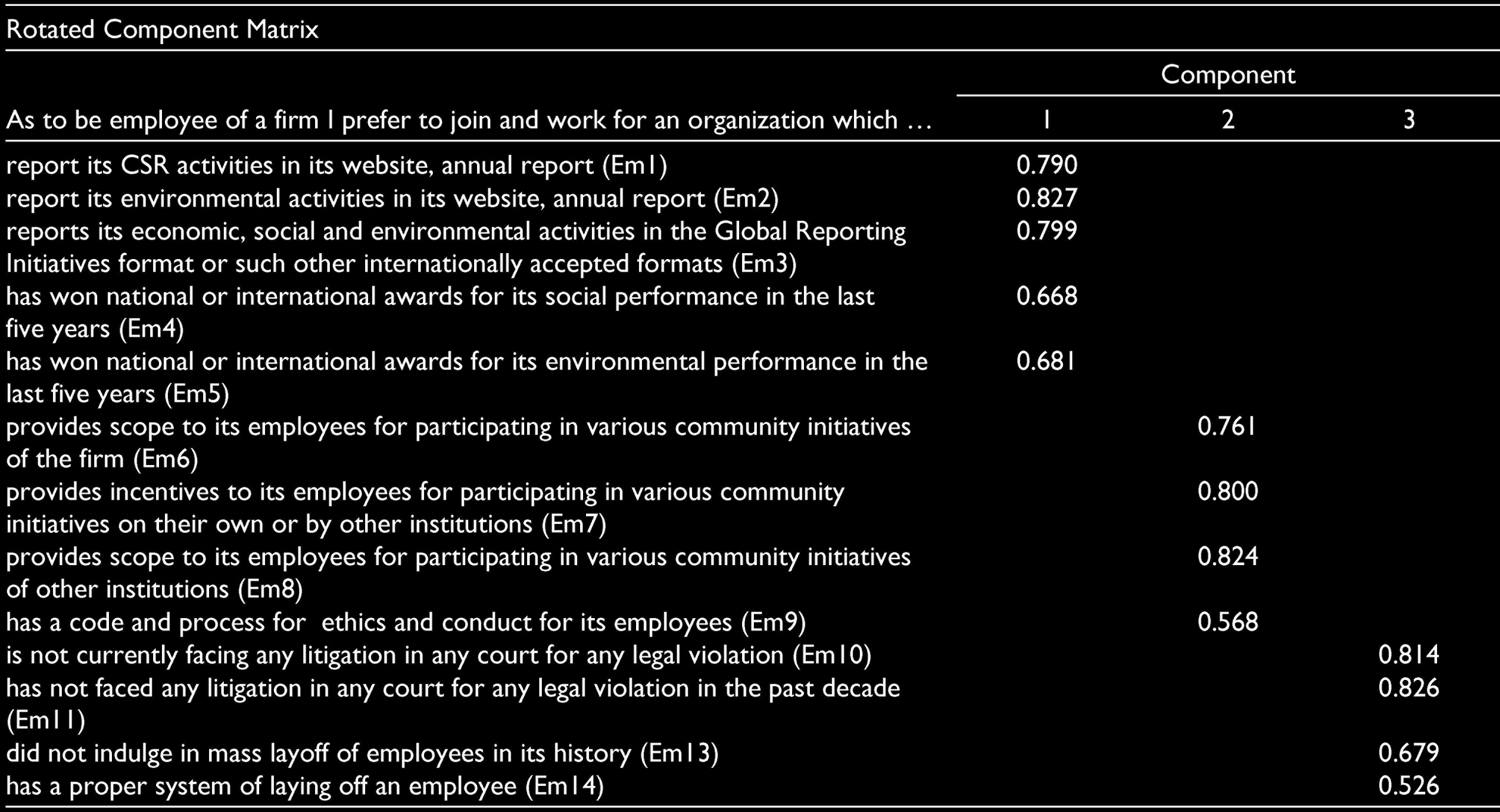
The variable ‘EM’ of an individual towards a firm had a cumulative variance of 63.372 per cent. The rotation converged after five iterations. The KMO and Bartlets test of sphericity to test sample adequacy was found to be adequate and significant (KMO = 0.79, p = 0.01). Three factors explaining reasons of individual preference to be an employee of the firm were extracted. These are dis-semination and recognition of CSR (DRCSR), acknow-ledgement of employee engagement (AEE), behavioural standards. The questionnaire had 15 items.
Dissemination and recognition of CSR (DRCSR): Factor 1 proposes items where firms are engaged in social, environmental and economic cause and disseminates infor-mation about the same on various platforms. This step by organization helps in two ways, first, by disseminating information and, second, by recognizing activities. This factor had five items. It had explained 24.6 per cent of variance and had eigenvalue of 5.35.
Acknowledgement of employee engagement (AEE): This factor indicated the steps taken by organization for employee engagement programmes and promoting emplo-yees who would like to take initiatives for socially relevant activities. This factor had 4 items with 20.1 per cent variance and 1.58 eigenvalue.
Behavioural standards (BS): Factor 3; provided clear indication of preference of respondents for organization which is not engaged in any kind of dispute and discrimination. They also look for having clearly implemented ethical code of conduct. Factor 3 explained 18.6 per cent of variance and had eigenvalue of 1.3. It had four items.
Post EFA, the remaining 13 items were then subjected to CFA to study the degree to which these items fit the proposed 3 factor structure (Arbuckle & Wothke, 1999; Byrne, 2001). Following were the model fit indices: Chi square value = 148 (df = 49 and significance level = 0.01), GFI = 0.942, AGFI = 0.908, NFI = 0.939, RMSR = 0.051 and RMSEA = 0.071. These fit indices indicate acceptable fit (Bollen, 1989) values of the model supporting three factors structure of the model (Table 5 and Figure 5).
Factor Analysis of Variable 4: Employability Preference

To check the robustness of measurement scale, the value of average variance extracted (AVE) and composite reliability (CR) were calculated. The acceptable value for AVE and CR is 0.5. The scale of CPP had AVE value of 0.8 and CR value of 0.89. The scale of CFP had AVE value of 0.8 and CR value of 0.89. The scale of IP had AVE value of 0.8 and CR value of 0.89. The scale of EP had AVE value of 0.8 and CR value of 0.89. The values substantiate the appropriateness of all the four scale.
Discussion and Conclusion
The importance of individuals emphasizes the theoretical importance of microfoundations based approach (Gond et al., 2017; Hafenbrädl & Waeger, 2017). The success of products/services and organizational processes decided whether customers would buy a product or not, whether an investor would invest or not, and whether an organization would attract good quality prospective candidates to join organizations as an employee. Hence, the study focused on developing a scale to operationalize a construct to measure CSR from an individual microfoundations perspective. This has been captured by seeking responses from individuals playing roles as a customer or an investor or as a prospective employee. The individual respondents may also play all the roles in combination. The conceptualization from a MFT perspective indicated that individuals playing different roles would impact organizations differently (Gond et al., 2017; Hafenbrädl & Waeger, 2017). The ideological dissemination by individuals (role-plays as customers, investors and possible employees) will initiate at individual level and then move to group levels (like work teams, departments and cross-functional teams) and finally, to the organizational level with wider reach. The infusion of ideology across the mentioned levels forms a pervasive ideological network.
The variable CPP had four factors, namely SIP, EI, RPMP and PCA. Coming from a microfoundations perspective, these four factors indicated the nature of role-play of an individual as a customer of a product/service. Beckmann (2007) advocated that the products that had wider scope of usability by different segments of society (like elderly, differently challenged and illiterates) were preferred by customers. The second factor of CPP indicated customer-preferred products which carried information regarding environmental impact during product usage, manufacturing and distribution. Brown and Dacin (1997) had emphasized the importance of information sharing and creating a transparent process as a desired responsibility.
The third factor, responsible product manufacturing process, indicated the fair manufacturing practices followed by firms. Fair practices included fair compensation to employees (Gaudêncio, Coelho, & Ribeiro, 2014). As advocated by the work of Boiral (2009), the products that were composed of non-harmful materials were preferred by customers. This is construed as responsible manufacturing practices. Maignan et al. (2002) found that customers prefer products which have associated themselves with certain social and environmental causes. This was because the association of a product/service to such a cause brought visibility and goodwill. Therefore, the fourth factor of CPP was PCA.
The second variable was CFP. The first factor of this variable was FseA which indicated that customer preferred firms that had illustrious performance records towards social and environmental causes. Fombrun (2005) also advocated that firms having good history of reception of social and environmental awards received customer recognition. Firms having such good performance records were recognized by independent award giving bodies. These awards received by firms provided confidence to customers about the good CSR initiatives carried out by firms. The second factor in CFP was regarding FSEE. This factor included firm initiatives on disposal of firm product wastes and avoidance of usage of harmful products. Application of sustainable manufacturing process by firms was preferred by customers. This increased the willingness of customers to buy firm products (Boiral, 2009). From a microfoundations viewpoint, these two factors (FseA and FseE) demonstrated the nature of role-play of an individual as a customer for firms’ products and services.
The third variable was IP and this consisted of two factors, namely RM and FSLEP. Similar to the findings of Bučiūnienė and Kazlauskaitė (2012), this research (reflecting RM) laid emphasis that individuals preferred to invest in such firms that reported its social and environmental performance and adhered to global standards. FSLEP emphasized regarding the importance of having positive news stories about an organization in media. This factor indicated that organizations should be engaged in creating positive business externalities. Investors preferred organizations which received national and international awards on social and environmental performance (Brown-Liburd & Zamora, 2014). As per the tenets of microfoundationsstandpoint, these two factors (RM and FSLEP) established the nature of role play of an individual as an investor.
The fourth variable EP had three factors, namely DRCSR, AEE and BS. The factor DRCSR indicated that the potential employees seek information on firms’ social and environmental engagements. Individuals preferred to be recruited in organizations which disseminated their social and environmental activities information (Duarte, 2010; Hansen et al., 2011). The factor AEE indicated that individuals were inclined to join organizations which promoted employee participation and engagement in firms social and sustainability causes directly (Lee et al., 2013; Rodrigo & Arenas, 2008). The factor BS reflected indivi-dual preference to be employed in organizations which implemented ethical code of conduct and were not subjected to any legal cases of dispute or discrimination (Brockner, 1992). Researchers like Rodrigo & Arenas (2008) found similar results while assessing preference to join the firm. Through the lens of a microfoundations based approach, individuals as prospective employers would manifest their role based upon judgements on the three factors, namely DRCSR, AEE and BS. This study is limited to the emerging economy context of India. Further, the study was restricted to management students. In future, a study based on managerial inputs could be undertaken.
Our results led to several practical implications. First and foremost is the belief that implementation of CSR initiatives is not a standalone activity of CSR managers but it requires inclusion of other employees of organization and stakeholders of organization. The MFT of CSR helped in understanding different roles stakeholders may take. CSR initiatives can be specific to the needs of the stakeholders. Any initiative becomes sustainable (well-being of larger society and long term) when the relevant stakeholders are heard and their inputs are considered. Further, as managerial implication organizations must undertake such initiatives that would help sell products and services that are socially and environmentally sensitive. Also, organizations must work hard to secure awards on social and environmental fronts which would attract socially and environmentally sensitive individuals to a firm.
This study developed a scale on individual perspectives on CSR based on MFT. From a micro foundations perspective (Gond et al., 2017; Hafenbrädl & Waeger, 2017), the authors investigated how a business management student evaluated the notion of a socially and environmentally responsible firm based upon the roles he/she played as an individual, that is, the three roles: as a customer, as an investor and as an employee. Most CSR studies have prescribed about doing CSR in certain theme areas based upon the institutional or on own corporate versions of normative and utilitarian perspective (McWilliams & Siegel, 2001). This is the first study wherein an individual-centric viewpoint for a firm CSR thematic intervention was evaluated and presented. This would help firm CSR managers to design future CSR intervention themes so that it has maximum impact among socially and environmentally sensitive individuals. Future research in this area may include sectoral studies in manufacturing and services. This study could also be conducted in the developed countries which would provide insights as to which of the three roles have more impact. Future studies would further unfold and advance the theoretical knowledge on the individual centric viewpoint on firm CSR thematic evaluation based on the roles they play every day. This would further the journey of CSR from MFT.
Footnotes
Declaration of Conflicting Interests
The authors declared no potential conflicts of interest with respect to the research, authorship and/or publication of this article.
Funding
The authors received no financial support for the research, authorship and/or publication of this article.