



Abstract
A highly engaged workforce is being looked at as the means for attaining a sustainable competitive advantage in the dynamic business world. Research has shown that both the academicians and practitioners tout employee engagement to improve organizational and financial performance. However, numerous overlapping yet inconsistent definitions have created a conceptual chaos. Delineation between the academic and industrial view on employee engagement creates difficulty in operationalization of the construct.
This paper explores the construct of employee engagement by conducting structured interviews of HR heads of 15 best companies to work for in India. The data obtained were subjected to thematic analysis using Grounded Theory Methodology by Charmaz (2006). The emergent themes around the notion of employee engagement led to the development of a theoretical framework comprising three dimensions (Alignment, Affectiveness and Action-orientation) of employee engagement. Various drivers of employee engagement and the challenges in engaging employees were exemplified with narratives from practitioners in the Indian context.
An attempt has been made to bridge the gap between the academic and industrial view by exploring variables of the construct after taking inputs from the HR practitioners. It attempts to bring a conceptual clarity on construct which may help the organizations to develop effective engagement strategies and interventions for fostering higher engagement levels among employees.
Keywords
Introduction
Over the past decades, research on employee engagement has flourished and it continues to be a hot topic among practitioners and scholars. As a result, voluminous literature has been published on employee engagement causing perplexing multiplicity of definitions and operationalization of the construct. However, despite the availability of extensive literature among scholars’ and practitioners’ community, some fundamental questions concerning the conceptualization and operationalization of employee engagement still remain ignored (Albrecht, 2010).
Engagement has become one of the most crucial concepts in the field of management concerning the light of the fact that organizations are keen on leveraging better individual and organizational performance through high levels of employee engagement (Bailey, Madden, Alfes, & Fletcher, 2017). Since its emergence in the academic literature in 1990 when Kahn published his work on ‘personal engagement’, two key themes have emerged.
Firstly, engagement has been viewed as a catalyst for success and sustainability of business organizations as the studies have shown that high engagement level is significantly related to better task performance (Rich, Lepine, & Crawford, 2010; Shuck & Wollard, 2010; Soane, Truss, Alfes, Shantz, Rees, & Gatenby, 2012), creativity (Bakker & Demerouti, 2008), employee retention (Saks, 2006), enhanced customer satisfaction and loyalty (Salanova, Agut, & Peiró, 2005). Even the financial implications of having an engaged workforce are gratifying (Lockwood, 2007; Nayar, 2010; Robinson, Perryman, & Hayday, 2004; Towers Perrin Global Workforce Study, 2008). In 2013, a study conducted by Aon Hewitt found a 5 per cent increase in employee engagement to cause a 3 per cent increase in the revenue growth in the subsequent year (Aon Hewitt, 2013). Contemporary organizations have refocused their attention on engaging employees. As a result, many consultancy firms are offering engagement surveys and citing case studies on increased profitability and customer satisfaction through high levels of employee engagement.
Secondly, it has also been reported time and again that engagement levels are at an alarming low rate. Gallup, a pioneer organization, tracking employee engagement in different countries since 2000, reported only 13 per cent of the working population to be engaged worldwide (Mann & Harter, 2016). In fact, engagement levels have barely increased over a decade. Mann and Harter (2016) reported this worldwide employee engagement crisis to have serious and lasting repercussions for the global economy. It has also been reported that the overall work experience of employees with regard to enablement, autonomy and sense of achievement has continuously deteriorated as companies struggle to drive engagement among employees (Aon Hewitt, 2015). As the global engagement levels continue to remain stagnant, it becomes the need of the hour to align engagement with other workplace priorities in order to achieve organizational goals with engaged workforce.
Literature Review and Research Gaps
An extensive literature review on the meaning and measurement of employee engagement revealed a fundamental issue that remains unresolved. Despite, proliferation in engagement research, there is a lack of conceptual clarity. Numerous overlapping yet inconsistent definitions have led to a conceptual chaos (Shrotryia & Dhanda, 2018). The researchers tried to decipher employee engagement and found the existence of six different theories with no generally accepted notion of employee engagement.
Kahn, one of the first to theorize work engagement, defined engaged employees to physically, cognitively, and emotionally express and employ themselves during their role performances (Kahn, 1990, p. 694). Engagement is described as a psychological construct with three conditions of psychological meaningfulness, safety and availability. Engagement then emerged as an antithesis of burnout and is defined as an energetic state of involvement with personally fulfilling activities that enhance one’s sense of professional efficacy (Leiter & Maslach, 1998). Leiter and Maslach (2005) explained the psychological state of an employee on a continuum ranging from burnout to engagement with three dimensions of exhaustion-energy, cynicism-involvement, and inefficacy-efficacy.
In 2002, Gallup’s approach marked the beginning of positive psychology on employee engagement and viewed it as the satisfaction, involvement and enthusiasm of the employee at work (Harter, Schmidt, & Hayes, 2002, p. 417). Another theory viewed engagement through the lens of job characteristics. The job demand-resource model described engagement to happen when job resources are adequate to meet and exceed the job demands (Bakker & Demerouti, 2006). Under this model, one of the widely accepted definitions is that by Utrecht Group defining engagement as a positive, fulfilling, work-related state of mind that is characterized by vigour, dedication and absorption (Schaufeli, Salanova, Gonzalez-Roma, & Bakker, 2002).
Another definition of employee engagement is based on social exchange theory that defines employee engagement as a construct which consists of cognitive, emotional and behavioural components associated with individual role performances (Saks, 2006, p. 602). Finally, employee engagement was brought to the centre stage by Macey and Schneider (2008) who took a holistic view of the construct explaining the three facets of engagement, viz., psychological, behavioural and trait engagement.
Within the practitioners’ community too, existence of a universal agreement on the definition of employee engagement is unlikely. Many consulting firms offering employee engagement surveys define it in different conceptual spaces. DecisionWise, 1 a management consulting firm based in U.S. conducting employee surveys in over 70 countries, defines engagement to occur when employees find meaning, autonomy, growth, impact and connection in what they do. Another consulting firm, 3D Group 2 founded by psychologists, focus on the cognitive, behavioural and emotional components of employee engagement. Mercer, 3 a professional services firm with business in over 130 countries, describes engagement as the commitment, enthusiastic involvement, alignment and perseverance to pursue excellence.
Many organizations also refer engagement as a strategy for managing talent and gauging it for increased competitiveness. Bains 4 view employee engagement as the degree of an employee’s attachment to job, colleagues and organizations, helping them determine their willingness to go beyond the basic parameters of their job. According to Vodafone, 5 employee engagement is an outcome measured or seen as a result of people being committed to something or someone in the business—a very best effort that is willingly seen. Dell 6 refers to being engaged as giving time and talent to team building activities. Barclays 7 define engagement as an employee’s belief in goals and values and a sense of attachment to organization. Deloitte 8 considers engagement as the temperature gauge of a company’s ability to proactively address all issues on the behalf of the workforce. Facebook’s approach towards engagement focuses on employees’ feeling of pride in the company which enables them to internalize organizational goals as their own 9 .
It is worthwhile noting that different perspectives of employee engagement reflect an essential theme of engagement being a positive work-related attitude which enables employees to willingly contribute towards work-role and organization (Albrecht, 2010). However, academics, firms and consultants have inconsistent answers when asked about employee engagement. Their working definitions range from a simple notion (voluntary effort or involvement) to more complex framework (state, trait and behavioural constructs).
Throughout literature, employee engagement takes different meanings reflecting a divergence between academic and industrial view. Academicians view engagement as a psychological state of employees (Hallberg & Schaufeli, 2006; Kahn 1990; Maslach, Schaufeli, & Leiter, 2001; Rothbard, 2001), but practitioners view engagement as an outcome of their psychological state in terms of their commitment, involvement and discretionary efforts (Blizzard, 2004; Lockwood, 2007; Readership Institute, 2004; Robinson, Perryman, & Hayday, 2004; PHRPS Research Committee, 2002; Towers Perrin study, 2008). This incongruity arises as organizations focus on the macro aspect considering engagement as an organizational level construct but scholars consider it as an individual’s internal decision focusing on the micro aspect of employee engagement (Dalal, Brummel, Wee, & Thomas, 2008; Saks, 2006; Wefald & Downey, 2009).
Another reason for this academic-practitioner gap on employee engagement is the lack of collaboration for producing research. Practitioner’s community focuses on the positive outcomes of employee engagement and is far ahead in measuring the construct without precisely defining it. As a result, companies often overlap engagement with other constructs such as job satisfaction, organizational commitment and involvement and use them as a proxy for employee engagement (Graber, 2015). Academic writings are also stained with the lack of relevance for practical use (Khurana & Spender, 2012; Panda, 2014; Purcell, 2014). Scholars are more concerned about debating on the construct of employee engagement with complex jargons which lacks practicality for measuring and engaging talent (Bailey, 2016).
To be of any practical value, employee engagement needs to be revisited for a precise definition to bridge the incongruity between academic and industrial view. Academicians need to address the needs of practitioners by understanding the perspectives of different stakeholders on employee engagement. Against this backdrop, this study was conducted to build a conceptual framework, well-grounded on practitioners’ notion of employee engagement.
Objective of the Study
The research study attempts to build an alliance of academics and practitioners on the construct of employee engagement with an aim to develop a theoretical framework based on the notion, experiences and perspectives of practitioners in the Indian context. It aims to bridge the academic-practitioner divide and bring conceptual clarity on construct of employee engagement for precise operationalization and focused interventions aimed at improved organizational performance.
Research Methodology
Selection of Companies
Constructing a descriptive theory grounded in perceptions, behaviours and experiences of the members of the organizations require a constant movement between the data and theory (Kahn, 1990). For this study, the researchers selected 30 best companies to work for in India based on their rankings among five popular surveys (Great Places to Work Survey, 10 Most Admired Companies in India, 11 Most Respected Companies in India, 12 Best Employers in India 13 and Top Attractors Survey 14 ). Data for past years (2010–2016) was collected from secondary sources for these surveys and the companies which featured in these surveys were noted. Top thirty companies which ranked high in at least two out of these five surveys were selected (Annexure 1).
Data Collection
The researchers contacted the HR heads of these thirty companies. The HR heads of the companies were sent a mail about the purpose of the study and were asked to confirm their participation. After a series of clarifications and guarantees of confidentiality, the HR heads of fifteen companies agreed to participate and discuss their notion of employee engagement. Two companies refused to participate in this research and other thirteen companies did not respond (Annexure 1).
A tentative interview schedule was prepared to capture the narratives and experiences of HR heads. Since, the HR heads of the companies were based in different states of India like Mumbai, Delhi, Karnataka, Assam etc. and some of them were travelling abroad during the period, the researchers resorted to two ways of conducting the interviews, i.e. face-to-face interviews and interviews using Skype/Facetime. Structured interviews were conducted with the HR heads at different dates and time slots as per their availability. The dialogue centred on the notion of employee engagement, drivers, outcomes, best HR practices, challenges in engaging employees, engagement surveys, etc. This data was collected over a period of five months from June to October 2016. All the interviews were transcribed and verified. The length of the conversations ranged from 50 to 90 minutes. The HR heads held top managerial positions such as Executive Director, Director, Vice President, Country Head, and Senior HR Manager etc. with experience ranging between 1 to 33 years in the respective organization (Annexure 2).
Analysis of Data
Qualitative research approach has been used in the study to understand the subjective notion of practitioners on employee engagement. Grounded theory was an appropriate methodology for this research study as it systematically collects the data and analyses it through coding to develop a theory on employee engagement. This research study used the grounded theory methodology given by Charmaz (2006), which is based on the social constructivist point of view. In Charmaz (2006) grounded approach, theories were ‘constructed’ through social interactions as compared to Glaser and Strauss (1967) and Strauss and Corbin (1990) approach in which theories are ‘discovered’ through data collection and analysis. Therefore, social constructivist point of view was chosen for this research study to acknowledge that each participant’s notion of employee engagement would depend upon his/her workplace dynamics and social interactions.
All the verbatim transcriptions were used for coding to find a pattern in the data collected. Coding provides a pivotal link between collecting the data and developing an emergent theory to explain the data. The data analysis started with initial coding and the researcher resorted to line-byline coding of each transcript. Line-by-line coding helps in exploring all the theoretical possibilities to discern the data. Codes are used to capture and condense the meanings and the actions. The vivo codes used by the HR heads were unpacked into general terms. At this stage, the researchers paid close attention to language used to describe the data to reduce bias. In order to have consistency in coding and for minimization of individual bias, five transcripts were simultaneously coded by two more researchers having an understanding of qualitative research in organizational behaviour. After due deliberations, a consensus was built to ensure inter-rater reliability. A comparison was made of data with data to find out the similarities and differences in the same interview and different interviews to develop the concepts, later used to build a theory.
The researchers then moved to focused coding to categorize initial codes. In focused coding, more significant and frequent codes were used for large amounts of data to make an analytical sense. A question-by-question comparison was done to explore the relationship between the data. The researchers then used the focused codes to integrate them into theoretical codes. At this stage, the researchers made decisions about the usefulness of the initial codes to categorize the data incisively and completely. The focused coding of data allowed for concepts, themes and relationships to be developed into a theoretical framework. Memos were used to facilitate the writing process necessary to generate a theory. Writing enabled researchers to pull together all the information collected in a way that explains the data to a reader. Finally, all the theoretical codes were categorized for the possibility of theorization.
Results
The analysis of narratives helped the researchers comprehend practitioners’ view on employee engagement. The notion emerging from the narratives provided a nuanced understanding of engaged employees in the industry. In the first stage of data analysis, the researchers deduced 81 initial codes (Annexure 3) through line-by-line coding for each transcript. It enabled exploring all the theoretical possibilities to discern the data. Initial coding allowed the researchers to quickly move through the data, comparing data with data and constructing short codes. Vivo codes were unpacked into general terms to capture simple but significant meanings. The 81 initial codes generated for understanding employee engagement gave leads for the construction of a theoretical framework.
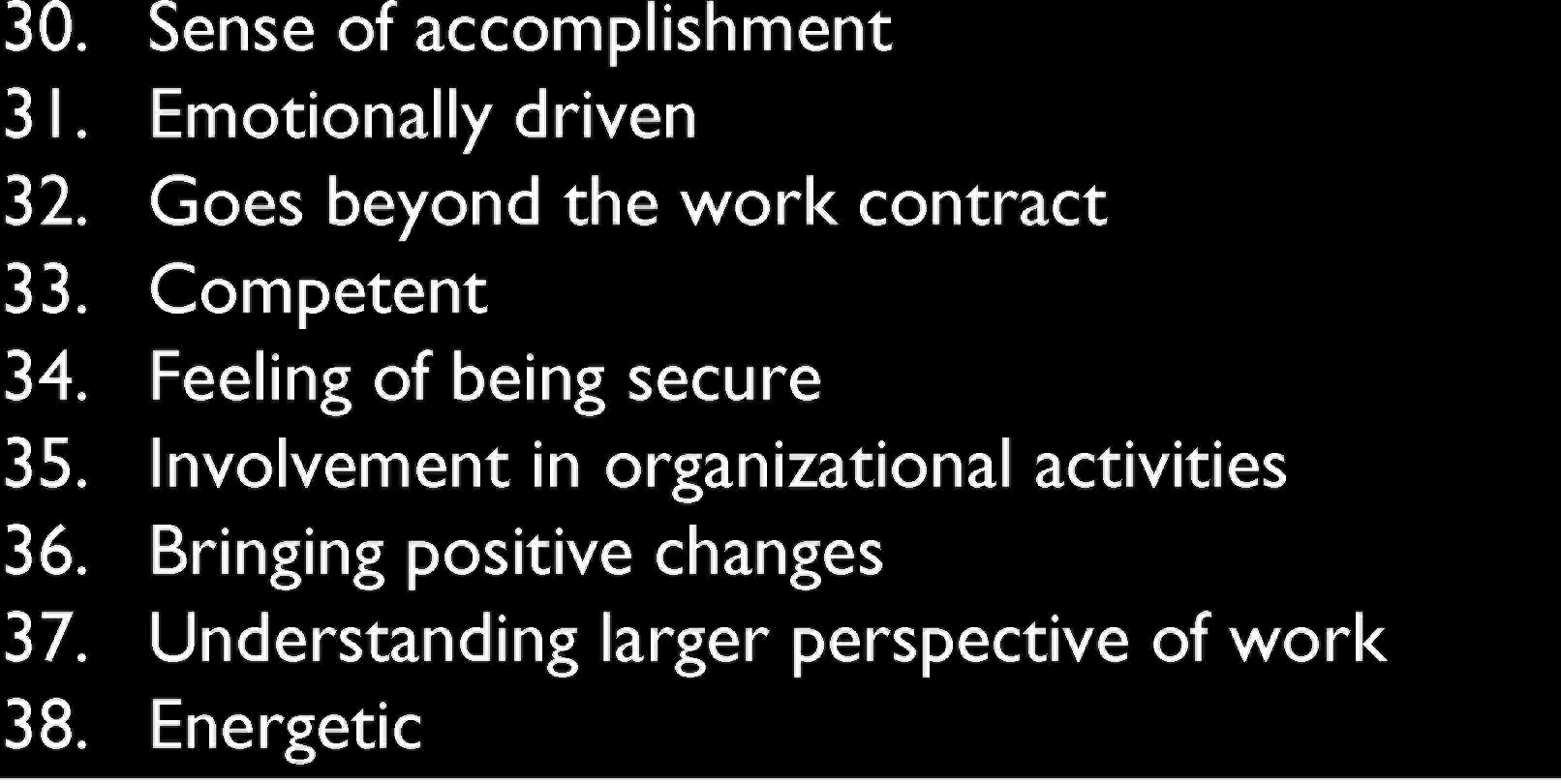
In the next stage, 38 focused codes (Annexure 4) were used to categorize the data completely. While engaging in focused coding, close attention was paid to select what seemed to be the most useful initial codes. Duplicate codes were eliminated from 81 codes by grouping them into more conceptual and selective codes to give an analytical sense to the data. While in initial coding, the goal was to remain open to all possible theoretical directions as per the transcriptions; during focused coding, more significant and frequent codes were used to categorize large amounts of data to reach to 38 focused codes. During this stage, decisions were made about the usefulness of the initial codes to categorize the data completely and drop the codes which were repetitive. Codes that permitted the separation, sorting and synthesis of initial codes were included in this stage. These 38 focused codes pin-pointed the most salient categories in the large batches of data. For instance, initial codes such as ‘shares the vision’, ‘identifies with organization’s goals’, ‘matching personal and professional goals’ were synthesized as ‘internalization of vision and mission’ (focused code). Similarly, ‘feels a part of the organization’, ‘feeling of family’, ‘valued by others’ were put together as ‘sense of belongingness’ (focused code). There were many such cases which were dealt in this way in order to reach to 38 focused codes.
Finally, after due discussion with experts, the 38 focused codes were further reduced to select 30 theoretical codes which integrated the data to present a conceptual framework on employee engagement. Codes that crystallized meanings and actions in the data were retained and remaining 8 codes were dropped from further analysis as they did not directly relate to the theoretical underpinning of employee engagement.
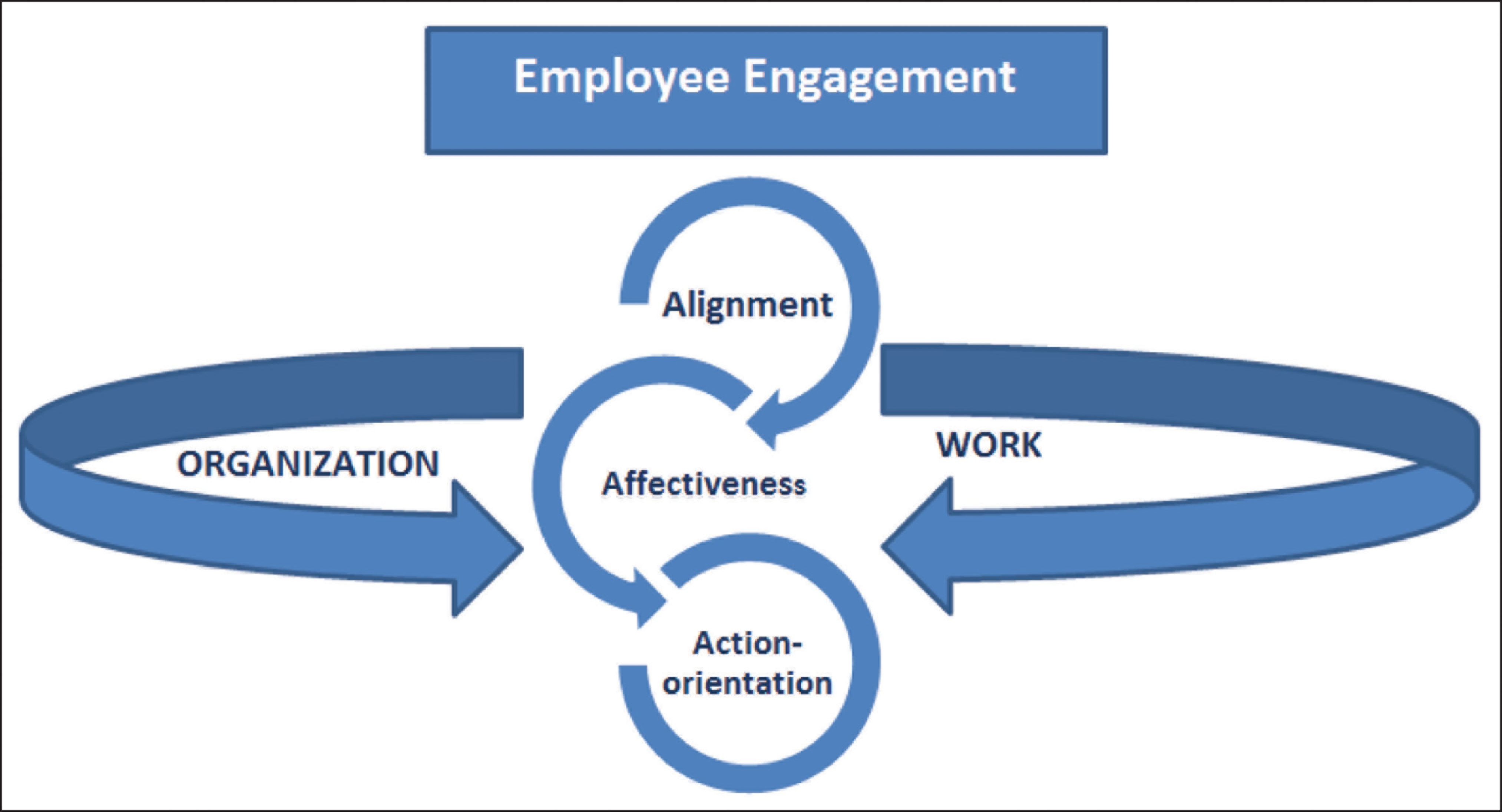
The conceptual framework presented in this research study begins with elucidating employee engagement as a multidimensional construct with three facets of Alignment, Affectiveness and Action orientation. The theoretical codes centred on the theme of being engaged in both the domains of work and organization. To move to a specific definition, the researchers considered an overall understanding of different components that the construct of employee engagement subsumes. Engaged employees are aligned, affective and action-oriented in both domains of work and organization which illustrates the constructs of work and organizational engagement, respectively (Figure 1).
Alignment Dimension of Employee Engagement
Alignment
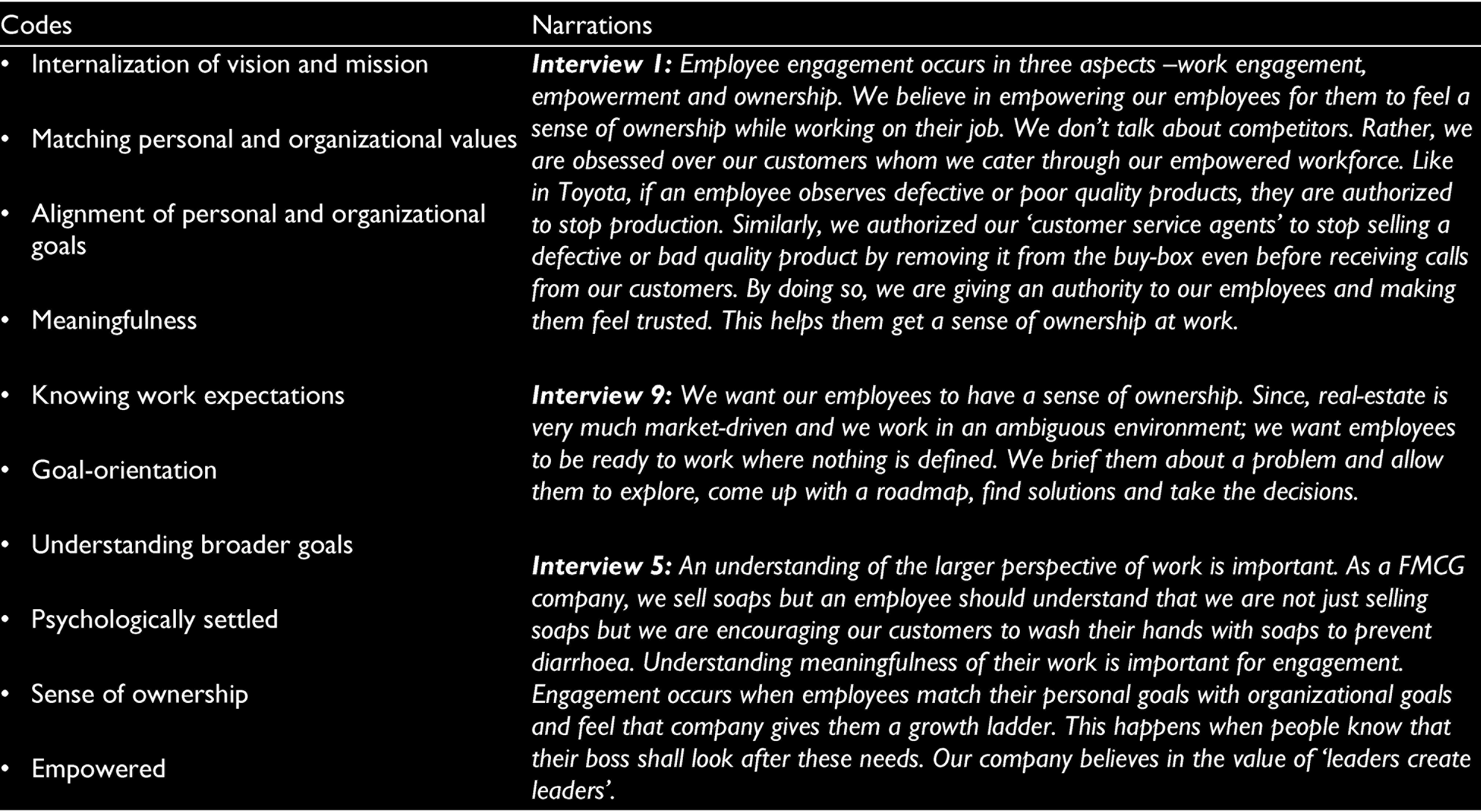
The alignment dimension of employee engagement captures an employee’s understanding of his/her work role to be in sync with the overall organization. An engaged employee aligns with vision and mission of the organization, incorporates organizational values, understands the broader work goals and has knowledge of what is expected out of him/her. Considering the work to be meaningful, an aligned employee feels empowered, takes ownership and focuses on his/her goals for accomplishment of overall organizational goals.
Affectiveness
The affectiveness dimension of employee engagement captures an employee’s positive affectivity towards work and organization. It reflects the emotional experience of an employee marked by feelings of pride, commitment, belongingness and positivity. An employee with positive affectivity is motivated to put his/her heart and soul into work. Such an engaged employee enjoys being at work and experiences self-enhancement.
Action-Orientation
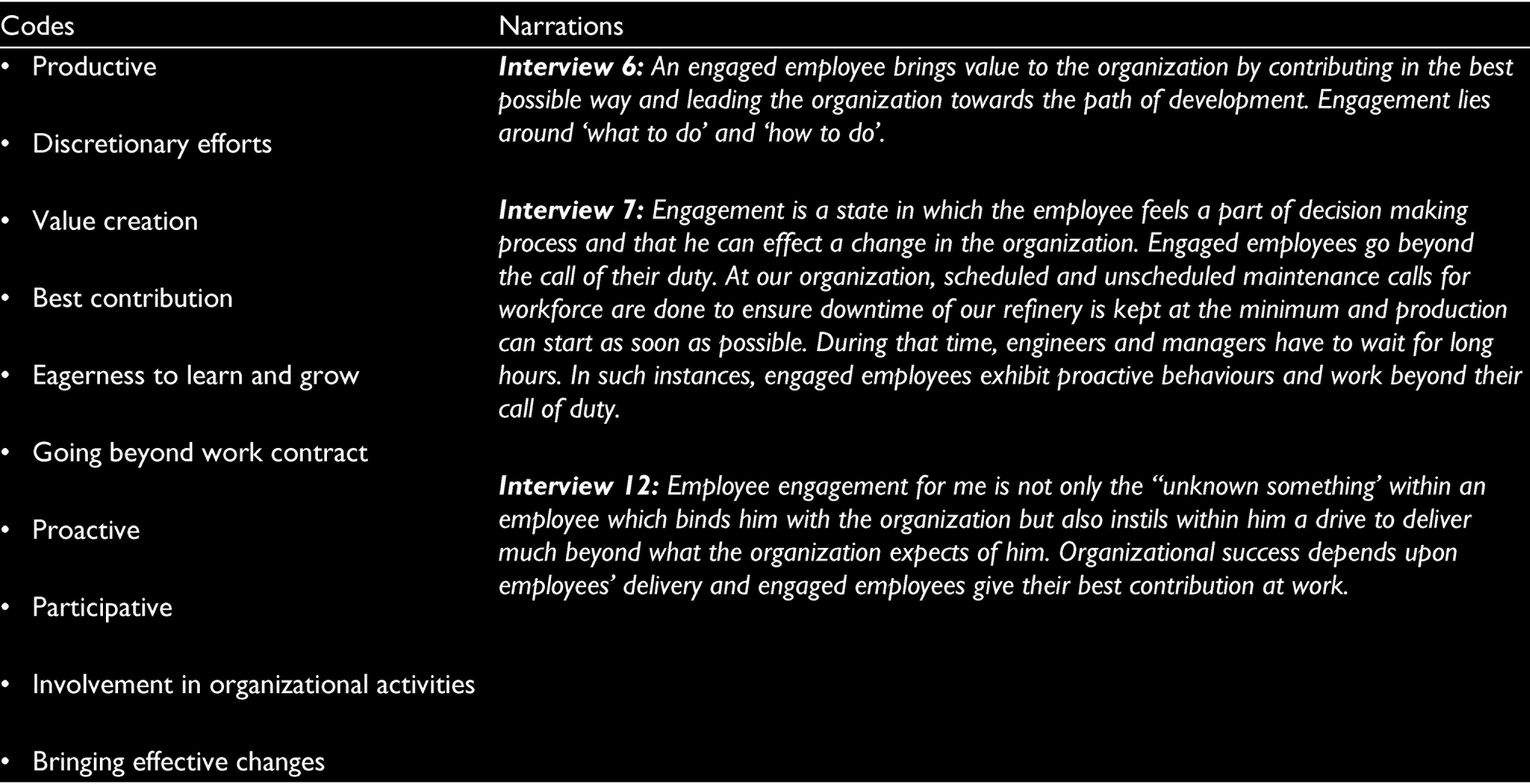
The dimension of action-orientation captures the behavioural manifestation of employee engagement. It reflects an employee’s willingness to take an action for organizational effectiveness. An engaged employee is productive and creates value for the organization he/she works for. Action-orientation is viewed in terms of an employee’s proactivity, discretionary efforts, participation and contribution at work and for organization.
Discussion
The emergent themes in the analysis speak volumes of employee engagement being a multi-dimensional construct with three facets of Alignment, Affectiveness and Action-Orientation. Understanding employee engagement in this conceptual space renders a useful enlightenment of the construct creating valuable knowledge for practitioners. The conceptual framework presented in this research study is relevant, comprehensible and directly applicable in the practical world as it is built upon notions of HR Heads on employee engagement. This understanding allows its use and application to make sense to practitioners.
Academicians are often incentivized to generate knowledge on the behalf of practitioners for improved business results but unfortunately, their abstract or complex conceptualization fails to draw attention of companies for its operationalization (Bailey, 2016; Guest, 2014). Academia mainly concentrates on theory and methodology for assessment of research findings to be published in peer-reviewed journals but practitioners are looking for practical solutions. Organizations develop new ideas through experiences, observations and practices while academic research focuses on generation of theories and methods (Janssens & Steyaert, 2009; Panda, 2014). Therefore, the academic-practitioners divide arises as scholars put their ideas into practice while practitioners base their theories on the on-going practices without considering each other’s domain of knowledge (Bartunek & Rynes, 2014; Rousseau & Barends, 2011; Wensley, 2009). Similar academic practitioners divide on employee engagement was revealed when a wide range of definitions and measures forwarded by scholars and practitioners were reviewed (Gatenby, Rees, Soane, & Truss, 2009; Macleod & Clarke, 2009; Storey, Wright, & Ulrich, 2008; Tower Perrin Global Workforce Study, 2006;).
Affectiveness Dimension of Employee Engagement

In the past, many conceptualizations of employee engagement have been offered. However, these constructs have often been stained as being opinion-based rather than being evidence-based (Bailey, 2016; Saks, 2008). The academic writings in the domain of employee engagement have been criticized for lacking any practical utility for practitioners (Khurana & Spender, 2012; Panda, 2014; Purcell, 2014). The scholars have been more concerned about debating on the construct of employee engagement with complex jargons which lacks any practicality for measuring and engaging talent (Bailey, 2016). Companies are also far ahead in measuring engagement levels of employees without precisely defining it. As a consequence, practitioners are measuring multitude of workplace factors in the name of employee engagement.
Action-Orientation Dimension of Employee Engagement
Over the years, scholars have called for a more detailed understanding of employee engagement to refine its construction and provide a precise definition (Shuck, Adelson, & Reio, 2016). Therefore, efforts were made to present employee engagement phenomenon in a broader, full range of experiences of employees working in Indian organizations. The study focused on the nuanced areas of being engaged and emphasized on employee engagement being a high order factor supported by the three lower order factors of being aligned, affective and action-orientated.
The ‘alignment’ dimension captures the understanding of an employee about his/her work role to be in sync with the overall organization. ‘Affectiveness’ dimension represents an employee’s positive affectivity towards work and organization and ‘action-orientation’ dimension shows an employee’s willingness to take an action for organizational effectiveness. Understanding employee engagement in this conceptual space renders a useful enlightenment of the construct creating valuable knowledge for practitioners. The conceptual framework presented in this study is relevant, comprehensible and directly applicable in the practical world as it is built upon notions of the HR heads on employee engagement. This understanding allows its use and application to make sense to practitioners unlike other definitions which have been purely based upon the perspective of scholars (Bakker & Demerouti, 2006; Macey & Schneider, 2008;Leiter and Maslach, 2005; Pati, 2012).
This research study led to a close collaboration between the two communities to bridge the academic-practitioner divide. The conceptual framework on employee engagement is presented in the style which works for practitioners. In the past, many scholars have described engagement in terms of different elements such as vigour, absorption and dedication (Schaufeli, Salanova, Gonzalez-Roma, & Bakker, 2002); psychological, behavioural and trait engagement (Macey & Schneider, 2008); absorption and attention (Rothbard, 2001), which did not gain much attention of practitioners. Kahn’s conceptualization served as the foundation of many measurement instruments (James, Mckechnie, & Swanberg, 2010; May, Gilson, & Harter, 2004; Rich et al., 2010; Shuck et al., 2016), which focused on cognitive, behavioural and emotional employee engagement. However, these instruments also remained confined to use by the academicians.
One of the widely used surveys by the companies around the world is by the Gallup which has also appeared in highly ranked peer-reviewed journals (Harter et al., 2002). The Gallup Work Audit (GWA) has been criticized for the lack of content validity by research scholars (Christian et al., 2011). GWA defined employee engagement as an employee’s involvement and satisfaction at work (Harter et al., 2002) and focused on the work conditions which lead to employee engagement. Macey and Schneider (2008) argued GWA to define engagement in terms of conditions under which people work but the state of engagement itself is not assessed. Many consultancy firms (Blessings White, Great Places to Work, CultureIQ, Hay Group, HPWP Consultancy, and The Employee Engagement Group etc.) have their own surveys which are often denigrated by scholars for measuring its antecedents or consequences in the name of employee engagement.
In this study, employee engagement defined in terms of alignment, affectiveness and action-orientation aligns perspectives of both worlds of academia and practitioners to take a holistic view of the construct. This construct is built upon on the notion of the major stakeholders, that is, HR heads of the companies as they are ones who are going to design and implement strategies for capitalizing the positive outcomes of employee engagement. Understanding the three facets of engagement in both domains of work and organization can enable managers to be conscious of the aspect where an employee needs to be engaged. For instance, an employee may be goal-oriented and productive at work but may not feel a sense of belongingness with the organization. In such a case, manager needs to focus on affectiveness dimension of employee engagement and customize intervention strategies to enhance the experience of the employee to feel a part of the organization. Similarly, an employee may be filled with positivity and energy at workplace but fails to understand the broader organizational goals. In this case, managers should be focusing on effective communication strategies to revamp alignment dimension of employee engagement. Therefore, ramifying employee engagement in a form and language that is comprehensible and consequential for practitioner’s audience enables designing and implementing intervention strategies for leveraging high engagement levels of employees.
Conclusion
The practitioners’ notion on employee engagement analysed through grounded theory method led to the construction of a conceptual model on employee engagement defining it in terms of three dimensions of alignment, affectiveness and action-orientation. The researchers included 10 variables for each dimension after analysis of the narratives of HR heads of best companies to work for in India. The construct considers multitude of factors in both domains of work and organization to ensure construction of effective engagement strategies for employees. Through this study, efforts are made to contribute to the literature on employee engagement with a new perspective forwarded by academia and practitioners which gauge the practical experience of Indian organizations with employee engagement. The purpose of taking India’s best firms to work for is based on the intention of developing the theoretical foundation of employee engagement on perception, percipience and practice of premier business organizations in India.
The theoretical framework brings a conceptual clarity on the construct as it bridges the academic-practitioners gap. The researchers delineated the three dimensions of employee engagement in a form which is meaningful and comprehensible for both the communities. The future scope of the research could be operationalization of the construct of employee engagement. Surveys could be established for capturing an employee’s level of alignment, affectiveness and action-orientation at work and for organization. Surveys based on an agreed-upon definition, well-grounded in theory would be advancement in the emerging engagement theory and organizational interventions based on the results of surveys, based on well-grounded theory, would ensure increasing the engagement levels and combating the current employee engagement crisis around the world.
Footnotes
Acknowledgements
We would like to express our gratitude towards the HR heads for sharing valuable inputs and helping us conduct this study successfully. We thank them for their unconditional support and cooperation.
Declaration of Conflicting Interests
The authors declared no potential conflicts of interest with respect to the research, authorship and/or publication of this article.
Funding
The authors received no financial support for the research, authorship and/or publication of this article.
Appendix
Focused Codes (as per Focused Coding Followed in Grounded Theory Methodology)

| 1. | Productive |
| 2. | Empowered |
| 3. | Sense of ownership |
| 4. | Sense of pride |
| 5. | Commitment |
| 6. | Enjoys being at work |
| 7. | Discretionary efforts |
| 8. | Internalization of vision and mission |
| 9. | Meaningful work |
| 10. | Identification with organizational values |
| 11. | Alignment of personal and organizational goals |
| 12. | Positive feelings |
| 13. | Knowing work expectations |
| 14. | Sense of belongingness |
| 15. | Work engagement |
| 16. | Goal-oriented |
| 17. | Excellence-driven |
| 18. | Proactive |
| 19. | Enhancement of self-worth |
| 20. | Value creation |
| 21. | Best contribution |
| 22. | Participative |
| 23. | Psychologically settled |
| 24. | Emotional engagement |
| 25. | Eager to learn and grow |
| 26. | Binding with organization |
| 27. | Self-driven |
| 28. | Motivated |
| 29. | Organizational engagement |
| 30. | Sense of accomplishment |
| 31. | Emotionally driven |
| 32. | Goes beyond the work contract |
| 33. | Competent |
| 34. | Feeling of being secure |
| 35. | Involvement in organizational activities |
| 36. | Bringing positive changes |
| 37. | Understanding larger perspective of work |
| 38. | Energetic |