




Abstract
The study examines the influence of organizational spirituality (OS; specifically, the spiritual value of welfare and wellness of others) on employees’ intention to volunteer for organization-supported community development programmes through investigating affective organizational commitment and psychological flourishing as intervening variables. The study uses a questionnaire-based survey design, drawing upon the sample of 288 employees from the Indian telecom sector. We assess a multiple-mediation model using PLS-SEM. Overall, the results confirm the strong total indirect effect of OS on employee volunteering intention (EVI). This article contributes to the literature on employee volunteering by directing attention towards examining the effect of organizational-level factor of spiritual values on EVI. Contribution is also made to the literature on OS by highlighting its benefits for not only the employee and the organization but also the wider community/society.
Keywords
Introduction
Government and society have put considerable pressure on organizations to support larger social causes to fulfil their social responsibility. One of the ways how organizations meet this demand is through employee volunteering, which is understood in terms of the time employees give to external non-profit/charitable groups or organizations. As a planned activity, it requires active involvement and deliberation on the part of the employee and the organization. Since employee volunteering takes place within the working hours and at the organization’s cost, it has been shown to have positive internal and external effects. Internally, it boosts employee motivation and even strengthens employee’s managerial, interpersonal and leadership skills (Peterson, 2004). Externally, organization-supported community programmes and employee’s participation in them have been shown to strengthen organizational image (Rodell et al., 2016).
The growing interest in employee volunteering has led to the examination of a range of antecedents influencing employee volunteering. At an individual level, demographics, identity, motives and personality factors have been shown to influence volunteering (Clary & Snyder, 1999; Pajo & Lee, 2011; Rodell et al., 2016; Sekar & Dyaram, 2017). Age, gender and higher levels of education have been shown to affect volunteering. Volunteering motives have been shown to range from self-focused (advancing careers, building social relationships, etc.) to other-focused (concern for specific groups of people, concern for others well-being; Caligiuri et al., 2013, Pajo & Lee, 2011). Personality related research on volunteering has focused on investigating the effect of prosocial personality, agreeableness and extraversion on employee volunteering. Identity-focused research highlights the role of the salience of volunteering identity on employee volunteering (Grube & Piliavin, 2000). Contextually, factors pertaining to work design, work schedule and job uncertainty have been examined for their effects on employee volunteering (Vallerand, 1997). Organization-level factors, however, remain understudied.
In this article, we direct attention towards examining the effect of organizational spiritual values on employee volunteering intention (EVI). Specifically, we focus on the role of the organizational spiritual value of wellness and welfare of others on employees’ intention to volunteer through studying the mediating role of affective organizational commitment (AOC) and psychological flourishing (PF). Our choice of EVI is guided by Ajzen’s (2002) work that highlights the intention to be the strongest predictor of behaviour. Our choice of spiritual values is shaped by the existing research highlighting the positive and enduring effects of these values on employee commitment and their prosocial behaviour (Jurkiewicz & Giacalone, 2004; Rego & Cunha, 2008). Organizations’ integration of spirituality has been shown to have positive effects on employees’ attachment to their workplaces and employees’ well-being; which explains our choice of the intervening variables of affective organization commitment and PF. Data for this study were collected from 288 full-time working professionals across three private telecommunication organizations in India. The analysis was carried out using PLS-SEM. Findings highlight a significant positive role of AOC in mediating the relationship between organizational spirituality (OS) and EVI. These findings contribute to the scholarship on employee volunteering by highlighting the role of spiritual values on EVI. In doing so, we advance the current research on employee volunteering by examining the effect of an organization-level factor (spiritual values) on EVI, which remains understudied. We argue that these effects are likely to be enduring; facilitating the direction, intensity and persistence of employee volunteering. This not only will have implications for theory but would be practically useful for managers responsible for driving employee volunteering. This study also advances the literature on OS by highlighting that integrating spiritual values not only benefits employees and the organization but also the wider community/society.
The rest of the article is structured to first review the conceptualization of employee volunteering and the prominent research around its antecedents, which help to highlight the gaps in the literature. We then review the organizational spirituality literature in order to cull out the role of spiritual values in influencing employee attitudes, emotions and behaviour. Next, we discuss the importance of AOC and PF with the aim of highlighting their importance as mediating variables in our study. The methodology section outlines the research design, measures used and sources for data collection. We adopt a multiple-mediation approach to examine the mediation effects of AOC and PF, findings of which form the core of the discussion section. We close the article with reflections around the contributions of the study, its limitations and areas for future research.
Literature Review and Hypotheses Development
Employee Volunteering
Research on employee volunteering is multidisciplinary and has gathered pace in the recent past, as scholarship has noted the positive benefits of employee volunteering for employees as well as employers (Afkhami et al., 2019). In consolidating the previously fragmented research on employee volunteering, Rodell et al. (2016) argued in favour of a behavioural approach to conceptualizing volunteering and offered important boundary conditions to mark it. First, volunteering is about giving time, which is indicative of active involvement and not simply passive financial support to an external non-profit/charitable cause. Second, it is a planned activity and not a spur of the moment act of kindness. Third, it takes place keeping in focus a recipient of the volunteering behaviour (e.g., a non-profit organization). Definition wise, therefore, employee volunteering refers to ‘giving one’s time, knowledge, or skills as part of a community service, outreach, or social responsibility activity on company time without additional compensation or direct personal remuneration’ (Grant, 2012, pp. 592–593).
As an effortful behaviour, the three aspects of paramount concern to employee volunteering are direction, intensity and persistence (Rodell et al., 2016). Volunteering direction pertains to an individuals’ choice of the domain towards which he/she wishes to direct their volunteering time and effort (Rodell et al., 2016). Intensity captures the extent and frequency of volunteering, while persistence captures the longevity of an employee volunteering (Rodell et al., 2016). All the three aspects are of great interest to practitioners for they together assure active and enduring participation of an employee in organization-supported community development programmes. Theoretically, these open up a wider scope for research to understand the antecedents to each of these.
As intention is reported to be the primary significant predictor of actual behaviour (Ajzen, 2002), we define EVI as the willingness of an individual to volunteer for employer supported community service programmes/initiatives. In this article, we draw attention to the role played by OS (spiritual values of wellness and welfare of others) and its effects on EVI (for organization-led community development programmes) through examining the role of AOC and PF as intervening variables.
In the next section, we explicate the rationale for the choice of organizational spiritual values for our study.
Spirituality at the Workplace
The integration of spirituality at the workplace has gained substantial academic attention due to its positive outcomes for organizations (see, Ashmos & Duchon, 2000; Milliman et al., 2003; Pandey et al., 2016). Integrating spirituality at work has been shown to have several benefits for employees and organizations such as employee well-being, learning, extra mile behaviour, retention, job satisfaction, organizational commitment, creativity and performance (Afsar & Badir, 2017; Garg, 2017; Garg et al., 2019; Mahipalan et al., 2019; Milliman et al., 2003; Pandey et al., 2016).
Karakas (2010), based on an extensive review of literature on spirituality at work, highlights three perspectives to explain how spirituality at work benefits employees and organizations. The three perspectives bring into focus the different benefits that result from integrating spirituality at work. The first perspective emphasizes the positive effects of spirituality on employee well-being and quality of life. Spirituality at work is shown to reduce stress and burnout and increase employee commitment and productivity (Karakas, 2010; Pawar, 2016; Sharma & Batra, 2019). The second perspective focuses on the meaningfulness and purposefulness that results by integrating spirituality at work. Organizations that move beyond materialistic agenda and vision to serve a higher purpose, help to quench their employees need for meaning and purpose in life. Benevolence exhibited by such organizations strengthens employees trust in their organization and makes space for them to exercise their values of care and concern for others (Milliman et al., 1999). The third perspective draws attention to the sense of interconnectedness and community as outcomes of workplace spirituality. This interpersonal perspective captures the social dynamics of spirituality wherein employees who experience spiritual values at work tend to develop a stronger sense of connectedness and trust with other members at work (Jurkiewicz & Giacalone, 2004; Milliman et al., 1999).
While there is considerable consensus around the benefits accruing from integrating spirituality at work, there is less convergence around the conceptualization and operationalization of spirituality at work. Spirituality at work has been variously defined—as a psychological state (see, Ashmos & Duchon, 2000; Milliman et al., 2003; Pawar, 2016; Tombaugh et al., 2011), from organizational culture/climate perspective (practising higher-order values as a framework of organizational culture; Jurkiewicz & Giacalone, 2004; Kolodinsky et al., 2008; Pandey et al., 2009), leadership perspective (spiritual leadership; Fry, 2003) and diversity perspective (management of different spiritual beliefs and values; Lewis & Geroy, 2000). Underlying these multiple perspectives are the different lenses and levels of workplace spirituality ranging from individual (micro) to organizational (macro) levels (Rocha & Pinheiro, 2020). Individual-level spirituality considers the employee as a unit within the organization and concerns with their values, habits, needs, attitudes towards meaningfulness, inner life and connectedness (Pawar 2016). Organization-level spirituality concerns with the organization as a whole and is often manifested through their vision and mission statements, values, practices, rituals and initiatives adopted. Rocha and Pinheiro (2020) in their recent article urge researchers to make explicit the level of spirituality that they focus on to ensure better clarity and results.
In this study, we focus on organizational-level spirituality (specifically, the spiritual value of wellness and welfare for others) and its effect on EVI mediated by AOC and PF. The next section outlines the rationale for the choice of the mediating variables and the model proposed.
Conceptual Framework and Hypotheses Development
Organizational values and their propagation play a crucial role in not only verbalizing the underlying belief systems developed and refined over the years in an organization but also inviting the employees to align with the espoused values (Denison, 1996). When shared widely and strongly amongst employees, these values exert normative pressure on the organizational members to act in accordance with the group’s values and norms (Denison, 1996) and facilitate cohesion amongst groups. Employees experience positive emotions when their personal and work values are in alignment. Jurkiewicz and Giacalone (2004) contended that organizations with universal values (other-oriented) such as benevolence instil positive emotions in oneself and others and nurture positive interpersonal relationships. This assertion is (empirically) validated in the literature of well-being, suggesting that other-oriented acts (of kindness) increase positive emotions (Do Paco & Cláudia Nave, 2013).
Research has suggested that individuals when subjected to positive experiences develop a craving to experience them again, even outside of the work domain (Rodell, 2013). This desire for positive experiences repeatedly enhances the employee’s tendency to participate in activities that provide him/her with similar pleasant experiences (Rodell, 2013). Community development programmes have been shown to provide employees with a sense of meaningfulness, joy and, connectedness (see, Grant et al., 2007), which enhance the employees’ likelihood to contribute to such initiatives. The volunteering scholarship provided empirical evidence for the ‘spillover’ effect; individuals when experience intrinsic rewards in one domain tend to develop a favourable attitude to indulge in such activities in other domains that provide them with the same experiences and, therefore, would be more willing to participate in organization-supported community development programmes (Rodell, 2013). We, therefore, hypothesize the following:
H1: Employee’s perception of OS will positively influence the employee’s intention to volunteer for organization-supported community service programmes.
Integration of spiritual values (such as benevolence, justice, respect, humanism, meaningful work, hope, dignity and honesty) in an organization is argued to create an environment where employees feel respected and able to bring their whole selves to work (Jurkiewicz & Giacalone, 2004). Humanistic values in the organization and opportunity to do meaningful work strengthen employees’ hope, health and self-esteem. Employees who perceive that their organization embraces the value of care and concern for others are likely to develop a sense of positive self-identity through perceiving themselves as caring and compassionate human beings; perceived positively by others (both outside and within the organization), fostering their organizational-based self-esteem (OBSE; see, Milliman et al., 2003). This helps employees to link their organizational membership with their self-concept, which further bolsters their commitment to the organization as a whole.
Affectively committed employees show greater ‘emotional attachment to, identification with, and involvement in, the organization’ (Allen and Meyer, 1990, p. 1). Such employees strongly identify with their organization, are more involved and relish their organizational membership (Allen & Meyer, 1990). AOC is reported to benefit organizations in terms of enhanced employees’ citizenship behaviours (Allen & Meyer, 1990; Johnson & Chang, 2006). In this article, we argue that the AOC triggered by the adoption of spiritual values extends employees likelihood for prosocial behaviour not only towards their colleagues but also towards the wider society. We draw support from Grant (2012) who argued that employees who receive incentives and recognition that complies with their self-image are more likely to volunteer for community programmes backed by management support. Volunteering activity satisfies the employee’s need for meaning and purpose and, augments their sense of self-worth (Laverie & McDonald, 2007). As per the self-consistency theory, individuals indulge in behaviours (volunteering activity in this case) that are consistent with their self-concept (Korman, 1976). Further, it is found that employees who are emotionally attached (score high on AOC) with their organization, tend to volunteer for community development programmes to strengthen their organization’s image (Rodell, 2013). Based on the above, we propose the following:
H2: AOC will mediate the influence of OS on an employee’s intention to volunteer for organization-supported community service programmes.
Continuing the line of argument, we propose that AOC triggered by spiritual values positively influences employees’ psychological flourishing (PF), which strengthens their likelihood to participate in community development programmes outside of the organization. Positive emotions experienced by employees in humanistic organizations not only strengthen the employees’ bond with their organization but also replenish his/her internal and external resources (such as physical, emotional and societal) (Fredrickson, 2001) and enhance well-being (Nelson et al., 2016); supporting their PF. Such an employee experiences well-being across different important domains of life (refer to Diener et al., 2010). Therefore, employees who rate their organizations higher on spirituality are likely to experience PF. Such individuals will experience feelings of meaningfulness, competence, purpose in life and cordial interpersonal relationships (Diener et al., 2010). Extant research has suggested that heightened sense of competence and connectedness to others leads to constructive social development; strengthening an individuals’ prosocial intention (Pavey et al., 2011).
H3: PF will mediate the influence of OS on an employee’s intention to volunteer for organization-supported community service programmes.
H4: Employee’s perception of OS will positively influence an employee’s intention to volunteer for organization-supported community service programmes through AOC, which in turn influences PF.
Methodology
Sample
Questionnaire-based survey methodology was used to collect data from 288 working professionals (full time) across three private telecommunication firms in India, using convenience sampling. Several empirical reports have held telecommunication industry accountable for contributing to the ill health effects (Blettner et al., 2009; Bortkiewicz et al., 2012). These reports adversely influence the organizations’ reputation in public, and employees perceive them as signals damaging the positive image of their organization. These perceptions can negatively influence employees’ identification with the organization (De Roeck & Delobbe, 2012). Organization’s social performance and care for the wider community holds great significance in such cases. The sample constituted of 59.4 per cent males and 40.6 per cent females with 4.2 years of average experience with the current organization (SD = 2.49). The majority (58.2%) fall in the age bracket of 31–40 years and 39 per cent fall in the age group of 20–30; mostly entry and lower middle-level employees (83.7%). A total of 81.9 per cent were graduates and 18.1 per cent had postgraduation and above degree.
Measures Used
Organizational Spirituality
Kolodinsky et al. (2008) offered OS scale based on employee’s perception of higher-order organizational values such as benevolence, trust, integrity and humanism. Drawing on the scholarship of the self-transcendent spiritual value of benevolence and prosocial behaviour, we took three items from OS scale reflecting higher-order values of welfare and wellness of others (Kolodinsky et al., 2008). The responses were collected on a 7-point Likert scale ranging from 1 (very strongly disagree) to 7 (very strongly agree). Sample items were ‘This organization fosters giving to others in need’, ‘In this organization, all forms of life are valuable’ and ‘In this organization, we are encouraged to actively seek a sense of purpose in our lives’.
Psychological Flourishing
PF was assessed using eight-item Diener et al.’s (2010) PF scale. The sample item was ‘I lead a purposeful and meaningful life’. Reported alpha reliability was 0.87.
Affective Organizational Commitment
Six items effective organizational scale developed by Rhoades et al. (2001) was used. The sample item was ‘I feel a strong sense of belonging to my organization’. The alpha reported was 0.83.
All responses were captured on the 7-point Likert scale from 1 (very strongly disagree) to 7 (very strongly agree).
Employee Volunteering Intention
To measure EVI, we adapted the scale by Hyde and Knowles (2013). It originally measures student intention to volunteer for community service. To suit our study requirements, the items were slightly modified to fit the organizational context, particularly focusing on the intention to support organization-supported community service rather than general community service which was the case in the original scale. For example, the item in the original scale ‘I intend to volunteer for community service in the future’ was modified to ‘I intend to volunteer for organization-supported community service in the future’. Prior permission regarding the scale adaptation was taken from the original first author of the scale. The adapted items were judged by six experts, who rated each statement for conceptual equivalence, clarity and relevance on a scale of 1 (very poor) to 5 (very good). All items which depicted more than 80 per cent inter-rater agreement were retained. Responses for EVI were collected on a 7-point Likert scale ranging from 1 (extremely unlikely) to 7 (extremely likely). We checked social desirability bias of the new measure, against a 10-item, Marlowe–Crowne Social Desirability Scale (Fischer & Fick, 1993) with statements rated as True (1) and False (0). Correlation between EVI items and social desirability scores indicated no significant association (at p < .01).
Control Variables
This study controlled for gender (1 = Males; 2 = Females) and age (1 = 20–30; 2 = 31–40; 3 = 41 and above years).
Data Analysis
Common Method Bias
Harman’s single factor and the common latent factor (CLF; both unmeasured latent factor and measured latent factor) tests as suggested by Podsakoff et al. (2003) were done. Both tests depicted unsatisfactory fit indices.
The mediating role of AOC and PF between OS and employee’s intention to volunteer for community development programmes was assessed through multiple-mediation analysis. Multiple-mediation unveils the specific indirect effect of various mediators through which the predictors influence the endogenous or dependent variable. Acknowledgement of intervening variables helps to reduce parameter bias (Preacher & Hayes, 2008). To do multiple-mediation analysis, nonparametric PLS-SEM (SmartPLS 3) with bootstrapping procedure (5,000 bootstrap samples) was chosen for analysing the model depicted in Figure 1 (Hair et al., 2017).
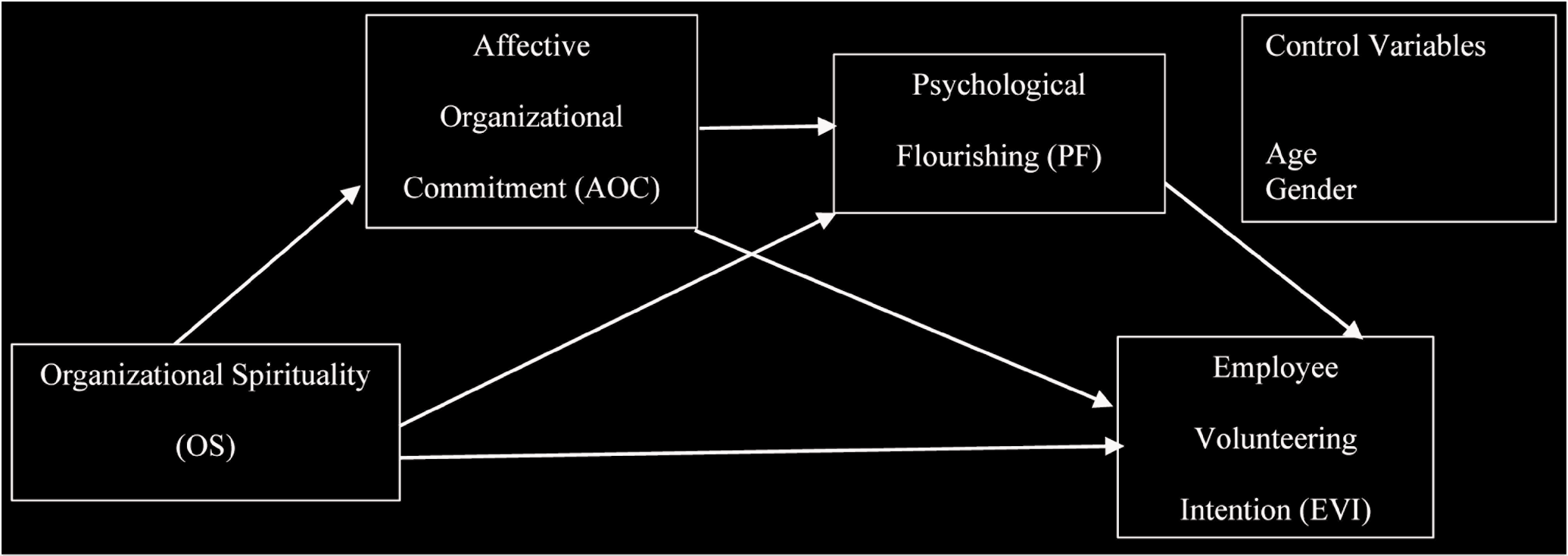
As all the constructs were reflective, PLS consistent algorithm (PLSc) with the consistent bootstrapping procedure was chosen for analysis. After running PLSc, indicators’ loadings of all constructs were checked for significance. Indicators of all the latent constructs evidenced significant loadings (at p < .01). Subsequently, the convergent and discriminant validity of all constructs was checked, before estimating structural paths. As per the guidelines suggested by Hair et al. (2017), all constructs exhibited Cronbach alpha more than 0.7 and average variance extracted (AVE) more than 0.5 (except OS; refer to Table 1), thus establishing the convergent validity of all latent constructs. OS reported AVE of 0.47 which was slightly below the acceptable value of 0.50. However, all the indicator loadings of this construct were above 0.6 and significant (Igbaria et al., 1995). The construct also reported acceptable Cronbach alpha (more than 0.7). Therefore this construct was retained. Next, discriminant validity was assessed through Fornell–Larcker, cross-loadings and heterotrait-monotrait (HTMT) criterion (Hair et al., 2017). As per the Fornell–Larcker criterion, the square root of AVE (represented by the diagonal value) should be greater than the correlation (corresponding) with all other latent constructs. Also, all indicators of latent constructs should load high on their corresponding constructs in comparison to other constructs. The other HTMT criterion requires HTMT values to be less than 0.85. Also, the upper and lower confidence intervals of HTMT should not include 1. Table 2, demonstrates all constructs fulfil Fornell–Larcker, cross-loadings and HTMT criterion, substantiating the discriminant validity of all constructs.
Results
Descriptive Statistics
Table 1 presents mean, SD and the Pearson inter-correlation results. OS was strongly related to affective commitment and showed modest correlations with PF and EVI. Expectedly, affective commitment was strongly associated with PF and EVI. PF also showed modest relatedness with EVI.
Descriptive Statistics, Mean, SD, Cronbach Alpha, AVE and Inter-correlation

Results for Discriminant Validity Using—Fornell–Larcker, Cross-loadings and HTMT Criterion

Model Testing
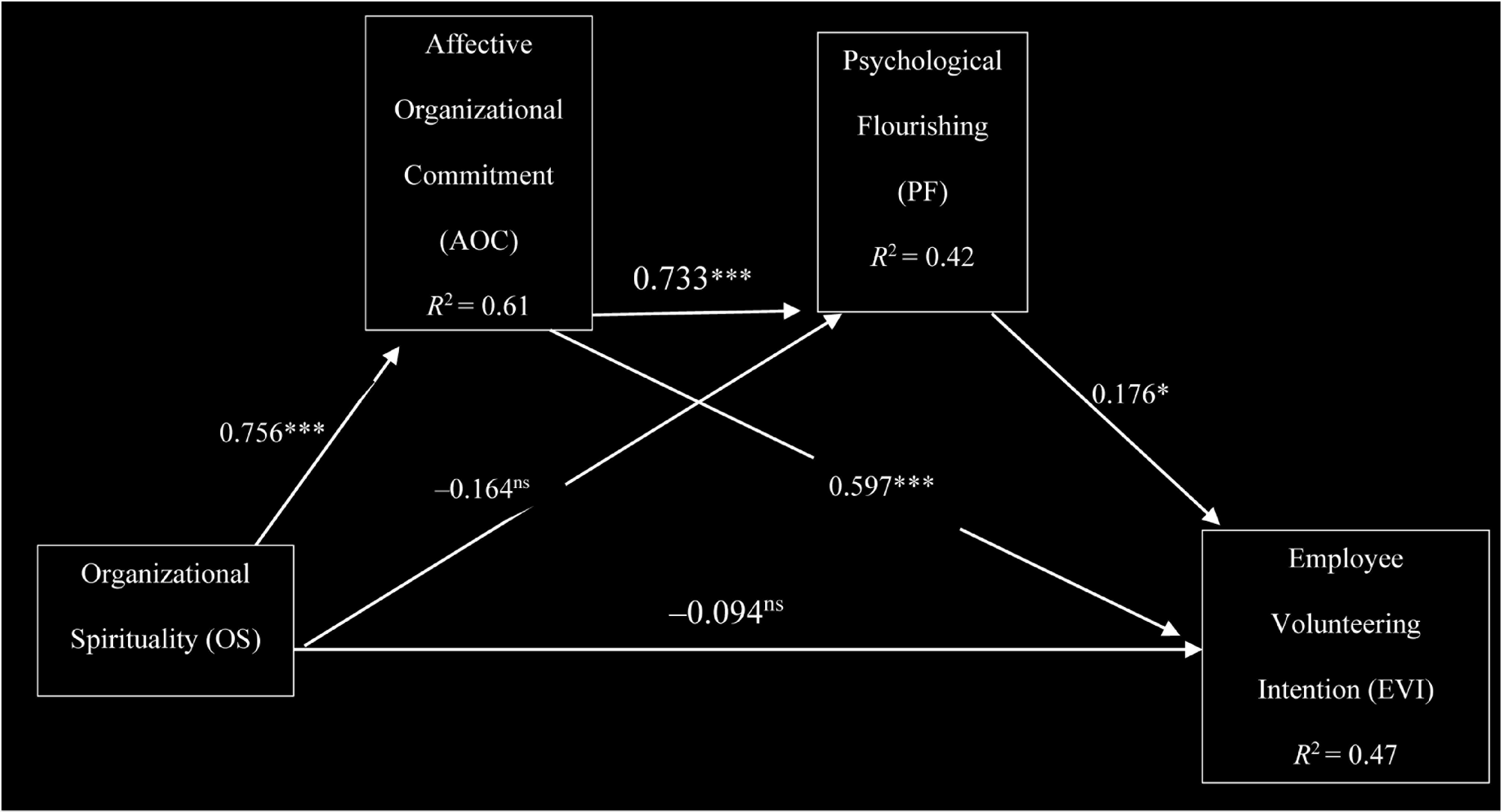
See Figure 2 for structural path analysis results. Results depicted that OS was not significantly related to EVI (β = –0.094, p > .05). Therefore, Hypothesis 1 was not supported. However, OS was significantly and positively related to AOC (β = 0.756, p < .01). AOC was positively and significantly related to EVI (β = 0.597, p < .01), supporting Hypothesis 2. Results indicated that OS was not significantly related to PF (β = –0.164, p > 0.05), thus rejecting Hypothesis 3. As shown in Figure 2, AOC was positively and significantly related to PF (β = 0.733, p < .01). PF was also positively and significantly related to EVI (β = 0.176, p < .05). This provided support for Hypothesis 4. Table 3 presents the significance analysis of different indirect and the direct paths. The specific indirect effect of OS on EVI through AOC (β = 0.451, p < .01) was significant and stronger than the specific indirect effect through PF and AOC (β = 0.097, p < .10; both mediators). Overall, the total indirect effect of OS on EVI was significant and positive (β = 0.519, p < .05).
Direct and Indirect Effects—Significance Analysis (PLS-SEM Results)

The R2 values for endogenous constructs of AOC reported as 0.61, PF 0.42 and EVI 0.47 (see Figure 2). Next, the effect size (f2) was checked. As per the guidelines of Henseler et al. (2016), 0.02, 0.15 and 0.35 were taken as small, medium and large effect size. Accordingly, OS had the largest effect size on AOC (f2 = 1.307, p < .05) and no effect size on EVI and PF. AOC had a medium effect size on EVI (f2 = 0.193, p < .05) and large effect size on PF (f2 = 0.363, p < .05). PF had small non-significant effect size on EVI (f2 = 0.034, p > .05).
Discussion
There is increasing pressure on organizations to work towards larger social causes and initiate efforts towards community development. These efforts require active and sustained participation of their employees, which is often difficult to enlist (Boccalandro, 2009). Search for antecedents of employee volunteering has highlighted the role of individual and work-related factors. The effect of organizational-level factors, however, remains under-examined. This study attempted to address this gap and investigate the effect of organizational spiritual value (OS; of wellness and welfare for others) on EVI. The role of AOC and PF as mediating factors between OS and EVI was examined.
Findings corroborated that AOC fully mediated the influence of OS on EVI and PF. Overall, results indicated a strong total indirect effect of OS on EVI, through AOC being stronger than the other indirect structural path through AOC and PF (both as mediators). These findings can be explained by drawing upon the social identity lens (Ashforth & Mael, 1989; Haslam et al., 2014) and research on the effects of positive emotions.
Social identity theory posits that individuals categorize themselves in different social categorization schemas on the basis of group membership (Ashforth & Mael, 1989; Haslam et al., 2014). This helps to define an individual’s social identity, which relates with a connectedness to the group (or organization in our case). Strong psychological connectedness or belongingness to the organization is characterized by defining self in terms of social referent membership (organizational membership) such that personally experiencing its successes and failures as one’s own, called as organizational identification (Ashforth & Mael, 1989; Haslam et al., 2014). Ashforth and Mael (1989) noted that organizational identification fulfils the need for meaning and connectedness.
Humanistic values in the organization and opportunity to do meaningful work strengthen employees’ hope, health and self-esteem. Employees who perceive that their organization embraces the value of care and concern for others are likely to develop a sense of positive self-identity through perceiving themselves as caring and compassionate human beings; perceived positively by people outside and within the organization; fostering their OBSE (see, Milliman et al., 2003). This helps employees to link their organizational membership with their self-concept, which further bolsters their commitment to the organization as a whole.
The affective bonds and positive emotions that employees experience at work, positively influence their attitudes and behaviours towards the organization and even spill over to other domains in their life. Employees reciprocate by strengthening their loyalty towards the organization and adopting supportive behaviours towards the organization (employee volunteering in this case). This not only strengthens the positive organizational image but also helps to reinforce their commitment towards organization and employees’ positive self-identity.
Theoretical Implications
First, in the employee volunteering literature, individual factors (demographics, motives, identity and personality traits) have received considerable attention but the role of organizational-level factors on employee volunteering have remained poorly understood (Rodell et al., 2016). The present study contributes to fill this gap.
Second, considerable research on employee volunteering is skewed towards the intensity of volunteering (Rodell et al., 2016). One-item measures capturing the intensity of volunteering are susceptible to reliability issues. This study has employed a scale-based measure of EVI. Literature has noted that scale-based measures are less prone to validity issues (Rodell et al., 2016).
The third contribution is to the literature on AOC. Existing research on AOC has acknowledged the positive influence of affective commitment on physical and psychological well-being (see, Meyer & Maltin, 2010). Our study supports and extends this line of research evidencing the influence of AOC on psycho-social well-being. The strength of affective commitment as an intervening variable (in comparison to other intervening variables) in influencing EVI gives greater confidence for sustained engagement by employees in these organization-supported community development programmes.
Fourth, our study supports the influence of OS on individual psycho-social well-being, organizational commitment and volunteering intention. This study advances the literature on spirituality at work by highlighting that OS has benefits for not only the employee and the organization but also the wider community/society, a direction identified by Rocha and Pinheiro (2020) as needing greater attention.
Practical Implications
Findings pertaining to the positive effects of OS on EVI through the strong mediating role of AOC offer several practical insights. Contribution of the spiritual value of wellness and welfare towards others in eliciting employee affective commitment indicates that when organizations move beyond a materialistic agenda and vision to serve a higher purpose/support others, it helps the employees to fulfil their need for meaning and purpose in life and feel a stronger sense of connection with the organization that supports it. Organizations can harness the benefits of the validated model, through the provision of an organizational culture characterized by benevolence that yields the necessary intrinsic motivation to volunteer through influencing AOC and PF. Organizational values are experienced by employees when they are put in action. Greater the congruence between the stated values and reality, the stronger would be the organizational culture. These findings, therefore, encourage the leaders and managers to adopt policies and practices that support otheroriented values. Initiating community support programmes, for instance, may help to convey the values of care and concern for the society at large and elicit affective commitment which would help to sustain their success through greater employee participation.
The strong role of affective commitment in our study highlights the importance of intrinsic motivation for the success of community support programmes initiated by the organizations. This would be helpful for managers responsible for planning and executing such programmes and ensuring their success over a long period of time. The presented research model helps to provide implications for enduring employee volunteering compared to sporadic volunteering.
Limitations and Future Research Scope
The limitations of this study pertain to the single-source data collected from telecom companies in India. This study focused on the willingness of the employees to volunteer rather than actual volunteering behaviour. Future research could use the multisource design to investigate the actual employee volunteering behaviour and collect data from a wider range of sectors/industries. Future research can unearth other intervening variables that will help to reduce parameter bias.
Given the role played by individual-level factors (personality characteristics, identity factors, etc.) on employee volunteering, some of these can be examined as moderators in future research. The effortful nature of volunteering could benefit from a nuanced understanding of the factors affecting the three aspects of employee volunteering: direction, intensity and persistence (Rodell et al., 2016). All the three aspects are of great interest to practitioners for they together assure active and enduring participation of an employee in organization-led/supported community development programmes. Theoretically, these open up a wider scope for research to understand the antecedents to each of these. A longitudinal study design could support such investigations better.
Footnotes
Declaration of Conflicting Interests
The authors declared no potential conflicts of interest with respect to the research, authorship and/or publication of this article.
Funding
The authors received no financial support for the research, authorship and/or publication of this article.