




Abstract
Impulse buying is an important area of consumer behaviour. The process of impulse buying is influenced by various external, situational, and internal stimulus factors. The extant literature review suggests that various external and situational factors are studied in great detail; however, studies on various internal stimulus factors are rare. Hence, this study explores relevant research gaps, and, in this process, it identifies three internal stimulus factors such as materialism, hedonism and perceived risk as potential antecedents to impulse buying. This article also suggests the use of moderator variables, individualism, and income, the impact of which is to be tested on the respective proposed relationships. This article reviews the contributions of all seminal as well as other important works from 1950 through 2018 conducted in the field of impulse buying. In this process, it includes relevant published academic and research papers through a comprehensive search from the database of Scopus, electronic sources such as Sage Journals, Science Direct, Emerald Insight and aggregators such as JSTOR and EBSCOhost. However, consequently, it excludes unpublished doctoral thesis, conference proceedings, working papers, and dissertations. The reviewed literature are all written and documented in the English language.
Executive Summary
This article extensively reviews the literature published in the international peer-reviewed journals in the field of impulse buying. The underlying aim is to explore various stimulus factors that influence impulse buying among consumers. An extant literature review indicates three types of stimulus factors that govern consumers’ buying impulsiveness, namely external, situational, and internal stimulus factors. An in-depth study of literature brings forth the fact that extensive research has been conducted to understand the influence of various external stimulus factors, including store atmospherics, product characteristics, promotional activities, as well as the influence of situational factors, including time, money, presence of others, and in-store browsing on impulse buying. However, studies on the influence of various internal stimulus factors on impulse buying are rare. This is because, initially, the researchers adopted a taxonomical approach to understand the phenomenon of impulse buying. However, since the late 1980s and early 1990s, the researchers posit the importance of understanding the internal cues or stimuli of a consumer that drives him/her into buying impulsively. This ignites the search for the relevant internal stimulus factors that influence consumers’ motives while buying. In this context, this study identifies specific internal stimulus factors whose influence on impulse buying needs immediate attention. Second, it contextualizes the proposed relationships in the light of cultural differences and specific demographic variables while identifying them as moderators. Hence, this study explores the relevant literature and identifies three internal stimulus factors, namely materialism, hedonism, and perceived risk as potential antecedents to impulse buying that need immediate probing. In sum, this article aims to provide future directions to research on impulse buying by putting forth the antecedents that need to be studied and also by providing a research framework for future research, which requires empirical validation.
Introduction
Impulse buying is an important area of study in the field of consumer behaviour (Piron, 1991). This phenomenon has captured researchers’ attention for almost 70 years now (Applebaum, 1951; Clover, 1950; West, 1951). It is classically described as a buying process that involves lack of planning (Clover, 1950; West, 1951), hedonic motivations (Rook, 1987; Rook & Hoch, 1985), and emotions (Piron, 1991). Therefore, conceptually, impulse buying is a spontaneous act of carefree purchase with diminished regard to future consequences (Sofi, 2018).
Impulse Buying in Eastern Landscapes
Studies on impulse buying, initially, are found restricted to the Western world predominantly. The reason being, this phenomenon is influenced by the cultural practices of the people of a country or a specific geographic region. More individualist approaches lead to more impulse buying (Lee & Kacen, 2008). However, post-globalization, impulse buying is omnipresent across the globe and no more restricted to the Western world alone. This is because the millennials in the eastern half of the globe defy traditional collectivism and exhibit increasing individualist practices and, accordingly, display impulse buying. The discussion on impulse buying becomes important for academicians and practitioners especially in the eastern landscapes because of a few reasons: First, there is a discernible rise in individualism among the youths. The rise in individualism is known to be associated with impulse buying. Second, the purchasing power of millennials is on the rise because of their substantial representation in the workforce. Third, the generation of millennials is essentially aspirational. Therefore, a traditionally collectivist, non-western country no longer turns its back to impulse buying. For example, China is known to have represented a typical collectivist country (Hofstede, 1980); their interdependent cultural practices, group needs, and desires, emotional control and moderation, discourage impulse buying (Yu & Bastin, 2010). However, today the millennials are bicultural (Zhang, 2009) and less collectivist (Lu & Shu, 2006; Reardon et al., 2005). Likewise, India, with a multi-facet cultural amalgamation, records 34.8% of millennial representation in the population, that is, age ranging from 17 to 34 years (according to the data furnished by the Social Statistics Division of the Central Statistics Office, Ministry of Statistics and Programme Implementation, Government of India, as of 2011). Therefore, it is of no wonder that with such significant presence of millennials, India scores a considerable 48 on individualism in Hofstede’s 6-Dimensions of culture. The increasing exhibition of individualism among millennials, therefore, makes India a very conducive market for impulse buying (Mittal et al., 2018). The millennials comprised a mix of both earning and non-earning groups. However, both the earners, a financially powerful generation (Grant & Stephen, 2005) and the non-earners, have the capacity of influencing the spending dynamics of their parents (Taylor & Cosenza, 2002). As a result, it creates a greater demand for products and, accordingly, increases firm profitability. This urges marketers to comprehend millennials’ attitude in order to be innovative and come up with new ways to attract this lucrative consumer segment (Grant & Stephen, 2005). Hence, citing to the heavy presence of impulse buying among the millennials and the possible beneficial outcomes of it for the businesses, a probe in the eastern countries becomes inexorable. The research continuum starts by stating impulse buying is product dependent. However, subsequent research argues that the taxonomical approach of the study tends to take the attention away from the shoppers’ internal motivations that are crucial to impulse buying (Rook, 1987). It is, thus, important to understand the reactive behaviour to stimuli that generate an uncontrollable impulse within a buyer (Rook & Gardner, 1993; Weun et al., 1998). The importance of this strong undeniable urge that motivates a shopper to buy leads researchers to agree upon the fact that impulse buying is controlled by internal stimulus directly.
Importance of the Study
Past research puts forward a detailed review and an account for all the important research works in the field of impulse buying in great detail (Kalla & Arora, 2011; Muruganantham & Bhakat, 2013; Vohra, 2016). Further, research reports categorically various internal, external, and situational stimulus factors that influence impulse buying (Ünsalan, 2016). However, neither of these studies has reported specific constructs that need immediate attention of researchers. Therefore, it falls short to provide future directions. This article is similar to previous research as it comprehensively and chronologically reports the advancement of the research continuum until present (Table 1). However, it differs from the prior research and stands unique because, first, it identifies specific internal stimulus factors whose influence on impulse buying needs immediate attention. Second, it contextualizes the proposed relationships in the light of cultural differences and specific demographic variables while identifying them as moderators. Accordingly, a research framework is proposed that could be replicated in future research.
Chronological Advancements in the Study of Impulse Buying
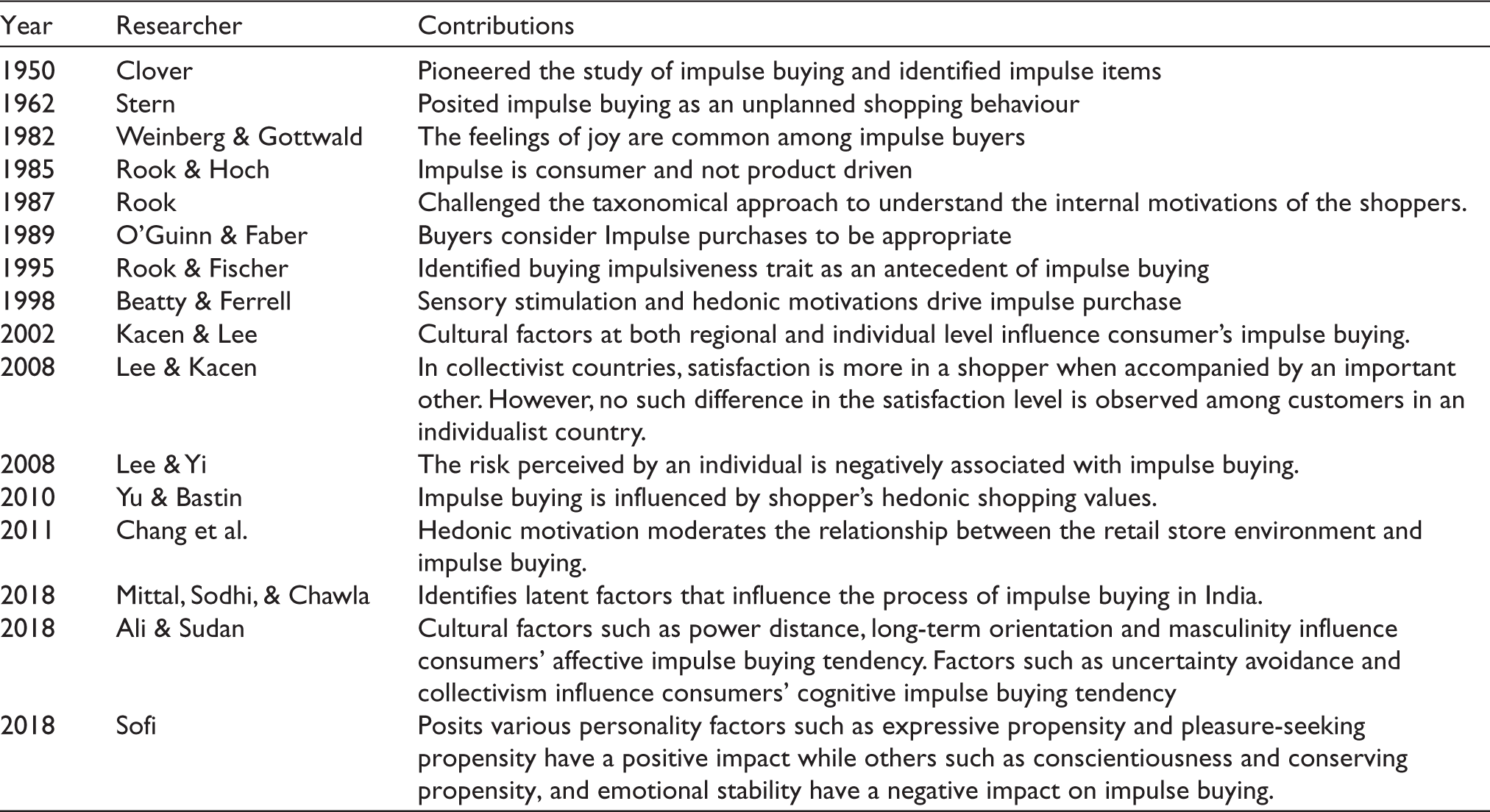
The article follows the stated flow of reporting its arguments. The succeeding section reports the review of the literature and identifies the existing research gaps that need immediate probing followed by a proposed research framework. The discussion and future direction section would suggest future scopes and guidelines.
Review of Literature
Impulse buying accounts for a great volume of sales of products every year across all categories (Kollat & Willet, 1967; Peck & Childers, 2006; Rook & Fisher, 1995; Weinberg & Gottwald, 1982). Evidence from previous research suggests that in the USA markets, approximately 60% of all buying happens on impulse (Abrahams, 1997) and it produces an annual sales volume of over $4.2 billion (Kacen & Lee, 2002). Researchers also observe a heavy presence of impulse buying in countries such as Australia, Singapore, Malaysia (Lee & Kacen, 2008), China (Yu & Bastin, 2010), Vietnam (Tuyet Mai et al., 2003) and India (Badgaiyan & Verma, 2014).
Initial studies on impulse buying observed that certain items are bought on impulse while others are not. Researchers categorized these items as impulse items and non-impulse items, respectively (Bellenger et al., 1978). Later, with the shift in the focus of the study towards the consumers from products, researchers posit the influence of various internal and emotional factors, such as mood (Donovan et al., 1994; Rook & Gardner, 1993), trait impulsiveness (Weun et al., 1998), norms (Rook & Fisher, 1995), product (Bellenger et al., 1978) and culture (Lee & Kacen, 2008) on impulse buying. Due course of the review observes the influence of various stimulus factors, namely external, situational, and internal factors (Ünsalan, 2016) on impulse buying. External stimulus factors for impulse buying are the specific variables related to the shopping environment and are external to the consumer at the time of purchase. Previous research posits the influence of numerous external factors that include store environment (Applebaum, 1951; Atulkar & Kesari, 2018; Stern, 1962), product characteristics (Duarte et al., 2013; Harmancioglu et al., 2009; Lucas & Koff, 2014), promotional activities (Duarte et al., 2013; Hultén & Vanyushyn, 2011) on impulse buying. Situational stimulus factors for impulse buying are those that depend on the situation in which the consumer is in at the time of buying. Prior studies show, extensively, how various situational factors that include time (Lin & Chen, 2013), money (Muruganantham & Bhakat, 2013), the presence of others (Luo, 2005; Rook & Fisher, 1995), in-store browsing (Beatty & Ferrell, 1998) influence impulse buying. Hence, an extant research is available to establish the association between external and situational stimulus factors and impulse buying. However, focus on the internal stimulus factors is rare.
Internal stimulus factors for impulse buying represent the internal characteristics of a person that might influence the buying process, which are categorized into culture and consumer characteristics (Ünsalan, 2016). Studies across geographical regions confirm that an individual’s cultural practices (Badgaiyan & Verma, 2014; Kacen & Lee, 2002; Lee & Kacen, 2008) influence impulse buying. In addition, extensive studies as well as several elements of consumer characteristics are done to prove their influences on impulse buying, which includes age (Kacen & Lee, 2002; Pentecost & Andrews, 2010; Wood, 1998; Xu, 2007), gender (Dittmar et al., 1995; Lucas & Koff, 2014; Pentecost & Andrews, 2010; Tuyet Mai et al., 2003), mood (Beatty & Ferrell, 1998; Rook & Gardner, 1993), and impulse buying tendency (Badgaiyan et al., 2016; Beatty & Ferrell, 1998; Gerbing et al., 1987; Lin & Chen, 2013). However, extensive studies on the influence of several more elements of consumer characteristics on impulse buying are still unsettled, which includes materialism, hedonism, and perceived risk. The study on the influence of internal stimulus factors on impulse buying is insufficient unless the antecedents are probed into. In the subsequent section, each of these constructs is explained in detail.
Research Gaps
Materialism
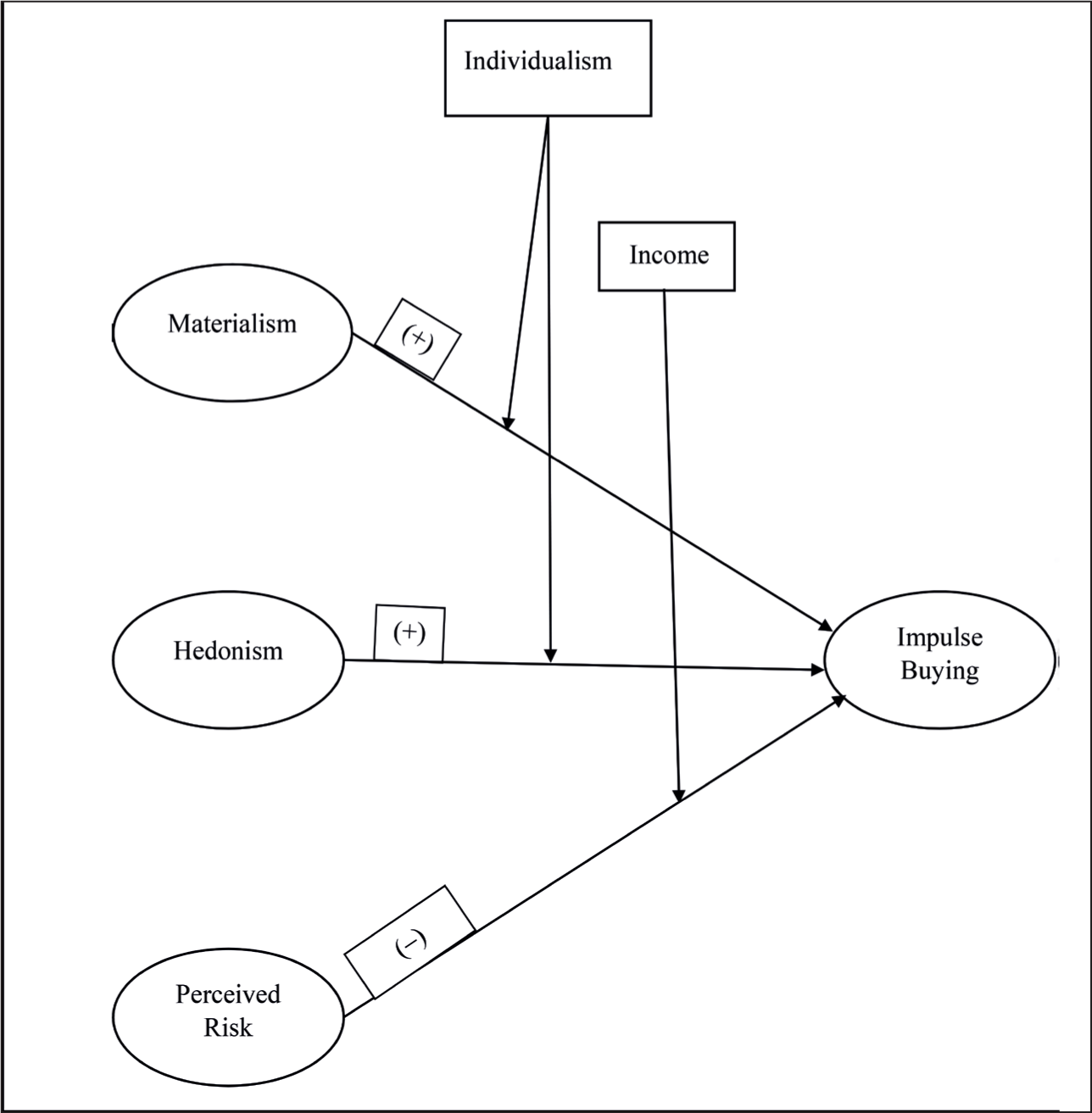
To modern consumer researchers, understanding the phenomenon of materialism is paramount (Podoshen & Andrzejewski, 2012). Researchers argue that materialists see products as a tool for their self-completeness, hence are more prone to impulse buying (Richins & Dawson, 1992). Materialism has been defined most consistently on the themes of centrality, happiness, and success (Richins & Dawson, 1992). Therefore, conceptually, materialism is a phenomenon that drives individuals to an increasing urge of worldly possessions, which allures them to buy in excess, a considerable portion of it is impulsive. Thus, the expectation is that the influence of materialism is positively associated with impulse buying (Figure 1).
Moderating Role of Individualism in Materialism–Impulse Buying Relationship
The research discourse on impulse buying has not addressed the issue of situating its antecedents within the context of cultural differences embedded in individualism/collectivism (Triandis, 1995). Scholars describe individualism as a social pattern where individuals consider themselves to be independent and self-governed while collectivism as a social pattern where individuals believe themselves to be an integral part of the in-groups or the family (Kacen & Lee, 2002; p.165). It is important to contextualize the relationship between materialism and impulse buying in the light of individualism/collectivism. In individualistic cultural practice, an individual is susceptible to internalize the influence process. That is, the individual might get influenced, say in buying decisions, but unlike the collectivists, he/she does modify the opinions to adapt their needs. A prior study suggests that such individuals who carry individualism as a cultural practice are likely to be more materialistic and display higher impulse buying (Lee & Kacen, 2008). Therefore, the expectation is that individualistic cultural practices strengthen the relationship between materialism and impulse buying.
Hedonism
Hedonism is an internal factor that motivates consumers’ buying (Babin et al., 1994; Muruganantham & Bhakat, 2013; Park et al., 2006). The studies suggest that for in-store buyers, hedonic motivations lead to browsing, which, in turn, influences impulse buying (Gültekin & Özer, 2012). Hedonists consider shopping as enjoyment and fun (Yu & Bastin, 2010). This self-appeasement and recreation from shopping lead consumers to impulse buying (Beatty & Ferrell, 1998). Thus, conceptually, hedonism, which is an act of satisfying one’s desire to attain novelty, fun, enjoyment, adventure, and self-gratification, prompts shoppers to impulse buying. The expectation is that the influence of hedonism is positively associated with impulse buying (Figure 1).
Moderating Role of Individualism in Hedonism–Impulse Buying Relationship
It is discussed in earlier sections that impulse buying is influenced by cultural practices. Hedonic value is essentially individualistic in nature. Alternatively, the contextualization of hedonism in pursuit of well-being exists in individual cultural practices (Joshanloo, 2014). Hence, the proposed influence that hedonic value exerts on consumers towards impulse buying is expected to have a higher impact in an individualistic culture. Therefore, the expectation is that the individualistic cultural practices strengthen the relationship between hedonism and impulse buying.
Perceived Risk
Perceived risk is a kind of uncertainty that a consumer faces while buying an item, especially when the product in question is high-priced. The level of this risk perception varies with the types of product, services (Sharma et al., 2014), and individuals (Hoover et al., 1978) involved in buying. Consumer researchers opine that risk perception often affects the new product adoption (Schaninger, 1976). Perceived risk also influences a consumer’s product evaluation, product choice, and behaviour (Boksberger et al., 2007). Moreover, impulse buying is expected to happen when the perception of risk among consumers is low (Lee & Yi, 2008). Therefore, conceptually, perceived risk is a stimulus that emerges out of the conflict between the buyers’ understanding of the product’s importance and the price that might hinder the buyer’s impulsivity.
Therefore, the expectation is that the influence of perceived risk is negatively associated with impulse buying.
Moderating Role of Income on Perceived Risk–Impulse Buying Relationship
It is discussed that perceived risk hinders buyer’s impulsivity to buy, more often when the product is highly priced. The positive perception of a consumer towards a product based on its importance is often contradicted by the price put up for the product in question. Accordingly, it resists impulse buying. Now the question that arises here is, can income be treated as a third variable that could improve the negative relationship between perceived risk and impulse buying? Various studies have been conducted on the impact of income on impulse buying, however, leading to ambiguous results. While a positive impact is reported from Vietnam (Tuyet Mai et al., 2003) and Bangladesh (Tinne, 2011), surprising results have been reported from the USA (Wood, 1998) and Malaysia (Khan et al., 2016), where income shows no impact on impulse buying whatsoever. However, following the assertion that higher income reduces the obstacle to buy on impulse (Tuyet Mai et al., 2003) by reducing the financial constraints, it is assumed that income might improve the perceived risk–impulse buying relationship.
Therefore, the expectation is that the negative influence of perceived risk on impulse buying is lower with higher income groups.
Proposed Research Framework
The expected relationships between the antecedents and impulse buying along with the proposed moderation analysis are articulated in the proposed research framework (Figure 1).
Discussions and Future Directions
This article identifies various internal stimulus factors that are expected to influence impulse buying, especially in the eastern countries. It also introduces cultural and demographic variables as moderators included in the research framework. Hence, it urges future researchers to emulate the framework for interesting and novel observations. This study puts forward relevant arguments, by citing various research works and findings, to state that the eastern markets are equally important today for impulse buying. Also, this study brings forward the fact that the major drivers for impulse buying in these markets are the millennials. Therefore, researchers in the eastern countries like India might consider this particular age group as the sample for their research.
Footnotes
Declaration of Conflicting Interests
The authors declared no potential conflicts of interest with respect to the research, authorship and/or publication of this article.
Funding
The authors received no financial support for the research, authorship and/or publication of this article.