




Abstract
The purpose of this study is to investigate the mediating role of corporate social responsibility (CSR) in between the sustainability orientation of managers and sustainable performance of small and medium enterprises (SMEs) in Tunisia. Besides that it aims to explore the impact of managers’ sustainability orientation on CSR practices, and how these activities could affect economic, social and environmental performance. The data have been collected by survey questionnaires from the owners and managers of SMEs across the manufacturing sector in Tunisia. Partial least square structural equation modelling statistical method has been used to analyse the research model using the software SmartPLS 3. The results reveal that CSR mediate the relationship between managers’ sustainability orientations and sustainability performance (except economic dimension). Moreover, the results also found that owners’ orientations towards sustainability positively influence CSR, and CSR also positively affect social and environmental sustainable performance. However, this study does not find a significant causal effect between CSR and economic sustainable performance. This study contributes to the Upper Echelon Theory by extending via empirical evidence with respect to sustainability, strategic, tactical orientations, CSR and sustainable performance. The limitations and direction for future research have been stated in this study.
Keywords
Introduction
The discussion of sustainability and environmental concerns has grown in the literature exponentially in the last decade (Tseng et al., 2019; Islam et al., 2020). Media and social media have highlighted the significant role of enterprises to be more sustainable. However, little focus has been given to small and medium enterprises (SMEs) in the Tunisian context. The owners/mangers of such firms are affected by their own thoughts because there are no board or civil organisations that can monitor their operations and decisions. Thus, knowing managers’ sustainability views towards society and natural environment could facilitate our understanding of their behaviours, consequently, the organisation’s outcomes.
Researchers have argued that social and environmental practices and sustainable performance are found to have positive impacts on societies’ desires and needs (Nulkar, 2014; Cardoso, 2020). Accordingly, Abbas et al. (2019) Jain and Winner (2016) and Kassel (2012) narrated that the practices of the corporate social responsibility (CSR) lead to sustainable performance due to which these activities contribute to sustainability factors. Therefore, combining managers’ orientations and linking them with organisations’ social activities are seen as an ambitious start to be sustainable (Ciemleja & Lace, 2011; Rexhepi et al., 2013; Hooi et al., 2016).
In the literature, most of the previous studies focussed on larger enterprises, and little effort has been given to SMEs in the context mentioned above (Windolph et al., 2014). Moreover, those studies have been carried out in fragmented efforts; for instance, sustainable performance and CSR (Emeseh & Songi, 2014) perceptions and CSR (Nejati et al., 2016) or with a particular aspect of sustainability such as environmental or economic aspects (Papagiannakis & Lioukas, 2012). Obviously, the role of leaders’ orientations on sustainability is widely ignored (Marcus et al., 2015; Gao, 2017). It illustrates a gap between CSR and sustainable performance concerns essentially across smaller enterprises (Baumgartner, 2014; du Plessis & Grobler, 2014). As can be seen, integrating sustainability orientation and sustainable performance is assumed to illustrate a comprehensive view of why some enterprises reach sustainable performance, whereas many others have yet to do so (Petrenko et al., 2016; Shahedul Quader et al., 2016).
Thus, examining these factors can provide a clearer picture of sustainable performance, in particular, across SMEs context in developing economies (Aguinis & Glavas, 2012; Baumgartner, 2014; Petrenko et al., 2016). Therefore, the study aims to address the literature gaps pertaining to the complex relationships between sustainability orientation and sustainable performance (economic, environmental and social). Mainly, is to examine them across SMEs with a mediating role of CSR.
The study sample is Tunisian’s small and medium manufacturers. According to the World Bank (WB), the manufacturing sector contributes to the country’s gross domestic product (GDP) about 16% (World Bank [WB], 2015). As can be seen, these types of firms have main effects on the Tunisian’s economy (Statistiques Tunisie, 2015). The data are collected through a questionnaire that has been distributed to the managers/ owners of those enterprises. The partial least square structural equation modelling (PLS-SEM) method has been used to test the hypothesis. The next section discusses the theoretical background and the literature followed by a detailed discussion of the methods. Next, this study presents the results and discussion as per the analysis. Finally, the study concludes by highlighting contributions, implications and limitations.
Literature Review
This section discusses the theoretical background followed by the operationalisation of the variables used in the research model.
Theoretical Background
To understand the relationships between managers’ orientation and sustainable performance of the firms is deeply rooted in the Upper Echelon Theory (UET). UET suggests underpinning such correlations since it examines managers’ motivations. It has been defined as the background of a manager that often affects managerial choices, which influences organisational performance (Hambrick & Mason, 1984; Hafsi & Turgut, 2013). UET reflects the cognitive bases and thoughts of key actors in an enterprise. These orientations act as a filter when a manager faces a complicated situation and impacts the outcomes (Manner, 2010). In other words, personal factors such as orientations determine mangers' behaviours and decisions, in consequence, performance will be impacted (Hambrick & Cannella, 2004). Hence, UET might provide clarification of managers’ sustainability orientations role on their choices, besides, how performance will be impacted.
According to Papagiannakis and Lioukas (2012), leaders’ personal factors such as attitudes and orientations impact the process of organisation strategic choices as UET proposed, consequently, the firm’s outcome. Hambrick and Mason (1984) argued that managers address many issues based on their backgrounds such as age, experiences, values and orientations. Further, leaders in many cases make strategic and tactical decisions based on them; therefore, the organisation’s performance is directly impacted. For those reasons, they proposed that the understanding performance starts from scrutinising owners’ personal traits (Hambrick & Mason, 1984). However, UET can provide an explanation of the role of managers’ tactical and strategic orientations regarding social activities and the firm’s performance (Manner, 2010). In other words, the owners’ background can strengthen or weaken the corporate engagement on social practices, which in turn influences the outcomes (Hambrick & Mason, 1984). Thus, as can be seen, UET could provide an explanation of the role of managers’ orientations on their choices, and how the performance will be affected by strategic and tactical orientations.
Sustainable Performance
Researchers have defined sustainable performance differently; for example, Laitinen (2002) has seen it as the ability of a firm to achieve superior performance in social and environmental aspects. Zhou et al. (2008) saw it as the enterprise’s outcome because of performing environmentally, socially and economically. The sustainable performance shows organisations’ planned goals (Vincenza Ciasullo & Troisi, 2013); social legitimacy, clients’ satisfaction, loyalty and brand equity (Fisman et al., 2008; Luo & Bhattacharya, 2009). Besides, it contributes to the cost reduction for operations, consumption and wastes (Maletic et al., 2015), which leads to improve the financial performance (Adams, 2002).
Chau et al. (2014) suggested that for scrutinising sustainable performance we have to understand managers’ inspiration to be sustainable since they have different motivations to do so, and studying it without knowing motivators of managers can lead to more questions rather than answers (Ngai et al., 2014). For example, sustainability orientation has central effects on enterprise managers’ tendency to involve in moral activities, besides, the degree of their views is critical for their organisations’ success (Hooi et al., 2016). Perceiving the importance of such issues can be seen as the key to determine whether ethical concerns have a priority or not (Singhapakdi et al., 1996). Therefore, understanding seniors’ moral orientations facilitate our predictions on their actions and reactions as well towards social responsibility and sustainable outcomes (Vitell & Paolillo, 2004).
Sustainability Orientation
Sustainability orientation has been recognised as a new term in the business field, it is beyond beliefs, values and attitudes, for instance, it affects individuals’ thoughts more than their values. In other words, orientations are based on an individual’s core values (McCarthy & Shrum, 1994; White, 2006). For instance, a manager might have some values, but he/she does not have orientations on a particular issue, but these orientations could not have existed without values. The sustainability orientation has a crucial impact on SMEs owners’ tendency to engage in ethical behaviours. Perceiving the importance of social and environmental concerns is a key that determines whether moral situations have a priority in owners’ minds (Singhapakdi et al., 1996). Thus, understanding managers’ ethical orientations could facilitate actions towards socially responsible matters, and it reflects their personality (Vitell & Paolillo, 2004).
In the literature, there are some attempts to define sustainability orientation based on individuals’ own views. For example, Sung and Park (2018) saw it as individual traits towards social and environmental concerns. Roxas and Coetzer (2012) argued that people’s behaviours are based on their views towards life, and they defined it as a manager’s orientation that reflects his/her philosophy of doing business socially and environmentally sustainable. The definition of the sustainability orientation from the perspective of Kuckertz and Wagner (2010) is the concerning level about ecology protection and social issues of individuals. Moreover, Tata and Prasad (2015) have proposed a further definition as managers’ readiness to engage and implement sustainability initiatives. As can be seen, research has focussed on individuals’ views towards society and the environment. Illies and Reiter-Palmon (2008) put forward that individuals during their life build up predictable behaviour preferences, which reflects their system hierarchy and priority. Chandrakumara (2011) suggested that what people prioritize and how these preferences are important relatively to another, which might shape their orientations. Schwartz (1996) highlighted that since there are different priorities of them, leaders might have different views on social and environmentally responsible practices and issues. Further, Stern (2000) pointed out that based on managers’ sustainability views the prediction of the act for he/she becomes easier since they are as a governance system of an individual’s choices (Wyer & Albarracin, 2005). Besides, implementing social and ecological practices is a result of SMEs managers’ backgrounds, since they are such a guide for them to adopt a new strategy or making decisions (Duarte, 2010; Tang et al., 2011). In other words, sustainability orientation is based on individual views and thoughts towards society and environmental challenges regardless of the business’s circumstances, issues, profits and so on (Diehl & Klee, 2015). Hence, sustainability orientation often determines a person’s views regarding the society and the environment (Tang et al., 2011).
Organisational Factors
To provide an explanation of owners’ views, the thesis has classified organisational factors into strategic and tactical orientations such as many studies have adopted (e.g., Soltani & Wilkinson, 2010; Nejati et al., 2016). These levels express the degree of readiness to incorporate social and ecological visions with the existing strategic and tactical options, but it needs to align with the firm’s structure, processes and the whole system (Tata & Prasad, 2015). However, those levels should have effective coordination; otherwise, it will be isolated attempts, in other words, ethical concerns can be disconnected across strategies and tactics (Bartocci Liboni & Oranges Cezarino, 2014).
As for strategic orientation, Nejati et al. (2017) defined the strategic orientation level as an organisation’s long-term view towards social responsibility. Slater et al. (2006) have defined the strategic level as the level that directs broad outlines for the firm’s strategy. David (1989) has defined the level as the process to plan, implement and evaluate a firm’s decisions in order to achieve long-term goals. Brews and Hunt (1999) defined it as what the organisation hopes to obtain. Bansal et al. (2015) saw it as decisions that involve a long-time horizon and a significant adjustment to the organisational structure.
As for tactical orientation, previous studies have proposed many definitions for this level. For example, Harrington and Ottenbacher (2009) have proposed that the tactical level is a firm’s strategic tool to achieve the desired objectives. Nejati et al. (2017) defined it as leaders’ short-term views towards social responsibility. Bansal et al. (2015) suggested that this level can be defined as the corporate social view for enhancing the relationships with stakeholders in the short-term since it requires fewer resources. Soltani and Wilkinson (2010) have defined the level as middle leaders’ beliefs in social responsibility and its impact on a firm’s outcome.
Corporate Social Responsibility
Despite social and environmental literature, the CSR has been seen differently from country to country or/and culture to culture. Researchers have focused on operating and running a business ethically within the contextual values and culture. However, enterprises specially smaller ones are not always considering these issues due to several reasons. The major one is that they claim their negative impacts on a community is at the lowest level (Pimenova & van der Vorst, 2004; Revell & Blackburn, 2007). Moreover, the owners of those firms argued that investing in social and environmental issues is unjustifiable as their clients will not pay extra for such investment (Williamson et al., 2006; Brammer et al., 2012). On the other hand, firms can benefit from those practices; for example, recruitment of skilled workers (Bernhut, 2002), improve their image (Nejati et al., 2017), and innovation (Ferrari & Parker, 2006).
The World Business Council for Sustainability Development (WBCSD) defined CSR as the role of enterprises towards their employees and the local community regarding improving the quality of life (WBCSD, 1999). The European Commission (EC) has defined it as voluntary efforts of corporations to incorporate environmental and social issues into their practices (EC, 2001). McWilliams and Siegel (2001) have defined it as actions that expand social activities beyond a firm’s interests. Matten and Moon (2008) saw CSR as a process to do the right thing for the firm and the society to improve the business’s image and performance.
On the other hand, Lopez et al. (2007) have found a negative effect of CSR practices on sustainable performance, further, Chih et al. (2010) have found no significant. Hillman and Keim (2001) concluded that practicing socially is negatively related to the shareholders’ value. Thus, some studies revealed a positive correlation, whereas others have found no relationship or even a negative association (King & Lenox, 2000; de Colle et al., 2014). However, the majority of studies were carried out in developed economies (Ciliberti et al., 2008; Tata & Prasad, 2015). Further, there is a lack of a comprehensive study on CSR practices and sustainable performance (Aguinis & Glavas, 2012). Hence, Aguinis and Glavas (2012), Baumgartner (2014) and Kennedy et al. (2009) pointed that CSR needs more examination, and should be studied as a mediator with sustainability in order to integrate these issues comprehensively in organisations’ management. Baron and Kenny (1986) have recommended that a mediator variable instead of a moderator is better once there is a relationship between a predictor and a criterion variable.
Figure 1 represents the research model of this study. The first component of the framework investigates the impact of orientations on environmental and socially responsible practices, and this relationship has been explained by UET widely (Waldman et al., 2006). Further, it assumes that owners’ moral strategic and tactical orientations to engage in social practices have an influence on the performance since manufacturing SMEs managers are free to set strategies for their enterprises (Hambrick & Mason, 1984; Manner, 2010). In other words, UET explains the role of owners’ personal views on CSR practices. The second part of the model examines the role of the mediating variable, which is CSR, impacts on sustainable performance. Finally, the outcome variable is a sustainable performance which is measured by three dimensions: economic, environmental and social performance.
Research Model

Hypotheses Development
Ngai et al. (2014) argued that personals’ factors such as orientations lead managers to take decisions although there is not much data since they rely on their experiences and values as well once they choose between alternatives. However, individuals’ elements cannot always determine behaviours, for example, a manager has attitudes in certain topics, but he does something else and sometimes can be seen contradictory to his beliefs (Collins et al., 2007). Besides, Pepper et al. (2009) have pointed out that orientations are not continually good for predictions due to which there are other reasons that souring organisations. Grayson (2004) studied personal factors role across larger and smaller enterprises, and concluded that there are differences among them regarding CSR; however, both of these types have been impacted by managers’ attitudes and views. Marcus et al. (2015) suggested that we should know the motivator factors of managers in order to understand firms’ moral practices. In contrast, Kennedy et al. (2009) have pointed out that based on the literature, individuals’ beliefs never completely can explain people’s actions, and in many cases, several values could be violated while others are acted upon.
Therefore, there is a need to know managers’ sustainability orientations impact on socially responsible practices, and how these activities could affect leaders’ choices to be socially responsible (Hasan, 2016). Particularly, the literature has not provided an explanation deeply about this relationship, in accordance, the following hypothesis is proposed:
There is a positive impact of sustainability orientation on CSR practices.
In addition, these practices could affect the outcomes of firms positively despite different results are expected across countries and cultures; for example, CSR can enhance organisations’ reputation, image, and so on. Further, socially responsible firms that involve environmental and society’s concerns expect to have better outcomes mainly social and ecological sustainable performance (Zhou et al., 2008). Moreover, employees often tend to work for responsible and safe companies; besides, clients choose to buy from ethical organisations; additionally, suppliers incline to have deals with moral and honest enterprises (Weber, 2008). Golini et al. (2014) have studied social and environmental policies across international manufacturers. They resulted that the performance is improved due to these organisations engage in such programs. Abdul-Rashid et al. (2017) found that for manufacturers that have satisfied sustainable practices, sustainable performance is improved. Further, Chang et al. (2013) examined organisations’ sustainable performance over time and have used different methods, and resulted that there are differences across industries regarding the outcome of social and environmentally responsible activities. Additionally, Eweje (2014) investigated CSR and sustainability across different developing economies by reviewing existing literature and chapters. He concluded that there are obvious gaps between developed and developing markets. Moreover, the significant reason is the lack of civil organisations, besides, the government regulations are absent in such issues.
On the other hand, Lopez et al. (2007) found negative effects of CSR activities on sustainable performance; furthermore, Hillman and Keim (2001) have concluded that practicing socially responsible is negatively correlated to the shareholders’ value. Moreover, Worthington et al. (2006) research has not found a major role of external groups against smaller enterprises to employ social responsibility standards. Hence, some research has revealed positive correlations, whereas others did not find a relationship or even negative associations (King & Lenox, 2000; de Colle et al., 2014). Therefore, the following hypotheses have been suggested.
There is a positive impact of CSR practices on economic sustainable performance.
There is a positive impact of CSR practices on environmentally sustainable performance.
There is a positive impact of CSR practices on social sustainable performance.
Moreover, personal factors evoke managers to analyse ethical situations, which impact performance as a result of their engagement in CSR (Manner, 2010). Gao (2017) has highlighted that leaders’ features could influence an organisation’s culture like morals attitudes, in consequence, the enterprise’s outcome. Castaldo et al. (2009) have mentioned that SMEs’ owners, who combine social beliefs into their activities, will take advantage of building confidence with stakeholders, which frequently influences a firm’s performance. Wiengarten et al. (2017) investigated the personal features of CSR department managers. They found that there is an association between leaders’ backgrounds and performance, particularly, when managers have more knowledge and orientations of arisen social concerns. Gao (2017) studied enterprise owners’ ethical values, and he mentioned that managers’ views towards CSR could influence organisations principles; for instance, ethics attitudes; as a result, the enterprise’s performance. Wu et al. (2015) have concluded that the antecedents of seniors might affect the outcome of a firm due to these personal factors impacts ethical decisions. Petrenko et al. (2016) found that even unpleasant aspects have an effect on practice socially responsible, however, unpleasant features decrease the positive impact of CSR on the outcome. Marcus et al. (2015) have found that personal factors often push managers to engage in moral behaviours, accordingly the performance. But the outcomes of those activities will be different across countries because seniors hold diverse orientations towards social responsible issues (Ramasamy et al., 2013; Sung & Park, 2018).
In spite of studies attempt to examine individual factors’ role on the desirable achievement, it did not clarify the causes and explanations of this relationship clearly (Asah et al., 2015; Alikaj et al., 2017). Furthermore, the literature has yet to provide a robust picture of owners’ sustainability orientations role on sustainable performance (Asah et al., 2015). However, reviewing social responsible practices towards stakeholders as a mediator provides a justification of how satisfying them leads to sustainable outcomes (Aguinis & Glavas, 2012; Baumgartner, 2014; Alikaj et al., 2017). Galpin et al. (2015) proposed that managers’ orientations towards sustainability might affect a firm’s performance positively by investing in the environment and society; besides, building a sustainable culture. Thus, Aguinis and Glavas (2012), Baumgartner (2014) and Kennedy et al. (2009) have pointed that CSR needs deeper examination and should be investigated as a mediator with sustainability to integrate these issues comprehensively. Hence, to understand sustainable performance deeply we need to know sustainability orientation with the mediating role of CSR practices (Aguinis & Glavas, 2012; Ngai et al., 2014; Alikaj et al., 2017). Therefore, the following hypotheses have been proposed:
There is a positive mediating effect of CSR practices on the relationship between sustainability orientation and economic sustainable performance. There is a positive mediating effect of CSR practices on the relationship between sustainability orientation and environment sustainable performance. There is a positive mediating effect of CSR practices on the relationship between sustainability orientation and social sustainable performance.
Method
The research has adopted a quantitative technique to study the relationships across sustainability orientation and sustainable performance, and the role of CSR as a mediator. A cross-sectional method is carried out to collect required data, so, questionnaires were handled to enterprises’ owners.
Sample
The sample of the study is managers and owners of SMEs across Tunisian’s manufacturing sector. According to the WB, this sector contributes to the country’s GDP up to 16% (WB, 2015). Further, it has been under enormous critics for performance and unethical practices. Thus, it seems optimal to investigate sustainability and CSR across these enterprises. However, SMEs in Tunisia are defined as those firms that employ 200 workers and less, and the total sample of the research is 122 units of managers and owners of these enterprises.
Measurements
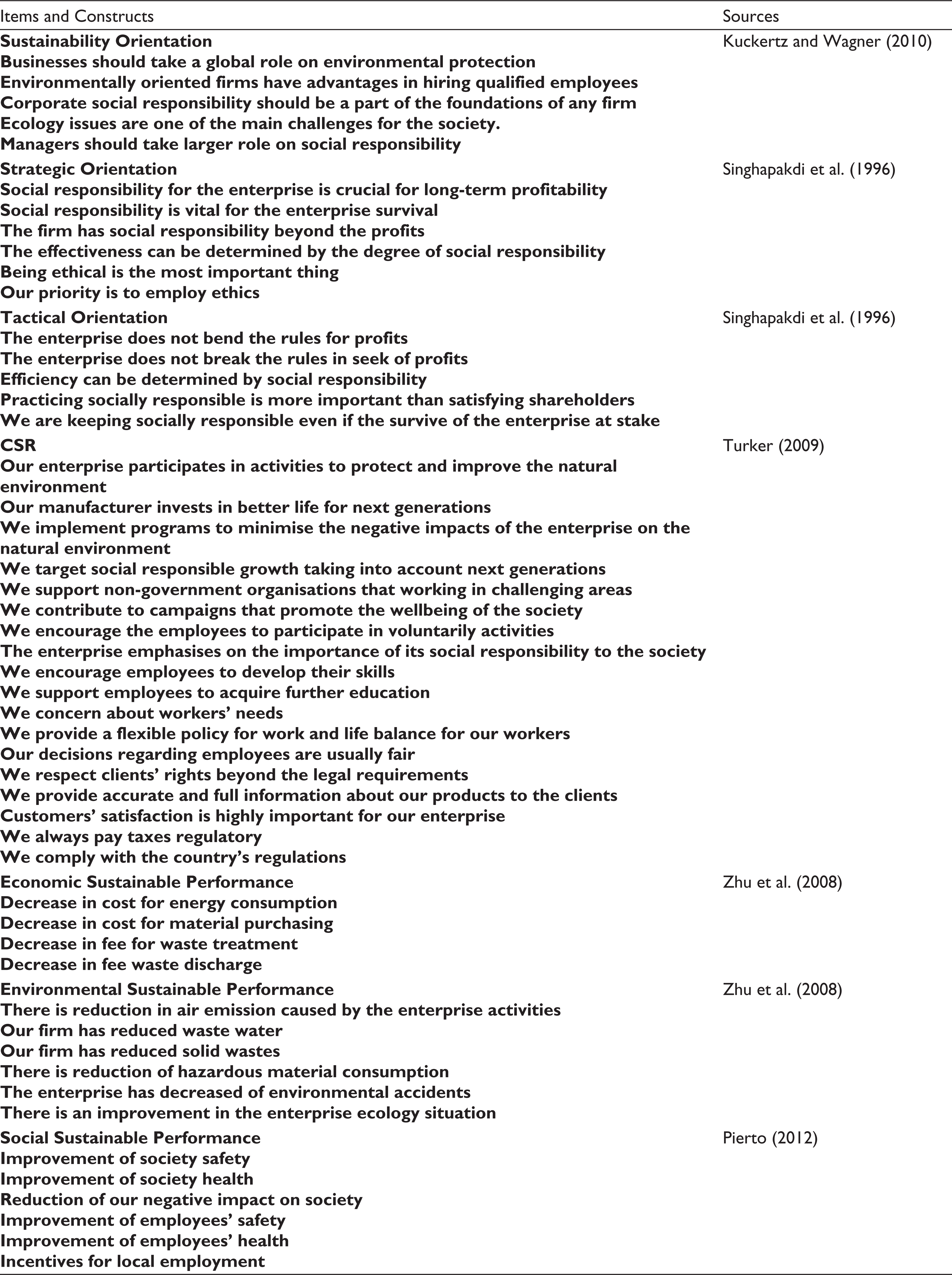
The research data have been collected through a survey, and it is divided into four sections. The first part has demographic features of owners and the enterprise. The second part includes orientation towards sustainability, and it can be seen as managers’ views towards the integration of social and environmental issues in business operations, and it is measured by five items (Kuckertz & Wagner, 2010). The third part covers CSR practices, and it is defined as a firm’s ethical practices without any intention to gain profits, and 16 items represent this factor (Turker, 2009). The fourth part is sustainable performance, which is an enterprise’s outcomes through performing economically, environmentally and socially, and it includes 16 questions (Zhou et al., 2008; Pierto, 2012). Table 1 presents the constructs and relevant items.
The Measurement Model
Data Analysis
The unit of analysis of the study is the organisational level, and data are collected from owners/managers of SMEs, who are in charge of the enterprise’s plans and policies. The study uses SPSS and PLS-SEM to analyse the data. SPSS has been used for some characteristics such as descriptive analysis. On the other hand, PLS-SEM is utilised for testing hypotheses. Specifically, PLS-SEM is used to analyse the causal relationship between exogenous/independent variables and endogenous/dependent variables. Previous studies also used this method for analysing the causal relationships and predictability in the structural model (Hair et al., 2019; Islam et al., 2019). Moreover for investigating the mediations this same methods has been applied. Previous studies also applied this technique for testing the mediation effect (Ang et al., 2015; Islam et al., 2019).
This study employed a 5-point Likert scale as a measure for the study variables due to its advantages in terms of increasing respondents’ rate; moreover, decreases the participants’ frustration level (Babakus & Mangold, 1992; Buttle, 1996). Furthermore, the possibility to compare the research results with other studies that have used the same scale since the majority of studies have used a 5-point Likert scale (Saleh & Ryan, 1991). Further, the scale seems to be less confusing (Babakus & Mangold, 1992), and easier for respondents to read the complete scale list (Dawes, 2008); besides, the scale is ranging from 1 (strongly disagree) to 5 (strongly agree).
The PLS-SEM can be classified as a second-generation technique that is a method to estimate causal relationships and to maximise the explanation of variance of dependent variables (Henseler et al., 2012). Hair et al. (2012) have provided an explanation regarding PLS-SEM processes, and the technique usually follows two stages. Firstly, it is to examine the validity and reliability of the measures in accordance with some criteria related to the reflective and formative measuring model in order to confirm that the measures are representing the construct. In the second step, it evaluates the structural model prediction across each latent variable. Therefore, PLS-SEM is a useful method to achieve the study objectives since it has several advantages such as prediction, the number of variables, sample size and the normality of the distribution.
Results and Discussion
The sample of this research comprises 121 units of small and medium manufacturers’ owners. However, the majority of them are males (represent 70%). Further, more than 65% of them have a degree, whereas the rest have a high school or less.
In accordance with Table 2, different means and standard deviations are shown. For example, the highest mean is for sustainability orientation (3.66), in contrast, economic performance is the lowest one (2.31). However, the other variables were ranged between 2.93 (environmental performance) and 3.26 (CSR).
Means and Standard Deviations

Moreover, Table 3 shows the explained variance of independent variables on dependent variables. For instance, the lowest R2 (.018) is for economic performance, which is understandable since there is no impact on social practices on economic sustainable performance. On the other hand, CSR explains the variance of environmental sustainable performance by almost 18%. Thus, as can be seen, different values of R2 can be explained by ethical practices and sustainability orientation.
Explained Variance
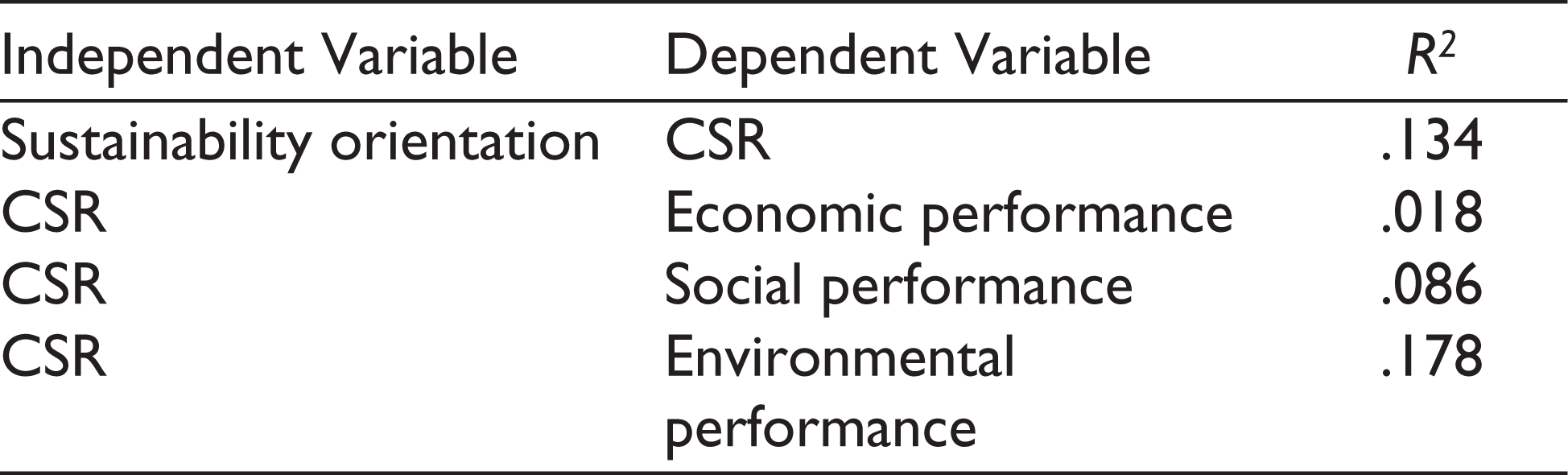
Table 4 depicts the significant level of direct relationships across variables. The sustainability orientation of owners has an impact on practicing socially responsible due to P-value is .00, which is significant level .05. However, CSR practices affect social and environmental sustainability performance since P-values for them are .001 and .000, respectively. On the other hand, CSR has not affected economic sustainable performance because of P-value is .135, which is non-significant.
Regression Analysis for Direct Relationships

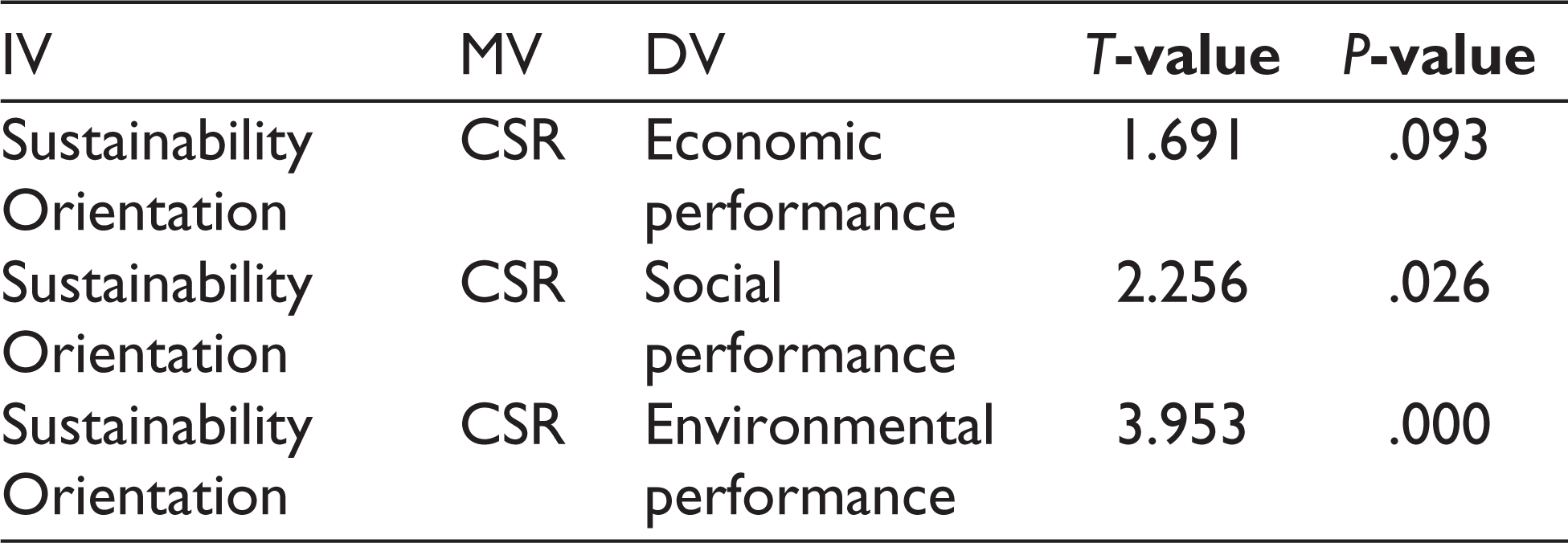
Moreover, Table 5 illustrates the role of the mediation variable (MV) in explaining the relationships across independent variables and dependent variables. CSR has mediated sustainability orientation and social, an environmental sustainable performance due to their P-values that are less than .05. However, economic sustainable performance has not been influenced by the sustainability orientation once social responsible practices have mediated such a relationship since P-value is more than .05. Hence, CSR mediates the sustainability orientation and social, environmental performance, but does not mediate orientation towards sustainability and the economic performance.
Regression Analysis for Indirect Relationships
Implications
The research has attempted to enrich knowledge by extending the sustainable performance domain in the context of SMEs by adding CSR as a mediator. In other words, the research has highlighted sustainable issues more deeply and broadly. Thus, incorporating such a variable enhances our understanding of the sustainable performance. It illustrates that successful social responsible practices are a beginning step for better outcomes. It shows that regardless of the country and culture, CSR has an important role in organisations’ outcomes, which leads to contribute on the literature that the western and eastern contexts have some shared views regarding some businesses’ concerns. So, some western measures can be used in other contexts as long as the culture has been respected. Moreover, the study extends the applied theory domain. The results consist of UET, for example, it assumes that personal factors have a role in managers’ decisions, which has been found in this examination. It has arrived at similar results despite economic outcomes have not been impacted.
In terms of practical implications, the results enhanced our understanding of the likely outcomes of engaging in social responsible practices and the role of owners’ orientations, and it opens a new window for them to rethink their own orientations towards CSR practices in order to gain better performance. Further, managers’ ethical views can be reflected on employees’ beliefs (e.g., sharing arisen issues like global warming, recycling), which leads them to avoid doing wrong actions or harming the natural environment. Besides, they should try to hire employees that share similar ethical orientations. In addition, managers need to be closer with stakeholders and facilitate communication channels with them for knowing their social and ecology needs particularly pressure groups since these groups develop moral standards regularly, also, occurring their feedback. However, each firm has its own context; thus, manufacturing SMEs may take or even build on the study measurements. Furthermore, these enterprises can share their experiences in CSR with suppliers and even competitors since it could reduce costs; consequently, it reflects a good image to other SMEs.
Furthermore, because Tunisian’s government follows the UN vision regarding sustainability, the government could build on the results. For example, policymakers need to have a closer relationship with these kinds of enterprises; hence, the state’s strategy is better once is mutual rather than it comes from the government without knowing the issues and concerns of the manufacturing sector.
Conclusion
This study investigated the mediated relationship between managers’ sustainability orientations and sustainable performance of the firms in SMEs in Tunisia. CSR has been identified as the mediating variable between the relationships. The results reveal that CSR mediates the relationships across sustainability orientation and ecological, social sustainability. This study also concludes that managers’ sustainability orientation has impacted CSR practices positively. Besides, these activities affect social and environmental sustainable performance. However, this study did not find a significant impact of CSR on economic sustainable performance in the given context nor does the CSR mediates the relationship between sustainability orientation and economic sustainable performance.
This study contributes to the UET by extending via empirical evidence with respect to sustainability, strategic, tactical orientations, CSR and sustainable performance. Moreover, this study contributes theoretically to existing sustainable performance literature in many facets; for example, it adds CSR as a mediator to know its antecedents and outcomes. Further, to estimate sustainability, tactical and strategic orientations on CSR practices; additionally, it includes the nature of the relationships between sustainability and CSR in different contexts. Lastly, the research extends knowledge by applying two theories for a comprehensive view.
There are several limitations despite the study contributions. It has explored a single sector of Tunisian’s economy, so future research can examine other sectors like service and financial. Besides, it proposed only one independent variable, researchers may add other variables such as values, perceptions, etc. The study sample is owners; thus, the results might be affected by their bias, therefore, studies could investigate stakeholders’ (i.e., employees, customers and suppliers) opinions to have a more accurate picture of sustainable performance. Further, the findings have been impacted by Tunisian’s economic conditions, which cannot be generalised to other Arabic states.
Future studies may investigate manufacturing SMEs from the perspectives of stakeholders particularly employees in order to provide further insights. In other words, stakeholders’ groups could provide different views than the owners on enterprises, which can enrich the body of knowledge. Moreover, future research might examine other sectors such as the service and financial sectors. These types have other features in comparison with the manufacturing sector, which in turn could enrich the sustainable performance domain. Hence, it may give further insights into both practitioners and theoretical contributions. Furthermore, future research can add new variables, or/and moderators to provide a clearer picture of factors that affect sustainable performance. These dimensions can be enterprises’ culture or ethical climate, government incentives, etc. This adding will give more comprehensive views of these factors.
Footnotes
Declaration of Conflicting Interests
The authors declared no potential conflicts of interest with respect to the research, authorship and/or publication of this article.
Funding
The authors received no financial support for the research, authorship and/or publication of this article.